Showing posts with label H1N1 flu. Show all posts

Monday, August 23, 2010

Is H1N1 still one to watch?


This year, however, H1N1 likely will be just part of the normal flu season. The U.S. Food and Drug Administration recently approved vaccines for the 2010-11 period that include the H1N1 virus.

H1N1 hasn't gone away, but this year it will be thought of as a seasonal flu. The availability of vaccines early will help that.

Click on the following for more details:  Is H1N1 still one to watch? :: The Courier News :: Local News

Wednesday, February 24, 2010

Illinois takes stock as swine flu deaths top 100

Most who died from the virus were between the ages of 25 and 64, and most had other health problems.

swine flu is on its last legs in Illinois, but the virus is still circulating and could return.

Click on following for more details:  Daily Herald | Illinois takes stock as swine flu deaths top 100

Friday, January 1, 2010

Third Kane resident dies with H1N1 complications

The largest number of deaths and hospitalizations came from the 25- to 49-year-old age group, with 679 hospitalizations and 33 deaths. Just 13 people older than 65 and two children younger than 2 years old died of swine flu complications this year in Illinois.

Click on the following for more details:  Third Kane resident dies with H1N1 complications :: Beacon News :: Local News

Tuesday, December 29, 2009

Flu virus can still mutate, warns WHO

World Health OrganizationThe H1N1 flu pandemic may not be conquered until 2011 and continued vigilance is required against the virus which can still mutate, the head of the World Health Organisation said on Tuesday….appropriate to continue to monitor the evolution of this pandemic for the next six to 12 months

Countries including Britain, Canada and the United States have passed peaks of a second wave of H1N1, but outbreaks are intensifying in India, Egypt and elsewhere…H1N1 has now spread to more than 200 countries, with nearly 12 000 deaths confirmed in laboratory, but it will probably take two years to establish the true death toll,

Click on the following for more details:  News - Medical: Flu virus can still mutate, warns WHO

Monday, December 14, 2009

H1N1 Flu Pandemic: New Wave in 2010?

Since early November, cases of H1N1 have continued to decline nationwide…Will there be a second wave of cases in the new year?

The answer depends on whom you ask. "We took an informal poll of about a dozen of some of the world's leading experts in influenza,’…. "About half of them said, Yes, we think it's likely that we'll have another surge in cases. About half said, No, we think it's not likely. And one said, Flip a coin."

CDC estimates, released by health officials Thursday, about 10,000 Americans have died from H1N1 and 50 million — or one-sixth of the population …

In other words, the more people who are vaccinated this year, the less likely the H1N1 virus, which will probably still be around next year, will take hold and spread.

Read more go to: H1N1 Flu Pandemic: New Wave in 2010? - TIME

Swine flu's lesson: We're not ready for anything virulent

Dr. Irwin Redlener, director of The National Center for Disaster Preparedness at Columbia University in New York will release Tuesday [a report] detailing deficiencies in the response to H1N1 and recommending changes in how future health emergencies are handled. The response to the flu, he said, mirrors government failures to fix glaring deficiencies in responding to the 9-11 terrorist attacks and Hurricane Katrina.

Click on the following for more details:  Daily Herald | Swine flu's lesson: We're not ready for anything virulent

The following is the center’s website, it is anticipated that the report will be posted there on Tuesday:  http://www.ncdp.mailman.columbia.edu/

Monday, December 7, 2009

Center for Disease Control - Seasonal Influenza (Flu) - Weekly Report: Influenza Summary Update

Synopsis:

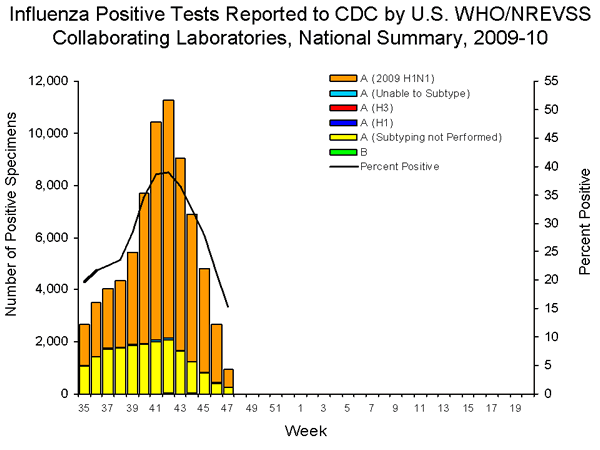
During week 47 (November 22-28, 2009), influenza activity continued to decrease in the U.S.

  • 956 (15.4%) specimens tested by U.S. World Health Organization (WHO) and National Respiratory and Enteric Virus Surveillance System (NREVSS) collaborating laboratories and reported to CDC/Influenza Division were positive for influenza.
  • Over 99% of all subtyped influenza A viruses being reported to CDC were 2009 influenza A (H1N1) viruses.
  • The proportion of deaths attributed to pneumonia and influenza (P&I) was above the epidemic threshold for the ninth consecutive week.
  • Seventeen influenza-associated pediatric deaths were reported. Twelve of these deaths were associated with 2009 influenza A (H1N1) virus infection and five were associated with an influenza A virus for which the subtype was undetermined.
  • The proportion of outpatient visits for influenza-like illness (ILI) was 3.7% which is above the national baseline of 2.3%. Eight of the 10 regions reported ILI at or above region-specific baseline levels. Regions 6 and 10 reported ILI below their region specific baselines.
  • Twenty-five states reported geographically widespread influenza activity, 17 states reported regional influenza activity, the District of Columbia, Puerto Rico and six states reported local influenza activity, and Guam, the U.S. Virgin Islands and two states reported sporadic influenza activities.

    INFLUENZA Virus Isolated
    View WHO-NREVSS Regional Bar Charts | View Chart Data | View Full Screen | View PowerPoint Presentation Microsoft PowerPoint file

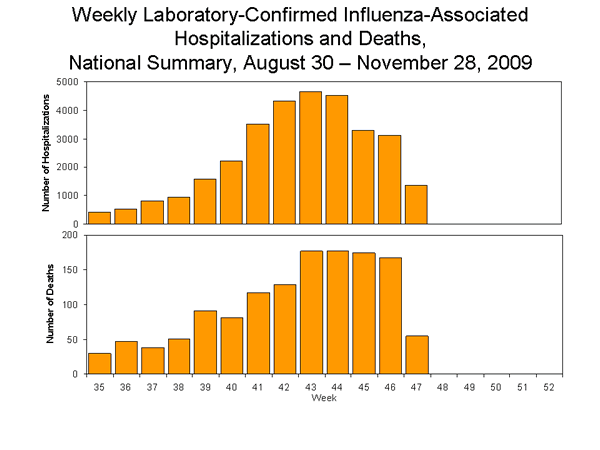
    Pneumonia and Influenza Hospitalization and Death Tracking:

    This new system was implemented on August 30, 2009, and replaces the weekly report of laboratory confirmed 2009 H1N1-related hospitalizations and deaths that began in April 2009. Jurisdictions can now report to CDC counts of hospitalizations and deaths resulting from all types or subtypes of influenza, not just those from 2009 H1N1 influenza virus. To allow jurisdictions to implement the new case definition, counts were reset to zero on August 30, 2009. From August 30 – November 28, 2009, 31,320 laboratory-confirmed influenza-associated hospitalizations and 1,336 laboratory-confirmed influenza-associated deaths were reported to CDC. CDC will continue to use its traditional surveillance systems to track the progress of the 2009-10 influenza season.

    Aggregate Hospital and Death Reporting
    View Full Screen
    | View PowerPoint Presentation Microsoft PowerPoint file

    Antigenic Characterization:

    CDC has antigenically characterized one seasonal influenza A (H1N1), three influenza A (H3N2), four influenza B, and 499 2009 influenza A (H1N1) viruses collected since September 1, 2009.

    One seasonal influenza A (H1N1) virus was tested and is related to the influenza A (H1N1) component of the 2009-10 Northern Hemisphere influenza vaccine (A/Brisbane/59/2007).

    The three influenza A (H3N2) viruses tested showed reduced titers with antisera produced against A/Brisbane/10/2007, the 2009-2010 Northern Hemisphere influenza A (H3N2) vaccine component, and were antigenically related to A/Perth/16/2009, the WHO recommended influenza A (H3N2) component of the 2010 Southern Hemisphere vaccine formulation.

    Influenza B viruses currently circulating globally can be divided into two distinct lineages represented by the B/Yamagata/16/88 and B/Victoria/02/87 viruses. The influenza B component of the 2009-10 vaccine belongs to the B/Victoria lineage. The four influenza B viruses tested belong to the B/Victoria lineage and are related to the influenza vaccine component for the 2009-10 Northern Hemisphere influenza vaccine (B/Brisbane/60/2008).

    Four hundred ninety-eight (99.8%) of 499 2009 influenza A (H1N1) viruses tested are related to the A/California/07/2009 (H1N1) reference virus selected by WHO as the 2009 H1N1 vaccine virus and one virus (0.2%) tested showed a reduced titer with antiserum produced against A/California/07/2009.

    Annual influenza vaccination is expected to provide the best protection against those virus strains that are related to the vaccine strains, but limited to no protection may be expected when the vaccine and circulating virus strains are so different as to be from different lineages. Antigenic characterization of 2009 influenza A(H1N1) viruses indicates that these viruses are only distantly related antigenically and genetically to seasonal influenza A(H1N1) viruses, suggesting that little to no protection would be expected from vaccination with seasonal influenza vaccine. It is too early in the influenza season to determine if seasonal influenza viruses will circulate widely or how well the seasonal vaccine and circulating strains will match.

    Antiviral Resistance:

    Since September 1, 2009, two seasonal influenza A (H1N1), five influenza A (H3N2), one influenza B, and 451 2009 influenza A (H1N1) virus isolates have been tested for resistance to the neuraminidase inhibitors (oseltamivir and zanamivir), and 1,089 2009 influenza A (H1N1) original clinical samples were tested for a single known mutation in the virus that confers oseltamivir resistance. In addition, two influenza A (H3N2) and 207 2009 influenza A (H1N1) virus isolates have been tested for resistance to the adamantanes (amantadine and rimantadine). Additional laboratories perform antiviral testing and report their results to CDC. The results of antiviral resistance testing performed on these viruses are summarized in the table below

  • To see the rest of the report/any update go to:  http://www.cdc.gov/flu/weekly/

Monday, November 23, 2009

Vaccines on horizon for 
AIDS, Alzheimer’s, herpes

drug sales are forecast to rise by a third in five years, vaccine sales should double, from $19 billion last year to $39 billion in 2013, according to market research firm Kalorama Information. That’s five times the $8 billion in vaccine sales in 2004.

– Malaria. Tuberculosis. Alzheimer’s disease. AIDS. Pandemic flu. Genital herpes. Urinary tract infections. Grass allergies. Traveler’s diarrhea.

You name it, the pharmaceutical industry is working on a vaccine to prevent it.

Click on the following for more details:  Business Journal | Vaccines on horizon for AIDS, Alzheimer’s, herpes

Saturday, November 14, 2009

Week 44--H1N1

FluView: A Weekly Influenza Surveillance Report Prepared by the Influenza Division

2009-2010 Influenza Season Week 44 ending November 7, 2009

All data are preliminary and may change as more reports are received.

Synopsis:

During week 44 (November 1-7, 2009), influenza activity decreased slightly in the U.S.

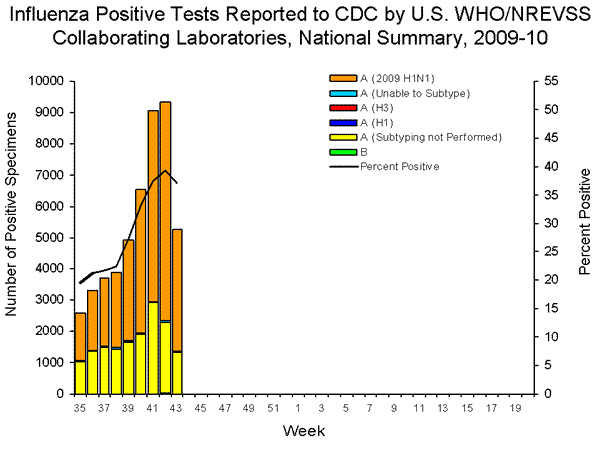
  • 3,834 (30.1%) specimens tested by U.S. World Health Organization (WHO) and National Respiratory and Enteric Virus Surveillance System (NREVSS) collaborating laboratories and reported to CDC/Influenza Division were positive for influenza.
  • All subtyped influenza A viruses being reported to CDC were 2009 influenza A (H1N1) viruses.
  • The proportion of deaths attributed to pneumonia and influenza (P&I) was above the epidemic threshold for the sixth consecutive week.
  • Thirty-five influenza-associated pediatric deaths were reported. Twenty-six of these deaths were associated with 2009 influenza A (H1N1) virus infection, eight were associated with an influenza A virus for which the subtype was undetermined, and one was associated with an influenza B virus infection.
  • The proportion of outpatient visits for influenza-like illness (ILI) was 6.7% which is above the national baseline of 2.3%. All 10 regions reported ILI above region-specific baseline levels.
  • Forty-six states reported geographically widespread influenza activity, Puerto Rico and four states reported regional influenza activity, the District of Columbia reported local influenza activity, Guam reported sporadic influenza activity, and the U.S. Virgin Islands did not report.
National and Regional Summary of Select Surveillance Components

B
19 (0.5%)

During week 44, influenza B viruses co-circulated at low levels with 2009 influenza A (H1N1) viruses. All subtyped influenza A viruses reported to CDC this week were 2009 influenza A (H1N1) viruses.
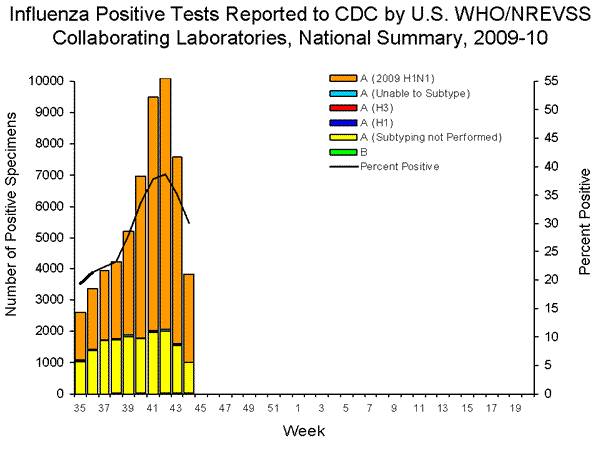
INFLUENZA Virus Isolated
View WHO-NREVSS Regional Bar Charts| View Chart Data | View Full Screen

Pneumonia and Influenza Hospitalization and Death Tracking:

This new system was implemented on August 30, 2009, and replaces the weekly report of laboratory confirmed 2009 H1N1-related hospitalizations and deaths that began in April 2009. Jurisdictions can now report to CDC counts of hospitalizations and deaths resulting from all types or subtypes of influenza, not just those from 2009 H1N1 influenza virus. To allow jurisdictions to implement the new case definition, counts were reset to zero on August 30, 2009. From August 30 – November 7, 2009, 22,364 laboratory-confirmed influenza associated hospitalizations and 877 laboratory-confirmed influenza associated deaths were reported to CDC. CDC will continue to use its traditional surveillance systems to track the progress of the 2009-10 influenza season.

Aggregate Hospital and Death Reporting
View Full Screen

Antigenic Characterization:

CDC has antigenically characterized one seasonal influenza A (H1N1), two influenza A (H3N2) and 320 2009 influenza A (H1N1) viruses collected since September 1, 2009.

One seasonal influenza A (H1N1) virus was tested and is related to the influenza A (H1N1) component of the 2009-10 Northern Hemisphere influenza vaccine (A/Brisbane/59/2007).

Both influenza A (H3N2) viruses tested showed reduced titers with antisera produced against A/Brisbane/10/2007, the 2009-2010 Northern Hemisphere influenza A (H3N2) vaccine component, and were antigenically related to A/Perth/16/2009, the WHO recommended influenza A (H3N2) component of the 2010 Southern Hemisphere vaccine formulation.

Three hundred and nineteen (99.7%) of 320 2009 influenza A (H1N1) viruses tested are related to the A/California/07/2009 (H1N1) reference virus selected by WHO as the 2009 H1N1 vaccine virus and one virus (0.3%) tested showed reduced titers with antisera produced against A/California/07/2009.

Annual influenza vaccination is expected to provide the best protection against those virus strains that are related to the vaccine strains, but limited to no protection may be expected when the vaccine and circulating virus strains are so different as to be from different lineages. Antigenic characterization of 2009 influenza A(H1N1) viruses indicates that these viruses are only distantly related antigenically and genetically to seasonal influenza A(H1N1) viruses, suggesting that little to no protection would be expected from vaccination with seasonal influenza vaccine. It is too early in the influenza season to determine if seasonal influenza viruses will circulate widely or how well the vaccine and circulating strains will match.

Antiviral Resistance:

Since September 1, 2009, 315 2009 influenza A (H1N1) virus isolates have been tested for resistance to the neuraminidase inhibitors (oseltamivir and zanamivir), and 761 2009 influenza A (H1N1) original clinical samples were tested for a single known mutation in the virus that confers oseltamivir resistance. In addition, one influenza A (H3N2) and 152 2009 influenza A (H1N1) virus isolates have been tested for resistance to the adamantanes (amantadine and rimantadine). Additional laboratories perform antiviral testing and report their results to CDC. The results of antiviral resistance testing performed on these viruses are summarized in the table below.

Antiviral Resistance Testing Results on Samples Collected (http://www.cdc.gov/mmwr/preview/mmwrhtml/mm5832a3.htm).

Pneumonia and Influenza (P&I) Mortality Surveillance

During week 44, 7.7% of all deaths reported through the 122-Cities Mortality Reporting System were due to P&I. This percentage was above the epidemic threshold of 6.8% for week 44. Including week 44, P&I mortality has been above threshold for six consecutive weeks.
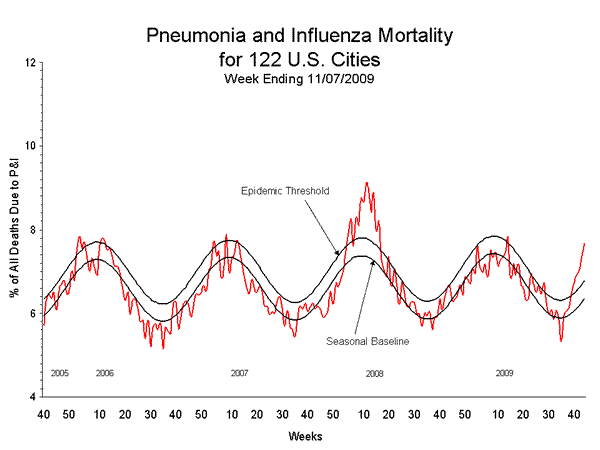
Pneumonia And Influenza Mortality
View Full Screen

Influenza-Associated Pediatric Mortality

Thirty-five influenza-associated pediatric deaths were reported to CDC during week 44 (Alabama, Arizona, Arkansas [2], California [8], Delaware, Georgia, Illinois, Michigan [2], Missouri, New Jersey, Ohio [2], Oklahoma [3], Tennessee [2], Texas [6], Utah, Virginia, and Washington). Twenty-six of these deaths were associated with 2009 influenza A (H1N1) virus infection, eight were associated with an influenza A virus for which the subtype is undetermined, and one was associated with an influenza B virus infection. These deaths occurred between March 15 and November 7, 2009.

Three deaths reported during week 44, including the death associated with influenza B virus infection, occurred during the 2008-09 season, bringing the total number of reported pediatric deaths occurring during that season to 127.

Since August 30, 2009, CDC has received 117 reports of influenza-associated pediatric deaths that occurred during the current influenza season (18 deaths in children less than 2 years old, 12 deaths in children 2-4 years old, 41 deaths in children 5-11 years old, and 46 deaths in children 12-17 years old). Ninety-eight (84%)of the 117 deaths were due to 2009 influenza A (H1N1) virus infections, and the remaining 19 were associated with influenza A virus for which the subtype is undetermined. A total of 156 deaths in children associated with 2009 influenza A (H1N1) virus infection have been reported to CDC.

Among the 117 deaths in children, 65 children had specimens collected for bacterial culture from normally sterile sites and 18 (27.7%) of the 65 were positive; Staphylococcus aureus was identified in eight (44.4%) of the 18 children. One S. aureus isolate was sensitive to methicillin, six were methicillin resistant, and one did not have sensitivity testing performed. Thirteen (72.2%) of the 18 children with bacterial coinfections were five years of age or older, and five (27.8%) of the 18 children were 12 years of age or older.


Influenza-Associated Pediatric Mortality
View Full Screen

Influenza-Associated Hospitalizations

Laboratory-confirmed influenza-associated hospitalizations are monitored using a population-based surveillance network that includes the 10 Emerging Infections Program (EIP) sites (CA, CO, CT, GA, MD, MN, NM, NY, OR and TN) and 6 new sites (IA, ID, MI, ND, OK and SD).

During September 1, 2009 – November 7, 2009, the following preliminary laboratory-confirmed overall influenza associated hospitalization rates were reported by EIP and the new sites (rates include influenza A, influenza B, and 2009 influenza A (H1N1)):

Rates [EIP (new sites)] for children aged 0-4 years and 5-17 years were 4.0 (8.1) and 2.0 (3.1) per 10,000, respectively. Rates [EIP (new sites)] for adults aged 18-49 years, 50-64 years, and ≥ 65 years were 1.5 (1.4), 1.7 (1.4) and 1.4 (1.3) per 10,000, respectively.

.

View Full Screen

Outpatient Illness Surveillance:

Nationwide during week 44, 6.7% of patient visits reported through the U.S. Outpatient Influenza-like Illness Surveillance Network (ILINet) were due to influenza-like illness (ILI). This percentage is above the national baseline of 2.3%.
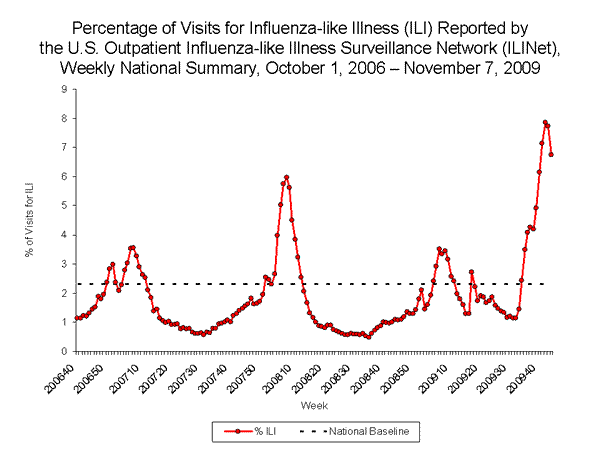
national levels of ILI and ARI
View ILINet Regional Charts | View Chart Data | View Full Screen

On a regional level, the percentage of outpatient visits for ILI ranged from 4.2% to 8.8% during week 44, and decreased in nine of the 10 surveillance regions compared to the previous week. All 10 regions reported a proportion of outpatient visits for ILI above their region-specific baseline levels.

Geographic Spread of Influenza as Assessed by State and Territorial Epidemiologists:

The influenza activity reported by state and territorial epidemiologists indicates geographic spread of both seasonal influenza and 2009 influenza A (H1N1) viruses and does not measure the severity of influenza activity.

  • During week 44, the following influenza activity was reported:
    • Widespread influenza activity was reported by 46 states (Alabama, Alaska, Arizona, Arkansas, California, Colorado, Connecticut, Delaware, Florida, Georgia, Idaho, Illinois, Indiana, Iowa, Kansas, Kentucky, Louisiana, Maine, Maryland, Massachusetts, Michigan, Minnesota, Missouri, Montana, Nevada, New Hampshire, New Jersey, New Mexico, New York, North Carolina, North Dakota, Ohio, Oklahoma, Oregon, Pennsylvania, Rhode Island, South Carolina, South Dakota, Tennessee, Utah, Vermont, Virginia, Washington, West Virginia, Wisconsin, and Wyoming).
    • Regional influenza activity was reported by Puerto Rico and four states (Hawaii, Mississippi, Nebraska, and Texas).
    • Local influenza activity was reported by the District of Columbia.
    • Sporadic influenza activity was reported by Guam.
    • The U.S. Virgin Islands did not report.

Click on the following for more details on these CDC studies:  Flu Activity data in XML Format | View Full Screen

Sunday, November 8, 2009

Center for Disease Control - Seasonal Influenza (Flu) - Weekly Report: Influenza Summary Update

Take a look at the graphs—perhaps we are over the peak for the spread of H1N1 (swine) flu. Especially, because vaccination is beginning for the the  most vulnerable.

Eighteen influenza-associated pediatric deaths were reported. Fifteen of these deaths were associated with 2009 influenza A (H1N1) virus infection and three were associated with an influenza A virus for which the subtype was undetermined.

INFLUENZA Virus Isolated
View WHO-NREVSS Regional Bar Charts| View Chart Data | View Full Screen

Pneumonia and Influenza Hospitalization and Death Tracking:

This new system was implemented on August 30, 2009, and replaces the weekly report of laboratory confirmed 2009 H1N1-related hospitalizations and deaths that began in April 2009. Jurisdictions can now report to CDC counts of hospitalizations and deaths resulting from all types or subtypes of influenza, not just those from 2009 H1N1 influenza virus. To allow jurisdictions to implement the new case definition, counts were reset to zero on August 30, 2009. From August 30 – October 31, 2009, 17,838 laboratory-confirmed influenza associated hospitalizations and 672 laboratory-confirmed influenza associated deaths were reported to CDC. CDC will continue to use its traditional surveillance systems to track the progress of the 2009-10 influenza season


Aggregate Hospital and Death Reporting
View Full Screen

Antigenic Characterization:

CDC has antigenically characterized one seasonal A (H1N1), two A (H3N2) and 239 2009 influenza A (H1N1) viruses collected since September 1, 2009.

One seasonal influenza A (H1N1) viruses was tested and is related to the influenza A (H1N1) component of the 2009-10 Northern Hemisphere influenza vaccine (A/Brisbane/59/2007).

Both influenza A (H3N2) viruses tested showed reduced titers with antisera produced against A/Brisbane/10/2007, the 2009-2010 Northern Hemisphere influenza A (H3N2) vaccine component, and were antigenically related to A/Perth/16/2009, the WHO recommended influenza A (H3N2) component of the 2010 Southern Hemisphere vaccine formulation.

Two hundred thirty-eight (99.6%) of 239 2009 influenza A (H1N1) viruses tested are related to the A/California/07/2009 (H1N1) reference virus selected by WHO as the 2009 H1N1 vaccine virus and one virus (0.4%) tested showed reduced titers with antisera produced against A/California/07/2009.

Annual influenza vaccination is expected to provide the best protection against those virus strains that are related to the vaccine strains, but limited to no protection may be expected when the vaccine and circulating virus strains are so different as to be from different lineages. Antigenic characterization of 2009 influenza A(H1N1) viruses indicates that these viruses are only distantly related antigenically and genetically to seasonal influenza A(H1N1) viruses, suggesting that little to no protection would be expected from vaccination with seasonal influenza vaccine. It is too early in the influenza season to determine if seasonal influenza viruses will circulate widely or how well the vaccine and circulating strains will match.

Pneumonia and Influenza (P&I) Mortality Surveillance

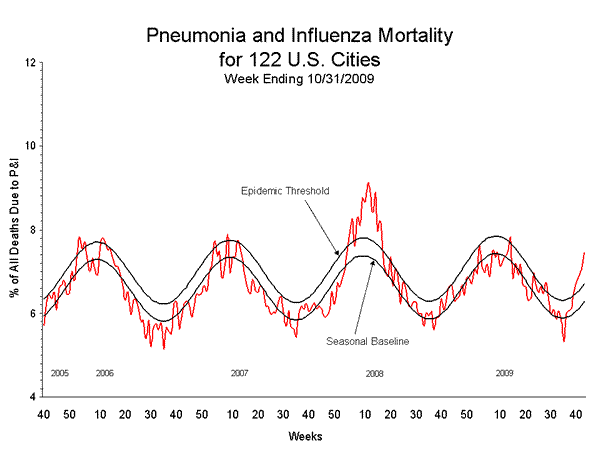
During week 43, 7.4% of all deaths reported through the 122-Cities Mortality Reporting System were due to P&I. This percentage was above the epidemic threshold of 6.7% for week 43. Including week 43, P&I mortality has been above threshold for five consecutive weeks.

Pneumonia And Influenza Mortality


For more details and studies go to:  CDC - Seasonal Influenza (Flu) - Weekly Report: Influenza Summary Update

Tuesday, November 3, 2009

Farmers: China's lifting of pork ban 'positive'

2008 Illinois was the fourth-largest hog and pig producer in the country, and DeKalb County ranked number two in hog and pig production within the state

announcement last Thursday that it intends to lift a ban on U.S. pork imports in effect since May.

concerns about the H1N1 virus last spring, commonly dubbed "swine flu," caused several countries, including China, to shut down U.S. pork imports

Russia, another top importer of U.S. pork that banned the meat due to the flu outbreak, also loosened some of its restrictions in October,


Click on the following for more details: Farmers: China's lifting of pork ban 'positive' | Daily Chronicle

Kane County halts H1N1 shot appointments


"We have no additional vaccine in the pipeline at this point, so we're not going to make additional appointments."

Like many surrounding counties, Kane County offered general clinics in October. Kane County officials ran low on vaccines, so they opted for individual appointments.

Read more by clicking on the following:  Daily Herald | Kane halts H1N1 shot appointments

Saturday, October 31, 2009

Health Department: No flu outbreak in St Charles High School

less than 10 percent of those students who reported illness on Oct. 19 and 20 actually had flu-like symptoms.

absenteeism "likely was due to a combination of several different causes of illness in conjunction with non-illness-related absences."

8 percent of students reported flu-like symptoms; about 20 percent reported respiratory illness that was not flu-like; about 22 percent reported gastrointestinal illness; about 50 percent reported a variety of symptoms.

Health Department: No flu outbreak in SC :: Beacon News :: Local News

Friday, October 30, 2009

Cholesterol drugs may improve flu survival


cholesterol-lowering statin drugs like Lipitor and Zocor.

people who were taking these drugs when they caught seasonal flu and had to be hospitalized were twice as likely to survive than those who were not on such medicines.

There might be justification for trying these drugs now in certain patients not doing well on any other treatment, said Dr. Ronald Turner of the University of Virginia, a prominent virologist who had no role in the new study.

Daily Herald | Study: Cholesterol drugs may improve flu survival

Lake County H1N1 sites out of vaccine again

Mundelein, Gurnee Round Lake Beach, Waukegan and North Chicago - were capped by 11:15 a.m. today.

That means the 4,143 vaccine doses that had been expected to last through Sunday already have been allocated. Clinic hours scheduled for Saturday and Sunday have been canceled.

Click on the following:  Daily Herald | Lake County H1N1 sites out of vaccine again

Thursday, October 29, 2009

Crowds await H1N1 vaccine at Boone clinic - Rockford, IL - Rockford Register Star


Marengo resident Maddie Morse, 5, waited patiently for more than 90 minutes today to receive her H1N1 flu vaccination at the Boone County Health Department clinic.


See Comments section:  emmazmom:  ….
Why are people from McHenry County getting free flu shots in Boone County? Boone County tax dollars hard at work. Can't they go to their own County Health Department

Click on the following for more details:  Crowds await H1N1 vaccine at Boone clinic - Rockford, IL - Rockford Register Star

Wednesday, October 28, 2009

Aon to offer coverage against H1N1 flu | Crain's Chicago Business

AON CENTER

Aon Corp., the world's largest insurance broker, is offering to cover companies against the risk of their offices being shut by the swine flu pandemic.

Since April, more insurers have excluded cover for pandemic building closure and now very few inclusive policies exist, according to Aon.

Click on the following for more of the story:  Aon to offer coverage against H1N1 flu | Crain's Chicago Business

Northwest Herald | CL man is McHenry County's first H1N1 death

A 50-year-old Crystal Lake man has been the first person in McHenry County whose death has been attributed to the H1N1 flu.

had medical conditions that increased his vulnerability to the virus, according to a news release from the McHenry County Department of Health.

Northwest Herald | CL man is McHenry County's first H1N1 death

Monday, October 26, 2009

Studying the H1N1 connection between pigs and people | Seattle Times Newspaper

This is a very informative summary regarding the swine-human connection with H1N1 flu. 

Many experts think pig farming presents a serious and overlooked risk to public health. Proof of that assertion — indirect but indisputable, in the opinion of virologists — is the 2009 H1N1 pandemic influenza.

Click on the following for the story:  Health | Studying the H1N1 connection between pigs and people | Seattle Times Newspaper

Sunday, October 25, 2009

Obama Declares Swine Flu Outbreak a National Emergency

widespread in 46 states, a level that federal officials say equals the peak of a typical winter flu season.

H1N1 virus has killed more than 1,000 Americans and hospitalized over 20,000.

The emergency declaration, which Mr. Obama signed Friday night, has to do only with hospital treatment, not with the vaccine. Government officials emphasized that Mr. Obama’s declaration was largely an administrative move that did not signify any unanticipated worsening of the outbreak of the H1N1 flu nationwide. Nor, they said, did it have anything to do with the reports of vaccine shortages.

Click on the following:  Obama Declares Swine Flu Outbreak a National Emergency - NYTimes.com