Showing posts with label college. Show all posts

Wednesday, June 15, 2016

DePaul University in Spotlight after controversial speaker and new President is being searched by the school—any connection?


image

In recent days, Minster, a freshman and vice president of the DePaul College Republicans, has become accustomed to other labels: “racist,” “white supremacist.”

The group drew the fury of activists after they invited the conservative online writer Milo Yiannopoulos to speak on May 24. Protesters stormed the stage, ultimately forcing Yiannopoulos and his hosts to abandon the student center’s auditorium, the first time current college administrators could recall such an ending to a campus event.

Students who attended were furious that security didn’t give the protesters the boot, while others were enraged that Yiannopoulos — who delights in mocking feminists and civil rights activists, among others — was allowed to speak on campus at all.

In a June 2 email to the entire university community, DePaul President Dennis Holtschneider wrote: “I am deeply sorry for the harm that was unleashed by a speaker whose intent was to ignite racial tensions and demean those most marginalized, both in our society and at DePaul.”

Holtschneider noted concerns from earlier in the year of black students “growing weary of the racism they found at DePaul.” But the president, promising to put together a task force to look at speech on campus, said “the bar on free speech is extremely high at a university.”

In its May 31 edition, The DePaulia student newspaper devoted eight of nine news pages to the Yiannopoulos event and the fallout from it, with the paper’s editor in chief, Matthew Paras, describing it as the biggest breaking news story on campus during his five years at the publication.

The incident has dramatically raised the profile of an organization that sometimes has difficulty filling a small college classroom for its weekly meetings.

“We typically get a lot of people who come in and out,” Minster, who is studying economics, said during a chat at the student center.

“Or they just don’t want to be seen with us,” joked Nicole Been, 21, president of the Republican group.

Perhaps even less so now.

Been, who is from Orland Park and calls herself a strong Donald Trump supporter, said she’s been getting a lot of “mean looks” on campus.

“Just a few days ago, me and my friend were walking . . . and people started following us and yelling, ‘white supremacist,’ ‘racist,’ ” said Been, an education major. “People started following me to the quad. I was not looking my best that day, and I was surprised they recognized me.”

Been and Minster said they expected protesters when their group invited Yiannopoulos to speak. At the DePaul event, after the protesters, mostly African-Americans, took over the stage, Yiannopoulos, who is gay, said: “I worked out why there are so many black girls here. I think it’s because I f—– their brothers.”

But Minster and Been expected the campus security to remove the protesters, which didn’t happened.

The DePaul Republicans say they chose Yiannopoulos, in part, because they’d had limited success with past on-campus events.

“People would come, but they’d be on their phones,” Been said. “They weren’t real excited about it.”

Former U.S. senator and presidential candidate Rick Santorum drew about 100 people last week. About 550 people came to hear Yiannopoulos, Minster said.

“We don’t support racism, period,” Minster said. “But we do support interesting arguments that sort of challenge the norms that people think about every day at this school. DePaul prides itself on social justice, diversity and multiculturalism and all those things. So we thought it would be interesting to bring someone who is directly against all those things.”

Mario Morrow Jr., president of DePaul’s Black Student Union, said Yiannopolous clearly crosses the line: “He is promoting hate speech, making it seem OK to everyone that this is acceptable language to use, especially on a college campus built on diversity.”

Neither Minster nor Been said they plan to avoid controversial speakers for future events. They do plan to make sure they have sufficient security.

Does either have regrets about attending a college where perhaps a majority of the students don’t share their political leanings?

Both say no. They have opportunities at DePaul that they might not have at a more traditionally conservative school.

“Gov. Rauner’s people came to me and we’re like, we need to start this thing up and get him elected,” Been said. “[U.S. Sen.] Mark Kirk’s people have been reaching out to us. Opportunities are endless here because there are so few of us. So everything is at our fingertips.”

Said Minster: “I’m not looking to go to a school that might tell me exactly what I might already know. I would prefer if DePaul had a little bit more of a conservative lean than where we are now.”

“Or even just like a moderate lean,” Been added.

Above is from:  http://chicago.suntimes.com/news/depaul-republicans-spotlight-controversial-speaker/


*****************************************

DePaul University

Dear DePaul Alumni,


Yesterday, I informed the Board of Trustees that I would be stepping down as president of DePaul University at the end of the 2016-17 academic year. You are a key part of the DePaul family, and I wanted to write you as well.


My twelve years at DePaul have been blessed ones. Much of what we set out to do more than a decade ago has been accomplished. We have built or renovated facilities for all ten of DePaul's colleges, our library and many of our athletic teams. We have established over 75 new academic programs, including new colleges of Communication and Science/Health, as well as schools of hospitality and film. Every year, DePaul is becoming more of a national university instead of a regional one. Through all the change, we have stayed true to our mission of assisting those of modest means to access a life-changing education.


While there is always more to do, the current strategic plan is coming to an end. All of the buildings on the master plan have been built or are currently in construction. The campaign to fund these plans was concluded successfully. 2017 will be a natural moment in the university's life to seek new leadership and define the next set of ambitions, so I have decided to step aside so this transition can happen now.

While there has been some speculation in the press that the timing of my announcement was related to a controversial speaker that was on campus at the end of the spring quarter, in fact, my religious superior approved this decision in January, the board leadership was informed in early March and a search firm was contracted in early May. The two are entirely unrelated.


I know I will look back on my years leading DePaul with overflowing gratitude. It has been my privilege to meet thousands of alumni, and I am continually impressed with your passion for and dedication to DePaul. As an important university constituency, alumni will have an opportunity to express their views as to the desired qualities of DePaul's next president. Graduates may contribute their thoughts to the following dedicated email account: presidentsearch@depaul.edu. In your message, please indicate that you are an alumnus/a.

For more information, please see the press release issued by our board chair (http://depaulne.ws/pres). Thank you for all you have done for the university and will continue to do in the years to come. We are a stronger university because you, our alumni, love this university and support us in so many ways.

God bless you,
Rev. Dennis H. Holtschneider, C.M.
President

Sunday, October 25, 2015

University Presidents Meet Privately With Gov. Rauner | News Local/State | Illinois Public Media


On Thursday, Governor Bruce Rauner held private meetings with university presidents, who say their schools are "at the brink of serious operational damage."  Illinois' nine public institutions have now gone four months without money amid a budget stalemate.

"We had a very candid conversation about strategies going forward, and possible restitutition of budgets downstream," said University of Illinois President Timothy Killeen.  He says that did not include any guarantee the schools will get their money anytime soon.

Western Illinois University President Jack Thomas says he realizes Rauner inherited a fiscal mess and wants to fix it.

"We want to make sure that we don't sacrifice our students, and higher education," he said.

Earlier this year, Rauner proposed cutting higher education by 30-percent.  Southern Illinois University President Randy Dunn said the governor didn't double down on that.

"The take I had from the meeting is, as all the parties come together to come to a resolution to this, everything's on the table for discussion."

As in -- just how much universities will get from the state, and when, depends on how and when the partisan gridlock is broken.

University Presidents Meet Privately With Gov. Rauner | News Local/State | Illinois Public Media

Tuesday, October 20, 2015

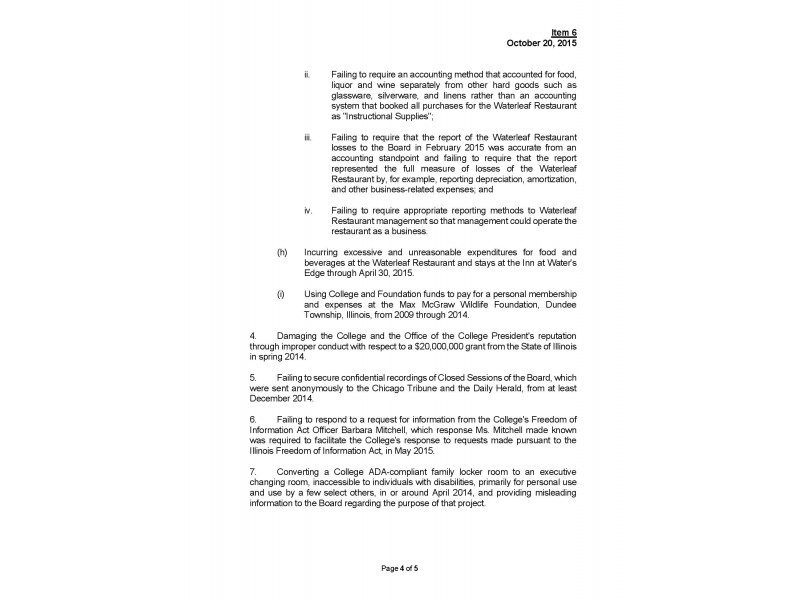
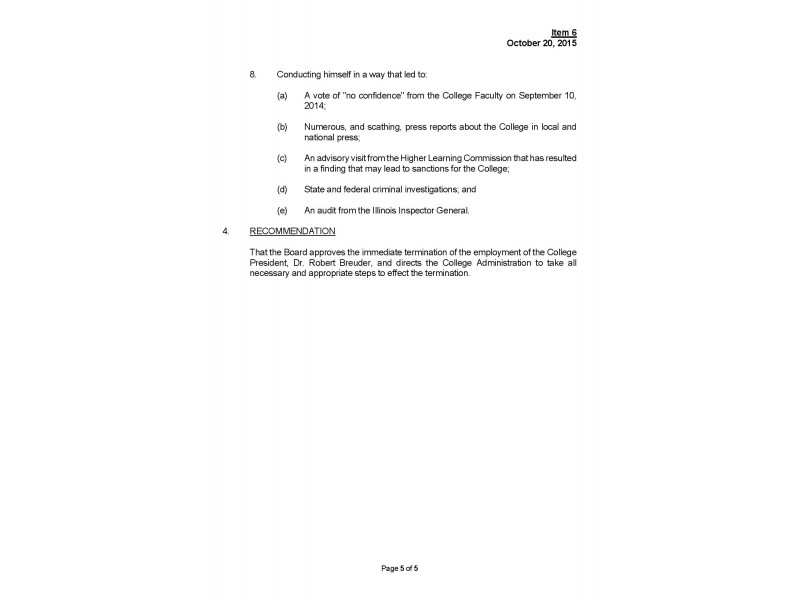
College of DuPage Board Fires Robert Breuder | Patch

By Amie Schaenzer (Patch Staff) October 20, 2015


The College of DuPage Board of Trustees fired its embattled President Robert Breuder at a meeting Tuesday night.

The board voted 4-1 to approve the termination, with Trustee Dianne McGuire of Naperville casting the sole no vote. She said the firing of Breuder was centered around a ”politically driven vendetta that is unworthy of this board.” Two trustees, Erin Birt and Joseph Wozniak, were not present and did not vote.

Other trustees spoke of the many examples of misconduct and mismanagement during Breuder’s term. Deanne Mazzochi, board vice chairman, said improper “electioneering activities” by Breuder helped the college secure a $168 million referendum “that this institution and taxpayers will be paying for for decades.”

The College of DuPage and Breuder have been under fire for months regarding its finances and administrative practices and Breuder has been the subject of public scrutiny regarding a $762,867 severance package the former board of trustees approved, according to the Daily Herald.

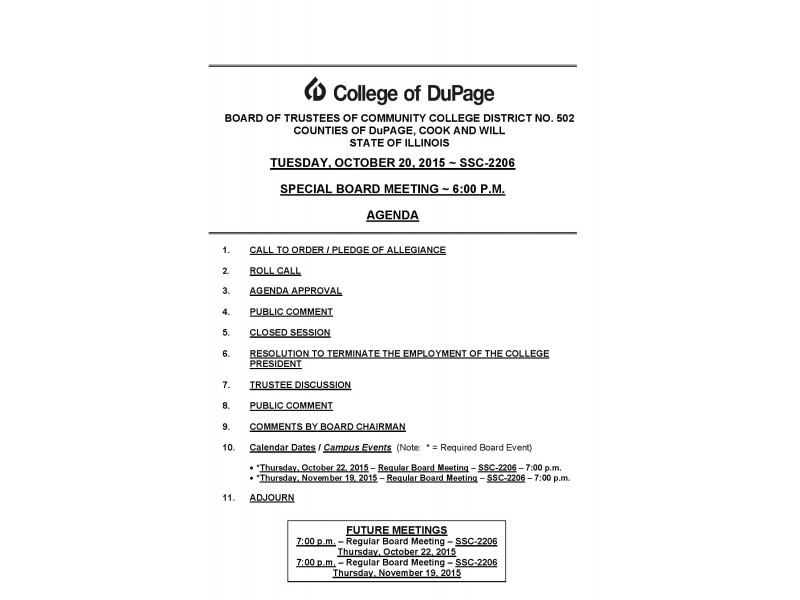
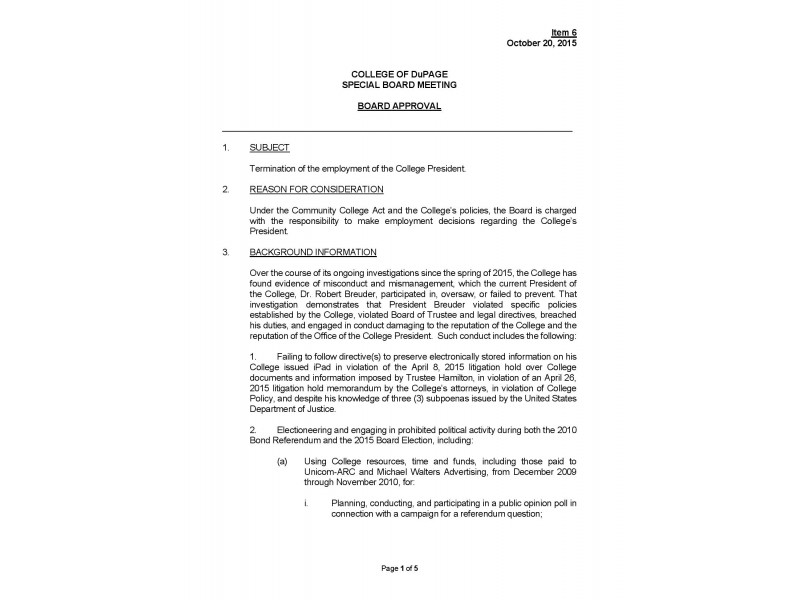
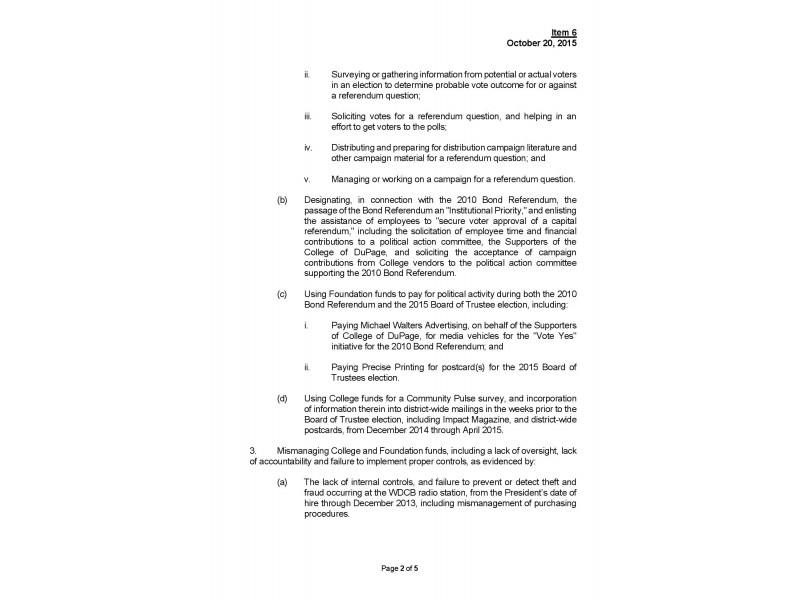
An investigation into Breuder began in spring 2015. During the course of the investigation, “the college found evidence of misconduct and mismanagement, which Breuder, participated in, oversaw or failed to prevent,” according to the special board meeting agenda. A full list of the allegations of Breuder can be viewed below in the board agenda.

Here is a brief timelines looking at some of the allegations leveled against Breuder, who has been on paid leave, over the past year:

College of DuPage Board Fires Robert Breuder | Patch

Saturday, October 10, 2015

Colleges worry about spring semester if budget feud continues - DailyHerald.com


State officials say some community colleges have expressed concern about having to cut back class and program offerings for the spring semester if the ongoing budget feud in Springfield drags on into next year.

Local community colleges aren't getting state money via court orders like many programs are, so any money owed to them since July 1 hasn't been sent.

"We are hearing from some of our colleges that they are worried about the spring semester," Illinois Community College Board spokesman Matthew Berry said.

In remarks this week, Gov. Bruce Rauner publicly raised the idea that the outcome of Illinois not having a budget could be even more severe.

"Universities and community colleges will not receive state funding, causing some to wonder whether they will be open for the second semester. Outrageous. Should not happen," Rauner said.

No local community colleges are talking publicly about drastic action, and how individual colleges will fare as the state budget impasse drags on could "vary widely," Berry said. Community colleges get a large share of their income from property taxes, and suburban districts tend to have higher property values than colleges elsewhere in the state. So the effects might be less serious in the suburbs.

Oakton Community College spokesman Paul Palian said he doesn't know of any class-cutting plans, but he said schools are "preparing to tighten our belts even further."

Palian said a main concern for students is whether colleges will be able to keep floating the need-based state-funded scholarships. Most Illinois colleges and universities are covering the cost of the Monetary Award Program for its students that qualify, counting on the state to come through and pay eventually.

That could get harder to do if the battle between Rauner and Democratic leaders lasts much longer.

"We're monitoring the situation in Springfield very closely," Palian said.

Harper College identified those scholarships as one of its concerns, too, saying in a statement "the college is committed to funding these expenses for the time being."

An Elgin Community College leader said future issues could be "difficult to predict."

"In the past, when the state has made late payments or missed payments, we have been forced to use funds from other areas to continue programs like adult education, (general education development), or (English as a second language)," Sharon Konny, the college's vice president of business and finance, said in a statement. "But if this impasse continues, it will certainly limit our ability to offer high quality educational and training opportunities to our district residents."

And College of DuPage board Chairwoman Kathy Hamilton didn't signal any problems ahead.

"We have cut our property tax levy, tuition, and our deficit while raising salaries by three percent," she said. "This shows that it's possible for community colleges to tighten their belts."

Rauner this week again tried to push Democrats to either help adopt his pro-business proposals or approve a budget without Republican support. Democrats, though, say it's the governor who had the chance to avoid the budget struggle.

"There is no question all of the disruption caused by the current impasse is due to the governor's decision to veto the spending plan approved by the legislature," House Speaker Michael Madigan said.

Lawmakers are due back in Springfield Oct. 20.

Colleges worry about spring semester if budget feud continues - DailyHerald.com

Wednesday, September 9, 2015

College of DuPage financial officials fired - Chicago Tribune

he College of DuPage's top two finance officials were fired Wednesday, following reviews that found weak financial controls and violations of the school's investment practices.

Treasurer Thomas Glaser and Controller Lynn Sapyta, who have been on paid leave since June, are the first employees fired for cause since a new majority took over the Glen Ellyn-based school's board of trustees in April. President Robert Breuder remains on paid administrative leave pending termination proceedings.

"We are going to be embarking on a search for highly capable individuals and it is part of the new era for the College of DuPage," board Chairwoman Katharine Hamilton said.

Glaser's attorney, Shelly Kulwin, said he plans to file a lawsuit for wrongful termination and breach of contract.

Full Tribune coverage: College of DuPage

Full Tribune coverage: College of DuPageOpen link

"We believe the termination is unjustified. The charges on which the termination was based are meritless," Kulwin said. "The charges themselves reveal it is clearly a political termination."

Sapyta's attorney, Peter Lubin, said in a statement that she "faithfully discharged the duties of her office" and "received numerous accolades" during her employment. She may also sue, he said.

Though the termination decisions were handed down Wednesday, Glaser and Sapyta's fates seemed sealed after a heated spring election in which a Hamilton-controlled majority took a majority on the board. Hamilton had openly criticized both at public meetings and on the campaign trail, and she had promised changes to the college's leadership if the slate of candidates she backed was elected.

Lubin described Sapyta as a "scapegoat" who has had her reputation tarnished to bolster Hamilton's agenda.

"It's a political firing," he said.

7

Glaser and Sapyta are now entitled to a post-termination hearing before an officer chosen by the college. The private hearing, which must be requested within five days and then held within 30 days after that, is conducted like a trial, and witnesses can be called. The officer will decide whether to uphold or overturn the firings.

Since June, an outside firm has been handling the college's day-to-day finances and reviewing its financial controls. The board hired the firm after an internal audit found that the school's investment practices did not comply with its policies. The college lost nearly $2 million in one prohibited investment.

A Chicago-based financial management firm, Alix Partners, recently detailed how the noncompliance was greater than the auditor realized, with about 73 percent of the portfolio, worth about $274 million last fall, not in line with school policy.

"That was a monumental failure on many levels," trustee Frank Napolitano said at an August board meeting.

In a letter sent to Sapyta on Wednesday, the college provided nine reasons for termination. They included failing to maintain financial controls over the college's radio station, where an employee for years allegedly stole from the college, and its high-end restaurant, Waterleaf, which lost more than $2 million since it opened in 2011 as senior administrators spent hundreds of thousands of public dollars on meals and drinks.

Lubin said the Waterleaf-related accusations are "an attempt to shift the blame" to Sapyta from her supervisors and the board.

Sapyta also was accused of not following the college's investment policy and not cooperating with the internal auditor's review. The letter also alleged that she violated school ethics policy by using the college's email system to solicit votes on behalf of trustee candidates.

Lubin described the allegations against his client as "vague, unsubstantiated and legally deficient," saying most of them had nothing to do with her professional duties. Saptya, he said, was not responsible for investment decisions during her five-year tenure at the college. Still, she knew some of the investments exceeded school policy and pointed them out to Glaser, as her job required, Lubin said.

In a statement released after her firing, Sapyta said interim President Joseph Collins, who as executive vice president oversaw the restaurant and radio station, was trying to shift blame to her. She said Collins was well aware that she did not control the school's investments.

"I'm being made into a scapegoat for the criticism that the media has leveled at Dr. Breuder and his administration, including Executive Vice President Collins, for lavish spending at the College's restaurant and other issues over which I had no control," she said. "The Board approved these expense accounts and it should answerable for how it approved tax payers money being spent. That was not part of my job duties as Dr. Collins is well aware."

Glaser's salary was $232,112, and Sapyta's was $163,828.

The school's audit and the subsequent outside financial review detailed numerous breakdowns in oversight at the state's largest community college, an issue the Tribune has uncovered in a number of investigations over the past several months. According to the audit findings, the board of trustees did not get detailed quarterly investment reports as required, while the treasurer's committee, which is supposed to meet every four months, went almost two years without a meeting.

Finance administrators acknowledged that although they knew there were instances of noncompliance, the full board received monthly reports summarizing investment activities and "did not raise any concerns," according to the audit report.

The audit found that the college's portfolio exceeded its own policy limits for certain types of investments. For example, the policies capped investments in local government investment pools at 5 percent of the full portfolio. Yet the college eventually put more than 29 percent of its value into the Illinois Metropolitan Investment Fund, a pool that invests tax dollars on behalf of more than 200 suburban governments.

The college's board of trustees authorized investing in IMET in April 2014, and about $10 million was initially invested. Then, without authorization or endorsement, the college increased that amount by September to more than $80 million, or 29.2 percent of the portfolio.

At the time, IMET was providing a higher return than other investments, according to the audit.

The IMET fund, however, later disclosed that it believed it had been defrauded and lost more than $50.4 million for its participants. The college, the fund's biggest investor, lost $2.2 million. If the college had followed its policy and limited its investment to 5 percent, the audit found, it would have lost only $381,436. The college has since removed most of its money from the IMET pool and is attempting to recoup its loss.

The audit also found concerns with other investments. The college invested 43 percent of its portfolio in bond mutual funds, far exceeding the 5 percent limit outlined in its investment policy.

The portfolio's overall performance also was lackluster compared with those of other community colleges in the Chicago area. The college's returns ranked fifth among the area's eight largest community colleges, with an average annual yield of 0.38 percent, according to the audit.

lR

Top administrators in the college's finance department knew about the audit results in March, a month after the review was completed, but did not act, school officials said. The report surfaced in May, the officials said, after a new board majority took over and voted to place Breuder on paid leave.

College auditor James Martner, who performed the financial review, reported directly to Breuder. The embattled president frequently applauded the school's fiscal policies when defending his controversial tenure that included accusations of lavish spending and excessive perks.

Instead of embracing recommendations in the audit, school administrators attempted to retool the college's financial policies to quietly bring their own past practices into compliance, according to records obtained by the Tribune.

sstclair@tribpub.com

College of DuPage financial officials fired - Chicago Tribune

Monday, August 10, 2015

2 searches for leaders underway as Belvidere Superintendent Michael Houselog preps for Rockford University - News - Rockford Register Star - Rockford, IL


By Corina Curry
Rockford Register Star

Posted Aug. 9, 2015 at 7:54 PM

ROCKFORD — In about 10 days, Belvidere School District Superintendent Michael Houselog will become the new director of graduate programs in education at Rockford University, heading up a department attended in large numbers by area teachers seeking advanced degrees and those studying to enter the field of education.
Houselog joins an organization that’s actively seeking a new leader and leaves an 8,600-student school district in Boone County to do the same, setting the stage for dynamic changes in the region's educational landscape.
Houselog's primary focus will be development and oversight of varied offerings in education at the graduate level. The university has 13 programs in education, from obtaining a master's degree in teaching to professional licensure or endorsement. The college has 150 to 200 full- and part-time students in such programs.
The position was part time but is being expanded to full time so the university can best serve the community's needs.
“Dr. Houselog’s years of experience as a superintendent, principal and teacher are valuable assets that will enhance Rockford University’s ability to meet the dynamic needs of today’s educators,” interim Provost Belinda Wholeben said. "We are quite fortunate to be in a position to have a full-time staff member fully dedicated to the expansion and assessment of this program, to focus on outreach and finding out the needs of our educators."
Making the director's position full time will allow the university to expand on partnerships with school districts in the region and professional development opportunities, said Kimberlee Wagner, assistant professor of education and head of the university's education unit. It will also give Wagner more time to focus on redesigning elementary, middle and early-childhood education programs to incorporate new standards in teaching.
Increase access
Rockford University is a private, liberal arts college. It has about 900 full-time undergraduate students and 400 to 500 full-time-equivalent students enrolled in special programs or seeking master's degrees.
Houselog is landing there after three years seeking superintendent jobs in his native Iowa. Since 2012, he’s been a finalist in superintendent searches in Marion, Dubuque, Johnston and Southeast Polk school districts.
Those days are done, Houselog said. Relocating is "not part of my interest now. This job creates exciting new opportunities for me. ... I've always been interested in higher education."
Houselog said he's also not interested in applying for university's presidency.
"I am focused on becoming the new director of graduate programs in education and being successful at that," he said.

"I'm excited to learn more about the programs and add to them, to make them more accessible to people in the region and maintain the high quality. ... I'll want to stay out of the duplication business and look into areas where we, as a region, may be missing the boat and try to cultivate that."

Page 2 of 2 - The university is eager to explore new opportunities in online education and assisting educators in becoming trained to teach English as a Second Language.
Superintendent search
Houselog, 63, made the announcement July 13 that he would be retiring from the Belvidere district. His last day will be Aug. 14.
The district is just beginning its process to find a replacement. The School Board met July 30 and decided to seek proposals from three search firms to assist the board in hiring an interim superintendent and a new superintendent.
The board plans to meet Aug. 10 to receive presentations from the firms, then select a temporary superintendent and select a search firm at its board meeting.
The district has about 8,600 students enrolled in 10 schools.
President sought
Rockford University is also seeking a new leader.
Robert Head announced plans in February to close out his seven-year tenure. He will stay through the remainder of his contract, June 30, 2016.
The search for his successor started last spring.
Jim Keeling, vice chairman of the board of trustees, is heading the search committee; its 13 members represent university employees, students and community members.
The committee reviewed proposals from eight executive-search firms that specialize in higher education, hiring Hyatt–Fennell of Conway, Pennsylvania.
“We’ve been engaged in some self-study,” Keeling said. “Looking at where we are. What kind of competencies and qualities do we seek? At the end of August, the firm will come to campus and do some more of that.”
Keeling expects to attract top candidates: “The university is doing quite well right now. It has worked hard to redefine itself.”
The board should see a group of applicants by late October or early November, Keeling said. Interviews are likely to take place in December. The committee hopes to select a new president in early 2016.
That would give the candidate plenty of time to give notice and be on the job before Head leaves. The university hopes to avoid having to hire an interim president.
Keeling believes the university’s next leader should be a visionary.
“It’s a position where you really have to be able to do it all. The person needs to be a good leader and a good team member. … Higher education is changing very rapidly. There has to be a vision for what we’re going to be.”
Head will continue to work at the university on a part-time basis, assisting with special projects.
Corina Curry: 815-987-1371

2 searches for leaders underway as Belvidere Superintendent Michael Houselog preps for Rockford University - News - Rockford Register Star - Rockford, IL

Friday, July 10, 2015

These 20 schools are responsible for a fifth of all graduate school debt - The Washington Post


These 20 schools are responsible for a fifth of all graduate school debt

By Danielle Douglas-Gabriel July 9


In this Oct. 6, 2011 photo, Gan Golan of Los Angeles, dressed as the “Master of Degrees,” holds a ball and chain representing his college loan debt during Occupy DC activities in (AP Photo/Jacquelyn Martin)

Getting an advanced degree doesn’t come cheap, which is why graduate students carry nearly half of all student debt. But it turns out that a handful of schools are responsible for a large share of that money.

A new study from the Center for American Progress (CAP) found that 20 universities received one-fifth, or $6.5 billion, of the total amount of loans the government gave graduate students in the 2013-2014 academic year. Those schools, however, only educate 12 percent of all graduate students.

What’s striking about the Center’s findings is that a majority of the debt taken to attend the 20 schools on its list is not for law or medical degrees that promise hefty paydays. Most graduate students at those schools are seeking master’s degrees in journalism, fine arts or government, according to CAP.

[It’s about to get cheaper to borrow for college]

Still, at two foreign medical schools, St. George’s University in Grenada and Ross University in Dominica, students borrowed more than $200 million in a single school year. Medical schools in the Caribbean are often a refuge for students rejected from top American schools, but their tuition easily rival schools in the United States. Tuition for one semester at Ross, for instance, costs up to $21,710.

It’s not exactly shocking that pricey private schools like New York University, Georgetown University and George Washington University made the list–tuition alone at all three schools is well over $40,000 a year. But the eight for-profit colleges, including University of Phoenix and Capella University, may raise some eyebrows.

Indeed, students borrowed the most amount of money, $756 million, to attend Walden University, a for-profit school that specializes in offering graduate degrees in education, healthcare and business. The second highest loan balance on the list is attributed to Nova Southeastern University, a private college in Florida where 59 percent of students are working toward graduate degrees online.

Although online programs are billed as time and cost effective, schools like Nova and Liberty University prove otherwise. About 98 percent of graduate students at Liberty, founded by evangelical leader Jerry Falwell, are enrolled in online programs that led them to borrow $351 million in a single year.

These 20 schools are responsible for a fifth of all graduate school debt - The Washington Post

Saturday, April 11, 2015

Online Petition Seeks to Replace Gov as SIUC Keynote | WSIU


A SIU Carbondale student has started a petition drive to remove Governor Bruce Rauner as one of the keynote speakers for the university's graduation ceremony next month.

petition originated on change.org to remove Gov. Rauner as a keynote speaker at SIUC's spring commencement.

petition originated on change.org to remove Gov. Rauner as a keynote speaker at SIUC's spring commencement.

Credit change.org

The petition created on 'change.org' is circulating through social media.   SIUC student Emily Neal created the petition.  As of Friday afternoon more than 700 people had signed the petition - including a number of SIU students, faculty, and alumni. One individual signing the petition said it's "not fair to the graduates whose accomplishments are being celebrated."   Another expressed similar frustration saying that having Governor Rauner speak at graduation is a "slap in the face to the student body."

SIU-Carbondale spokesperson Rae Goldsmith say the university realized some people would oppose Rauner's commencement visit, but she says it's always an honor to have the sitting governor speak at graduation.  Goldsmith says SIU President Randy Dunn extended the invitation to the Governor in January before Rauner announced his proposed budget cuts for higher education.   She says that makes the Governor's visit even more important to show him the positive and powerful outcome of the state's investment in higher education.

Goldsmith says the university hopes those opposing Rauner's appearance will be respectful of the ceremony and not cause any disruptions. She says SIU-C will prepare for any possible unrest.  Governor Rauner is scheduled to speak on May 16th at the 1:30 p.m. commencement ceremony for students in the College of Business and the College of Education and Human Services.

Online Petition Seeks to Replace Gov as SIUC Keynote | WSIU

Saturday, January 24, 2015

University of Illinois finalizes Solar Farm agreements


University of Illinois finalizes Solar Farm agreements

Jan 20, 2015

Construction to start this spring

CHAMPAIGN, IL (January 20, 2015) – Construction of a 5.87 megawatt (MW) Solar Farm on campus will begin in Spring 2015 after university and state officials approved power purchase and land lease agreements with Phoenix Solar South Farms, LLC.
Once installed, the Solar Farm will be one of the largest on-site university arrays in the country, according to U.S. Environmental Protection Agency statistics, producing 7.86 million kilowatt-hours per year, or approximately two percent of the electrical demand for the Urbana campus in fiscal year 2015.
Facilities & Services Executive Director Al Stratman said, “We are very pleased to see this long awaited agreement completed and signed, so the installation can begin. This unique and challenging project was only made possible through the dedication of many people working together and focused on achieving our renewable energy goals.”
In 2008, the chancellor signed the American College and University Presidents’ Climate Commitment, pledging to be carbon neutral by 2050. As a part of this commitment, specific goals for energy conservation and renewable energy were outlined in the 2010 Illinois Climate Action Plan. The Solar Farm will contribute toward the renewable energy used on campus for at least twenty years.
"The Solar Farm represents the success of numerous efforts, including those made by the many hard-working students committed to advancing renewable energy and environmental sustainability,” said Amy Liu, chair of the Student Sustainability Committee. “Its construction will be a historic project and a source of great pride for campus."
Established in California in 2010 as the U.S. subsidiary of Phoenix Solar AG, Phoenix Solar Inc. (www.phoenixsolar.us) is a leader in the design, construction, operation and maintenance of solar photovoltaic power plants in North America. Phoenix Solar Inc. will be the contractor for the Solar Farm installation and operation.
Dr. Murray Cameron, CEO & President of Phoenix Solar Inc. said, “We are proud to support the university’s efforts to achieve their renewable energy goals and applaud Illinois for being a leader in sustainability amongst higher education institutions.”
The 20.8 acre solar farm, to be located along the south side of Windsor Road between First Street and the railroad tracks, was first approved by the University of Illinois Board of Trustees in November 2012.

University of Illinois finalizes Solar Farm agreements

image

image

image

Tuesday, November 25, 2014

Illinois universities asked to explore budget cuts - News - Rockford Register Star - Rockford, IL


Executive Director James Applegate sent an email to the presidents, obtained by the Springfield bureau of Lee Enterprises newspapers (http://bit.ly/1xMfv03 ), saying the schools should be prepared for possible funding cuts of up to 30 percent over the next 18 months. He described it as “bad budget news.”
“They have asked us to prepare a budget recommendation for (fiscal year 2016) involving a 20 percent reduction. We may also be asked to create spending reserves of 5 percent or 10 percent out of our existing budget for the remainder of (fiscal year 2015),” Applegate wrote.
Rauner spokesman Mike Schrimpf told The Associated Press on Monday that the Republican’s transition team was not ordering budget cuts but seeking information on how a rollback of the state’s temporary income tax would affect state agencies.
Schrimpf said the team met with officials from many agencies — not just the universities — as part of Rauner’s own budget preparing process. He said the agencies were asked to “be prepared to talk about” budgets without the extra spending “as a starting point.”….

Read more:  Illinois universities asked to explore budget cuts - News - Rockford Register Star - Rockford, IL

Saturday, July 26, 2014

Monday, February 24, 2014

Community Action Agency 2014 Scholarship Available

February 21, 2014
Phone: 815-987-5711
E-mail: owen.carter@rockfordil.gov
Community Action Agency
2014 Scholarship Applications Available
ROCKFORD
– Applications are now available for the 2014 Scholarship Program sponsored by the City of Rockford Human Services Department, A Community Action Agency. Applicants must have household income below 125% of the federal poverty level, reside in Winnebago or Boone County, and plan on attending a post secondary accredited school or training program located in the state of Illinois in the fall of 2014. There is no age requirement. The average scholarship award is $1,000 with multiple awards available. The financial assistance is paid directly to the institution for direct costs of tuition and textbooks.
Applications, which include more detailed eligibility information, are available on the City of Rockford website at www.rockfordil.gov/human-services.aspx under Community and Neighborhood Programs/Community Action tab, or at the office of the City of Rockford Human Services Department, at 555 N. Court St., Suite 301. Completed applications and supporting documents must be received at this office no later than 4:00pm, Friday, March 28th, 2014. Selected candidates will be contacted for an interview.
The scholarships are funded by the Illinois Department of Commerce and Economic Opportunity through the Community Services Block Grant.

Thursday, April 25, 2013

How highly rated are Boone County High Schools?

Well here are high ranking schools in McHenry County.

Three McHenry County high schools made the latest U.S. News and World Report rankings as top high schools in the state.

Cary-Grove (50), Richmond-Burton (53) and Marengo (61) all made the Illinois rankings, which listed the top 69 high schools in the state.

All three schools scored above or near the Illinois average in student-to-teacher ratio, college readiness, math proficiency and reading proficiency....

Click on the following for more details:  Northwest Herald | Three area high schools make U.S. News and World Report list

Hononegah is the only Winnebago-Boone County listed in the top 62. 

The actual listing are available at:  http://www.usnews.com/education/best-high-schools/illinois/rankings?int=c0b4c1

image

High school juniors in Illinois take the Prairie State Achievement Examination, which assesses reading, math and science skills. Learn more from the Illinois State Board of Education.

Illinois has many schools ranked in 2013 among the U.S. News Best High Schools, including 19 gold medal schools, 50 silver medal schools and 69 bronze medal schools. Although the capital of Illinois is Springfield, the state's biggest city is Chicago, home to the Chicago Public Schools.

Top Ranked IL Schools

To be eligible for a state ranking, a school must be awarded a national gold or silver medal.

image

image

SEE Hononegah #44.  All of Boone County’s high schools are much lower as far as college readiness scores. All are in single digits. Hononegah is at 31.2.

image

image

image

image

image

image


image

image

image

image

image

image

Monday, June 6, 2011

USC football: It's official, BCS strips Trojans of 2004 title

ThUsc_640
The Bowl Championship Series on Monday officially stripped USC of its 2004 championship as a result of major infractions involving star running back Reggie Bush.

The BCS title will be vacated for that season. The Associated Press previously announced USC would remain its 2004 champion.

"The BCS alerted us today that their presidents have voted to vacate USC's 2005 BCS Championship Game victory," USC Athletic Director Pat Haden said in a statement. "This was not an unexpected outcome. We will comply with all requirements mandated by the result of this BCS vote."

The ruling came less than two weeks after the NCAA denied USC's appeal to have some of the sanctions reduced. The Trojans were slapped with a two-year ban on postseason play and the loss of 30 scholarships.

USC, however, effectively forfeited its 2004 title last year when it admitted Bush was an ineligible player during the Trojans' run to the title. USC claimed the crystal trophy with a 55-19 victory over Oklahoma in the 2005 Orange Bowl. 

Click on the following for the rest of the story:  http://latimesblogs.latimes.com/sports_blog/2011/06/its-official-bcs-strips-usc-of-2004-football-title.html

Monday, April 18, 2011

Texas University Takes Cue From Kyle Bass to Hold $1 Billion in Gold Bars - Bloomberg

5% in gold?

The fund, whose $19.9 billion in assets ranked it behind Harvard University’s endowment as of August, according to the National Association of College and University Business Officers, added about $500 million in gold investments to an existing stake last year

endowment, which oversees funds held by the University of Texas System and Texas A&M University, has 6,643 bars of bullion, or 664,300 ounces, in a Comex-registered vault in New York owned by HSBC Holdings Plc (HSBA), the London-based bank, according to a report distributed at the meeting in Austin.

Texas University Takes Cue From Kyle Bass to Hold $1 Billion in Gold Bars - Bloomberg

Monday, July 19, 2010

Rock Valley College’s Downtown Campus: The Financial Details

Several weeks ago the college announced its decision to place a satellite facility in downtown Rockford—in the Stewart Building.

This will be known as the  Learning and Opportunities Center.  It will  begin this year to address the needs of students who live west of downtown and find it challenging to get to the college’s east-side campus to continue their education.  See more of the story at:  http://www.rrstar.com/carousel/x1353756358/Stewart-Square-to-become-Rock-Valley-College-site

The press releases, newspaper coverage gave no financial details.  The Board of Trustee packet that is posted on the college’s website referenced a lease agreement but did not provide the lease terms.  Based upon a Freedom of Information Act request the following details were obtained:

Almost 11,000 square feet of space is being rented:

image

The monthly rent is $1.00 per square foot, $12.00 per year.  There is an annual increase in the cost based upon the Consumer Price Index.

image

It is left to the reader to obtain the other details concerning the lease terms.

Click on the photocopy to enlarge:

image image

image image

image image

image image

Thursday, June 3, 2010

Are taxpayers ready to let College of DuPage take on more debt?

Rock Valley College recently did the same but did not need to seek voter approval.

The question may be whether to extend its existing debt for another 20 to 25 years, or allow its debt to expire - and, accordingly, its tax rate to drop…The college is close to paying off debt from past projects and would need voter support to extend the current tax rate to raise $168 million for the potential projects

Daily Herald | Are taxpayers ready to let College of DuPage take on more debt?

Wednesday, December 2, 2009

Gitmo poetry event at McHenry County College postponed

Even before the scheduled wake there was controversy about this event—read the comments.

A Mc­Henry County College official said a student group postponed an event featuring poetry by Guantanamo detainees so that the college could arrange for more staffing.

The Student Peace Action Network had planned to have a law professor who worked on unlawful detainment actions for 17 Guantanamo detainees speak at 7 p.m. Thursday. That is the same evening as a wake that has been set for Sgt. Jason McLeod, the Crystal Lake soldier who was killed last week in Afghanistan.

Click on the following for more details:   Northwest Herald | Gitmo poetry event at MCC postponed

Wednesday, October 28, 2009

Rock Valley College’s Salary Schedule

Rock Valley College campus

The following is the teaching faculty’s salary schedule:

2009-10, 2008-09 plus 4.60%    2010-11, 2009-10 plus 4.75%
Lane Minimum Maximum              Lane Minimum Maximum
L7 49,071 96,377                                  L7 51,402 100,955
L6 47,276 92,561                                  L6 49,522 96,957
L5 45,483 88,393                                L5 47,643 92,592
L4 43,688 84,494                                L4 45,763 88,508
L3 41,892 80,596                                 L3 43,882 84,424
L2 40,098 76,698                                L2 42,002 80,341
L1 38,303 73,009                                 L1 40,123 76,477
 

Lane Advancement
Faculty will be eligible for lane advancement on the faculty salary schedule by successfully
completing pre-approved graduate courses as follows:
1. Graduate courses in the faculty member’s teaching area.
2. Graduate courses in education such as: Community College, Educational Psychology,
Philosophy of Education, Administration of Higher Education, Guidance, Evaluation and
Testing, Educational Statistics, Instructional Technology, or Adult Education.Applications for coursework approval shall be submitted to the appropriate Dean at least thirty (30)
days prior to commencement of the graduate course. Evidence of coursework completion must be submitted to the Dean as provided in Section 7.1.2.
Faculty members shall not be advanced to a lane for which the degree has not been earned. For example, a faculty member who has not been awarded a Master’s degree shall not be advanced to the Master’s lane or beyond until the degree is awarded and the coursework completed. A faculty member who has not been awarded a Doctoral degree shall not be advanced to the doctoral lane.

The initial step placement will be rounded to the nearest whole number (with .5 rounded up to the next number) and the initial step placement will not exceed Step 6.
All current faculty members will be advanced one step for each year of service from their step placement on the 2007-2008 salary schedule for each succeeding year of the contract.

Within each lane --a year of additional experience will be rewarded by $1000 or more per year of experience.