By Amie Schaenzer (Patch Staff) October 20, 2015
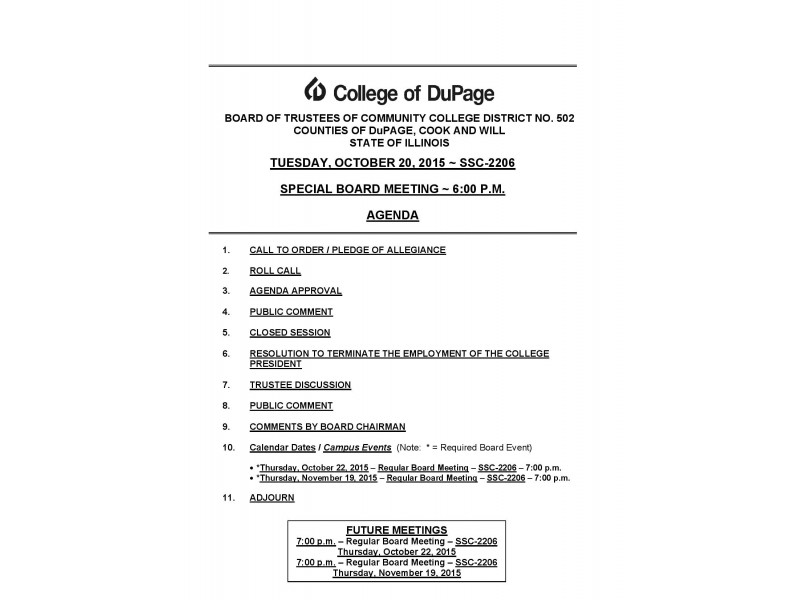
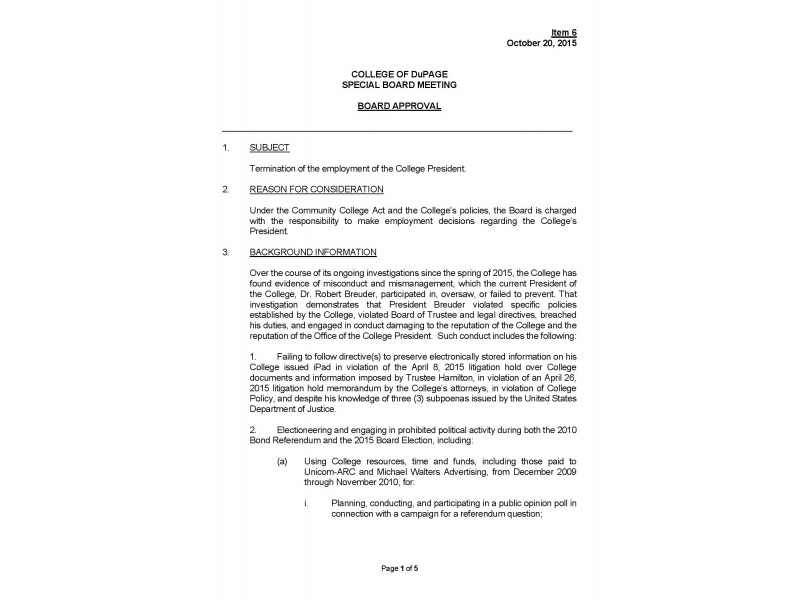
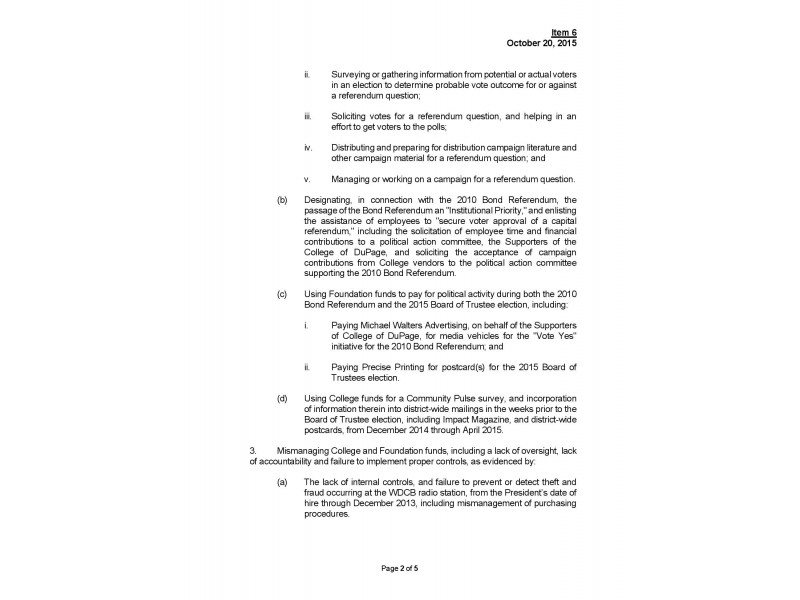
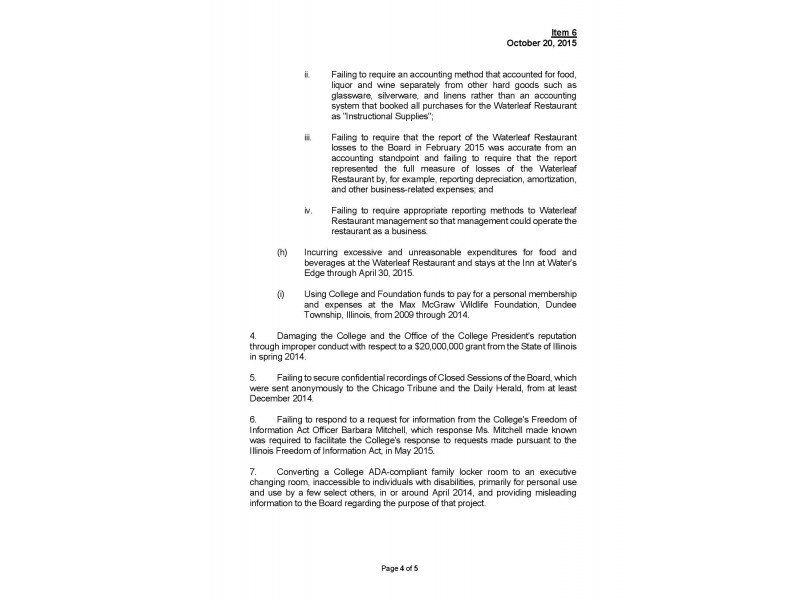
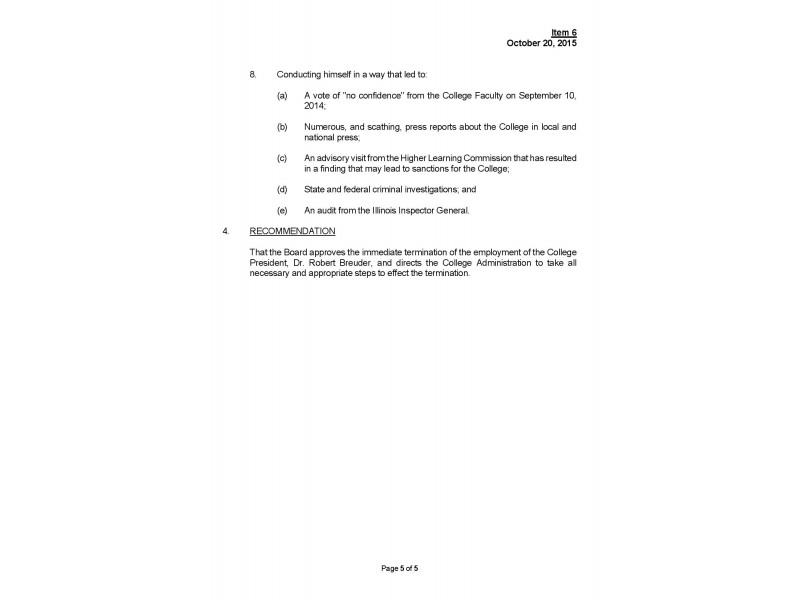
The College of DuPage Board of Trustees fired its embattled President Robert Breuder at a meeting Tuesday night.
The board voted 4-1 to approve the termination, with Trustee Dianne McGuire of Naperville casting the sole no vote. She said the firing of Breuder was centered around a ”politically driven vendetta that is unworthy of this board.” Two trustees, Erin Birt and Joseph Wozniak, were not present and did not vote.
Other trustees spoke of the many examples of misconduct and mismanagement during Breuder’s term. Deanne Mazzochi, board vice chairman, said improper “electioneering activities” by Breuder helped the college secure a $168 million referendum “that this institution and taxpayers will be paying for for decades.”
The College of DuPage and Breuder have been under fire for months regarding its finances and administrative practices and Breuder has been the subject of public scrutiny regarding a $762,867 severance package the former board of trustees approved, according to the Daily Herald.
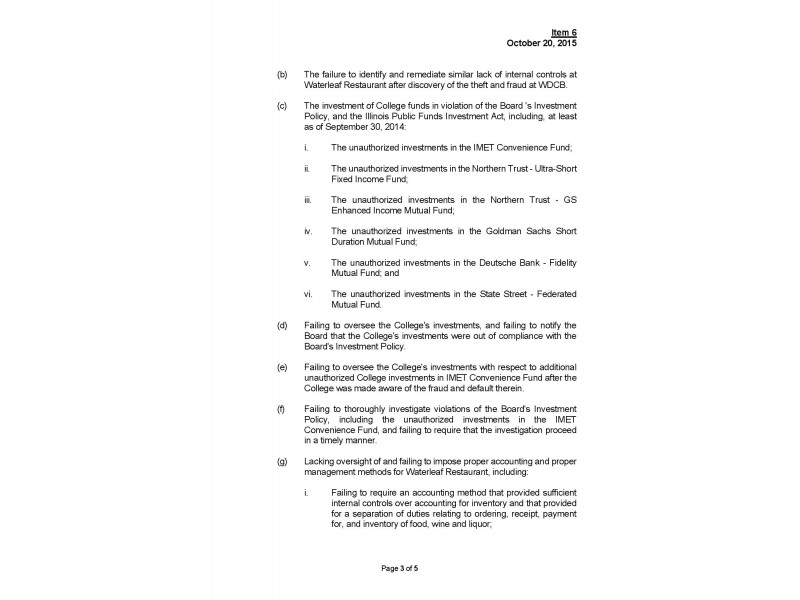
An investigation into Breuder began in spring 2015. During the course of the investigation, “the college found evidence of misconduct and mismanagement, which Breuder, participated in, oversaw or failed to prevent,” according to the special board meeting agenda. A full list of the allegations of Breuder can be viewed below in the board agenda.
Here is a brief timelines looking at some of the allegations leveled against Breuder, who has been on paid leave, over the past year:
- In January, school board members voted to send the community college’s president Robert Breuder away with a $762,000 buyout. That was funded by taxpayers.
- Audio tapes of the buyout negotiations between Breuder and the board of trustees revealed that the president initially asked for a $1.5 million severance payment—almost three years’ salary—and other perks. The board refused to accept those terms.
- Then there were the business dealings at the college radio station and a move tocensure a board member.
- Earlier in March, it was revealed that nearly $200,000 was charged in food and liquor costs at the college’s fine dining restaurant, Waterleaf.
- The last week in March, the college allegedly awarded signage contracts to a foundation member without going to bid for the jobs.
- On April 13, the former radio station employee pleaded not guilty to the charges he faces.
- Then on April 20, it was discovered that an additional $160,000 has been spent at the College of DuPage restaurant, Waterleaf, from an account that was previously undiscovered.
- August 2015: College of DuPage trustees vote to close the Waterleaf restaurant.
- September 2015: The Chicago Tribune releases an article about a pricey, private locker room Breuder had built
- October 2015: The Higher Learning Commission said COD did not meet two core components for accreditation. HLC found COD non-compliant in the area of institutional integrity and in the area of effectiveness of administration and governance.
Tuesday, October 20, 2015
College of DuPage Board Fires Robert Breuder | Patch



Monday, October 12, 2015
Exclusive: U.S. probes allegations AB InBev seeking to curb craft beer distribution - Yahoo Finance
By Diane Bartz
Related Stories
- AB InBev says talking to DOJ, California AG about two planned distributor deals Reuters
- Justice Department investigating A-B InBev for trying to block craft beer: Report American City Business Journals
- Big Beer versus Craft Beer: If You Can’t Beat ‘em, Join ‘em Market Realist
- Anheuser-Busch InBev to Buy Los Angeles Craft Brewer Golden Road The Wall Street Journal
- Anheuser-Busch scoops up another craft brewer CNBC
- 100 Rare Historical Photos...You'll Be Speechless Dunzo.net Sponsored
WASHINGTON (Reuters) - The U.S. Justice Department is probing allegations that Anheuser-Busch InBev (ABI.BR) is seeking to curb competition in the beer market by buying distributors, making it harder for fast-growing craft brewers to get their products on store shelves, according to three people familiar with the matter.
In the past few months, the world's largest brewer has rattled the craft beer world by striking deals for five distributors in three states. Many states require brewers to use distributors to sell their product, and once AB InBev buys a distributor, craft companies say they find that they can't distribute their beer as easily and sales growth stalls.
Antitrust regulators are also reviewing craft brewers' claims that AB InBev pushes some independent distributors to only carry the company's products and end their ties with the craft industry, two of the sources said, noting that the investigation was in its early stages. AB InBev's purchase of several craft beer makers in recent years means that it is in a position to offer a greater variety of products itself.
State regulators in California, where AB InBev announced wholesaler purchases in Oakland and San Jose in September, are also looking into the matter, the people familiar with the matter said.
The beer giant confirmed that it was talking to regulators. "Anheuser-Busch has been in communication with the Department of Justice and California attorney general’s office about the transactions. We are working cooperatively to address any questions they have," an Anheuser-Busch spokesperson said in an email.
Craft brewers, who produce everything from well-crafted classics to odd flavors such as pumpkin or raspberry beer, have been a bright spot in an otherwise dull U.S. beer market. While beer sales rose 0.5 percent in 2014, craft beer sales rose by 17.6 percent to capture 11 percent of the U.S. market.
The Justice Department review comes at an awkward time for AB InBev as it is seeking to buy No.2 SABMiller Plc (SAB.L) for more than $100 billion in what would be the biggest-ever merger of brewers. AB InBev is widely expected to sell SABMiller's stake in U.S.-based MillerCoors if the merger goes through, leaving its U.S. market share unchanged at 46.4 percent.
Small craft brewers have already been rattled by AB InBev's purchases of craft beer makers, including Golden Road in September, Blue Point Brewing in 2014 and Goose Island Beer Co in 2011.
As AB InBev also snaps up distributors, craft brewers have expressed concern that the company would push distributors to only carry its products.
To retain the craft title, a brewery must make less than 6 million barrels annually. That means those that get taken over by a big brewer like AB InBev lose that identity even if they still make small batches with distinctive flavors.
It was not clear if other state regulators were looking at the recent purchases of two distributors in Colorado and one in New York as well.
The Justice Department declined comment. The attorney generals' offices for California, New York and Colorado did not respond to requests for comment.
QUICKLY STALLED
Nikos Ridge, CEO of Ninkasi Brewing Co in Oregon, said that when two of his distributors were bought by AB InBev in 2011 and 2012, he saw what had been healthy sales growth quickly stall until it found alternative distributors.
"Our feeling was that we weren't getting the same level of representation," said Ridge. "We saw our trends drop and we have seen improvements since we've switched."
An executive at a second craft brewer, who asked not to be named, said that AB InBev had recently bought one of its distributors. "It (the distributor) is slowly but surely divesting itself of everything that is not ABI. And we're one of the last ones," said the executive, who noted that its other options for distribution were limited. "We're at the mercy of a lot of big players."
Their experience is not unique. Conversations with at least four other craft brewers told the same story.
There were some 4,000 craft beer companies as of September, brewing everything from artfully made classics like Dale's Pale Ale, Brooklyn Lager and Gordon Biersch Hefeweizen, as well as quirky brews like Breckenridge Vanilla Porter, and the super hoppy Palate Wrecker from Green Flash Brewing Co.
A handful of antitrust experts say that craft brewers have a case, albeit not an easy one.
The authorities could step in if AB InBev bought so many distributors that craft brewers lost significant access to a local market, said Jonathan Lewis, an antitrust expert at the law firm Baker Hostetler LLP. He estimated that the breaking point could be when AB InBev owned some 50 percent of distributors in a given area.
Andy Gavil, a former head of the Federal Trade Commission's Office of Policy Planning who now teaches antitrust law at Howard University Law School, said he believes the problem could be resolved by scrapping a requirement for alcoholic beverages to go through liquor distributors in most U.S. states. That would allow the craft brewers to go directly to the supermarkets, liquor stores and bars.
"There are some older justifications that it's about preventing underage sales but since the ultimate sale is done by a retailer, that's a bogus argument," Gavil said.
(Editing by Soyoung Kim and Martin Howell)
Exclusive: U.S. probes allegations AB InBev seeking to curb craft beer distribution - Yahoo Finance
Thursday, October 1, 2015
Todd Shattuck announces bid for Boone County Circuit Clerk
BOONE COUNTY – Todd Shattuck, 40, of Belvidere has formally announced his bid as a Republican Candidate for Boone County Circuit Clerk.
Shattuck has strong ties to the Boone County community. Shattuck was raised in Boone County, and chose to remain in his hometown with his wife, Lynn, to raise their daughter Rachel.
He graduated from Belvidere High School in 1993 and from Western Illinois University in 1997 with a Bachelor of Science degree.
He began his career working in the Boone County Courthouse as a Probation Officer for the 17th Judicial Circuit. More recently, he has worked in the business banking industry as an Account Manager advising efficient payment processing for local businesses.
“The Circuit Clerk is often the first encounter the public has with the courthouse, is responsible for handling hundreds of thousands of dollars, and is instrumental in ensuring that court runs efficiently and professionally,” Shattuck said.
“I am running to provide a professional Circuit Clerk’s Office that treats the public with respect, to provide the independent supervision needed to protect the public’s money, and to implement the technology needed to improve courtroom efficiencies.”
Above is from: Todd Shattuck announces bid for Boone County Circuit Clerk
Friday, September 18, 2015
Primary Dealers Rigged Treasury Auctions, Investor Lawsuit Says - Bloomberg Business
69% of reissued Treasury auctions were suspicious, suit says
Same type of analysis caught cheating in currencies, Libor
The same analytical technique that uncovered cheating in currency markets and the Libor rates benchmark -- resulting in about $20 billion of fines -- suggests the dealers who control the U.S. Treasury market rigged bond auctions for years, according to a lawsuit.
The analysis was part of a 115-page lawsuit filed in Manhattan federal court on Aug. 26 by Quinn Emmanuel Urquhart & Sullivan LLP and other law firms. The plaintiffs built their case against the 22 primary dealers who serve as the backbone of Treasury trading -- including Goldman Sachs Group Inc., JPMorgan Chase & Co. and Morgan Stanley -- using data from Rosa Abrantes-Metz, an adjunct associate professor at New York University who has provided expert testimony in rigging cases.
Her conclusion: More than two-thirds of a certain type of Treasury auction appear to have been rigged. She found issues with other auctions, too.
“The only plausible explanation is that Defendants coordinated artificially to influence the results of the auctions in the primary market,” according to the complaint filed by the Cleveland Bakers and Teamsters Pension Fund and other investors.
The lawsuit, which seeks unspecified damages, comes as the U.S. Justice Department probes whether information in the Treasury auction market is being shared improperly by financial institutions, three people with knowledge of the investigation said in June. Treasury traders at some banks learn of customer demand hours before auctions, and were communicating with their counterparts at other firms via chat rooms as recently as last year, Bloomberg News reported earlier this year.
Abrantes-Metz’s analysis is similar to one used in lawsuits claiming bank and broker manipulation of the London interbank offer rate, or Libor. Those cases resulted in about $9 billion in settlements from the financial firms. Banks and brokers have paid about $9.9 billion in fines to global regulators related to manipulation of currency markets as of May.
Representatives of Goldman Sachs, JPMorgan and Morgan Stanley declined to comment on the Treasury lawsuit’s allegations.
The U.S. Treasury initially sells securities to the primary dealers who in turn sell them to clients, creating a secondary market for trading. Sometimes, after auctioning off debt, the government later issues an identical batch of securities -- known as reissued Treasuries.
When the second set of Treasuries is issued, their prices and yields can be compared with the identical securities already trading in the secondary market. If there are pricing differences, that could be evidence of a problem. According to the plaintiffs, 69 percent of the auctions of reissued Treasuries from 2009 to 2015 appear to have been rigged, artificially boosting yields by 0.91 basis points.
The plaintiffs said there’s evidence of cheating from at least 2007 through earlier this year, when press reports revealed the Justice Department investigation into the auction process.
“These analyses reveal a consistent pattern: Treasury auction yields were artificially high (and prices correspondingly low),” according to the complaint. “Defendants then turned around and sold the Treasuries at higher prices (and correspondingly lower yields) in the secondary markets, reaping substantial profits.”
The data analysis showed similar discrepancies when prices at Treasury auctions were compared to those in the secondary market as well as the when-issued market. Treasury futures experienced similar downward pressure on prices leading up to auctions, the lawsuit claims.
Among the lawyers representing the investors is Daniel Brockett, a Quinn Emmanuel attorney who recently won a $1.87 billion settlement against Wall Street’s largest banks in a case alleging they conspired to limit competition in the market for credit-default swaps.
Brockett said in an interview that the new lawsuit alleges the artificially low auction prices grew in direct proportion to how many primary dealers were involved in an auction.
“No matter which way you measure it, they end up benefiting in ways that wouldn’t otherwise be possible in a liquid market of this size,” he said. The $12.8 trillion Treasury market helps sets interest rates on everything from home mortgages to credit cards and is often described as the largest, most-liquid market in the world.
Another group of investors, including Boston’s public employee retirement system, has filed a similar suit against Wall Street primary dealers. Experts interviewed by Labaton Sucharow LLP, the law firm that filed that suit, analyzed auctions and the market for when-issued securities, which are essentially agreements to buy or sell Treasury bonds, notes or bills once they’re issued.
They claim that banks colluded to push prices artificially low at auctions, and to drive prices for when-issued securities to artificially high levels, until December 2012, when news broke of investigations into how Libor was set.
“These scenarios all turn on a very simple conflict of interest,” attorney Michael Stocker said in a telephone interview. “You had banks who were auction participants who also had the power to move the prices that those markets depended on.”
The new case is Cleveland Bakers and Teamsters Pension Fund v. Bank of Nova Scotia, 15-cv-06782, U.S. District Court, Southern District of New York (Manhattan).
Primary Dealers Rigged Treasury Auctions, Investor Lawsuit Says - Bloomberg Business
Monday, July 20, 2015
Governor's budget office review suffers in stalemate
The stalemate between Democrats who control the General Assembly and Republican Gov. Bruce Rauner has left Illinois in a state of suspended animation.
Although state troopers are still out patrolling the roads and prison guards are keeping an eye on the inmates, there are some functions of government that are simply not getting done.
Take the governor's budget office, for example.
In January, the governor issued an executive order calling for the budget office to review state personnel contracts to determine if any of them were wasteful or improper.
Figuring that enough time had elapsed for the review to be complete, I recently asked for a copy of the results. The governor's office said it hadn't been done.
I also asked about the purpose of the review. Spokeswoman Catherine Kelly did not respond to multiple inquiries.
My guess is that the review was triggered by stories and investigations, including one by the Better Government Association, about cronies getting lucrative state contracts, as well as retirees going back to work for the state on contract while they were earning a state pension.
There are dozens of these kinds of double-dipping arrangements at numerous agencies under the control of the governor. Many of them appear to have been in place before Rauner took over as chief executive in January.
In all, there are more than 1,500 contract workers spread across various state agencies. The man who earns the most as a contract worker is Essam El-Beik, a Texas-based telecom expert who is a consultant on a state-run broadband Internet service.
In the first half of this year, El-Beik has earned more than $163,000.
Of the top 25 contract earners, seven are former state workers who, on top of receiving their pension checks, also are earning money for their current work.
Two of them, Scott Deubel and Mark Stevens, are former state police employees who now work for the Illinois Gaming Board. Both retirees have been paid more than $70,000 from their contracts this year.
In what came as absolutely no surprise, Kelly hilariously blamed the governor's lack of compliance with his own executive order on the governor's nemesis, House Speaker Michael Madigan, D-Chicago.
"Reviewing the employment contracts in state government is a momentous task, but before it can begin, (the budget office) is working on making sure the current fiscal year has a balanced budget in place," Kelly said.
A NEW WAY? In an unprecedented switch from his usually stealthy mode of operation, Madigan has been holding weekly news briefings.
the inmates, there are some functions of government that are simply not getting done.
Take the governor's budget office, for example.
In January, the governor issued an executive order calling for the budget office to review state personnel contracts to determine if any of them were wasteful or improper.
Figuring that enough time had elapsed for the review to be complete, I recently asked for a copy of the results. The governor's office said it hadn't been done.
I also asked about the purpose of the review. Spokeswoman Catherine Kelly did not respond to multiple inquiries.
My guess is that the review was triggered by stories and investigations, including one by the Better Government Association, about cronies getting lucrative state contracts, as well as retirees going back to work for the state on contract while they were earning a state pension.
There are dozens of these kinds of double-dipping arrangements at numerous agencies under the control of the governor. Many of them appear to have been in place before Rauner took over as chief executive in January.
In all, there are more than 1,500 contract workers spread across various state agencies. The man who earns the most as a contract worker is Essam El-Beik, a Texas-based telecom expert who is a consultant on a state-run broadband Internet service.
In the first half of this year, El-Beik has earned more than $163,000.
Of the top 25 contract earners, seven are former state workers who, on top of receiving their pension checks, also are earning money for their current work.
Two of them, Scott Deubel and Mark Stevens, are former state police employees who now work for the Illinois Gaming Board. Both retirees have been paid more than $70,000 from their contracts this year.
In what came as absolutely no surprise, Kelly hilariously blamed the governor's lack of compliance with his own executive order on the governor's nemesis, House Speaker Michael Madigan, D-Chicago.
"Reviewing the employment contracts in state government is a momentous task, but before it can begin, (the budget office) is working on making sure the current fiscal year has a balanced budget in place," Kelly said.
A NEW WAY? In an unprecedented switch from his usually stealthy mode of operation, Madigan has been holding weekly news briefings.
Last week, he was asked how the never-ending impasse will be resolved if the Democrats who control the legislative branch and Rauner aren't meeting on a more regular basis.
“I don’t necessarily agree with the first part of your remarks, that in the end this will be negotiated between the governor and the leaders. I don’t necessarily agree with that,” Madigan said. “I don’t think you should proceed under any presumptions that are based upon what happened in the past. I don’t necessarily presume that there will be some kind of a deal put together between the governor and the legislative leaders.”
Madigan didn't elaborate on how that might work.
One way of getting a budget in place without Rauner's signature would be for the Democrats to approve a new spending plan and then use their supermajorities to override a veto by the governor.
That scenario, however, would imply that Madigan actually wants the budget impasse to be resolved.
NOT SATISFIED: The Illinois Department of Employment Security reported last week that the state's unemployment rate dropped to 5.9 percent in June. It was the first time the state jobless rate fell below 6 percent since 2008.
It wasn't a cause for celebration in the Rauner camp. Positive economic news doesn't fit with their theme that Illinois is a crappy place to do business and therefore needs drastic, pro-business, anti-union changes to boost the economy.
“As jobs continue to leave Illinois, we need to focus on enacting reforms to reinvigorate our business climate and create greater economic opportunities for all Illinois families,” Illinois Department of Commerce and Economic Opportunity Director Jim Schultz said
It should be noted that Schultz also is chairman of Rauner's campaign fund.
kurt.erickson@lee.net|(217) 782-4043
Wednesday, July 8, 2015
Yahoo News
To Help US Veterans Charity, George W. Bush Charged $100,000
MEGAN CHUCHMACH and BRIAN ROSS
July 08, 2015
To Help US Veterans Charity, George W. Bush Charged $100,000 (ABC News)
To Help US Veterans Charity, George W. Bush Charged $100,000
MEGAN CHUCHMACH and BRIAN ROSS
July 08, 2015
Former President George W. Bush charged $100,000 to speak at a charity fundraiser for U.S. military veterans severely wounded in Iraq and Afghanistan, and former First Lady Laura Bush collected $50,000 to appear a year earlier, officials of the Texas-based Helping a Hero charity confirmed to ABC News.
The former President was also provided with a private jet to travel to Houston at a cost of $20,000, the officials said.
The charity, which helps to provide specially-adapted homes for veterans who lost limbs and suffered other severe injuries in “the war on terror in Iraq and Afghanistan,” said the total $170,000 expenditure was justified because the former President and First Lady offered discounted fees and helped raise record amounts in contributions at galas held in 2011 and 2012.
“It was great because he reduced his normal fee of $250,000 down to $100,000,” said Meredith Iler, the former chairman of the charity.
However, a recent report by Politico said the former President’s fees typically ranged between $100,000 and $175,000 during those years.
One of the wounded vets who served on the charity’s board told ABC News he was outraged that his former commander in chief would charge any fee to speak on behalf of men and women he ordered into harm's way.
“For him to be paid to raise money for veterans that were wounded in combat under his orders, I don’t think that’s right,” said former Marine Eddie Wright, who lost both hands in a rocket attack in Fallujah, Iraq in 2004.
“You sent me to war,” added Wright speaking of the former President. “I was doing what you told me to do, gladly for you and our country and I have no regrets. But it’s kind of a slap in the face.”
Bill Clinton Cashed In When Hillary Became Secretary of State
Clinton Foundation Taking Money From Accused Rights Violator
Do you have information about this or another story? CLICK HERE to send your confidential tip in to Brian Ross and the ABC News Investigative Unit.


Monday, May 11, 2015
Cuomo Orders Emergency Measures to Protect Workers at Nail Salons - NYTimes.com
New York State has a long history of confronting wage theft and unfair labor practices head on, and today, with the formation of this new Enforcement Task Force, we are aggressively following in that tradition,” Mr. Cuomo said in a statement. “We will not stand idly by as workers are deprived of their hard-earned wages and robbed of their most basic rights.”
Articles in this series are examining the working conditions and potential health risks endured by nail salon workers.
Part 1 The Price of Nice NailsMAY 7, 2015
Part 2 Perfect Nails, Poisoned WorkersMAY 8, 2015
The swiftly assembled plans, while still taking shape, are the start of an effort to reshape an industry that has been a major entry point for immigrants into the city’s economy, but in which exploiting the people who toil over hands and feet appears to be, in many instances, simply the way business is done.
Salons will be required to publicly post signs that inform workers of their rights, including the fact that it is illegal to work without wages or to pay money for a job — a common practice in the nail salon industry, according to workers and owners. The signs will be in half a dozen languages, including those most spoken in the industry — Korean, Chinese and Spanish.
The emergency measures announced on Sunday will become permanent in the coming months, the governor’s office said.
Under new rules, manicurists must wear gloves to reduce the risks of contracting skin conditions, such as fungal infections and warts, and developing burns from handling chemicals.
The plan currently will also require masks, though occupational health experts say the hospital-style masks that manicurists sometimes wear give only the appearance of safety. Such masks do almost nothing to prevent exposure to chemicals, such as dibutyl phthalate, toluene and formaldehyde, that are used in nail products and have been linked to leukemia and fetal defects. And salons will be required to be ventilated, to reduce the chemical fumes.
The state’s Health Department, one of the agencies in the task force, will conduct a study of the most effective safety practices, and the eventual rules put in place may change in scope depending upon the findings.
Salons will now be required to be bonded — which is intended to ensure, through a contract with a bonding agency, that workers can eventually be paid if salon owners are found to have underpaid the workers. The move is an attempt to counteract the phenomenon of salon owners’ hiding assets when they are found guilty of wage theft.
Many workers are undocumented and fear exposing themselves to the authorities, so they rarely speak up. The agencies involved in the task force do not inquire about workers’ immigration status as part of their investigations, the governor’s office said. An education campaign will also be introduced through community groups to inform workers they have the right be compensated fully, regardless of their immigration status, and encourage them to report mistreatment.
The framework for the emergency measures began to take shape shortly after the first article was published on Thursday, according to Alphonso B. David, counsel for the governor. Staff members from several agencies reacted strongly, and began to call one another upon reading the findings, convening on Friday for hours of brainstorming sessions to hash out the plan. A decision was made to take emergency measures rather than go through the usual route by which policies are updated, which involve time-consuming steps like periods of public comment, Mr. David said.
“The article highlighted a significant problem in New York State,” Mr. David said. “We cannot wait to address the problem.”


Cuomo Orders Emergency Measures to Protect Workers at Nail Salons - NYTimes.com
Tuesday, May 5, 2015
Did Governor Rauner's Campaign Violate State Elections Law? | WSIU
After spending nearly 65 million dollars... Governor Bruce Rauner's campaign has been assessed a penalty by the State Board of Elections.
Director Steve Sandvoss confirms it's because of a late report filing ... but says he can't give details.
"In light of fairness to the respondent and due fairness principles, we don't comment publicly on the nature of an ongoing proceeding. But rather, we'll let the process bear itself out."
A spokesman for the governor says there was a "snafu." He says a firm hired to file contributions paperwork prepared a report ... but failed to upload it. The mistake was corrected eight hours later.

With 20 million dollars sitting in Rauner's campaign account ... he'd have no trouble paying a potential fine.
A hearing is set for Thursday in Chicago. An official will then make a recommendation to the state elections board ... whose members have the final say on whether or not the governor's campaign was in the wrong.

Did Governor Rauner's Campaign Violate State Elections Law? | WSIU
Friday, April 17, 2015
Feds Target Corruption at Pace - Patronage & Contractor Kickbacks - McHenry County Blog
Very interesting article from Cal Skinner regarding the RTA and PACE buses.

Read all of the article by clicking on the following: Feds Taget Corruption at Pace - Patronage & Contractor Kickbacks - McHenry County Blog
Thursday, March 26, 2015
Schock’s fundraiser: I feel ‘sad, angry, cheated’ - POLITICO
By Jake Sherman, Anna Palmer and John Bresnahan
3/24/15 1:53 PM EDT
Rep. Aaron Schock’s longtime fundraiser sent an email to the Illinois Republican’s donors, saying she feels “sad, angry, cheated” and filled with “total disgust, disbelief and disappointment” at the congressman’s alleged misspending of taxpayer and campaign dollars.
Lisa Wagner is an Illinois-based GOP fundraiser who worked for Schock for the past four years, helping to catapult him to the top tier of the Republican money world.
Story Continued Below
Wagner’s email offers a window into the sudden fallout and acute anger in Schock’s world from the scandal that brought down the fourth-term congressman, who announced his resignation last week effective March 31. Schock is now under investigation by the Justice Department. Schock aides have been called to testify before a federal grand jury next month in Springfield, Illinois.
“You personally and generously supported Aaron in the past and were very kind to him,” Wagner wrote in an email, obtained by POLITICO. “He deceived us all.”
Wagner added, “The last time I saw Aaron was February 8, 2015. I have tried to text, email and call, but with zero response. Right now, I feel like someone we thought we knew really well died.”
“I believe he should be held accountable for his choices…. whatever the consequences [may] be…I have no sympathy for the him right now,” she wrote.
A spokesman for Schock had no comment.
Reached on Tuesday, Wagner told POLITICO that she spoke to Schock for the first time Monday since the scandal broke.
“We talked about the email I sent to a handful of individual donors who were close to Aaron,” Wagner wrote in an emailed statement to POLITICO. “During our conversation, I shared how angry and how disappointed I was with him. Our conversation was very raw, authentic and human.”
Wagner said that she is praying for Schock and believes that he will “work hard to make things right as best he can.”
She said that after talking with Schock, “I — for the first time — started to separate the sin from the sinner.”
“Aaron is going thru Hell,” Wagner wrote. “Many, many people genuinely like and care about Aaron as a human being, and their hearts are heavy and sad. I believe Aaron will work hard to make things right as best he can. From starting the process of returning checks to reaching out to people, Aaron will take full responsibility for his actions and choices.”
While Schock had kept a lower profile before announcing his resignation, the Illinois Republican voted this week and attended the weekly House Republican Conference meeting on Tuesday morning.
In her earlier email to donors, Wagner wrote that she worked for Schock for four years, “got paid a modest monthly retainer, but received no bonus, no trips, no gifts, no sporting events or rock concerts, not even a Schock t-shirt.”
“Worked my tail off and played by the rules for him,” she wrote. “I guess that is why I was kept out of the loop — until he [needs] something - a fundraiser for [Illinois Gov. Bruce] Rauner, a fundraiser for him, 15M for the [National Republican Congressional Committee].”
Wagner said she has “requested any money donated to him in 2015 be returned.”
“The response I received from the person managing his compliance now is that they legally have to return the 2016 general contributions, but not the primary money,” she wrote. “My request is that all of it should be returned.”
In closing, Wagner wrote that she is “truly sorry for the pain Aaron’s situation is causing you, me, his friends, supporters, staff, donors, the voters, those who believed in him — everyone. This whole situation hurts everyone.”
Above is from: Schock’s fundraiser: I feel ‘sad, angry, cheated’ - POLITICO
Friday, March 20, 2015
US opens criminal inquiry of resigning Illinois congressman - Yahoo News
Justice Department is investigating the congressional expenses and business deals of Illinois Rep. Aaron Schock, and FBI agents have begun issuing subpoenas to witnesses, a person familiar with the case told The Associated Press on Friday.
Investigators were focusing on Schock's House office expense account, expenditures by his re-election campaign and his personal investments with long-time political donors, the person said. Schock, 33, a young, media-savvy Republican, abruptly announced his resignation Tuesday after weeks of mounting media reports about questionable expenditures and personal finances.
The government was convening a federal grand jury in Springfield, Illinois, according to the person, who was not authorized to publicly discuss the case. The person also said that FBI agents were visiting people close to the Republican congressman who were being compelled by subpoena to testify. The grand jury was hearing testimony in early April, according to the subpoenas.
A spokesman and lawyers for Schock did not respond to repeated phone calls and emails Friday from AP.
Schock's sudden resignation followed revelations over six weeks about his business deals and lavish spending on travel, personal mileage reimbursements and office redecorating in the style of "Downton Abbey." Congressional ethics investigators had begun probing Schock's conduct in the days before his announcement, but that probe was expected to shut down because of the federal investigation.
Questions have included Associated Press investigations of Schock's real estate transactions, air travel and entertainment expenses — including some events that Schock documented in photographs on his Instagram account. On Monday, the AP confirmed that the Office of Congressional Ethics had reached out to Schock's associates as it apparently began an investigation.
The owner of an air charter service in Peoria confirmed Friday that he had been contacted by an ethics investigator interested in Schock's extensive flights on planes owned by campaign donors. Harrel W. Timmons, owner of Jet Air Inc., was not a Schock donor but said the investigator wanted to know about the lawmaker's flights on a plane owned by D&B Air, a Peoria aviation firm owned by a prominent Schock donor.
AP previously reported that Schock's use of the D&B plane appeared to violate congressional rules in place at the time prohibiting the use of office accounts to pay for private flights. Schock had used office expenses to pay $24,000 for eight flights in 2011 and 2012. Since mid-2011, Schock's office and campaign expenses paid for more than $40,000 worth of flights on planes owned by his political donors.
House ethics investigators typically stand down open inquiries once federal authorities open their own probe or when the House Ethics Committee orders a halt in the inquiry. The OCE had been authorized to continue its inquiry until Schock's planned March 31 resignation. His decision to quit has no impact on the FBI investigation.
Earlier this week, Schock's father, Richard, told an ABC reporter: "Two years from now he'll be successful, if he's not in jail."
"If you're going to investigate his real estate dealings, etc., then find out the facts," Richard Schock said. "The facts are what are going to convict him or exonerate him."
The AP reported last week that much of Schock's personal wealth, estimated at about $1.4 million, grew from a series of real estate deals involving other long-time political donors. Schock's political contributors built, financed and later purchased a house the lawmaker owned as an investment in Peoria. He owns a stake in a Peoria apartment complex involving other contributors. And he pushed for a federal appropriation that would have benefitted a donor's development project.
Schock's expenses came under scrutiny last month after the Washington Post reported that Schock had paid $40,000 from his House expense account for a lavish office redecoration modeled on decor depicted in the TV serial "Downton Abbey." Reports by Politico and other news organizations also singled out Schock's unusually high, personal reimbursements for auto mileage.
Schock responded to the growing scrutiny by paying back his office decorator $40,000. The day of his resignation, Schock also paid back his mileage expenses, but his spokesman did not say how much he had repaid.
In resigning abruptly on Tuesday, Schock cited a "heavy heart," following six weeks of revelations about his business deals. He said in a statement that the constant questions about his spending and business dealings had made it impossible to serve effectively as congressman.
House Speaker John Boehner was not informed of Schock's resignation before it was announced but has said he supported the decision to quit.
A spokeswoman for the Federal Elections Committee also confirmed Friday that staff lawyers were reviewing a complaint from a liberal-leaning watchdog group, Citizens for Responsibility and Ethics in Washington. The group complained Feb. 26 that two political committees associated with Schock paid more than $9,000 for flights on donor planes. The FEC does not investigate complaints until the full committee votes on the matter. That has not happened, the spokeswoman said.
US opens criminal inquiry of resigning Illinois congressman - Yahoo News
Tuesday, March 17, 2015
Behr Iron & Steel faces $366K in fines for hazards in Rockford, Peoria - News - Rockford Register Star - Rockford, IL
- By Georgette Braun
Rockford Register StarPosted Mar. 16, 2015 at 2:10 PM
Updated at 9:23 PMROCKFORD — Behr Iron & Steel recycling plants face penalties of $366,400 for continued exposure of workers to hazards, the U.S. Department of Labor's Occupational Safety and Health Administration said Monday in a news release.Behr, which employs 450 people at 14 Midwest facilities, was cited for exposing workers to amputation hazards during maintenance and while processing scrap metal in Rockford and Peoria. Safety mechanisms were not in place, the agency said. The penalties are for five willful and nine serious safety violations, including fall and confined-space hazards.The company operates at 1100 Seminary St. and 208 Quaker Road in Rockford, where OSHA said Behr failed to use energy-control procedures, such as powering off and affixing locking devices. At Behr's Peoria facility, OSHA said workers at the company must enter a sorting house conveyor to use the shredder.OSHA initiated the inspections at three Behr facilities when similar hazards were found during an investigation into the March 2014 death of a worker at the company's recycling facility in South Beloit.The company has five days to make improvements or to contest the findings. A woman who answered the phone at Behr in Rockford said no one was available to speak with a Register Star reporter seeking more information.Before the latest checks, the company had been inspected seven times in five years and cited for machine hazards at various locations in Illinois and Iowa.
Tuesday, March 10, 2015
Ferguson City Manager Cited in Justice Department Report Resigns - NYTimes.com
FERGUSON, Mo. — The city manager of Ferguson, whom a Department of Justice report blamed as one of the officials responsible for much of the questionable conduct by the police and the courts here, has agreed to resign.
The announcement came during a City Council meeting here on Tuesday, about a week after the scathing Justice Department report.
The manager, John Shaw, 39, had held the post since 2007. As Ferguson’s chief executive, he is the city’s most powerful official.
The resignation was announced about 30 minutes into the Council meeting, with members voting 7 to 0 to approve a “mutual separation agreement” with Mr. Shaw.
As people in the packed Council chamber began to understand what was happening, a buzz shot through the room as onlookers mumbled and a few let out muted cheers.
“We appreciate John’s service and commitment to the City of Ferguson for the past eight years,” Mayor James Knowles III said in a written statement. “The City Council and John Shaw feel that this is the appropriate time to move forward as we begin our search for a new city manager.”
Ferguson City Manager Cited in Justice Department Report Resigns - NYTimes.com
Monday, March 9, 2015
Missouri Court Assigns a State Judge to Handle Ferguson Cases - NYTimes.com
By ELI YOKLEY and JOHN ELIGON
FERGUSON, Mo. — The Missouri Supreme Court, citing the need for “extraordinary action” to restore trust in Ferguson’s court system after the Department of Justice blasted it for routinely violating constitutional rights, assigned a state appeals court judge on Monday to oversee all municipal cases.
The court’s unusual move came as the current municipal judge, Ronald J. Brockmeyer, who was repeatedly cited in the Justice Department report for abusive practices, announced his resignation after holding the position for more than a decade.
Brendan Roediger, a law professor at St. Louis University who runs the university’s civil litigation legal clinic, said this was the first time to his knowledge that a state Circuit Court had taken over an entire Municipal Court docket.
“It’s a very big deal because it actually is the solution,” he said. “It puts the cases in front of full-time professional courts with no conflicts of interest.”
Mr. Brockmeyer, 70, will keep his other Municipal Court positions in St. Louis County, as a judge in Breckenridge Hills and a prosecutor in Vinita Park, Dellwood and Florissant.
Last week, the Department of Justice issued a scathing report that accused Ferguson officials of using the city’s police and court system to generate revenue, rather than to protect public safety and mete out justice.
Mr. Brockmeyer was among the officials who received particular scrutiny for practices like fixing traffic tickets for colleagues and himself, punishing defendants who challenged him, and instituting new fees, many of which were “widely considered abusive and may be unlawful,” according to the Justice Department.
“The Municipal Court does not act as a neutral arbiter of the law or a check on unlawful police conduct,” the Justice Department report said. “Instead, the court primarily uses its judicial authority as the means to compel the payment of fines and fees that advance the city’s financial interests.”
Judge Roy L. Richter of the Missouri Court of Appeals will take over Ferguson’s cases, according to a news release from the Missouri Supreme Court, which said it had the authority to take such action under Article 5 of the State Constitution.
In addition to adjudicating cases, Judge Richter also will be expected to carry out “needed reforms to court policies and procedures in Ferguson to ensure that the rights of defendants are respected and to help restore the integrity of the system,” the release said.
“Judge Richter will bring a fresh, disinterested perspective to this court’s practices, and he is able and willing to implement needed reforms,” Chief Justice Mary R. Russell said in a statement. “Extraordinary action is warranted in Ferguson, but the court also is examining reforms that are needed on a statewide basis.”
Gov. Jay Nixon of Missouri praised the move, saying in a statement, “Today’s strong and appropriate actions by the Missouri Supreme Court are a solid step forward.”
Mr. Brockmeyer’s replacement came as Ferguson officials grappled with whether they could legally remove him from his post. (The St. Louis Post Dispatch’s editorial board on Friday called for him to step down.)
The judge, who was recommended by the city manager and approved by the City Council in 2003, certainly had his skeptics within City Hall. In 2012, a Council member wrote to other city officials opposing the …
Read the entire article by clicking on the following: http://www.nytimes.com/2015/03/10/us/state-judge-to-take-charge-of-city-cases-in-ferguson.html?emc=edit_na_20150309&nlid=53444314&_r=0
Saturday, February 28, 2015
Legal Action by FDIC maybe part of the reason DeKalb County Treasurer left so suddenly after his 2012 election.
As shown by the two documents that follow, Mark Todd was appointed(February 2011) County Treasurer when Christine Johnson filled the Illinois Senate District seat. The former bank vice-president ran unopposed in the November 2012 General Election as a Republican and resigned in December 2012 effective February 2013.

Mark Todd Quits County Treasurer Position
December 26, 2012 - Gov Watch - 2 comments
Apparently county board Chairman Jeff Metzger announced that DeKalb County Treasurer Mark Todd quit to pursue a job in Hawaii. That’s according to a news release sent to the Daily Chronicle. According to his Facebook page his wife got a great job there back in October.
I’d take a better job in Hawaii. What an opportunity!
But the warm sunny skies and grass skirts of our 50th state didn’t influence this rant against the great injustice of it all. The press release should have come from Todd and it should have been posted on the County Treasurer’s website for all those that just voted in the election three weeks ago.
For this voter who filled in Todd’s slot on my ballot the Chronicle report read like a “wham bam thank you ma’am” letter direct from someplace near Honolulu.
“While the statutes do not provide specific qualifications for the office of county treasurer, I plan to develop criteria to evaluate candidates interested in this post so that the county is assured of getting a highly qualified individual to manage the treasurer’s office,” Metzger said in the news release.
Todd’s resignation will be effective Feb. 8 [2013], if the news release was accurate. He was appointed DeKalb County Treasurer back in February 2011. Long serving Christine Johnson left to fill the Illinois Senate District 35 seat vacated by Brad Burzynski’s retirement. He rain unopposed in the November 2012 election.
It would be more courteous, in my opinion, if elected officials shared their job pursuits with the public before election day instead of three weeks after. Especially in this job market. Had Todd announced his Hawaii intentions earlier who knows how many highly qualified candidates might have applied for the voters to choose from. Instead the deal will be done among party bosses or among those most connected. Maybe that’s what Metzger meant when he said that leading Republicans would step up and say why they wanted him for the county board chair. He won the seat by unanimous vote of the Democrats (plus his lone Republican vote).
Metzger will appoint the new DeKalb County Treasurer some time in the next 60 days (from Feb. 8). Evidently, state statutes require the appointment go to someone of the same political party as the vacating incumbent. Mark Todd was a Republican.
Feb 8. Why that date? Severance pay? Severance agreement?
Fair questions.
Above is from: Mark Todd Quits County Treasurer Position | DeKalb County Online
Mr. Todd was Vice-President of Farmers and Traders State Bank, Shabbona which was closed by the FDIC in June 2012. (see document below).

First State Bank, Mendota, Illinois, Assumes All of the Deposits of Farmers and Traders State Bank, Shabbona, Illinois
FOR IMMEDIATE RELEASE
June 8, 2012
Media Contact:
LaJuan Williams-Young
Office: 202-898-3876
Email: lwilliams-young@fdic.gov
Farmers and Traders State Bank, Shabbona, Illinois, was closed today by the Illinois Department of Financial and Professional Regulation, which appointed the Federal Deposit Insurance Corporation (FDIC) as receiver. To protect the depositors, the FDIC entered into a purchase and assumption agreement with First State Bank, Mendota, Illinois, to assume all of the deposits of Farmers and Traders State Bank.
The two branches of Farmers and Traders State Bank will reopen on Saturday as branches of First State Bank. Depositors of Farmers and Traders State Bank will automatically become depositors of First State Bank. Deposits will continue to be insured by the FDIC, so there is no need for customers to change their banking relationship in order to retain their deposit insurance coverage up to applicable limits. Customers of Farmers and Traders State Bank should continue to use their existing branch until they receive notice from First State Bank that it has completed systems changes to allow other First State Bank branches to process their accounts as well.
This evening and over the weekend, depositors of Farmers and Traders State Bank can access their money by writing checks or using ATM or debit cards. Checks drawn on the bank will continue to be processed. Loan customers should continue to make their payments as usual.
As of March 31, 2012, Farmers and Traders State Bank had approximately $43.1 million in total assets and $42.3 million in total deposits. In addition to assuming all of the deposits, First State Bank agreed to purchase essentially all of the failed bank's assets.
Customers with questions about today's transaction should call the FDIC toll-free at 1-800-640-2607. The phone number will be operational this evening until 9:00 p.m., Central Daylight Time (CDT); on Saturday from 9:00 a.m. to 6:00 p.m., CDT; on Sunday from noon to 6:00 p.m., CDT; on Monday from 8 a.m. to 8 p.m., CDT; and thereafter from 9:00 a.m. to 5:00 p.m., CDT. Interested parties also can visit the FDIC's Web site at http://www.fdic.gov/bank/individual/failed/ftsb.html.
The FDIC estimates that the cost to the Deposit Insurance Fund (DIF) will be $8.9 million. Compared to other alternatives, First State Bank's acquisition was the least costly resolution for the FDIC's DIF. Farmers and Traders State Bank is the 27th FDIC-insured institution to fail in the nation this year, and the second in Illinois. The last FDIC-insured institution closed in the state was Premier Bank, Wilmette, on March 23, 2012.
# # #
Above is from: https://www.fdic.gov/news/news/press/2012/pr12066.html
In December 2014 the following legal action was finalized by the FDIC. . As shown by the legal order, Mr. Todd is prohibited from bank ownership or conducting the affairs of a financial institution.

Above is from: https://www.fdic.gov/news/news/press/2015/pr15011a.html?source=govdelivery&utm_medium=email&utm_source=govdelivery


The above is the attachment from: https://www.fdic.gov/news/news/press/2015/pr15011a.html?source=govdelivery&utm_medium=email&utm_source=govdelivery
Bloggers in McHenry County asking many questions regarding a motorcycle
This mink-condition 2012 police motorcycle showed up on the Harley-Davis, Woodstock website. And then disappeared when questions were being asked by blogger—McHenry County Secrets--http://www.mchenrycountysecrets.com/
In case you cannot make out the lettering; it says: “McHenry County Conservation District POLICE”. And the vehicle has seven miles on the odometer. Did this ever belong to this governmental agency? If so, why was it never used?


It is pretty certain that this story is not over with. Keep turned to: http://www.mchenrycountysecrets.com/ (shown below) or Cal Skinner’s McHenry County Blog: http://mchenrycountyblog.com/ (also shown below).


Wednesday, February 4, 2015
Boone County Board approves 'use-it-or-lose-it' vacation policy - News - Rockford Register Star - Rockford, IL
By Ben Stanley
Rockford Register Star
Posted Feb. 3, 2015 at 3:00 PM
Updated at 7:33 PMBELVIDERE — When it comes to vacation days, it’s now “use-it-or-lose-it” for Boone County employees.
According to a new county employee vacation policy approved by the County Board on Jan. 24, county employees can now only carry over five days of vacation per year with permission from their department heads. Vacation days that carry over must be used within six months of the anniversary of employment.
Under the previous policy, employees could save up vacation days for years and cash them in for huge sums just before retirement. The saved vacation days were paid out according to the employee’s most recent rate of pay — unused vacation days increased in value if a person’s salary rose.
Thousands of dollars worth of unused days can strain the budget when claimed unexpectedly. Winnebago County released a report in 2014 regarding vacation policy abuse that revealed an unpaid bill of $805,255 worth of vacation racked up by 105 county employees.
According to county officials, similar data has not been gathered in Boone County.
Boone County Administrator Ken Terrinoni and County Board Chairman Bob Walberg said the board began discussing changes to vacation policy during executive session in December. Talks started around the same time former Boone County Public Defender Azhir Minhas was cut a $28,000 check for 10 weeks of unused vacation he had stored up during his final years in office. -
See more at: http://www.rrstar.com/article/20150203/NEWS/150209822#sthash.8TC8O5UG.dpufBoone
Additional story on Azhir Minhas go to: http://boonecountywatchdog.blogspot.com/2015/02/boone-county-benefits-from-case-of.html
Below is the revision which occurred to the vacation policy: The corrections are the recent changes. It is very interesting that Mr. Minhas is the Depart Head of the Public Defenders Office and apparently allowed the carry-over of his own vacation days.


Above is taken from: http://www.boarddocs.com/il/boone/Board.nsf/files/9SBQWE6A7C4E/$file/Personnel%20Policy_201412311240.pdf
Friday, January 23, 2015
Dixon Comptroller will not receive her pension
Rita Crundwell committed perhaps the crime of the decade here in Illinois. It is great that she will not receive a pension and the benefit will be used as restitution to Dixon.
But what about Boone County’s government embezzler —Deputy Circuit Clerk Donna Osoria. SEE: http://boonecountywatchdog.blogspot.com/2014/12/deputy-clerk-osoria-offers-guilty-plea.html Will Boone County seek to insure that she will not receive retirement benefits for her years of less than meritorious service? What do we have to do to insure that she does not?


The above is from page A9, Rockford Register Star, January 23, 2015
Friday, January 9, 2015
BCJ Criticizes Lack of Accounting Audit in Circuit Court Clerk Office Crime


The Boone County Journal is available free of cost at merchants across the county and on-line at: http://www.boonecountyjournal.com/news/2015/Boone-County-News-01-09-15.pdf#page=1
THE FOLLOWING STATEMENT REGARDING THIS EDITORIAL WAS PUBLISHED BY THE BOONE COUNTY JOURNAL on January 16, 2015.

Above is from: http://www.boonecountyjournal.com/news/2015/Boone-County-News-01-16-15.pdf#page=1
Friday, December 19, 2014
Email phishing scams escalate | The Rock River Times
For each legitimate confirmation email that will be sent by online retailers, there will be just as many that are fraudulent. The Better Business Bureau (BBB) is issuing an alert to consumers warning of “phishing” scam emails that may hit their in-boxes.
“The scammers target individuals posing as major online sellers like Amazon, eBay and airlines,” said Dennis Horton, director of the Rockford Regional Office of the BBB. “Because consumers are anxious to receive confirmation of their purchases, they more easily fall into the trap of opening phishing and other malicious emails.”
The criminals are out to get personal and financial information to use for identity theft and other illegal activities. As an example, the Amazon phishing emails have a subject of “Your order on Amazon.com” and return address of “amazon.com” and use actual Amazon graphics, making them appear real. The email also has an attachment that, when opened, installs a Trojan virus that creates a process that will harvest banking information, email logins and social media accounts.
Horton also suggests employers warn their employees not to open attachments from major retail sites.
“Trying to stay ahead of their Christmas shopping, employees try to get some purchases done during the work day,” Horton said. “However, doing so can put your company at risk for a security breach. Because it’s difficult to monitor this kind of activity, it’s important to make sure your company’s computers have reliable email filters that will prevent spam, protect in-boxes and check for suspicious content.”
Following are some tips to avoid becoming a victim of a cyber-crime:
• If you are expecting a confirmation receipt, log into your account and check for confirmation there.
• Be cautious of emails that contain attached files.
• Don’t respond to unsolicited emails.
• Don’t click on links in unsolicited emails.
• Avoid filling out forms contained in email messages asking for personal information.
• Make sure that all links in an email match.
• If you are requested to act quickly or are told that there is an emergency, it may be a scam.
• Install anti-virus software and keep it up to date.
• Install a personal firewall and keep it up to date.
If you might have been tricked by a phishing email, do the following:
• File a report with the Federal Trade Commission at www.ftc.gov/complaint.
• Visit the FTC’s Identity Theft website. Victims of phishing could become victims of identity theft; there are steps you can take to minimize your risk.
• Forward phishing emails to spam@uce.gov — and to the company, bank or organization impersonated in the email.
For more about scams, visit www.bbb.org.