Showing posts with label McHenry County. Show all posts

Wednesday, December 16, 2015

Job opening: Correction Officer in Woodstock


---------------A press release from the McHenry County Sheriff’s Office:------------

MCSO Taking Applications for Correctional Officers


The day room of the Immigration and Customs Enforcement floor.
The McHenry County Sheriff’s Office is currently taking applications for the position of Correctional Officer.
Testing will take place on Saturday, January 9, 2016.
Applications and required documents must be received by Tuesday, January 5, 2016.
Applications for Correctional Officers can be found at www.mchenrysheriff.org or at the Corrections Facility located at 2200 N. Seminary Drive, Woodstock, IL.
Qualifications to apply are as follows:
Age: Minimum of 21 years of age. Applicants may test at age 20, but cannot be hired until age 21.
Education: High school diploma or GED.
Citizenship: United States citizenship or possess a permanent resident card. (Green Card)
Experience: No prior experience required.
Driver’s License: Applicant must possess a valid driver’s license.
FOID Card: Applicant must possess a Firearm Owner’s Identification Card. (Can be applied for online at: https://www.ispfsb.com/) 
Residency:  Must live in McHenry County or any bordering Illinois counties, or Kenosha/Walworth counties in Wisconsin, within one year of hiring.
Currently, starting pay is $49,751, with paid holidays, paid vacation and sick time after one-year probation. Major medical, dental and life insurance offered by the County for the employee and dependents (co-pay).
* Benefits subject to change and are dependent upon union contract negotiations.*
Applicants must return the required documents to:
McHenry County Sheriff’s Department Corrections Division ATTN: Natalie Andrews
2200 N. Seminary Avenue Woodstock, IL 60098
Phone: (815) 334-4933 Fax: (815) 338-3321 Email: NCAndrews@co.mchenry.il.us

Monday, November 30, 2015

McHenry County Blog reports local case of drug-resistant TB

Very interesting report from Cal Skinner.

image


With all the talk about consolidating government, I’ve been wondering why McHenry County still has a Tuberculosis District.

It is financed with $250,000 of property tax dollars a year.

TB Districts were the first public health districts in Illinois.

McHenry County did not create its own Health Department until the mid-1960’s.  (My home county on the Eastern Shore of Maryland had a health department before I was born in 1942.)

In  the 1980’s then County Board member Ann Hughes got a referendum on the ballot to abolish the TB District, but that failed.

I recently took a look at the meeting packet of the TB District and found an extraordinary story.

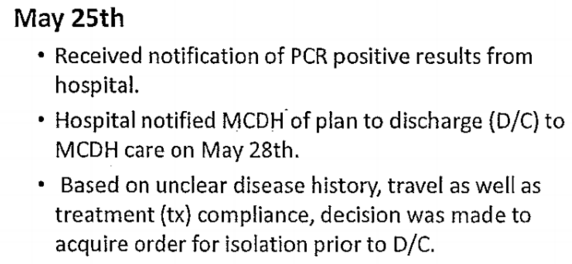
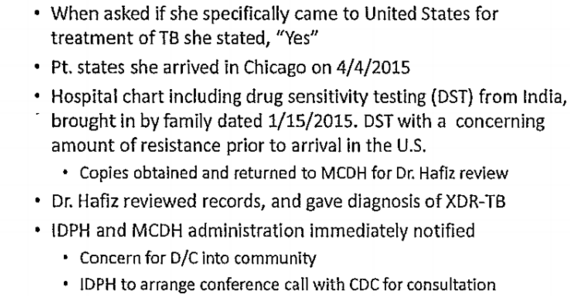
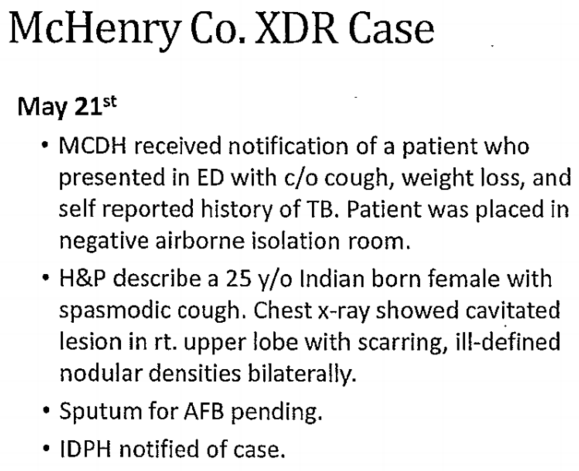
McHenry County’s Health Department dealt with a case of drug resistant tuberculosis of nationwide significance in May and June.

How important was it?

The New York Times wrote a big story about it entitled, “Indian Woman Being Treated in U.S. for Drug-Resistant Tuberculosis.

Susan Karras

Susan Karras

Quoted was Susan Karras, the Health Department’s Communicable Disease Coordinator.

A woman recently from India via Missouri and Tennessee sought medical help from a local hospital.

When diagnosed with tuberculosis, the Health Department arranged for her medical care to be provided by a National Institutes of Health hospital near Washington.

Federal taxpayers foot the bill there, according to Anthony Fauci, head of the agency, “Everything is free at the N.I.H.  No one pays,” the New York Times reported.

Karras told me that the County paid to fly her to the National Institute of Health facility in Bethesda, Maryland.

The air ambulance cost $12,000.

McHenry County Health Department Director Michael Hill explained what happened:

Mike Hill

Mike Hill

Because we were able to get this patient to NIH (this involved going all the way to the President’s office [by the CDC]) the direct costs to us were minimized.

I was able to get the air transport done for $12,000 (quotes ranged up to $35,000 from the few companies who were willing to do it).

I can’t complain about the federal government in this case since the patient’s treatment by NIH probably will end up in the hundreds of thousands of dollars, and the feds took on that expense.

If the county had to absorb the cost of this patient’s treatment, it would have been financially crippling for the TB program.

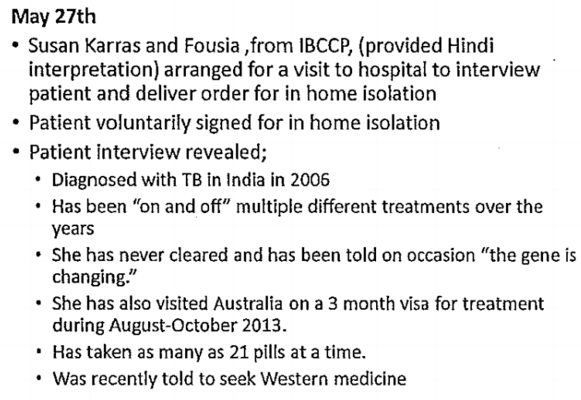
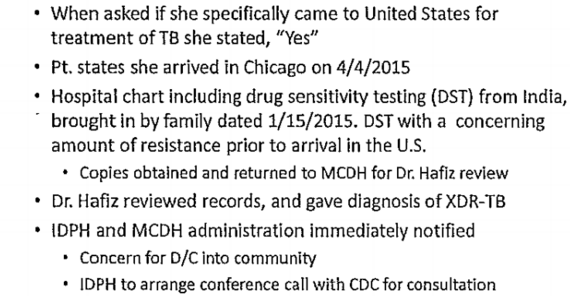
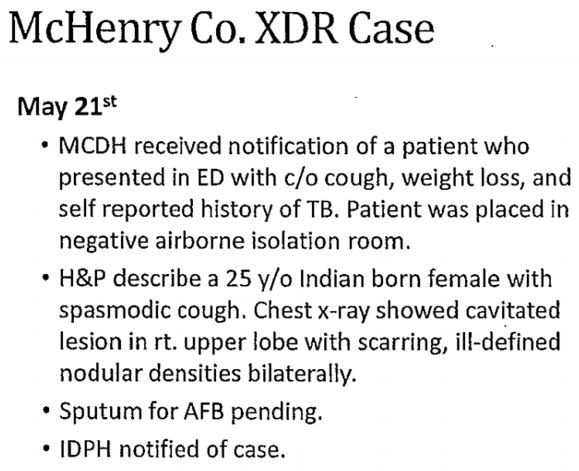
Below is the summary of the case that caught my attention.
TB11

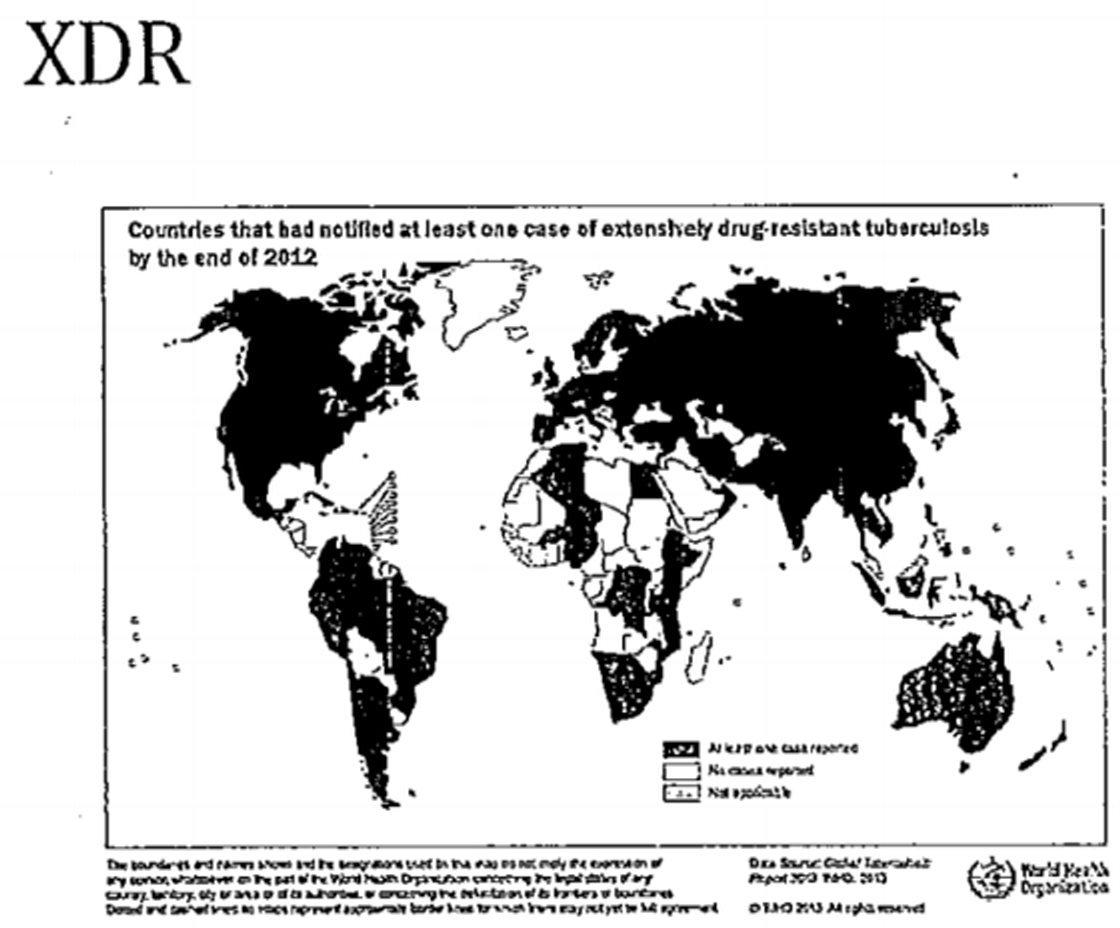
Spread of the type of tuberculosis treated in McHenry this summer.
Spread of the type of tuberculosis treated in McHenry this summer.
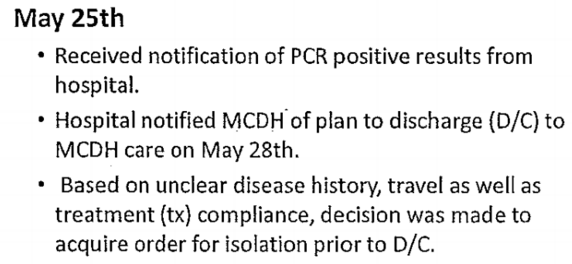
TB1TB2TB3TB4


Additional Daily Reports are available at:  http://mchenrycountyblog.com/2015/11/25/mchenry-county-center-of-dangerous-tb-case/


On June 5th, the Health Department sent out the following press release on the matter:

Health Department reports case of extensively drug-resistant tuberculosis

Woodstock Ill. — McHenry County Department of Health (MCDH) reports that on April 4 an individual from India infected with an extensively drug-resistant form of Tuberculosis, also known as XDR-TB, entered the United States and then traveled to other states.

On May 18, this individual visited family in McHenry County and, during this visit, sought treatment.

The patient has since been transferred out of state for care. Individuals who were in close contact with the patient have been interviewed and are being monitored.

Tuberculosis is not easily transmissible and XDR-TB, in particular, is also rare.

XDR-TB is a form of TB which is resistant to many of the most powerful anti-TB drugs.

According to the World Health Organization, developing XDR-TB is usually a sign of an active TB patient receiving inadequate clinical care or when a patient doesn’t receive the proper information, counseling and material support to complete their full course of treatment.

Tuberculosis is spread through the air by an infected person when coughing and sneezing.

People who are nearby may breathe in the TB bacteria and become infected.

TB is not spread by shaking someone’s hand, sharing food or drink, touching bed linens or toilet seats, sharing toothbrushes or kissing.

This is the first time MCDH has identified a case of XDR-TB in the County.

MCDH works closely with the Centers for Disease Control and Prevention, the Illinois Department of Public Health and local public health partners through its surveillance system to identify and monitor reportable infectious diseases in McHenry County.

In 2014, five active cases of TB (not XDR-TB) and 57 people with latent, non-infectious TB were treated.

MCDH’s Tuberculosis Clinic, located in Woodstock, provides chest x-rays, diagnostic studies, laboratory services and medication to any McHenry County resident in addition to outreach to those populations at high risk for developing TB.

If you think you have been exposed to someone with TB, contact your health care provider or MCDH to see if you should be tested. For more information on TB, call MCDH’s Communicable Disease Program at 815-334-4500

Posted in CDC, Centers for Disease Control, Contact Tracing, Illinois, McHenry County, McHenry County Health Department, Mike Hill, Susan Karras, TB Board, TB District, XDR-TB | 9 Replies


Above items are from: http://mchenrycountyblog.com/2015/11/25/mchenry-county-center-of-dangerous-tb-case/



image

image


By DENISE GRADYJUNE 9, 2015

Inside

    Photo

    Susan Karras, the communicable disease coordinator for McHenry County, outside Chicago, where a TB patient visited. Credit Steve Kagan for The New York Times


    In the latest incident, a woman with TB flew from India to O’Hare International Airport in Chicago, landing on April 4. She traveled by car to visit relatives in Illinois, Tennessee and Missouri before seeking medical care sometime after May 18 at a hospital in Illinois. Tests there detected extensively drug-resistant tuberculosis, or XDR-TB. Doctors notified the state health department and the Centers for Disease Control and Prevention. The arduous task of contact tracing began in the three states.

    Health officials say the risk to the public is low. TB is nowhere near as contagious as the flu or measles. But people who had long periods of close contact with the patient, like the relatives with whom she stayed, are at risk.

    For people who were on the flight with the woman from India, the odds of catching TB are low but not zero. Cases have occurred in passengers on a long flight who sat near someone in advanced stages of the disease. In this case, the C.D.C. said, it will obtain the flight manifest for the woman’s trip from India and notify passengers who may have been exposed. An agency spokesman declined to reveal the airline or flight number.

    Visitors from other countries are not screened for TB when they arrive, but those applying for legal residency are required to have TB tests, according to the C.D.C. Even if the government wanted to screen arriving passengers, it would be difficult, because there is no rapid test for tuberculosis.

    On Friday, the patient from India was transferred to the National Institutes of Health in Bethesda, Md. In the past two decades, the N.I.H. has treated about 20 patients with drug-resistant TB, the most recent a year or so ago, according to Dr. Anthony S. Fauci, the head of the National Institute of Allergy and Infectious Diseases. Most came from other countries.

    “Our track record has been good,” Dr. Fauci said, adding that about 80 percent were cured. That success rate is higher than the figures usually cited — 30 percent to 50 percent cured — because the lower estimates include results from poorer countries that have less access to drugs and other resources.

    “This person is looking at a very long course of careful treatment and observation,” Dr. Fauci said.

    Globally, nine million people contracted TB in 2013, and one and a half million died from it, according to the World Health Organization. Nearly a quarter of all the cases occurred in India, which has the world’s largest epidemic.

    Over all, drug-resistant bacteria cause only about 5 percent of all cases, and XDR bacteria are a small subset of that group, causing about 48,000 cases in 2013. But XDR-TB has shown up in 100 countries, and it can be deadly, particularly in countries with weak health care systems.

    So far, 12 people who had contact with the woman in Illinois have been identified, according to Susan Karras, the communicable disease coordinator for McHenry County, northwest of Chicago, the part of Illinois the patient visited. They were traced in 15 to 20 hours of interviews with the patient and her family at the hospital and by phone.

    Some have had TB tests, but Ms. Karras declined to reveal whether any were positive. People whose initial results were negative will be tested again in about eight to 10 weeks, because the infection does not always show up on early tests.

    Spokesmen for the Tennessee and Missouri health departments said contacts were being traced in those states, but did not provide any details.

    Anyone who is infected will be treated, Ms. Karras said. In many people, TB can be latent, meaning that their immune systems keep the infection in check so they are not sick or contagious. But latent disease can become active. So even people with the latent form of the disease will be treated with whatever mix of potent drugs it takes to kill this particular strain of XDR-TB, she said.

    “We want to treat it before it becomes infectious,” Ms. Karras said. “That’s why we want to find them.”

    The woman from India is in isolation in a hospital at the N.I.H., Dr. Fauci said. She has no contact with other patients, and doctors and nurses who treat her must wear gloves, gowns, eye protection and specially fitted masks called N-95 respirators. Even though they take every precaution, health workers who treat TB patients are usually tested for the disease once a year, Dr. Fauci said.

    At the N.I.H., patients with this kind of TB are usually kept in the hospital for weeks or even months, until sputum tests no longer find the bacteria, indicating that the disease is not contagious anymore, Dr. Fauci said.

    Standard TB usually requires treatment with four drugs, which can take six to nine months. Treating XDR-TB takes longer, sometimes a year or more, and requires more drugs.

    The drugs have unpleasant side effects that are hard to tolerate, Dr. Fauci said. They cause nausea, weakness and other problems that make patients want to quit taking them before the full course is finished. But missing doses and quitting too soon are precisely what cause drug-resistant bacteria to develop — requiring even longer treatment with more drugs and nastier side effects.

    Sometimes in severe cases, surgery is needed to remove diseased and scarred parts of the lung harboring bacteria that the drugs cannot reach.

    The patient will not be charged for her treatment. Even if patients are citizens of other countries, Dr. Fauci said, their governments are not billed.

    “Everything is free at the N.I.H.,” he said. “No one pays.”

    Dr. Fauci said that the woman’s treatment would be expensive, given the long stay and costly drugs needed, but that he could not even begin to estimate the ultimate cost.

    Above is a from: http://www.nytimes.com/2015/06/10/health/indian-woman-being-treated-in-us-for-drug-resistant-tuberculosis.html?_r=2

    Tuesday, November 17, 2015

    McHenry County's Algonquin Township subject to tax protest suit


    Are any of Boone County’s townships/other governmental units this rich with cash? 

    Will be interesting to see how this court case is decided.

    Note other McHenry County taxing districts are involved in separate suits.  Of the cases, Algonquin Township suit appears to have the greatest disparity between cash investments and annual tax levy.

    The articles on the tax protests are from Cal Skinner’s McHenry County Blog.


    image

    Algonquin Township’s Tax Protest Suit

    Posted on 11/17/2015 by Cal Skinner

    November 17, 2015

    Tax protest attorney Tim Dwyer is suing Algonquin Township on behalf of local property taxpayers for having too much money in the bank to justify levying real estate taxes
    .
    Here are the details:

    In December 2014, Algonquin Township adopted its Tax Levy Ordinance.
    The Township levy was for $1,800,368.00.
    The Road District levy was for $4,048,930.00.
    Although the Township and the Township Road District are separate entities for purposes of its tax levy, the Township audit incorporates both entities.
    After Algonquin Township and the Algonquin Road District issued its levies in December of 2014, the last audit for both entities found that at the end of the 2013-14 fiscal year, the Township had $11,711,449 in cash and investments.
    Prior to issuing its levies, the Township and the Township Road District had a three year average annual expenditure of $4,545,760, according to its own internal audits.
    As of its last fiscal year or March 31, 2014, the Township and the Road District had assets of $11,711,225, according to its 2013-14 comprehensive audit.
    The assets on hand, coupled with the tax revenue from its 2014 levy, puts the Township and the Road District having in excess of 15 million dollars, or three times the available funds for that which is necessary for its annual expenses.
    Spending approximately 4.5 million dollars per year, the Township and the Road District had ample funds in order to meet their respective annual expenses without even imposing a levy.
    According to its own audit, the Township, collectively, had investments of $4,356,863, which was almost as much as its three year annual expenditures.
    This remains a violation of Illinois law, rendering both levies as excessive, invalid and illegal.
    According to its own 2014 audit, prior to its levy for the Town Fund of $1,578,536, the Township had $3,166,393 in liquid assets for the Town Fund.
    The $3,166,393, coupled with the levy of $1,578,536 exceeds 2.6 times the annual average expenditure of 1.8 million. 155. As such, the Town levy issued by the Township is invalid, excessive and illegal.
    The same is true for the General Assistance Fund.
    With respect to the Road Distict, the Road and Bridge Fund, coupled with the Equipment and Building Fund, the Road District had reserves in excess of $5,400,000.
    The annual expenses for both of these Funds were approximately 2.4 million.
    The tax levy revenue, coupled with the existing funds on hand, was nearly three times the amount of the annual expenditure. 

    Algonquin Township
    As such, the Road and Bridge Fund, as well as the Equipment and Building Fund, are excessive, invalid and illegal.
    In addition to the excess accumulation, the Road District levied funds in excess of that which was appropriated.
    It is well settled in Illinois, that a municipal entity can only spend that which has been legitimately appropriated. In other words, the Levy Ordinance cannot exceed those line items delineated within the Budget and Appropriation Ordinance.
    For its General Road Fund, the Road District appropriated $2,388,600, but levied for $2,576,076.
    As a matter of law, the General Road Fund is void.
    For its Social Security Fund, the Road District appropriated $70,000, but levied $71,068.
    For its IMRF Fund, the Road District appropriated $100,000, but levied $129,890.
    Similar to the General Road Fund, the levy for the aforesaid funds are void and illegal, and should be ordered rebated as a matter of law.
    Here’s what the suit requests:
    WHEREFORE, Plaintiff Tax Protestors pray that this Court consider the matters raised herein,
    find, determine and otherwise adjudicate that the entire levies adopted by Algonquin Township and the
    Algonquin Road District are illegal, void and/or excessive as a matter of law, order that the McHenry
    County Treasurer issue full rebate payments to the Tax Objectors, award statutory interest pursuant to
    35 ILCS 200/23-20, et. seq. and issue whatever further relief this Court deems just and appropriate
    .
    Last year at the initiative of newly-elected Trustee Larry Emery, the Town Fund levy was reduced 1%.

    The above is from: http://mchenrycountyblog.com/2015/11/17/algonquin-townships-tax-protest-suit/

    There are additional tax protest suits in McHenry County.  See Cal Skinner’s other McHenry County Blog articles shown below:

    http://mchenrycountyblog.com/2015/11/13/tax-protest-suit-against-mchenry-county-harrison-school-cl-grade-high-school-plus-mchenry-township/

    http://mchenrycountyblog.com/2015/11/14/tax-protest-suit-against-wonder-lakes-harrison-grade-school/

    http://mchenrycountyblog.com/2015/11/15/cl-district-47s-tax-protest-suit/

    Thursday, August 27, 2015

    McHenry County Board is told how to consolidate townships

    Cal Skinner has recently blogged the legal opinion which McHenry County Board received from their States Attorney on the matter. 

    If anyone is interesting in the process of changing/abolishing townships GO TO: http://mchenrycountyblog.com/2015/08/26/states-attorneys-opinion-on-township-consolidation/  Shown below is the page previously referenced.

    image

    Tuesday, April 21, 2015

    Our View: Township consolidation is a small but key step | Northwest Herald

    image

    As the McHenry County Board closely examines whether to put a referendum question on the ballot on consolidating the county’s townships from 17 to 8, it’s important to look at the big picture.


  • With about 7,000 taxing bodies, Illinois leads the nation in the number of line items that show up on our property tax bills. Coincidentally, Illinois has the second highest property taxes in the United States behind New Jersey.
  • These facts can’t only be coincidences. Would consolidating units of government save money and reduce property taxes? Unless it is done with breathtaking incompetence, it’s difficult to see how it could not.

    Regardless of which agency performs them, government services need to be performed. Students need an education, roads need to be maintained, police and firefighters are needed to provide safety, and the list goes on.

    It’s also important that some local control be maintained in making the decisions that affect the residents in those communities. Decisions made on behalf of Chicago residents are different than decisions made for McHenry residents. This is one of the major arguments against consolidation.

    But the benefits of local control are diluted when residents have so many different taxing bodies governing them that they’re left dizzy keeping track of who’s in charge. In many cases, it’s different people controlling their village, their parks, their libraries, their fire districts, their townships, their county, etc.

    By spreading the accountability so widely, it removes accountability. Taxpayers are left barely knowing who is taxing them and for what.

    And each one of those taxing bodies, in addition to serving residents, serves its own interests. They provide jobs and often pensions. The more vital the services they provide, the easier it is to justify their need for more employees, more tax dollars.

    Consolidating townships is the tip of the iceberg of bloated government that’s flattened Illinois’ economy, leaving a mountain of debt just as the glaciers flattened the Illinois landscape, leaving the Great Lakes behind.

    But Illinois needs to start somewhere, and it needs to do so fearlessly and without regard to the hundreds of tiny fiefdoms who are fighting for self preservation. It must do so wisely in the interest of taxpayers and the economy, not merely in the interest of political philosophy.

    McHenry County Board Chairman Joseph Gottemoeller has appropriately asked the McHenry County State’s Attorney’s Office to review the law and guide the board on what it might consider to put as a question to voters.

  • Common sense tells us government consolidation has to be part of the solution for turning Illinois around for the better. But those steps need to be taken much faster than the pace of a glacier.

  •  

  • Our View: Township consolidation is a small but key step | Northwest Herald

    Friday, April 17, 2015

    Feds Target Corruption at Pace - Patronage & Contractor Kickbacks - McHenry County Blog

    Very interesting article from Cal Skinner regarding the RTA and PACE buses.


    image

    Read all of the article by clicking on the following:  Feds Taget Corruption at Pace - Patronage & Contractor Kickbacks - McHenry County Blog

    Tuesday, March 31, 2015

    Citizens wish to reduce townships from 17 to 8 in McHenry County

    The organization currently only has a one page website on which donations are taken.  SEE:  http://www.mcc4tc.org/


    image

    Cal Skinner’s McHenry County Blog has a good summary of the proposal.

    image


    “….A press release from Nunda Township Trustee and Nunda Township Republican Central Committee Chairman Mike Shorten:

    Township Consolidation Initiative Launched Citizen Lead Effort to Reduce Government Units in McHenry County

    Crystal Lake, IL March 31, 2015 — The McHenry County Citizens for Township Consolidation (MCCTC) announced plans today to pursue an initiative to reduce the number of Townships in McHenry County through consolidation via a binding referendum in the March 15, 2016 primary.”

    ….”This could be accomplished through petition, which would mean gathering 10,000 signatures, or by having the McHenry County Board place a referendum on the ballot.

    Organizers are looking at the March, 2016, primary election date so township governments would have about a year to figure out details. The next township elections would occur in the spring of 2017.

    Voters in any township could vote down the referendum.  If a township’s residents did so, there would be no change in their township government.

    Township populations in 2010 were as follows:

    • Algonquin – 88,389
    • Grafton – 53,137
    • McHenry – 47,653
    • Nunda – 38,245
    • Dorr – 20,911
    • Greenwood – 13,990
    • Chemung – 9,134
    • Marengo – 7,564
    • Richmond – 6,683
    • Burton – 5,003
    • Coral – 3,552
    • Seneca – 2,994
    • Riley – 2,922
    • Dunham – 2,844
    • Hebron – 2,356
    • Hartland – 2,031
    • Alden – 1,402

    To read all this article go to:  http://mchenrycountyblog.com/2015/03/31/effort-to-combine-townships-announced/

    Saturday, February 28, 2015

    Bloggers in McHenry County asking many questions regarding a motorcycle

    This mink-condition 2012 police motorcycle showed up on the Harley-Davis, Woodstock website.  And then disappeared when questions were being asked by blogger—McHenry County Secrets--http://www.mchenrycountysecrets.com/  

    In case you cannot make out the lettering; it says: “McHenry County Conservation District POLICE”.  And the vehicle has seven miles on the odometer. Did this ever belong to this governmental agency?  If so, why was it never used?


    image


    It is pretty certain that this story is not over with. Keep turned to:  http://www.mchenrycountysecrets.com/ (shown below)   or Cal Skinner’s McHenry County Blog:  http://mchenrycountyblog.com/  (also shown below).

    image


    image

    Friday, February 27, 2015

    Former McHenry County Coroner Indicted in Bizarre Baby Remains Coverup | Huntley, IL Patch

    image

    Former McHenry County Coroner Indicted in Bizarre Baby Remains Coverup

    Marlene Lantz failed to dispose of an infant's body properly for many, many years, prosecutors allege.

    By Dennis Robaugh (Patch National Staff) February 27, 2015 at 10:00am


    McHenry County’s former coroner held onto the remains of dead baby for two decades and then lied and falsified forms to cover up her actions, according to an indictment unveiled Thursday.

    Marlene Lantz, who served for 24 years, was arrested and posted a $1,000 bond Thursday. She faces two felony counts of official misconduct and one felony count of forgery.

    Reports the Northwest Herald:

    According to the indictment, from March 13, 1992, until Lantz left office on Nov. 30, 2012, she failed to dispose of the body of “Baby Reinert,” also known as “Baby Doe.” As part of her official duties, Lantz should have buried the remains, cremated them or donated them to science, the indictment says.

    The indictment also says Lantz signed a death certificate saying the baby was buried and that the identity of the mother was unknown, and she did so knowing that such information was false.

    Lantz served from 1988 to 2012. Why she may have done this as yet is unclear. Authorities are not discussing the evidence.

    Above is taken from:  Former McHenry County Coroner Indicted in Bizarre Baby Remains Coverup | Huntley, IL Patch


    The actual indictment papers are  available at Cal Skinner’s McHenry County Blog at:  http://mchenrycountyblog.com/2015/02/27/lantz-indictment/


    McHenry County Secrets  says:

    Lantz held the death “Inquest” into the now deceased former Metro Board member Phil Pagano’s death in absolute record time. Why? What was the hurry?

    Why did Lantz “hide” the recently found child’s body for over fifteen years? Then, lie about its disposal?

    image

    Above is from:  http://www.mchenrycountysecrets.com/keith-nygren/former-mchenry-county-coroner-marlene-lantz-i-n-d-i-c-t-e-d/

    Tuesday, December 30, 2014

    McHenry County questions jail-rental program - News - Journal Star - Peoria, IL

    Note to readers:  Boone County earlier this year signed a $85 per day agreement with the Federal Marshall Program-- that contact was negotiated with the help of an expensive consultant.  See that story at:  http://boonecountywatchdog.blogspot.com/2013/12/boone-county-risks-20k-to-generate.htmlBy the Associated Press

  • Journal Star

    By the Associated Press

    Posted Dec. 28, 2014 @ 5:00 pm

    By the Associated Press
    Posted Dec. 28, 2014 @ 5:00 pm

  • WOODSTOCK, Ill. — A jail-rental program with the federal government that has produced more than $73 million in the past decade has some McHenry County officials nonetheless wondering if it is worth it.
  • The (Crystal Lake) Northwest Herald reports (http://bit.ly/1Aco4SX) that county taxpayers have subsidized the initiative to temporarily house detainees of the U.S. Marshals Service and Immigration and Customs Enforcement.
    They question whether the agreement should be renewed when it expires at the end of 2015.
    At issue is the $85-a-day per-bed rate, which hasn't changed since 2008. A lobbyist hired by the county in 2013 found the county's cost is $131 daily. But that report has been criticized as oversimplified.
    County Administrator Peter Austin claims the cost varies. He contends that while there are fixed costs to providing the jail, which the county must do by state law, the population varies, changing the daily inmate cost.
    "We have to turn the oven on whether we're making 200 biscuits or 400 biscuits," Austin said.
    The county has asked for an increase from its federal partners. The Marshals Service agreed to a $10-a-day increase — and then pulled its detainees the next day. Federal authorities note that other facilities in the Chicago area charge less — Dodge County, Wisconsin, has a $60-a-day rate.
    ICE uses the McHenry County lockup to a greater degree than the Marshals Service did. In 2012, for example, the average daily ICE population was 241 compared to 45 in the Marshals' custody. But the county has felt additional financial pressure as the overall population has dropped from an average of 350 a day in 2011 to 180 daily this year, not counting December.
    A consultant the county hired in the spring of 2013 plugged the county's costs into a federal reimbursement formula and determined the county was paying $131 per day to house the inmates.
    That outraged some officeholders.
    "We're talking between $40 and $50 million over a seven-year period," county board member Donna Kurtz said. "This never should have happened."
    Information from: The Northwest Herald, http://www.nwherald.com
  • Above is from:  McHenry County questions jail-rental program - News - Journal Star - Peoria, IL


    This problem has been a concern of some McHenry County board members for months.  SEE the First Electric Newspaper article of March 5, 2014 (http://www.firstelectricnewspaper.com/2014/03/county-board-members-ask-for-real-costs.html)

    image


    Wednesday, March 5, 2014

    County Board Members Ask For Real Costs At McHenry County Jail


    Controversy building behind the scenes for the past month about the cost of housing federal inmates at the McHenry County Jail finally broke out in public complaints at Tuesday's McHenry County Board meeting.  Administrator Peter Austin announced hopes the County will get more money per prisoner, at least for some prisoners, "within 30 days" but members complained bitterly that they're being kept in the dark about what it really costs to house one.
    Finance Committee Vice Chairman Donna Kurtz charged that, using the only numbers available, McHenry County's lost $30 milllion keeping federal prisoners in McHenry County Jail since 2008.  "This isn't beanbag," she said.  "We're talking real money."
    The problem, as Austin laid it out, is that the County houses a lot of federal prisoners for U.S. Immigration and Customs Enforcement and the U.S. Marshall's Service but the rate of payment hasn't gone up in six years.  The County's been trying to boost it since July of 2012 but without success, even after hiring a $60,000 expert who said he'd have a new contract in the bag by last July 31.  Austin, returned Monday from a trip to Washington,  said ICE still wasn't talking but that he'd secured an "oral agreement" with the Marshall's office, yet to be confirmed,  that he estimated would bring in another $1 million.
    Former head of the Board's Justice Committee, Nick Provenzano, complained that was all very well but not much help if Members didn't know how much it cost the County to house prisoners in the first place.  Referring to an $85 per-day figure provided by consultant Joseph Summerill last year,  Provenzano asked, "Are they accurate or are they not accurate?"
    "They're not accurate," replied Austin who hastened to say that the way federal officials figure prisoner costs isn't the same as the way the County figures them.  Austin said Summerill's Jail costs were more suggestive than definitive when he was trying to convince the Board to hire him..
    "It was not presented to us as an illustration in a sales brochure," complained Member John Hammerand.  "It's infuriating to me."
    Kurtz charged Summerill's numbers were sold to the Board as authoritative.  "Sheriff Nygren, Undersheriff Zinke and [Sheriff's Business Manager] Angela [Wood-Zuzevich] all nodded their heads," she said.  "I trust Sheriff Nygren when he said he was behind the numbers."
    But if the Summerill numbers are no good, what are the real ones, inquired Member Paula Yensen?  "Many of us have been asking for that information," she complained.
    FEN's been trying to find out, too., filing a Freedom of Information Act request last month for the federally-required Jail Operating Expense Information report McHenry County had to submit for the latest round of negotiations.  It lists 43 different kinds of Jail expenditures that the U.S. Department of Justice considers at least theoretically allowable in setting bed-rental rates.  In fact, FEN filed two requests since it wasn't clear who had the report and Summerill didn't reply to inquiries.  The one to McHenry County Administration was turned down on the premise the report was among "proposals and bids for any contract" and "preliminary drafts, notes, recommendations and memoranda",  both of which are exempt from disclosure.  The one to the Sheriff's Office was answered, eventually, with what appeared to be a standard printout of how close last year's Jail budget came to actual expenditures.  (Answer: pretty close.)
    Austin told the County Board other newspapers have been inquiring about Jail costs, too, but said, "I'm not going to negotiate in public."

    Sunday, October 5, 2014

    Should Restaurant Sanitation Ratings be published?


    Well based upon a recent posting from Cal Skinner’s McHenry County Blog--it appears that McHenry County is moving in that direction.

    image

    Click on the embolden title to read all of Cal Skinner’s posting.

    CL Restaurant Sanitation Ratings – The Pizza Place – X-Treme Wheels

    Posted on 09/29/2014 by Cal Skinner

    14

    Health Dept restaurant rating KY Waffle House

    Could a sign like this be coming to restaurants in McHenry County?

    Restaurant customers may be on the verge of being able to figure out how clean their favorite establishment is.

    The Public Health Committee of the McHenry County Board discussed making the Health Department’s quarterly inspections much more friendly to those who eat out.

    A solid majority on the committee–Donna Kurtz, John Hammerand and Paula Yensen–were in favor of more transparency.

    Mary McCann and Anna May Miller did not agree.

    Over the last four days, the rankings for Crystal Lake zip code restaurants have been published in McHenry County Blog.

    Today, you can read the results for those restaurants in the last part of the alphabet.

    Restaurant ratings CL 9-14 5

    Here are some more of Cal’s posting on the issue: 

    CL Restaurant Sanitation Ratings – The Pizza Place – X-Treme Wheels

    Posted on 09/29/2014 by Cal Skinner

    14

    Restaurant customers may be on the verge of being able to figure out how clean their favorite establishment is. The Public Health Committee of the McHenry County Board discussed making the Health Department’s quarterly inspections much more friendly to those … Continue reading →

    Posted in Crystal Lake, McHenry County Board., McHenry County Department of Public Health, McHenry County Public Health Department, Ranking, Rating, Restaurant, Sanitation | 14 Replies

    CL Restaurant Sanitation Ratings – Portarelli’s – The Morning Grind

    Posted on 09/28/2014 by Cal Skinner

    3

    At its last meeting the McHenry County Board’s Public Health Committee looked favorably on more transparency concerning sanitation reports of area restaurants. The Committee split four to two with Chairwoman Donna Kurtz, John Hammerand and Paula Yensen coming down on … Continue reading →

    Posted in Crystal Lake, McHenry County Board., McHenry County Public Aid Committee, McHenry County Public Health Department, Ranking, Rating, Sanitation | 3 Replies

    Rating CL Restaurants on Cleanliness – Kumi Sishi – Pizza Hut

    Posted on 09/27/2014 by Cal Skinner

    4

    This is page three of the spreadsheet of sanitation rankings of Crystal Lake restaurants. The most recent inspection and the one before it have been listed by the McHenry County Department of Public Health. Making the results of these inspection … Continue reading →

    Posted in Crystal Lake, McHenry County Board., McHenry County Department of Public Health, Ranking, Rating, Restaurant | 4 Replies

    Crystal Lake Restaurant Sanitation Ratings – CL Country Club – Krystal Thai

    Posted on 09/26/2014 by Cal Skinner

    Reply

    Yesterday I wrote of the McHenry County Board’s Public Health Committee having given a thumbs up to posting sanitation reports for restaurants. Donna Kurtz, John Hammerand and Paula Yensen were in favor. Mary McCann and Anna May Miller were opposed. … Continue reading →

    Posted in Crystal Lake, McHenry County Board of Health, McHenry County Board., Ranking, Rating, Resturant | Leave a reply

    Telling Customers Cleanliness of Restaurants, CL Ratings 1776 – Crystal Brewing

    Posted on 09/25/2014 by Cal Skinner

    5

    Led by McHenry County Board members Donna Kurtz, John Hammerand and Paula Yensen, the Public Health Committee supported having restaurant inspections made more public than they are now. Opposing the proposal were Mary McCann and Anna May Miller. You may … Continue reading →

    Posted in Crystal Lake, McHenry County Board., McHenry County Health Department, Ranking, Rating, Resturant, Sanitation | 5 Replies

    Rating Restaurants

    Posted on 08/12/2014 by Cal Skinner

    6

    The McHenry County Health Department inspects restaurants. I’m (Cal Skinner) told that the minimum passing grade is 70% and some restaurants are satisfied with ratings that barely pass. But, as a consumer, you wouldn’t know about that. The information is available through … Continue reading →

    Posted in Grade, Inspection, Kentucky, McHenry County Board of Health, Restaurant, Sanitation, Score | 6 Replies

    Sunday, September 14, 2014

    Oakwood Hills president resigns amid power plant controversy


    Stacey Wescott, Chicago Tribune

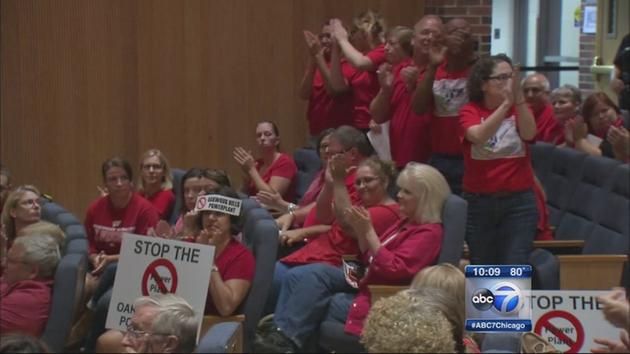
    Many residents of Oakwood Hills oppose a plan for a power plant in the area, saying the proposal caught them off guard.

    Many residents of Oakwood Hills oppose a plan for a power plant in the area, saying the proposal caught them off guard. (Stacey Wescott, Chicago Tribune)

    By Robert McCoppin, Tribune reporter

    The village president of Oakwood Hills has resigned in response to outrage over a proposal she helped negotiate for a power plant.

    President Melanie Funk resigned Wednesday in a letter, writing, "I no longer feel that I can continue to take the abuse that I have been subject to over these last few months."

    The $450 million power plant proposed by Enventure Partners sparked protests by hundreds of people at meetings on the subject in July. Residents are concerned about the plant's potential effects on pollution, noise, water use and property values. The proposed plant would be built about a half-mile from homes and across the street from a grade school.

    Village officials shut down village hall for the month of August after they said someone made a threat against public officials over the plant, though they said they had no documentation of a threat.

    Village Trustee Beth Gorr and Village Attorney John Cowlin also resigned, Village Clerk Melissa Goldman confirmed.

    Trustee Paul Smith, who was president pro tempore, becomes acting president, Goldman said. That opens up two trustee positions for election next April

    Read more of the article by clicking on the following:  http://www.chicagotribune.com/news/local/breaking/chi-oakwood-hills-president-resigns-amid-power-plant-controversy-20140911-story.html

    Here is the Village’s view of the zoning issue:

    image

    Energy Center Information

    Upcoming The next Zoning Board Hearing will take place on October 9, 2014 at the Holiday Inn; the time will be posted soon.

    Done The Open House will be on Tuesday, July 22, 2014 from 4:00 PM until 8:00 PM at the HOLIDAY INN Conference Room in Crystal Lake.

    DoneThe Zoning Board Hearing will be on Thursday, July 24, 2014 beginning at 6:30 PM at the HOLIDAY INN Conference Room in Crystal Lake.

    DoneThe additional Zoning Meeting will be held on Thursday, July 31, 2014 beginning at 6:30 PM at the HOLIDAY INN Conference Room in Crystal Lake.

    It is apparent from the responses of the public at the zoning hearings on July 24th and 31st regarding the zoning petition that there was a lack of understanding of the process before the Zoning Board and a need for clarification of the process that the Zoning Board is required to follow in considering the Petitioners’ request.

    The Zoning Ordinance of Oakwood Hills provides that anyone who is seeking approval for variations, amendments or other zoning requests from the provisions stated in the Oakwood Hills Zoning Ordinance must follow the procedures outlined in the Ordinance.

    Once a Petitioner submits a Petition the Zoning Ordinance requires that a hearing be set up not less than 15 nor more than 30 days from the time the notice of hearing is published in the Northwest Herald and is given to the taxpayers of record that abut the property for which the request is made. The initial date and time for the hearing is strictly controlled by when the Petitioner files the notice of hearing set forth in the ordinance.

    The hearing held on the Petition filed is a public hearing. It is a process to allow the Petitioner to present its case for what is being requested. As a public hearing, it is also to in favor of Petitioner’s proposal. At the conclusion of the public presentation, the public presentation is closed then the Petitioner has the obligation to respond to the questions and comments raised by the public.

    Once the Petitioner has concluded its responses to the questions and/or comments from the public, it is then the Zoning Board members time to raise any questions or concerns that they may have regarding the Petition to the Petitioner. The hearing is over when the Zoning Board members have concluded their questions of the Petitioner. After the conclusion of the meeting, the Zoning board may postpone its vote only once to a future meeting unless a further delay is obtained with the approval of the Petitioner.

    The original schedule of meetings listed a meeting on July 24th from 6:30 p.m. to 10:30 p.m. with an additional meeting, if needed, for July 31st at the same times to allow everyone interested in the proposal to be present and speak. On July 24th, the Zoning Board continued the meeting to July 31st as there were members of the public that had not had the opportunity to speak or make a presentation to the Board. The public was informed that they would also be given an opportunity on the 31st to sign in if they did not do so on the 24th.

    The Zoning Board received a Motion for a Continuance of the Hearing to October 9th to allow the Petitioner to obtain new counsel and consider the statements made by the public at the meeting on July 24th. The Petitioners were within their rights in making the request and the decision of the Zoning Board approved their request which effectively brought the meeting to an end on July 31st. At the meeting on the 31st, someone shouted, “Why don’t you just vote no now.” As I have outlined, the Zoning Board is required to follow the rules established by the Zoning Ordinance of the Village, which are not unique to the Village.

    The Zoning Board is committed to follow the procedures established in order that both the Petitioners and public are provided due process as required in the hearing process. When the hearing reconvenes on October 9th the meeting is at the public presentation stage of the proceedings. Those members of the public who have not had an opportunity to speak will be given that opportunity. With the large number of public that has shown an interest in speaking, everyone will be given that opportunity and, if necessary, additional meetings will be held until the hearings are brought to a conclusion.


    See earlier post:  http://boonecountywatchdog.blogspot.com/2014/09/oakwood-hills-residents-voice-concern.html

    Friday, September 5, 2014

    Oakwood Hills residents voice concern over proposed power plant


    Bill is a former resident of the Oakwood Hills area.  And he thought this story would interest some blog followers.  To some degree it is a “not in my backyard” story but openness and transparency is what is being demanded by these citizens. That is a demand of local politics across the nation and the reason for the Illinois Open Meetings Act.

    image

    Oakwood Hills residents voice concern over proposed power plant

    More than 120 citizens showed up at a village meeting, concerned that a $450 million power plant will be built in Oakwood Hills.

    SEE the film clip by clicking on the following: http://abc7chicago.com/news/oakwood-hills-residents-voice-concern-over-proposed-power-plant-/295615/

    By Stacey Baca

    Thursday, September 04, 2014

    OAKWOOD HILLS, Ill. (WLS) --

    A controversial plan over a proposed power plant closed down Oakwood Hills' village government last month. On Thursday night, a village meeting had to be moved to Crystal Lake to a location big enough to handle the crowd.
    Oakwood Hills is a village in McHenry County with just 2,000 people. More than 120 citizens showed up at the meeting, concerned that a $450 million power plant will be built in their community.
    "We are not a bunch of thugs, bullies, liars and gossips - as we have been referred to - but are concerned residents of Oakwood Hills," said Rosie Riley, resident.
    Although it's not on Thursday night's agenda, residents are concerned that the village will approve plans to build a massive power plant in this field. Transparency is an issue.
    "Have you folks met? Have you met in secret? What have you done - created a police state for us?" said Regina Narusis, resident.
    The issue has been so contentious that the village hall was shut down for nearly a month after board members reportedly received threats - an issue the police chief declined to talk about Thursday.
    But the police presence was obvious as officers used hand-held detectors and checked bags - and residents are not finished fighting.
    "It's been a black hole, we have no idea what is going on with the board, and that's probably what is driving most of the concern," said Ryan Noonan, who opposes the power plant.
    The village president declined to talk to Eyewitness News Thursday night, and during the meeting, she did not address specific concerns about the power plant.
    The village board is expected to take up the power plant issue next month.

    Earlier Channel 7 coverage:  http://abc7chicago.com/news/oakwood-hills-village-hall-shut-down-by-personal-threats/245415/

    http://abc7chicago.com/news/oakwood-hills-village-hall-re-opens-after-threats/283731/

    Thursday, October 10, 2013

    McHenry County Blog publishes story about Boone County’s “tootsie roll ordinance”

    The following is taken from Cal Skinner’s Blog, McHenry County Blog.  Cal is glad not to be regulated by the Boone County Health Department. 

    The article is available at:  http://mchenrycountyblog.com/2013/10/08/boone-county-candy-police/

    image

    Boone County Candy Police

    Posted on 10/08/2013 by Cal Skinner

    1

    I know more than one family who has moved from McHenry County to Boone County.

    It’s cheaper to live there.

    But, alerted by former McHenry County resident and Democratic Party Board member Bill Pysson’s “Boone County Watchdog,” I discovered a reason to be glad I’m living here.

    The Boone County Board of Health has decided to require organizations handing out packaged candy and bottled water to get a license.

    Lots of entries distribute lots of candy at the Marengo Settlers Days Parade.

    Lots of entries distribute lots of candy at the Marengo Settlers Days Parade.

    A Belvidere Daily Republican article caught my interest.

    It says the Board of Health was going to continue requiring organization to get licenses, but would discontinue the $75 charge.

    Opponents call it “the ‘Tootsie Roll’ thing. It’s stupid,” to put it in the words of Boone County Board member Marion Thornberry.

    He was referring to some Boone County Fair exhibitors who had to get a Health Department permit to hand out pieces of wrapped candy.

    The article describes talk on the County Board about abolishing the Health Department.

    I called the McHenry County Health Department and learned there are not similar plans in McHenry County.

    Good thing, too, because Marengo Settlers Days Parade is this Sunday, October 13th at 2 PM.

    It is a wonderful parade, made pretty close to spectacular by the many marching bands who have a competition at the high school after the parade.

    Here are the photos and commentary McHenry County Blog published on the 2011 parade:

    Here’s what the Illinois Department of Public Health had to say on the subject:

    “Per the Food Service Sanitation Code Part 750, a food service establishment includes ‘any such place regardless of whether consumption is on or off the premises and regardless of whether there is a charge for the food.’

    “A local health department may permit any establishment it considers to fall under this definition.

    “The Code is the minimum requirement for food service.

    “Local health departments can customize their programs as long as they are at least as stringent as the Code; they cannot be less so.

    “Due to staffing levels or funding, some local health departments must devote staff to regulate higher-risk establishments (high relative risk of causing food-borne illness.)”

    Saturday, July 20, 2013

    Northwest Herald | Our View: Clean up McHenry County Sheriff's race

    How bad can an election get?

    We’re still eight months away from the primary for McHenry County sheriff, and the mud already is slinging in the campaign to replace retiring Sheriff Keith Nygren.

    Calls for a special prosecutor to investigate a now debunked claim that one candidate interfered in a federal drug probe. Accusations of lax oversight in a previous position against another candidate. Middle-finger accusations flying at a public parade. An apparent campaign law violation.

    All this and more, and it’s not even Labor Day yet.

    If things continue down this road, this race between announced candidates Andy Zinke and Bill Prim on the Republican side and independent Jim Harrison will make the 2010 run for sheriff look tame by comparison.

    You remember that one.

    Fired sheriff deputy Zane Seipler ran against his former boss, Nygren, in the Republican primary. Lawsuits over Seipler’s reinstatement in the middle of the campaign. Calls for special prosecutors.

    After Nygren easily won the primary, Democrat Mike Mahon and independent blogger Gus Philpott tried to paint him as an out-of-touch bully who spent more time in his vacation homes in Florida and Wisconsin than in running the department.

    Nygren won the general election handily.

    The mudslinging didn’t work four years ago. Our hunch is it won’t this time, either.

    We want a healthy debate about who the next sheriff should be. Sometimes, that’s going to involve criticism of each of the candidates’ record.

    But it shouldn’t get personal. Voters see through that. Let’s keep it clean – mostly, anyway.

    And, of course, keep it legal. No campaigning on the public’s time or dime. Seems like county taxpayers have paid enough for allegations about that fairly recently.

    Zinke, as undersheriff the current second-in-command to Nygren, and Prim, who spent 27 years with the Des Plaines Police Department and lives in Cary, square off in the March 18 primary. Harrison, a Woodstock-based attorney specializing in employment law and former sheriff’s deputy, faces the winner in the Nov. 4 general election.

    Perhaps other candidates will join the race in the meantime.

    Let’s have a clean but passionate discussion about who our next sheriff should be.

    Northwest Herald | Our View: Clean up county sheriff's race

    Cal Skinner puts Ethics Committee to work in McHenry County

    Recently Cal Skinner of Lakewood questioned the use of Sheriff Department emails for political purposes.  This is a possible ethics code violation.  Here is the story from Cal’s blog, McHenry County Blog.  Go to:  http://mchenrycountyblog.com/2013/07/18/mchenry-county-ethics-commission-will-hear-complaint-about-undersheriff-andy-zinkes-using-office-email-for-political-purposes/image

    Sunday, July 7, 2013

    Average Property Tax Rates and Homeowners’ Bills in McHenry County |

    Will people continue to come to Boone County to escape the high taxes of McHenry County? 

    Well that may be very dependent upon where in McHenry they currently live.

    Here are McHenry County’s rates:

    Property tax rates in McHenry County ranked from highest to lowest.  Calculated by Algonquin Township Assessor Bob Kunz.

    Property tax rates in McHenry County ranked from highest to lowest. Calculated by Algonquin Township Assessor Bob Kunz.  Click to enlarge.

    The average tax for each community are as follows, keep in mind the higher McHenry County value of real estate makes the actual taxes higher than in Boone County.

    Very interesting is the fact that lowest tax rate is for the community with the highest income—Barrington Hills—the village ranks 87th on the list of highest-income places in the United States (Wikipedia)

    • Fox River Grove – $7,001
    • Woodstock – $6,819
    • McCullom Lake – $6,654
    • Harvard – $6,469
    • McHenry – $6,349
    • Cary – $6,225
    • Bull Valley – $6,130
    • Marengo – $6,085
    • Crystal Lake – $6,083
    • Lakemoor – $6,081
    • Island Lake – $6,026
    • Holiday Hills – $6,009
    • Richmond – $6,005
    • Wonder Lake – $5,987
    • Oakwood Hills – $5,937
    • Trout Valley – $5,906
    • Cary (unincorporated) – $5,906
    • Hartland Township (unincorporated) – $5,903
    • Lake in the Hills – $5,872
    • Lakewood – $5,834
    • Seneca Township (unincorporated) – $5,825
    • Prairie Grove – $5,815
    • Fox Lake – $5,779
    • Port Barrington – $5,788
    • Greenwood – $5,721
    • Algonquin – $5,666
    • Spring Grove – $5,551
    • Huntley – $5,501
    • Cary (unincorporated) – $5,458
    • Riley Township (unincorporated) – $5,380
    • Dunham Township (unincorporated)- $5,332
    • Union – $5,310
    • Algonquin Township (unincorporated) – $5,301
    • Johnsburg – $5,223
    • Hebron – $5,203
    • Hebron Township (unincorporated) – $5,203
    • Coral Township (unincorporated) – $5,401
    • Ringwood – $5,035
    • Alden Township (unincorporated) – $4,780
    • Barrington Hills – $4,630

    THE ABOVE IS TAKEN FROM Cal Skinner’s McHenry County Blog:  Average Property Tax Rates and Homeowners’ Bills in McHenry County |