Monday, March 9, 2015

Missouri Court Assigns a State Judge to Handle Ferguson Cases - NYTimes.com

By ELI YOKLEY and JOHN ELIGON

FERGUSON, Mo. — The Missouri Supreme Court, citing the need for “extraordinary action” to restore trust in Ferguson’s court system after the Department of Justice blasted it for routinely violating constitutional rights, assigned a state appeals court judge on Monday to oversee all municipal cases.

The court’s unusual move came as the current municipal judge, Ronald J. Brockmeyer, who was repeatedly cited in the Justice Department report for abusive practices, announced his resignation after holding the position for more than a decade.

Brendan Roediger, a law professor at St. Louis University who runs the university’s civil litigation legal clinic, said this was the first time to his knowledge that a state Circuit Court had taken over an entire Municipal Court docket.

“It’s a very big deal because it actually is the solution,” he said. “It puts the cases in front of full-time professional courts with no conflicts of interest.”

Mr. Brockmeyer, 70, will keep his other Municipal Court positions in St. Louis County, as a judge in Breckenridge Hills and a prosecutor in Vinita Park, Dellwood and Florissant.

Last week, the Department of Justice issued a scathing report that accused Ferguson officials of using the city’s police and court system to generate revenue, rather than to protect public safety and mete out justice.

Mr. Brockmeyer was among the officials who received particular scrutiny for practices like fixing traffic tickets for colleagues and himself, punishing defendants who challenged him, and instituting new fees, many of which were “widely considered abusive and may be unlawful,” according to the Justice Department.

“The Municipal Court does not act as a neutral arbiter of the law or a check on unlawful police conduct,” the Justice Department report said. “Instead, the court primarily uses its judicial authority as the means to compel the payment of fines and fees that advance the city’s financial interests.”

Judge Roy L. Richter of the Missouri Court of Appeals will take over Ferguson’s cases, according to a news release from the Missouri Supreme Court, which said it had the authority to take such action under Article 5 of the State Constitution.

In addition to adjudicating cases, Judge Richter also will be expected to carry out “needed reforms to court policies and procedures in Ferguson to ensure that the rights of defendants are respected and to help restore the integrity of the system,” the release said.

“Judge Richter will bring a fresh, disinterested perspective to this court’s practices, and he is able and willing to implement needed reforms,” Chief Justice Mary R. Russell said in a statement. “Extraordinary action is warranted in Ferguson, but the court also is examining reforms that are needed on a statewide basis.”

Gov. Jay Nixon of Missouri praised the move, saying in a statement, “Today’s strong and appropriate actions by the Missouri Supreme Court are a solid step forward.”

Mr. Brockmeyer’s replacement came as Ferguson officials grappled with whether they could legally remove him from his post. (The St. Louis Post Dispatch’s editorial board on Friday called for him to step down.)

The judge, who was recommended by the city manager and approved by the City Council in 2003, certainly had his skeptics within City Hall. In 2012, a Council member wrote to other city officials opposing the …

Read the entire article by clicking on the following: http://www.nytimes.com/2015/03/10/us/state-judge-to-take-charge-of-city-cases-in-ferguson.html?emc=edit_na_20150309&nlid=53444314&_r=0

In bid to lower costs, FDA OKs sale of 'biosimilar' knockoff of Amgen drug - LA Times

By Stuart Pfeifer

Stuart Pfeifer is a business reporter for the Los Angeles Times. He covers pharmaceutical companies, hospitals and healthcare. Stuart joined The Times in 2000 as a reporter for the Metro staff, covering courts, county government and law enforcement. Before his career at The Times, Stuart worked as a reporter for the Orange County Register. He is a graduate of Cal State Fullerton

Food and Drug Administration approved the first copycat version of a biologic drug in the United States, allowing a Swiss company to sell a knockoff of Amgen Inc.’s chemotherapy recovery drug Neupogen.

The FDA authorized Novartis' Sandoz unit to sell its version of the Amgen drug in the United States. Sandoz intends to market it under the brand name Zarxio.

The decision is expected to pave the way for other “biosimilar” drugs to hit the U.S. market in coming years, a move that many say will lower drug costs by increasing competition.

Amgen fourth-quarter earnings, revenue beat estimates

Biologic drugs like Neupogen had faced competition from knockoff drugs outside the United States for several years, but not in the United States. Sandoz sells biosimilars in more than 60 foreign countries. It has sold the Neupogen knockoff under the name Zarzio overseas since 2009.

Although pill medications had faced generic competition for years in the United States, the FDA had never before approved a copycat version of a biologic drug.

Things started to change in 2010 when the Affordable Care Act included a clear, concise approval process for knockoff versions of biologics. The move was intended to increase competition and reduce costs of the effective, but often expensive, drugs.

Biologic drugs are made from living cells or tissue and are impossible to replicate exactly. That’s why knockoff versions are called “biosimilars” and not generics.

In its application to the FDA, Sandoz said studies had found its version to be “highly similar” to Neupogen with patients receiving similar medical benefits.

Amgen has fought to delay the sale of Sandoz’s Zarzio. In October, Amgen sued Sandoz in federal court for allegedly infringing on its patent. Last month, Amgen asked a judge to temporarily block Sandoz from selling its Neupogen version, even if it wins FDA approval.

Sandoz has said it followed the law and looks forward to its day in court. A hearing on Amgen’s request is scheduled for March 13 in San Francisco.

Sandoz also is pursuing FDA approval of two other Amgen drugs, Neulasta, which also boosts white blood-cell counts, and Enbrel, which treats rheumatoid arthritis. Another company, Hospira Inc., has applied to the FDA for approval of a biosimilar version of Amgen’s anemia drug Epogen.

The four Amgen drugs targeted by biosimilar competition generated nearly $11 billion in U.S. sales last year.

Outside the United States, biosimilars have typically sold at a 20% to 30% discount to the original drug, while generic pills often sell at up to 90% discounts. Analysts expect roughly the same discounts in the United States.

Still, the price cuts could shave billions of dollars a year from the cost of U.S. healthcare. A RAND study estimated that biosimilars will generate $44 billion of savings in 10 years

In bid to lower costs, FDA OKs sale of 'biosimilar' knockoff of Amgen drug - LA Times

April 7, 2015 Consolidated Election Absentee by Mail Application | Boone County, Illinois

image

There are elections:  municipal and school board.

For the April 7, 215, Consolidated Election, the Boone County Clerk's Office is now accepting applications to vote absentee by mail.  If you wish to vote by mail click on the attachment below and return to the Boone County Clerk's Office at 1212 Logan Ave, Suite 103, Belvidere, IL 61008.  The last day applications are being accepted is April 2, 2015.  If you have any questions please contact the County Clerk's Office at (815) 544-3103.


Click on the following for the application:  Application for Absentee Ballot 2015_04_07.pdf
128.34 KB

April 7, 2015 Consolidated Election Absentee by Mail Application | Boone County, Illinois

Saturday, March 7, 2015

BCJ: Windfarm Text Rewrite

imageimage


image

image

image

BCJ Editorial on Boone County Board Chairman and his “Pals”


image

image

Letter: In response to recent editorials - Opinion - Rockford Register Star - Rockford, IL

The items in “red” are links.  Just click on them to read the referenced item.

Mar. 3, 2015 at 9:00 AM
Updated Mar 5, 2015 at 2:53 PM

In response to Karen Gadke’s editorial and the subsequent rebuttal from Laura Kiedaisch, a breeder in Boone County, I would like to provide some information. The original text amendment presented to the Boone County Board was drafted with recommendations from the Puppy Mill Project in Chicago and the architect hired by Boone County to build the new animal services building.
This text amendment is simply an attempt to require more humane living conditions for dogs in breeding facilities in Boone County. The text amendment referred to in Ms. Gadke’s letter is a public document available to anyone and can be found on the Boone County Website (boonecountyil.org) under Advisory Committees: Breeding/Boarding Ordinance Advisory Committee.
Another great source of information on this subject was in an editorial by Lisa Fowler-Kobylewski. I would urge the Rockford Register Star to run that article again in hopes that more people could be educated on this issue.
— Jane Gordon, Belvidere

Above is from:  Letter: In response to recent editorials - Opinion - Rockford Register Star - Rockford, IL

Friday, March 6, 2015

Illinois oil train derailment involved safer tank cars - Yahoo News


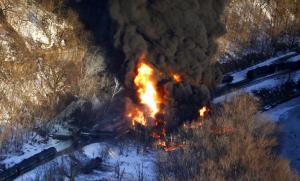
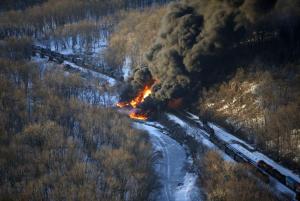
GALENA, Ill. (AP) — The rail cars that split open and burst into flames during a western Illinois oil train derailment this week had been retrofitted with protective shields to meet a higher safety standard than federal law requires, railroad officials said.

The fire continued to burn Friday, a day after 21 of the train's 105 cars derailed in a rural area south of the city of Galena. No injuries were reported, but the accident was the latest in a series of failures for the safer tank-car model that has led some people calling for even tougher requirements.

"It certainly begs that question, when ... those standards failed to prevent leakage and explosions that threaten human safety and environmental contamination," said Steve Barg, director of the Jo Daviess Conservation Foundation, which owns a nature preserve several hundred yards from the derailment site.

BNSF Railway said in a news release that the train's tank cars were a newer model known as the 1232, which was designed during safety upgrades voluntarily adopted by the industry four years ago in hopes of keeping cars from rupturing during derailments. But 1232 standard cars involved in three other accidents have split open in the past year.

Those other accidents included one last month in West Virginia in which a train carrying 3 million gallons of North Dakota crude derailed, shooting fireballs into the sky, leaking oil into a waterway and burning down a house. The home's owner was treated for smoke inhalation, but no one else was injured.

In Thursday's accident in Illinois, 21 cars derailed in an area where the Galena River meets the Mississippi. The company said a resulting fire spread to five rail cars, and emergency personnel were still working to contain the blaze Friday.

View gallery

Smoke and flames erupt from the scene of a train derailment …

Smoke and flames erupt from the scene of a train derailment Thursday, March 5, 2015, near Galena, Il …

Firefighters could only access the derailment site by a bike path, said Galena Assistant Fire Chief Bob Conley. They had to pull back initially for safety reasons, but by midday Friday officials described the area as "stable."

The Federal Railroad Administration said its investigators expected to have access to the site around noon.

The train had 103 cars loaded with crude oil from the Northern Plains' Bakken region, along with two buffer cars loaded with sand, according to company spokesman Andy Williams. The cause of the derailment hasn't been determined.

The accident occurred 3 miles south of Galena in a wooded and hilly area that is a major tourist attraction and the home of former President Ulysses S. Grant. It's part of the Driftless Area, a multi-state region prized in the largely flat Midwest for its high bluffs, karst limestone and steep ravines that escaped the last continental glacier.

It is also just alongside part of the Upper Mississippi River Wildlife and Fish Refuge. So far, there's no indication of any oil contamination there, said U.S. Fish and Wildlife Service spokeswoman Georgia Parhan.

View gallery

Smoke and flames erupt from the scene of a train derailment …

Smoke and flames erupt from the scene of a train derailment Thursday, March 5, 2015, near Galena, Il …

As of June of last year, BNSF was hauling 32 Bakken oil trains per week through the surrounding Jo Daviess County, according to information disclosed to Illinois emergency officials.

Recent derailments have increased public concern about the safety of shipping crude by train. According to the Association of American Railroads, oil shipments by rail jumped from 9,500 carloads in 2008 to 500,000 in 2014, driven by a boom in the Bakken oil patch of North Dakota and Montana, where pipeline limitations force 70 percent of the crude to move by rail.

Since 2006, the U.S. and Canada have now seen at least 22 oil-train accidents involving a fire, derailment or significant amount of fuel spilled, according to an Associated Press examination of federal accident records.

The wrecks have intensified pressure on the administration of President Barack Obama to approve tougher standards for railroads and tank cars, despite industry complaints that it could cost billions and slow freight deliveries.

Oil industry officials had been opposed to further upgrading the 1232 cars because of costs. But late last year they changed their position and joined with the railway industry to support some upgrades, although they asked for time to make the improvements

Illinois oil train derailment involved safer tank cars - Yahoo News