Friday, February 27, 2015

Boone County panel probed for possible Open Meetings Act violation - News - Rockford Register Star - Rockford, IL

To read earlier postings on this subject see:  http://boonecountywatchdog.blogspot.com/2015/02/did-boone-countys-ad-hoc-committee.html or to see BCJ’s editorial go to:  http://boonecountywatchdog.blogspot.com/2015/02/bcj-editorial-on-boone-county-ad-hoc.html

By Ben Stanley
Rockford Register Star
Posted Feb. 26, 2015 at 12:06 PM
Updated Feb 26, 2015 at 8:22 PM

BELVIDERE — The Illinois attorney general's office is investigating an ad hoc committee in Boone County for possible violation of the Open Meetings Act.
The Boarding and Breeding Ordinance Advisory Committee, which is reviewing possible changes to regulations governing boarding and breeding kennels, secretly met Jan. 14 under instructions from a County Board member.
"Please remember this is an advisory ad hoc committee, which means we do not have to post public agendas or open our meeting up for the public to attend," Boone County Board member Denny Ellingson wrote in a Jan. 7 email, which the Rockford Register Star obtained through a Freedom of Information Act request.

"Please do not tell others about where or when these meetings are set for, so that we can meet without interference. When we get our work done, the public will get a chance to review our thoughts and decisions as our proposed ordinances will back through the ZSA and the PZB before the County Board gets a chance to adopt them."

The meeting was carried out behind closed doors. The Open Meetings Act says citizens have the right to attend the meetings of public legislative, executive, administrative and advisory bodies and should be given advance notice of those meetings.
Boone County State's Attorney Michelle Courier said it's unclear whether the committee falls under the regulation of the Open Meetings Act.
"It’s a gray area as to whether or not they should be subject to it," she said. "This is not the County Board members (meeting) or members that were entirely appointed by the County Board."
The committee has seven members — a veterinarian, two animal-welfare advocates, two community residents, one breeder and one kennel operator — and only one, Ellingson, is an elected official. Committee members joined at the request of County Board Chairman Bob Walberg, which further blurs the lines.
For the committee to have violated the Open Meetings Act, the attorney general's office would have to determine that the committee qualifies as a "public body," which state statute defines as "all legislative, executive, administrative or advisory bodies of the state, counties, townships, cities, villages, incorporated towns, school districts and all other municipal corporations, boards, bureaus, committees or commissions of this state, and any subsidiary bodies of any of the foregoing including but not limited to committees and subcommittees which are supported in whole or in part by tax revenue, or which expend tax revenue."

Courier received complaints after the meeting that an Open Meetings violation may have occurred. She said Ellingson didn't ask her for legal advice before the meeting convened. "So it was my recommendation (to the committee) simply to publish the agenda, and they’ve been doing it since."

If the committee is found in violation, the attorney general's office can issue either an informal opinion, which is a nonbinding recommendation to correct practices, or a formal opinion, which could include fines and other punishments.  ….

- Read  more by going to: http://www.rrstar.com/article/20150226/NEWS/150229528/0/SEARCH#sthash.7V6HGoJl.dpuf

A Tale of Two Midwestern States and Their Wealthy Governors | John A. Tures


Minnesota and Illinois share a common region, a similar economy, and even the same athletic conference (the Big 10). They both have billionaire governors. One launched a series of progressive policies, with great results for the business climate in the state, a stark contrast to the anti-working class agenda of the other.

2015-02-26-0226151030.jpg

Mark Dayton, Minnesota's billionaire governor, was elected in two years that were bad for Democrats: 2010 and 2014. As Carl Gibson, writing for the Huffington Post points out, he did adopt a progressive agenda. He raised taxes on the wealthy, increased the minimum wage (his predecessor tried to keep waiters and waitresses from earning anything other than tips) and created a budget deficit. Dayton's results included a drop in unemployment, a budget surplus, and a better environment for business.

CNBC ranked Minnesota as having the third best economy for doing business (behind two other progressive states, Hawaii and Vermont). The rest of the top ten list for business is made up of other progressive states, like Washington and Oregon, New England states, as well as three prairie states (like the Dakotas and Nebraska) with GOP governors. CNBC's report for Minnesota reads:

The North Star State has something to offer almost everyone. Enjoy the natural beauty of the North Woods or the cosmopolitan sophistication of the Twin Cities. And everyone, it seems, is "Minnesota Nice"--so much so that the crime rate is among the nation's lowest. The home of the famed Mayo Clinic is one of America's healthiest states, and the environment is among the cleanest. But if you're not a fan of winter, beware. With an average annual temperature of just 41.2 degrees Fahrenheit, Minnesota is one of America's coldest states. But they'll tell you -- nicely -- that they know how to adapt.

And there's not much Dayton can about the temperature. But Minnesota is fifth in quality of life among the fifty states.

Meanwhile, Illinois is being led by another billionaire, Bruce Rauner, who seeks to increase sales taxes on all services, except for those associated with Rauner's type of business, as well as cut taxes for the wealthy. He is also cutting just about every government agency. It's probably too unfair to rate Rauner, since he's only been in office a month or so. But he does seem to be adopting the Scott Walker agenda step-by-step, so how's Wisconsin doing?

According to CNBC's 2012 survey, Wisconsin's not doing too badly in the second year of the Walker Administration, at 17th, still well behind Minnesota. But a closer look at the data shows the Dairy State might take a tumble. A lot of that ranking comes from Wisconsin being tenth in education (the second highest score for the state). As Walker goes after his state's schools and colleges, that number is likely to fall as state education funding is decimated.

Illinois was doing better than expected on the CNBC business climate (26th, despite all of the state budget struggles), with a decent 17th ranking in education (of the state's better scores). But Rauner's following the Walker model, and cutting that too. But hey, folks in Rauner's income bracket can expect to get three-quarters of a million dollars back a year based on his economic model, according to Robert Creamer with Huffington Post.

It's about time the voters of these states realize that what's good for one business person isn't always good for the entire business climate of the state, and the workers, start-ups, and the quality of life for its residents.

--

John A. Tures is a professor of political science at LaGrange College in LaGrange, Ga. He can be reached at jtures@lagrange.edu.

A Tale of Two Midwestern States and Their Wealthy Governors | John A. Tures

Mayors hit cuts in Rauner plan


By Bob Rakow and Jack Murray

Orland Park would see a loss of $3 million in state funds under Gov. Rauner’s proposed budget, a group of Chicago area mayors said last week.

Local mayors oppose Gov. Rauner’s first budget plan unveiled last Wednesday as they contemplate the cuts it proposes in the share of state income tax funds Illinois disburses to cities and villages.

               The governor’s call to reduce those funds by 50 percent would cost localities nearly $50 per resident, according to the Metropolitan Mayors Caucus, which is chaired by Orland Park Mayor Daniel McLaughlin. Thus, Orland Park with a population of 60,000 would see its annual local share cut by about $3 million, the mayors group said in a statement on its website.

“The Caucus’ member mayors from 273 municipalities in the Chicago metropolitan area are very concerned about how this $600 million cut will affect their abilities to provide essential services to their residents,” the statement added.

“I’m not sure Governor Rauner understands the effect this proposal will have on local governments,” Mayor McLaughlin said in the group’s statement. “Our annual budgets have already been adopted. Communities are counting on their share of the income tax to pay for local services. Reducing revenues will force communities to have to make further decisions to lay off police officers and firefighters, end repairs to critical infrastructure and cut other key services. These are real decisions that will impact the everyday lives of our citizens.”

To the north of Palos-Orland, the six communities of Worth, Palos Hills, Chicago Ridge, Oak Lawn, Hickory Hills and Evergreen Park could combine to lose $6 million a year if Rauner’s proposal becomes reality and that has some of their mayors fuming.

In Oak Lawn, Mayor Sandra Bury is concerned but added she would welcome an opportunity to show what the cuts could do to her community and towns all across the state.

“I would like to invite him to Oak Lawn anytime,” Bury said last week in reaction to Rauner’s proposed 50 percent cutback in towns’ annual share of state income tax revenue.

She thinks he should see her town as it would serve as a model for him to check out.

Bury would like to open the village’s books to the newly-elected governor and explain that Oak Lawn and other communities throughout the southwest suburbs cannot afford such a significant revenue hit.

She’d also like to point out that Oak Lawn—like most other towns—does not have cash reserves on hand for a rainy day.

If approved, Rauner’s cuts would mean an estimated $2.7 million annual revenue loss for Oak Lawn, Bury said. It’s a figure the mayor has a tough time grasping. Indeed, the village would have few options to make up the loss.

“You either layoff or raise taxes. It’s wrong,” Bury said.

At a time when Oak Lawn and other communities are already making budget cuts to fully fund employee pensions, a significant revenue reduction from the state is the last thing they need, Bury said.

McLaughlin and Bury are not alone in their displeasure with Rauner’s plan.

Palos Hills Mayor Gerald R. Bennett said the proposal is unnecessary.

“All they’re doing is putting (the burden) on the backs of local residents,” said Bennett, president of the Southwest Conference of Mayors. “They’re going to bankrupt local governments.”

Palos Hills and other communities such as neighboring Hickory Hills already operate with fewer employees in key departments such as public works than they did just a few years ago, Bennett said.

Additional reductions in manpower would make it extremely difficult to provide basic services to residents. Additionally, towns would have a tough time avoiding cuts to the public safety, he said.

“It will bankrupt us. The fight is on, I guess,” Bennett said.

Evergreen Park could lose approximately $500,000 annually if Rauner’s proposal becomes a reality. “I hope he doesn’t fix (the state’s financial problems) on the back of local governments,” said Evergreen Park Mayor Jim Sexton. “We can’t afford to pay other people’s bills.”

Worth Mayor Mary Werner said she’s uncertain how her community would absorb additional revenue losses, which would also equate to about $500,000 under Rauner’s plan.“That would be a huge loss. We’ve already made major cuts,” Werner said, referring to numerous staff reductions made within the past five years.

“I understand the state of Illinois is a horrible, horrible financial state,” Werner said. She added that municipalities are required by law to approve a balanced budget while the state is remedy its budget woes on the backs of municipalities.

“We’ve been making sacrifices for years,” Werner said. “At the local level, we’re all doing a good job living within our means.”

Hickory Hills Mayor Mike Howley agreed. He said his city relies on the utility tax to help balance the annual budget. The city has put off capital improvement projects such as street and sewer work to help make ends meet.

Chicago Ridge Mayor Chuck Tokar echoed the feelings of his mayoral colleagues.“That’s a big chunk of change,” Tokar said. “I wasn’t expecting [Rauner] to say that. I can’t replace $600,000, $700,000.” Tokar admitted that that his town is fortunate to draw sales taxes from a regional shopping mall, but that revenue stream would never replace the state’s money, he said.

At least one local elected official said he agreed with Rauner’s plan.

“I would say there’s always room for cuts,” said Palos Hills Alderman Al Pasek. He added that smaller communities should consider merging if they can no longer go it alone. But mayor and many aldermen

Above is from:  Mayors hit cuts in Rauner plan

The Illinois budget: Averting doomsday | The Economist


Bruce Rauner is trying to fix the finances of America’s worst-run state

Feb 28th 2015 | CHICAGO | From the print edition


THE Scott Walker model of tough-it-out conservatism (see article) may be proving most influential in a neighbouring state. The new Republican governor of next-door Illinois, Bruce Rauner, has just signed an executive order ending mandatory union fees for state workers who do not want to join a union or support its agenda. And on February 18th, as part of his $31.5 billion budget plan, Mr Rauner proposed savings of $6.7 billion in state spending on health care for the poor, pensions for public workers, local government and universities. His aim, he said, was to present a budget that “lives within our means—without raising taxes or relying on irresponsible borrowing”.

Illinois has overspent and borrowed recklessly for years, and is now in the biggest fiscal mess of any state in the country. It has the most underfunded retirement system of any state, amounting to $111 billion in unfunded pension liabilities, as well as the highest pension burden relative to state revenue. Its credit rating is the lowest of all the states, which means dramatically higher borrowing costs. “Drastic measures are needed,” says Christopher Mooney of the Institute of Government and Public Affairs at the University of Illinois, Chicago, who thinks the governor’s “doomsday budget” was meant to get people’s attention.

Yet unlike Mr Walker, who can count on support from a Republican majority in both houses of the Wisconsin legislature, Mr Rauner faces a veto-proof majority of Democrats in both houses. “This budget is not politically viable,” says David Merriman of the University of Illinois. In particular, he adds, the big cuts in pension benefits and in the Medicaid programme, which handles health-care costs for the poor, will never get through. Mr Rauner hopes to save $2.9 billion by moving all state workers into the less generous pension plan that legislators approved in 2010 for state employees hired after January 1st 2011. And he wants to slash spending on Medicaid, which has already been squeezed, by a whopping $1.5 billion.

The governor’s pension reform is different from the overhaul passed in 2013 by lawmakers under Pat Quinn, his Democratic predecessor, which would have reduced annual increases in pension payments, raised the retirement age and capped pensionable salaries. A circuit judge struck down the Quinn reform, saying it violated the state constitution. The case is now before the Illinois Supreme Court, which is expected to rule the same way. The Rauner camp claims that his pension proposal can withstand court challenges, but most experts expect it too to run into legal trouble.

In the next few months the governor will have to negotiate with legislators to craft a budget that all sides can live with. If he wants to balance the books he will have to raise taxes, however unpopular that may make him with his Republican base. Supporters of Mr Rauner’s tough course say that small-scale pension reforms and tax increases simply won’t be enough to solve Illinois’s gargantuan problems, and would make the governor a lame duck.

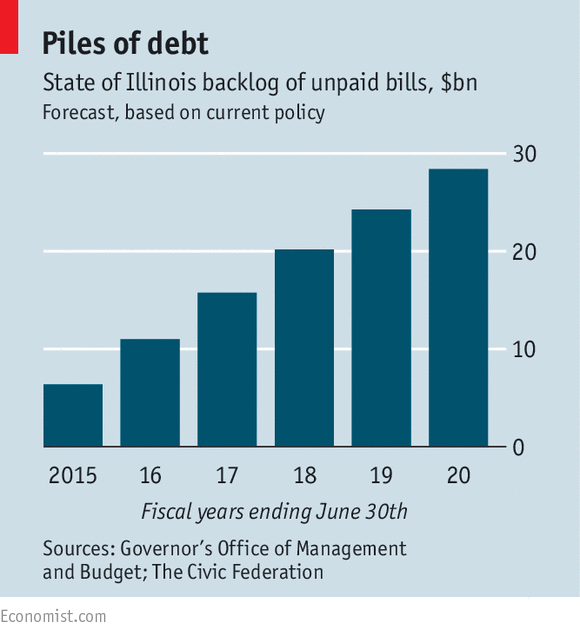
The Civic Federation, a budget watchdog, suggests even sterner measures. They include getting rid of the tax exemption for retirement income, excluding Social Security payments and pension income of less than $50,000 a year. Mr Rauner should also tax 32 professional services that are currently untaxed, says the federation, and repeal the state’s sales-tax exemption for food and non-prescription drugs until the $6.4 billion backlog of unpaid bills is gone.

After years of mismanagement, Illinoisans are keen on change. A Gallup poll last year found that one in four of them believes their state is the worst to live in; about half of them said they would leave if they could. Only 28% of respondents said they trusted their government, compared with 60% nationally: fair enough, in a state where four of the last seven governors have ended up in jail. If the new governor turns Illinois round, as he promises, he will be a hero, says Mr Mooney. At this point, that is a very big “if” indeed.

Above is from:  The Illinois budget: Averting doomsday | The Economist

Thursday, February 26, 2015

California Republicans -- evolve or die - LA Times

Republicans in a blue states need to understand.

image

California Republicans under Reagan led a national revolution. Now they must lead their own evolution.

Delegates to the California Republican Party state convention that begins Friday in Sacramento should be asking themselves just two questions: Why can't they find an electable U.S. Senate candidate and how do they revive a state party that's become irrelevant?

This state went from red to blue because the California GOP lost its Reaganesque compass and, alarmingly, a willingness to discern between moral absolutes and generational evolution. Ronald Reagan brilliantly never let himself be the captive or defender of the status quo or party orthodoxy. He embraced broad principles and found ways to solve problems without selling out.

Voters, popes, presidents and even some elders have evolved. The state party has not and seems to be perversely proud of it. Political parties are meant to win elections, not be martyrs to lost causes of bygone eras.

Republicans need their own rhetoric of reliance


New leader of the state Senate Kevin de León made waves last fall for both the lavish “inaugural” bash he threw himself and for the speech he gave there. “Isn't it time we shatter the great American myth about pulling oneself up by the bootstraps?” the Democrat...

New leader of the state Senate Kevin de León made waves last fall for both the lavish “inaugural” bash he threw himself and for the speech he gave there. “Isn't it time we shatter the great American myth about pulling oneself up by the bootstraps?” the Democrat... ( Pete Peterson )

For the first time in 24 years there's an open U.S. Senate seat in California, and the party should be ashamed it has no viable candidates. The problem is “us” not “them.” What are some of the changes the state party needs to make to return California to a truly two-party state?

8

Immigration: Quit whining. President Obama masterfully outsmarted the GOP. No one should be more sensitive to the implications than California Republicans but they're still clueless. In 1994, I wrote an op-ed in this paper warning that by voting for Proposition 187, the party risked becoming the “anti-immigrant” party, alienating Latinos. Since Gov. Pete Wilson's reelection that year, cynically on the back of 187, there has not been a GOP governor or U.S. senator (Arnold Schwarzenegger was a faux-GOP anomaly).

Today, the party does not have a single statewide office holder. Now, another generation of Latinos is reminded that the GOP divides families, seeks to deny education and social services to children and believes in absurd mass or self-deportation of 3 million hardworking souls in our state. Even if the GOP wins battle against Obama's executive orders, the party loses voters, especially here in California.

Voters, popes, presidents and even some elders have evolved. The state party has not and seems to be perversely proud of it.- 

Same-sex marriage: Get over it. Regardless of what the U.S. Supreme Court does, same-sex marriage is here to stay. California families are as diverse as its people. Stop alienating gays, lesbians, their families, friends and younger Californians. Even the Mormon Church supports LGBT anti-discrimination laws. Yet the state GOP's politically anachronistic and offensive platform still opposes them. It is on the wrong side of civil rights history.

The GOP loathes the “nanny state” but it is all too happy to be the “nanny party.”

Are there no courageous state Republican leaders to say we are better then this? The silence, especially among civil libertarians, is deafening, disappointing and cowardly.

Small government: The excesses and scandals of GOP big spenders makes it indistinguishable from the Democrats. Reclaim the Reagan doctrine that, however noble the goal, big government is inherently a threat to individual liberty. That includes the failed over-regulating administrations of Schwarzenegger and “too big to fail” budget-busting George W. Bush.

Inclusion: I was campaign manager and chief of staff to Bob Dornan, one of Congress' most conservative members in a swing Democratic district in the heart of largely Latino central Orange County. In his first election we were told to “not waste time and money” going after the black and Latino vote. We ignored that advice and Dornan won his marginally Democrat seat with 40% of the Latino vote in three successive elections. With year-round outreach and tangible deliverables, it still can be done. The GOP must court minority voters with substantive programs, not solely with targeted mail and condescending “Viva” campaign committees.

Opportunity society: If white children were largely products of single-parent families and had drop-out and youth incarceration rates similar to those of today's young African Americans, you can bet we'd have a serious strategy. The party of Lincoln should be vigorously working to reverse this alarming growth of an underclass in which so much young talent is lost and opportunity denied.

This is where the state GOP can act by creating a nonprofit foundation to teach, train, place and give back through non-government means to those who need help the most and probably dislike the GOP even more. Call them Ronald Reagan Centers.

Go where the party is not wanted. In places such as Chico, Oakland, Stockton, San Bernardino, Los Angeles, Compton and Indio, make a sustained commitment to the most challenged neighborhoods with at-risk youths and families. These Reagan Centers would be focused on small business, pre- and postnatal care, ESL, job placement, computer skills, public-private partnerships, HIV/AIDS and public healthcare, etc. This is a necessary, unorthodox commitment to people with whom the state GOP needs to rebuild allegiances.

Republicans in California under Reagan led a national revolution. Now they must lead their own evolution.

This lost competitive opportunity for the Barbara Boxer Senate seat must be a wake-up call — not for capitulation of principle but for the courage to push for realistic change. Otherwise, these biennial GOP conventions will remain insular social clubs instead of calls to action for what was once the nation's most influential state political party.

Brian O'Leary Bennett, a former member of the state executive committee of the California Republican Party and five-time GOP national convention delegate, has been a conservative activist for nearly 40 years.

California Republicans -- evolve or die - LA Times

Commentary: Rauner’s minimum wage plan just more of the same from GOP | The Rock River Times


The Rock River Times


Commentary: Rauner’s minimum wage plan just more of the same from GOP

February 25, 2015

By Gregory John Campbell
Guest Columnist

Republican Gov. Bruce Rauner’s policy recommendation for increasing the minimum wage in Illinois to $10 per hour over a seven year period is insulting and demeaning to the very workers it proposes to benefit, because no family or worker can live on such a meager wage now, let alone in seven years, coming from a man whose political role is to cement elite privilege over common poverty in Illinois.

Somali Republicans, like Gov. Rauner, have as their sole motives the enhancement of power and acquisition of property over others, because they lack humanity, being what this citizen characterizes as “object beings,” not human beings.

Object beings exist to purchase, own or possess material objects, wealth and power only, treating others in the same manner—as objects to own or property to dispense with—as so much flotsam on the water or cattle in a pen. Accordingly, object beings are not moral in motivation or behavior because they lack the human capacity to be so, and cannot be trusted to serve those who are in any private or public venue.

But what they can be trusted to do is diminish the humanity in our state and nation to secure their personal property, economic privilege and political power over any persons or principles preventing them from doing so, like the social contract morally existing between “the people” and their elected representatives.

But Gov. Rauner is first and foremost a corporate businessman, before he is a human being or a public servant, because business, not public service or humanity, is his range of awareness, and he lacks consideration in dealing with others.

And so it’s to be expected Gov. Rauner would want more prison guards in our state, because he knows his policies are going to impoverish countless more in achieving “fiscal balance”; and because he also knows that desperate people do desperate things when living on the street and starving.

Like all Somali capitalists, endless greed and the lust for power are the only principals behind the Somali reality of Republican politics they use, to abolish the upward middle class mobility our nation once stood for, because their sole intent is to impound as much wealth and power from the middle class as they can through their Somali economic policies and practices. The Koch brothers personify this fiscal “free rape-it” ideological inhumanity precisely.

Today’s Somali Republicans are like the Robber Barons of the late 19th century, and should be understood as the fiscal plunderers who will kill the father, rape the mother, sell the son and keep the daughter to accomplish what they want in Springfield or Washington as political Genghis Khan’s.

And if you think this statement harsh, think of the millions who’ve lost their jobs or homes through Somali (corporate) foreclosure, offshoring and outsourcing, because without these their lives and families have been plundered.

The Illinois pension problem is the result of both political parties failing to meet the fiduciary requirements they pledged they would, to responsible citizen contributors who did, over a 40 year period. And so the Governor will complete the further pauperization of state pensioners by blaming them for policy shortfalls Somali politicians like himself, Democrat and Republican, intended or permitted.

Accordingly, Somali Republicans are skillful at laying-off workers, cutting benefits and social programs and ruining lives because they’re intrinsically Hobbesian, believing men to be more evil than good, like themselves. Such human self-contempt must turn outward then, to disguise what their conscience would never permit if they had one—that they’re not only anti-labor, anti-union and anti-American, they’re also anti-human and Christian.

Above is from:  Commentary: Rauner’s minimum wage plan just more of the same from GOP | The Rock River Times

Local Papers Oppose Rep Sosnowski’s legislation on public notices


image


image

Meet John Doe: Keep public notices in print | The Rock River Times

By Paul Gorski
Columnist

According to “Sosnowski calls for public notices to be pulled from papers” by Shane Nicholson, State Representative Joe Sosnowski (R-Rockford/Belvidere) wants to “end the publication of public and government notices in newspapers.”

I strongly oppose that ill-advised plan. Public, especially government, notices of meetings, hearings and other important events should be posted in local newspapers as it is in the public interest to do so. We cannot have a free, open, deliberative government unless we know when our public bodies are meeting to discuss important issues.

As Nicholson’s article points out, many governments do not properly post public notices online, and the public does not appear to go to the sites that have these notices. One sure way of hiding or burying a public notice is to publish it only online.

One benefit of having notices posted in newspapers is that each newspaper prints public notices in a consistent manner; readers do not have to learn how to navigate the newspaper to find the notices, like they might have to do with a variety of different government websites.

Sosnowski states his plan is “Just trying to move us into the 20th century. Internet has been around for a while. Maybe next year we can work on the 21st.” I do not buy that argument at all. By that reasoning, people should stop buying printed Bibles and read the good book on their Kindles. While some people may prefer an e-reading device for this use, I’m pretty sure printed Bible sales are still strong. I am also fairly certain that most churches prefer printed Bibles. Get important information out in as many ways as you can.

People are divided on how they consume news and information. Many people still read print newspapers and books; other read the same content on websites. Others only frequent social media outlets like Twitter and Facebook. More and more people are using their smartphones and tablets as their primary Internet-access device, and many government websites are not mobile friendly. You might save money on printing costs, but then pay big bucks for updating your website, and then be forced to pay staff to monitor, post, and reply to posts on social media outlets.

Sosnowski’s plan to stop printing public notices in newspapers is shortsighted. Newspapers provide a standard, portable format for sharing government information. If budgets allow, post the same information on websites and social media. Sharing public information on more, rather than fewer, media outlets is in the public interest and critical to encouraging the public to engage government.

Paul Gorski (paul@paulgorski.com) is a Cherry Valley Township resident who also authors the Tech-Friendly column seen in this newspaper.

The above is from:  Meet John Doe: Keep public notices in print | The Rock River Times

image

Editorial:

image

image

News Coverage:

image


image

image