Showing posts with label pension funds. Show all posts

Saturday, September 12, 2015

Gov. Rauner Speaks Out on Budget Impasse | Chicago Tonight | WTTW


One week after a legislative victory over House Speaker Michael Madigan and one day after the state's comptroller said the budget impasse could lead to a deficit of $12 billion, Gov. Bruce Rauner faced the media.

Has the governor softened his stance on some of his agenda items, given that the state's fiscal picture is growing worse and there's no budget agreement in sight? And what is the governor's message to Democrats who aren't scheduled to be back in session for weeks?

The message from the conservative governor to the General Assembly: “I will raise taxes, but you’re going to have to agree to some of the pro-business reforms I want.”

The governor made his remarks Thursday at a press conference highlighting a U.S. Chamber of Commerce study that says the state is one of the most litigious in the nation.

There are more lawsuits in Illinois with higher awards than almost anyplace else, according to the study, which the governor says is scaring business out of the state.

It’s one of the things he wants reformed as part of a budget agreement, along with redistricting reform, term limits, changes to the workers compensation law, and a statewide property tax freeze which would include with it some changes to public worker wages and collective bargaining.

“You want me to raise taxes, I’ll do it, but I’m going to do it with reforms,” Rauner said. “If [you] don’t want any reforms with it, you do the tax hike. You’ve got a supermajority. You’ve proven you can do things without my support. But you have to choose. Do your unbalanced budget and raise taxes, or work with me. So far they’ve refused to do it.”

House Speaker Michael MadiganHouse Speaker Michael Madigan Democratic House Speaker Michael Madigan has referred to Rauner’s requests as being extraneous to the budget situation and “operating in the extreme.”

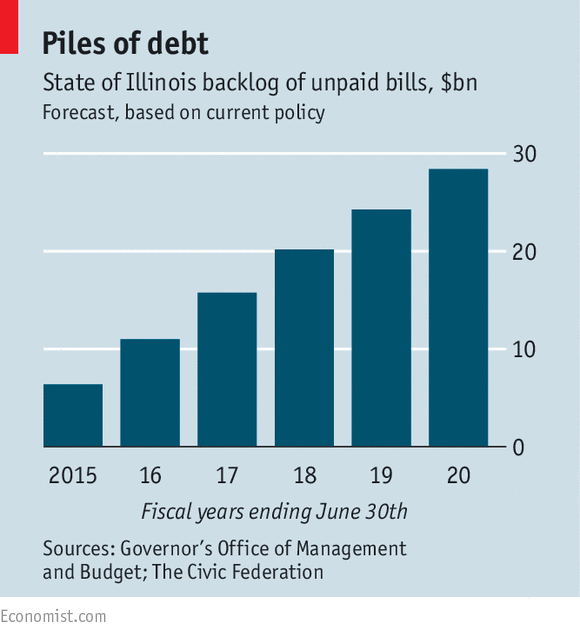
Wednesday, the state’s comptroller said that the budget impasse is costing the state dearly. The bill backlog could approach $12 billion by the end of the year because programs are still being funded without enough money to pay for them.

Despite the worsening situation, the governor maintains that the holdout is a worthy fight.

“We are increasing the amount of unpaid bills,” he said. “It’s outrageous, I hate it. Some of it has 12 percent interest, some has 9 percent. It’s outrageous. The deficit was $4 billion out of balance, right now it looks like it’ll be $5 billion out of balance. Ridiculous, unacceptable, all we can do is keep pushing as hard as we can.”

One of the things driving the budget crisis is the huge unfunded pension crisis: There have been lots of failed attempts, but another proposal is surfacing today. It’s coming from some suburban Republican House lawmakers.

The premise is simple: buy retirees out of their pension by offering a one-time lump sum payment worth 80 percent of what the pension would have been worth. The downside is the state has to come up with that money right away, the upside is that lawmakers predict it could save $10 billion in the long term.

“This is a plan that helps us thrive long term,” said Rep. Mark Batinick (R-Plainfield), who is authoring the proposal. “You start to see some of the benefits initially. But if you look at the pension payout ramp, some of those years out – 10-15 years – start to scare me. So you do this, you flatten that ramp.”

Public employee union representatives are not so enthused with this plan, in a statement they said:

"Although no specific 'buyout' program has been proposed, the public should be very skeptical of the concept. A buyout program designed to reduce the net liabilities of the retirement systems would shortchange workers and retirees, giving them less upfront than the value of the modest pension they have earned and paid into. What's more, because the problem plaguing public retirement systems is inadequate funding, a program of lump-sum payouts would further deplete fund assets and make it more difficult to achieve funding solutions. 

“We continue to believe that all parties must join together to develop real pension funding solutions, such as reamortizing the debt caused by the state’s failure over decades to adequately fund its obligations.”

Politics

Gov. Rauner Speaks Out on Budget Impasse | Chicago Tonight | WTTW

Saturday, May 23, 2015

Cash Penalties for Salary Spikes for near retirees

What The Chicago Tribune failed to state is that some of these raises were in labor contracts and/or individual administrator’s contacts prior to enactment of the law and as such must be paid.

image

This information is available at: 

http://www.chicagotribune.com/ct-search-for-cash-penalties-at-your-school-district-database-pension-20150522-htmlstory.html

image

image

image

image

Thursday, May 14, 2015

Rauner sticks to his pension approach despite questions about its legality - Chicago Tribune


That position was relayed as the Republican governor dispatched a lawyer and policy adviser to a House committee to discuss the approach on pensions months after Rauner floated it. While no legislation has been filed, the new governor has talked broadly about moving all current workers to a less generous benefit package beginning in July. Upon retirement, those workers would collect two pensions — one from the more generous plan in place now, and a second from the less generous benefits accrued after July.

Skeptical lawmakers noted that the state Supreme Court ruled Friday that an earlier attempt to slash pension benefits for workers and retirees violated a clause in the Illinois Constitution that says such benefits cannot be "diminished or impaired."

In the unanimous ruling, justices also made clear that pension benefits promised to a public worker on the first day of employment cannot be reduced later. That distinction appeared to blow a hole in Rauner's plan.

But Wednesday, Rauner administration attorney Kim Fowler said the governor was not deterred.

"We continue to believe that the governor's proposal … is constitutional under the current constitution even after the Supreme Court's ruling that came out Friday," Fowler said.

The Rauner team's view is that the court was unclear about whether future benefits have the same protections as those benefits already earned. "We don't think the court clearly answered what benefits are protected," Fowler said.

Rauner sticks to his pension approach despite questions about its legality - Chicago Tribune

Monday, May 11, 2015

Illinois cities prepare for pension diversion law - News - Rockford Register Star - Rockford, IL


ROCKFORD — Cities across the state with underfunded police and firefighter retirement systems must get payments back on track or risk losing a slice of state tax dollars.
Municipal governments are preparing to meet the demands of a 2011 pension law that requires them to fund employee pensions to required levels in 2016 or risk having state grants diverted from their intended purpose into the pension fund. The law is designed to bring pension funds up to 90 percent funded by 2040, and local governments must make payments that will put them on track to do so. The law is not affected by the Illinois Supreme Court's decision Friday to strike down a piece of 2013 pension legislation.
The law is a concern for many municipalities that have a lot of ground to make up, said Joe McCoy, legislative director for the Illinois Municipal League. "The difficulty and the reason we have so many concerns is, for many communities ,that's a pretty steep ramp."
The law says that in 2016, one-third of state grants could be diverted to the pension fund if the required payment isn't met. That increases to two-thirds in 2017 and all of the grants by 2018.
"That's a lot of money for cities to lose out of their operating budgets," McCoy said. The consequence could be cuts in services or property tax increases to meet the pension demands. Gov. Bruce Rauner proposed a property tax freeze during his State of the State speech in February, which puts a further squeeze on municipal budgets, McCoy said.
"We're actually, through a myriad of different policies, encouraging municipal budget problems."
McCoy said pension reform is needed to help municipal and state budgets.
The Great Recession of 2008 was the start of many municipalities' pension funding problems, Loves Park Mayor Darryl Lindberg said. His city does not levy a property tax, which is how most governments fund their pension systems. The city relies heavily on sales tax, so it suffered major losses during the recession when shoppers were buying less.
"When we hit the recession, most communities, including Loves Park, reduced (pension contributions) because we just couldn't afford to put it in," he said.
The city's police pension was 48 percent funded as of April 2013, the city's most recent audit. It's risen since then because the city has met its required contributions for the past two years in a row, contributing $774,000 last year, Treasurer John Danielson said. He and Lindberg said the city will be able to meet its requirements in 2016.
The village of Rockton's police pension fund is about 76 percent funded, Mayor Dale Adams said. The village pays $250,000, about 5 percent of its general fund budget, to finance its pension contribution. Adams said the village will be able to meet the required payments next year.

Read more by clicking on the following:  Illinois cities prepare for pension diversion law - News - Rockford Register Star - Rockford, IL

Tuesday, April 21, 2015

State retirees' lawyers to get $1.5 million for work on health insurance case - News - The State Journal-Register - Springfield, IL


  • Lawyers representing state retirees in a case involving their health insurance premiums will receive a little more than $1.5 million in fees and costs for their work.
    The amount, determined by Sangamon County Associate Judge Steven Nardulli, is less than half of the $3.1 million in compensation (including a multiplier) the lawyers sought during a court hearing two weeks ago.
    Money to pay the fees will come out of the roughly $63 million in health insurance premiums collected from retirees. The money was deducted from their pension checks.
    In his ruling, Nardulli said the attorney fees amount to about 2.37 percent of the premium money paid. In other words, when refunds are made, for every $100 in premium refunds due to an employee, $2.37 will be deducted to pay legal fees.
    After the state passed a law that began to charge all retirees premiums for their state-subsidized health insurance, multiple lawsuits were filed challenging the law as a violation of the Illinois Constitution's pension protection clause. Nardulli consolidated the various cases, but multiple attorneys remained involved.
    The attorneys affected by the legal fees decision took their cases on a contingency basis, meaning they would not get paid unless they won. Some other attorneys were paid by their clients as the case proceeded through the courts.
    Nine lawyers and a paralegal initially claimed more than 3,500 hours working on the case. The lawyers' fees ranged from $250 to $400 an hour. They also claimed a multiplier that is allowed in class-action lawsuits.
    Nardulli reviewed the billing and cut the hours to 2,668. He also limited hourly billing to $250. Springfield lawyers Don Craven and John Myers, who brought one of the earliest lawsuits against the law, worked the most hours on the case, Nardulli determined. Each will be paid $265,625 for his work. Craven could not be reached for comment. Myers declined to comment.
    Hundreds of people filed letters with the court, virtually all of them objecting to attorney fees. Many felt the state should cover the legal expenses since it lost the case. Nardulli said that while he sympathized with their position, nothing in the law allowed him to shift the costs to the state.
    More than 300 others objected because they said they were paying their own counsel and should not have to pay for others. A number of those were members of the State Universities Annuitants Association, which hired its own firm to represent members. Nardulli noted, though, that the association didn't get involved until after the Illinois Supreme Court ruled against the law and sent it back to circuit court for further proceedings.
    "The fact remains that the work performed in overturning the assessment of health insurance premiums was performed by attorneys other than SUAA attorneys," Nardulli wrote in his decision. "To exclude SUAA members from sharing in the cost of the litigation would unfairly shift the burden of the attorney fees to other retirees, and would provide a benefit to SUAA members for which they did not contribute."
    Page 2 of 2 - In a short briefing to members, the annuitants association said it is "grateful to be able to say that the fees being taken from money being returned to (retired university) members are far less than requested."
    Now that attorney fees have been decided, work can being on determining how much of a refund is due to each retiree. The court schedule calls for refunds to be sent out in early June.
    — Contact Doug Finke: doug.finke@sj-er.com, 788-1527, twitter.com/dougfinkesjr.
  • By Doug Finke, State Capitol Bureau

    The State Journal-Register

    By Doug Finke, State Capitol Bureau

    Posted Apr. 15, 2015 at 1:23 PM
    Updated Apr 15, 2015 at 10:14 PM


State retirees' lawyers to get $1.5 million for work on health insurance case - News - The State Journal-Register - Springfield, IL

Friday, February 27, 2015

The Illinois budget: Averting doomsday | The Economist


Bruce Rauner is trying to fix the finances of America’s worst-run state

Feb 28th 2015 | CHICAGO | From the print edition


THE Scott Walker model of tough-it-out conservatism (see article) may be proving most influential in a neighbouring state. The new Republican governor of next-door Illinois, Bruce Rauner, has just signed an executive order ending mandatory union fees for state workers who do not want to join a union or support its agenda. And on February 18th, as part of his $31.5 billion budget plan, Mr Rauner proposed savings of $6.7 billion in state spending on health care for the poor, pensions for public workers, local government and universities. His aim, he said, was to present a budget that “lives within our means—without raising taxes or relying on irresponsible borrowing”.

Illinois has overspent and borrowed recklessly for years, and is now in the biggest fiscal mess of any state in the country. It has the most underfunded retirement system of any state, amounting to $111 billion in unfunded pension liabilities, as well as the highest pension burden relative to state revenue. Its credit rating is the lowest of all the states, which means dramatically higher borrowing costs. “Drastic measures are needed,” says Christopher Mooney of the Institute of Government and Public Affairs at the University of Illinois, Chicago, who thinks the governor’s “doomsday budget” was meant to get people’s attention.

Yet unlike Mr Walker, who can count on support from a Republican majority in both houses of the Wisconsin legislature, Mr Rauner faces a veto-proof majority of Democrats in both houses. “This budget is not politically viable,” says David Merriman of the University of Illinois. In particular, he adds, the big cuts in pension benefits and in the Medicaid programme, which handles health-care costs for the poor, will never get through. Mr Rauner hopes to save $2.9 billion by moving all state workers into the less generous pension plan that legislators approved in 2010 for state employees hired after January 1st 2011. And he wants to slash spending on Medicaid, which has already been squeezed, by a whopping $1.5 billion.

The governor’s pension reform is different from the overhaul passed in 2013 by lawmakers under Pat Quinn, his Democratic predecessor, which would have reduced annual increases in pension payments, raised the retirement age and capped pensionable salaries. A circuit judge struck down the Quinn reform, saying it violated the state constitution. The case is now before the Illinois Supreme Court, which is expected to rule the same way. The Rauner camp claims that his pension proposal can withstand court challenges, but most experts expect it too to run into legal trouble.

In the next few months the governor will have to negotiate with legislators to craft a budget that all sides can live with. If he wants to balance the books he will have to raise taxes, however unpopular that may make him with his Republican base. Supporters of Mr Rauner’s tough course say that small-scale pension reforms and tax increases simply won’t be enough to solve Illinois’s gargantuan problems, and would make the governor a lame duck.

The Civic Federation, a budget watchdog, suggests even sterner measures. They include getting rid of the tax exemption for retirement income, excluding Social Security payments and pension income of less than $50,000 a year. Mr Rauner should also tax 32 professional services that are currently untaxed, says the federation, and repeal the state’s sales-tax exemption for food and non-prescription drugs until the $6.4 billion backlog of unpaid bills is gone.

After years of mismanagement, Illinoisans are keen on change. A Gallup poll last year found that one in four of them believes their state is the worst to live in; about half of them said they would leave if they could. Only 28% of respondents said they trusted their government, compared with 60% nationally: fair enough, in a state where four of the last seven governors have ended up in jail. If the new governor turns Illinois round, as he promises, he will be a hero, says Mr Mooney. At this point, that is a very big “if” indeed.

Above is from:  The Illinois budget: Averting doomsday | The Economist

Tuesday, February 10, 2015

Kansas Weighs Risky Bet to Cover Its Pension Needs - Yahoo Finance


Brownback is pressing the state legislature to approve the issuance of between $1 billion and $1.5 billion in so-called “pension obligation bonds.” The revenue from the bond offering would be immediately invested in the state pension fund, boosting both its bottom line and its capacity to produce investment returns. Brownback, who was reelected to a second four-year term in November, inherited a chronically underfunded pension system when he took office in 2011, though the funding levels initially fell further early in his first term.

The state will pay the bondholders from general revenue, not from the pension fund. But proponents insist this is a good deal for taxpayers, because they assume the earnings from the new money injected into the pension fund will be higher than the interest rate the state has to pay on the bonds. That means that the pension fund will stay on track to meet its growth target while the legislature, on net, spends less money to make that happen.

The catch, of course, is that this is essentially a bet. Kansas taxpayers, and possibly its retirees, would lose big if the spread between the interest rate on the bonds and the pension fund’s investment returns isn’t wide enough or goes negative.

Kansas, because of its revenue problems, was downgraded by credit ratings agencies Moody’s Investors Service and Standard & Poor’s last year. Even after those downgrades, the state should be able to sell bonds offering an annual rate below 5 percent. Backers of the bond offering estimate that the state pension fund will earn 8 percent annually.

Read the entire article:  Kansas Weighs Risky Bet to Cover Its Pension Needs - Yahoo Finance

Sunday, February 1, 2015

Illinois Gov. Bruce Rauner's arguments for reform don't all add up - News - Rockford Register Star - Rockford, IL


  • By Sarah Burnett, Carla K. Johnson and Nick Swedberg
    The Associated Press
    Posted Feb. 1, 2015 at 8:54 PM

    CHICAGO — As he prepares to deliver his first State of the State address, Gov. Bruce Rauner has been traveling Illinois previewing what are expected to be his first legislative proposals, saying the state's dire financial situation is cause for cutting Medicaid and public-employee salaries and making Illinois more hospitable to businesses.
    The speeches, given mostly to college audiences, have had the feel of university lectures complete with PowerPoint slides and a slew of statistics.
    The Associated Press reviewed some of the facts the Winnetka Republican is using to make his case for change in Springfield. Some were spot on, others lacked context or weren't accompanied by other important information.
    No one disputes what Rauner says is his central claim: That Illinois is in deep financial trouble facing a more than $9 billion deficit in the upcoming fiscal year by some estimations and dramatic action is needed to fix it.
    Here's a look at some of what Rauner has been saying as he prepares for Wednesday's address:
    Medicaid Rauner said Medicaid spending is "booming" and "unsustainable." He showed a slide comparing a recent three-year rise in Medicaid spending to relatively flat Illinois population growth.
    "Just raising taxes to try to fix that? No chance," he said.
    The slide leaves out important facts.
    First, Washington paid for most of that increase. To improve access for the poor, the nation's new health law expanded Medicaid eligibility and increased rates for primary-care doctors treating low-income patients. The federal government paid the entire cost of covering more than 536,000 Illinois adults who previously had no insurance and wound up as charity care cases when they got sick.
    Second, Illinois spends less per Medicaid enrollee than the national average and less per enrollee than any of its neighboring states. In 2011, the most recent year available, Illinois ranked 47th in Medicaid spending per enrollee, according to the Kaiser Family Foundation. California, Alabama, Georgia and Nevada spent less.
    Rauner spokesman Lance Trover said Rauner's point was to highlight that job growth hasn't kept up with spending pressures.
    "It's not a sustainable trend line regardless of the amount of federal dollars," Trover said.
    State salariesRauner said state employee salaries are about 22 percent more than worker salaries in the private sector, and that the average salary for Illinois government employees is third-highest in the country. He noted the other states with the highest average salaries were New Jersey, California and Rhode Island what he called the "most bankrupt states in America."
    "It's no coincidence," Rauner said.
    Rauner cited a 2012 study from the Pew Research Center, a think tank that used data from the U.S. Bureau of Labor Statistics. But the bureau advises against comparing its numbers for public and private sector pay because it didn't consider education and other demographic factors.
    Page 2 of 2 - A 2013 University of Illinois study did look at salarrates employers pay have fallen significantly. Rauner says he wants to go further. ies of private and public employees with comparable backgrounds. It found that "working in state and local government in Illinois is strongly associated with incomes 13.5 percent less on average than in the private sector."
    Trover notes that the university study examined state and local workers not state workers on their own, which could skew numbers.
    Rauner's claim about the average government employee salary being the third-highest checks out, with the average Illinois state worker making $63,669 in 2012, according to Pew.
    Workers' compensationThe cost of workers' compensation insurance is one of the main complaints Rauner said he's heard from Illinois business owners, noting the state ranks 7th for the highest cost per $100 of salary. Rauner said that's preventing businesses from creating jobs and in some cases leading them to leave Illinois.
    The governor is correct about Illinois' rates, according to the Oregon Department of Consumer and Business Services, which compiles rates for all 50 states every two years.
    John Goetz, the owner of R.D. Lawrence Construction Co. in Springfield, told AP the costs are "a killer for new jobs."
    Lawmakers approved changes to the law in 2011 that were designed to decrease costs, and the state Department of Insurance says the
  • PensionsRauner says state employees' pension benefits are too generous, among his many criticisms of Illinois' massively underfunded system.
    He cites a "sample state worker" with a career average salary of about $39,000. That worker will chip in $40,539 to their own pension over a 26-year career, but will receive $821,588 in total benefits over 20 years of retirement, Rauner said. He called that imbalance "a time bomb for taxpayers and the economy."
    But Rauner leaves out a critical point, despite being a former private equity investor who boasts of success in investing pension funds for Illinois teachers and firefighters: The state also contributes to the pension systems (though he accurately notes that for many years legislators didn't make the payment). Those combined funds are invested, and the returns are used to help pay for benefits.
    The State Employee Retirement Systems' 2014 annual report states that in the past five years, the fund's investments have returned an average of 12.3 percent a year.
    Trover says "investment returns don't negate the financial burden placed on the state."
  • By Sarah Burnett, Carla K. Johnson and Nick Swedberg
    The Associated Press

    Rockford Register Star

    By Sarah Burnett, Carla K. Johnson and Nick Swedberg
    The Associated Press

    Posted Feb. 1, 2015 at 8:54 PM

  • More

Illinois Gov. Bruce Rauner's arguments for reform don't all add up - News - Rockford Register Star - Rockford, IL

Tuesday, December 9, 2014

Wall Street to Workers: Give Us Your Retirement Savings and Stop Asking Questions - Working In These Times


If you are a public school teacher in Kentucky, the state has a message for you: You have no right to know the details of the investments being made with your retirement savings.

That was the crux of the declaration issued by state officials to a high school history teacher when he asked to see the terms of the agreements between the Kentucky Teachers’ Retirement System and the Wall Street firms that are managing the system’s money on behalf of him, his colleagues and thousands of retirees.

The denial was the latest case of public officials blocking the release of information about how billions of dollars of public employees’ retirement nest eggs are being invested. Though some of the fine print of the investments has occasionally leaked, the agreements are tightly held in most states and cities. Critics say such secrecy prevents lawmakers and the public from evaluating the propriety of the increasing fees being paid to private financial firms for pension management services.

The secrecy trend is spreading throughout the country. Last month, for instance, Illinois officials denied an open records request for information identifying which financial firms are managing that state’s pension money. Like their Kentucky counterparts, Illinois officials asserted that the firms’ identities "constitute trade secrets." Illinois’ Freedom of Information Act includes special exemptions for information about private equity firms.

The denial from Illinois pension officials followed a decision earlier this year by Rhode Island General Treasurer Gina Raimondo, a Democrat, to reject a newspaper’s open-records request for information about state pension investments. The treasurer's office argued that financial firms have the right to “minimize attention” around their compensation. Last week Raimondo, who is now Rhode Island's governor-elect, held a closed-door meeting of the state investment commission to review the state’s $61 million investment in a controversial hedge fund.

Read more by clicking on the followingWall Street to Workers: Give Us Your Retirement Savings and Stop Asking Questions - Working In These Times

Wednesday, November 26, 2014

News and Investigations Poshard, The Prince Of Pensions


Poshard, The Prince Of Pensions

Former Congressman Glenn Poshard, who lost the governor's race in 1998, is collecting more than $200,000 a year, in total, from four taxpayer-funded pensions – one of the largest takes among retired Illinois politicians.

By Chuck Neubauer, Patrick Rehkamp and Sandy Bergo

November 18, 2014 10:15 PM


poshardcityclubyoutube600x450

Former Congressman Glenn Poshard / YouTube

Glenn Poshard lost the governor's race in 1998, but these days he's a pension winner – collecting more than $200,000 in taxpayer-subsidized retirement benefits a year, more than the current governor makes in salary

See the videoNews and Investigations Poshard, The Prince Of Pensions

Monday, November 10, 2014

BGA To Governor-Elect Rauner: Let's Discuss Your Reform Plans Over Lunch


Dear Governor-elect Rauner,

Please join us at a Better Government Association luncheon in Springfield on Tuesday, Nov. 18, for a conversation about fiscal and ethical reform in Illinois.

I'll give you the details in a minute, but first, congratulations on your victory, after a bruising campaign that consumed a lot of energy, airtime and money, much of it your own.

It was the most expensive governor's race in Illinois history —nearly $100 million — but it turned on a simple fact: A majority of voters want a new approach to running the state, and you promised one.

Now the campaign is over, and we don't need any more sales pitches. We need solutions.

Illinois, as you know all too well, is facing daunting fiscal and ethical challenges, and taxpayers want to know how their new governor intends to work with legislative leaders on a long-term rescue plan before it gets worse.

The most pressing initial question is the future of the state income tax, which went up by a whopping 67 per cent in 2011. The increase was supposed to be temporary, and the phase out is scheduled to begin on Jan. 1.

That's good news for taxpayers, but not for a state budget that stands to lose several billion tax dollars.

Are you comfortable with that, and do you still want to eliminate the entire tax increase over the next four years, as you've indicated? If so, we need a detailed plan for dealing with the lost revenue.

Ilinois residents also deserve a broader discussion about taxes in general — what the state can realistically expect to collect each year, and how the burden should be balanced among the individuals and businesses that pay income, sales and property taxes.

In other words, what's the fairest mix for Illinois?

Those tax and revenue questions have to be answered quickly to address a serious budget shortfall, a massive stack of unpaid bills, and pension obligations that eat up increasingly more of our limited revenue each year.

And speaking of our pension crisis — it's still the worst in the country — you predict the courts will find the reforms approved by the Legislature last year unconstitutional.

If that happens, then what? The 401k-style plan you'd like to implement? Or a reworked version of the current defined benefits approach?

The point is, Illinois needs a viable "Plan B," and that requires another round of intense negotiations with the public employee unions.

The backup plan should also address the loopholes and abuses that unjustly pad the pensions of clouted public officials, draining the state's scarce resources even more, and further exacerbating the public's waning confidence in government.

Restoring that confidence will require many other reforms, and here are a few you should consider: Strengthen the Freedom of Information Act to enhance transparency; make public officials disclose more information on their ethics statements; address the conflicts that arise when part-time lawmakers have private sector jobs that intersect with government; and create a fairer and more accessible election system to encourage competition and participation.

We'd also appreciate your commitment to enacting additional reforms aimed at reducing the wrongful convictions we exposed in a 2011 investigation. That can help local governments avoid multi-million-dollar lawsuits, and reduce the incalculable human toll on those who spend years in prison for crimes they didn't commit.

And finally, for now at least, we'd like to see your long-term plan for reducing Illinois' 7,000 units of local government — that's a couple thousand more than any other state — through consolidations, mergers and reorganizations.

"Smart streamlining" is still one of our top priorities, and we welcome you to the fight.

We don't expect you to have all the answers right away, but it's time to begin the conversation, and a good way to do that is to attend our Springfield Advisory Board luncheon on the future of Illinois.

Former Governor Jim Edgar will be joining us for a question and answer session, and we'd like you to share your thoughts and ideas.

We're pretty sure you'll be in Springfield on the 18th because the fall veto session begins the following day, so drop by for an hour to begin this all-important conversation.

You invited voters in a campaign ad to throw you out in four years if you don't follow through on your promise to "shake up Springfield and bring back Illinois."

Well, four years is a long way off, so we're inviting you to start shakin' and bakin' with us on Nov. 18.

Sincerely,

Andy Shaw
President and CEO

Tuesday, July 15, 2014

25 people with the highest pensions in the state as of April 1, 2014.

Here’s a list of 25 people with the highest pensions in the state as of April 1, 2014.  This list is from:  http://www.rebootillinois.com/2014/07/02/editors-picks/kevin-hoffmanrebootillinois-com/top-25-highest-illinois-government-pensions/19817/?utm_source=hotlist_20140707&utm_medium=email&utm_campaign=

You’ll notice many of the pensioners are/were employed by the University of Illinois-Chicago College of Medicine. Last year, the Better Government Association found that a handful of UIC employees retired, began collecting their pensions, and then were rehired after waiting the required 60 days in order to work part-time for a smaller salary.

Similar to the Naperville police chief who “double dips” — collects a pension on top of a taxpayer-funded salary —  nine UIC College of Medicine employees on this list are receiving pension payouts along with salaries.


(*Assumes Life Expectancy of 85 and 3% COLA compounded annually.)

1. Tapas K. Das Gupta
  • Title: Professor/Head of Department of Surgical Oncology, Chief of Service (Current)
  • Employer: University of Illinois-Chicago
  • Qualifications: M.D. / Ph.D.
  • Annual Pension: $452,843
  • Employee Contributions: $475,331
  • Age at Retirement: 72
  • Pension Paid to Date: $3,876,691
  • *Estimated Lifetime Pension Payout: $5,276,384
  • Percentage of Lifetime Estimate Paid by Employee: 9.0%
2. Edward Abraham
  • Title: Orthopedic Surgeon (Current)
  • Employer: University of Illinois-Chicago
  • Qualifications: M.D.
  • Annual Pension: $439,965
  • Employee Contributions: $535,165
  • Age at Retirement: 66
  • Pension Paid to Date: $2,829,593 
  • *Estimated Lifetime Pension Payout: $9,073,587
  • Percentage of Lifetime Estimate Paid by Employee: 5.9%
3. Mahmood Mafee
  • Title: Clinical Professor of Radiology (Current)
  • Employer: University of Illinois-Chicago
  • Qualifications: M.D.
  • Annual Pension: $392,682
  • Employee Contributions: $562,570
  • Age at Retirement: 64
  • Pension Paid to Date: $2,708,810
  • *Estimated Lifetime Pension Payout: $8,841,639
  • Percentage of Lifetime Estimate Paid by Employee: 6.4%
4. Herand Abcarian
  • Title: Professor of Surgery / Division of Colorectal Surgery (Current)
  • Employer: University of Illinois-Chicago
  • Qualifications: M.D.
  • Annual Pension: $359,360
  • Employee Contributions: $628,987
  • Age at Retirement: 67
  • Pension Paid to Date: $1,791,316 
  • *Estimated Lifetime Pension Payout: $6,891,360
  • Percentage of Lifetime Estimate Paid by Employee: 9.1%
5. Ronald Albrecht
  • Title: Associate Professor of Anesthesiology; Chief, Anesthesiology Service, Jesse Brown VA Medical Center (Current)
  • Employer: University of Illinois-Chicago
  • Qualifications: M.D.
  • Annual Pension: $358,002
  • Employee Contributions: $462,077
  • Age at Retirement: 70
  • Pension Paid to Date: $2,254,661
  • *Estimated Lifetime Pension Payout: $5,438,136
  • Percentage of Lifetime Estimate Paid by Employee: 8.5%
6. James Ausman
  • Title: Chairman of the Neuropsychiatric Institute (1991-2001)
  • Employer: University of Illinois-Chicago
  • Qualifications: M.D.
  • Annual Pension: $328,767
  • Employee Contributions:  $418,471
  • Age at Retirement: 70
  • Pension Paid to Date: $1,868,250
  • *Estimated Lifetime Pension Payout: $5,208,225
  • Percentage of Lifetime Estimate Paid by Employee: 8.0%
7. Jacob Wilensky
  • Title: Professor of Ophthalmology (Current)
  • Employer: University of Illinois-Chicago
  • Qualifications: M.D.
  • Annual Pension: $306,456
  • Employee Contributions: $410,791
  • Age at Retirement: 62
  • Pension Paid to Date: $2,565,764
  • *Estimated Lifetime Pension Payout: $7,351,922
  • Percentage of Lifetime Estimate Paid by Employee: 5.6%
8. Phillip Forman
  • Title: Professor Emeritus of Health Policy & Administration (Current)
  • Employer: University of Illinois-Chicago
  • Qualifications: M.D.
  • Annual Pension: $298,740
  • Employee Contributions: $376,541
  • Age at Retirement: 67
  • Pension Paid to Date: $2,987,430
  • *Estimated Lifetime Pension Payout: $4,919,800
  • Percentage of Lifetime Estimate Paid by Employee: 7.7%
9. Joel Sugar
  • Title: Professor of Ophthalmology; Cornea Service Vice Chair; Clinical Operations (Current)
  • Employer: University of Illinois-Chicago
  • Qualifications: M.D.
  • Annual Pension: $290,789
  • Employee Contributions: $446,643
  • Age at Retirement: 59
  • Pension Paid to Date: $2,488,810
  • *Estimated Lifetime Pension Payout: $8,350,201
  • Percentage of Lifetime Estimate Paid by Employee: 5.3%
10. Lawrence A. Wyllie
  • Title: District Superintendent
  • Employer: Lincoln-Way High School District 210
  • Qualifications: Ed.D.
  • Annual Pension: $289,861
  • Employee Contributions: $398,488
  • Age at Retirement: 75 (Retired June 30, 2013)
  • Pension Paid to Date: $219,006
  • *Estimated Lifetime Pension Payout: $3,163,732
  • Percentage of Lifetime Estimate Paid by Employee: 12.6%
11. Edward A. Andersen
  • Title: President & CEO
  • Employer: CGH Medical-Sterling
  • Qualifications: BA/MBA
  • Annual Pension: $289,626
  • Employee Contributions: $312,570
  • Age at Retirement: N/A (Retired Jan. 4, 2013)
  • Pension Paid to Date: $309,750
  • *Estimated Lifetime Pension Payout: N/A
  • Percentage of Lifetime Estimate Paid by Employee: 0.0%
12. Henry S. Bangser
  • Title: District Superintendent
  • Employer: New Trier TWP HSD 203
  • Qualifications: Ed.D
  • Annual Pension: $285,945
  • Employee Contributions: $275,366
  • Age at Retirement: 57 (Retired July 2006)
  • Pension Paid to Date: $1,917,706
  • *Estimated Lifetime Pension Payout: $9,601,168
  • Percentage of Lifetime Estimate Paid by Employee: 2.9%
13. Gary T. Catalani
  • Title: District Superintendent
  • Employer: Community Unit SD 200
  • Qualifications: Ed.D
  • Annual Pension: $284,674
  • Employee Contributions: $289,151
  • Age at Retirement: 56 (Retired June 30, 2011)
  • Pension Paid to Date: $1,652,783
  • *Estimated Lifetime Pension Payout: $10,345,806
  • Percentage of Lifetime Estimate Paid by Employee: 2.8%
14. Craig Bazzani
  • Title: Vice President for Business Affairs
  • Employer: University of Illinois at Urbana-Champaign
  • Qualifications: N/A
  • Annual Pension: $281,767
  • Employee Contributions: $298,686
  • Age at Retirement: 55 (Retired 2002, but under a pension formula intended for police officers and firefighters)
  • Pension Paid to Date: $2,834,047
  • *Estimated Lifetime Pension Payout: $9,431,462
  • Percentage of Lifetime Estimate Paid by Employee: 3.2%
15. Laura L. Murray
  • Title: District Superintendent
  • Employer: Homewood-Flossmoor CHSD 233
  • Qualifications: Ed.D
  • Annual Pension: $280,070
  • Employee Contributions: $298,591
  • Age at Retirement: 57
  • Pension Paid to Date: $1,442,008
  • *Estimated Lifetime Pension Payout: $9,994,442
  • Percentage of Lifetime Estimate Paid by Employee: 3.0%
16. George R. Honig
  • Title: Professor Emeritus Department of Pediatrics (Current)
  • Employer: University of Illinois-Chicago
  • Qualifications: M.D. / Ph.D.
  • Annual Pension: $279,628
  • Employee Contributions: $401,027
  • Age at Retirement: 67
  • Pension Paid to Date: $2,478,490
  • *Estimated Lifetime Pension Payout: $4,965,034
  • Percentage of Lifetime Estimate Paid by Employee: 8.1%
17. Joel Milner
  • Title: Professor Emeritus Psychology
  • Employer: Northern Illinois University
  • Qualifications: Ph.D.
  • Annual Pension: $277,316
  • Employee Contributions: $429,142
  • Age at Retirement: 63
  • Pension Paid to Date: $1,746,505
  • *Estimated Lifetime Pension Payout: $6,904,273
  • Percentage of Lifetime Estimate Paid by Employee: 6.2%
18. Mary M. Curley
  • Title: District Superintendent
  • Employer: Hinsdale CCSD 181
  • Qualifications: Ed.D
  • Annual Pension: $272,012
  • Employee Contributions: $248,708
  • Age at Retirement: 55
  • Pension Paid to Date: $1,579,270
  • *Estimated Lifetime Pension Payout: $10,406,837
  • Percentage of Lifetime Estimate Paid by Employee: 2.4%
19. John Roland Folse
  • Title: Head of Department of Surgery
  • Employer: Southern Illinois University-Carbondale College of Medicine
  • Qualifications: M.D.
  • Annual Pension: $271,556
  • Employee Contributions: $288,201
  • Age at Retirement: 67
  • Pension Paid to Date: $3,128,842
  • *Estimated Lifetime Pension Payout: $4,264,931
  • Percentage of Lifetime Estimate Paid by Employee: 6.8%
20. James J. Schuler
  • Title: Surgeon in Division of Vascular Surgery
  • Employer: University of Illinois-Chicago
  • Qualifications: M.D.
  • Annual Pension: $269,615
  • Employee Contributions: $564,913
  • Age at Retirement: 59
  • Pension Paid to Date: $2,104,504
  • *Estimated Lifetime Pension Payout: $7,971,747
  • Percentage of Lifetime Estimate Paid by Employee: 7.1%
21. Gerald S. Moss
  • Title: Dean of UIC College of Medicine
  • Employer: University of Illinois-Chicago
  • Qualifications: M.D.
  • Annual Pension: $266,394
  • Employee Contributions: $475,674
  • Age at Retirement: 70 (Retired 2004)
  • Pension Paid to Date: $2,028,208
  • *Estimated Lifetime Pension Payout: $3,751,356
  • Percentage of Lifetime Estimate Paid by Employee: 12.7%
22. Nick Holonyak, Jr.
  • Title: Professor Emeritus of Electrical and Computer Engineering (Invented LED lighting)
  • Employer: University of Illinois at Urbana-Champaign
  • Qualifications: Ph.D.
  • Annual Pension: $266,257
  • Employee Contributions: $125,718
  • Age at Retirement: 84
  • Pension Paid to Date: $198,358
  • *Estimated Lifetime Pension Payout: $198,358
  • Percentage of Lifetime Estimate Paid by Employee: 63.4%
23. Reginald L. Weaver
  • Title: President (Current)
  • Employer: National Education Association
  • Qualifications: N/A
  • Annual Pension: $265,158
  • Employee Contributions: $264,894
  • Age at Retirement: 69
  • Pension Paid to Date: $1,355,105
  • *Estimated Lifetime Pension Payout: $4,394,843
  • Percentage of Lifetime Estimate Paid by Employee: 6.0%
24. Maureen L. Hager
  • Title: District Superintendent
  • Employer: North Shore SD 112
  • Qualifications: Ed.D.
  • Annual Pension: $263,741
  • Employee Contributions: $277,774
  • Age at Retirement: 58
  • Pension Paid to Date: $1,132,953
  • *Estimated Lifetime Pension Payout: $9,186,752
  • Percentage of Lifetime Estimate Paid by Employee: 3.0%
25. Jonathan E. Lamberson
  • Title: District Superintendent
  • Employer: Riverside SD 96
  • Qualifications: Ed.D.
  • Annual Pension: $262,516
  • Employee Contributions: $370,166
  • Age at Retirement: 58
  • Pension Paid to Date: $218,764
  • *Estimated Lifetime Pension Payout: $10,339,571
  • Percentage of Lifetime Estimate Paid by Employee: 3.6%

Wednesday, May 1, 2013

Speaker Madigan’s Pension Proposal


Speaker Madigan’s Pension Proposal – HA #1 to Senate Bill 1

House Amendment #1 to Senate Bill 1 is a comprehensive package that will stabilize and bring solvency to 4 of the State’s pension funds (GARS, SERS, SURS, and TRS). This package will ensure the State meets its obligations to the pension systems by adopting an actuarially accepted payment schedule,providing an enforceable funding guarantee, and altering benefits for current and prospective annuitants.The concepts in this package are not new, and several have been approved by the House.


1)New funding schedule.

The new schedule requires the systems to reach 100% funding in 30 years,beginning in FY 15 and ending 2044.


2)New method for certifying contributions.

Beginning in FY 15, contributions will be certified using the entry age normal actuarial cost method (“EAN”) instead of the projected unit credit actuarial method (“PUC”). The PUC method, which the systems currently use, requires higher contributions closer to retirement. The EAN method averages costs evenly over the pensioner’s employment,thereby resulting in more level contributions. This change was approved by the House in HB 1277(Senger).


3)Supplemental contributions beginning in FY 20.

The State currently makes payments on pension obligation notes from 2010 and 2011, and in 2019, the State will make a final payment of $952million. Once those payments end, the State commits to annually contribute $1 billion

in addition to

the state’s scheduled contributions to the state-funded systems. The additional contributions will continue until all systems reach their funding goal.


4)Provide a funding guarantee.

If the State fails to make a required payment under the funding schedule

or

fails to contribute the additional $1 billion promised above, the systems will have a right to bring a mandamus action to compel the State to make the payment. Each Board will have a fiduciary duty to bring an action if necessary. Payments compelled under this provision are expressly subordinate to the state’s debt service obligations.


5)Establish a pensionable salary cap for Tier I employees.

The amendment applies the Tier II salary cap to Tier I employees. For 2013, the salary cap was $109,971. The cap will increase annually by ½ the consumer price index for urban consumers. There is a grandfather clause for those employees with salaries that currently exceeds the cap or will exceed the cap based on raises due to the person under a current collective bargaining agreement. Under the proposal, a person whose salary exceeds the salary cap is only eligible for an annuity based on the salary cap.


6)New method of calculating the COLA.

Retired members will keep the compounded 3% annual increases they received up until the enactment, but future COLAs will be calculated differently. Going forward, the COLA will be based on 3% of a maximum annuity amount based on their years of service. The cap will be $1,000 for each year the employee had worked ($800 for those coordinated

with Social Security). As an example, an individual retiring with 30 years of service will have a COLA of 3% of $30,000 or $900, which accumulates annually. If a person’s initial annuity is under this threshold, that person will continue receiving a 3% compounded adjustment based on their initial annuity until they reach the cap. This adjustment was originally proposed by Senator Radogno and incorporated in Senate Amendment #4 to SB 35. Additionally, current and future retirees would have the first or next year in which they can receive their COLA delayed. Retirees who are age 67 and older would be unaffected by this delay. Those under age 67 would have their COLA paused until either they reach age 67 or until the 5th

anniversary of their retirement, whichever comes first.

1

7)Increase the retirement age for employees under 45 years old.

The amendment raises the retirement age, on a graduated scale, for current Tier I members who are under 45 years old (no change for those 45 years of age or older). This language was approved by the House in HB1166(Madigan) and is included in the Cross-Nekritz pension reform package (HB 3411).The retirement age is increased by the following schedule:

Age 40 to 44 – additional 1 year added to the applicable system’s minimum retirement age;

Age 35 to 39 – additional 3 years added; and

Below 35 – additional 5 years added.


8)Increase employee contributions by 2%.

Beginning July 1, 2013, employees will be required to contribute an additional 1%, and this is increased to 2% on July 1, 2014.


9)Eliminate the subject of pensions for collective bargaining.

Bargaining units and employers with participants in the State systems would be prohibited from negotiating changes related to pensions.


10)Fix the COLA for Tier II members of GARS.

Under current law, the General Assembly and Judges’ Retirement systems have their salary cap and annuity increased by the lesser of CPI or 3%. All other systems have their salary cap and annuity increased by the lesser of one-half of CPI or 3%. This draft lowers the General Assembly Retirement System down to one-half of CPI to bring it in line with other systems.


11)Prohibit non-governmental organizations from participating in State systems.

The amendment prevents new employees of several “non-governmental” organizations from participating under IMRF,SURS, and TRS. Additionally, it prohibits new employees of all state systems from using sick time or vacation time in calculating their annuity.


12)Change the effective rate of interest

. The amendment suggests that the Comptroller adopt a more conservative number for what is known as the “effective rate of interest” (“ERI”). Under current law,the ERI determines benefits for university and community college employees hired before 2005. The amendment still provides that the Comptroller set this rate, but advises a figure that will more appropriately determine benefits for certain participants.


13)Prohibit the use of pension funds to pay costs associated with healthcare.

The amendment makes clear that the state funded pension systems are not to use retirement contributions for the purpose of subsidizing the cost of retiree healthcare.


14)Require separate appropriation request for employer normal cost and amortization of the unfunded liability.

The Governor must introduce and the systems must certify these costs separately.

The above is taken from:  Speaker Madigan’s Pension Proposal

Thursday, March 7, 2013

Franks: Suspend House’s business until pension crisis resolved | Belvidere Daily Republican

Written by kbatzkall

Addressing our pension crisis is of paramount importance and for the time being, we must suspend all other business before the House of Representatives until we have solved it,” he said in a statement.

“All sides of the debate have succeeded in little besides prolonging the brinksmanship and reaping the wrath of bond-rating agencies, while costing taxpayers $17 million a day in additional debt.”

Click on the following to read all of the article:  Franks: Suspend House’s business until pension crisis resolved | Belvidere Daily Republican

Saturday, January 19, 2013

Assets of state pension systems sag - Springfield, IL - The State Journal-Register

By DOUG FINKE (doug.finke@sj-r.com)

The State Journal-Register

Audits of the five state-funded systems released Wednesday show the net assets of the systems dropped by nearly $1.5 billion during the budget year that ended June 30, 2012.

The systems still had assets of nearly $62 billion at the end of the 2012 fiscal year.

The systems’ 2012 performance were a reversal from fiscal 2011, when their investment income was higher.

“What this points out is the unpredictability and volatility of the economy,” said Dave Urbanek, spokesman for the Teachers’ Retirement System, the larges

Overall, auditors said, the systems ended the 2012 fiscal year with a 39 percent funding ratio. That was down from 43.3 percent the year before.

The best-funded of the systems was the State University Retirement System at 41.3 percent. The worst was the General Assembly Retirement System at 17.5 percent.

t of the retirement systems.


CLICK ON THE FOLLOWING FOR MORE DETAILS;Assets of state pension systems sag - Springfield, IL - The State Journal-Register

Sunday, September 2, 2012

Retired Illinois Rep. Dave Winters to earn $65K annual pension - Rockford, IL - Rockford Register Star

By Kevin Haas

Retired state Rep. Dave Winters, R-Shirland, will earn a more than $65,000 annual pension for his 18 years of service in the Illinois House of Representatives.

Still, the retired state representative said he would have supported a bill legislators balked at earlier this month to eliminate state lawmakers pensions.

Click on the following for more details:  Retired Illinois Rep. Dave Winters to earn $65K annual pension - Rockford, IL - Rockford Register Star

Wednesday, December 28, 2011

Public Pension Web site now known in Freeport

Apparently Freeport received word of the site simultaneously with my first posting.

see:  http://blumdoggle.blogspot.com/2011/12/public-pensions-in-freeport.html

image

Local Government Pensions

The following are taken from Champion pension site.  Some of the list are only partial list of the highest paid.

All are taken from the following: http://www.webploration.com/Pensions/PBE.php?Employer_search=belvidere&sel_id=2544&pe_op=send&PE_submit=Find+Pensions

image

image

image

image

Belvidere Community Schools IMFR

image

Boone County

image

Rock Valley College—SURS

image


Other note worthies by name only:

image

image

Thursday, April 21, 2011

Pensions to be paid without borrowing, first time in two years | Illinois Statehouse News


The General Assembly approved a plan to pay about $4.5 billion into its various pension systems during the upcoming fiscal year using cash instead of borrowing. It's the first time that has happened in two years.

It wasn’t just Democrats who applauded the idea of using cash on hand to fund the pension system. The plan had the support of most Republicans in the Legislature, too.

The state’s unfunded pension liabilities — how much the state has promised to pay employees when they retire minus funds that will be available for pensions — stands at $79 billion, according to a recent report from the University of Illinois’s Institute of Government and Public Affairs.

Giertz said that If the state had made all required payments the system would be close to fully funded, though the state would still be facing financial problems if it borrowed to make those payments.

talk of further changes, including possible changes to current employees’ benefits, though the constitutionality of that has come into question and no legislation has been introduced.

Pensions to be paid without borrowing, first time in two years | Illinois Statehouse News