Wednesday, February 25, 2015

Battle Over Boone County Wind Farm Picks Up, Again


BOONE COUNTY (WIFR) -- It's been just over a year since Boone County voted down a change to county law to make it harder to build wind turbines but that battle has started up again as a group wants even tighter restrictions than were proposed last time.

Boone County farmer David Cleverdon says while he supports wind energy, he doesn't want to see wind turbines built near anyone's home.

"I just don't think wind turbines should be in residential rural areas, near homes," he says.

Cleverdon is part of a group trying to make it harder for wind companies to build turbines in Boone County.

This isn't the first time a group has done this. A previous proposal was asking for the current one-thousand foot setback- which is the distance between a turbine and a home- to be extended to 15-hundred feet. That proposal was struck down by county board members last January.

This newest plan is asking for an even larger setback, at 2,640 feet, exactly half a mile from all property lines unless a homeowners.

"I want a safer Boone County," says Cleverdon.

Chris Dorman works for Mainstream Renewable Power, the company wanting to build a three to four hundred million dollar, one hundred turbine wind farm in northern Boone County. He says these changes would kill their plans.

"If not zero, near zero percent of the property would be able to host a turbine," says Dorman. "That is a ban."

Deb Doetch is a big supporter of wind energy. She lives in Poplar Grove and says she's tired of the opposition to a clean energy source.

"Well I think it's forward thinking, I don't want to go backward thinking," says Doetch.

Cleverdon presented his proposed zoning ordinance change to the county's Zoning Board of Appeals Tuesday night. It marks the first of what is expected to be several public information hearings on the proposed changes. It could be several weeks or longer before the proposal would come to a vote.

Battle Over Boone County Wind Farm Picks Up, Again

IL Governor Rauner Gets $750,000 Tax Break, Proposes Slashing Services to Middle Class and Poor | Robert Creamer


Illinois' new GOP Governor, Bruce Rauner, will personally receive a $750,000 per year tax cut as a result of his decision not to continue the state's temporary 1.25% income tax surcharge that expired last year.

His taxes were cut by an amount equal to the annual income of 14 families of four making the median income. And remember that after adjusting for inflation, that median income number has not materially increased in about 35 years, since virtually all of the income growth resulting from the massive increase in worker productivity over that period has been siphoned off by speculators like Rauner.

Rauner, who made $61 million in 2013 - or $29,000 per hour - is one of a small group of multi-millionaire speculators who would directly benefit enormously from lower state tax rates. Among them is his friend Ken Griffin, reputedly the wealthiest man in Illinois, who contributed $2.5 million to Rauner's campaign for Governor - and has also pitched in $10 million to a $20 million campaign war chest that Rauner plans to use to run opponents to members of the Legislature that oppose his policies.

Griffin and his soon-to-be former wife, Anne Dias Griffin, are involved in a high profile multi-million dollar divorce battle. He and Dias are fighting over the control of tens of millions of dollars.

One filing by Dias, quoted by CNBC, gives you a flavor:

Dias said she and their children have come to "enjoy a lifestyle reserved only for the very wealthy," including houses in Chicago, Aspen, Hawaii, Miami Beach and New York. They also have "unrestricted access" to two private jets "to travel to the aforementioned homes" as well as other destinations.
She said the family has a "large group of staff members assisting the family, including extensive household, security and family office employees," and their own company that employs staffers, called "Griffin Family Services."

Dias is asking a million dollars a month -- $12 million a year -- in child support. That's right, $12 million per year in child support - you can't make this stuff up.

Just by way of comparison, remember that a highway worker for the state of Illinois who makes an average income of $49,000 a year laying hot asphalt and filling pot holes, would take about 244 years to make $12 million. But Griffin's pal, Rauner, says he wants to cut the pay for such workers - claiming they make too much and should be paid something closer to the $39,000 a year he says they make in surrounding states.

None of this seems to bother Rauner one bit, since at the same time he and his friends get that big tax cut, Rauner's new state budget promises draconian cuts in services that benefit the middle class and the poor.

Rauner proposed six billion dollars in cuts for state spending on universities, health care, local governments and pensions for state employees.

Here are some high points:

  • Limiting eligibility for Department of Aging Community Care Programs.
  • Cutting health care benefits for homecare workers.
  • Slashing funding for the Department of Children and Family Services.
  • Eliminating all Department of Children and Family services for youths 18-21.
  • Cutting adult dental and podiatry services as well as kidney transplants for undocumented children.
  • Eliminating exemptions for drugs for severe mental illness from a state 4-prescription limit.
  • Reducing payments to facilities for children on ventilators, supportive living facilities and children with severe mental illness.
  • Cutting Medicaid spending by1.5 billion - including735 million in cuts to hospitals serving Medicaid patients.
  • Eliminating assistance to families with Hemophilia.
  • Freezing intakes on childcare for children over 6.
  • Increasing childcare copays for working parents.
  • $27.5 million in reductions to community substance abuse programs.
  • $82 million reduction to community mental health programs.
Eliminating State funding for specific organizations providing: - Services for people with disabilities - Services to children with autism - Services to homeless young people - Services to run away teenagers - Immigrant integration services - Advanced placement classes - After school programs - Agricultural education - Arts and foreign language programs - Parent mentoring - Safe Schools initiatives
  • Cuts to breast and cervical cancer programs.
  • And a 31.5% cut to higher education.
His plan would also move state employees - most of whom make middle class salaries or less - into pension plans with lower benefits.

Rauner claims that his proposal is a "turnaround budget." "Like a family, we must come together to address the reality we face. Families know that every member can't get everything they want," he said. Unless, of course, you are Bruce Rauner or one of his mega-wealthy friends.

Seems that the state can't afford more childcare for working parents, but it can afford huge tax cuts for the very rich. After all, Ken Griffin needs to make that million dollar a month "child care" payment.

The fact is, of course, that Illinois - like most other states - are not in the midst of dramatic declines in economic performance that would require this kind of "belt tightening." In fact, Illinois, like most of America, is wealthier today per person, than at any other time in its history.

The problem is that the wealthy have rigged the economic rules of the game to allow people like Bruce Rauner and the millionaires who got him elected to siphon off most of the wealth for themselves and leave middle income incomes flat.

One of those rigged rules is found in the Illinois State Constitution. It would make sense to get much of the money needed to finance public services from those who have benefited most from the state's economy - rather than those whose incomes have been flat. You'd do that with higher income tax rates on millionaires and billionaires than the one charged for ordinary working people.

But when the state constitution was rewritten in the 1970's, the wealthy organized to insert a provision preventing State Government from having progressive income tax rates. They wanted to keep their own share of taxes low, and to shrink state revenue in general by requiring that if tax rates go up for them, they have to go up for ordinary people as well.

That problem needs to be fixed with a Constitutional amendment that allows a progressive income tax - which of course Rauner adamantly opposes. But in the meantime it would still be possible to raise desperately-needed revenue in ways that mainly target the wealthy taxpayers by providing substantial personal exemptions in any new tax aimed at replacing the state's temporary income tax surcharge that expired last year.

Rauner, of course, opposes any new state taxes and if you want to know why, just ask the mega-wealthy donors who financed his $63.9 million campaign to occupy the Governor's mansion.

Through his new state budget, Rauner intends to continue his life's work excavating the pockets of the poor and middle class in order to benefit himself and his wealthy associates. That's why Rauner serves as the personal embodiment - the poster boy -- for Wall Street's War on the Middle Class.

Bruce Rauner may think that he is auditioning for a spot on the 2016 GOP ticket or a cabinet post in a Bush, Walker or Christie administration.

In fact he could easily become the national symbol of the trickle down economic theory that has failed to produce benefits for everyday Americans and is at the core of the economic philosophy of every one of the 2016 Republican Presidential aspirants and their billionaire backers.

Robert Creamer is a long-time political organizer and strategist, and author of the book: Stand Up Straight: How Progressives Can Win, available on Amazon.com. He is a partner in Democracy Partners and a Senior Strategist for Americans United for Change. Follow him on Twitter @rbcreamer.

Above is from:  IL Governor Rauner Gets $750,000 Tax Break, Proposes Slashing Services to Middle Class and Poor | Robert Creamer

Chicago Mayoral Race Isn't Over Yet, As Rahm Emanuel Falls Short Of Votes Needed To Avoid Runoff


Former congressman and White House chief of staff Rahm Emanuel won the most votes in Tuesday’s Chicago mayoral election, but he failed to receive the degree of support needed from voters to avoid a runoff election in April.

In his quest for a second term as Chicago mayor, Emanuel won 45 percent of the vote with 97 percent of precincts reporting. Election law states that should the winning candidate in a municipal race fail to win more than 50 percent of the overall vote, he or she must face off with the second-place challenger in a separate runoff election.

That election will take place April 7 between Emanuel and Cook County Commissioner Jesus “Chuy” Garcia, who outperformed recent polling on the race to win 34 percent of the vote Tuesday. The Associated Press confirmed Emanuel is heading to a runoff.

In the 20 years since Chicago’s mayoral elections have consisted of one election potentially followed by a runoff, an incumbent mayor has never before been forced into runoff.

Among the three other candidates, entrepreneur Willie Wilson won 10 percent of the vote, Chicago alderman Bob Fioretti won 7 percent and perennial candidate William “Dock” Walls won roughly 3 percent.

Two years ago, Emanuel’s paltry approval rating seemed to indicate that the mayor was vulnerable as he looked toward reelection. Criticism of Emanuel only increased after the school board he appointed voted, in May 2013, to close 49 of the city’s public schools, largely in minority neighborhoods, all at once. It was the city's largest mass public school closure on record.

Violent crime and controversy over the city’s red-light cameras further angered many residents, but critics of Emanuel had difficulty fielding a candidate with a high enough profile to defeat the mayor. Early favorites, like Cook County Board President Toni Preckwinkle, ultimately opted not to enter the contest, while Chicago Teachers Union President Karen Lewis, who had all but declared her candidacy, abruptly withdrew from the race in October 2014 after she was diagnosed with a serious illness.

Lewis later threw her support behind Garcia, who says the fiery labor leader essentially talked him into running.

Challengers to the mayor also struggled with fundraising. While Emanuel raised some $15 million in his campaign, almost half of which he spent on TV ads, the next best funded candidate was Wilson, who raised more than $2 million, most of it his own money.

The barrage of ads, in addition to a last-minute visit from President Barack Obama, appear to have helped Emanuel’s approval rating climb significantly in the weeks leading up to the election. The latest pre-election poll showed the mayor inching toward the 50-percent-plus-1 mark he would have needed to hit to avoid a runoff.

However, Garcia and his fellow challengers had some success painting Emanuel as out of touch with Chicago's neighborhoods and obsessed instead with the city's central business district and tourism reputation. Garcia was particularly critical of Emanuel for not hiring 1,000 new city police officers, as he had said he would do during his 2011 campaign. Garcia has insisted he would make good on that promise but has offered few details on how the cash-strapped city would finance it.

Garcia tweeted Tuesday night on the heels of the runoff news:

While voter registration was up in Chicago leading up to the election, compared to 2011 numbers, voter turnout on Tuesday was expected to be on par with the 33 percent record low turnout set in 2007, RedEye reported.

Chicago Mayoral Race Isn't Over Yet, As Rahm Emanuel Falls Short Of Votes Needed To Avoid Runoff

image

Tuesday, February 24, 2015

GOP ends right-to-work hearing early, enraging unions - Yahoo News


MADISON, Wis. (AP) — Republicans on the state Senate's labor committee ended a public hearing on contentious right-to-work legislation early and sent it on to the full Senate Tuesday, enraging dozens of people who had been waiting all day to speak and sparking a demonstration in front of the Senate chamber.


The daylong hearing began at 10 a.m. Sen. Stephen Nass, a Whitewater Republican and the committee's chairman, had planned for it to last until 7 p.m. But around 6:20 p.m. he announced he was ending the hearing due to what he called a "credible threat" that union members planned to disrupt the proceeding.

"We're not going to take a chance," Nass told the crowd. He issued a statement later Tuesday evening saying he didn't want protesters disrupting his meeting the way they did hearings on Republican Gov. Scott Walker's signature measure stripping most public workers of their union rights in 2011.

"As Chairman, it is my duty to keep the legislative process moving forward and not to allow the protesters to take over the process of representing all of the people of this great state," the statement said.

Dozens of people in the hearing room who had waited hours to speak leapt to their feet, shouting profanities. Nass called a vote on the bill over the din, but it was impossible to hear the roll over chants of "Shame!" Nass' office said later the vote was 3-1. Sen. Chris Larson, a Milwaukee Democrat, did not vote, instead accusing Nass of "wimping out."

Police escorted the three Republicans on the committee out of the room after the vote. Steamfitters Local 601 members Mike Puleo, left, and Gary Pease join labor workers for a rally in….

Service Employees International Union officials had planned to protest the hard stop at 7 p.m., but the effort was going to be peaceful, SEIU Healthcare Wisconsin Vice President Bruce Colburn told reporters later.

"This is just an example of them taking away workers' voice," he said. "What they did here was an act of political cowardice."

The Senate was expected to take up the bill Wednesday afternoon. Throngs of union supporters migrated to the corridors outside the Senate chamber after the hearing ended Tuesday, chanting "Get up, get down, Madison's a union town" and "Hey-hey, ho-ho, right-to-work has got to go." The Senate was not in session.

All but one protester left without incident when Capitol Police closed the building at 8 p.m. Police led the remaining protester away in handcuffs after he refused to leave.

The breakdown at the hearing marked the culmination of a tense day at the Capitol. About 2,000 construction workers, electricians, carpenters and other union members rallied against the bill on the building's steps and in the rotunda around midday.

The gathering paled in size and intensity to protests when Walker pushed through his public union restrictions. Those rallies lasted for weeks and grew as large as 100,000 people.

Right-to-work laws, in place in 24 states, prohibit private-sector companies from reaching labor agreements in which workers have to pay fees to the unions as a condition of employment. Indiana and Michigan were the two most recent states to pass such a law, in 2012, and right-to-work was also being debated this year in the New Mexico Legislature.

"We need to make Wisconsin more competitive and this certainly does that," Republican Senate Majority Leader Scott Fitzgerald, the bill's sponsor, testified in front of the labor committee.

Walker, a likely 2016 presidential candidate, has said right-to-work wasn't a priority and would be a distraction from his agenda that could lead to protests again that would hurt the state's economy. But on Friday the governor said he would sign the bill.

Opponents said the measure will lower worker pay and allow nonunion members to benefit from protections and benefits negotiated by the union. Unions have to represent both members and nonmembers in workplace grievances and in other situations.

View gallery

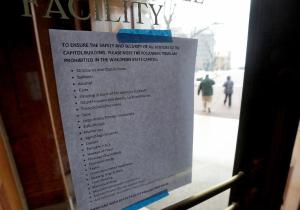
A sign on a door of the Wisconsin State Capitol building …

A sign on a door of the Wisconsin State Capitol building in Madison, Wis. indicates items prohibited …

The NFL Players Association issued a statement opposing it as well, saying right-to-work would hurt union workers at Lambeau Field where the Green Bay Packers play.

While union members were vowing to fight the measure and try to sway Republicans to vote against it, some were resigned to defeat given GOP majorities and Walker's support.

"I think it's inevitable," said Sally Feistel, a United Steelworkers union leader from Menasha.

GOP ends right-to-work hearing early, enraging unions - Yahoo News

Obama Vetoes Keystone XL Pipeline Bill - NYTimes.com

By CORAL DAVENPORT and MICHAEL D. SHEARFEB. 24, 2015

WASHINGTON — President Obama on Tuesday vetoed a bill to approve construction of the Keystone XL oil pipeline, rejecting an effort by Republicans and some Democrats to force his administration to let the highly contested energy project move forward.

By saying no to the legislation, Mr. Obama retains the authority to make a final judgment on the pipeline on his own timeline. The White

House has said the president would decide whether to allow the pipeline when all of the environmental and regulatory reviews are complete.

But the veto — his first rejection of major legislation as president — is also a demonstration of political strength directed at Republicans who now control both chambers of Congress. Mr. Obama is signaling that he will fight back against their agenda.

The Obama administration must decide whether to approve infrastructure projects like the Keystone pipeline, which cross a border with another country.

Since 2011, the proposed Keystone pipeline, which would deliver up to 800,000 barrels daily of heavy petroleum from the oil sands of Alberta to ports and refineries on the Gulf Coast, has emerged as a broader symbol of the partisan political clash over energy, climate change and the economy.

Obama Vetoes Keystone XL Pipeline Bill - NYTimes.com

Monday, February 23, 2015

GOP lawmakers will have to defend Rauner's budget to constituents : Politics


Gov. Bruce Rauner put Republicans representing downstate legislative districts in a sticky wicket with his budget speech on Wednesday.

While the rookie chief executive laid out a road map for correcting Illinois' long-festering budget imbalance, he did it by, in part, calling for reductions in pensions for state workers, university employees and public school teachers. On top of that, he outlined a plan to make these public servants pay more for their health insurance.

Most downstate Republicans represent areas filled with thousands of these workers, spelling trouble for when they return to their districts to try and explain whether they support their own governor's plans.

Among the people they will have to face is Tracy Freeman, a high school social studies teacher who works at Normal West High School in McLean County.

Her take on Rauner's proposal: "It's unbelievable to me."

As Freeman sees it, Rauner's push to limit retirement pay for teachers will send the wrong message to the people who are charged with educating Illinois youngsters.

"I think he's doing everything he can to push dedicated teachers out," Freeman said.

And, she added, "I don't know if I could tell my students to go into education."

"I feel it's a complete disconnect with what's going on in the public schools," Freeman said. "I really am in disbelief."

"I really hope that our more local and more frequently elected politicians will stand up to him," Freeman said. "We have local representatives who have always listened to our students and genuinely are interested in our local schools."

That wasn't exactly the type of message being spread by at least one downstate Republican in the aftermath of Rauner's speech Wednesday.

Here's what state Sen. Chapin Rose, R-Mahomet, had to say in a statement he issued:

“Over half a decade ago, I called for an immediate 5 percent across the board cut to the state budget, but no one listened. Not only did no one listen, they increased spending, created new programs, and spent wildly out of control. It was unsustainable and the day of reckoning is here.

"Governor Rauner hit the hard facts head on and didn’t sugarcoat this in today’s speech. For example, Governor Quinn last year promised higher education over a billion dollars in funding. To date, very little of that has been paid because the money didn’t exist in the first place.

"Governor Rauner was truthful about our reality. Importantly, though, he also discussed necessary reforms to government to cut the waste, fraud and abuse — reforms that if implemented, will allow us to restore some of the more draconian leftovers of the Quinn/Blagojevich years.”

Here's guessing that Rose is going to hear an earful in the coming weeks

BEHIND CLOSED DOORS: Budgets are not just random, robotic spreadsheets that outline how your tax dollars are going to be spent.

They are political documents too. Governors and members of the Legislature can put their stamp on parts of the spending plan, diverting money to pet projects and funneling money away from programs they don't like.

That's why one part of Rauner's budget proposal caught my eye.

In the section reserved for state construction projects, Rauner is proposing to buy doors for Attorney General Lisa Madigan's office.

Apparently, there are many assistant attorney generals who are assigned offices in the state's main office building in Chicago that do not have doors. This can be a problem when they conduct confidential discussions.

"There is a need to improve the level of privacy and more effectively safeguard sensitive materials," budget documents note.

Perhaps Rauner is trying to curry favor with the attorney general after he proposed zapping 10 percent of her budget, 10 percent of her father's budget as head of the House Democratic caucus, and 20 percent of her mom's budget, as chairwoman of the Illinois Arts Council.

THE REVOLVING DOOR: In December, after the unexpected death of Republican Comptroller Judy Baar Topinka, Rauner called for her chief of staff, Nancy Kimme, to step in and serve as her replacement.

In January, the governor issued an executive order saying state employees should be banned from taking lobbying jobs for one year after they leave state government.

Last week, we learned that Kimme is leaving her job at the comptroller's office. To become a lobbyist.

The more things change ...

GOP lawmakers will have to defend Rauner's budget to constituents : Politics

Rent walkouts point to strains in U.S. farm economy | Reuters


Across the U.S. Midwest, the plunge in grain prices to near four-year lows is pitting landowners determined to sustain rental incomes against farmer tenants worried about making rent payments because their revenues are squeezed.

Some grain farmers already see the burden as too big. They are taking an extreme step, one not widely seen since the 1980s: breaching lease contracts, reducing how much land they will sow this spring and risking years-long legal battles with landlords.

The tensions add to other signs the agricultural boom that the U.S. grain farming sector has enjoyed for a decade is over. On Friday, tractor maker John Deere (DE.N) cut its profit forecast citing falling sales caused by lower farm income and grain prices.

Many rent payments – which vary from a few thousand dollars for a tiny farm to millions for a major operation – are due on March 1, just weeks after the U.S. Department of Agriculture (USDA) estimated net farm income, which peaked at $129 billion in 2013, could slide by almost a third this year to $74 billion.

Rent walkouts point to strains in U.S. farm economy | Reuters