Showing posts with label Republican Candidates for President. Show all posts

Wednesday, October 28, 2015

House passes budget deal, Senate expected to act soon - The Washington Post


Congress on Wednesday moved a step closer to clearing a bipartisan budget deal that would boost spending for domestic and defense programs over two years while suspending the debt limit into 2017.

The House passed the bill on a 266 to 167 vote late Wednesday and Senate leaders have promised to quickly move it through the upper chamber.

The agreement would essentially end the often contentious budget battles between congressional Republicans and President Obama by pushing the next round of fiscal decision making past the 2016 election when there will be a new Congress and White House occupant.

House Republican leaders unveiled the proposal earlier this week and immediately faced challenges from conservatives upset over both the secretive negotiations that led to the agreement as well as the policies contained in the bill.

Some of this discontent was dealt with after a change was made to the bill late Tuesday night to ensure that the full cost of the $80 billion in new discretionary spending was offset by an equal amount of mandatory spending cuts and increased revenue.

Some Republicans raised concerns  earlier Tuesday that the bill fell about $4 billion short of this goal, but the Congressional Budget Office on Wednesday reported that the changes to the legislation had closed this gap.

Senior Republicans came forward ahead of the vote to support the legislation and encourage others to join them. House Armed Services Committee Chairman Mac Thornberry (R-Texas) said the bill would benefit the military and prevent the threat of another shutdown.

“It stops the cuts in defense, it increases the money going to our troops and it prevents them from being used as a bargaining chip in the future,” Thornberry said. “I think that is the sort of stability and predictability they need and that they deserve.”

Still, many House Republicans remained opposed to the deal and only 79 voted in favor of the deal while 187  Democrats supported the bill on the floor.

The agreement would lift the so-called sequester spending caps to increase discretionary spending by about $80 billion over two years, an amount that would be split equally among defense and domestic programs. To offset this cost, negotiators tapped a number of sources, including by making changes to Medicare and Social Security, auctioning off spectrum controlled by the government, selling crude oil from the Strategic Petroleum Reserve and tightening tax rules for business partnerships.

In addition, the legislation would limit a historic premium increase for Medicare Part B beneficiaries set to go into effect next year for services like hospital care and doctor visits. The agreement also would prevent a potential 20 percent across-the-board cut to Social Security Disability Insurance benefits that is also set to take place next year, by transferring some funding from the main Social Security fund and making changes to the program. These cost-saving changes include allowing some recipients who can still work to receive partial payments while earning outside income and expanding a program requiring a second medical expert to weigh in on whether an applicant is truly disabled.

Senate leaders want to move the bill quickly — the Treasury Department estimates the deadline for raising the debt ceiling is Nov. 3 — and a tax bill that already passed the House is being used as the vehicle for the agreement in order to speed up the procedural process in the upper chamber.

Presidential candidate Sen. Rand Paul (R-Ky.) said Tuesday that he plans to filibuster the bill, but his chances of slowing down passage are limited.

The agreement will have to clear one procedural hurdle with at least 60 votes before it can be approved by a simple majority. At most Paul could briefly delay the final vote by refusing to allow leaders to cut off debate before the maximum 30 hours allowed under Senate rules have expired.

The final Senate vote could come as early as this week.

Attempts to do away with two of the thorniest problems facing the House GOP — setting spending levels and raising the debt ceiling — come as Republicans on Wednesday nominated Rep. Paul D. Ryan (R-Wis.) to replace John Boehner (R-Ohio), who is resigning from Congress this week, as speaker of the House.

House passes budget deal, Senate expected to act soon - The Washington Post

Saturday, October 10, 2015

Ben Carson–as described by Wikipedia, the free encyclopedia

image

Early life

Carson was born in Detroit, Michigan, the son of Sonya (née Copeland) and Robert Solomon Carson, a Seventh-day Adventist minister.[4] Both his parents came from rural Georgia.[4] The results of a DNA test on the television series African American Lives estimated his ancestry as 20% European and 80% African, including ancestors within the Makua people.[5] His parents divorced when he was eight, and he and his ten-year-old brother Curtis were raised by their mother.[6]

In his book Gifted Hands, Carson relates that in his youth, he had a violent temper. Once, while in the ninth grade, he nearly stabbed a friend during a fight over a radio station.[7] After this incident, he began reading the Book of Proverbs, applying verses on anger and thereafter "never had another problem with temper".[8][9][10]

Carson attended Southwestern High School in Southwest Detroit where he excelled in JROTC, a program sponsored by the United States Armed Forces. He quickly rose in rank and was offered an appointment to West Point,[11] but never went on to serve in the military.[12]

Carson graduated from Yale University, where he majored in psychology.[13] He received his M.D. from the University of Michigan Medical School,[14][15] and completed his residency in neurosurgery at Johns Hopkins Hospital in Baltimore.[16]

Medical career

Carson was a professor of neurosurgery, oncology, plastic surgery, and pediatrics, and he was the director of pediatric neurosurgery at Johns Hopkins Hospital.[17] At 33, he became the youngest major division director in the hospital's history as director of pediatric neurosurgery. He was also a co-director of the Johns Hopkins Craniofacial Center.

Carson specialized in traumatic brain injuries, brain and spinal cord tumors, achondroplasia, neurological and congenital disorders, craniosynostosis, epilepsy, and trigeminal neuralgia.[17]

Carson believes his hand–eye coordination and three-dimensional reasoning made him a gifted surgeon.[18] After medical school, he became a neurosurgery resident at Johns Hopkins Hospital. He began his career as a neurosurgeon, but also developed an interest in pediatrics.[18]

In 1987, Carson successfully separated conjoined twins, the Binder twins, who had been joined at the back of the head (craniopagus twins). The 70-member surgical team, led by Carson, worked for 22 hours. Both twins survived.[19][20][21]

Carson figured in the revival of the hemispherectomy, a drastic surgical procedure in which part or all of one hemisphere of the brain is removed to control severe pediatric epilepsy. He refined the procedure in the 1980s, encouraged by John M. Freeman,[22] and performed it many times.[23][24]

Carson has served on the boards of the Kellogg Company, Costco, and the Academy of Achievement.[25] He is an emeritus fellow of the Yale Corporation.[25][26][27]

In March 2013, Carson announced he would retire as a surgeon, stating "I'd much rather quit when I'm at the top of my game".[28] His retirement became official on July 1, 2013.[29]

Awards and honors

Carson is a member of the American Academy of Achievement,[30] Alpha Omega Alpha Honor Medical Society,[31] and the Horatio Alger Association of Distinguished Americans.[32] Carson has been awarded 38 honorary doctorate degrees and dozens of national merit citations.[33] Detroit Public Schools opened the Dr. Benjamin Carson High School of Science and Medicine[34] for students interested in pursuing healthcare careers. The school is partnering with Detroit Receiving Hospital and Michigan State University.[35]

Writing

Carson is the author of many articles in peer-reviewed journals. He has also written six bestselling[48] books published by Zondervan, an international Christian media and publishing company. The first book is an autobiography, and two are about his personal philosophies of success (hard work, faith).

On July 8, 2013, Carson joined The Washington Times as a weekly opinion columnist. He also writes for American CurrentSee, an online publication for conservative African-Americans.[49]

Political affiliation and views

Carson said in 2013 that he was not a member of any political party.[50] However, he joined the Republican Party on November 4, 2014, the day the 2014 midterms took place, as "truly a pragmatic move" because he was considering running for president in 2016.[51] In his book America the Beautiful, he explained his decision to enter politics: "I believe it is a very good idea for physicians, scientists, engineers, and others trained to make decisions based on facts and empirical data to get involved in the political arena".[52][53]

Abortion and human fetal tissue

Carson has stated that he is pro-life.[54] After news about Planned Parenthood and undercover videos[55] revealed executives in the organization discussing the extraction and distribution of tissue from aborted fetuses, he condemned the videos and stated to Fox News, "there's nothing that can’t be done without fetal tissue."[56] Soon after, it was revealed[57] he had previously done research where the doctors applied, "human choroid plexus ependyma and nasal mucosa from two fetuses aborted in the ninth and 17th week of gestation."[58] He was interviewed, after the research was identified, in order to resolve the apparent conflict by stating to the Washington Post, "If you’re killing babies and taking the tissue, that’s a very different thing than taking a dead specimen and keeping a record of it".[59]

Cannabis legalization

Carson is against the legalization of recreational cannabis. He believes it to be a gateway drug that leads to more serious drug use.[60][61][62]

Economy and taxes

Carson has suggested that the U.S. abandon its current tax system in favor of a flat tax, arguing that a flat tax would eliminate loopholes and cheating. During a debate on September 15, 2015, Carson called progressive taxation, "socialism."[63] Carson has also advocated for a national luxury tax on "very expensive items".[64][65] Carson believes in raising the minimum age to receive Social Security benefits, "because people are living longer, straining the solvency of the program".[66]

Gun control

Carson stated in a 2013 interview with Glenn Beck that semi-automatic firearms should be better regulated in large cities and high-crime areas.[67] This statement has caused some with conservative views on gun control to question if his views were at odds with most conservatives. Later, clarifying that "This isn’t any evolution of my views, just that I’ve learned how to express myself," he stated that he is strongly in favor of the Second Amendment and that while guns being used on innocent people "is horrible," it "is not nearly as horrible as having a population that is defenseless against a group of tyrants who have arms. And that is what we have to bear in mind."[68] He also said that if in a position of national authority, he would allow citizens to own any weapons, including automatic and semi-automatic guns, that they could buy[69] and that he would not support any efforts to restrict the Second Amendment.[70]

Healthcare
Affordable Care Act

On October 11, 2013, Carson spoke at the conservative Values Voters Summit in Washington, D.C., where he called the Affordable Care Act (ACA) "the worst thing that has happened in this nation since slavery," further adding that it is a form of slavery because it "[makes] all of us subservient to the government." He claimed that the ideology behind the ACA originated with Vladimir Lenin, and quoted Lenin as saying that "socialized medicine is the keystone to the establishment of a socialist state".[71] There is no evidence that Lenin actually said this, but the purported quote appears on a number of conservative websites.[72][73] After an onslaught of criticism, Carson denied that he was "equating Obamacare with slavery" in an October 15 Washington Times column and denounced the "PC police" for attempting "to discredit and... silence" him.[74] During the National Prayer Breakfast, Carson said about the ACA: "Here's my solution. When a person is born, give him a birth certificate, an electronic medical record and a health savings account [HSA]".[75]

Criticism of health insurance companies

In a 2009 interview, Carson said that he found the "concept of for-profits for the insurance companies" absurd. He continued, "The first thing we need to do is get rid of for-profit insurance companies. We have a lack of policies and we need to make the government responsible for catastrophic health care. We have to make the insurance companies responsible only for routine health care."[76][77]

In 2014, Carson wrote in support of expanded use of health savings accounts, plus a system "similar to Medicare and Medicaid" to address "complex pre-existing or acquired maladies".[78] More generally, his position is that, "we need to remove health care from the political arena and recognize that any government proposals affecting the health of all citizens should be free market-based and should be so appealing that it would not be necessary to force citizens into the program."[79]

End-of-life care

In 1992, Carson wrote that aging and technological advancement will eventually lead to many people surviving their 100th birthdays.[80] He questioned the merits of prolonging life, citing the fact that "up to half of the medical expenses incurred in the average American's life are incurred during the last six months of life". He discussed the "dignity of dying in comfort, at home, with an attendant if necessary". Carson also stated: "Decisions on who should be treated and who should not be treated would clearly require some national guidelines... If a patient insisted on having everything done, consideration of more aggressive treatment should be given."[77][80][81] In January 2015, Carson stated that his views have evolved since 1992.[82][83]

Immigration

In the Washington Times, Carson wrote: "Once illegals have legal status, it will be difficult to deny them any of the multitudinous entitlements that are freely distributed throughout our society." Nevertheless, Carson believes that illegal immigrants should be able to register as guest workers and have a pathway to apply for permanent resident status.[66]

Religion

See also: Seventh-day Adventist theology

Evolution and creationism

Ben Carson endorses Seventh-day Adventist theology, which includes belief in a literal reading of the first chapters of Genesis.[84]

Carson's views on evolution and creationism have been controversial.[85] In a 2006 debate with Richard Dawkins, Francis Collins, and Daniel Dennett, Carson stated: "I don't believe in evolution... I simply don't have enough faith to believe that something as complex as our ability to rationalize, think, and plan, and have a moral sense of what's right and wrong, just appeared."[86] In 2012, nearly 500 professors, students, and alumni of Emory University wrote a letter expressing concern about his views in advance of his commencement speech. They cited a quote in an interview with the Adventist Review: "By believing we are the product of random acts, we eliminate morality and the basis of ethical behavior."[87] Carson clarified:

Those of us who believe in God and derive our sense of right and wrong and ethics from God's word really have no difficulty whatsoever defining where our ethics come from. People who believe in survival of the fittest might have more difficulty deriving where their ethics come from. A lot of evolutionists are very ethical people.[85]

In a 2012 address to a Seventh-day Adventist audience, Carson discussed creationism and the Big Bang theory. He applied a junkyard tornado argument to the theory, and said it contradicts the second law of thermodynamics.[88] He argued that retrograde orbits in the solar system are inconsistent with conservation of angular momentum, which he said invalidates the Big Bang theory. Lawrence Krauss argues that, as Carson argues that Muslim candidates should be subjected to scrutiny about their religious beliefs, he too deserves scrutiny for how his worldview is inconsistent with the consensus of scientific information.[84]

Separation of church and state and Islam

In a 2014 op-ed article, Carson argued that separation of church and state in the First Amendment Establishment Clause has been "reinterpreted" by progressives away from its original intent, and that "our Judeo-Christian values have taken a big hit in recent years, we have not yet reached the point of a totally godless government".[89][90][91]

During a 2015 Meet the Press interview Chuck Todd asked Carson "Should a President's faith matter [to voters]?".[92] Carson stated, "I guess it depends on what that faith is. If it's inconsistent with the values and principles of America, then of course it should matter. But if it fits within the realm of America and consistent with the Constitution, no problem." When asked by Todd whether he believes Islam is consistent with the Constitution, Carson said: "No, I don't – I do not." He further stated, "I would not advocate that we put a Muslim in charge of this nation. I absolutely would not agree with that." He considers a Muslim running for Congress to be "a different story," however, saying that it would depend on who the Muslim is as well as their policies, just like it would be with any other person.[93]

Marriage and homosexuality

In March 2013, Carson described his views about same-sex marriage on Hannity, saying: "Marriage is between a man and a woman. No group, be they gays, be they NAMBLA, be they people who believe in bestiality, it doesn't matter what they are. They don't get to change the definition."[94] Carson's comments drew criticism for using "gays" in the same sentence as pedophiles and practitioners of bestiality. A group of Hopkins students petitioned that he be replaced as the university's commencement speaker.[94][95]

Several days later, Carson withdrew as Hopkins's commencement speaker and apologized, saying that "the examples were not the best choice of words", adding that the Bible "says we have an obligation to love our fellow man as ourselves, and I love everybody the same—all homosexuals".[95][96] He said on CNN that he loved all people, whether gay or straight.[94] Carson added, "I was trying to say that as far as marriage was concerned, it has traditionally been between a man and a woman and no one should be able to change that."[97]

In October 2014, Carson was added to the Southern Poverty Law Center (SPLC)'s extremist watch list because of his association with groups considered by SPLC to be extremist in nature, "linking gays with pedophiles", and his comparison of health care and liberal government to slavery and totalitarianism.[98][99] In February 2015, the SPLC removed his name and apologized to Carson,[100][101][102][103][104][105] stating:

"In October 2014, we posted an 'Extremist File' of Dr. Ben Carson. This week, as we've come under intense criticism for doing so, we've reviewed our profile and have concluded that it did not meet our standards, so we have taken it down and apologize to Dr. Carson for having posted it. We've also come to the conclusion that the question of whether a better-researched profile of Dr. Carson should or should not be included in our 'Extremist Files' is taking attention from the fact that Dr. Carson has, in fact, made a number of statements that express views that we believe most people would conclude are extreme."[106]

In a March 2015 interview with Chris Cuomo, Carson stated that homosexuality was "absolutely" a choice, claiming that "a lot of people go into prison straight, and when they come out, they're gay".[107] In a Facebook post, Carson apologized, saying that he "[does] not pretend to know how every individual came to their sexual orientation."[108][109] In a Facebook post, Carson said that he supports civil unions for gay couples and that he has "for many years".[110]

National Prayer Breakfast speech on social and fiscal issues

Carson was the keynote speaker at the February 7, 2013 National Prayer Breakfast.[111] In his speech, he commented on political correctness ("dangerous", because it goes against freedom of expression), education, health care, and taxation. Regarding education, he spoke favorably about graduation rates in 1831, when Alexis de Tocqueville visited the United States, and when "anybody finishing the second grade was completely literate". He espoused the idea of a tax-exempt health savings account created at birth, that can be bequeathed at death, along with an electronic medical record and birth certificate. He supports a flat tax, which he calls the "proportional tax" in reference to the biblical tithe.[112]

At the White House in 2008 for an award.

The speech garnered Carson considerable attention because the event is normally apolitical in nature, and the speech was critical of the philosophy and policies of President Barack Obama, who was sitting 10 feet away.[113] Conservative commentators from Rush Limbaugh to Sean Hannity and Neil Cavuto of Fox News praised the speech as an example of speaking "truth to power". The Wall Street Journal titled one of its op-eds "Ben Carson for President".[114] Columnist Star Parker wrote that he "owes no apology for honest talk".[115] Fox contributor Cal Thomas and commentator Bob Beckel, however, found his comments inappropriate.[116][117]

In an interview with Neil Cavuto, Carson defended himself, "Somebody has to be courageous enough to stand up to the bullies".[118] On February 8, he appeared on Hannity, and said that he would run for president "If the Lord grabbed me by the collar and made me do it".[119]

After the speech, Carson said: "I don't think it was particularly political...You know, I'm a physician".[120] Regarding the policies of President Obama, he said: "There are a number of policies that I don't believe lead to the growth of our nation and don't lead to the elevation of our nation. I don't want to sit here and say all of his policies are bad. What I would like to see more often in this nation is an open and intelligent conversation".[120]

In the National Review, Jonah Goldberg compared Carson to Booker T. Washington,[121] while David Graham compared him to Herman Cain without the "personal skeletons" in The Atlantic.[122]

Carson's sudden popularity among conservatives led to him being invited as a featured speaker at the 2013 Conservative Political Action Conference (CPAC). He tied for seventh place in the Washington Times/CPAC 2013 Straw Poll with 4% of the 3,000 ballots cast.[123][124] In the 2014 CPAC straw poll, he came in third place with 9% of the vote, behind senators Ted Cruz of Texas (with 11%) and Rand Paul of Kentucky (31%).[125]

Carson had a strong showing in the polls at the 2013 and 2014 Values Voter Summits: in 2013, he tied with former Pennsylvania senator Rick Santorum for second place with 13%, behind Ted Cruz's 42%. In 2014, he took 20% of the Values Voter Summit vote to Cruz's 25% and came in first place for the vice presidential poll.[126][127]

2016 presidential campaign

Main article: Ben Carson presidential campaign, 2016

In January 2015, The Weekly Standard reported that the Draft Carson Committee had raised $13 million by the end of 2014, shortly after Carson performed well in a CNN/ORC poll of potential candidates in December 2014, coming in second in two different versions. He came in second with 10% behind Mitt Romney's 20%, but in the same poll with Romney removed from the list, Carson closed the gap with 11% to Jeb Bush's 14%.[128][129] The Wall Street Journal mentioned that the Draft Carson Committee had chairmen in all of Iowa's 99 counties, and that Carson had recently come in first place in two separate Public Policy polls for the state of Pennsylvania.[130][131]

On May 3, 2015, Carson confirmed his candidacy for President in an interview with a local television station in Cincinnati, Ohio. The next day, on May 4, 2015, he officially announced he was running for the Republican nomination in the 2016 Presidential election at a rally in Detroit, his hometown.[3]

Carson Scholars Fund

In 1994, Carson and his wife started the Carson Scholars Fund, which gave scholarships to students in grades 4–11 for "academic excellence and humanitarian qualities".[132] They founded it after reading that U.S. students ranked second to last in terms of math and science testing among 22 countries. They also noticed that schools awarded athletes with trophies whereas honor students only received "a pin or certificate".

Recipients of the Carson Scholars Fund get a $1,000 scholarship towards their college education. It has awarded 6,700 scholarships.[132][133] In recognition for his work with the Carson Scholars Fund and other charitable giving throughout his lifetime, Carson was awarded the William E. Simon Prize for Philanthropic Leadership in 2005.[134]

Personal life

Carson and his wife, Lacena "Candy" Rustin, met in 1971 as students at Yale University. They married in 1975 and have three sons: Murray, Benjamin Jr., and Rhoeyce. They live in West Friendship, Maryland, and are members of the Seventh-day Adventist Church.[135][136]

Carson was baptized at Burns Seventh-day Adventist Church on Detroit's eastside. A few years later he told the pastor at a church in Inkster, Michigan he was attending that he had not fully understood his first baptism and wanted to be baptized again, so he was. He has served as a local elder and Sabbath School teacher in the Seventh-day Adventist Church.[137] His mother is a devout Seventh-day Adventist.[138]

Ben Carson - Wikipedia, the free encyclopedia

What does Presidential Candidate, Ben Carson, stand for?

Well here is his political contribution request letter says.

image

Dear Reader,

I dedicated my life to helping children, and because I retired from medicine doesn't mean that mission is over.

I'm running for President so our children and grandchildren have the opportunity to think big, pursue happiness, and reach their full, God-given potential.

From the beginning, the Washington political class has said only someone with decades of "political experience" can be elected President.

I believe differently. So did our Founding Fathers. And now that I am leading in the polls, the American people do as well.

My campaign is built for the long haul — and I intend to win. We've received over 620,000 small grassroots donations from everyday, hardworking Americans, helping us to raise an astounding $21 million in the 3rd fundraising quarter. For a grassroots, outsider campaign this is an amazing feat, but we must keep moving forward.

Now that we've begun the 4th fundraising quarter, I ask you to join us by donating.

I didn't get into this race to lick the boots of billionaires. The only special interest group I'm interested in representing is "We the People."

As your President, I will secure the borders and enforce our laws. I will call our enemy by its name -- radical Islam -- and protect the American people. I will institute a flat tax that is simple and fair and close the special interest loopholes. I will protect religious liberty, because it's what makes America free.

Working together, I believe that our movement of "We the People" can make history and leave the Washington political class scratching their collective heads for years to come.

I hope you will decide to join me right now by making a donation.

Thank you for your support.
Sincerely,

Ben Carson

Carson America, Inc | P.O. Box 26261 |  Alexandria, VA 22313

Thursday, October 8, 2015

Election 2016: Koch Brothers Officially Back Carly Fiorina, Opening Door To Big Donations


It’s official: The influential Koch brothers have thrown their weight behind Republican presidential candidate Carly Fiorina, CNN reported Wednesday. Fiorina will gain access to a large pool of funding from conservative groups with the endorsement.

The Freedom Partners Chamber of Commerce, an umbrella organization that funds many conservative groups backed by the industrialist brothers Charles and David Koch, announced that Fiorina will be one of five candidates it backs. The group had previously backed Wisconsin Gov. Scott Walker before he dropped out of the race in September.

"Governor Jeb Bush, Carly Fiorina and Senators Ted Cruz, Rand Paul and Marco Rubio are leading a thoughtful and substantive discussion on the issues and we look forward to hearing more about their vision for the country," said James Davis, a Freedom Partners spokesman, according to CNN.

Despite backing Fiorina in her unsuccessful 2010 California Senate race against incumbent Barbara Boxer, the Koch brothers waited with their endorsement in this race. Fiorina’s own campaign manager has previously worked for the Koch group.

Election 2016: Koch Brothers Officially Back Carly Fiorina, Opening Door To Big Donations

Monday, October 5, 2015

Koch Brothers, Mega Donors Warm To Carly Fiorina


By Michelle Conlin

NEW YORK, Oct 4 (Reuters) - Carly Fiorina has emerged as the Republican candidate of the moment in conservative fundraising circles, drawing the notice of the billionaire Koch brothers and other wealthy donors who could instantly remake her shoestring presidential campaign.

Fiorina's show-stealing performance in a Republican presidential debate last month, and her subsequent surge in the polls, has prompted industrialists Charles and David Koch to take a "serious look" at the former Hewlett-Packard chief executive, according to three sources close to the brothers.

She has now moved to the short list of candidates the Kochs may support with their reported $1 billion war chest, the sources said. Florida Senator Marco Rubio is among those on the coveted list, the sources said.

A spokesman for the Kochs declined to comment

Other politically powerful mega donors are also lining up.

Texas oilman T. Boone Pickens hosted a packed luncheon at a posh Dallas venue for Fiorina in late September, while venture capitalist Tom Perkins is planning a fundraising gala in California in the next few months.

"My money is on her," said Perkins, who served on HP's board during Fiorina's tenure. "I think she could be president."

As the only woman on stage at the Sept. 16 debate, Fiorina emerged as the most effective candidate in taking on front-runner Donald Trump, chastening the celebrity real estate magnate for his controversial comments about her looks.

"The emails have not stopped" since then, said seasoned California political fundraising consultant Karolyn Dorsee, who is working on behalf of several Republican presidential candidates, including Rubio and former Florida Governor Jeb Bush. "Everybody wants her, nationwide, in every single state."

Even before her rapid rise in the polls - she has vaulted to second place in the key early voting state of New Hampshire - Fiorina had already garnered about $2 million in support from the likes of reclusive hedge fund baron Robert Mercer and former Univision CEO Jerrold Perenchio.

"SHE'S PRETTY VIABLE"

Fiorina's campaign now appears far less of a long-shot than it did over the summer, when she was struggling with sparse crowds, scant name recognition and a coffer of just $5 million that put her at the bottom of the money race.

Her campaign thus far has been a bare-bones operation, relying on a young, relatively low-paid, skeletal staff as opposed to the sprawling operations built by more well-endowed candidates like Bush.

Support from the Kochs would change her operation overnight.

"We think she's pretty viable," said broadcasting billionaire Stanley Hubbard, a member of the Koch brothers' network of conservative advocacy groups who donates heavily to political candidates.

The Kochs have been keeping a close eye on Fiorina ever since she announced in May, the Koch sources said. They extended an invite to her to speak at their exclusive summit of rich donors at an oceanfront luxury resort in August along with Rubio, Bush, Wisconsin Governor Scott Walker, and Texas Senator Ted Cruz.

Fiorina, the lowest polling candidate at the gathering, impressed the big money attendees with her mastery of policy detail and heavyweight stage presence. "She's good in the room," said one participant at the event, who declined to be named.

The Fiorina campaign, and the independent fund-raising Super PAC supporting her, declined comment.

The Kochs, who own America's second-largest private company, have backed Fiorina in the past, notably when she ran unsuccessfully against incumbent Democrat Barbara Boxer for her California Senate seat in 2010.

At the time, the Kochs had helped mount a campaign for Proposition 23, a ballot measure designed to suspend the state law banning higher carbon emissions that was ultimately defeated.Fiorina also supported the measure. A Koch Industries PAC helped sponsor a Washington fundraiser for Fiorina at the time and gave $10,000 to her campaign.

As Fiorina's money problems fade, some high dollar donors who have already contributed are now considering doubling down. Dallas philanthropist Elloine Clark has so far written one $100,000 check to the Super PAC supporting Fiorina. She says she may give more. "I think she's unflappable," said Clark. "And she doesn't react like an adolescent." (Reporting By Michelle Conlin; Additional reporting Emily Stephenson in Washington, D.C.; Editing by Paul Thomasch and Ross Colvin)

Koch Brothers, Mega Donors Warm To Carly Fiorina

Saturday, October 3, 2015

Voodoo Never Dies - The New York Times Opinion Piece on Tax Cuts

Paul Krugman

So Donald Trump has unveiled his tax plan. It would, it turns out, lavish huge cuts on the wealthy while blowing up the deficit.

This is in contrast to Jeb Bush’s plan, which would lavish huge cuts on the wealthy while blowing up the deficit, and Marco Rubio’s plan, which would lavish huge cuts on the wealthy while blowing up the deficit.

For what it’s worth, it looks as if Trump’s plan would make an even bigger hole in the budget than Jeb’s. Jeb justifies his plan by claiming that it would double America’s rate of growth; The Donald, ahem, trumps this by claiming that he would triple the rate of growth. But really, why sweat the details? It’s all voodoo. The interesting question is why every Republican candidate feels compelled to go down this path.


You might think that there was a defensible economic case for the obsession with cutting taxes on the rich. That is, you might think that if you’d spent the past 20 years in a cave (or a conservative think tank). Otherwise, you’d be aware that tax-cut enthusiasts have a remarkable track record: They’ve been wrong about everything, year after year.

Every weekday, get thought-provoking commentary from Op-Ed columnists, The Times editorial board and contributing writers from around the world.

Some readers may remember the forecasts of economic doom back in 1993, when Bill Clinton raised the top tax rate. What happened instead was a sustained boom, surpassing the Reagan years by every measure.

Undaunted, the same people predicted great things as a result of George W. Bush’s tax cuts. What happened instead was a sluggish recovery followed by a catastrophic economic crash.

Most recently, the usual suspects once again predicted doom in 2013, when taxes on the 1 percent rose sharply due to the expiration of some of the Bush tax cuts and new taxes that help pay for health reform. What happened instead was job growth at rates not seen since the 1990s.

Then there’s the recent state-level evidence. Kansas slashed taxes, in what its right-wing governor described as a “real live experiment” in economic policy; the state’s growth has lagged ever since. California moved in the opposite direction, raising taxes; it has recently led the nation in job growth.

True, you can find self-proclaimed economic experts claiming to find overall evidence that low tax rates spur economic growth, but such experts invariably turn out to be on the payroll of right-wing pressure groups (and have an interesting habit of getting their numbers wrong). Independent studies of the correlation between tax rates and economic growth, for example by the Congressional Research Service, consistently find no relationship at all. There is no serious economic case for the tax-cut obsession.

Still, tax cuts are politically popular, right? Actually, no, at least when it comes to tax cuts for the wealthy. According to Gallup, only 13 percent of Americans believe that upper-income individuals pay too much in taxes, while 61 percent believe that they pay too little. Even among self-identified Republicans, those who say that the rich should pay more outnumber those who say they should pay less by two to one.


So every Republican who would be president is committed to a policy that is both demonstrably bad economics and deeply unpopular. What’s going on?

Voodoo Never Dies - The New York Times

Monday, September 28, 2015

Sanders jabs Koch brothers over Walker exit | TheHill


Sen. Bernie Sanders (I-Vt.), a 2016 Democratic presidential hopeful, on Sunday took a jab at the Koch brothers over their support of Wisconsin Gov. Scott Walker, who dropped out of the GOP race last week.

ADVERTISEMENT

Sanders said money controls politics, despite the well-funded Walker's exit from the race.

"I wish the Koch brothers would say, ‘Well, gee, now we can take the $900 million that we planned to spend in this campaign supporting right-wing Republicans… and we’re not going to spend it,’” Sanders said on CBS’s “Face the Nation” on Sunday. “But, John, I’m not sure that the Koch brothers learned that lesson.”

The self-identified Democratic socialist took Jeb Bush to task for saying people vote for “free stuff.”

“Well, let’s be clear that what Jeb Bush is proposing are massive tax breaks for the richest people in this country, while he will fight to cut social security and Medicare and programs that tens of millions of elderly people and middle-class people and working-class people depend upon,” Sanders said.

“I happen to believe, John, that in a democratic, civilized society, all people should be entitled to healthcare as a right – yeah, I do believe that.”

Bush had described the Democratic Party platform as buying voters with "free stuff."

Sanders also called for public colleges and universities to be tuition free and said the wealthy will have to pay “substantially more in taxes.”

Sanders jabs Koch brothers over Walker exit | TheHill

Wednesday, September 23, 2015

Ben Carson argued evolution was 'encouraged by' Satan | MSNBC


By Steve Benen

A few years ago, then Rep. Paul Broun (R-Ga.) delivered some rather amazing remarks in which he described pillars of modern science – including evolutionary biology and the big bang – as quite literally “lies straight from the pit of Hell.”

House GOP leaders made Paul Broun a member of the House Science Committee.

As it turns out, the same year, Republican presidential hopeful Ben Carson delivered remarks that were strikingly similar. BuzzFeed reported yesterday:

In a speech delivered in 2012, Ben Carson said the big bang theory was part of the “fairy tales” pushed by “high-faluting scientists” as a story of creation.

Similarly, Carson, a noted creationist, said he believed the theory of evolution was encouraged by the devil.

I wish I could say that’s an exaggerated description, but it’s really not. The retired right-wing neurosurgeon, known for his off-the-wall ideas about a great number of issues, called the science surrounding the big bang “ridiculous,” and added in reference to evolution, “I personally believe that this theory that Darwin came up with was something that was encouraged by the adversary.”

In context, “the adversary” appears to refer to Satan.

Addressing his bizarre views yesterday, the GOP presidential hopeful said, “I’m not gonna denigrate you because of your faith and you shouldn’t denigrate me for mine. And that’s the kind of attitude, you know – that’s the kind of attitude that I think is very important in the society in which we live today.”

It’s an unsatisfying response because it misses the point of what makes revelations like these significant. A leading national candidate, who’s asking Americans to trust his judgment, has ridiculous ideas about a demon shaping our understanding of modern biology. It’s the sort of the thing that, for some in the reality-based community, is a disqualifying characteristic for someone seeking the world’s most important job.

Carson seemed to suggest yesterday that his bizarre beliefs are somehow off-limits. To notice a presidential candidate’s weird ideas, he says, is to “denigrate” the man who talked about those ideas publicly.

It’s treating faith as some kind of trump card – as if prominent public figures who denigrate science (and scientists) should be left alone because of their religious motivations, regardless of the disservice they’re doing to the discourse.

Campaigns for national leadership don’t, and can’t, work this way.

Explore:

The MaddowBlog, Ben Carson, Creationism, Election 2016 and Elections

Ben Carson argued evolution was 'encouraged by' Satan | MSNBC

Enjoy it while it lasts, Mr. Trump: The GOP power brokers who’ll decide when the show is over - Salon.com


The Koch brothers haven't spent the last 30 years consolidating their power just to let an unanointed candidate win

David Brock

Donald Trump has good reason to feel confident after last week’s debate.

After all, he seems incapable of saying anything so inflammatory or dumb that it turns the Republican base against him. Indeed, even after being upbraided by Carly Fiorina for his ugly personal attacks, he continues to lead all polls.

The Republican establishment is hoping that someone will emerge to stop Trump. The Koch brothers’ favorite, Scott Walker, is now out of the running for the job. Tellingly, in his swan song, the Koch’s messenger boy called on the GOP to rally around an anti-Trump strategy. But efforts by party leaders to date to rein in Trump have only made him more powerful.

With Walker’s implosion, the Kochs aren’t looking especially fearsome in this week’s news cycle. That said, Trump should make sure to enjoy this moment while it lasts. Because when the Kochs – the GOP’s true power brokers – decide it’s time to put an end to this show, Trump’s bubble is likely to burst faster than he (or, in this case, the Kochs) can say, “You’re fired.” For all of Trump’s bluster,  Charles and David Koch are the alpha dogs of the Republican Party. And the only thing more implausible than Trump’s hair is the notion that he can beat them at their own game.

As I detail in my new book, “Killing the Messenger,” the Koch brothers have spent the last 30 years (and hundreds of millions of dollars) consolidating their control over our political system via what Charles has called a “vertically and horizontally integrated” strategy – in his words, the Kochs have their hands in everything “from idea creation to policy development to education to grassroots organization to lobbying to litigation to political action.”

The Kochs’ state-based infrastructure helped Republicans seize control of legislatures and governors’ mansions so they could gerrymander district lines, practically ensuring a GOP majority in the House until the next census in 2020. The Kochs’ attack ad factory helped demolish the Democratic Senate majority in 2014, handing the GOP complete control of Capitol Hill. And with a Koch-approved agenda already road-tested in states like Wisconsin and North Carolina, the only thing the brothers need to complete the hijacking of our democracy is a president they can call their own.

There are plenty of candidates who still aspire to that position.  Jeb Bush’s Koch ties go back decades, pre-dating his first run for governor of Florida. Marco Rubio has taken special care to support every aspect of the Koch agenda, from opposing the Export-Import Bank to blocking a raise in the minimum wage. Ted Cruz is a longtime favorite speaker at Koch events. Even Carly Fiorina, a relative newcomer to politics, has been courting the brothers, hiring a former Koch Industries employer as her campaign manager.

One after another, these Republican candidates have strutted their stuff at private auditions for the brothers, as if they were interviewing for a job at Koch Industries (which, of course, they kind of are).

Enjoy it while it lasts, Mr. Trump: The GOP power brokers who’ll decide when the show is over - Salon.com

Monday, September 21, 2015

Wisconsin Gov. Scott Walker to drop out of GOP presidential race - Chicago Tribune


Scott Walker abandoned his bid for the Republican presidential nomination on Monday, exiting the race that saw him rise to front-runner and fall to afterthought in a matter of months.

The Wisconsin governor planned a news conference for Monday evening in Madison, where he was to announce he will be the second major GOP candidate to quit the race.

"It has been communicated to me that he is getting out of the race," said Iowa state Sen. Brad Zaun, who endorsed Walker earlier this year. "I'm proud of our efforts in Iowa. And I think he's an incredible candidate. It's unfortunate."

One of the last Republicans to enter the race, Walker will join former Texas Gov. Rick Perry as one of the first to leave it, having been unable to adjust to the popularity of billionaire businessman Donald Trump or break out in either of GOP's first two debates.

He will return to his job in Wisconsin as governor, where his term runs through 2018.

"I'm not sure what went wrong," said Iowa state Sen. Mark Costello, who endorsed Walker earlier this year. "I think all the more provocative statements some of the candidates made got them more press.

"I don't think he made any really big mistakes," Costello said, "but people lost enthusiasm."

Walker, 47, tried to appeal to religious conservatives, tea party conservatives and the more traditional GOP base. He tried to cast himself as an unintimidated conservative fighter who had a record of victories in a state that hasn't voted Republican for president since 1984.

He came to the race having won election in Wisconsin three times in four years, and having gained a national following among donors and conservatives by successfully pushing his state to strip union bargaining rights from its public workers.

Walker pointed to those Wisconsin wins, in a state that twice voted for Barack Obama as president, as signs that he could successfully advance a conservative agenda as the GOP's White House nominee.

He called himself "aggressively normal" and campaigned on a Harley-Davidson motorcycle, and made a splash in January with a well-received speech before religious conservatives in Iowa.

Groups backing Walker went on to raise $26 million, tapping wealthy donors whom Walker had cultivated in his years as governor and during his successful effort to win a recall election in 2012.

But Walker's fall was dramatic. He was unable to adjust to Trump's rise and repeatedly had trouble clearly stating his position on several issues.

He took days to clarify whether he supported ending birthright citizenship. He initially showed interest in building a wall between the U.S. and Canada, only to later laugh it off as ridiculous. Walker also declared he wasn't a career politician, despite having held public office for 22 straight years.

After Trump, Ben Carson and Carly Fiorina displaced Walker at the top of the polls, Walker took a more aggressive approach, promising to "wreak havoc" on Washington. He vowed to take on unions as president, just as he did as Wisconsin governor, outlawing them for federal government workers and making the entire country right-to-work.

But the anti-union policy proposal fell flat; announced in the days before the second GOP debate, it wasn't mentioned at all — by Walker or anyone else — on stage.

While only Texas Sen. Ted Cruz and former Florida Gov. Jeb Bush had more super PAC money available to boost their chances in the original 17-person 2016 Republican field, Walker struggled to generate money for his official campaign.

He has yet to report fundraising totals to federal regulators, but top fundraisers and donors have said his plummeting poll numbers left them struggling to generate cash.

Walker called his senior staff to the governor's mansion in Madison on Monday to review recent polling, in which he was mired at the bottom of the GOP field, and his campaign's finances.

"I'm disappointed," said Stanley Hubbard, a billionaire media mogul from Minneapolis who had backed Walker's campaign. "He's a good man and would have been a good president."

As word spread of his decision to exit the race, Republican operatives in Iowa working for other campaigns were already making plans to contact state lawmakers who had committed to support Walker.

The Wisconsin governor had assembled a campaign organization in every one of Iowa's 99 counties and had a number of state lawmakers committed to him.

Walker, one of the most divisive political figures in Wisconsin history, will have some work to do repairing his relationship with voters in his home state. His job approval ratings fell dramatically during his presidential run, hitting their lowest mark ever of 39 percent in an August poll conducted by Marquette University.

Wisconsin state Assembly Speaker Robin Vos, a Republican and close ally of Walker's, said he "has an amazing story to tell about Wisconsin and the reforms we put into place."

But Vos said he suspects Walker realized he would have had a difficult time taking attention away from other candidates, like Trump, who are "sucking up a lot of the oxygen."

Associated Press

Wisconsin Gov. Scott Walker to drop out of GOP presidential race - Chicago Tribune

Scott Walker Mounts a Last Stand in Iowa - Bloomberg Politics


Whether there's another climb up the tracks isn’t likely to be known for weeks or months, as Walker deploys a new strategy that places virtually all his chips on Iowa.

The signs of his precipitous fall were all too vivid Sunday afternoon inside Serena's Coffee Café in Amana, Iowa, where about 40 stoic supporters showed up for his first retail campaign event in the state since Wednesday's debate.

Gone were most of the network television cameras that had followed Walker much of the summer. Just one network was on hand, along with one reporter-photographer from a nearby station in Cedar Rapids. A second event at a Pizza Ranch in Vinton, Iowa, brought out another small crowd, along with one local TV camera.

Walker lingered at both events, shaking virtually every hand. He'd woken Sunday morning to news that he'd fallen below 1 percent in the most recent national CNN poll, a new all-time low for his candidacy that could further rattle donors.

In an interview, Walker said he's planning to spend 10 days a month in Iowa, "maybe more." Other than "fundraising and visits to New Hampshire and South Carolina," his time will be spent in Iowa, he said.

It will be so much time, he said, that people might think he's running for governor of the state. "People are going to know us like they know their governor in this state, there's no doubt about it," he said.

Walker's swing through three Iowa counties on Sunday brought his total to 33 visited, exactly a third of the number in the state overall. He's committed to hitting all of them before the caucuses.

In the interview, Walker said his campaign is paying its bills and not deficit spending. "We're on pace to do things right," he said. "We're not going to have a 50-state strategy right now."

It was just two months ago that Walker made his first trip into Iowa as declared official presidential candidate, amid soaring poll numbers and expectations for him in the state.

On his latest Iowa swing, the fallen Iowa front-runner showed an increased willingness to draw contrasts with other candidates, including Trump, retired neurosurgeon Ben Carson and former Hewlett-Packard CEO Carly Fiorina.

"You wouldn't hire me to build condos for you in New York City, or to be a neurosurgeon, or to run HP, because that's not where my skill sets are," he said in Vinton. "But if you want someone who has got a proven track record of taking on the Washington-based special interests and winning, if that's what you want—somebody who can shake things up in Washington—then I'm tested unlike anybody else in this race."

Speaking to reporters in Amana, Walker said he's convinced the donors in his database of 350,000 supporters from all 50 states will stick with him, in part on the strength of that network. 

Asked about the latest controversy surrounding Trump's candidacy—one that started Thursday when a man at one of his rallies in New Hampshire called President Barack Obama a Muslim who is not a U.S. citizen—Walker said he would have corrected the man.

"I don't think that's accurate and I don't think that's helpful for the discussion going forward," he said, adding that if it had happened at one of his event's he would have told the man he disagreed with him.

Interviews with potential supporters at Sunday's events showed Walker's collapse in the polls is weighing on their minds, even though most said they think there's time for him to recover.

Photographer: John McCormick/Bloomberg

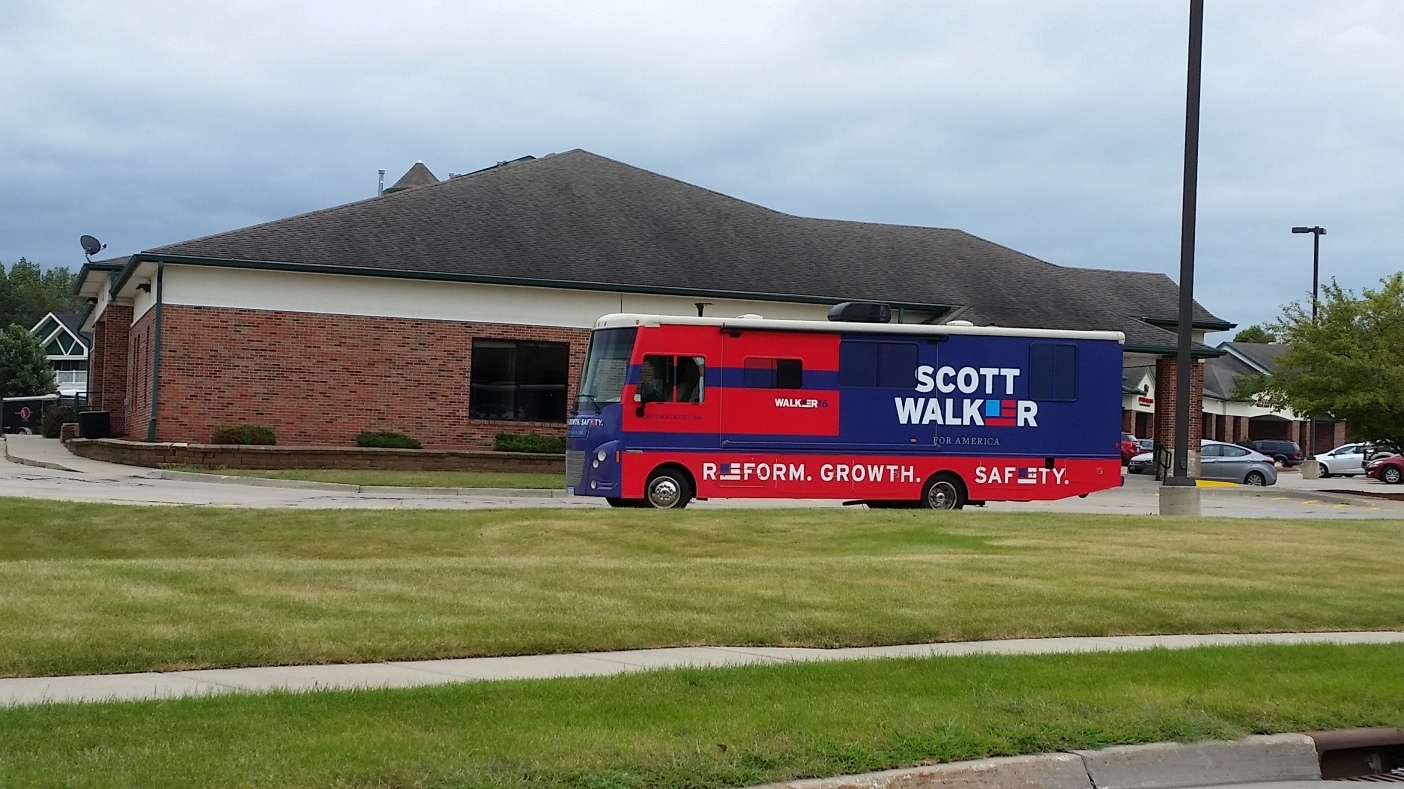
Scott Walker's tour bus waits outside his statewide campaign office earlier this summer in suburban Des Moines.

Joel McElroy, a factory worker from Belle Plaine, Iowa, said he'd likely support Walker, if he remains a candidate. "It all depends on who is still around when caucus time comes around," he said. "The field will eventually narrow down."

Earl Lanphere, a Walker support from Swisher, Iowa, said he hopes Walker "holds in there long enough" until the field narrows down and Trump loses some standing. "I'm not going to give up on him," Lanphere said of Walker.

Walker's aides argue their candidate still isn't well known in Iowa or nationally, so there's room for growth. A national Quinnipiac University poll released Aug. 27 showed 43 percent of registered Republicans haven't heard enough about him to form an opinion of him, compared to just 9 percent for Trump.

In the most recent Bloomberg Politics/Des Moines Register Iowa Poll, Walker was backed by just 8 percent of likely caucus-goers, less than half what he recorded in a late-May Iowa Poll. The only real upside for him was that he was the only candidate besides Carson to score a favorability rating above 70 percent.

As Trump has surged, Walker has been hurt more than any other candidate. Known as a disciplined campaigner in Wisconsin, he's suffered self-inflicted wounds on the national stage and turned into two debate performances that have been labeled lackluster.

Walker's focus on Iowa, even if successful, could put at risk his viability, should the nomination process drag into the spring or early summer of 2016, as Republican leaders and strategists increasingly expect. If he doesn't raise enough money to look and play like a national candidate, he might not have the resources to compete past Iowa.

As the fall campaign gets underway, Walker is getting some Iowa help from the super political action committee backing him. The Unintimidated PAC started running television spots the day after Labor Day on Walker's behalf as part of a $7 million campaign in the state.

Doug Gross, a Des Moines lawyer and Republican activist who was once Governor Terry Branstad's chief of staff, said he doesn't see a path for Walker in Iowa, given his tumble.

"He looks and acts and talks like a politician and that's not what people want," said Gross, who is neutral in the race, although also a longtime Bush family ally.

Garland S. Tucker III, a Walker donor who is chief executive of Raleigh-based Triangle Capital Corp., said he remains confident, at least for now. "I haven't given up, by any means," he said in an interview. "Sooner or later Trump's message is going to wear pretty thin."

Asked if he has a second-choice, should Walker exit the race or fail to regain any traction, Tucker said no. "I haven't found a need to do that yet," he said.

On a conference call with donors on Thursday, Walker and his team tried to calm the nerves of donors. One of the speakers was Todd Ricketts, a co-owner of the Chicago Cubs and one of Walker's two national finance chairmen. He told those on the call that their job was to "keep the gas in the Winnebago."

At least on Sunday, the gas-guzzling red and blue recreational vehicle that Walker's campaign rents for his travel in Iowa was still motoring across the state's interstates and highways.

Scott Walker Mounts a Last Stand in Iowa - Bloomberg Politics

Wednesday, September 16, 2015

The Koch Brothers' Magic Trick | Fred Wertheimer


In August, 2015, Charles and David Koch gathered their fellow billionaires and multimillionaires at a semi-annual meeting of the Koch network "to save" the country, in the words of Charles Koch.

It was not exactly the same kind of meeting that occurred in July 1776 when the Founding Fathers gathered in Philadelphia to create a nation or at Gettysburg in November 1863 when President Lincoln declared to the nation that "government of the people, by the people, for the people, shall not perish from the earth."

Charles Koch, however, apparently felt it was of comparable significance declaring to the "Super Rich" participants gathered for the meeting, and the Presidential candidates who had been summoned, that they were engaged in "a life or death struggle for our country."

Charles Koch said that if the Koch network failed to convince a "majority of Americans behind the [Koch] vision, then we're done for."

Charles Koch and his brother David Koch are each worth more than $40 billion, according to Forbes magazine. Together, they bring a combined total of more than $80 billion to their crusade "to save" the country.

According to a New York Times article (January 15, 2015), "The political network overseen by the conservative billionaires Charles G. and David H. Koch plans to spend close to $900 million on the 2016 campaign, an unparalleled effort by coordinated outside groups to shape a presidential election that is already on track to be the most expensive in history."

At the August 2015 meeting, the Koch network backed off some, stating that the $889 million would be spent on issue advocacy, education grants and political activity. Much of the issue advocacy run by groups in recent years, however, has involved campaign-related expenditures.

While no one knows just how much the Koch network will end up spending in the 2016 elections, according to the Times article, "In 2012, the Kochs' network spent just under $400 million, an astonishing sum at the time. The $889 million spending goal for 2016 would put it on track to spend nearly as much as the campaigns of each party's presidential nominee."

The Kochs could easily fund this venture by themselves, but that is not how the Kochs became the sixth and seventh richest individuals in the country, according to Forbes.

A portion of the funds they plan to spend during the 2016 election cycle will come from the Kochs' own resources. The rest of the funds will come from the billionaires and multimillionaires who help finance the Koch network.

We will not know, however, the sources and how much each gave.

That is because the Kochs operate in secret in our political system. They use nonprofit, tax-exempt groups to hide most of the donors funding their network. (Freedom Partners Action Fund, a Koch network Super PAC which discloses its donors, spent $23.4 million in the 2014 election cycle, according to the Center for Responsive Politics).

If the Kochs are successful, their investment in the 2016 election cycle will bring the two brothers extraordinary power and influence over government decisions. Since the Kochs control the spending of these massive funds -- or the delivery of the benefits - the power and influence will accrue directly to them, regardless of the other donors supporting the network.

This is a magic trick worthy of the Magic Hall Of Fame.

It is also the overriding campaign finance story of the 2016 election.

Koch Industries is the second largest privately held company in the United States, with annual revenues of $115 billion, according to Forbes. The company has economic interests in oil, natural gas, coal, chemicals, minerals, fertilizer, pulp and paper and commodities trading, among others. The stakes the company has in government policies include climate change, energy, environmental regulation, other government regulations and tax laws, among others.

This "experiment" in "democracy" is unheard of in American history. Two unelected private citizens with huge financial stakes in government actions and decisions are planning to control the spending of an unheard of amount of money in order to obtain the government they want.

The Supreme Court majority had no idea about the political shambles that would result from its 5 to 4 decision in Citizens United (or even worse, the Court majority did). The Court has given the country a new political system increasingly focused on billionaires, millionaires, Super PACs, corporations and nonprofit corporations.

At the core of the Court's new political system are the three basic elements that resulted in the historic Watergate campaign finance scandals: unlimited contributions, secret money and corporate funds.

These same elements are unfolding in the 2016 elections.

The "Super Rich" are funding, with unlimited contributions, individual-candidate Super PACs that operate as arms of the presidential candidates they support. The Super PACs have one basic purpose: to allow a presidential candidate to circumvent and thereby eviscerate the $2,700 per donor, per election, candidate contribution limit with huge contributions made to the Super PAC supporting the presidential candidate.

If the 2012 presidential election was the first year of the individual-candidate Super PAC, then the 2016 presidential election is the first year they were joined by individual-candidate nonprofit corporations - which are supposed to be "social welfare" organizations.

Eight presidential candidates are associated with these kinds of nonprofit corporations which also have one basic purpose: to allow donors to make unlimited, secret contributions to support the candidate.

Unlimited, secret contributions are the most dangerous kind of influence-buying money in American politics. They provide widespread opportunities for government corruption since they are invisible and the buyers and sellers of government actions cannot be held accountable for corrupt practices.

In the face of this corrupt system, however, citizens are not helpless.

Major campaign finance scandals resulted in effective, major reforms in the 1970s, 1990s and 2000s.

Today, we have systemic corruption in the wake of Citizens United and transactional corruption scandals are bound to follow. Ordinary Americans can fight back and win effective reforms, as they have done successfully in the past.

Fundamental changes to improve the system can be made, even in the face of the Supreme Court's destructive decision.

A reform agenda can be enacted to counter what is happening today that includes:

• A public financing system for presidential and congressional elections in which citizens choose candidates to receive public funds by providing small contributions that are matched with multiple public funds;

• New campaign finance disclosure requirements to close the gaping loopholes under which the "Super Rich" are injecting hundreds of millions of dollars in secret contributions into our elections;

• New anti-coordination restrictions to shut down individual-candidate Super PACs, and the new individual-candidate nonprofit groups, and to strengthen the coordination restrictions applicable to other outside spending groups; and

• A new, real campaign finance enforcement agency to replace the dysfunctional and failed FEC.

These changes would empower ordinary Americans by making their small contributions more valuable to candidates, dilute the impact of big money, provide an alternative way for candidates to finance their campaigns and reduce dependency on influence-seeking donors.

The changes would also end the use of individual-candidate Super PACs and nonprofits to eviscerate candidate contribution limits, end secret money in our elections and end a system where campaigns and political operatives know they can violate the campaign finance laws with impunity.

This agenda is impossible to enact today.

But campaign finance reform is always impossible to enact - until it is enacted, as it will be again.

Important work lies ahead for concerned citizens and groups to set the stage to strike when the opportunities arise. That work is currently underway in many ways, such as the 21st Century Democracy Agenda created by reform groups.

At his event last August, Charles Koch compared the efforts of the Koch network with the American Revolution, the anti-slavery movement, the women's suffrage movement and the civil rights movement.

This is an absurd comparison.

The movements described by Koch involved issues of enormous moral justice and social consequence, and sprung from ordinary Americans doing extraordinary things. They did not come from two multibillionaires rallying their fellow billionaires and multi-millionaires "to save" the nation.

The Koch brothers apparently believe it is their calling to determine what is best for more than 300 million of us.

We choose instead to go with Abraham Lincoln who said, "Government of the people, by the people, for the people, shall not perish from the earth."

Follow Fred Wertheimer on Twitter: www.twitter.com/FredWertheimer

More:

Koch Brothers Elections 2016 Campaign Finance Super PACs Charles Koch David Koch

The Koch Brothers' Magic Trick | Fred Wertheimer