Friday, January 13, 2023

A Democrat can also bring motion to vacate House Speaker

Newsweek

Newsweek


Fact Check: Can House Democrats Bring Motion to Vacate House Speaker?

Story by Tom Norton • 8h ago


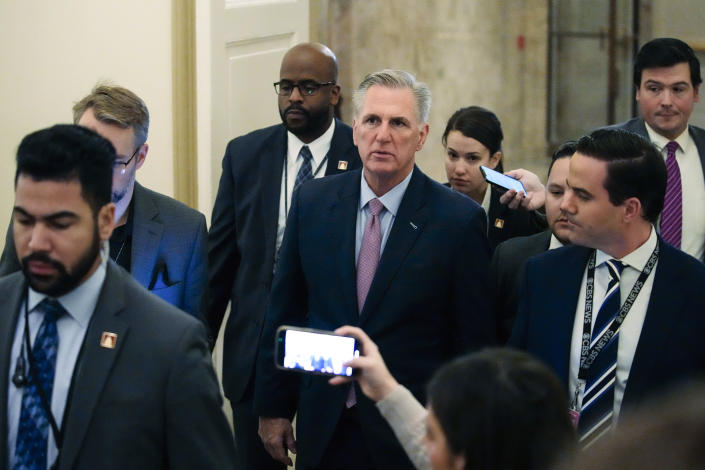
After a protracted battle between House Republicans, Rep. Kevin McCarthy (R-CA) has finally begun settling in as Speaker following a series of concessions to a faction on the right of his party.


Ad - Up Next "C-SPAN asks Kevin McCarthy to keep cameras in House full time"

C-SPAN asks Kevin McCarthy to keep cameras in House full time

McCarthy, whose ascension above the dais was halted for several days by representatives from the GOP's Freedom Caucus, led by Rep. Matt Gaetz (R-FL) and Rep. Lauren Boebert (R-CO), has spent his first week in the role introducing committee and rule changes following his deal with party colleagues.


One important concession included reducing the threshold for triggering a vote to remove the Speaker at any given time. However, social media posts now suggest that this new change might make him vulnerable not just to fellow Republicans, but even to the minority opposition.

The Claim

A post published on Reddit on January 11, 2022, which received more than 45,000 engagements, highlighted that under new House rule changes, a Democratic representative could initiate a "recall vote" for House Speaker.

The post included a tweet about Rep. Marjorie Taylor Green (R-GA), claiming she opposed the "compromise to allow one House Member to bring a Motion to Vacate to remove the Speaker because even one Democrat can do it, and she heard Democratic Rep. Al Green is getting ready to do it already."

The Facts

It's true that under rules changes made for the 118th Congress, it will now only take one member to motion for the Speaker to vacate their seat.

The privilege was introduced under early House rules set out in Jefferson's Manual, a book of parliamentary procedure written by Founding Father and former U.S. president Thomas Jefferson, stating: "A Speaker may be removed at the will of the House."

Jefferson's Manual didn't stipulate the number of members required to begin a motion. This remained the case until 2018, when changes enacted by Rep. Nancy Pelosi (D-CA) lifted the threshold requiring "that a resolution causing a vacancy in the Office of the Speaker will be privileged if offered by the direction of a major party caucus or conference."

The motion to vacate has rarely been used. But the changing of its wording back to what existed before 2018 may remind McCarthy of the House's tools of accountability.

And it's not just the Republican House members that pose such a threat. As pointed out on social media, the re-wording of the 118th House Rules does not prohibit a minority party from bringing such a motion.

The likelihood of any such motion succeeding is another matter, but, in principle, under the current wording, the Democrats could begin a motion to vacate (without any restrictive threshold) and then with a simple majority (requiring some Republican rebels) remove McCarthy.

As Dr. David Andersen, assistant professor of United States Politics at Durham University, told Newsweek, the new rules put McCarthy in an "awful position," leaving it a possibility that Democrats would only need five Republicans to pass a motion to vacate.

"The really interesting scenario is whether five Republicans will get so frustrated with McCarthy that they would do the unthinkable—work with Democrats to oust the Speaker," Andersen said.

"If just five Republicans in the House join together with a united Democratic caucus, the Speaker will be ousted and nothing can be done until a new Speaker is elected.

"Given that 20 Republicans worked to deny McCarthy the seat, once the GOP starts attempting to legislate—and more importantly, once certain members start competing for media attention—this possibility will become very interesting to watch.

"McCarthy can't change the rules now that they have been passed so this is something that he will have to live with for the next two years.

"Honestly, the one person rule doesn't matter too much other than for grandstanding by individual legislators. It is the risk of a 5-member GOP defection that is more interesting."

Minority Leader Hakeem Jeffries speaks after US House of Representatives Kevin McCarthy was elected Speaker of the US House of Representatives on the 15th ballot at the US Capitol in Washington, DC, on January 7, 2023. Clips from Jeffries' speech went viral on social media. OLIVIER DOULIERY/AFP/GETTY

Minority Leader Hakeem Jeffries speaks after US House of Representatives Kevin McCarthy was elected Speaker of the US House of Representatives on the 15th ballot at the US Capitol in Washington, DC, on January 7, 2023. Clips from Jeffries' speech went viral on social media. OLIVIER DOULIERY/AFP/GETTY© OLIVIER DOULIERY/AFP/GETTY

How long it might take for such an alliance to form is another matter.

For now, McCarthy appears to be meeting some of the wishes of the Freedom Caucus, with Gaetz saying that he had nearly run out of "stuff to ask for" from the Speaker during the negotiations.

This suggests McCarthy may face less pressure from his party, at least in the short term.

Furthermore, the vote for Speaker took so long to pass—a situation described as "embarrassing" to CNN by Rep. Ryan Zinke (R-MT)—that it may be some time before any Republicans would side with Democrats, in fear of the political repercussions.

But Boebert told Fox News: "I'm proud that we took a few extra days to make sure that we get this right. It may look like chaos and dysfunction, but I'm a mom of four boys that's a part of my everyday life.

"And really last week was the most productive week I have experienced in Congress."

Given the disruptive power motion to vacate could wield, why hasn't it been used more?

A 2015 fact check by Ballotpedia found that the rule has only been used in 1910, to remove Republican Speaker Joseph Cannon, and in 2015 against Republican Speaker John Boehner (although in Boehner's case, he retired before the motion could even reach a vote).

As mentioned, a motion brought by the Democrats, unless orchestrated with support from a sufficient number of Republicans, would be unlikely to succeed. As for Republicans, McCarthy still has the majority of support from GOP House members.

In theory, there may be little to stop a series of motions to vacate (particularly now the privilege is fresh in the mind of House members), perhaps as a way to frustrate the GOP's legislative efforts.

Notably, there is little indication at the moment that this strategy is being explored by the Democrats, including Rep. Al Green (D-TX), who was mentioned in the original comment.

A representative of Green told Newsweek by email that the congressman "has no such plans and has never discussed any aspect of such plans with anyone," adding that this publication's inquiry "is the first time Congressman Al Green has ever heard of this."

Still, if that were to change, such a move could trigger the introduction of rules or changes to better protect the Speaker (including altering or reversing rules on the motion to vacate). This might make it harder for Democrats to change the Speaker (should they wish to) and weaken the hand of McCarthy's opponents.

Nonetheless, as Iwan Morgan, Emeritus Professor of United States History at the Institute of the Americas at University College London, told Newsweek, McCarthy now faces a balancing act between keeping the right of his party happy and his House effective.

"We are sailing into uncharted waters. The reversion to former institutional rules takes place amid unprecedented partisanship and bitter intra-party divisions within the GOP," Morgan said. "No one knows for sure what may happen, but we can speculate.

"McCarthy is between a rock and a hard place. Whatever procedural maneuvers he comes up with, the bigger picture remains the same in terms of the dilemma he faces. He has to keep his far-right Republicans on side, but this may cost him any hope of cutting deals with the opposition Democrats to keep government going.

"GOP right-wingers tend to target the deficit and the public debt when they face a Democratic president (less so when one of their own is in the White House) and may demand huge spending cuts. If McCarthy bowed to their demands, the Democrats would come out swinging.

"Such cuts would have little hope of getting through the Senate, of course, and would face a presidential veto if they did. So, we may get into a position of government shutdowns early in the Congressional year.

"We could be back into Clinton-era standoffs over the budget as in 1995-96, but then it was the GOP Congress vs. a Democratic president. This is a much more complex political situation and therefore harder to resolve."

Newsweek has contacted the House Conference Chair, House Republicans, House Democrats and Kevin McCarthy for comment.


Under changes made to House rules, the Speaker could in theory be ousted by House Democrats if they found a simple majority through cooperation with Republican colleagues. However, for practical, political, and historical reasons, the likelihood appears small.

FACT CHECK BY Newsweek's Fact Check team

Above is from:  Fact Check: Can House Democrats Bring Motion to Vacate House Speaker? (msn.com)

New development projects in the works across Belvidere

Rockford WIFR-LD

Rockford WIFR-LD

<?XML:NAMESPACE PREFIX = "[default] http://www.w3.org/2000/svg" NS = "http://www.w3.org/2000/svg" />FollowView Profile

Several new development projects in the works across Belvidere

Story by Stephanie Quirk • 5h ago


ROCKFORD, Ill. (WIFR) - With a new year, comes a new Belvidere. The City of Murals is blooming with several new development projects that are in the works, bringing more jobs and more business to the stateline.

Construction helmet (generic)

Construction helmet (generic)© Provided by Rockford WIFR-LD

“You’re talking anywhere to six to 800 direct jobs, which also brings a number of construction jobs to the community,” said Growth Dimensions Executive Director Pamela Lopez-Fettes.

Belvidere was selected as the prime location over several Chicago suburbs to build a 1.2 million square foot cold storage distribution center, under the name “Project Yukon”.

“It has a space for around 1500 trailers,” said Lopez-Fettes. “That brings a lot more truck traffic, exposure, and people coming in and out of the community.”


Leaders foresee a promising future for Project Yukon, however just across the street from where the site is proposed to break ground on US-20, is an uncertain one.

Gets The Job Done, Every Time

Ad

Mercedes-Benz® Vans

Gets The Job Done, Every Time

“It’s great for the city of Belvidere, going to bring jobs, bring in tax revenue,” said Belvidere Alderperson Clayton Stevens. “It’s not going to make up for Chrysler, and all their employees.”

The revitalization in the city takes shape a few weeks after Stellantis announced plans to idle the Belvidere Assembly Plant, beginning at the end of Feburary. While Stevens wishes the company’s decision was different, he’s optimistic about Project Yukon, along with the other new projects underway.

“The dispensary, that’s going to be coming,” said Stevens. Belvidere may also see the first marijuana in city history to open it’s doors, on Crystal Parkway near Walmart.

Both of the proposed projects will be voted on by city council in the next few weeks, but Stevens expects them to pass with flying colors. He adds that both projects are expected to break ground before 20

Thursday, January 12, 2023

January 12, 2020: Johns Hopkins COVID 19 Situation Report

COVID-19 Situation Report

Weekly updates on COVID-19 epidemiology, science, policy, and other news you can use.

Click to Subscribe

Announcements

COPEWELL The Johns Hopkins Center for Health Security recently completed a feasibility study of the CDC-supported Composite of Post-Event Well-Being (COPEWELL) model to ensure those engaged in improving community functioning and resilience can efficiently and effectively use the project’s resources. Read about the feasibility study and its impact on communities throughout the country here: https://www.centerforhealthsecurity.org/news/center-news/2023-01-11-COPEWELL.html

In this issue

> Lessons of the COVID-19 pandemic should inform future pandemic preparedness and response

> US renews COVID-19 public health emergency; WHO advisory committee to meet later this month to consider PHEIC declaration

> US government launches new Home Test to Treat initiative, reflecting shift to more at-home health services during the pandemic

> A useful tool during the pandemic, wastewater surveillance is having a moment

> Growing body of evidence supports Omicron-targeting bivalent booster’s benefits over original boosters; some experts question need among younger, healthy populations

> Most long COVID symptoms resolve 1 year after infection, Israeli study shows; more research needed into multiorgan involvement

> What we're reading

> Epi update

Lessons of the COVID-19 pandemic should inform future pandemic preparedness and response

The world must heed the “harsh lessons” of the COVID-19 pandemic by making “bold investments” in pandemic preparedness, prevention, and response, UN Secretary-General António Guterres said in a statement marking the International Day of Epidemic Preparedness on December 27, 2022. Many wonder, however, as the pandemic fades from our collective memory, whether the global community is—or will be—prepared to face the next pandemic.

The abilities to detect and analyze potential biological risks are critical to plan for, predict, and respond to disease outbreaks before they reach pandemic levels. Several factors—including climate change and distrust in public health agencies—are accelerating the threat of another pandemic, and various gaps—such as those in leadership, funding, and surveillance—must be filled in order to bolster our ability to face whatever comes next.

In the United Kingdom, scientists this week launched the Respiratory Virus and Microbiome Initiative, supported by the Wellcome Sanger Institute in cooperation with the UK Health Security Agency, to expand genomic sequencing of various common respiratory pathogens, including SARS-CoV-2 and other coronaviruses, various types of influenza, respiratory syncytial virus (RSV), and other microbes. The program’s goal is to elucidate known threats, detect any worrisome mutations, and potentially alert experts to the emergence of new viruses.

In the United States, the US Congress is facing a deadline next year to reauthorize the Pandemic and All Hazards Preparedness Act, which could provide an opportunity for momentum to instill lessons learned. While lawmakers approved some modest changes as part of a December 2022 pandemic preparedness package—including requiring Senate confirmation of future US CDC directors—a proposal to create a bipartisan commission to evaluate the federal pandemic response, identify gaps, and make recommendations for future actions was dropped. In the US House, now under control of Republicans, a Democrat-formed subcommittee—originally focused on the nation’s poor pandemic response and misinformation surrounding vaccines and treatments—will shift its priorities to examining the origin of SARS-CoV-2, investigating gain-of-function research, and probing federal spending and pandemic-related mandates. Though the CDC is expected to roll out changes in the way it addresses health emergencies, the agency continues to require congressional authority to demand data from states. Meanwhile, several states, private foundations, and academic institutions are exploring ways to institute changes on their own or make recommendations for reform.

US renews COVID-19 public health emergency; WHO advisory committee to meet later this month to consider PHEIC declaration

With various sublineages of the Omicron variant of concern (VOC) circulating worldwide—including the XBB.1.5 subvariant that appears to be increasing in prevalence globally—and China facing a severe COVID-19 outbreak, the International Health Regulations (IHR) Emergency Committee for COVID-19 is set to meet January 27 for a fourteenth time to consider whether the pandemic still represents a Public Health Emergency of International Concern (PHEIC). Several leading experts and WHO advisors say it is too early to end the pandemic emergency phase, particularly in light of the situation in China.

In the US, the Biden administration this week quietly renewed the COVID-19 public health emergency for the eleventh time. Several people familiar with the process say this could be the last renewal, although a decision has not been finalized amid yet another surge in cases. If the emergency declaration is allowed to lapse in the spring, it would mark a significant turning point in the pandemic response, triggering a shift in several significant components of the federal response, such as an end to free vaccinations and tests and the resumption of Medicaid enrollment requirements. Moderna this week said it is considering a commercial price of US$110-$130 per shot for its SARS-CoV-2 vaccine, similar to the price Pfizer-BioNTech said it is considering and likely out of reach for many who do not have health insurance. The cost to consumers would be about 4 times the price the federal government paid to secure vaccine doses. In a letter to Moderna’s CEO, US Senator Bernie Sanders (I-VT) chastised the announcement, saying the proposed price tag is “unacceptable corporate greed.”

US government launches new Home Test to Treat initiative, reflecting shift to more at-home health services during the pandemic

The US National Institutes of Health (NIH), in partnership with the Administration for Strategic Preparedness and Response (ASPR) at the US Department of Health and Human Services (HHS), launched a new Home Test to Treat program to provide free at-home rapid tests, free telehealth sessions, and free at-home treatments for COVID-19 in select communities. Berks County, Pennsylvania, will be the first community to pilot the new program, with wider implementation is expected to occur in additional communities that will be selected based on community need, access to healthcare, anticipated COVID-19 incidence rates, and socioeconomic factors. Up to 100,000 individuals may be eligible to take advantage of this program in the coming year. Program leadership hopes the initiative will increase access to COVID-19 health services while potentially reducing community transmission.

The new program model benefits from avoiding some obstacles of the original Test to Treat program launched last year. Some patients faced difficulties accessing the antiviral treatment Paxlovid, including because of a lack of staff at pharmacies able to prescribe the medicine. Additionally, federal subsidies for the treatment are expected to end early this year, and uninsured individuals likely will be confronted with potentially prohibitive price tags.

The new program also reflects the greater shift to at-home health services, associated with high demand from patients and increased health seeking behavior in some cases. A study published January 6 in JAMA Health Forum documented that during the first year of the pandemic, March 2020-December 2020, increases in telehealth services for major depressive disorder, anxiety, and adjustment disorders more than compensated for concurrent drops to in-person appointments, increasing overall mental health service utilization for these conditions. Additionally, there’s been massive patient demand for the expansion of rapid at-home tests for diseases beyond COVID-19, such as RSV and flu.

A useful tool during the pandemic, wastewater surveillance is having a moment

The value of wastewater surveillance rose to prominence during the COVID-19 pandemic. Now, experts are wondering what the method’s future may look like beyond COVID-19, particularly since the 2020 launch of the US CDC’s National Wastewater Surveillance System (NWSS) program, which aggregates data from federal contractors, academic laboratories, state laboratories, and state-contracted commercial laboratories. However, advocates and experts note that while there are numerous advantages to utilizing wastewater surveillance, further evaluation and investment to determine the best applications of wastewater data are needed. An international meeting this week seeks to determine if a global COVID-19 wastewater monitoring system may provide further value, building off existing European Union recommendations and airport wastewater monitoring programs. The WHO this week urged all nations currently experiencing COVID-19 outbreaks to increase genomic sequencing of SARS-CoV-2 and share those sequences, noting that the number of shared sequences has dropped by more than 90% since the peak of the initial Omicron surge.

See also: If interested in learning more about wastewater surveillance, consider listening to this episode of a new Johns Hopkins Center for Health Security podcast series, The BWC Global Forum: Biotech, Biosecurity & Beyond.

Growing body of evidence supports Omicron-targeting bivalent booster’s benefits over original boosters; some experts question need among younger, healthy populations

A growing body of evidence from lab tests and real-world data suggest the bivalent vaccine boosters targeting the Omicron BA.4/BA.5 subvariants provide broad and better protection than the original boosters against severe COVID-19 outcomes. A recent report in the US CDC’s MMWR shows that a bivalent booster dose provided 73% additional protection against COVID-19 hospitalization among immunocompetent adults aged 65 and older, compared to past monovalent mRNA vaccination only. Among the study population, a bivalent booster dose received after ≥2 monovalent mRNA doses provided strong protection against COVID-19–associated hospitalization during a period of Omicron BA.5 or BQ.1/BQ.1.1 predominance. Newer CDC data show that during November 2022, there was a 90% reduction of hospitalizations for people aged 65 and older who had the bivalent booster compared to those who were unvaccinated, a 13.5-fold increased risk of hospitalization for unvaccinated individuals, and a 2.5-fold risk among those who were vaccinated but not a bivalent booster. An Israeli study found similar results—the Omicron-adapted booster provided an 81% reduction in hospitalization among people aged 65 and older who had received the shot.

Another recent MMWR study looking at younger adults aged 18 and older found the bivalent booster was 38-57% effective against hospitalization, consistent with, but at a lower magnitude, than protection among older adults. CDC data also support the bivalent booster’s effectiveness in young adults aged 18-49 years, showing monthly rates of COVID-19-associated hospitalizations were 29.9 times higher in unvaccinated individuals in this age group and 3.2 times higher in vaccinated individuals who did not have an updated booster. Some experts—including Dr. Paul Offitt, a member of the FDA’s Vaccines and Related Biological Products Advisory Committee—say some of these data support booster dosing only among those most likely to need protection against severe disease, such as older adults, people with multiple comorbidities that put them at high risk for serious illness, and those who are immunocompromised. To date, only 15.4% of the US population aged 5 years and older have received the updated booster, including 38.1% of those aged 65 and older.

Most long COVID symptoms resolve 1 year after infection, Israeli study shows; more research needed into multiorgan involvement

The vast range of symptoms known as post-COVID conditions, post-acute sequelae of SARS-CoV-2, or, most commonly, long COVID, can persist for a long time in some people. While more research is needed on exactly how SARS-CoV-2 infection impacts the body, many scientists and doctors are coming to understand that COVID-19 can affect multiple organ systems, as well as cognition and mental health.

A study posted online in the journal Neuropsychology analyzed data from neuropsychological evaluations of 110 adults who had confirmed SARS-CoV-2 infection 12 months prior to enrollment to identify demographic and clinical predictors of cognitive dysfunctions and complaints. Based on the findings, about half the study participants had abnormal performance in at least 1 of 3 cognitive tests, and lower educational background and acute infection-related headache and sleep disturbance were critical predictors of cognitive dysfunction.

Among more than 4,100 US children and adolescents hospitalized with post-COVID multisystem inflammatory syndrome in children (MIS-C), deaths, length of stay, adverse drug reactions, and the proportion of Black patients rose along with the number of organ systems involved, according to a study published January 5 in JAMA Network Open. In related news, the US NIH announced it has awarded 8 research grants to refine new technologies for early diagnosis of severe illnesses resulting from SARS-CoV-2 infection in children, including MIS-C.

For a study published January 11 in the journal BMJ, Israeli researchers examined nearly 2 million patient records, concluding that long COVID symptoms resolve within the first year after infection for most people with mild cases. Notably, several common symptoms of long COVID, such as fatigue, post-exertional malaise, and dysautonomia/POTS, were not included in the study, presenting a major limitation.

What we're reading

VACCINATION DISPARITIES COVID-19 vaccination rates among US children aged 5 to 17 years vary widely, with the highest coverage among Asian youth and the lowest among Black children, according to a study published in the US CDC’s MMWR. The authors state that providers and trusted messengers should provide culturally relevant information and vaccine recommendations to increase overall vaccination coverage and address disparities.

OMICRON NOMENCLATURE Do we really need to be keeping track of the “alphabet soup” of Omicron variant offspring? Do nicknames like “Kraken” help keep it all straight or add another layer of complexity? Does keeping up with the sublineage help people take actions to protect themselves and others, such as getting booster vaccines or wearing masks, or does it confuse such messaging? The Atlantic, STAT, and Fortune examine these questions.

SITUATION IN CHINA China is in the midst of what could be the world’s largest COVID-19 outbreak, but there are no reliable data about who has been infected, hospitalized, or died. The government stopped reporting daily COVID-19 data on January 9, saying it will switch to monthly reports. Both the Washington Post and the New York Times this week published pieces helping to visualize what appears to be a serious situation, using satellite imagery, photos, and videos.

VACCINE DELIVERY IN LMICs An initiative that helped bring COVID-19 vaccines to low- and middle-income countries (LMICs), the COVID-19 Vaccine Delivery Partnership, is winding down in June. The partnership—among Gavi, the Vaccine Alliance; UNICEF; and the WHO—was never meant to be permanent, will continue to support countries’ vaccination campaigns in the coming months, and help examine how to improve future vaccine deliveries, according to reporting by Devex.

Epi update*

As of January 12, the WHO COVID-19 Dashboard reports:

  • 661 million cumulative COVID-19 cases
  • 6.7 million deaths
  • 3 million cases reported week of January 2
  • 7% decline in global weekly incidence as of January 2
  • 11,467 deaths reported week of January 2
  • 9% decline in global weekly mortality as of January 2

Over the previous week, incidence declined 33% in Europe; 27% in South-East Asia; 7% in the Americas; 1% in the Eastern Mediterranean; and 1% in Africa, and increased 3% in the Western Pacific.

UNITED STATES

The US CDC is reporting:

  • 101.1 million cumulative cases
  • 1.09 million deaths
  • 470,699 cases reported week of January 4
  • 14% increase in weekly incidence as of January 4
  • 2,731 deaths reported week of January 4
  • 7.6% increase in weekly mortality as of January 4
  • 8.6% decrease in new hospital admissions
  • 3.7% increase in current hospitalizations

*Recent holidays might delay accurate reporting of data for the WHO and the US.

The Omicron sublineages BQ.1.1 (34%), XBB.1.5 (28%), and BQ.1 (21%) account for a majority of all new sequenced specimens, with various other Omicron subvariants accounting for the remainder of cases.

Editor: Alyson Browett, MPH

Contributors: Erin Fink, MS; Clint Haines, MS; Noelle Huhn, MSPH; Amanda Kobokovich, MPH; Aishwarya Nagar, MPH; Christina Potter, MSPH; Matthew Shearer, MPH; and Rachel A. Vahey, MHS

Buying legal weed in Belvidere?


Is a new cannabis dispensary coming to Belvidere? - MyStateline.com

MyStateline.com

BELVIDERE, Ill. (WTVO) — Heartland Leaf, a Highland Park-based marijuana dispensary, could be opening a location near the planned 43-acre gas ...

Wednesday, January 11, 2023

Belvidere auto workers offered relocation assistance

Rockford Register Star

Rockford Register Star

<?XML:NAMESPACE PREFIX = "[default] http://www.w3.org/2000/svg" NS = "http://www.w3.org/2000/svg" />FollowView Profile

Union: Stellantis to offer Belvidere plant workers $6K to $30K to take jobs elsewhere

Story by Jeff Kolkey, Rockford Register Star • 17h ago

713Comments

Stellantis plans to offer Belvidere Assembly Plant workers the chance to apply for a transfer to open positions at other factories once indefinite layoffs begin Feb. 28, according to information from the United Auto Workers Local 1268.

The Stellantis Belvidere Assembly Plant is seen here on Wednesday, April 27, 2022, in Belvidere.

The Stellantis Belvidere Assembly Plant is seen here on Wednesday, April 27, 2022, in Belvidere.© CHRIS NIEVES/ROCKFORD REGISTER STAR

The maker of Chrysler, Dodge, Jeep, Fiat and Ram among other brands, announced Dec. 9 that it would "idle" the Belvidere factory at the end of February and layoff what it said were the 1,350 remaining workers at the factory.

More Stellantis:Future of Belvidere Assembly Plant, 56-year employee up in the air as shutdown looms

Stellantis said it would "make every effort to place indefinitely laid-off employees in open full-time positions as they become available."

Information posted on the Local 1268 Facebook page indicates that the company is offering $6,000 in relocation assistance to employees who volunteer for jobs in other markets possibly in areas like Boston, Cleveland, Detroit, and Kokomo, Indiana among others.

Some workers could be eligible to request a return to the Belvidere Assembly Plant after six months if it is operating.

Related video: Stellantis Spotlight 2022 Year in Review (Dailymotion)

Saturday, January 7, 2023

The 6 Republicans Who Switched Their Votes to Make McCarthy House Speaker

Bloomberg

Bloomberg

<?XML:NAMESPACE PREFIX = "[default] http://www.w3.org/2000/svg" NS = "http://www.w3.org/2000/svg" />Follow

The 6 Republicans Who Switched Their Votes to Make McCarthy House Speaker

Story by Lindsey Rupp • Yesterday 11:58 PM

12335790 Comments

(Bloomberg) -- The US House speaker fight is finally over.

Representative Kevin McCarthy, a Republican from California, after becoming House speaker during a meeting of the 118th Congress in the House Chamber at the US Capitol in Washington, DC, US, Saturday, Jan. 7, 2023. McCarthy achieved his long-held ambition of becoming House speaker after quelling a rebellion by GOP conservative hardliners, but at the cost of further weakening his precarious position within a sharply divided party.

Representative Kevin McCarthy, a Republican from California, after becoming House speaker during a meeting of the 118th Congress in the House Chamber at the US Capitol in Washington, DC, US, Saturday, Jan. 7, 2023. McCarthy achieved his long-held ambition of becoming House speaker after quelling a rebellion by GOP conservative hardliners, but at the cost of further weakening his precarious position within a sharply divided party.© Bloomberg


Republican leader Kevin McCarthy’s deal that includes rule changes to give conservatives more influence has helped flip antagonists. A 14th vote on Friday night ended in a stunning defeat for McCarthy when four conservatives voted for others and two voted “present,” leaving him one vote short of a majority. After chaos erupted on the floor, a motion to adjourn failed and the House voted for a 15th time. McCarthy secured 216 votes, enough to win.


These are the conservatives who flipped to vote for McCarthy after negotiations for rule changes:


Dan Bishop, North Carolina Josh Brecheen, Oklahoma Michael Cloud, Texas Andrew Clyde, Georgia Byron Donalds, Florida Paul Gosar, Arizona Andy Harris, Maryland Anna Paulina Luna, Florida Mary Miller, Illinois Ralph Norman, South Carolina Andy Ogles, Tennessee Scott Perry, Pennsylvania Chip Roy, Texas Keith Self, Texas Victoria Spartz, Indiana

These are the conservatives who responded “present” during the 15th roll call vote on Saturday:

Andy Biggs, Arizona Lauren Boebert, Colorado Eli Crane, Arizona Matt Gaetz, Florida Bob Good, Virginia Matt Rosendale, Montana

No conservatives voted for another candidate during the 15th vote.

(Updates with 15th vote throughout.)

McCarthy elected House speaker in vote 15 after chaotic week

Associated Press

McCarthy elected House speaker in vote 15 after chaotic week


House Republican Leader Kevin McCarthy, R-Calif., arrives as the House meets for the fourth day to elect a speaker and convene the 118th Congress in Washington, Friday, Jan. 6, 2023. (AP Photo/Matt Rourke)

House Republican Leader Kevin McCarthy, R-Calif., arrives as the House meets for the fourth day to elect a speaker and convene the 118th Congress in Washington, Friday, Jan. 6, 2023. (AP Photo/Matt Rourke)


1 / 19

Congress

House Republican Leader Kevin McCarthy, R-Calif., arrives as the House meets for the fourth day to elect a speaker and convene the 118th Congress in Washington, Friday, Jan. 6, 2023. (AP Photo/Matt Rourke)

ASSOCIATED PRESS

LISA MASCARO and FARNOUSH AMIRI

Thu, January 5, 2023 at 11:57 PM CST

In this article:


WASHINGTON (AP) — Republican Kevin McCarthy was elected House speaker on a historic post-midnight 15th ballot early Saturday, overcoming holdouts from his own ranks and floor tensions boiling over after a chaotic week that tested the new GOP majority’s ability to govern.

After four days of grueling ballots, McCarthy flipped more than a dozen conservative holdouts to become supporters, including the chairman of the chamber’s Freedom Caucus, leaving him just a few shy of seizing the gavel for the new Congress.

As the House resumed for the late night session McCarthy had been on the cusp of victory in the 14th round but he fell one vote short.

He strode to the back of the chamber to confront Matt Gaetz, sitting with Lauren Boebert and other holdouts. Fingers were pointed, words exchanged and violence apparently just averted.

At one point, Republican Mike Rogers of Alabama started to charge toward Gaetz before another Republican, Richard Hudson, physically pulled him back.

“Stay civil!” someone shouted.

Republicans quickly moved to adjourn, but then McCarthy rushed forward to switch his vote to remain in session as colleagues chanted “One more time!”

The few Republican holdouts began voting present as well, dropping the tally he needed to finally seize the gavel in what was heading toward a dramatic finish on the fourth long day of a grueling standoff that has shown the strengths and fragility American democracy.

McCarthy had declared to reporters earlier in the day that he believed “we’ll have the votes to finish this once and for all.”

The day's stunning turn of events came after McCarthy agreed to many of the detractors' demands -- including the reinstatement of a longstanding House rule that would allow any single member to call a vote to oust him from office.

Even if McCarthy is able to secure the votes he needs, he will emerge as a weakened speaker, having given away some powers and constantly under the threat of being booted by his detractors.

But he could also be emboldened as a survivor of one of the more brutal fights for the gavel in U.S. history. Not since the Civil War era has a speaker's vote dragged through so many rounds of voting.

The showdown that has stymied the new Congress came against the backdrop of the second anniversary of the Jan. 6, 2021, attack on the Capitol, which shook the country when a mob of then-President Donald Trump’s supporters tried to stop Congress from certifying the Republican’s 2020 election defeat to Democrat Joe Biden.

At a Capitol event on Friday, some lawmakers, mostly Democrats, observed a moment of silence and praised officers who helped protect Congress on that day. And at the White House, Biden handed out medals to officers and others who fought the attackers.

“America is a land of laws, not chaos,” he said.

At the afternoon speaker's vote, a number of Republicans tiring of the spectacle temporarily walked out when one of McCarthy's most ardent challengers railed against the GOP leader.

Contours of a deal with conservative holdouts who have been blocking McCarthy's rise emerged after three dismal days and 11 failed votes in an intraparty standoff unseen in modern times.

And an upbeat McCarthy told reporters as he arrived at the Capitol, “We’re going to make progress. We’re going to shock you.”

One significant former holdout, Republican Scott Perry, chairman of the conservative Freedom Caucus who had been a leader of Trump's efforts to challenge the 2020 election, tweeted after his switched vote for McCarthy: “We're at a turning point.”

Another Republican holdout, Byron Donalds of Florida, who was repeatedly nominated as an alternative candidate for speaker, switched on Friday, too, voting for McCarthy.

Trump may have played a role in swaying the holdouts. Donalds said he had spoken to the former president who had been urging Republicans to wrap up their public dispute the day before.

As Rep. Mike Garcia nominated McCarthy for Friday, he also thanked the U.S. Capitol Police who were given a standing ovation for protecting lawmakers and the legislative seat of democracy on Jan. 6.

But in nominating the Democratic leader Hakeem Jeffries, Democrat Jim Clyburn recalled the horror of that day and told his colleagues: “The eyes of the country are on us today,” he said.

Without a speaker, the chamber is unable swear in members and begin its 2023-24 session, a sign of the difficulty ahead for the new Republican majority as it tries to govern.

Electing a speaker is normally an easy, joyous task for a party that has just won majority control. But not this time: About 200 Republicans have been stymied by 20 far-right colleagues who said he’s not conservative enough.

The disorganized start to the new Congress pointed to difficulties ahead with Republicans now in control of the House, much the way that some past Republican speakers, including John Boehner, had trouble leading a rebellious right flank. The result: government shutdowns, standoffs and Boehner’s early retirement when conservatives threatened to oust him.

The agreement McCarthy presented to the holdouts from the Freedom Caucus and others centers around rules changes they have been seeking for months. Those changes would shrink the power of the speaker’s office and give rank-and-file lawmakers more influence in drafting and passing legislation.

At the core of the emerging deal is the reinstatement of a House rule that would allow a single lawmaker to make a motion to “vacate the chair,” essentially calling a vote to oust the speaker. McCarthy had resisted allowing a return to the longstanding rule that former Speaker Nancy Pelosi had done away with, because it had been held over the head of past Republican Speaker Boehner. But it appears McCarthy had no other choice.

Other wins for the holdouts are more obscure and include provisions in the proposed deal to expand the number of seats available on the House Rules Committee, to mandate 72 hours for bills to be posted before votes and to promise to try for a constitutional amendment that would impose federal limits on the number of terms a person could serve in the House and Senate.

What started as a political novelty, the first time since 1923 a nominee had not won the gavel on the first vote, has devolved into a bitter Republican Party feud and deepening potential crisis.

Before Friday's ballots, Democratic leader Jeffries of New York had won the most votes on every ballot but also remained short of a majority. McCarthy ran second, gaining no ground.

The longest fight for the gavel started in late 1855 and dragged on for two months, with 133 ballots, during debates over slavery in the run-up to the Civil War.

___

AP writers Mary Clare Jalonick and Kevin Freking and video journalists Nathan Ellgren and Mike Pesoli contributed to this report.