Illinois new COVID 19 cases increased by 1187 to 156,693 cases; 8 additional deaths now totaling 7226. Boone County had 2 additional cases now totaling 656 cases; no additional deaths.

Illinois new COVID 19 cases increased by 1187 to 156,693 cases; 8 additional deaths now totaling 7226. Boone County had 2 additional cases now totaling 656 cases; no additional deaths.
Illinois has 707 new cases for a total of 155,506. Statewide 25 new COVID deaths for total of 7218.
Boone County 3 new cases for total of 654. No new COVID deaths still 21 total.

By WIFR Newsroom
Published: Jul. 13, 2020 at 12:45 PM CDT|Updated: 2 hours ago
BOONE COUNTY, Ill. (WIFR) - All employees at the Boone County Animal Services resigned on Friday, July 10.
Boone County Board member Cherie Bartlet (D-3) confirms the workers resigned. The board knows why the workers resigned, but won’t reveal why to the public at this time. It was “extenuating circumstances,” according to Bartlet.
Boone County Board Chairperson Karl Johnson says the animals are being cared for by Winnebago County Animal Services as well as Noah’s Ark Animal Sanctuary as they work to reopen.
“We would really ask the public for some patience and understanding during this time unusual time, its obviously a unique situation where you have an entire staff resign,” said Johnson.
Above is from: https://www.wifr.com/2020/07/13/boone-co-animal-services-workers-walk-off-job/

Editor
,
Yahoo News 360•July 13, 2020
Comment
“The 360” shows you diverse perspectives on the day’s top stories and debates.
0:39
0:56
Hedge fund manager calls Trump's coronavirus handling 'an incredible gift'
What’s happening
It’s a commonly accepted truth that the only way the coronavirus pandemic will come to an end is through the development of an effective vaccine. The effort to accomplish that goal has been underway for months in countries around the world, at a scale and speed that have never been seen before.
There are currently more than 100 potential vaccines in some stage of development, some of which have advanced to human trials. The Trump administration launched “Operation Warp Speed” in May with the goal of having millions of doses available by the end of the year. Dr. Anthony Fauci, the nation’s top infectious disease expert, recently said he was “cautiously optimistic” a vaccine could be ready by early 2021.
Experts say the virus will continue to spread until about 70 percent of the population has developed immunity. A vaccine is the quickest and safest way to establish what’s known as “herd immunity.” The other path — waiting until enough people have been infected — could lead to millions of deaths, epidemiologists say.
Why there’s debate
Despite promising progress on a number of vaccine candidates, there are still significant reasons to be skeptical of the idea that a game-changing vaccine is just a few months away, experts say. Developing a vaccine by the end of the year or even by next summer would shatter the record for the fastest vaccine ever developed, which currently stands at four years. Even if that extraordinary feat is accomplished, drug companies will still need to produce hundreds of millions of doses and distribute them to the people who need them.
It’s possible that will happen, but some experts worry about investing too much in what would be a best-case scenario. “We’ve never seen everything go perfectly,” a former Trump administration health official told Congress. A better plan, some argue, would be to prepare as if it might take years before a vaccine is widely available by developing effective systems of testing, tracing and therapeutic medicines that can last as long as they’re needed. There is even concern that the idea of a vaccine being right around the corner may be holding back efforts to put the virus mitigation measures we need right now in place.
Others have suggested that rushing development may backfire by increasing the risk that an unsafe vaccine might be the first to make it to market. Any setbacks could increase already pervasive anti-vaccine sentiment among the public, which may undermine herd immunity. There is also the possibility that any new vaccine may not be entirely effective or may provide immunity only for a short period of time.
Vaccine skepticism may make reaching herd immunity difficult
“An approved coronavirus vaccine won’t do any good if people aren’t willing to roll up their sleeves for it.” — Editorial, Pittsburgh Post-Gazette
A vaccine won’t be a magic solution, but it’s still the best path out of the pandemic
“If you’re imagining there’ll be one golden day when a vaccine is approved and the pandemic will be over — Finally! We can all crowd into one another’s living rooms and resume choir practice again — I’m afraid it won’t be quite like that. But it will be the beginning of the end. There’s much to be hopeful about, and enormous challenges lie ahead.” — Caroline Chen, ProPublica
The supply chain for vaccine materials could break down
“It would be a shame if production and supply chain bottlenecks, such as the ones faced for medical supplies, slow down vaccine availability after discovery. Production must be done globally to prevent bottlenecks, hoarding and to facilitate efficient distribution of vaccines to local clinics.” — Krishna B. Kumar, Mahshid Abir and Christopher Nelson, The Hill
Waiting on a miracle cure in the future is causing unnecessary deaths right now
“Like an overly optimistic doctor, some policymakers are banking on a future vaccine that, at best, may arrive in 2021 while people are sick and dying now and the economy continues to be hobbled with an unclear path forward to stability. The tragedy is that there is a playbook that can reduce the number of cases and deaths right now.” — Eric Schneider, Los Angeles Times
We shouldn’t neglect other mitigation measures while we wait for a vaccine
“Cheap and easy testing would dramatically reduce COVID-19 transmission and deaths, and better prepare us for future such pandemics. Vaccine development can continue in parallel. Our nation deserves to get back to normal as soon as feasible. We shouldn’t be a gambler at a casino, betting everything on one number. Lives aren’t chips. We have options other than a vaccine. Let's use them.” — Dr. Sudhakar V. Nuti, Samuel R. Turner and Dr. Howard P. Forman, USA Today
We should be putting the same resources toward treatments as we are a vaccine
“Dozens of approaches could serve as a valuable bridge, from repurposed drugs to bespoke antibody cocktails. None can replace the value of a vaccine in getting the world back to normal, but the availability of more treatment options for sick patients could help to increase the chances of a faster and fuller recovery, and reduce the lethality of the disease.” — Max Nisen, Bloomberg
It’s possible that a coronavirus vaccine may never come
“There is no guarantee that such a vaccine will ever be discovered, much less be effective or safe. … Vaccine science is notoriously unpredictable. Despite decades of research, there is still no vaccine to prevent viral infections like HIV/AIDS, hepatitis C, herpes simplex, Zika, West Nile or norovirus.” — Katherine Seley-Radtke and Josh Bloom, Baltimore Sun
The vaccine may be too expensive for average Americans to get it
“There’s been little action in Congress on the one thing that actually could get things back to normal: ensuring an affordable COVID-19 vaccine that could curtail the spread of the disease. The first step is obviously the investment we’re already seeing to create the vaccine, but the second step is just as important: regulation and accountability to ensure that medicines we’re paying to develop are accessible to all.” — Margarida Jorge, Marketwatch
Trump could rush out a flawed vaccine for political reasons
“Thousands of Americans have already died as Donald Trump has perpetually postponed effective public health interventions and made poor therapeutic recommendations. We must be on alert to prevent him from corrupting the rigorous assessment of safety and effectiveness of Covid-19 vaccines in order to pull an October vaccine surprise to try to win re-election.” — Ezekiel J. Emanuel and Paul A. Offit, New York Times
It’s unlikely that a vaccine will eradicate the coronavirus completely
“If and when we have a vaccine, what you get is not rainbows and unicorns. If we are forced to choose a vaccine that gives only one year of protection, then we are doomed to have Covid become endemic, an infection that is always with us.” — Vaccine expert Larry Brilliant to Guardian
A rushed vaccine may not be safe
“The excitement and enthusiasm for a COVID-19 vaccine by the end of 2020 is both palpable and understandable. … But there are risks that come with a fast-tracked vaccine delivered end of this year, not the least of which are the risks related to the safety of the vaccine itself. Telescoping testing timelines and approvals may expose all of us to unnecessary dangers related to the vaccine.” — William A. Haseltine, Scientific American
Above is from: https://www.yahoo.com/news/is-too-much-hope-being-put-into-a-coronavirus-vaccine-192703455.html

The new projections are through November 1, 2020 show huge increases for Southern states but the East and MidWest have states which were hit earlier with greater deaths per population. The projections are available from: https://covid19.healthdata.org/united-states-of-america and are as of July 7, 2020.
The list is arranged based on projected deaths per million.
United States 208,255 deaths Population 331.00 million 629.17 per million
Massachusetts 12,906 deaths Population 6.7 million 1926.27 per million
New York 32,221 deaths Population 18.8 million 1713.88 per million
Connecticut 4,692 deaths Population 3.7 million 1268.11 per million
Louisiana 4,643 deaths Population 4.6 million 1009.35 per million
Georgia 3,857 deaths Population 3.99 million 966.67 per million
District of Columbia 666 deaths Population .706 million 943.34 per million
Florida 17,477 deaths Population 21.47 million 814.01 per million
Pennsylvania 9,999 deaths Population 12.7 million 787.32 per million
Illinois 8,907 deaths Population 12.63 million 705.23 per million
Maryland 3,880 deaths Population 6.0 million 646.67 per million
Virginia 5,190 deaths Population 8.63 million 601.39 per million
Ohio 5,712 deaths Population 11.73 million 486.96 per million
Texas 13,450 deaths Population 29.90 million 449.83 per million
California 16,827 deaths Population 39.78 million 423.00 per million
Colorado 1937 deaths Population 5.8 million 333.97 per million
Washington 2,510 deaths Population 7.17 million 325.98 per million
Iowa 841 deaths Population 3.17 million 265.30 per million
Wisconsin 1,410 deaths Population 5.82 million 242,27 per million
Arkansas 724 deaths Population 3.018 million 239.89 per million
Kansas 632 deaths Population 2.77 million 228.16 per million
Arizona 5,553 deaths Population 7.29 million 193.42 per million
Oklahoma 587 deaths Population 4.0 million 146.75 per million
Oregon 471 deaths Population 4.3 million 109.53 per million
Idaho 120 deaths Population 1.75 million 68.57 per million
South Carolina 242 deaths Population 5.0 million 48.4 per million
Arizona Republic
AD
0:22
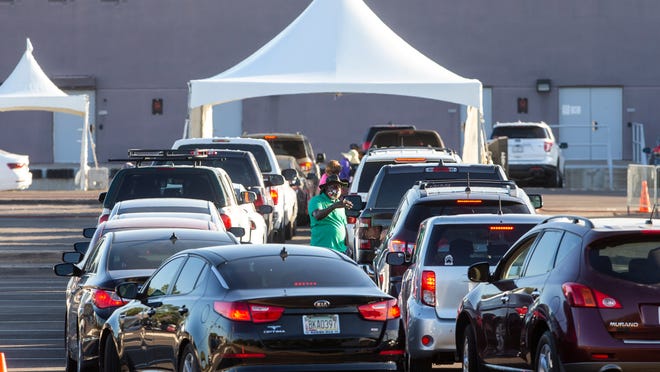
Over 90 percent of novel coronavirus samples from Arizona in a recent genetic analysis have a mutation that researchers hypothesize makes the virus more infectious.
So far, researchers have analyzed more than 1,400 samples of the virus from patients with COVID-19 and have identified a mutated strain that they believe could help explain the recent explosion of cases in the state.
This genetic mutation affects the spikes on the outside of the virus that the virus uses to attach to and infect host cells.
Because of the mutation's crucial location, it could change the way the spikes operate to infect people, making the virus more transmissible, according to David Engelthaler, co-director of the Translational Genomics Research Institute’s Pathogen and Microbiome Division.
"That might be why it's become the dominant strain that has really moved through Europe and the Americas and certainly what we see here in Arizona," he said.
This mutated strain of the virus is the same one that researchers first identified in April as the dominant strain in Arizona and seems to have originated in Europe. Researchers initially thought that this strain was no more infectious than other strains, but was merely dominant due to chance.
However, given additional data, researchers now believe this strain behaves differently than others.
"The earlier strains that came into Arizona didn't have this mutation and those strains didn't go on in most cases to cause any type of sustained outbreaks," Engelthaler said. "They typically fizzled out."
The mutation itself is called the D614G mutation, which Dr. Anthony Fauci acknowledged as seeming to improve the virus's ability to replicate.
The next important question is whether this more-spreadable strain is just as deadly as others.
In an interview with the Journal of the American Medical Association’s Dr. Howard Bauchner, Fauci said, "We don’t have a connection to whether an individual does worse with this or not; it just seems that the virus replicates better and may be more transmissible.”
In the interview, Fauci cautioned that researchers still need to confirm these theories and analyze the mutation further.
Engelthaler thinks this mutation could be making the virus less deadly.
"It's really hard to directly link the fatality rate to the strain of the virus," he said. "But I think there's more evidence that the fatality rates are dropping."
According to data released by the Arizona Department of Health Services, there had been a total of 14,796 confirmed COVID-19 cases and 802 COVID-19 related deaths in Arizona by May 15, when Gov. Doug Ducey's stay-at-home order expired. This translates to roughly a 5.4% death rate from the virus in the state.
As of July 9, there have been a total of 112,671 confirmed COVID-19 cases and 2,038 COVID-19 related deaths statewide, translating to about a 1.8% death rate from the virus.
However, this decreased fatality rate could be because of increased testing statewide, which has allowed the state to better track the total number of coronavirus cases, whereas early numbers may be more likely to only reflect more severe, hospitalized cases.
More cases also are now confirmed among younger patients, who typically have a lower fatality rate.
On May 15, people age 20-44 accounted for 39% of all confirmed cases in Maricopa County. As of July 9, they accounted for 53%.
However, Engelthaler pointed out that the death rate within higher risk age groups has been falling as well. According to Maricopa County's data, about 17% of those who had the disease and were 65 or older died as of May 15. Today the death rate among those infected within that age group hovers around 10%.
"We can't necessarily say that it's directly related to any specific mutations yet in the virus," he said. "But right now, there certainly is an association."
However, he stressed that this doesn't mean the state should relax precautions against transmissions.
"We still need to do everything we can to protect those at most risk," he said.
It's also important to continue to keep track of virus mutations and try to better understand this spike protein mutation, because any mutations could have a big impact on how effective potential vaccines or treatments are.
In particular, since many vaccines and therapeutic drugs are targeting the spikes on the outside of the virus, any harmful mutation on the spike protein could render vaccines useless.
So far, no mutations, including this one, have been found to interfere with vaccine development that is underway, according to Engelthaler.
"We can't say for sure whether or not mutations will cause a negative effect for these vaccines," he said. "But there's no evidence right now to indicate that they would have a negative impact or that the vaccines wouldn't work."
Each time a virus infects a new host, it has another opportunity to mutate. Since this new coronavirus has had the chance to move rapidly across the globe, Engelthaler said it's likely that this will create multiple versions of this virus.
These different versions may have different characteristics or may not all respond to the same vaccines or treatments.
"Hopefully with vaccines, we can whittle those down and just knock down the total amount of transmission," he said. "I think trying to get it to completely go away is certainly not within reach right now, even with a good vaccine program."
In addition to mapping out a genetic family tree of the novel coronavirus so that researchers can better understand and research the various strains, TGen will use their genetic analysis to improve the accuracy of the state's COVID-19 contact tracing efforts.
Engelthaler said TGen hopes to better understand how different strains of the virus are spreading so that they can better limit transmission.
"The virus itself is going to tell us what we need to focus on," he said. "And clearly what we're seeing now is this particular mutation is dominant and will likely remain dominant."
Amanda Morris covers all things bioscience, which includes health care, technology, new research and the environment. Send her tips, story ideas, or dog memes at amorris@gannett.com and follow her on Twitter @amandamomorris for the latest bioscience updates.
Katie Rogers
,
The New York Times•July 10, 2020
1,059 Comments
President Donald Trump at the White House in Washington, July 8, 2020. (Anna Moneymaker/The New York Times)
WASHINGTON — In September 2016, Donald Trump stood on the debate stage as a presidential candidate and addressed a question that had dogged him on the campaign trail: When would he release his tax return?
“I’m under a routine audit, and it’ll be released,” Trump said. “And as soon as the audit is finished, it will be released.”
Nearly four years later, the White House says the IRS is still at it.
“His taxes are under audit, and when they’re no longer under audit he will release them,” Kayleigh McEnany, the White House press secretary, told reporters Thursday.
In fact, every sitting president’s returns are audited as a matter of routine, and the IRS has long said that nothing prevents an individual from making tax returns public while an audit is underway. Every president since Jimmy Carter has voluntarily released his returns.
So at this point, no one is expecting to see the president’s tax returns anytime soon, even though the Supreme Court issued a major ruling Thursday that cleared the way for New York prosecutors to seek them. But there will be further skirmishing in the lower courts, and there is little chance of a final decision before the next election.
The Early Promises
Trump has promised to release his tax returns under varying conditions for nearly a decade.
In 2011, he began appearing on television to question whether President Barack Obama was born in the United States — spreading a lie that he has never fully apologized for — and suggesting that he would release his returns when Obama released his birth certificate.
“Maybe I’m going to do the tax returns when Obama does his birth certificate,” he said in an interview with ABC in April 2011. “I’d love to give my tax returns. I may tie my tax returns into Obama’s birth certificate.”
Days after that interview, Obama released his long-form birth certificate.
Trump did not keep his end of the deal. In 2014, an Irish journalist pointed out that he had never released his tax returns, even though he had coerced Obama into releasing his birth certificate. In that interview, Trump then added a new qualifier: He would release them if he ran for president.
“If I decide to run for office, I’ll produce my tax returns, absolutely,” he said during a visit to Ireland, where he promoted his golf club in Doonbeg. “And I would love to do that.”
The Audit
By the time Trump was running for president in 2016, he had adopted the audit as the reason he could not release his taxes. That spring, his lawyer Sheri Dillon released a letter that claimed Trump’s tax returns had been under “continuous examination” by the IRS since 2002 and that the audit for his tax returns since 2009 was ongoing.
Steven Rosenthal, a senior fellow at the Urban-Brookings Tax Policy Center, said in an interview that it could be normal for an audit for a taxpayer like Trump to take anywhere from six to eight years for each year filed. He called Dillon’s letter “on the mark” and said that presidents were automatically audited each year while in office. But he said there was no legal reason for Trump to hold back his tax returns.
“The excuse that he’s under audit is a non-excuse,” Rosenthal said. “He’s always under audit.”
After Trump won the election, he added another reason beyond the audit for why he was withholding his returns. In May 2017, he told The Economist that only journalists cared about his tax returns and that he might not release them until he left office.
“Maybe I’ll release them after I’m finished because I’m very proud of them actually,” Trump said. “I did a good job.”
In reality, polls show a majority of Americans believe that the public has a right to see Trump’s tax returns, as they have seen the returns of every modern president over the last four decades. A June poll by the Pew Research Center found that 56% of Americans said Trump had a responsibility to release them.
One critical question the returns would answer is how much Trump paid in taxes, or whether he paid taxes at all. In October 2016, an investigation by The New York Times revealed that a $916 million loss on Trump’s 1995 returns would have allowed him to legally avoid paying income taxes for 18 years. Trump declined to comment, and his campaign released a statement that neither challenged nor confirmed the $916 million loss.
Another investigation by The Times in 2018 found that Trump helped set up a sham corporation to disguise millions of dollars in gifts from his parents, assisted his father in taking improper tax deductions and undervalued his family’s real estate holdings.
On Thursday, a White House spokesman directed questions about the status of the IRS audit to the Trump Organization, which did not return a request for comment.
The Rulings
One ruling delivered a victory to Cyrus Vance, the Manhattan district attorney and a Democrat, whose office sought eight years of business and personal tax records in connection with a state grand jury investigation into Trump’s role in hush-money payments made to a pornographic film star before the 2016 election.
The court ruled 7-2 that Trump was not immune from criminal proceedings while in office but sent the case back to the lower courts, where Trump’s lawyers will presumably make new arguments that the subpoena for financial records is improper.
Should Vance eventually win, as many legal experts expect, the tax returns will go to a secret grand jury that will delay the release of that information to the public, if it is released at all.
Another ruling concerned subpoenas made by several House committees to gather Trump’s financial information from his accountants and banks. The court ruled that Congress had limited power to issue those subpoenas and again sent the case to the lower courts.
Trump, for his part, attacked the rulings on Twitter: “This is all a political prosecution,” he wrote.
“Courts in the past have given ‘broad deference’. BUT NOT ME!” he added.
This article originally appeared in The New York Times.
Above is from: https://www.yahoo.com/news/trump-releasing-tax-returns-absolutely-121739976.html