Wednesday, February 13, 2019

Rock River Valley awaits solar lottery results to learn where panels will go

By Susan Vela
Staff writer

Posted Feb 12, 2019 at 5:54 PMUpdated Feb 12, 2019 at 7:53 PM

BELVIDERE — The Boone County Board has approved at least 15 solar farm proposals, but a lottery could decide which are built.

Similar situations are playing out across the region and state because of the Future Energy Jobs Act, a state law that went into effect June 2017. It demands Illinois utilities get 25 percent of their retail power from renewable sources such as solar and wind by 2025.

An unexpected consequence was how many companies jumped to build. So far, Stephenson County has approved approximately 40 special-use permits for the companies submitting proposals; Ogle County, about 5; Winnebago County, nearly 10; and Rockford, about 5.

Since there isn’t enough tax money to go around, a lottery will decide who gets the tax incentives and, essentially, where solar farms get built.

“This lottery is going to limit how many projects get approved,” Boone County Administrator Ken Terrinoni said.

In Boone County, developers that include Borrego Solar Systems Inc., Hendricks Solar LLC and Terra Navigatoralready have received special-use permits, which means they are set to meet the lottery’s Wednesday deadline.

The Illinois Power Agency will review their proposals and then choose the lottery winners by April.

Power Agency Director Anthony Star said a lottery was needed because there have been more solar proposals getting approved than anticipated. To provide tax incentives to all, the state would need five times the dollar amount it expects to have available for such projects.

Solar developers are expected to pay close attention to the lottery, since winners will move one step closer to breaking ground on their projects.

Alexander Farkes, Borrego’s project development director, said the upcoming lottery “is one of the key criteria for having a viable community solar project in Illinois.”

He’s concerned about the randomness of a lottery.

″(But) I think the state went through a lot of time putting together the process,” Farkes said. “What we’re most interested in is the most viable projects getting selected. We’re really looking forward to the future of Illinois and what’s going to happen next.”

Boone County projects that have received approval range from 12 to 200 acres. The largest is a 200-acre, $36.4 million proposal at Genoa and Reeds Crossing roads. Board members approved Hendricks Solar’s request for a special-use permit Oct. 17.

Chairman Karl Johnson is looking forward to the lottery determining which projects get built. Until then, the board keeps having to review every proposal that gets placed before them.

“That’s the biggest frustration for me,” he said. “We’ve spent a lot of man hours on solar farm issues. It’s a waste of taxpayer dollars to continue to do this work over and over.”

Susan Vela: 815-987-1392; svela@rrstar.com; @susanvela

Above is from:  https://www.rrstar.com/news/20190212/rock-river-valley-awaits-solar-lottery-results-to-learn-where-panels-will-go

Tuesday, February 12, 2019

Monday, February 11, 2019

Was El Paso One of the ‘Most Dangerous Cities’ in U.S. Before a Border Fence Was Built?


Was El Paso One of the ‘Most Dangerous Cities’ in U.S. Before a Border Fence Was Built?

<?XML:NAMESPACE PREFIX = "[default] http://www.w3.org/2000/svg" NS = "http://www.w3.org/2000/svg" />

Claim

El Paso was one of the U.S. most dangerous cities before a border fence was built there.

Rating

FalseAbout this rating

Origin

On 5 February 2019, President Donald Trump delivered the annual State of the Union address and made an appeal in his ongoing effort to deliver on a campaign promise to build a border wall.

In his speech, President Trump stated that the city of El Paso, Texas, “used to have extremely high rates of violent crime — one of the highest in the country, and [was] considered one of our nation’s most dangerous cities. Now, with a powerful barrier in place, El Paso is one of our safest cities.”

Following that remark, El Paso Mayor Dee Margo took to Twitter to dispute its accuracy:

El Paso was NEVER one of the MOST dangerous cities in the US. We‘ve had a fence for 10 years and it has impacted illegal immigration and curbed criminal activity. It is NOT the sole deterrent. Law enforcement in our community continues to keep us safe #SOTU

— Mayor Dee Margo (@mayor_margo) February 6, 2019

We looked at crime data from the Federal Bureau of Investigation’s Uniform Crime Report (UCR) to weigh which public official’s statements were accurate. The FBI’s UCR project compiles and analyzes data from “more than 18,000 city, university and college, county, state, tribal, and federal law enforcement agencies voluntarily participating in the program.”

Crime data do not support the president’s claim either that El Paso was one of the country’s “most dangerous cities” or that the barrier built between El Paso and Juarez, Mexico, had the effect of dramatically reducing crime on the U.S. side of the border.

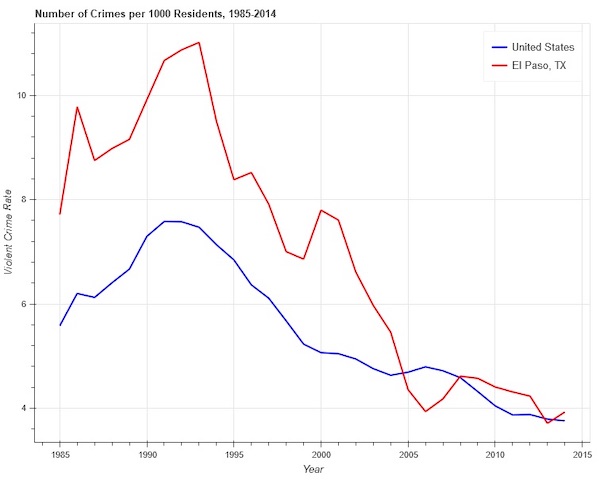
Instead, UCR data show that violent crime in El Paso generally followed a national trend. It spiked to its highest level in 30 years in the early 1990s and has steadily declined since. The following graph compares crime data from the El Paso Police Department with nationwide figures from 1985 to 2015.

Source: Uniform Crime Report.

In that 30-year time frame, El Paso was never one of the “most dangerous cities” in the United States. When compared to cities with similarly-sized populations, El Paso’s violent crime rate consistently fell well below locales such as Boston, Baltimore, Detroit, and Memphis, according to UCR data (which can be found online).

In 2018, US News & World Report ranked El Paso number 11 in “best places to retire,” citing in part the community’s relative safety and thriving economy. This ranking was not new, as El Paso had regularly been ranked one of the country’s safest cities for its population size going as far back as 2005 — three years before the border fence there was built.

Construction on the barrier between El Paso and Juarez began in 2008 under President George W. Bush and was completed in 2009 as part of a larger border security plan known as “Operation Hold the Line” which was launched in 1993. UCR data drawn from the El Paso Police Department shows that violent crime, already trending downward, continued to drop fairly consistently in the five years leading up to fence construction, from a high of 6,109 incidents in 1993 to an all-time low in 2006 of 2,422:

Source: Uniform Crime Report.
During the fence construction and in the years immediately afterward (2008 to 2012), violent crime incidents rose very slightly.

Source: Uniform Crime Report.
In a 5 February 2019 interview with El Paso television station KDBC, Border Patrol Sector Chief Aaron Hull credited the sharp decline in violent crime that started in the early 1990s to the increased presence of border agents:

El Paso’s violent crime was at its peak in 1992. What did make a difference was a flood of Border Patrol agents, who began Operation Hold the Line in 1993.

Hundreds of agents were stationed every few feet along the border.

Violent crime in El Paso drastically reduced in the years following.

“We’ve played a big part of that,” said Border Patrol Sector Chief Aaron Hull.

We can’t determine whether crime in El Paso fell as a result of increased Border Patrol presence, the dynamic that caused crime to drop nationwide, or some combination of both. But what can be determined from crime data is that over the previous three decades, border wall construction hadn’t shown a positive impact on reducing violent crime in that community, and El Paso was far and away notone of the most dangerous cities in America.

The 2019 State of the Union wasn’t the first instance during which the Trump administration made this false claim, and it wasn’t the first time that claim had been debunked. In their own fact check, the El Paso Times reported that Texas Attorney General Ken Paxton had also promoted the claim, along with White House press secretary Sarah Sanders:

In January 2018, White House Press Secretary Sarah Huckabee Sanders tweeted “Ask El Paso, Texas (now one of America’s safest cities) across the border from Juarez, Mexico (one of the world’s most dangerous) if a wall works.”

She linked to an opinion piece published in the New York Post that was titled “This town is proof that Trump’s wall can work.” The piece, written by a conservative political commentator based in Washington, D.C., argued that El Paso’s border fence is the reason for the city’s low crime rate and decreased illegal border crossings.

At the time, local leaders rejected the article’s findings and argued that it did not mention the police-community relations and cooperation between law enforcement agencies that contributed to the city’s safety before border fencing was put in place.

On the 2016 campaign trail, Donald Trump promised supporters that if elected, he would build a border wall that Mexico would pay for. As time went by and it became clear Mexico would not finance the construction of such a wall, Trump waffled on how it would be funded, resulting in the longest partial shutdown of the federal government in U.S. history when he and Congressional Democrats reached an impasse over the issue.

Sources
  • Mekelburg, Madlin.   “Fact Check State of the Union: Trump Says El Paso Among Most Dangerous Cities Until Fence.”
    El Paso Times.   5 February 2019.

  • Mekelburg, Madlin.   “Did Construction of a Border Fence Cut Down on Crime Rates in El Paso?”
    El Paso Times.   10 January 2019.

  • ABOVE IS FROM:   https://www.snopes.com/fact-check/el-paso-border-barrier-crime/

Sunday, February 10, 2019

12 Things We Should Have Known About Illinois’ New Private School Scholarships

WBEZ News

12 Things We Should Have Known About Illinois’ New Private School Scholarships

Linda Lutton

August 16, 2018

4 MINADD TO QUEUE

An illustration of a swirl of money with the words "taxpayer dollars" flowing into a school building labeled "private schools"

Paula Friedrich/WBEZ

Kids are about to head back to school, and for the first time ever, thousands of Illinois students will be using state taxpayer money to attend private schools.

Last August, with almost no public vetting or debate, Illinois passed a massive school choice program, making it the 18th state to add a “tax credit scholarship” program. Now, at least 5,600 Illinois students are headed to private school with taxpayer help, according to data compiled by WBEZ. Tens of thousands of kids tried for the scholarships, which can pay up to $12,793.

Tax credit scholarships aren’t technically vouchers, but for families and schools, there’s little difference. Opponents call them “neo-vouchers.”

The $100 million “Invest in Kids” program was insisted on by Gov. Bruce Rauner in as part of a fix to the state's broken public school funding system.

Now that it’s up and running, key details of the scholarship program are emerging, including its groundbreaking size compared to other states and the fact that many students who aren’t poor are receiving scholarships.

Here are a few things the public might have learned had the plan gotten more scrutiny before it passed:

No other state has started off with a bigger program.

Illinois’ program allows up to $75 million in taxpayer money to be diverted to private schools each year. For comparison, Indiana’s program is $18 million; when it began in 2010, it was $14 million. Today, Florida has the biggest tax credit scholarship program in the country — last year they gave out $698 million in tax credits and 107,095 scholarships. That program began in 2002 at $50 million.

EdChoice, a school choice advocacy group, says Illinois’ giant first-year program should be put in perspective: “The $75 million credit cap, while seemingly large, is a small fraction of what Illinois spends on K–12 education.”

While Illinois’ program allows for $75 million in tax credits ($100 million in total donations), just $31.5 million in credits have been claimed. Advocates say taxpayers are still finding out about the program.

$31.5 Million

Tax dollars diverted so far to private school scholarships in Illinois

Source: Illinois Department of Revenue, Aug. 1, 2018

Illinois law prohibits sending public money to religious schools. This program gets around that. 

With vouchers, states pay private schools directly from taxpayer funds. But with tax credit scholarships, the state never actually takes control of tax money. Instead,

  1. Taxpayers donate to a nonprofit “scholarship granting organization.”
  2. Those groups award scholarships and distribute the money to schools.
  3. The state then issues taxpayers a “credit” toward their tax bill. 

In Illinois, taxpayers get a 75-cent credit for every dollar they donate. Because it’s all voluntary, state supreme courts have repeatedly upheld tax credit scholarship programs. Declining to hear a challenge in 2011, the U.S. Supreme Court said in a 5-4 decision that when “taxpayers choose to contribute to [scholarship organizations], they spend their own money, not money the State has collected.”

$1 Million

Maximum amount an individual taxpayer can divert to private school scholarships

Illinois taxpayers get a huge tax credit. 

First off, a tax credit is worth much more than a deduction, which is what people usually get when they make a donation to a charity. (A deduction reduces a taxpayer’s income, lowering the amount they’re taxed on. A credit erases actual taxes owed.)

There are about a dozen credits Illinois taxpayers could possibly take. None comes close to giving back 75 percent of a donation or expense.

What’s more, Illinois allows individuals to claim a huge credit, far more than other states. In Arizona, where tax credit scholarships began, credits are capped at $2,213 for a married couple or $1,107 for a single filer. In Illinois, individuals can get up to $1 million dollars in tax credits.

Stay up-to-date with the latest news, stories and insider events.

SIGN UP

The scholarships aren’t just for poor kids. 

Early figures show 28 percent of the scholarships are going to kids who don’t qualify for free or reduced-price lunch. A family of four can make up to $73,800 and get one or more scholarships; once they’re selected they can make up to $98,400 without losing their tuition help. While poor kids are supposed to get priority under the law, that doesn’t necessarily happen. Kids who live in a low-performing school district also get priority. And donors can designate funds to specific schools. If scholarship groups can’t find enough free-lunch kids at that particular school, they can give the designated funds to non-poor applicants (more on this below).

Some school choice advocates are fine with this; they’re pushing for the middle class to be included in tax credit scholarship programs. Enrollment of middle-income studentsin private schools has been falling.

28%

Percentage of scholarships going to kids who are not considered low-income

Source: WBEZ analysis of data provided by scholarship granting organizations

It looks like many scholarship winners were already attending private school.

This has also happened in other states. Many Illinois private schools made sure to get the word about the scholarships out to their families; some held application events so their students would have a better shot at the new first-come, first-served scholarships. At St. Mary Star of the Sea School on the Southwest Side, 30 kids are getting tax credit scholarships. According to Principal Candice Usauskas, two-thirds were already students there. All seven kids who will attend Frances Xavier Warde with taxpayer help were already students at the school, according to the group that awarded their scholarships. 

We may never know how many scholarship winners were already attending private schools because scholarship groups aren’t required to report that information.

0

Number of scholarship granting organizations subject to Illinois’ public records law

Transparency is a problem. 

The scholarship groups must report certain information annually beginning Jan. 31, including the names of schools benefiting and the grade, race, gender, income level, and zip code of scholarship students. But other info, like the schools that students originally attended, remains hidden. Donor names are also kept private under the law. So far, eight wealthy Illinois taxpayers have made donations of at least $1 million. Their contributions make up 24 percent of the program funds. Scholarship groups submit an audit of their accounts and records completed by a CPA, but no one can watchdog or regulate the scholarship granting process as it plays out.

As the first students head to private schools with taxpayer help, WBEZ collected as much data as possible (viewable here), but scholarship groups had no obligation to share it. And some declined giving more detailed information. For instance, Empower Illinois, which controls 73 percent of all scholarship money and is the only active scholarship group operating in the entire state, declined to say where scholarship recipients live.

Scholarship groups are not subject to Illinois’ open records laws. That’s in contrast to Illinois charter schools, which are privately managed but receive taxpayer dollars, and are subject to FOIA.

$12,973

Maximum scholarship amount

Illinois scholarships pay up to $12,973.

That covers full cost of tuition and fees at most Illinois private schools. Vouchers are sometimes criticized for not giving students enough money to actually attend all but the lowest-cost private schools. Illinois’ scholarship amount is tied to the average operational expense of public schools. It’s the most generous scholarship amount in the country.

The nonprofits that administer the scholarships take 5 percent of all donations. 

Empower Illinois, the group that controls 73 percent of all scholarship funds, wrote and lobbied for the tax credit program and is now benefiting from it financially. The group has accepted $30.8 million in contributions, which entitles it to $1.5 million.

5%

Amount “scholarship granting organizations” can take in administrative fees

There are no limits to the number of nonprofits that can administer scholarships.

Nine groups have been approved by Illinois as scholarship granting organizations. Of those, five actually raised money and distributed scholarships. In some states, scholarship organizations have become a cottage industry. Georgia has 30 SGOs. Arizona has 62. In Pennsylvania, where the scholarship groups can take up to 20 percentof contributions as an administrative fee, there are 189 groups administering one tax credit scholarship program; 258 groups ad  minister another, making oversight a challenge.

School choice is limited by donors.

When proponents talk about Invest in Kids, it sounds like  a way for low-income kids to go to the private school of their choice. But it turns out donors have a big say in shaping which schools kids can attend. That's because they’re allowed to designate that their contribution go to a single school or set of schools (think Wheaton Academy or Chicago Archdiocesan schools).

Kids can apply to any school they like, but if there aren’t enough funds designated to that school, they’ll be out of luck. So far, according to the scholarship organizations, the majority of funds they’ve received are designated. Business donations are all undesignated, but those contributions have lagged.

Donors’ ability to designate funds also allows for higher income children to move faster to the front of the scholarship line. At schools with lots of donor-designated funds (typically schools with powerful alumni or well-developed donor networks), the scholarship granting organizations can start handing awards to higher income kids once they’ve exhausted applications from priority students.

An example: All funds donated to Children at the Crossroads scholarship organization were designated to one school, Frances Xavier Warde, known in part for the politically connected families enrolled there. Only two of Frances Xavier Warde’s seven scholarships will go to kids who qualify for free lunch. (Children at the Crossroads was a pre-existing foundation that became an official state-approved scholarship organization after the Invest in Kids program was passed.)  

Scholarship groups and school choice advocates say allowing people to channel their money to to a particular school or set of schools makes them more likely to contribute. But some states prohibit scholarship granting organizations from benefiting a single school.

Archbishop of Chicago Cardinal Blase Cupich pushed for this program, and early numbers show Catholic schools winning big.

Schools with the most tax credit scholarship recipients include elite college prep schools like St. Ignatius in Chicago, Loyola Academy in Wilmette, and Fenwick High School in Oak Park. Also on the list of top beneficiaries are Waukegan’s Cristo Rey St. Martin College Prep and Chicago Jesuit Academy on the city’s West Side. In fairness, Catholic schools make up the majority of private schools in the Chicago metro area. The top non-Catholic beneficiaries appear to be Solomon Schechter Day School, a Jewish school in Northbrook, and the Islamic Universal School in Bridgeview.

No state with a tax credit scholarship program has ever repealed it. 

Illinois’ program sunsets after five years, which means lawmakers will have to pass legislation to extend it. This year, donations to the program only reached half what they’re allowed to. But with each additional donation — and every scholarship granted — the number of supporters and invested families grows, making repeal less likely. Supporters are already organizing parents and schools to win greater support from Democratic lawmakers, many of whom opposed creating this program. A bigger school choice program has never passed in a blue state, and advocates want to keep it alive. Democratic gubernatorial candidate for governor J.B. Pritzker has said he would endthe private school scholarship program.

Linda Lutton covers education for WBEZ. Follow her @WBEZeducation and @lindalutton.

Monday, February 4, 2019

University of Illinois—Champaign—Measles Alert

illinois public media news

Second Measles Case Reported In Champaign-Urbana

February 03, 2019

BY JIM MEADOWS.

Champaign-Urbana Public Health District office building.

Offices of the Champaign-Urbana Public Health District in Champaign.

CU Citizen Access

A second case of measles has been reported in Champaign-Urbana. Like the first case announced in January, this second case involves a member of the University of Illinois campus community.

“What we have right now are two college-age unvaccinated persons, who are infected with measles,” said Champaign-Urbana Public Health District Administrator Julie Pryde. “And we know that right now that it’s not into the school-age population, the K-through-12 or the younger children.”

Measles is more likely to result in potentially life-threatening complications among children under 5 and adults over 20, according to the federal Centers for Disease Control. Complications can include pneumonia and encephalitis (swelling of the brain).

Campus Vice-Chancellor for Academic Affairs and Provost Andreas Cangellaris says the university is working with its own McKinley Health Center and the Public Health District to try to identify and warn anyone susceptible to measles about the local presence of the highly infectious disease. That includes anyone who has never had measles and who has never been vaccinated for it.

The C-U Public Health District says the second measles patient was infectious when visiting the following locations around the following times (two hours have been added to the time after the patient left the following locations):

1/28/19, 9 AM-Noon & 2:30-5:30 PM:  MTD #22 Bus (weekday daytime Illini or Illini Limited bus)

1/28/19, 9:30 AM – 4:15 PM & 1/29/19, 3-6 PM: University of Illinois School of Social Work, 1010 W. Nevada St., Urbana, IL

1/31/19, 7:30-9:30 PM: Carle Hospital Emergency Department, Urbana IL

1/27-31/19: Maywood Apartment Building, 51 E. John Street, Champaign IL

Pryde says the two people diagnosed with measles had not been vaccinated or had measles before. She says it’s fortunate for the general population that the measles vaccination rate in the Champaign-Urbana area is high.

“Champaign is highly immunized, and we definitely have the herd immunity going on right now,” said Pryde. “That is one of the things that we need to be vigilant about and maintain.”

Immunization against measles is included in the MMR (Measles, Mumps, Rubella) vaccine. The vaccine is delivered in two doses, with the first dose typically given to children at the age of one. But Pryde says the level of protection from the measles virus is up to 93 percent with the first dose alone, and 97 percent with two doses.

Pryde says anyone who has not been vaccinated for measles should contact their healthcare provider or the Public Health District at 217-531-4255. She says anyone who feels they may have the measles stay home and call their healthcare provider first before going into see them, so that precautions can be taken against exposing others to the virus.

Symptoms of measles include rash, high fever, cough, runny nose and red, watery eyes. The disease is easily spread through the air via coughing or sneezing. Contact with mucus or saliva from an infected person can also spread measles. Pryde says people with measles can spread the virus for four days before showing symptoms, and be contagious for another four days once symptoms appear.

Once a common childhood disease, measles was all but eradicated in the United States with the development of the measles vaccine. But small outbreaks of measles have returned in recent years, attributed to a drop in vaccination rates. More than 40 people have been diagnosed with measles in an ongoing outbreak in parts of Oregon and Washington state.

In Illinois, the last measles outbreak of any size was 17 cases in 2015. In 2018, there were just four cases as of December 5th, no cases reported in 2017, and two cases in 2016. Pryde says that before this year, the last measles case reported in Champaign-Urbana and Champaign County was in 2006.

Above is from:  https://will.illinois.edu/news/story/second-measles-case-reported-in-champaign-urbanaMcKinley Health Center

Measles Alert

McKinley Health Center is working with the Champaign-Urbana Public Health District regarding a recent measles case. Measles is a highly contagious disease to persons who are unvaccinated and exposed. The MMR vaccine (Measles/Mumps/Rubella) provides protection against measles in most situations. The MMR is a routine immunization in many countries and is a requirement at the University of Illinois.

Measles is spread to others through the air after someone coughs or sneezes. Measles symptoms include: fever, cough, runny nose, red-watery eyes, and a rash.

Public Health considers a person protected (immune) from measles if they have had one of the following:

  • Two doses of measles containing vaccine (MMR or measles).
  • A laboratory confirmed positive measles antibody result.
  • Born before 1957.

McKinley is working with Public Health to identify at risk individuals and will be notifying these individuals as identified.

If you are unsure if you meet the above immunity standards, you may:

  • View your immunization history on the MyMcKinley Student Health Portal. 
  • Call McKinley Health Center at (217)333-2700 to review your vaccination history. 
  • If you think you have symptoms of measles, stay home, stay away from others and contact McKinley immediately.

Additional information on measles can be found at: https://www.cdc.gov/measles/index.html

Lawmaker wants townships with big bank accounts to return money to taxpayers


This article was also reprinted in the Boone County Journal, February 1, 2019


Lawmaker wants townships with big bank accounts to return money to taxpayers

A township in central Illinois that overtaxed residents for years is returning more than $735,000 to local property taxpayers, a rare rebate that one lawmaker said he wants to see happen in more of the state's 1,400 townships.

Shelbyville Township recently returned $735,000 back property taxpayers because its reserve funds exceeded two and a half years of annual operating expenses, said state Rep. Brad Halbrook, R-Shelbyville, who helped pass a law that mandated such rebates. Shelbyville Township's general assistance fund, used to help low-income residents, typically spent about $16,000 a year, according to media reports. The general assistance fund had a balance of more than $200,000 – enough for 12.5 years.

Halbrook said the law he passed a year and a half ago was based on a 1969 Illinois Supreme Court Case from Adams County.

“A business owner sued the county because they had funds on interest and ‘they’re overtaxing me’ and the courts ruled in that favor,” Halbrook said.

Halbrooks’ measure requires townships to limit reserves to two and a half years worth of annual operating expenses.

“That’s two and a half years worth of cash,” Halbrook said. “That’s a big number, so there’ll be all kinds of stuff going on. The whole idea was to protect taxpayers. We have to maintain taxpayers in the back of our minds all the time.”

Halbrook wants Shelbyville Township to serve as a model for others.

“Hopefully the townships across the state of Illinois would do the right thing and take a look,” Halbrook said. “I think what’s going to happen in our township is, a year ago before they voted to rebate the funds back they reduced our levy in the town portion 33 percent. This year they held it even and so I think as this thing balances out we’ll see a reduction of the overall tax burden to property owners.”

Halbrook said last month’s rebates to more than 2,000 property owners ranged from a few thousand dollars to $20 to $30, based on the equalized assessed value of the property.


  • Greg Bishop

Greg Bishop

Reporter

Greg Bishop reports on Illinois government and other statewide issues for INN. Bishop has years of award-winning broadcast experience, and previously hosted “The Council Roundup,” as well as “Bishop On Air,” a morning-drive current events talk show.

Above is from:  https://www.ilnews.org/news/state_politics/lawmaker-wants-townships-with-big-bank-accounts-to-return-money/article_20c9fd78-1b53-11e9-a1d8-1b3d85960e72.html

Sunday, February 3, 2019

Is your township overtaxing you?

This is a work in Progress-----------------------


The article posted immediately above raised my interest. (The article also appeared in the February 1, 2019 BOONE COUNTY JOURNAL). 

Are Boone County townships reserving too many funds?


Here is the law:

(60 ILCS 1/85-65)
Sec. 85-65. Accumulation of funds. Township funds, excluding the township's capital fund, shall not exceed an amount equal to or greater than 2.5 times the annual average expenditure of the previous 3 fiscal years.
(Source: P.A. 100-474, eff. 9-8-17.)


With a little research it was discovered that the law is actually from 2017.  But are townships abiding by the law?

New Illinois law prohibits excessive accumulation of township reserve funds

Shutterstock photo


  • ILLINOIS NEWS NETWORK

A measure signed into law by Gov. Bruce Rauner caps the amount of taxpayer money that township officials can sock away in numerous local government accounts.

Gov. Bruce Rauner signed HB 1896 after it passed the legislature by a near-unanimous vote. The bipartisan bill, which was sponsored by Rep. Brad Halbrook, R-Shelbyville, Rep. Carol Ammons, D-Urbana, and Sen. Chapin Rose, R-Mahomet, grew out of an investigation by the Edgar County Watchdogs group into financial records of Shelbyville Township southeast of Springfield.

The Watchdogs group, a citizen organization that advocates for transparency in local governments across Illinois, found that Shelbyville Township was stockpiling funds in multiple accounts that far exceeded what the Illinois Supreme Court found in 1969 to be reasonable. The township’s Medicare Fund contained nearly 18 times what was deemed sufficient based on average expenditures; the Unemployment Fund, more than 205 times the needed amount; and the Workers Compensation Fund, more than 63,000 times the required amount to pay bills, according to the citizens group.

The township also doled out more than $93,000 over a recent four-year period to nonprofit groups the township board felt merited the money, the Watchdogs group found.

In the wake of those revelations, some Shelbyville Township officials have resigned, and the board plans to rebate excess funds back to the taxpayers, according to Kirk Allen, one of the Edgar County Watchdogs’ researchers.

“It’s good because those types of people didn’t have an interest in doing what’s best for the people …” Allen told Illinois News Network. “Good people step up and fill the void.”

Nearly 270 public officials have left their positions as a result of the transparency group’s investigations over the past five years, he said.

Evidence of excessive local taxation is common around Illinois, Allen said. Even though the state is broke as a result of out-of-control spending policies, he said, local boards can raise property taxes by up to 5 percent annually. The boards that oversee townships are often advised by attorneys to seek the maximum amount year after year regardless of projected service needs, according to Allen.

Township board members also gain from handing out taxpayer funds to community groups and nonprofits, he said.

“It’s a way to secure their re-election,” Allen said, adding that such donations also make them look like saints in the community, even as the property tax burden continues to rise.

HB 1896 basically codifies the 1969 high court decision by requiring all township funds, with the exception of capital funds, not to exceed 2.5 times the annual expenditure based on a three-year average, according to Rep. Halbrook, who also said Shelbyville Township was in the process of correcting its problems.

Excessive accumulation of local funds is a big problem affecting several townships, Halbrook said, adding that he expected that some townships would lower levies to get their finances in order.

“They’re going to have to make decisions about whether they have to rebate or transfer the money,” he told Illinois News Network.  “I’m very hopeful that there will be rebating going on.”

Halbrook sees the accumulation-of-funds issue as another possible reason to move forward on local government consolidation efforts. Laws have become increasingly complex, and some of the part-time elected officials who oversee local agencies may not be able to keep up, he said.

“I’m for consolidation when it makes sense, like coterminous townships,” Halbrook said.

Staff members at the Chicago-based Better Government Association also expressed optimism that the new law would do some good.

Above is from: https://www.ilnews.org/news/state_politics/new-illinois-law-prohibits-excessive-accumulation-of-township-reserve-funds/article_1c521fbe-996d-11e7-bd91-bf3ec22a505a.html

********************************************************************************

Current entry from this professional organization for township officials

THE TOWNSHIP OFFICIALS OF ILLINOIS

Question: Is the maximum cash reserves allowed by law unlimited?

Answer: No. Court cases have allowed only about 200% of the average expenses over last three years. However, this amount may be hard to justify. DCEO recommends minimum cash reserve should be 6 months operating expense. A capital fund should be established to dedicate funds toward capital improvement as a part of the annual budget and appropriation ordinance for both the township and road district.

Above is from: https://www.toi.org/Resources/faq/#12

******************************************************************************************************************************************************************

Maine Township is in Cook County Illinois and includes the greater Des Plaines area. Is the Maine Township situation typical? Note the really big surplus in the General Assistance Fund.

Examining Maine Township Surpluses

Posted on 01/24/2019 by Cal Skinner

From Wirepoints, reprinted with permission:

Some Illinois governments are hoarding taxpayer funds

By: Ted Dabrowski and John Klingner

It’s bad enough that Illinoisans are forced to pay the nation’s highest property taxes. It’s even worse if many of those dollars sit idly in the coffers of their local governments.

Recent reports reveal that some local governments are hoarding taxpayer funds in the form of reserves – far in excess of what they need.

That’s definitely the case in Maine Township – which includes Des Plaines, Park Ridge and some of Niles – where the board has amassed reserves equivalent to 1.6 years of operating revenues.

No township needs that much in reserves.

And unfortunately, Maine Township isn’t alone.

Any local government that holds excessive reserves should return that money to taxpayers.

Maine Township’s build-up

While Maine Township as a whole has excess reserves – $11.6 million in total (see appendix) – there’s one part of its budget that’s particularly egregious: its General Assistance (GA) fund.

The GA is used to provide senior and disabled support services, individual and family counseling, and other assistance to residents. It spends about $870,000 a year but has more than $2.4 million in reserves.

The reserve buildup is the result of years of operating surpluses. Since 2011, the fund has generated yearly surpluses as high as $370,000. (See appendix.)

The services the fund provides are important, but that $2.4 million in reserves is nearly three year’s worth of expenditures sitting in an account doing nothing.

It’s far more than the typical three months of reserves a government should have to cover any short-term budget emergencies.

It’s also against the law. Illinois townships can’t hold fund reserves bigger than 2.5 times the fund’s annual expenditures (expenditures defined as the average of the previous three years). That law, now codified as ILCS1/85-65, was passed in 2017 and sponsored by Shelbyville state representative Brad Halbrook.

The fact that such a large surplus exists makes the Maine Township Board’s December 2018 approval of a 2019 $827,000 levy for the GA irresponsible and, on its face, illegal.

Taxpayers shouldn’t have to keep pouring more money into a fund that doesn’t need it.

And seeing how the General Assistance fund only spends money on annual health and welfare services, there is no need for it to accumulate money for capital projects.

Worse, the money isn’t even transferable to other township funds. (On the other hand, the GA may receive transfers from the township fund and the road fund, if necessary.)

So what to do with the excess funds? Give them back to taxpayers say Maine Township Trustees Susan Sweeney and David Carrabotta. Sweeney wants to “stop the tax and spend the 2019-2020 budget out of the reserves.”

Under Wirepoints calculations, if the township were to target a reserve level equivalent to just one year, for example, it could avoid taxing its residents for the General Assistance fund for nearly two years.

And that’s exactly what the township should do.

Excess reserves in other local governments

Maine Township’s numbers may be small in the overall context of the mess in Illinois, but the issue of excess reserves affects all sorts of local governments, from school districts to townships to library districts.

Jake Griffin of the Daily Herald has covered the issue in detail.

For example, last year he reported “that two-thirds of the 93 school districts in the Daily Herald’s coverage area grew their reserves from 2016 to 2017.

Eighty-seven of them were holding more than 25 percent in reserve – including 18 with enough in reserve to cover an entire year’s expenses.”

Or consider Griffin’s report on library districts.

Years ago, Lake Villa voters rejected a call for a new library.

Today, the library district is constructing a new building anyway – using $20.4 million in reserves it amassed over the years.

Local officials circumvented the will of the Lake Villa public by hoarding taxes. Because they now have the money for the building, officials don’t need to ask for permission to build it.

How local governments accumulate unneeded reserves comes back to how they raise property taxes.

Most governments can hike property taxes by up to 5 percent annually, depending on inflation. And some do so, every year, whether they need the money or not.

The result is growing surpluses that elected officials can spend when they want.

Excess reserves need to be given back to residents, either through rebates or by freezing/reducing levies until the reserves are back to appropriate levels.

The good news is, as reported recently by the Illinois News Network, that one township has begun the rebate process. Shelbyville Township, near Springfield, is rebating $735,000 back to taxpayers because its reserves exceeded the 2.5-year reserve limitation. For the 2,000 homeowners there, the rebates ranged from a low of $20 to a high of a few thousands dollars.

The bigger question for hoarding governments is, why bother collecting the levies if they’re going to be rebated anyway? Just don’t take taxpayer money in the first place. It would be a lot cheaper and certainly less messy.

Appendix

Posted in Maine Township, Surplus, Susan Sweeney, Township Government

Above is from: http://mchenrycountyblog.com/2019/01/24/examining-maine-townshp-surpluses

***************************************************************************************

As shown in this 2011 article by the Better Government Association; this has been going on for a long time.

Money In The Bank: Piling Up A Mountain Of (Taxpayer) Moola

The majority of the 20 suburban Cook County townships hoard large amounts of cash that’s in excess of the "rainy day" fund that municipal finance experts recommend. Some townships have enough cash to cover a full year’s expenses without going to taxpayers.</p>

By Robert Reed

Nov 7, 2011 9:00 AM

<?XML:NAMESPACE PREFIX = "[default] http://www.w3.org/2000/svg" NS = "http://www.w3.org/2000/svg" />

The majority of the 20 suburban Cook County townships carry large amounts of cash; 11 have more than 40 percent of their total assets in cash and cash equivalent assets, according to the townships’ balance sheets. Leading the pack is:

  • Thornton with $14.6 million in cash (42 percent of assets);
  • Lyons had $13 million (65 percent);
  • Stickney had $9.2 million (45 percent);
  • Hanover had $8.5 million (48 percent); and
  • Wheeling had $5.8 million (51 percent).

Such reserves are in excess of what municipal finance experts recommend as a "rainy day" fund—enough cash on hand to cover operating expenses for three to six months in case of a financial crisis.

For example, in fiscal 2010, Thornton reported total expenditures/expenses of $12.8 million. Based on those obligations, Thornton has enough money in the bank to cover expenses for more than 12 months. Lyons reports expenditures/expenses of $8.1 million—nearly $5 million less that its reserve.

Even some other township supervisors are wondering about the need for such abundant cash resources.

"Townships should not be in the business of hoarding taxpayer money," says Sam Yingling, supervisor for Lake County’s Avon Township. "Anything over six months needs to be looked at."

Holding that much cash is morally wrong and a bad business practice agrees David Hamilton, a township expert and former chair of the Department of Political Science and Public Administration at Roosevelt University who wrote an in-depth analysis on Illinois townships in April 2008, including the 20 in suburban Cook County, which also found the majority had big cash coffers.

"It’s unconscionable there (are) such large reserves," says Hamilton, who is now Director of the Public Administration Program at Texas Tech University. "Why not leave the money with the taxpayers, rather than put them in the township’s bank?"

When asked to address why these townships hold so much cash, Cook County township spokesman Robert Porter said its reflective of the townships’ "conservative management" philosophy that calls for keeping lots of money on hand to pay for major purchases such as trucks, snowplows or buildings.

Thornton County Supervisor Frank Zuccarelli notes his township’s $14.6 million is the "largest surplus we’ve ever had." However, he adds that the township recently paid $2.2 million to purchase a new garage and make related construction improvements to house 45 township vehicles, including trucks, buses and snowplows.

Another construction project is being planned but won’t likely happen until next year, he adds.

Stickney Township Supervisor Louis Viverito says his township’s cash reserves are now closer to a "couple of million" dollars because it used some of the funds on the new Stickney Public Health Center, which opened in July complete with a ribbon-cutting ceremony attended by Illinois House Speaker Michael J. Madigan (D-Chicago).

At a time when many levels of government have racked up huge amounts of crushing debt, it begs the question: Isn’t the township approach to finance a better course of action?

Townships authorities say yes. But Hamilton doesn’t agree.

"If there (are) large reserves, there’s an incentive to spend them," says Hamilton, who adds that townships often draw down their cash holdings by overpaying for the few services they provide, especially road maintenance, construction and repairs.

BGA Director of Programming & Investigations Robert Reed Talks Townships by wdcbnews

Above is from:  https://www.bettergov.org/news/money-in-the-bank-piling-up-a-mountain-of-taxpayer-moola