Monday, December 31, 2018

Will Pres. Trump sign this bill?


Senate approves bill to make lynching a federal hate crime after nearly 100 years of failed attempts


Elise Viebeck Washington Post

After nearly 100 years of failed attempts, the Senate on Wednesday unanimously approved legislation to make lynching a federal crime.

Sponsored by the Senate's three African-American members, Kamala Harris, D-Calif., Cory Booker , D-N.J., and Tim Scott, R-S.C., the bill would ensure that lynching triggers an enhanced sentence under federal law like other hate crimes.


"This has been a long arc, a painful history and a shameful history in this body," Booker, who has been mentioned as a possible 2020 presidential candidate, said on the Senate floor. "At the height of lynchings across this country affecting thousands of people, this body did not act to make that a federal crime. . . . At least now, the United States Senate has now acted. One hundred senators, no objections."

Booker introduced the bill with Harris, another possible presidential hopeful, and Scott following what Harris described as 200 previous attempts by Congress to pass similar legislation.


"Lynching is a dark and despicable aspect of our nation's history. We must acknowledge that fact, lest we repeat it," Harris tweeted after the bill passed.

The NAACP says lynching emerged in the late 19th century as a "popular way of resolving some of the anger that whites had in relation to free blacks." About 3,450 black people were lynched in the United States between 1882 and 1968, accounting for 73 percent of the total number of people lynched.

Only five states had no lynchings during that period, according to the NAACP.

The Senate bill defines someone guilty of lynching as "willfully, acting as part of any collection of people, assembled for the purpose and with the intention of . . . [causing] death to any person." The crime could be punished by a sentence of up to life in prison.

Seven presidents petitioned Congress to end lynching between 1890 and 1952, the bill said.

The measure was introduced in June 2018 and unanimously passed the Senate Judiciary Committee in October. A companion bill from Rep. Bobby Rush, D-Ill., was introduced in June.

The Senate's presiding officer during the vote was Sen. Cindy Hyde-Smith, R-Miss., whose previous expressions of pride in the Confederacy came under scrutiny this year after she said she would sit with a supporter in the front row of a "public hanging."

Hyde-Smith defended the remark as an exaggerated show of friendship. Critics said it alluded to hanging.

Appointed to the Senate, Hyde-Smith successfully ran for election.

First published in The Washington Post

Above is from:  https://www.chicagotribune.com/news/nationworld/politics/ct-senate-lynching-hate-crime-20181219-story.html

More than 250 Illinois laws take effect Jan. 1. Here's what you need to know.


More than 250 Illinois laws take effect Jan. 1. Here's what you need to know.


More than 250 new state laws are set to take effect Jan. 1, 2019. (Terrence Antonio James/Chicago Tribune)

Mike RiopellChicago Tribune

Privacy Policy

Some take on serious issues such as the safety of children, sexual harassment or synthetic marijuana that led to multiple deaths in 2018. Another abolishes a task force on farmers markets that hasn’t met in two years.

In all, more than 250 new state laws take effect Jan. 1. The final batch of new laws imposed under outgoing Republican Gov. Bruce Rauner run the gamut from technical corrections in laws that will have little effect on people’s daily lives to requiring parents of young children to keep them in rear-facing car seats longer.


An even busier year could be on the horizon in Springfield with Democratic Gov.-elect J.B. Pritzker set to take over Jan. 14 and a legislative wish list that includes legalizing marijuana and sports betting. But first, here’s a sampling of Illinois’ new laws for 2019.
Guns

State lawmakers and Rauner tangled over several gun control efforts sparked by the deadly school shooting at a Parkland, Fla., high school and the downtown killing of Chicago police Cmdr. Paul Bauer.

What was approved in the end?

The state created a 72-hour cooling-off period for people who want to buy firearms, expanding a requirement that already applies to handgun sales.

A new law requires schools to conduct an active shooter drill observed by law enforcement within 90 days of the start of the school year.

And hunters can wear blaze pink, not just blaze orange, for safety.

Transportation

Children in 2019 will have to ride in rear-facing car seats until they’re 2 years old, weigh 40 pounds or are 40 inches tall, making recommendations from child safety advocates into Illinois law.

Not following the new rules could land a driver a $75 fine for the first violation, and $200 for each one after that, according to the Illinois State Police.

State law already required drivers to use a “child restraint system” for children younger than 8 years old, but it didn’t specify which way the car seat had to face.

“There’s always been some confusion out there,” said Tara Devine, a personal injury attorney with the law firm of Salvi Schostok & Pritchard. “This at least provides consistency and clarity for pediatricians, the public and manufacturers.”


A different new law will require the Illinois secretary of state to include information about the so-called Dutch reach method of exiting a parallel-parked vehicle in its “Rules of the Road” pamphlet and ask questions about safe driving around cyclists on its written tests.

The Dutch reach method instructs drivers to use their right hand to open the door of their vehicle, basically physically forcing them to look behind to see if there is an oncoming cyclist or vehicle that could cause an accident or injury.

Sexual harassment

Sexual harassment complaints and how to address them was a continuing story in Illinois government and politics amid the national #MeToo movement. The new year means the Illinois General Assembly in March will get a new top watchdog, a job that came under increased scrutiny amid a flood of sexual harassment complaints at the Capitol since late last year.

But lawmakers directed some of their attention on the private sector, with a new law requiring companies that want to do business with the state or qualify for certain tax breaks to provide a copy of their anti-harassment policies

And a different new rule says that anti-harassment training must be part of the continuing education needed to renew a professional license.

Law and order

Statewide this year, at least four people died after ingesting “fake weed,” which refers to plants or oils with chemicals added that are meant to mimic the effects of marijuana. The drugs in those cases were laced with brodifacoum, a form of rat poison that prevents blood from clotting normally.

Lawmakers approved a new law aimed at preventing manufacturers of synthetic marijuana from skirting laws banning the substance often sold and branded as “Spice” or “K2.” It bans all types of synthetic cannabinoids instead of just specific formulas. It’s a “catch-all” approach designed to prevent manufacturers from circumventing laws that only ban specific chemical combinations. Manufacturing or delivery of those substances would carry two to five years of prison time and fines of as much as $25,000. Possession may result in at least one year in jail.

Other new laws include exempting nursing mothers from jury duty and requiring every Circuit Court building to provide a dedicated lactation room.

Odds and ends

A state law that takes effect Jan. 1 gives DuPage County authority to dissolve its independent election commission, a move made after it had trouble tallying results of the March primary election.

Another change replaces references to “chairman” in the elections code to the gender-neutral “chair.”

And 2018 means the end of the Farmers Market Task Force, a group that last posted an agenda to meet in February 2016. A new law abolishes it.

Now, a new law for 2019 creates the Illinois Route 66 Centennial Commission, a group intended to get ready for the road’s 100-year anniversary in 2026.

Chicago Tribune’s Mary Wisniewski contributed.

mriopell@chicagotribune.com

Twitter @MikeRiopell

Above is from:  https://www.chicagotribune.com/news/local/politics/ct-met-illinois-2019-new-state-laws-20181226-story.html

Saturday, December 29, 2018

Illinois' population is falling, but the sky isn't

Analysis: Illinois' population is falling, but the sky isn't

By Tim Jones
Better Government Association

Updated 6/9/2018 4:04 PM


Illinois hiked the state income tax rate by 66 percent in 2011 and three years later, according to revised census estimates, the state's population had grown by more than 20,000. The tax rate dropped down again in 2015 and, since then, the census estimate has plunged 60,000.

There's a popular and populist narrative afoot in Illinois that taxes are a root cause of a recent population swoon. But experts say a careful look at the data, in Illinois and elsewhere, blows holes in that notion.


How Illinois compares

Total population growth in Midwestern states since the 2000 census
Illinois 3.1%
Indiana 9.6
Iowa 7.9
Kansas 8.3
Michigan 0.2
Minnesota 13.4
Missouri 9.2
Nebraska 12.2
North Dakota 17.6
Ohio 2.7
South Dakota 15.2
Wisconsin 8.0

"The knee-jerk tax thing doesn't work because you can find high-tax areas that are growing in the U.S. and you can find low-tax areas that are declining," said Chicago demographer Rob Paral. "I know that gets lost on people who want to blame taxes on everything."

Exhibit A is Minnesota, the state with the highest income tax rates in the Midwest but one of the fastest-growing populations. Exhibit B is Kansas, suffering slow population growth despite going on a tax-cutting frenzy sold as a way to supercharge the state.

Some complicated stew of events and trends clearly is affecting Illinois, with recent annual census estimates showing head count nudging down as immediate neighbors grow, albeit marginally. Economic experts say one possible reason for the divergence is that neighbors benefited more significantly from a resurgence in auto manufacturing following the Obama administration's federal bailout of that industry.

Rather than spur sophisticated analysis of a multifaceted problem, the numbers more typically become fodder for a blame game in which scoring political and ideological points is paramount.

The instinct to pounce obscures a statistical quirk of the census: Population estimates decried as disastrous on first blush often get revised upward, sometimes significantly, to little fanfare. That clearly has been the case for Illinois, where a numbers downturn is troubling but far from the free fall some media reports and partisans suggest.

In 2016, for example, the Census Bureau's American Community Survey population estimate for Illinois was initially listed as 12,801,539 and said to reflect a drop of more than 37,000 from the previous year. In 2017, the initial estimate was pegged at 12,802,023 and said to be down more than 33,000.

The glaring problem, of course, is that the first estimates released for both years were almost identical, so the big back-to-back declines in population that stirred sky-is-falling headlines don't add up. What got buried in the analysis was that the 2016 estimate was later increased significantly from its original value.

Such recalculations are common with census estimates, and it's too early to tell how those dire-sounding numbers for 2017 will be revised.

What is clear, however, is that because this is an election year a distorted storyline about population loss is sure to get elevated to a partisan rant: Somebody running for office in Illinois screwed up.

Those periodic data dumps of population estimates from the Census bureau -- the latest last month showing slight declines for Chicago and other Illinois cities -- have become fodder to be politically exploited and summed up in talking points and TV ads.

The scapegoat nominees include not just high taxes but House Speaker Mike Madigan, Gov. Bruce Rauner, government regulations, financial chaos and uncertainty from a two-year budget stalemate, not to mention old standbys greed and corruption.

"Over the past dozen years, 275,000 more people decided to leave Illinois than chose to come here," Rauner, then the newly elected Republican governor, told the Democratic controlled General Assembly in 2015, re-emphasizing his frequent indictment of the state's tax climate.

He uttered those words just weeks after the state income tax was cut by 25 percent. Yet, modest population gains turned to losses after Rauner took office, something duly noted by his critics.

"Rauner's not only failed to stem the population loss, it has gotten worse as more people are leaving the state," the Democratic Governors Association said in response.

Illinois does have a significant tax Achilles' heel, and it is property taxes, among the highest in the nation for several years that predate recent population softness. That is a consequence of decades of state policy pushed by Democrats and Republicans that provides low levels of support for public schools, thrusting the lion's share of those costs onto local property taxpayers.

Where politicians and activists are programmed to seize on troubling data for advantage, demographers get their wonk on. And what the numbers experts see in Illinois is a continuation of long-range trends that accelerated with the Great Recession.

Immigration drove population growth in Chicago and Illinois during the 1990s, but has slowed substantially since, according to the Migration Policy Institute. Meanwhile, the numbers of both black and non-Hispanic white residents have declined in recent years.

That has had a modest impact on population numbers in the Chicago area, but a much steeper one downstate. Of Illinois' 102 counties, 88 have seen population drops since the 2010 decennial census, a phenomenon that tracks with mostly rural counties throughout the Midwest.

An analysis of Midwestern employment by Bill Testa, vice president and director of regional research at the Federal Reserve Bank of Chicago, shows fundamental differences separating Illinois from most of its neighbors.

Illinois is more reliant on agriculture, construction and mining machinery manufacturing, as well as management, technical consulting and securities and investments. Michigan, Ohio, Indiana and Wisconsin are as much as five times above the national average in terms of motor vehicle-related manufacturing. In a touch of political irony, the controversial federal bailout of the auto industry during the Obama administration appears to have helped prop up population in those Republican-leaning states.

The effects of well-known negatives in Illinois, such as chronic deficits, unpaid bills and pension shortfalls, are more difficult to quantify. But it's clear there is a reshuffling of the state's demographic deck, occurring in ways that don't fit neatly into a TV attack ad.

"If you look at a rural county in Illinois, it's almost like any other state, where they're losing just like the Illinois county is," Paral said. "Illinois, though, is both unique in its total population but with very different things going on."

"Black population growth and immigration growth used to offset the white decline," Paral said. "Not anymore."

• Tim Jones is a reporter for the Better Government Association

Above is from:  https://www.dailyherald.com/news/20180609/analysis-illinois-population-is-falling-but-the-sky-isnt

Friday, December 21, 2018

Belvidere approves levy in emergency session on Friday

  • This a Work in Progress


Belvidere aldermen to revote on rejected $5.9 million tax levy

By Brittany Karlin |

Posted: Tue 5:25 PM, Dec 18, 2018  |

Updated: Tue 5:56 PM, Dec 18, 2018

BELVIDERE, Ill. (WIFR) - The aldermen and the Belvidere city mayor prepare for a showdown Friday to reevaluate the property tax levy vote.

"Basically a third or more of our annual budget going bye-bye creates a huge issue and a huge hole," said Belvidere Mayor Mike Chamberlain.

Belvidere aldermen said no to a proposed $5.9 million property tax levy. Mayor Chamberlain says it’s a major chunk and a key to balancing the city's $17 million budget.

"We will not be able to fund fire, police and public works at the normal levels. It would have created havoc in the city and the end of it would have been we have to eat up our reserve fund which would put us in a very uncomfortable position," said Mayor Chamberlain.

The proposal needed a majority yes vote to pass and four aldermen voted no, including Aldermen Clayton Stevens. He says taxpayers are already getting hit hard.

"Well, we already increased the gas tax by two cents a gallon. We have increased the sales tax by half a cent and those two rights there are going to bring in an extra $2 million projected next year,” said Stevens.

"It was alarming that the council members present last night were unaware of what they were doing and voting down $5.9 million that is desperately needed to balance our book," said Mayor Chamberlain
Stevens says he voted against the increase because he thought the other aldermen would vote yes. He also didn't discuss other possibilities with the mayor.

"I am going to vote against the 3.5 percent. I didn't discuss it with anybody. I was the first one to vote on it and I was quite surprised it went four and four,” said Stevens.

The special meeting to reconsider the levy is scheduled for 8:30 Friday morning. Mayor Chamberlain says aldermen can submit any changes they want and re-vote.

Busy Boone County Intersection Could See Changes to Roads


By:

Posted: Dec 19, 2018 10:44 PM CST

Updated: Dec 19, 2018 10:44 PM CST


BOONE COUNTY - Boone County leaders are looking at ways to make a busy intersection safer.  This comes about a month after a woman was killed there.  The 55-year-old didn't stop at the intersection of  Poplar Grove and Squaw Prairie Roads.  The woman was then hit by another vehicle.  The county is now considering changes to the two-way stop.

"I would like to publicly address the Boone County Board about my concerns with the intersections of Poplar Grove Road and Squaw Prarire Road," said Boone County Resident Pamela Gustafson.  Boone County residents, like Pamela Gustafson want something done about the intersection. Wednesday night, Boone County Board members discussed approving an agreement with an engineer about possible changes to the roads.

"We want to make sure that we take a look at it and makes sure we find ways to improve the safety for all our citizens," said Boone County Board Chairman Karl Johnson.  The county would apply for a $14-thousand Federal Grant to conduct studies on what would be the best safety measures to take.  Boone County Sheriff Dave Ernest says this year there have been nine accidents, including one fatality, last month.   "The accidents have increased at that intersection over the years," said Sheriff Ernest.  "That's based off of increase of traffic in those areas as some of our northern communities have been growing, Poplar Grove, Candlewick."

"People do not drive 55 miles per hour, they pass the intersection, which is against the law, they're just in too big of a hurry and they're driving too fast," said Gustafson.  "I have to sit in my driveway and watch traffic from the north and from the south. I can never just pull out."

"I am scared in the summertime when I'm mowing." said Boone County Resident Marilyn Hunt,  "I mow part way up the road on the terrace. I'm always afraid, because they just come flying down Poplar Grove Road."

Currently, there are signs in place that reduce the speed limit to 45 miles per hour, lights have been added to signage, and white lines mark where to stop on the East and West bound lanes.

"It's not the case that people are blowing the stop sign," said Sheriff Ernest.  "95-percent of those accidents stop and they pull out.  It really is the congestion during those key, high-traffic times."

"If eventually, it comes down that it needs to be a four-way stop, then that's what will happen, but there's so many other things that we need to investigate," said Chairman Johnson.

The board has approved the measure to move forward on the grant application.  If the award is granted, the board could begin to take action as early as Spring season

Above is fromhttps://www.mystateline.com/news/busy-boone-county-intersection-could-see-changes-to-roads/1667684306

Christopher Steele Gave Copies of Trump Dossier to a McCain Pal, a Paul Ryan Aide, and a GOP Rep. in Late 2016

The GOP Rep was our Adam Kinzinger.

By Debra Heine December 20, 2018

chat 182 comments

Speaker of the House Rep. Paul Ryan, R-Wis., greets President Donald Trump at the National Republican Congressional Committee March Dinner on Tuesday, March 20, 2018, in Washington. (AP Photo/Evan Vucci)

Christopher Steele gave copies of his discredited dirty dossier on then-candidate Donald Trump to a Republican congressman, the chief of staff to House Speaker Paul Ryan, and a longtime associate of John McCain in December 2016, well before BuzzFeed published the infamous report, according to court documents released Wednesday.

David Kramer, a former State Department official who was an executive at the McCain Institute, is the person who provided a copy of the dossier to BuzzFeed News. He met with BuzzFeed reporter Ken Bensinger on December 29, 2016, according to the court filing submitted by U.S. District Court Judge Ursula Ungaro in the BuzzFeed dossier-related defamation lawsuit.

BuzzFeed and Kramer disagree about how Bensinger obtained a copy of the dossier, according to a footnote in Ungaro's court filing.

“The parties dispute whether Kramer gave Bensinger a copy or whether Bensinger took photos of the Dossier when Kramer was not looking,” the judge wrote.

“Kramer testified that Bensinger took photos of the Dossier when Kramer was out of the room, even though he asked Bensinger not to,” Ungaro continued, adding that “in a later declaration, Kramer stated that he had no objection to Bensinger taking a hard copy and had provided hard copies to other journalists.”

The other journalists Kramer provided copies of the dossier to were not identified.

Ungaro also stated that Christopher Steele provided at least one memo from the dossier to Rep. Adam Kinzinger (R-Ill.) and longtime Paul Ryan aide Jonathan Burks.

“Steele gave Report 166 to Kramer, an unnamed senior British security official, Ms. Wallender [sic] at the NSC, Representative Adam Kinzinger (R-Ill.), and House Speaker Paul Ryan’s Chief of Staff, John Burks,” Ungaro wrote.

Ungaro also stated that Christopher Steele provided at least one memo from the dossier to Rep. Adam Kinzinger (R-Ill.) and longtime Paul Ryan aide Jonathan Burks.

“Steele gave Report 166 to Kramer, an unnamed senior British security official, Ms. Wallender [sic] at the NSC, Representative Adam Kinzinger (R-Ill.), and House Speaker Paul Ryan’s Chief of Staff, John Burks,” Ungaro wrote.

That report, which is one of 17 written by Steele, accused Russian businessman Aleksej Gubarev of using his companies to hack Democrats’ computer systems during the 2016 campaign. Gubarev vehemently denied the allegations and sued BuzzFeed for defamation, claiming that the website failed to investigate Steele’s claims.

Ungaro noted in her filing Wednesday that BuzzFeed did not reach out to Gubarev prior to its publication of the dossier on Jan. 10, 2017. The website apologized to Gubarev and redacted his name from its report after the Russian sued.

Ungaro ultimately ruled in favor of BuzzFeed on the grounds that its decision to publish the dossier was protected by the fair report privilege.

Sponsored

Steele also apparently supplied copies of his dossier to Celeste Wallander, the Obama National Security Council’s top official on Russia-related matters.

Though Ungaro wrote that Steele provided Burks and the others with parts of the dossier, a spokeswoman for Ryan’s office said that Burks never met Steele and did not receive information directly from the former British spy.

“Burks has never met Christopher Steele nor received any document directly from him. However, he was aware of and had read the dossier prior to its publication,” AshLee Strong told The Daily Caller News Foundation.

She did not respond to follow-up questions about how Burks obtained the report, whether he disseminated it, and whether Ryan knew he had received the document.

Inquiring minds would like to know exactly when Burks got the Steele dossier and what he did with it. And did he tell Republicans on the House Intelligence Committee or any other committees about it?

Kinzinger’s office did not respond to the Daily Caller's request for comment.

Above is from:  https://pjmedia.com/trending/christopher-steele-gave-copies-of-trump-dossier-to-a-mccain-pal-a-paul-ryan-aide-and-a-gop-rep-in-late-2016/

Above is from: 

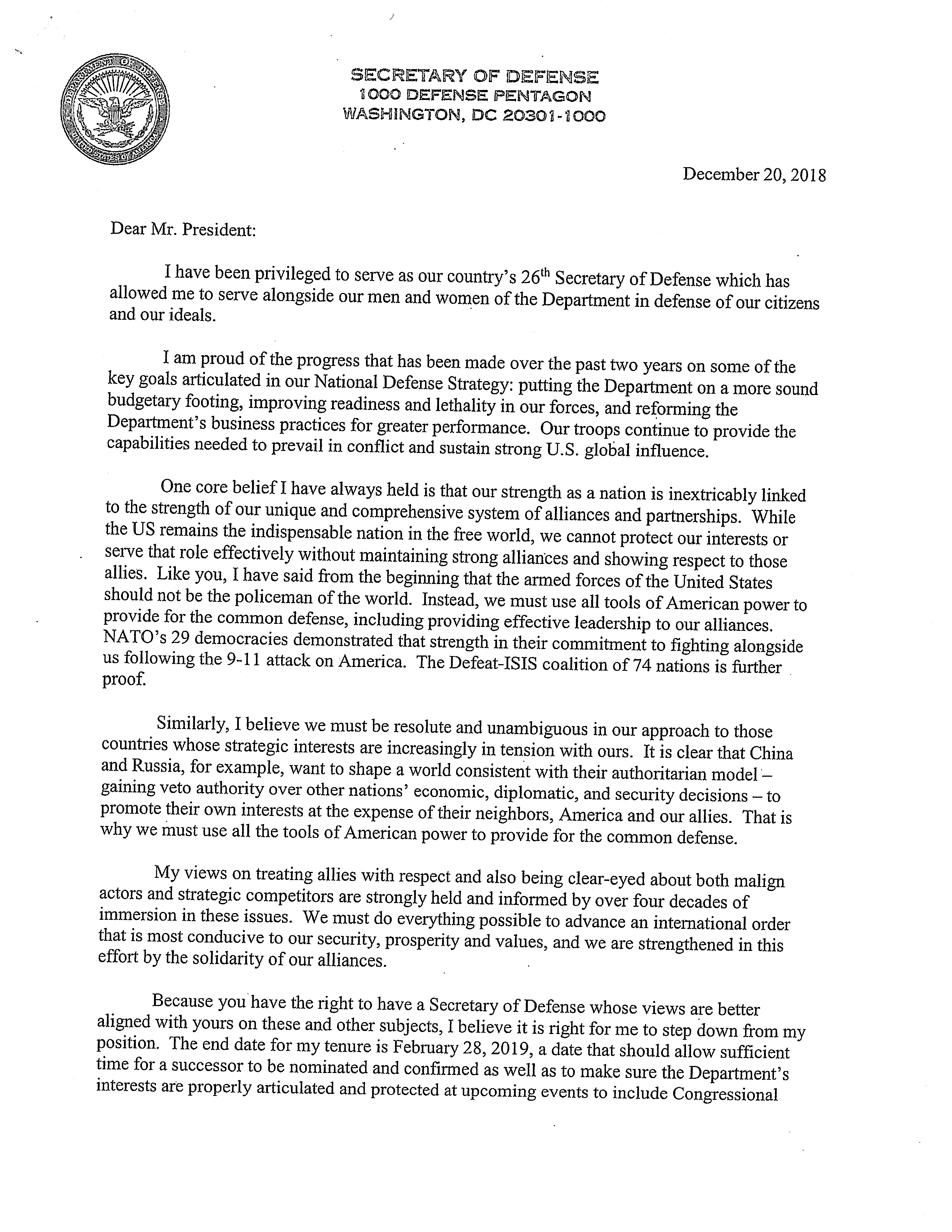
Gen Mattis resignation letter

image

Dear Mr. President:

I have been privileged to serve as our country’s 26th Secretary of Defense which has allowed me to serve alongside our men and women of the Department in defense of our citizens and our ideals.

I am proud of the progress that has been made over the past two years on some of the key goals articulated in our National Defense Strategy: putting the Department on a more sound budgetary footing, improving readiness and lethality in our forces, and reforming the Department’s business practices for greater performance. Our troops continue to provide the capabilities needed to prevail in conflict and sustain strong US global influence.

One core belief I have always held is that our strength as a nation is inextricably linked to the strength of our unique and comprehensive system of alliances and partnerships. While the US remains the indispensable nation in the free world, we cannot protect our interests or serve that role effectively without maintaining strong alliances and showing respect to those allies. Like you, I have said from the beginning that the armed forces of the United States should not be the policeman of the world. Instead, we must use all tools of American power to provide for the common defense, including providing effective leadership to our alliances. NATO’s 29 democracies demonstrated that strength in their commitment to fighting alongside us following the 9-11 attack on America. The Defeat-ISIS coalition of 74 nations is further proof.


  • James Mattis

Similarly, I believe we must be resolute and unambiguous in our approach to those countries whose strategic interests are increasingly in tension with ours. It is clear that China and Russia, for example, want to shape a world consistent with their authoritarian model—gaining veto authority over other nations’ economic, diplomatic, and security decisions—to promote their own interests at the expense of their neighbors, America and our allies. That is why we must use all the tools of American power to provide for the common defense.

My views on treating allies with respect and also being clear-eyed about both malign actors and strategic competitors are strongly held and informed by over four decades of immersion in these issues. We must do everything possible to advance an international order that is most conducive to our security, prosperity and values, and we are strengthened in this effort by the solidarity of our alliances.

Because you have the right to a Secretary of Defense whose views are better aligned with yours on these and other subjects, I believe it is right for me to step down from my position. The end date for my tenure is February 28, 2019, a date that should allow sufficient time for a successor to be nominated and confirmed as well as to make sure the Department’s interests are properly articulated and protected at upcoming events to include Congressional posture hearings and the NATO Defense Ministerial meeting in February. Further, that a full transition to a new Secretary of Defense occurs well in advance of the transition of Chairman of the Joint Chiefs of Staff in September in order to ensure stability within the Department.

I pledge my full effort to a smooth transition that ensures the needs and interests of the 2.15 million Service Members and 732,079 DoD civilians receive undistracted attention of the Department at all times so that they can fulfill their critical, round-the-clock mission to protect the American people.

I very much appreciate this opportunity to serve the nation and our men and women in uniform.

James N. Mattis