Friday, November 2, 2018

Trump's Surprise Border Mission Is a Politically Motivated Waste of Money: Pentagon Sources


image


The Trump administration’s plan to deploy thousands of troops to the U.S. border took officials by surprise, with many senior-level Defense Department officers saying they believed the move was politically motivated and a waste of money, multiple Pentagon sources with knowledge of the directive told Newsweek.

Sources with direct knowledge of how plans for the troop deployment—dubbed Operation Faithful Patriot—came together said that the initial directive to send troops to the border came directly from the president’s office, known in Pentagon parlance as National Command Authority, which would mean President Donald Trump or Defense Secretary James Mattis.

Moreover, sources affirmed that even if Mattis, a former U.S. Marine general, had been delegated authority for the operation, it would still have required permission from the commander in chief. But ultimately, the decision to move forward with the southern-border deployment was unexpected by military planners.

Speaking to Newsweek on condition of anonymity, as they are not authorized to speak to the media, U.S. military sources said senior leaders within the Pentagon had derided the deployment not only as a significant waste of taxpayer dollars but as running counter to military readiness, while a minority lauded the Trump administration’s hardline crackdown on immigration.

What the majority of service members within the higher echelon seemed to agree on was that the decision to deploy thousands of troops to the border was a politically motivated tactic, with the Trump administration ordering the deployment less than a week before the November 6 midterm elections, sources suggested.

“If Ray Charles was deaf he could still tell you that this is just an election stunt,” one source told Newsweek. “There is no practical or tactical reason for this to happen.”

Brownsville_BorderPlanning Planners from the military and U.S. Customs and Border Protection discuss the requirements for DoD support to ensure the security along the Southwest Border on October 26, 2018, in Brownsville, Texas. DoD has a long history of supporting the Department of Homeland Security and CBP with capabilities such as engineering, aviation, and administrative support. Patti Bielling/Operation Faithful Patriot

The remarks come amid the president's doubling down on his immigration rhetoric on Thursday as he spoke to reporters in the Roosevelt Room at the White House.

“Anybody throwing stones, rocks, like they did to Mexico and the Mexican military, Mexican police, where they badly hurt police and soldiers of Mexico, we will consider that a firearm,” Trump said. "We’re not going to put up with that. They want to throw rocks at our military, our military fights back. I told them to consider it a rifle.”

Pentagon sources speaking to Newsweek moments after Trump concluded his comments said that service members deploying to the southern border had not received credible intelligence about “bad actors,” and there had not been a change to the rules of engagement that would permit service members to treat rocks as firearms.

Trump had previously called the expected arrival of the caravans, composed mostly of women and children from Honduras and other Central American countries, an “invasion of our country.”

The president had also falsely claimed that the caravan contained terrorist cells, and that Democrats were organizing and handing out money to the traveling migrants.

Critics of the president have called the troop deployment a publicity stunt meant to garner Republican support just days before the midterm elections.

Despite the president’s assertions that the caravans were “made up of some very bad thugs and gang members,” documents obtained by Newsweek show that intelligence officials did not anticipate high involvement of criminal gangs—or any terrorist infiltration—as the caravan continued to follow its projected route.

The documents also showed that the Trump administration had anticipated that “only a small percentage” of migrants traveling with the caravans headed to the U.S. would make it to the border based on historical trends. The assessment said only about 20 percent of the 7,000 migrants, or what equates to 1,500 traveling with the caravan, would make it to the border.

To put this in perspective, this means there would be about 3.5 members of the military deployed for each migrant.

Currently, there are at least four caravans of Central Americans making their way to the U.S. border, with the first group having departed from San Pedro Sula, Honduras, on October 13. By Thursday, the main group, which saw its numbers swell to 7,000 before dropping to roughly 4,000, had made it to the city of Juchitan in southern Mexico.

Asylum seekers traveling with the caravan still had about 875 miles to go before they reached the closest U.S. port of entry in McAllen, Texas.

Caravan_Shoe_Pentagon A child's shoe sits along the roadside as members of the Central American caravan head out for their next destination on November 1, 2018 in Juchitan de Zaragoza, Mexico. The group of migrants, many of them fleeing violence in their home countries, took a rest day on Wednesday and resumed their journey towards the United States border on Thursday. Spencer Platt/Getty Images

Their journey could more than double, however, if they choose to follow the same route of an earlier caravan of asylum seekers that made the trip to the U.S. border in April—they took a significantly longer trek to Tijuana in the far northwest of Mexico, to claim asylum at San Ysidro port of entry in San Diego, California.

Other files obtained include a slideshow presentation produced by the Joint Force Land Component Commander Threat Working Group on Operation Faithful Patriot.

Commanders were briefed on the presentation on Saturday, and it contained U.S. government guidance to subordinate commands handling press relations during the interagency operation led by the Department of Homeland Security, suggesting government officials had planned for its official narrative on the military deployment to be “top-down driven.”

That means that “a lot of these questions will be handled in Washington and by the Pentagon,” said David Lapan, a former Homeland Security spokesman under the Trump administration and a former U.S. Marine, speaking to Newsweek. “Recognizing all the policy and political implications, they’re going to want individual service members to stay away from those things.”

The Department of Defense will make sure to differentiate between uniformed members of the military and “people who are members of the administration or people who hold policy positions in the Pentagon and can talk about political stuff,” said Lapan.

The U.S. Army North documents show that Pentagon officials were well aware of the political effect that deploying thousands of U.S. forces to the southern border might have on the upcoming November midterm elections well before the Trump administration announced the deployment.

Presentation slides provided guidance on the role that the November elections could play in driving narratives around the arrival of the caravan in an “information environment analysis” completed by the operations wing of U.S. Northern Command, the Pentagon unit overseeing the southern border deployment.

“Midterm elections NOV 06 will be the dominant driver of competing narratives and increase competitive and combative nature of IE,” stated a slide titled “Public Affairs.”

The president insisted his show of military force had little to do with next week’s elections. “I’ve been saying this long before election[s], Trump said. "I've been saying this before I ever thought of running for office. We have to have strong borders. If we don’t have strong borders, we don’t have a country.”

KellyField_Border Deployers from the 541st Engineering Company, 19th Engineering Battalion, Fort Knox, KT., land at Kelly Field, San Antonio, in support of Operation Faithful Patriot, October 30, 2018. SrA Alexandra Minor/U.S. Air Force

The public affairs documents go on to instruct officials to emphasize the collaborative nature of the interagency deployment, and how it will avoid any potential legal trouble.

The Department of Defense was asked to direct all communications coordination to the Department of Homeland Security, with public affairs officials being told to highlight the temporary nature of the mission to members of the press.

“From a military standpoint, the timing or reason for a mission is out of our control. We get an order from the commander in chief, and we do that mission when they tell us to. If you have a question about why you’re doing it, you don’t talk about it because that’s not you, that’s the White House,” said Lapan.

“It’s a tricky situation for military service members to be in given how politically fraught the situation is right now. I don’t know why the policymakers are doing this now or how they’re going to answer those questions. I haven’t seen any policymaker answer the question of why they’re doing this now and whether it has to do with midterms,” Lapan said.

Trump has staunchly defended his administration’s decision to send as many as 15,000 troops to the border, telling ABC News chief White House xorrespondent Jonathan Karl that the U.S. needed to “have a wall of people” standing guard at the border for when the caravans eventually arrive.

The U.S. Army North operation order used to coordinate tasks at the southern border paints a dire picture of the situation there, which seems to echo Trump’s sentiments: “CURRENT SITUATION. THE SECURITY OF THE UNITED STATES IS IMPERILED BY A DRASTIC SURGE OF ILLEGAL DRUGS, DANGEROUS GANG ACTIVITY AND EXTENSIVE ILLEGAL IMMIGRATION THREATENS SAFETY OF CITIZENS AND UNDERMINES THE RULE OF LAW. THE SITUATION AT THE BORDER HAS REACHED A POINT OF CRISIS AND POTUS HAS TAKEN ACTION TO SECURE OUR BORDERS. DOD WILL SUPPORT THE DEPARTMENT OF HOMELAND SECURITY (DHS) AND THE UNITED STATES CUSTOMS AND BORDER PROTECTION (CBP).”

Brad Moss, a Washington, D.C., based national security attorney, told Newsweek: “The deployment of thousands of active duty personnel to the border remains a decision with unclear motivations or intentions…[but] under federal law, military personnel are limited in what they can do, particularly in terms of domestic law enforcement.

“They certainly have the authority to provide technical and intelligence assistance to local law enforcement and DHS personnel, but they are prohibited from directly handling seizure and detention of any undocumented immigrants from the ‘caravan’ that reach the U.S. border.

“This isn’t an area of differing interpretations. Under the Posse Comitatus Act, the military is strictly prohibited from handling domestic law enforcement tasks absent an explicit grant of authority by Congress or a presidential determination regarding the existence of an emergency,” Moss said.

The Posse Comitatus Act is a longstanding federal statute that restricts the government’s ability to use the U.S. military as a police force; however, language contained in the documents give an overview of the legal authorizations for deploying U.S. troops domestically.

The president maintains an “inherent authority” exception, according to the documents. Trump could use those executive powers to restore order in extraordinary circumstances, even if a state governor objected to the president wielding his authority.

Trump had initially vowed to send up to 5,200 troops to the southern border in anticipation of several caravans of Central American migrants heading toward the U.S. border, but the president more than doubled that figure on Wednesday, indicating that he could send as many as 15,000 military troops to multiple ports of entry locations across the southwest border.

PublicAffairs_Document_Caravan A screenshot from a presentation obtained by Newsweek showing a tweet from Dana White, the Pentagon's chief spokeswoman. Defense Department sources say the southern border mission was a surprise from the White House, with many believing it was politically motivated. Newsweek

The surge in troop levels aligned with Newsweek’s report on Monday revealing how government documents showed that the Pentagon had placed roughly 7,000 troops on notice to deploy to the southern border within 24-hours. A Defense Department official told Newsweek it didn't believe the number of U.S. forces would surpass the 15,000 figure touted by Trump.

In a presentation briefed to commanders on Saturday, a public affairs slide included a Twitter screen shot from the verified account of Dana White, the Pentagon’s chief spokeswoman. The date stamp showed the tweet had been posted on the same Saturday as the briefing.

@DeptofDefense is in support of @DHSgov request to provide support to the @CBP. #SecDef Mattis’ signed order did not specify the number of troops that will support this mission. Media reports of 800 or 1000 troops deploying are inaccurate."

Sources told Newsweek that while it was true that the order Mattis signed did not indicate troop strength numbers when he signed the directive this past Friday, operational planners at the Defense Department knew the troop levels would surge to more than 14,000 before White’s October 27 tweet.

Newsweek sought comment from the Pentagon, but received no reply on Thursday.

On Wednesday, when asked if the number of U.S. troops on the border was a political stunt, Mattis said: “The support that we provide to the Department of Homeland Security is practical support based on the request from the commissioner of customs and border police,” Mattis said per a poll report. “We don’t do stunts in this department.”

Thursday, November 1, 2018

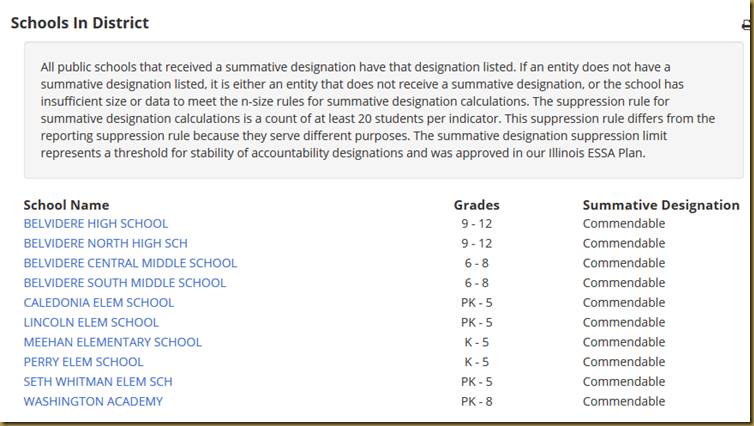
Illinois Report Cards for Boone County Schools


image


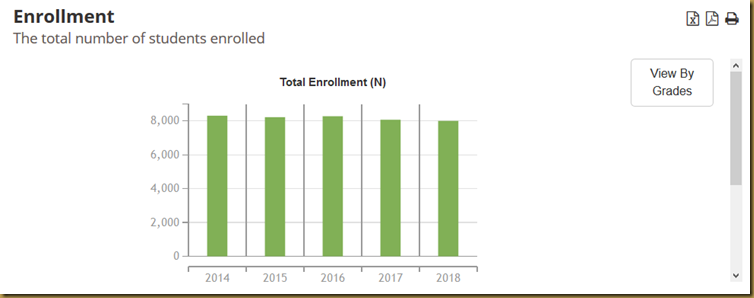
Belvidere Community District #100

image

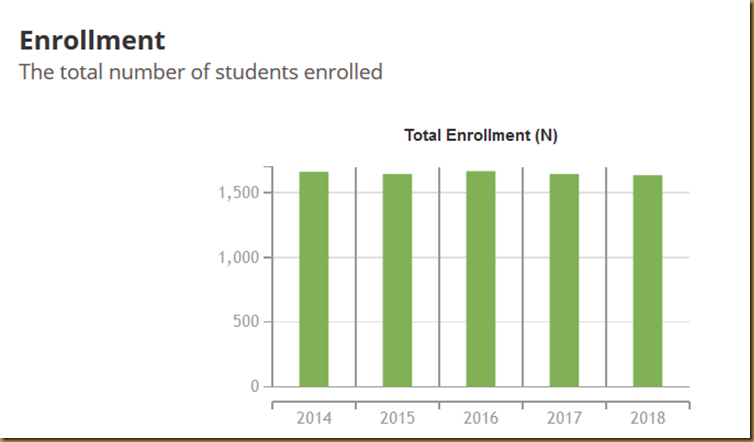
North Boone School District #200

image


Belvidere School Statistics and Scores are available for individual schools at:  http://www.illinoisreportcard.com/search.aspx?address=61008&miles=5

North Boone Statistics and Scores are available at:  http://www.illinoisreportcard.com/District.aspx?source=schoolsindistrict&Districtid=04004200026


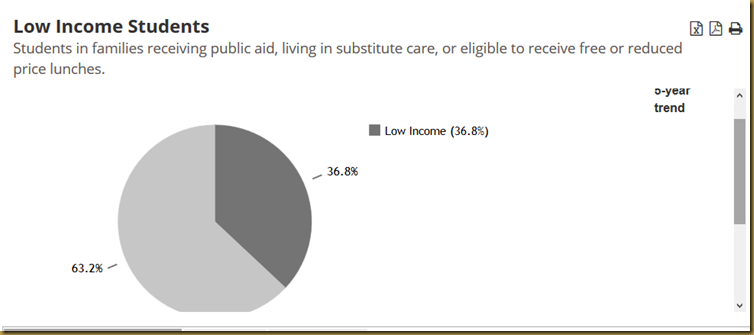
Belvidere Community School District #100

image

image

image

North Boone District #200

image

image


image


Second Fight over Enbridge pipeline?


image

Boone County residents gear up to fight possible second Enbridge pipeline

Most Popular

Our Picks

By Susan Vela
Staff writer

Posted at 12:19 PM Updated at 3:48 PM

CAPRON — A strip of bright green grass identifies the Enbridge pipeline running parallel to Ronald Gadow’s property.

The pipeline, officially Line 61, which starts in Superior, Wisconsin, runs through Boone County on its way to its endpoint near Pontiac, carrying an average of 930,000 barrels of crude oil a day.

Now, a new $2.6 billion Enbridge oil pipeline project sparking debate in Minnesota has Gadow and other Boone County residents concerned that the Canadian company will revive studies designed to lay the groundwork for a “twin” Line 61 that would carry more oil through the county. Enbridge officials say they have no such plans.

Gadow fears he could lose woodlands and a whole host of plants and wildlife if that happened.

“Safety is one of my concerns,” Gadow said. “It also devalues the property. If you don’t have a lawyer, you’re a total victim to what Enbridge can do.”

He has hired an attorney and plans to join other landowners and groups like Save Our Illinois Land, called SOIL, and Wisconsin Safe Energy Alliance, or WiSE, in pressing the Boone County Board to pass a resolution opposing the use of eminent domain to obtain land for a new Enbridge line. Eminent domain is the right of a government or its agent to take property at fair market value for public use.

Experts agree that Enbridge could prevail if it seeks to use eminent domain, and residents doubt they could stop the project.

“I’ve just always been under the impression that the oil companies always win,” Gadow said.

Residents are wary after Enbridge’s massive 2010 oil spill into Michigan’s Kalamazoo River and because of the Minnesota controversy.

“I think that you have to consider other things that Enbridge is doing,” said Deni Mathews, a SOIL activist.

SOIL and WiSE have invited residents living near Line 61 to informational meetings that are being held despite Enbridge’s insistence that there is no plan for a second line.

“Our stakeholders know we are not pursuing another pipeline project,” said Jennifer Smith, an Enbridge manager, during a telephone interview last month. “We have no plans to build south of Superior.”

Line 61 went into service in 2008. The company added three new pumping stations to the existing line between 2014 and 2016 to increase daily pumping capacity from about 400,000 barrels a day to 1.2 million barrels a day.

Surveys were done in anticipation of a potential twin line, Smith said. The market did not support construction of a second line, however.

Jim and Lori Schall live near Gadow. Their property also would be at risk if a twin line were built.

“You hear about things happening, like leaks,” Lori Schall said. “You can fight. You can express your concerns. But is it going to matter? It can’t hurt. It’s nice to at least let them know our concerns. If they can listen and address our concerns, more power to them.”

“Nobody is going to want it on their property,” Jim Schall said. “Nobody is going to want it near them. It’s just like having a prison built.”

Robert McNamara, a senior attorney for the Virginia-based Institute for Justice, said pipeline companies’ use of eminent domain is the subject of debate.

Although a County Board resolution may carry little weight, McNamara nonetheless says residents should “stand up, make your voice heard, and make it known you don’t intend to go quietly.”

The Boone County Board in 2016 approved a resolution opposing a proposed $8 billion, 275-mile rail line that would have cut through the county after residents expressed concerns that eminent domain would be used to acquire vast stretches of private land for the project.

“If residents want to band together, we’re more than happy to listen to what their concerns are,” County Board Chairman Karl Johnson said. “I personally am not a big fan of eminent domain.”

Susan Vela: 815-987-1392; svela@rrstar.com; @susanvela

Above is fromhttp://www.rrstar.com/news/20181101/boone-county-residents-gear-up-to-fight-possible-second-enbridge-pipeline

Wednesday, October 31, 2018

Whopping 62 percent of jobs don't support middle-class life after accounting for cost of living


Whopping 62 percent of jobs don't support middle-class life after accounting for cost of living

Paul Davidson, USA TODAY Published 5:01 a.m. ET Oct. 30, 2018 | Updated 2:54 p.m. ET Oct. 30, 2018


new-york-city-manhattan-e1463493307898.jpg


Esther Akutekha, who lives in Brooklyn, New York, has a good job as a public relations specialist that pays more than $50,000 a year.


But because of the $1,440 a month rent on her studio apartment in the Prospect-Lefferts Gardens neighborhood, she never takes vacations, dines out just once a month and scrapes together dinner leftovers for lunch the next day.

“I’m frustrated with the fact that I’m not going to be able to save anything because my rent is so high,” says Akutekha, who says she’s 30ish. “I don’t even know if I can afford” to have children.

Despite an unemployment rate that has reached a 50-year low of 3.7 percent, most jobs across the U.S. don’t support a middle-class or better lifestyle, leaving many Americans struggling, according to a new study.

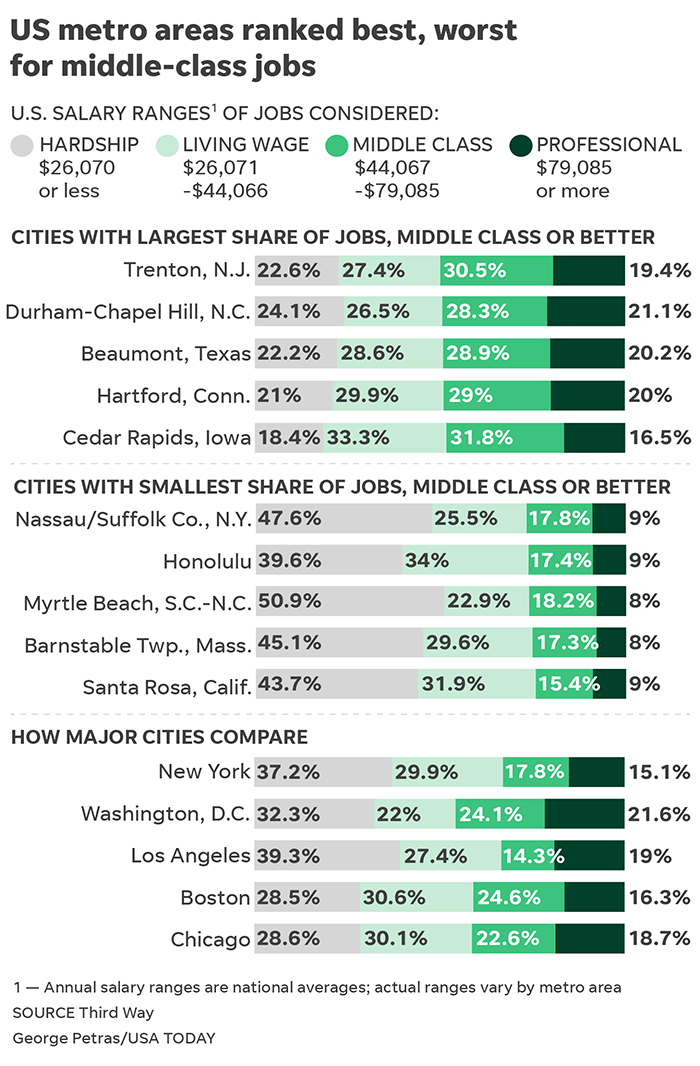
Sixty-two percent of jobs fall short of that middle-class standard when factoring in both wages and the cost of living in the metro area where the job is located, according to the study by Third Way, a think tank that advocates center-left ideas.


“There’s an opportunity crisis in the country,” says Jim Kessler, vice president of policy for Third Way and editor of the report. “It explains some of the economic uneasiness and, frankly, the political uneasiness” even amid the most robust U.S. economy and labor market since before the Great Recession of 2007 to 2009.

A slight majority of Americans, 52 percent, do live in middle-class households, according to recent annual reports by Pew Research Center. And another 20 percent or so live in upper income households. But that’s because they’re juggling multiple jobs, for example, or relying on investments, an inheritance or other household members who may have higher-paying jobs.

The Third Way study more starkly assesses the jobs in each metro area and the opportunities they’re providing to live a good life. By those measures, the study found that Trenton, New Jersey, and Durham, North Carolina, rank highest among the nation’s 204 largest metro areas in share of middle-class or better jobs. Honolulu and Myrtle Beach, South Carolina, on the other hand, are near the bottom.


Some areas, such as Myrtle Beach, fall short because of a scarcity of good-paying jobs. Among the biggest cities, Los Angeles, New York City and San Francisco were ranked fairly low (172nd, 168th and 174th, respectively) despite thriving economies because of their high cost of living.

Other large cities such as Washington, D.C. (14th) and Boston (61st) surmounted their high-cost burdens with a large share of jobs in flourishing sectors such as government and technology. Houston (18th) is blessed with both vibrant energy and aerospace industries and relatively moderate costs.

The rankings highlight some vivid contrasts. A factory machinist in Cedar Rapids, Iowa, earns an average $45,470 a year, more than enough to meet the $40,046 threshold for a middle-class job in that area.

A similar machinist makes more – $57,220 on average – in San Francisco, but that’s far short of the $82,142 minimum for a middle-class job in that area, according to the report. It costs an average $32,440 a year to rent a one-bedroom apartment in San Francisco, compared with $7,368 in Cedar Rapids.

Esther Akutekha

Esther Akutekha (Photo: Kristina Brown)

Akutekha was set back in her career path because she graduated from college during the Great Recession and initially could only find jobs in industries such as fast-food and as an assistant in a law office. She got the public relations position at a nonprofit this year but, “I just feel like I’m back to square one,” she says.

She says she’s not considering moving because major cities such as New York offer far more opportunities in her field.

Nationally, the study found:

  • 30 percent of jobs are “hardship jobs,” meaning they don’t allow a single adult to make ends meet.
  • 32 percent are “living wage” jobs, enough to get by but not to take vacations, save for retirement or live in a moderately priced home.
  • 23 percent are middle-class jobs, allowing for dining out, modest vacations and putting some money away for retirement.
  • 15 percent are “professional jobs,” paving the way for a more comfortable life that includes more elaborate vacations and entertainment and a more expensive home.

A big reason for the dearth of middle-class jobs is the offshoring of millions of middle-income factory positions to countries with lower labor costs, such as China, in recent decades and the spread of lower-paying service jobs. Former manufacturing strongholds that have remade themselves fare better. Cleveland, which has become a health and biotech hub, is ranked sixth while Youngstown, Ohio, is 80th.

Here’s a look at the top five metro areas for middle-class or better jobs:

Trenton, New Jersey

Share of jobs middle-class or better: 49.9 percent

Middle-class salary threshold: $50,947

Has largely lost its manufacturing base but it’s the state capitol and an education hub centered around Princeton University.

Durham-Chapel Hill, North Carolina

Share of jobs middle-class or better: 49.4 percent

Middle-class salary threshold: $45,169

Part of the Research Triangle, a vibrant cluster of research universities and related industries such as biomedicine and technology.

Beaumont, Texas

Share of jobs middle-class or better: 49.2 percent

Middle-class salary threshold: $37,693

Chiefly supported by the oil industry and one of the nation’s largest seaports. But the share of prime-age Americans who have jobs is relatively low.

Hartford, Connecticut

Share of jobs middle-class or better: 49.1 percent

Middle-class salary threshold: $48,203

The country’s largest insurance industry hub and home to the University of Connecticut.

Cedar Rapids, Iowa

Share of jobs middle-class or better: 48.3 percent

Middle-class salary threshold: $40,046

A large center for corn processing and close to the University of Iowa.

Here are the bottom five areas for middle-class or better jobs:

Nassau and Suffolk Counties (Long Island)

Share of jobs middle-class or better: 24.4 percent

Middle-class salary threshold: $73,400

Long Island is an anomaly. The cost of living is high and the median household income is about $95,000, but many people who have higher-paying jobs work in Manhattan, which is part of a separate metro area.

Honolulu

Share of jobs middle-class or better: 25.3 percent

Middle-class salary threshold: $66,049

Has a large tourism industry and is a center for defense jobs. But its cost of living is among the highest in the country.

Myrtle Beach, South Carolina

Share of jobs middle-class or better: 25.3 percent

Middle-class salary threshold: $39,021

Has low costs but many jobs in tourism and other service industries are low-paying.

Town of Barnstable, Massachusetts

Share of jobs middle-class or better: 26.8 percent

Middle-class salary threshold: $60,052

The Cape Cod community is set back by its high housing costs.

Santa Rosa, California

Share of jobs middle-class or better: 26.8 percent percent

Middle-class salary threshold: $61,506

The area has the fifth-highest housing costs the country.

Above is fromhttps://www.usatoday.com/story/money/2018/10/30/jobs-62-percent-fall-short-middle-class-standard-us/1809629002/

Tuesday, October 30, 2018

Wisconsin’s $4.1 billion Foxconn boondoggle


Wisconsin’s $4.1 billion Foxconn boondoggle

Gov. Scott Walker promised billions to get a Foxconn factory, but now he’s running away from it

By Bruce Murphy Oct 29, 2018, 11:50am EDT


It was a veritable lovefest in Milwaukee in July 2017 when Republican Gov. Scott Walker and Foxconn chairman Terry Gou announced their plan to create a heavily subsidized manufacturing plant in southeastern Wisconsin. Walker gushed that Gou, who founded his Taiwan-based company in 1974, was “one of the most remarkable business leaders in the world.” Gou returned the favor by saying, “I’ve never seen this type of governor or leader yet in this world.” Effusive, yet ambiguous.

The details of the deal were famously written on the back of a napkin when Gou and the Republican governor first met: a $3 billion state subsidy in return for Foxconn’s $10 billion investment in a Generation 10.5 LCD manufacturing plant that would create 13,000 jobs.

Key points

  • Wisconsin Gov. Scott Walker wooed Foxconn with a huge subsidy plan, which was first drawn up on the back of a napkin
  • It now totals $4.1 billion, much of it in cash, and many doubt taxpayers will ever be repaid
  • Now, Foxconn no longer plans to build a Generation 10.5 factory manufacturing panels for 75-inch TVs
  • Instead, it plans to build a smaller factory manufacturing smaller panels and requiring far less investment
  • Foxconn maintains it will still create 13,000 jobs, but they will mostly be for knowledge workers developing an ecosystem it calls “AI 8K+5G”
  • Foxconn was given large exemptions from environmental regulations, raising concerns about pollution 
  • The Walker administration refused to talk to The Verge for this story

The size of the subsidy was stunning. It was far and away the largest in Wisconsin history and the largest government handout to a foreign company ever given in America. Like most states, Wisconsin had given subsidies to companies in the past, but never higher than $35,000 per job. Foxconn’s subsidy was $230,000 per job.

But Walker was elected in 2010 on a promise of creating 250,000 new jobs in the state in his first term as governor. Six years into his tenure, he still was far short. Running for a third term in 2018, he badly needed a big win.

And the Foxconn deal was beyond big. Some predicted that bringing the company that manufactures devices for Apple and many other tech giants to the state would create the “Silicon Valley of Wisconsin,” which is no small claim in a state that’s far from a high-tech hotbed. Conservatives predicted Walker’s re-election would be a slam dunk on the back of the deal.

But what seemed so simple on a napkin has turned out to be far more complicated and messy in real life. As the size of the subsidy has steadily increased to a jaw-dropping $4.1 billion, Foxconn has repeatedly changed what it plans to do, raising doubts about the number of jobs it will create. Instead of the promised Generation 10.5 plant, Foxconn now says it will build a much smaller Gen 6 plant, which would require one-third of the promised investment, although the company insists it will eventually hit the $10 billion investment target. And instead of a factory of workers building panels for 75-inch TVs, Foxconn executives now say the goal is to build “ecosystem” of buzzwords called “AI 8K+5G” with most of the manufacturing done by robots.

Polls now show most Wisconsin voters don’t believe the subsidy will pay off for taxpayers, and Walker didn’t even mention the deal in a November 2017 speech announcing his run for re-election. He now trails in that re-election bid against a less-than-electric Democratic candidate, the bland state superintendent of public instruction Tony Evers.

It all seemed so promising. So how did

When Walker signed the Foxconn deal in November 2017, the details matched those jotted on the napkin: the state promised a $3 billion state subsidy if the company invested $10 billion in a plant that created 13,000 jobs.

The size of Wisconsin’s subsidy quickly began to grow, as spelled out in state legislation passed about six weeks later and implemented by the Walker administration. By December 2017, the public cost had grown to include $764 million in new tax incentives from local governments in Racine County, which is just 40 minutes south of Milwaukee where the plant was to be located. Other additions included $164 million for road and highway connections built to service the plant, plus $140 million for a new electric transmission line to Foxconn that would be paid for by all 5 million ratepayers of the public utility We Energies. With other small costs added, the total Foxconn subsidy hit $4.1 billion — a stunning $1,774 per household in Wisconsin.

The total Foxconn subsidy hit $4.1 billion, a stunning $1,774 per household in Wisconsin

Back when the subsidy was $3 billion, Wisconsin’s non-partisan Legislative Fiscal Bureau estimated that it would take until 2043 for taxpayers to recoup the subsidy. This long payback period was due to Walker and Republicans effectively cutting the state’s corporate income tax for manufacturers to zero in 2011. This meant the subsidies to Foxconn would not be a tax write-off, but billions in cash that would be paid back by state income taxes paid by Foxconn workers. At $4.1 billion, the payback date for the state was likely 2050 or later.

Some doubt the subsidy will ever actually be recouped. “Realistically, the payback period for a $100,000 per job deal is not 20 years, not 42 years, but somewhere between hundreds of years and never,” wrote Jeffrey Dorfman, an economics professor at the University of Georgia, in a story for Forbes. “At $230,000 [or more] per job, there is no hope of recapturing the state funds spent.” And this was before the subsidy had risen to $4.1 billion, or about $315,000 per job.


In retrospect, it’s clear that Walker had a strong hand to play in negotiations with Foxconn. The company had to locate in a Great Lakes state because of the huge amount of water needed to clean the glass used in manufacturing LCD screens. And no other Great Lakes state came close to offering the $4.1 billion Foxconn is getting. Michigan came the closest, offering $2.3 billion, but it was partly a tax subsidy rather than cash. As for Ohio, fellow Republican Gov. John Kasich condemned the Wisconsin deal. “I’ll tell you one thing,” he said, “it’s not going to take us 40 years to make back the investment we make. We don’t buy deals.”

Over the summer, Walker’s response to such criticism was pointed. ”There’s a whole lot of people out there scrambling to try and come up with a reason not to like this,” he said in July of last year. “They can go suck lemons. The rest of us are going to cheer and figure out how we are going to get this thing going forward.” Several weeks later, he called the deal a “once-in-a-lifetime opportunity” that will be “transformational” for the state. “These LCD displays will be made in America for the very first time, right here in the state of Wisconsin.”

”They can go suck lemons.”

The Walker administration did not return repeated requests for comment about when taxpayers would recoup the Foxconn subsidies.

In May, the Nikkei Asian Review reported that Foxconn was greatly scaling back its plans for the plant. Foxconn released a statement “categorically” denying this, but by late June, company officials conceded they would not be building the kind of plant Gou had originally promised Walker.

Instead of a Generation 10.5 plant, which produces 10-foot by 11-foot panels for 75-inch TV screens, Foxconn would be building a Generation 6 plant that only produces 5-foot by 6-foot glass panels. A Gen 6 plant would require about a $2.5 billion investment, according to Bob O’Brien, a partner at Display Supply Chain Consultants, rather than the $10 billion Foxconn initially promised.

They would not be building the kind of plant Gou had originally promised Walker

Foxconn had hoped to have New York-based Corning build a factory nearby, as the large glass panels required for a Generation 10 plant cannot be transported long distances. But Corning officials made it clear they’d need a subsidy for as much as two-thirds of the cost of this facility, and officials within the Walker administration, suffering continuing criticism about the Foxconn subsidy, ruled out any more handouts. The Walker administration, it seems, had not checked to see if Foxconn could deliver on its promises without help.

Foxconn spokesperson Louis Woo told BizTimes that a co-located glass plant “would no longer be a necessity” with a Gen 6 plant. “We can just ship [glass] from somewhere else… because the pieces of glass that would be required would be a lot smaller.”


But Foxconn officials also said that the company was still committed to a $10 billion investment and 13,000 jobs, adding it might eventually add a Gen 10.5 plant, but it would get there in “phases.” The phases were not spelled out.

Just seven weeks later, in late August, the company announced the plans had changed yet again — far more radically. Woo told the Racine Journal Times that Foxconn would never add a Gen 10.5 plant to its Racine campus, despite past statements, because by the time it was built, the market would be glutted by other manufacturers in China.

And even the Gen 6 panels might not be manufactured in Racine for long. “We are not really interested in television,” Woo told the newspaper, though he said the company wants to build America’s first thin-film transistor (TFT) fabrication, which can be used in LCD products. Rather, Woo said, workers at the Wisconsin plant will be focused on figuring out new ways to use Foxconn’s display, cellular, and AI technology, building out an “ecosystem” Woo calls “AI 8K+5G.”

All this means Foxconn needs far fewer assembly line workers. “If, six months ago, you asked me, what would be the mix of labor? I would pull out the experience that we have in China and say, ‘Well, 75 percent assembly line workers, 25 percent engineers and managers,’” Woo said. But “now it looks like about 10 percent assembly line workers, 90 percent knowledge workers.”

Almost all the actual assembly line work, he added, will be done by robots.

That’s an astonishing change to the company’s plans. For starters, it ends the hope of local politicians that lower-skilled, mostly minority workers from Racine and Milwaukee might be able to get a job.

Almost all the actual assembly line work will be done by robots

Wisconsin would not be the first government Foxconn has shifted its promises to. Foxconn had promised to invest $5 billion and create 50,000 jobs in India, only to cut it to a fraction of that. “Similar results were seen in Vietnam, where Foxconn committed to a $5 billion investment in 2007, and in Brazil, where Foxconn spoke of a $10 billion plan in 2011,” and the plans were never realized, The Washington Post reported. And then there is Harrisburg, Pennsylvania, where Foxconn’s promise to invest $30 million and hire 500 workers never happened.

In a statement to The Verge, Foxconn said it remains “committed to creating 13,000 high-value jobs and investing US$10 billion.” The company also said its “plans have always been associated with a phased approach to the development of the Wisconn Valley Science and Technology Park,” with the first phase consisting of the Generation 6 Thin-Film-Transistor facility and the next phase consisting of “future-generation research and development and manufacturing facilities.”

The Walker administration did not return requests for comment about how it evaluated the feasibility of Foxconn’s initial plan, the change in factory types, or the change in types of workers needed.


Meanwhile, concerns about Foxconn’s impact on the environment have started to grow.

The LCD screens being made by Foxconn require benzene, chromium, cadmium, mercury, zinc, and copper, according to Peter Adriaens, a professor of environmental engineering at the University of Michigan. These materials are hazardous if improperly discharged. A report by the City of Milwaukee’s Legislative Reference Bureau on Foxconn’s history noted that “as of 2013, 25 to 60 million acres of China’s arable land were polluted with heavy metals due to electronics factories,” and Foxconn was a significant contributor. Foxconn told The Verge that it will build a Zero Liquid Discharge system, “which will go beyond any local, state and federal requirements relating to industrial water discharge.”

The Walker administration had also exempted Foxconn from the state’s usual environmental rules, allowing it to discharge materials into wetlands and reroute streams during construction and operation. The state also exempted the company from doing an Environmental Impact Statement. At stake was a huge swath of land: the plan calls for Foxconn to eventually own 4.5 square miles of what had been mostly farmland. Adriaens says these exemptions and the fact that Wisconsin is allowing Foxconn to operate unusually close to Lake Michigan are “red flags.”

The environmental exemptions and the fact that Foxconn will operate unusually close to Lake Michigan are “red flags”

The Walker administration also agreed to allow Foxconn to draw massive amounts of water from Lake Michigan. Foxconn would use as much as 7 million gallons per day from the lake, of which 39 percent will be lost through evaporation. Environmentalists charged that the plan violates the provisions of the Great Lake Compact signed by the Great Lakes states and Canadian provinces to protect the lakes, and they filed a legal action to stop this.

Documents filed with the Wisconsin Department of Natural Resources by Foxconn also show the company will cause significant air pollution, including hundreds of tons of carbon monoxide, particulates, sulfur dioxide, nitrogen oxide, and volatile organic compounds per year. According to the Milwaukee Journal Sentinel, the plant will emit enough volatile organic compounds and nitrogen oxides to make it one of the worst such polluters in southeastern Wisconsin.

Documents show that the company will cause significant air pollution

The federal Environmental Protection Agency might have stood in the way, but its former director, Scott Pruitt, made a ruling to override pollution standards established under the Obama administration, giving Foxconn more leeway. As a result, the Racine plant could eventually emit 229 tons of nitrogen oxides, 240 tons of carbon monoxide, 52 tons of particulate matter, four tons of sulfur dioxide, and 276 tons of volatile organic compounds per year, Milwaukee’s BizTimes reported. In a statement to The Verge, Foxconn said it will make great efforts to reduce pollution, adding it will “invest in world-class control technology to minimize air emissions from the plant.”

The Walker administration did not return requests for comment about what environmental protection measures were being taken.


While all of this was going on, Foxconn was buying real estate for “innovation centers” to spread investment around the state.

In February 2018, Foxconn announced it would be buying a seven-story building in downtown Milwaukee for its new North American headquarters and the “Wisconn Valley Innovation Center.” In June, news came that it would buy a six-story building in Green Bay to create another “innovation center,” employing more than 200 engineers. In mid-July, Foxconn was back to announce yet another “innovation center,” this time in Eau Claire, to begin operations in early 2019, with 150 employees.

In both cities, the company said it wanted to attract top talent from area universities. But Milwaukee, Green Bay, and Eau Claire are homes to some of the state’s lesser universities, and it was unclear why these graduates couldn’t simply drive down to the Racine plant to apply for jobs.

Foxconn has been buying real estate for “innovation centers”

Equally unclear was the economic advantage for Foxconn to have three different small innovation centers spread around the state. Using virtually the same language in both Green Bay and Eau Claire, Foxconn officials declared the goal was to “inspire innovative ideas and catalyze cutting-edge solutions from companies and entrepreneurs” in the area. But critics suggested these small satellites were being added to help Walker make his case that the Foxconn deal would help the entire state.

By late August, less than three months before the election, Foxconn announced more bells and whistles: it would contribute $100 million to create a new research facility at the University of Wisconsin-Madison and use $25 million for a new state venture capital fund. That $125 million total represented just 3 percent of the $4.1 billion subsidy the company stood to collect.


Shortly after the Wisconsin deal was signed, Walker was touting the Foxconn deal in campaign-style speeches across the state. But by October 2017, just a month after the legislature passed the Foxconn deal, a poll showed only 38 percent of the people in southeastern Wisconsin, where the plant would be located, thought the plant would be a net positive for the state. This was followed by March 2018 poll, which showed that 66 percent of people in the state believed their local businesses wouldn’t benefit from the Foxconn deal, and only 25 percent thought it would be beneficial.

Even after seven months of announcing new innovation centers and contributions, Foxconn hadn’t moved the needle much in the election: polls still showed the majority of people in the state didn’t believe the Foxconn deal would help them.

This was dreadful news for Walker, who suddenly stopped talking about Foxconn. He didn’t even mention the deal in a November 2017 speech announcing his run for re-election. It was also bad news for Foxconn, as every Democrat running for governor proceeded to condemn the deal. Both Walker and Foxconn now needed to sell this deal to the voters.

Polls showed the majority of people in the state didn’t believe the Foxconn deal would help them

As Marquette Law School pollster Charles Franklin put it, if the company “really wants all the benefits that they were promised… they have to prefer the incumbent who negotiated the deal over the unknown of a Democratic governor.”

Foxconn still insists that it will create 13,000 jobs by 2023. That rapid scale-up might have been possible with the kind of manufacturing plants and labor force the company has in China, but for Foxconn to hire that many top-flight “knowledge workers” in Wisconsin as it transforms its approach to create new technology seems incredibly ambitious.

In reality, there is little pushing Foxconn to invest as much money or create as many jobs as promised because Walker squandered his leverage over the company. Yes, the full subsidy promised comes in increments, as the capital investments are made and jobs created by Foxconn. But all the other subsidies, worth more than $1 billion, will be paid regardless of money invested or jobs created. A smaller plant with fewer workers could lower the total tax bill considerably, but it would actually cost the state more on a per-job basis.

Walker squandered his leverage over the company

The deal, says Matthew Rothschild, executive director of the good government group Wisconsin Democracy Campaign, “is a ridiculous way to do economic development. It exposes a lie we’ve been told over and over that the cupboard is bare, that we don’t have enough money for our schools or our roads or our health care. But then when a company from Taiwan comes knocking, all of a sudden there’s $4 billion of taxpayer money to shell out. We could have helped a whole lot of small businesses for that kind of money.”

But local governments have already begun using eminent domain to buy up homes and push out residents in Racine County, where Foxconn is now building its plant. And state and local governments have already spent heavily on building the infrastructure Foxconn requires. Should Walker lose, a Democratic governor will have a hard time undoing this deal.

Whatever the impact of Foxconn on Wisconsin’s economy, there is no doubt about the bill to be paid. For the taxpayers of Wisconsin, their children, and perhaps their grandchildren, the Foxconn deal will be added to their annual cost of living for decades, if not generations, to come.

Above is from:  https://www.theverge.com/2018/10/29/18027032/foxconn-wisconsin-plant-jobs-deal-subsidy-governor-scott-walker

6 Considerations Before Joining a Nonprofit Board


6 Considerations Before Joining a Nonprofit Board


It may be the last thing you are thinking about when you volunteer on the board of a nonprofit, but are you aware you might be putting your personal assets at risk? The reason for that is nonprofits face many of the same threats as for-profit businesses, including the potential for lawsuits. If the nonprofit is sued and lacks the proper planning and protection, you could lose your savings, your home and other assets.

Nearly two out of three nonprofits reported a Directors & Officers liability claim within the past 10 years.1 These lawsuits can be brought by donors, vendors, competitors, employees, government regulators and others, and they are not limited to suing the nonprofit organization. As a member of the board, you could also be sued personally, and be responsible for the cost of hiring your own attorney to defend yourself.

“Serving on a nonprofit board can be a commitment of your time, talent and treasure,” says Thomas Herendeen, Non-Profit D&O Product Manager for Travelers. “You’ll want to take the time to understand the nonprofit’s mission, how it operates and whether you might have any conflicts of interest before you decide to join a board.”

Asking a few questions in advance can help you protect your personal assets, while also helping to ensure that the nonprofit has the strong board governance procedures and the proper coverage in place to protect its mission.

Following are six things to consider before you join a nonprofit board.

1. What’s expected of you as a board member?
Learn what other board members will expect of you, such as:

  • Are there specific governance responsibilities?
  • What is the time commitment and how many meetings does the nonprofit hold?
  • Are you expected to fundraise on behalf of the group?

2. Who else sits on the board of directors?

  • Who chairs the board? Consider meeting with the chairperson before committing to the board.
  • What is his or her leadership style? Is the board committed to effective governance?
  • Attend a board meeting before you commit to joining the board.

3. Does the organization have employees?

  • If so, does the organization have an employee handbook and other written employment policies and procedures?
  • Are managers and employees trained to make sure that they comply with employment laws?
  • Are personnel decisions centralized and made by human resource professionals?

4. Have you reviewed the reporting and corporate governance documents and the bylaws?

  • Review budgets, employee salaries and resource allocations, among other financial documents. What percentage of funds are used for administrative costs compared to fulfilling the organization’s mission?
  • Check to see if complete, up-to-date board meeting notes and other records are maintained. These could help in a future dispute.
  • Do the bylaws provide indemnification to the board members to the fullest extent permitted under the law?
  • Do the bylaws provide for the advancement of defense expenses?

5. Are there pending or past lawsuits or regulatory investigations?

  • Recent auditing issues or internal disagreements could influence your decision to join the board.
  • Check the media and charity evaluation websites for negative ratings or reviews.

6. Does the organization have a Directors & Officers Liability insurance policy?

  • If so, it’s also important to understand the scope of coverage and limits of liability provided to make sure you’re protected.
  • What is the financial rating of the insurance carrier?
  • Does the carrier offer risk management tools to help to the nonprofit organization mitigate risk?

It can be a rewarding experience to serve on a board of a nonprofit organization, but it is important to protect yourself by doing the legwork necessary to make an informed decision about all the potential risks before doing so.

Sources:
1 Towers and Watson Directors & Officers Liability Survey, 2012.

Above is from:  https://www.travelers.com/business-insights/industries/nonprofit/6-considerations-before-joining-a-nonprofit-board?MMT=DS&sponsor=dig546&tfn=8449006774&PRD=0M8374&pbl=Taboola&cm_mmc=Taboola-Paid-_-BI-NonProfit-_-PNP-ART-_-6Considerations-BHV-DT-NAT&plc=227488273&adid=42

Sunday, October 28, 2018

Catholic groups ask for humane treatment of migrants heading for border


image

Catholic groups ask for humane treatment of migrants heading for border

  • Catholic groups ask for humane treatment of migrants heading for border

    Children cry next to their mother after a caravan of Honduran migrants trying to reach the U.S. stormed a border checkpoint Oct. 19 in Ciudad Hidalgo, Mexico. (Credit: CNS photo/Edgard Garrido, Reuters.)

    WASHINGTON, D.C. - As a group from Central America heads to the border between the U.S. and Mexico, the Trump administration is said to be getting ready to send troops to meet them, and Catholic groups are asking that the migrants be treated humanely.

    “We urge the administration to manage refugee arrivals humanely and in a manner that respects their dignity and rights under U.S. and international law,” said an Oct. 26 statement by the Leadership Conference of Women Religious.

    The mobilization of migrants is believed to have formed sometime in mid-October and is comprised of mostly Honduran migrants seeking refuge from violence and poverty at home. It seems that, spontaneously, others from nearby countries have joined their ranks as the group travels north, likely seeking to ask for asylum in the United States.

    “These people simply want to live with their families free of fear. According to international law, they have a right to seek asylum where they feel safe,” said the Washington-based Franciscan Action Network in an Oct. 24 news release expressing solidarity with the group.

    Both groups denounced statements that insinuated the group of migrants is made up of people wanting to harm the population of the United States, including some made by President Donald Trump.

    In its statement, LCWR said it was “deeply troubled” by the president’s “continued denigration of those fleeing untenable situations in their home countries.”

    “These are mothers and fathers, sisters and brothers who have been forced from their homes by unimaginable violence and insecurity; runaway corruption; and droughts and floods linked to climate change,” the organization of leaders of women religious said in its statement. “These are women and girls fleeing intolerable situations of domestic violence. These are young men and women who have no access to quality education and no hope of economic opportunity.”

    “These are courageous people who have rejected cultures of corruption and exploitation,” they continued. “They are traveling the same road trod by our forbearers who fled tyranny and violence in search of the American dream. They are people of hope and promise who only want the opportunity to contribute their toil and talent to this nation.”

    The group said women religious have accompanied such groups in the past and would continue to do so and welcome them.

    The Franciscan Action Network also defended the group of migrants and called on the general public to “separate fact from fiction.”

    “As a nation of immigrants, we should welcome those who are escaping violence and persecution with open arms. Those in the migrant caravan are not gang members or terrorists, in fact many have family members in the United States who are citizens,” the network said in its statement. “These people simply want to live with their families free of fear. According to international law, they have a right to seek asylum where they feel safe.”

    The Hope Border Institute of El Paso, Texas, published information Oct. 26 about the group being referred to as a “caravan,” which it says numbers between 3,000 and 7,000 people and, of those, about 2,000 are youth and children.

    The mobilization is said to have grown largely because migrants see safety in numbers and some of them rushed to join because of fears of being assaulted when traveling in smaller groups on the journey north.

    Many Catholic grass-roots groups have joined other humanitarian organizations in providing food and shelter for the migrants along the way.

    In its information, the Hope Border Institute says the group may arrive at the U.S.-Mexico border “sometime between Thanksgiving and Christmas, or possibly sooner” and faith-based and other human rights groups are preparing to help.

    News reports say the Trump administration is preparing legal action before that happens, hoping to block the group from entering, including issuing an executive order that will deny entry for those seeking asylum

  • Above is from:  https://cruxnow.com/church-in-the-usa/2018/10/27/catholic-groups-ask-for-humane-treatment-of-migrants-heading-for-border/