Tuesday, April 17, 2018


Trump is a “Libel Bully”?
In the light of the recent “raid” on President Trump’s personal attorney a re-read of the October 2016 article seemed appropriate and helpful.
NYT: Fearing Trump, Bar Association Stifles Report Calling Him a ‘Libel Bully’

By ADAM LIPTAKOCT. 24, 2016
WASHINGTON — Alarmed by Donald J. Trump’s record of filing lawsuits to punish and silence his critics, a committee of media lawyers at the American Bar Association commissioned a report on Mr. Trump’s litigation history. The report concluded that Mr. Trump was a “libel bully” who had filed many meritless suits attacking his opponents and had never won in court.
But the bar association refused to publish the report, citing “the risk of the A.B.A. being sued by Mr. Trump.”
David J. Bodney, a former chairman of the media-law committee, said he was baffled by the bar association’s interference in the committee’s journal.
“It is more than a little ironic,” he said, “that a publication dedicated to the exploration of First Amendment issues is subjected to censorship when it seeks to publish an article about threats to free speech.”
In internal communications, the bar association’s leadership, including its general counsel’s office and public relations staff, did not appear to dispute the report’s conclusions.
But James Dimos, the association’s deputy executive director, objected to the term “libel bully” and other sharp language in the report, saying in an Oct. 19 email that the changes were needed to address “the legitimately held views of A.B.A. staff who are charged with managing the reputational and financial risk to the association.”
“While we do not believe that such a lawsuit has merit, it is certainly reasonable to attempt to reduce such a likelihood by removing inflammatory language that is unnecessary to further the article’s thesis,” Mr. Dimos wrote. “Honestly, it is the same advice members of the forum would provide to their own clients.”
Mr. Trump has made frequent threats in recent weeks to file more lawsuits, including ones against The New York Times for publishing parts of his tax returns and accounts of women accusing him of sexual misconduct. On Saturday, he threatened to sue the women themselves.
Members of the committee expressed dismay with the bar association’s actions.
“It’s colossally inappropriate for the A.B.A. to sponsor a group of lawyers to study free speech issues and at the same time censor their free speech,” said Charles D. Tobin, another former chairman of the committee.
Mr. Dimos did not respond to a request for comment. Carol Stevens, an A.B.A. spokeswoman and a former managing editor of USA Today, said the association had only minor and routine objections to the article’s tone.
“We thought it was an insightful article, and we asked them to consider minor edits,” she said.
George Freeman, a third former chairman of the forum, disputed that characterization.
“I don’t think it’s fair to say ‘minor edits,’ ” he said. “Among the edits they wanted to make were the title and the lede,” he said, using newspaper jargon for the article’s opening passage.
The article was titled “Donald J. Trump Is a Libel Bully but Also a Libel Loser.” The bar association’s proposed title was “Presidential Election Demonstrates Need for Anti-Slapp Laws.” The acronym stands for Strategic Lawsuits Against Public Participation. In states with such laws, defendants can sometimes seek early dismissal of libel and similar suits and recover their legal fees.
Mr. Freeman, a former lawyer at The New York Times Company, is executive director of the Media Law Resource Center, a trade association of law firms and media companies. On Friday, the center posted the report on its site [see note below to read the entire 12 page document]
Ms. Stevens, the bar association spokeswoman, emphatically denied that the fear of a libel suit had played any role in the association’s objections. Ms. Stevens declined to comment when she was read passages from Mr. Dimos’s email. “I’m not a lawyer,” she said, “and that wasn’t my fear.”
Presented with the email, which indicated that she had received it at the time, she pointed to a passage in it that raised another criticism of the study. “Mr. Dimos’s primary concern was the use of partisan language,” Ms. Stevens said. “By policy, the A.B.A. is strictly nonpartisan.”
The study was prepared by Susan E. Seager, a former journalist, a Yale Law School graduate and a longtime First Amendment lawyer. She found seven free speech-related lawsuits filed by Mr. Trump and his companies. They included ones against an architecture critic and his newspaper; a book author and his publisher; a political commentator; a former student at Trump University; two labor unions; a network executive; and a beauty contest contestant.
“It’s based on court records, all of it,” Ms. Seager said in an interview. The report includes 81 footnotes.
The report concluded that Mr. Trump had lost four suits, withdrawn two and obtained one default judgment in a private arbitration when a former Miss Pennsylvania failed to appear to contest the matter.
“Donald J. Trump is a libel bully,” the report concluded. “Like most bullies, he’s also a loser, to borrow from Trump’s vocabulary.”
The bar association sought to eliminate that conclusion, which Ms. Seager said was the point of her report.
“I wanted to alert media lawyers that a lot of these threats are very hollow,” she said.
Ms. Seager said the bar association’s action showed that Mr. Trump’s threats work. “The A.B.A. took out every word that was slightly critical of Donald Trump,” she said. “It proved my point.”
Mr. Tobin said the media law committee, the Forum on Communications Law, had been prepared to publish the report without changes.
“Everyone who looked at it on the forum side felt her conclusions were well founded, were backed up by her scholarship and that the A.B.A. should not be censoring a First Amendment lawyer’s point of view about a current presidential candidate’s litigation tactics,” he said.
Mr. Freeman said the bar association’s actions were also at odds with its larger role. “As the guardian of the values of our legal system,” he said, “the A.B.A. should not stop the publication of an article that criticizes people for bringing lawsuits not to win them but to economically squeeze their opponents.”
Mr. Bodney said the country’s finest media lawyers had been ready to defend the bar association without charge had Mr. Trump chosen to sue.
“If push came to shove, as I recently told an A.B.A. representative, one could surely imagine top-notch libel lawyers standing in line to defend this article against a defamation lawsuit on a pro bono basis,” he said. “Evidently, that wasn’t assurance enough.”
Above is from: http://www.nytimes.com/2016/10/25/us/politics/donald-trump-lawsuits-american-bar-association.html?_r=0
Ms. Seager’s 12 page research paper is available at: http://www.medialaw.org/images/stories/MediaLawLetter/2016/October/Trump_Libel.pdf
Sunday, April 15, 2018


On The Deficit, GOP Has Been Playing Us All For Suckers

On The Deficit, GOP Has Been Playing Us All For Suckers

Stan Collender , Contributor Opinions expressed by Forbes Contributors are their own.
To say we're all being played by House and Senate Republicans and the Trump administration when it comes to the deficit is my polite way of saying that the GOP is operating the federal equivalent of a huge budget bunco game.
Think of it as three-card monte with you betting billions on which card is the queen of hearts and you'll get the idea.
Still not sure what I mean? Start here.
The Congressional Budget Office last Monday released a report that for the first time officially projected the federal deficit rising to almost $1 trillion in 2019 and then staying at or well above that previously unfathomable level every year through 2028.
As I first pointed out in this post, these projections almost certainly underestimate the actual deficit that will occur because CBO assumes that current law will be followed. In this case, that means assuming that the individual cuts put in place by last year's tax bill that are set to phase out will, in fact, expire as scheduled. As Catherine Rampell noted in The Washington Post last Friday, if, as seems likely, the cuts are extended, the budget deficit will be an additional $2.6 trillion higher than what CBO estimated.
Just a few months after the tax bill was signed, the GOP-controlled Congress agreed to increase federal spending and the budget deficit by another $130 billion or so.
Think about this. The same congressional Republicans who over the previous eight years wanted everyone to believe they were fiscal conservatives hell bent on balancing the budget and not increasing the national debt, sponsored, passed and then danced around the fire because of legislation that will result in a permanent $1 trillion deficit and a debt that will soar to close to 100 percent of GDP by 2028.
And...House and Senate Republicans were enabled by a GOP president who during his campaign said he would eliminate the deficit and completely pay off the debt.
But it's not just that congressional Republicans and Trump faked far right and then actually went far left with these two bills that makes what they're doing a federal budget confidence game. They also:
1. Hid the real cost of the tax cut with the phaseouts so they could claim they were being fiscally judicious while they were actually being economically reckless.
2. First insisted the tax cuts would pay for themselves and then admitted in the president's fiscal 2019 budget released several months later that they would actually increase the deficit big time.
3. Viciously attacked the nonpartisan and very credible Congressional Budget Office for not producing cost estimates that made it easier for them to do what they wanted.
4. Enacted a huge tax cut that skyrocketed the deficit and a $1.3 trillion fiscal 2019 omnibus appropriation that increased it further and then insisted that the real problem is Social Security, Medicare and Medicaid.
5. Continually complained about mandatory spending but, even though they had the majority in both houses of Congress and control of the White House, didn't seriously try to do anything about it.
6. Refused to do a fiscal 2019 budget resolution because, after first enacting the tax and spending legislation that blasted the annual federal budget deficit to over $1 trillion, didn't want GOP members to have go on record in favor of those same deficits.
7. Kept saying that the deficit problem was because the congressional budget process is broken when, in fact, the process has actually enabled the GOP House and Senate Republican majorities to do exactly what they've wanted to do and hasn't forced them to do anything they've wanted to avoid.
8. First enacted legislation that created the permanent trillion dollar deficits and then had the unmitigated temerity to demand that the House vote on an amendment to the U.S. Constitution that would make it illegal for the federal government to run deficits.
9. Implied that the tax cuts and military spending increases they support (and the growing interest payments on the debt caused by those tax cuts and military spending increases) don't have an impact on the deficit.
10. Made it clear that, at the same time they want to reduce revenues and increase funds for the Pentagon, only the domestic part of the budget should be cut.
Just like winning a game of three card monte played on a cardboard box on a street corner, none of what we're being told about the budget by congressional Republicans and the Trump White House is real. But based on how they've operated so far, they obviously think they can keep running this game successfully.
Above is from: https://www.forbes.com/sites/stancollender/2018/04/15/on-the-deficit-gop-has-been-playing-us-all-for-suckers/#4732df04694f
Saturday, April 14, 2018
Foreclosure rates in four Illinois metros among worst in nation
Foreclosure rates in four Illinois metros among worst in nation
- By Cole Lauterbach | Illinois News Network
- Apr 13, 2018
More than a decade after the national housing crisis, four Illinois communities still have some of the worst foreclosure rates in the nation.
Attom Data Solutions’ quarterly foreclosure report shows that Rockford, Peoria, Cook County and the Quad Cities are all in the top 20 metropolitan areas in terms of foreclosures per total homes in the first quarter of 2018.
Vice President Daren Blomquist said the housing crisis is so far gone that Illinois’ foreclosure woes can longer be blamed on that.
“[Illinois] loans originated in the last seven years since the end of the Great Recession are performing not as well as the rest of the country and falling into default at higher rates,” he said.
At one foreclosure for every 335 homes, the Rockford metropolitan area has the seventh-highest foreclosure rate in the nation.
Bob Nieman, a veteran Rockford real estate agent, said his area’s lagging economy and high property taxes are the biggest reasons for so many bank-owned homes.
ore than a decade after the national housing crisis, four Illinois communities still have some of the worst foreclosure rates in the nation.
Attom Data Solutions’ quarterly foreclosure report shows that Rockford, Peoria, Cook County and the Quad Cities are all in the top 20 metropolitan areas in terms of foreclosures per total homes in the first quarter of 2018.
Vice President Daren Blomquist said the housing crisis is so far gone that Illinois’ foreclosure woes can longer be blamed on that.
“Add high taxes with high crime and you’ve got an exodus from the state of Illinois and the Rockford area,” he said, adding that banks are extraordinarily hesitant to list homes that they’re sitting on.
Illinois had the fourth-highest percentage of foreclosed homes in the nation, behind New Jersey, Delaware and Maryland.
The situation does appear to be improving, Blomquist said, with foreclosures dropping nearly 25 percent year-over-year.
“We’re getting closer to a point where the foreclosure activity in Illinois is, maybe, normal,” he said.
The average foreclosure proceeding in Illinois is falling but still among the nation’s longest, averaging 791 days.
High disability rates in the South

How disability is holding back the Trump economy
 Rick Newman Fri, Apr 13 9:53 AM CDT
In some parts of the country, the economy is so strong that companies can’t find enough workers to fill all the orders they have. Yet wage growth is weak, participation in the labor force is low and some areas seem chronically depressed. And economists can’t quite explain these disparities.
New research by the Conference Board examines one factor that might account for the large number of workers on the sidelines: disability. The portion of working-age adults who say they’re not in the labor force because of a disability rose from 4.2% in 1995 to 6.1% in 2017, according to government data analyzed by the Conference Board. The unemployment rate was 5.6% at the end of 1995, and it’s much lower now, at 4.1%. So you’d think the economy is stronger now. Yet GDP growth is actually lower now than it was in 1995.
Today’s higher disability rates suggest there’s more softness in the labor market than the low unemployment rate suggests. “There’s no doubt there’s a connection between labor market conditions and the share of people saying they’re disabled,” Gad Levanon, chief economist at the Conference Board, told Yahoo Finance. “The disability rate reflects weak labor market conditions in some areas.”
Getting in the way of growth
And that, in turn, may frustrate President Trump’s goal of sharply boosting economic growth. Trump insists his policies will help the economy grow at sustained growth rates of 3% or more, compared with the 2.2% average of the last five years. But cutting taxes and easing regulations won’t do the trick, if companies are turning down business because they can’t find enough workers, and several million people who ought to be earning and spending money instead are relying on others.
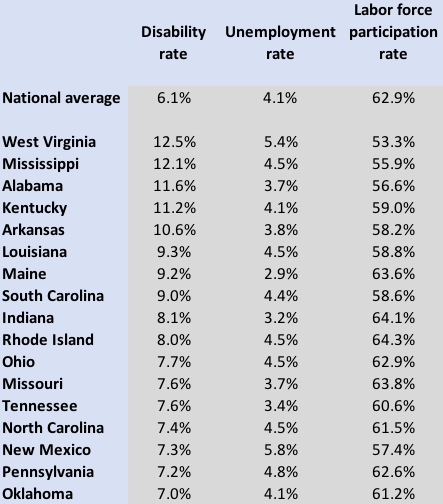
The Conference Board, as part of a new report on labor shortages in the economy, broke down disability rates by states for adults aged 20 to 64. In 17 states the disability rate is 7% or higher, and it’s above 10% in five states: West Virginia, Mississippi, Alabama, Kentucky and Arkansas. Here’s the national map:
Source: The Conference Board
One important caveat: These disability rates are not the ones used to determine who gets federal disability benefits under the Social Security program. That’s a completely different system. So these numbers don’t represent people saying they’re disabled just to get a government check. Rather, these are answers to Census Bureau survey questions asking people why they’re not in the labor force.
People who say they’re out of the labor force on account of disability aren’t counted in the unemployment statistics, which only measure people who have a job or are looking for a job. The 13.8% of working-age adults in West Virginia who are out of the labor force because of a disability, for instance, don’t have a job, aren’t looking for a job, and aren’t counted as unemployed.
Weak participation
But it’s those people who are completely out of the labor force who may explain labor shortages, sluggish economic growth and living standards that have barely been rising. While the unemployment rate is close to record lows, the portion of Americans who have a job or want one is also low. The so-called labor force participation rate peaked at 67.3% in 2000. It’s now at just 62.9%, roughly equal to where it was in the late 1970s—before women began surging into the work force. Disability may be one of the reasons the participation rate is so weak.
Six of the seven states with the highest disability rates have participation rates well below the national average. Here are the numbers for all states with a disability rate of 7% or higher:
So it could be a high rate of disability in some states that is hollowing out the work force, or at least contributing to a hollowing out. Normally, when the economy improves and employers create more jobs, pay goes up and that draws some people off the sidelines—even people who consider themselves disabled. That has happened somewhat in the current recovery, which has been underway since 2009. But the trend this time has been muted, with more people staying out of the work force for longer. Economists can’t fully explain that, but in addition to disability, it may involve opioid addiction, lack of relevant skills in a fast-changing digital economy, and government benefits that create a disincentive to work.
States with high disability rates don’t necessarily have high unemployment rates. In fact, three of the seven states with the highest disability rates have unemployment rates below the national average. But the high disability rate means those states also have a significant portion of working-age adults who might have been in the labor force 20 years ago, but aren’t now.
For employers, this may help explain why workers are hard to find, even when pay goes up, as Yahoo Finance documented in a February report. Labor shortages could become more acute in coming years, and they may already be constraining growth, because there are fewer people earning money and generating economic activity. For President Trump, it means tax cuts and deregulation may not be enough to hit 3% growth rates. He may also have to persuade people who aren’t working that they should get off the sidelines.
Confidential tip line: rickjnewman@yahoo.com. Encrypted communication available.
Above is from: https://www.yahoo.com/finance/news/disability-holding-back-trump-economy-145316656.html
Obama’s Syrian Chemical Weapons Attack--2013
On the last Saturday of August 2013, Labor Day weekend, the United States was once again about to go to war in the Middle East.
Less than two weeks earlier, in the middle of the night on August 21, the Syrian military had attacked rebel-controlled areas of the Damascus suburbs with chemical weapons, killing nearly 1,500 civilians, including more than 400 children. Horrific video footage showing people with twisted bodies sprawled on hospital floors, some twitching and foaming at the mouth after being exposed to sarin gas, had ricocheted around the world. This brazen assault had clearly crossed the “red line” that President Barack Obama had enunciated a year earlier—that if Assad used chemical weapons, it would warrant U.S. military action.
Heading into the long weekend, the Pentagon had made plans for round-the-clock staffing, since we thought the military operation would start over the holiday. As the assistant secretary of defense for international security affairs, I had been involved in the deliberations and planning for the strikes. Yet early Saturday morning, I received a call from Secretary of Defense Chuck Hagel’s office with surprising news: The president had called Hagel late the night before and told him he “wanted to explore another option.” Instead of ordering strikes immediately, the president wanted to pump the brakes and first go to Congress to ask for its authorization.
So when the president stepped into the sunny Rose Garden that Saturday morning, he announced that he had made two decisions: first, that the U.S. should act against Syria, and second, that he would seek explicit authorization from Congress to do so. With that, the administration set out on a different campaign than the military one we had been preparing for: to convince the American people that intervening in Syria was in the country’s interest.
What transpired over the next month was one of the most controversial and revealing episodes in eight years of Obama’s foreign policy. Despite the administration’s strong advocacy and support from a small minority of hawkish politicians, Congress and the American people proved strongly opposed to the use of force. In the end, however, the threat of military action and a surprise offer by Russia ended up achieving something no one had imagined possible: the peaceful removal of 1,300 tons of Syria’s chemical weapons (there have been reports of stray weapons and widespread use of industrial chemicals like chlorine, but no evidence of systematic deception on the part of the Syrian government).
By October 2013, without a bomb being dropped, the Bashar Assad regime had admitted having a massive chemical weapons program it had never before acknowledged, agreed to give it up and submitted to a multinational coalition that removed and destroyed the deadly trove. From my perspective at the Pentagon, this seemed like an incontrovertible, if inelegant, example of what academics call “coercive diplomacy,” using the threat of force to achieve an outcome military power itself could not even accomplish.
Yet the near unanimous verdict among observers is that this episode was a failure. Even the president’s sympathizers call the handling of the red line statement and its crossing a “debacle,” an “amateurish improvisation” or the administration’s “worst blunder.” They contend that Obama whiffed at a chance to show resolve, that for the sake of maintaining credibility, the U.S. would have been better off had the administration not pursued the diplomatic opening and used force instead. In this sense, a mythology has evolved around the red line episode—that if only the U.S. had used force, then it could have not only have addressed the chemical weapons threat, but solved the Syria conflict altogether.
ADVERTISING
But this conventional wisdom is wrong. Of course, some of the criticism can be explained by politics, with partisans unwilling to give Obama credit for any success. But many others criticize the policy less for its outcome than for the way it came about. This line of judgement reveals a deep—and misguided—conviction in Washington foreign policy circles that a policy must be perfectly articulated in order to be successful—that, in a sense, the means matter more than the ends. Far from a failure, the “red line” episode accomplished everything it set out to do—in fact, it surpassed our expectations. But the fact that it appeared to occur haphazardly and in a scattered way was enough to brand it as a failure in Washington’s eyes.
***
According to U.S. estimates, at more than 1,300 metric tons spread out over as many as 45 sites in a country about twice the size of Virginia, Syria’s arsenal of chemical weapons in 2013 was the world’s third-largest. It was 10 times greater than the CIA’s (erroneous) 2002 estimate of Iraq’s chemical weapons stash, and 50 times larger than the arsenal Libya declared it had in late 2011. Because of the size and scope of the threat, Syria’s chemical weapons were the administration’s top concern during the first several years of the crisis. I spent the better part of two years worrying over what to do about them.
So when I first heard about Obama’s decision to take the question of using military force in Syria to Capitol Hill, I was shocked. I had been in most of the White House meetings about Syria up to that point, and while the issue of legal authorities and Congress had come up, it was clear the president had all the domestic legal authority and international justification he needed to act. The idea of asking for a congressional vote had never been discussed at length; some had suggested we should ask for a vote, but there was skepticism it would pass, and therefore a feeling the question should not be asked. For an administration that prized careful and inclusive deliberation, it was unusual that a decision this big would arise so suddenly without first being thoroughly pored over in the interagency process.
But once the surprise wore off, I found myself thinking that, while abrupt, unexpected and unorthodox, this was the right move. Not for any legal reason or question of constitutional powers, but because after a decade of war in the Middle East, Congress and the American people needed to be fully invested in what we were about to do and prepared to accept the consequences.
The civil war in Syria had dominated the news for more than two years, but few politicians had thought deeply about it, relieved that it was not their problem. None were happy to share the responsibility of being accountable for what America would or would not do about the violence. And, in fact, now that they did share the responsiblility, it became clear that they were as uncertain as the administration had been about the risks of using force—and fears of the possible consequences.
For two weeks, the administration made its case on Capitol Hill, but it soon became clear that most Republicans and Democrats in Congress were against authorizing action—leaving Obama the option of going forward anyway (which he said he would do) or backing down altogether. Then, an unexpected opportunity emerged: During a September 9 news conference in London, Secretary of State John Kerry was asked whether there was anything Assad could do to avoid an attack. Sure, Kerry said in exasperation, the Syrian leader could admit that he had chemical weapons (something he still refused to do) and give them all up peacefully, but “he isn’t about to do it and it can’t be done.” Like Obama’s original red line a year earlier, this offhand remark wasn’t intended to be a policy pronouncement. But soon after Kerry walked off the stage he received a call from his Russian counterpart, Sergei Lavrov, who was then meeting with a delegation of Syrian diplomats in Moscow and wanted to talk with the secretary of state about his “initiative.”
Washington and Moscow had deep disagreements over Syria. Russia continued to be one of Assad’s few international backers and, importantly, the Syrian military’s chief supplier. But even Moscow worried about Syria’s chemical weapons. And though earlier talks of U.S.-Russian collaboration to deal with Assad’s stockpile had never led anywhere, the credible threat of U.S. military force suddenly changed the calculation. Now, Moscow was ready to pressure Assad to comply with Kerry’s offhand demand. Maybe this reflected Russian concerns about the proliferation of chemical weapons; or perhaps this was driven by the Kremlin’s desire to keep an ally in power; or possibly Russian leaders were simply trying to stay relevant geopolitically. Whatever the reason, the next day, following a meeting with the Russians in Moscow, the Syrians publicly admitted for the first time that they had chemical arms and committed to signing the Chemical Weapons Convention, the international treaty banning such weapons. The Syrians were pledging to come clean—and not just to reveal what they had, but to get rid of their chemical weapons altogether.
Initially, the Obama administration approached the Russian offer, and Syria’s compliance, skeptically. Putin and Assad had every reason to want to delay U.S. military action. Moreover, the idea of dismantling Syria’s stockpile was daunting—there seemed to be thousands of steps before we could be sure something like this had any hope of working. But Obama wanted to test the proposition. After all, if not using force enabled the U.S. to achieve something that was unquestionably in its security interests and had once seemed impossible, how could he not consider taking such a deal?
With U.S. Navy ships still ready to launch strikes, American and Russian diplomats spent several days hammering out the specific steps Syria would take to allow international inspectors to find, remove and destroy its chemical arms. The Syrians signed on, and the U.N. Security Council endorsed the deal, while also authorizing international action if Assad failed to comply. In just a matter of weeks, the administration had gone from plotting over how to deal with one of the world’s largest arsenals of chemical weapons to implementing a plan to eliminate all of them.
***
Despite the unexpected success of the whole episode, Obama’s sudden pivots—first abruptly pausing to go to Congress, then seizing a surprise opening for diplomacy—struck many in Washington and abroad as unseemly. It did not help that unscripted comments both got the U.S. into the situation (Obama’s original red line statement in August 2012) as well as out of it (Kerry’s public musing that Syria could avoid strikes by giving up its chemical weapons). Where the president saw nimble improvisations adjusting to new opportunities, the critics saw lurching indecision.
Many foreign leaders also asserted that failing to respond militarily had damaged the administration’s credibility. Although no Arab countries were willing to contribute their own forces and most Arab leaders refused even to support Obama publicly when he asked for their support, nearly all blamed him for not intervening. Even though the chemical weapons threat was removed, they questioned whether they could trust the U.S. to follow through on its commitments to them. Even some Europeans were disappointed—especially the French, who felt politically exposed as the only country that had declared itself willing to strike with the US. in September 2013.
Given such perceptions, it is worth reflecting on what might have happened had the U.S. barreled forward and attacked Syria as planned. Would we have been better off? In that case, it is highly unlikely that the tons of chemical weapons would have been safely removed from the country. Even if an initial salvo had deterred Assad from using more chemical weapons, he would still have had hundreds of tons at his disposal, since the strikes would have eliminated only a small fraction of his arsenal.
It is also safe to assume that there would have been absolute hysteria, with good reason, about such weapons being at large in a war-torn country—at risk of falling into the hands of ISIL and other terrorist groups. In fact, I believe that had Obama acted as he was ready to do in the fall of 2013, he would have ended up deploying substantial numbers of American troops to Syria to secure those remaining chemical weapons depots over which Assad likely would have lost control. And if Obama had done that, and had the chaos of the attack led in turn to a loose chemical weapon being used to strike Israel or conduct a terrorist attack in the U.S. or Europe, he deservedly would have been blamed and held accountable.
Perversely, critics at home and abroad treat the removal of Syria’s chemical arsenal as an afterthought—as minor and insufficient—and instead choose to assert that Obama soiled America’s reputation. It is as though they place higher value on being “tough,” especially if it involves military force, than on lasting accomplishment. In the name of maintaining “credibility,” they criticize Obama for not acting militarily, even if doing so would have delivered a less advantageous outcome for our overall security.
This is especially odd given our recent past. The U.S. went to war in Iraq in 2003 to address a WMD threat that did not exist, and the devastating result cost resources, took thousands of American lives and wounded many others, tarnished U.S. leadership, and unleashed a regional firestorm we are still dealing with today. In Syria in 2013, the U.S. addressed a WMD threat that did exist—and was of far greater scale—by avoiding the use of force. Yet this is widely perceived as a blow to American authority.
How can this be? The first part of the problem is Washington’s obsession with “credibility.” Perceptions do matter, but I think Obama would agree with the point made by the political scientist Richard Betts, who observes that “credibility is the modern antiseptic buzzword now often used to cloak the ancient enthusiasm for honor. But honor’s importance is always more real and demanding to national elites and people on home fronts than it is to [those] put into the point of the spear to die for it.” Obama is openly skeptical of the Washington establishment’s preoccupation with credibility, believing that the logic sets a trap leading to bad decisions.
A second issue is process. Procedure and presentation matter too, and Obama concedes that the red line affair was not a textbook execution of foreign policy. “We won’t get style points for the way we made this decision,” he has said. By exposing the public to the sausage-making of policy—and by thinking out loud, making clear all the uncertainties and risks, and shifting directions abruptly—the administration created an impression that it lacked confidence. The whole episode also wasn’t predictable, and people don’t like that. Presidents get rewarded for linear results, especially when things happen the way the collective wisdom says they are supposed to.
Obama’s sudden, and clumsy, move to go to Congress for approval didn’t help matters. It was the right decision, but it should not have been made on the fly and with no consultation with our allies, especially the French, who were the only ones willing to act with us. To this day, many believe that going to Congress was just a cynical move by the president to pass the buck and avoid strikes. I never believed this to be true, and remain unaware of any evidence to prove such an assertion. Although Obama asked for congressional support—and, given the risks of action against Syria’s chemical weapons, believed it important to have a show of unity—he always made clear he would act without it.
A third problem is dashed expectations. By drawing the red line, Obama unintentionally fueled the hope of some that he would respond with overwhelming force. Or, as many now assert, he should have used the crossing as a justification to achieve a different goal, something that the red line was never about and military strikes were never intended to do: take out Assad.
To be sure, it has been hard for the administration to claim the red line as a strategic success because of the improvised way it unfolded. And it’s possible Obama could have achieved the same result through different means—means that might have generated a greater sense of American leadership. But that shouldn’t cloud how we remember the chapter: In foreign policy, the end result matters more than the road one took to get there.
Obama is fine with winning ugly: “I’m less concerned about style points,” he told an interviewer after he pulled back from using force in September 2013. “I’m much more concerned about getting the policy right.” When asked about the criticisms, Obama said that “folks here in Washington like to grade on style … and so had we rolled out something that was very smooth and disciplined and linear, they would have graded it well, even if it was a disastrous policy. We know that, because that’s exactly how they graded the Iraq War.”
What’s instructive—and for many of Obama’s critics, inconvenient—is to listen to the foreign leaders who are most complimentary of the way things turned out: the Israelis. Syria’s vast chemical weapons arsenal was an acute threat to Israel—a threat for which it had no viable military answer. Israeli military officials later told me that they had done their own planning for airstrikes to take out the chemical weapons, yet all the scenarios had “horrific” civilian casualties.
While some Israelis were initially very worried that by pulling back from military action Obama had undermined his credibility, they were relieved by the outcome. The removal of Syria’s chemical weapons is an accomplishment that Prime Minister Netanyahu, a leader who has had his share of disagreements with Obama, described as “the one ray of light in a very dark region.” Such sentiments were echoed repeatedly by senior Israeli defense officials, who by 2015 considered the Syrian chemical weapons threat so insignificant they did not include gas attacks as a scenario in their annual emergency home-front drills.
In the United States and many other corners of the world, the whole episode is remembered quite differently: It has morphed into a short-hand critique of Obama’s handling not just of Syria, but of his exercise of American power. Even inside the administration, the phrase itself has become loaded, as though it were a slur, politically incorrect to utter.
In fact, the red line chapter is emblematic of Obama’s foreign policy strategy: This kind of long-range, flexible, restrained and targeted policy is a hallmark of his unique approach to global problems. But instead of being seen as a mistake, it should be considered an accomplishment. Judged by what the red line was originally intended to do—address the massive threat from Syria’s chemical weapons—it was a success. In fact, it has been perhaps the only positive development related to the Syria crisis.
There is no question the Syrian war is the greatest catastrophe of the post-Cold War world, with hundreds of thousands of casualites, millions of refugees, states disintegrating and extremists filling the vacuum. But there is a question about what America can and should do about it. Numerous critics (including some former administration officials) have made the case that the U.S. should be willing to use additional military power to achieve its other stated policy goals—to accelerate Assad’s departure, build a lasting political settlement, combat extremists, or simply to reclaim authority. The challenge Obama faces is how to reconcile this understandable impulse to act with the desire to prevent a problem like Syria from overwhelming American foreign policy.
The debate is often defined as “doing something” or “doing nothing,” but those are false choices. The policy debate exists between these extremes—deciding the way to address a problem like Syria somewhere between being all-in (like the Iraq invasion in 2003) or standing aside entirely. How the United States has navigated these competing interests and managed the trade-offs is one of the central stories of the Obama presidency. And it is a defining characteristic of his long-game strategy.
Derek Chollet is Counselor at The German Marshall Fund of the United States, and served in the Obama Administration in the White House, State Department, and Pentagon. This article is adapted from the book The Long Game: How Obama Defied Washington and Redefined America’s Role in the World.
Above is from: https://www.politico.com/magazine/story/2016/07/obama-syria-foreign-policy-red-line-revisited-214059
Subscribe to:
Posts (Atom)