Friday, January 5, 2018

Unusual volume trading on Chrysler stock

Fiat Chrysler shares surge 22%; company won't comment on talks

Greg Gardner, Detroit Free Press Published 5:31 p.m. ET Jan. 5, 2018 | Updated 6:31 p.m. ET Jan. 5, 2018

Mike Manley, head of the Jeep and Ram brands for Fiat Chrysler Automobiles, says a new Wrangler and Ram 1500 and refreshed Cherokee will make for a good year. Wochit

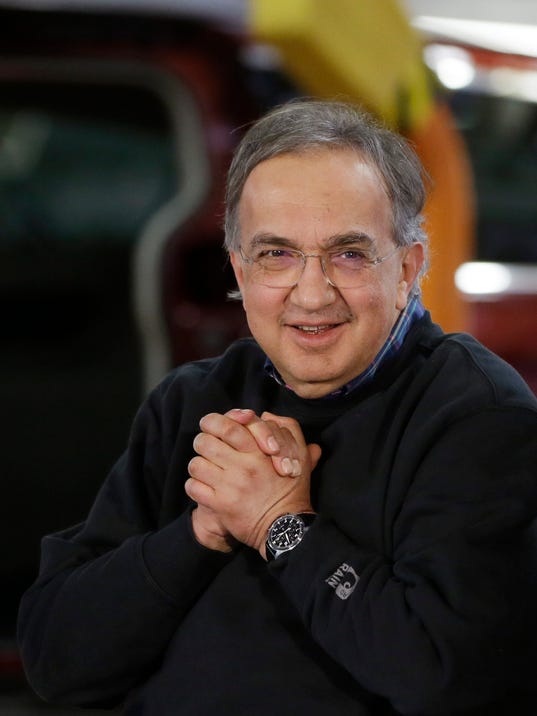
Sergio Marchionne

(Photo: Carlos Osorio, AP)

CONNECTTWEETLINKEDINCOMMENTEMAILMORE

Shares of Fiat Chrysler Automobiles surged more than 20% this week on heavy trading volume, raising the possibility that a potential acquirer is buying shares.

Under U.S. securities law, any investor who acquires 5% or more of a publicly traded company must disclose that holding and any additional shares thereafter. So far no one has made that disclosure.

The automaker's largest shareholder is Exor, an Italian investment company controlled by the Agnelli and Elkann families. The fund owns 25.3% of FCA.

FCA shares rose 5.4% Friday to close at a record high of $21.77. Since Tuesday, the stock has risen 22%. In each of the last three days, more trading volume has ranged between 10.6 million and 14.3 million shares, well above the average daily volume of 3.1 million.

By contrast, Ford and General Motors shares have gained 5.6% and 7.5%, respectively over that period, on light trading.

An FCA spokesman declined to comment on whether the company was currently in talks with a potential partner or acquirer.

CEO Sergio Marchionne has looking for a buyer for more than two years. He plans to retire by 2019 and the company has not signaled who might succeed him.

In May 2015, Marchionne pleaded with competitors to explore mergers and partnerships to deal with the rapidly rising cost of global manufacturing and new autonomous vehicles technologies.

Last August, a spokesman for Great Wall Motors, a Chinese manufacturer that sells mainly SUVs, said his company was interested in FCA's Jeep brand.

Read more:

What happens to Fiat Chrysler if Chinese automaker Great Wall buys Jeep?

Fiat Chrysler merger looming?

Last March at the Geneva auto show in Switzerland, Marchionne said, "I have no doubt that at the relevant time Volkswagen may show up and have a chat" for a merger. He said it in the context of General Motors sale of its Opel and Vauxhaul brands to PSA.

One month later he backed off, warning, "we need to be very careful that we don’t start unrealistic dreams about consolidation."

Then in early December he said FCA could potentially partner with Hyundai on hydrogen fuel cell technology.

On Wednesday, FCA reported its December sales in the U.S. fell 11% from a year earlier. But it is about to unveil a redesigned Ram pickup at this month's Detroit auto show. A redesigned Jeep Wrangler goes on sale soon. 

While North America has generated most of the automaker's profit since Fiat took control of Chrysler following its 2009 taxpayer-funded bankruptcy, FCA doubled its operating profit in Europe, the Middle East and Africa from 2015 to 2016, and is expected to show an increase for 2017 when it reports fourth-quarter results, said Richard Hilgert, a Morningstar analyst in Chicago.

Marchionne has talked about spinning off its Magneti Marelli components unit.

How could that deal raise the stock price?

"That would be like taking a car apart, selling the parts and realizing you get more than the price of selling the car," said Hilgert.

Maryann Keller, a former industry analyst and founder of MK&A Global Automotive Strategy, downplayed acquisition speculation. She said selling off nonessential holdings such as Magneti Marelli, paying down debt and a much lower tax rate on its U.S. earnings are driving the stock price.

"If someone were truly going to make a bid for FCA, they wouldn't be silently buying shares. They would be talking," Keller said. "The Chinese are not going to buy in dribs and drabs."

Despite is smaller scale, FCA was ahead of the curve by halting sales of small and midsize passenger cars in the U.S.

Unlike General Motors, Ford, Toyota, Nissan and others, FCA has outsourced its autonomous vehicle effort to Waymo, the Google spin-off, to which it has provided more than 500 Chrysler Pacifica minivans that Waymo equips with the sensors and navigation components. Waymo is testing those vehicles in the Phoenix area and elsewhere.

As a result, FCA is spending much less than competitors on this technology that initially will be introduced in ride-sharing and delivery fleets.

Contact Greg Gardner: 313-222-8848 or ggardner99@freepress.com. Follow him on Tiwtter @GregGardner12

Above is from:  https://www.freep.com/story/money/cars/chrysler/2018/01/05/fiat-chrysler-shares-surge-22-company-wont-comment-talks/1007349001/

Thursday, January 4, 2018

10 things from the explosive new book drawing fire and fury from Trump

10 things from the explosive new book drawing fire and fury from Trump

Dylan Stableford

Senior Editor

,

Yahoo News•January 4, 2018

Journalist Michael Wolff’s upcoming book about President Trump’s first year in office, “Fire and Fury,” is sending shockwaves through the administration. On Wednesday, the White House released an extraordinary statement denouncing Steve Bannon for his devastating remarks about Trump in the book, saying the president’s former chief strategist had “lost his mind.”

It was one of three separate statements from the administration about Wolff’s book, which will be published Jan. 9. White House press secretary Sarah Sanders said Trump was “furious” and “disgusted” by Bannon’s comments, and described the book as “trashy tabloid fiction.”

Related SearchesBook Fire And Fury TrumpFire And Fury WolffMichael Wolfe Fire And Fury TrumpFire And Fury Author

So what in the book has Trump so worked up? Excerpts published by the Hollywood Reporter and New York magazine and a separate report on the book posted by the Guardian paint the picture of a chaotic and dysfunctional administration filled with backstabbing and infighting, and led by a commander in chief compared by one confidant to a “semiliterate” child.

Below are 10 notable revelations from the excerpts released so far.

_____

Trump’s public defenders privately lamented having to defend the president

According to the excerpt published by the Hollywood Reporter, former press secretary Sean Spicer reportedly couldn’t believe he had to defend Trump’s claim of having the biggest inaugural crowd in history.

“You can’t make this s*** up,” Spicer is quoted by Wolff as saying shortly after giving his first press briefing. “Soon enough,” Wolff writes, Spicer “adopted this as a personal mantra.”

After his appointment as chief of staff, Reince Priebus wasn’t sure he’d last until the inauguration, according to Wolff. And Kellyanne Conway, Trump’s campaign manager and special counselor, “would put a finger-gun to her head in private about Trump’s public comments.”

_____

Rupert Murdoch walks with Donald Trump at Trump’s golf course in Aberdeen, Scotland, June 25, 2016. (Photo: Carlo Allegri/Reuters)

Rupert Murdoch described Trump as a “f***ing moron”

During Trump’s first year in office, the media mogul frequently placed calls to the president to offer him advice. But in private, Wolff writes, Murdoch “continued to derisively ridicule” Trump.

“What a f***ing moron,” Murdoch reportedly said after one such call.

Trump’s Cabinet held similarly low opinions of the president, according to Wolff.

To Secretary of State Rex Tillerson, Wolff writes, Trump “was a moron.” (An even saltier version of that assessment was made public last year.) For chief economic adviser Gary Cohn, Trump “was dumb as s***.” For national security adviser H.R. McMaster, Trump “was a hopeless idiot.” For Bannon, Trump “had lost his mind” —  coincidentally, the same thing Trump said about Bannon on Wednesday.

_____

Aides quickly became frustrated by Trump’s inability to comprehend basic policy briefings

According to Wolff, White House aides noticed that President Trump, soon after taking office, “didn’t process information in any conventional sense.”

“He didn’t read,” Wolff writes. “He didn’t really even skim. Some believed that for all practical purposes he was no more than semiliterate. He trusted his own expertise — no matter how paltry or irrelevant — more than anyone else’s. He was often confident, but he was just as often paralyzed, less a savant than a figure of sputtering and dangerous insecurities, whose instinctive response was to lash out and behave as if his gut, however confused, was in fact in some clear and forceful way telling him what to do. It was, said [deputy chief of staff Katie] Walsh, ‘like trying to figure out what a child wants.’”

Trump campaign aide Sam Nunberg recalled his attempt to explain the Constitution to the candidate.

“I got as far as the Fourth Amendment,” Nunberg said, “before his finger is pulling down on his lip and his eyes are rolling back in his head.”

_____

Trump was increasingly repeating stories and could not recognize old friends

Before taking the chief of staff job, Priebus had been reportedly warned about Trump’s penchant for “constantly” repeating himself.

“Here’s the deal,” a close Trump associate told Priebus. “In an hour meeting with him, you’re going to hear 54 minutes of stories, and they’re going to be the same stories over and over again.”

“Everybody was painfully aware of the increasing pace of his repetitions,” Wolff writes. “It used to be inside of 30 minutes he’d repeat, word-for-word and expression-for-expression, the same three stories — now it was within 10 minutes.”

And at Mar-a-Lago late last month, Trump “failed to recognize a succession of old friends.”

_____

Donald Trump Jr. greets his father during a town hall debate in St. Louis, Oct. 9, 2016. (Photo: Rick Wilking-Pool/Getty Images)

Bannon thought the infamous Trump tower meeting was “treasonous”

In one excerpt, published by the Guardian, Bannon reportedly told Wolff that the June 2016 Trump Tower meeting between Donald Trump Jr., Trump son-in-law Jared Kushner and campaign chairman Paul Manafort with a Kremlin-connected lawyer who claimed to have compromising information on Hillary Clinton should have been reported to the FBI at the time.

“The three senior guys in the campaign thought it was a good idea to meet with a foreign government inside Trump Tower in the conference room on the 25th floor — with no lawyers. They didn’t have any lawyers,” Bannon said, according to the excerpt published in the Guardian. “Even if you thought that this was not treasonous, or unpatriotic, or bad s***, and I happen to think it’s all of that, you should have called the FBI immediately.”

And Bannon believes that Trump Jr. not only briefed his father on that meeting — he also introduced the participants to the candidate.

“The chance that Don Jr. did not walk these jumos up to his father’s office on the twenty-sixth floor is zero,” Bannon was quoted as saying.

_____

Bannon also believed that the Mueller investigation would “crack Don Junior like an egg”

The Breitbart chief predicted that the federal investigation into possible collusion between the Trump campaign and Russia, led by special counsel Robert Mueller, would end badly for the president’s son.

“They’re going to crack Don Junior like an egg on national TV,” Bannon said, according to the Guardian.

_____

Ivanka Trump and Jared Kushner listen as President Trump holds a Cabinet meeting at the White House, Oct. 16, 2017. (Photo: Kevin Lamarque/Reuters)

Ivanka Trump has mused about becoming president

Wolff writes: “Both Jared and Ivanka decided to accept roles in the West Wing over the advice of almost everyone they knew. It was a joint decision by the couple, and, in some sense, a joint job. Between themselves, the two had made an earnest deal: If sometime in the future the opportunity arose, she’d be the one to run for president. The first woman president, Ivanka entertained, would not be Hillary Clinton; it would be Ivanka Trump.”

_____

Ivanka was known to make fun of her father’s comb-over

“She often described the mechanics behind it to friends: an absolutely clean pate — a contained island after scalp-reduction ­surgery — surrounded by a furry circle of hair around the sides and front, from which all ends are drawn up to meet in the center and then swept back and secured by a stiffening spray,” Wolff writes. “The color, she would point out to comical effect, was from a product called Just for Men — the longer it was left on, the darker it got. Impatience resulted in Trump’s orange-blond hair color.”

_____

Trump’s eccentricities were on display when he moved into the White House

Wolff writes: “In the first days, he ordered two television screens in addition to the one already there, and a lock on the door, precipitating a brief standoff with the Secret Service, who insisted they have access to the room. He ­reprimanded the housekeeping staff for picking up his shirt from the floor: “If my shirt is on the floor, it’s because I want it on the floor.” Then he imposed a set of new rules: Nobody touch anything, especially not his toothbrush.

And Trump’s love of fast food has an unusual origin, according to Wolff: “He had a longtime fear of being poisoned, one reason why he liked to eat at McDonald’s — nobody knew he was coming and the food was safely premade.”

_____

President-elect Trump arrives at his inauguration ceremony in Washington, D.C., Jan. 20, 2017. (Photo: Win McNamee/Pool/Reuters)

Donald Trump didn’t even want to be president

In the excerpt published by New York magazine, Wolff wrote that even on Election Day, “almost everyone” in the Trump campaign was convinced he would not win.

Wolff writes: “Even though the numbers in a few key states had appeared to be changing to Trump’s advantage, neither Conway nor Trump himself nor his son-in-law, Jared Kushner — the effective head of the campaign — wavered in their certainty: Their unexpected adventure would soon be over. Not only would Trump not be president, almost everyone in the campaign agreed, he should probably not be. Conveniently, the former conviction meant nobody had to deal with the latter issue.”

“Once he lost, Trump would be both insanely famous and a martyr to Crooked Hillary,” Wolff continues. “His daughter Ivanka and son-in-law Jared would be international celebrities. Steve Bannon would become the de facto head of the tea-party movement. Kellyanne Conway would be a cable-news star. Melania Trump, who had been assured by her husband that he wouldn’t become president, could return to inconspicuously lunching. Losing would work out for everybody. Losing was winning.

“Shortly after 8 p.m. on Election Night, when the unexpected trend — Trump might actually win — seemed confirmed, Don Jr. told a friend that his father, or DJT, as he calls him, looked as if he had seen a ghost,” Wolff adds. “Melania was in tears — and not of joy.”

According to Wolff, the unexpected victory “set the stage for the chaos and dysfunction that have persisted throughout his first year in office.”

“The mistaken outcome trusted by everyone in Trump’s inner circle — that they would lose the election — wound up exposing them for who they really were,” Wolff says.

Above is from:   https://www.yahoo.com/news/10-things-explosive-new-book-drawing-fire-fury-trump-160710575.html
Kmart Store on Sandy Hollow Road in Rockford to close in April 2018

imageimage

Above is from:  http://searsholdings.com/docs/010418-store-closing-list.pdf

Sunday, December 31, 2017

When Ayn Rand Collected Social Security & Medicare, After Years of Opposing Benefit Programs


When Ayn Rand Collected Social Security & Medicare, After Years of Opposing Benefit Programs

Josh Jones is a writer and musician based in Durham, NC. Follow him at @jdmagness

in Economics, Politics | December 27th, 2016 67 Comments


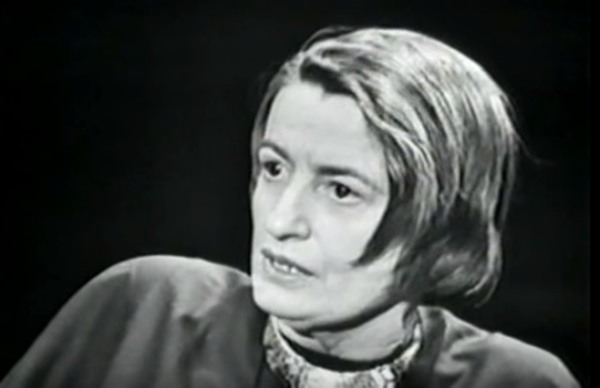
ayn-rand-social-security

Image via YouTube, 1959 interview with Mike Wallace

A robust social safety net can benefit both the individuals in a society and the society itself. Free of the fear of total impoverishment and able to meet their basic needs, people have a better opportunity to pursue long-term goals, to invent, create, and innovate. Of course, there are many who believe otherwise. And there are some, including the acolytes of Ayn Rand, who believe as Rand did: that those who rely on social systems are---to use her ugly term---“parasites,” and those who amass large amounts of private wealth are heroic supermen.

Rand disciple Alan Greenspan, for example, initiated the era of “Reaganomics” in the early 1980s by engineering “an increase in the most regressive tax on the poor and middle class,” writes Gary Weiss, “the Social Security payroll tax—combined with a cut in benefits.” For Greenspan, “this was no contradiction. Social Security was a system of altruism at its worst. Its beneficiaries were looters. Raising their taxes and cutting their benefits was no loss to society.”

One problem with Rand’s reasoning is this: whether “parasite” or titan of industry, none of us is anything more than human, subject to the same kinds of cruel twists of fate, the same existential uncertainty, the same illness and disease. Suffering may be unequally distributed to a great degree by human agen you, but nature and circumstance often have a way of evening the odds. Rand herself experienced such a leveling effect in her retirement. After undergoing surgery in 1974 for lung cancer caused by her heavy smoking, she found herself in straitened circumstances.

Two years later, she was paired with social worker Evva Pryor, who gave an interview in 1998 about their relationship. “Rarely have I respected someone as much as I did Ayn Rand,” said Pryor. When asked about their philosophical disagreements, she replied, “My background was social work. That should tell you all you need to know about our differences.” Pryor was tasked with persuading Rand to accept Social Security and Medicare to help with mounting medical expenses.

I had read enough to know that she despised government interference, and that she felt that people should and could live independently. She was coming to a point in her life where she was going to receive the very thing she didn’t like.... For me to do my job, she had to recognize that there were exceptions to her theory.... She had to see that there was such a thing as greed in this world.... She could be totally wiped out by medical bills if she didn’t watch it. Since she had worked her entire life and had paid into Social Security, she had a right to it. She didn’t feel that an individual should take help.

Finally, Rand relented. “Whether she agreed or not is not the issue,” said Pryor, “She saw the necessity for both her and [her husband] Frank.” Or as Weiss puts it, “Reality had intruded upon her ideological pipedreams.” That's one way of interpreting the contradiction: that Rand’s philosophy, Objectivism, “has no practical purpose except to promote the economic interests of the people bankrolling it"---the sole function of her thought is to justify wealth, explain away poverty, and normalize the sort of Hobbesian war of all against all Rand saw as a societal ideal.

Rand taught “there is no such thing as the public interest,” that programs like Social Security and Medicare steal from “creators” and illegitimately redistribute their wealth. This was a "sublimely enticing argument for wealthy businessmen who had no interest whatever in the public interest.... Yet the taxpayers of America paid Rand's and Frank O'Connor's medical expenses." Randians have offered many convoluted explanations for what her critics see as sheer hypocrisy. We may or may not find them persuasive.

In the simplest terms, Rand discovered at the end of her life that she was only human and in need of help. Rather than starve or drop dead—as she would have let so many others do—she took the help on offer. Rand died in 1982, as her admirer Alan Greenspan had begun putting her ideas into practice in Reagan’s administration, making sure, writes Weiss, that the system was “more favorable to the creators and entrepreneurs who were more valuable to society," in his Randian estimation, "than people lower down the ladder of success.” After well over three decades of such policies, we can draw our own conclusions about the results.

Related Content:

Ayn Rand Helped the FBI Identify It’s A Wonderful Life as Communist Propaganda

Free Audio: Ayn Rand’s 1938 Dystopian Novella Anthem

In Her Final Speech, Ayn Rand Denounces Ronald Reagan, the Moral Majority & Anti-Choicers (1981)

Flannery O’Connor: Friends Don’t Let Friends Read Ayn Rand (1960)

Ayn Rand Argues That Believing in God Is an Insult to Reason on The Phil Donahue Show (Circa 1979)

Josh Jones is a writer and musician based in Durham, NC. Follow him at @jdmagness

Above is from: http://www.openculture.com/2016/12/when-ayn-rand-collected-social-security-medicare.html

Saturday, December 30, 2017

Trump Justice Department Pushes for Citizenship Question on Census, Alarming Experts


Trump Justice Department Pushes for

Citizenship Question on Census, Alarming Experts

“This is a recipe for sabotaging the census,” said one. The administration’s stated reason for the controversial move: protecting civil rights.

by Justin Elliott

Dec. 29, 7:36 p.m. EST

The Justice Department is pushing for a question on citizenship to be added to the 2020 census, a move that observers say could depress participation by immigrants who fear that the government could use the information against them. That, in turn, could have potentially large ripple effects for everything the once-a-decade census determines — from how congressional seats are distributed around the country to where hundreds of billions of federal dollars are spent.

The DOJ made the request in a previously unreported letter, dated Dec. 12 and obtained by ProPublica, from DOJ official Arthur Gary to the top official at the Census Bureau, which is part of the Commerce Department. The letter argues that the DOJ needs better citizenship data to better enforce the Voting Rights Act “and its important protections against racial discrimination in voting.”

A Census Bureau spokesperson confirmed the agency received the letter and said the “request will go through the well-established process that any potential question would go through.” The DOJ declined to comment and the White House did not respond to a request for comment.

Observers said they feared adding a citizenship question would not only lower response rates, but also make the census more expensive and throw a wrench into the system with just two years to go before the 2020 count. Questions are usually carefully field-tested, a process that can take years.

“This is a recipe for sabotaging the census,” said Arturo Vargas, a member of the National Advisory Committee of the Census and the executive director of NALEO Educational Fund, a Latino advocacy group. “When you start adding last-minute questions that are not tested — how will the public understand the question? How much will it suppress response rates?”

The 2010 census included a handful of questions covering age, sex, race, Hispanic origin, household relationship and owner/renter status — but not citizenship.

“People are not going to come out to be counted because they’re going to be fearful the information would be used for negative purposes,” said Steve Jost, a former top bureau official during the 2010 census. “This line about enforcing voting rights is a new and scary twist.” He noted that since the first census in 1790, the goal has been to count everyone in the country, not just citizens.

There have been rumblings since the beginning of the year that the Trump administration wanted to add a citizenship question to the census. Adding to the concerns about the 2020 count, Politico reported last month that the administration may appoint to a top job at the bureau a Republican redistricting expert who wrote a book called “Redistricting and Representation: Why Competitive Elections Are Bad for America.” The Census Bureau’s population count determines how the 435 U.S. House seats are distributed.

The law governing the census gives the commerce secretary, currently Wilbur Ross, the power to decide on questions. They must be submitted to Congress for review two years before the census, in this case by April 2018. A census spokesperson said the agency will also release the questions publicly at that time.

A recent Census Bureau presentation shows that the political climate is already having an effect on responsiveness to the bureau’s American Community Survey, which asks a more extensive list of questions, including on citizenship status, to about one in 38 households in the country per year. In one case, census interviewers reported, a respondent “walked out and left interviewer alone in home during citizenship questions.”

“Three years ago, [it] was so much easier to get respondents compared to now because of the government changes … and trust factors. … Three years ago I didn’t have problems with the immigration questions,” said another census interviewer.

The Justice Department letter argues that including a citizenship question on the once-a-decade census would allow the agency to better enforce Section 2 of the Voting Rights Act, which bars the dilution of voting power of a minority group through redistricting.

“To fully enforce those requirements, the Department needs a reliable calculation of the citizen voting-age population in localities where voting rights violations are alleged or suspected,” the letter states. The letter asks that the Census Bureau “reinstate” the question.

The full census, however, hasn’t included questions about citizenship since 1950. The Census Bureau has gathered such data in other surveys. The bureau switched the method of those surveys after the 2000 census. Today, it conducts the American Community Survey every year, which includes questions about citizenship, along with many other questions. The survey covers a sample of residents of the United States.

Experts said the Justice Department’s letter was misleading. And they questioned the Justice Department’s explanation in the letter, noting that the American Community Survey produces data on citizenship that has been used in Section 2 cases.

“You could always have better data but it seems like a strange concern because no one in the communities who are most affected have been raising this concern,” said Michael Li, senior counsel at the Brennan Center’s Democracy Program.

Do you have information about the Trump administration and the census? Contact Justin at justin@propublica.org or via Signal at 774-826-6240.

Above is from:  https://www.propublica.org/article/trump-justice-department-pushes-for-citizenship-question-on-census-alarming-experts?utm_source=suggestedarticle&utm_medium=referral&utm_campaign=readnext&utm_content=https%3A%2F%2Fwww.propublica.org%2Farticle%2Ftrump-justice-department-pushes-for-citizenship-question-on-census-alarming-experts

Friday, December 22, 2017