Wednesday, October 25, 2017

Illinois House overrides veto of bill requiring monthly reports on state’s debt


Chicago News 10/25/2017, 09:25pm

Illinois Comptroller Susana Mendoza meeting with the Sun-Times Editorial Board in September. File Photo. | Rich Hein/Sun-Times

Tina Sfondeles


SPRINGFIELD—Illinois Comptroller Susana Mendoza is one step closer to gaining the ability to get a closer look at the state’s giant pile of unpaid bills on a monthly basis — a move the Democrat achieved with unanimous support on Wednesday in an Illinois House veto override.

The Illinois Senate plans to take up the override in November.

The Debt Transparency Act would require state agencies to report monthly the amount of bills being held, liabilities that are being appropriated and liabilities that may have late interest penalties. State agencies currently submit their unpaid bills once a year in October.

The state’s bill backlog is at a staggering $16.5 billion, according to the comptroller’s office.

“The one person in the state responsible for managing through any type of fiscal crisis or even good times fiscally has very limited visibility on the financials for the state of Illinois. It doesn’t make any sense,” Mendoza said after the House override.

Mendoza called it “an almost impossible task” to safeguard taxpayer dollars and manage cash or debt management without being able to see the bills more transparently.

Rauner vetoed the measure on Aug. 18, saying “the inclination” to be more transparent about the state’s finances is a “good one.” But he said her bill “more closely resembles an attempt by the Comptroller to micromanage executive agencies than an attempt to get the information most helpful to the monitoring of state government.”

Rauner too said it would divert limited funds and staff attention from their main duties in providing services to Illinois citizens.


Though the veto message appeared to take a political shot at Mendoza, bill sponsor state Rep. Fred Crespo, D-Hoffman Estates, said the intent of the bill wasn’t a continuation of the Mendoza-Rauner war.

“I know on her end I can attest to this, it was never political. It’s just doing the right thing,” Crespo said.

Also on Wednesday, the House voted to override Rauner’s veto of a bill that would stop employers from asking for wage histories from job applicants. Proponents of the bill said it was intended to try to narrow the pay gap between men and women by keeping low salaries from following them to a next job. The House also voted to override a veto of a bill that requires that cursive writing be taught in schools, with its main sponsor arguing cursive can be used for note taking, signing documents and reading historical texts. The governor vetoed it because he said it was an unfunded mandate on schools. Both of those bills now head to the Senate.

And a bill heralded by Illinois Attorney General Lisa Madigan to establish a Student Loan Bill of Rights was also overridden by the House and now heads to the Senate. It was created as a way to address widespread abuses and failures in the student loan industry, which were revealed by Madigan’s investigation and lawsuit against Navient, one of the country’s largest student loan companies.


Above is from:  https://chicago.suntimes.com/news/house-overrides-veto-of-bill-requiring-monthly-reports-on-states-debt/

Women are sending President Trump their birth control bills


Jennifer Gerson Uffalussy,Yahoo Beauty 13 hours ago


Many women are none too thrilled about the Trump administration’s new rules that roll back the contraceptive mandate of the Affordable Care Act (ACA) — the part of Barack Obama’s health care bill that guaranteed insurance plans would cover all forms of prescription birth control with a zero-dollar co-pay for women — and, starting today, they are sending their bills straight to President Trump.

Donald Trump on Oct. 23, 2017, in Washington, D.C. (Photo: Getty Images)

Keep Birth Control Copay Free campaign created a digital invoice generator for women to send the White House a bill for what birth control would cost should their employers move to end their no-cost contraception coverage.

One simply enters their FDA-approved form of prescription contraception, and the campaign’s online tool calculates the average annual cost — $600 for oral contraceptives, $800 for an implant, and $1,111 for an IUD.  And then the invoice generator immediately sends the bill to Trump and the Department of Health and Human Services.

Women at a birth control protest in Washington, D.C. (Photo: Getty Images)

Each invoice generated through the campaign’s tool will also be submitted to the Federal Register as an official comment opposing the new birth control rules. The comment period on the new rules will end on Dec. 5, 2017.

Kristen Bell, Gloria Steinem, Kate Walsh, Martha Plimpton, Sasheer Zamata, Ana Gasteyer, Margaret Cho, Franchesca Ramsey, and Cecily Strong are just some of the boldface names of women who have come out to endorse the campaign — and would really love for you to send an invoice to President Trump.

The cost of birth control pills is $600 per year. This is an example of the invoice the Keep Birth Control Copay Free campaign will send to President Trump. (Photo: Keep Birth Control Copay Free)

The ACA, known colloquially as Obamacare, made no-cost contraception accessible to 62.4 million American women, saving these women an estimated $1.4 billion annually.

“Women are tired of footing the bill for male politicians’ attacks on essential reproductive health care,” said Amy Runyon-Harms, the Keep Birth Control Copay Free campaign coordinator. “Together, we are pushing back against President Trump’s dangerous political decision to reduce access to birth control, and today we are sending him the bill.”

Polling released in March 2017 by nonpartisan research firm PerryUndem found that 75 percent of all voters consider birth control to be a part of preventive health care for women, with 85 percent of women voters in agreement with that.

Furthermore, 33 percent of women of reproductive age polled said they could not afford to pay more than $10 a month for birth control. Fourteen percent said they could not afford it at any price should they have to pay for it out of pocket today.

And 68 percent of voters said that Congress and President Trump’s top health care priority should be lowering people’s out-of-pocket costs — in other words, the exact opposite of what these new birth control rules stand to do.

Polling released this month by the Small Business Majority found that 71 percent of female small-business owners say health insurance issuers should be required to include birth control coverage in their health plans, with this majority opinion extending across all political, racial, religious, and age lines. And 56 percent of these women business owners said that the ability to access birth control and to decide if and when to have children allowed them to advance in their careers and start their own businesses.

However, Heritage Foundation research associate Melanie Israel told Yahoo Lifestyle this month that the Obamacare mandate was “onerous,” and a ”burden on employers, individuals, and religious organizations who, because of their beliefs concerning the protection of unborn human life, are faced with the decision to violate sincerely held religious or moral beliefs, pay steep fines, or forgo offering or obtaining health insurance entirely.”

Above is from:  https://www.yahoo.com/lifestyle/women-sending-president-trump-birth-control-bills-135938134.html

President Trump may be focused on saving coal miners, but solar continues to be the hot spot in today's jobs market.


Solar employment expanded last year 17 times faster than the total US economy, according to an International Renewable Energy Agency report published on Wednesday that cited data from the Solar Foundation.

Overall, more than 260,000 people work in the solar industry, up by 24% from 2015.


The solar business has benefited from the falling cost of solar energy and generous federal tax credits that make it more affordable for businesses and homeowners to install solar panels.

"It seems to be one of the few areas of high-paying, blue-collar jobs -- and you don't have to learn to code," said Bryan Birsic, CEO of Wunder Capital, a fintech company that allows investors to help finance solar panel installations.

Awareness is also up as Americans concerned about climate change look for cleaner energy options. Elon Musk has helped add to the solar buzz. Musk's Tesla recently started taking orders for solar roofs that is made of shingles to ease concerns that solar panels are ugly.

Most solar workers are in the installation business, the IREA report showed. Other leading jobs include manufacturing, project development, sales and research-and-development.

Related: Elon Musk's plan to make every solar roof beautiful

Men have most of the jobs in solar, but that is starting to change, especially in the sales business. Women now hold 28% of solar jobs, up from 19% in 2013, IREA said. By comparison, women make up just under half of the US workforce.

Solar isn't the only hot part of the clean energy job market -- wind jobs grew by 28%. About one-quarter of the roughly 102,000 jobs in the wind business are in manufacturing.

Both solar and wind scored a big victory in December 2015 when Congress decided to extend renewable tax credits that were set to expire.

The coal mining industry is grappling with far tougher conditions right now. Almost half of US coal jobs have disappeared just since the end of 2011, according to a Columbia University study. Kentucky, a state that overwhelmingly voted for Trump, lost an incredible 64% of its coal jobs over that span.

Attempting to revive coal jobs, Trump has signed executive orders aimed at easing the regulatory burden on the industry. But Columbia's study warned that Trump's regulation-busting is unlikely to spark a revival because coal's main problem is the abundance of cheap natural gas, not regulation.

Related: Why Trump's coal promises are doomed

Besides being better for the environment, the solar industry is considered to be fairly labor intensive.

Wunder Capital's Birsic said that's because unlike fossil fuels, solar energy in the form of sunlight is available in many environments naturally. That allows for more costs to go towards paying workers to install, manufacture and sell solar panels.

"Sunshine is free. You don't have to bring sunshine out there in the desert," said Birsic.

Solar costs have also come down dramatically. Birsic estimates that solar energy was 50% more expensive just five years ago. "It's showing no signs of stopping," he said.

While renewable energy job growth has slowed globally in recent years due to declines in Japan and Europe, IREA believes it will accelerate again. The group predicted that global renewable energy employment will nearly triple by 2030 to 24 million.

"The scales continue to tip in favor of renewables," the report said.

CNNMoney (New York) First published May 24, 2017: 12:52 PM ET

Monday, October 23, 2017

Trump's shiny tax-cut plan has a $1.5 trillion problem


  • In the name of tax cuts, Congress is speeding toward a budget plan that lets the government collect $1.5 trillion less revenue for the next 10 years.
  • One big problem: The government needs more revenue because millions more Americans retire each year to go on Social Security and Medicare.
  • In 2017, 45 million Americans receive Social Security retirement checks. By 2027 — the end of the 10-year period in which the budget would take in $1.5 trillion less — 60 million will.

John Harwood | @johnjharwood

Published 9 Hours Ago Updated 2 Hours Ago CNBC.com

Donald Trump

Getty Images

Donald Trump

Congress is speeding toward a budget plan that, in the name of cutting taxes, lets the government collect $1.5 trillion less revenue for the next 10 years.

One big problem: The government needs more revenue as it is — a lot more. The biggest reason is as simple as it is inevitable: Millions more Americans retire each year to go on Social Security and Medicare.

In January, the Congressional Budget Office projected a 2018 budget deficit of $487 billion, rising to triple that size by 2027. The cost of benefits for aging baby boomers propel those rising deficits.

President Trump urges Republicans to speed up tax reform push   8 Hours Ago | 04:35

Already, Social Security and Medicare comprise about 40 percent of federal spending and 8 percent of the economy. The only way for those numbers to go is up.

In 2017, 45 million Americans receive Social Security retirement checks. By 2027 — the end of the 10-year period in which the budget would take in $1.5 trillion less — 60 million will receive them, the system's trustees project.

That rapid growth will continue into the following decade, when the last boomers retire. By 2033, 77 million Americans will be eligible for Social Security.

Because life expectancy keeps rising, a growing share of them will be over 85, the age group requiring the costliest health services under Medicare and nursing home care under Medicaid. And because those boomers had fewer children than their parents, the number of tax-paying workers supporting each retiree will drop from 2.8 to 2.1.

"Federal spending and taxes will have to grow significantly," writes Paul Van de Water, an analyst at the Center on Budget and Policy Priorities. "This is not a statement of political values. It's a reflection of basic realities."

Other priorities require more federal money, too. President Donald Trump, many Republicans and some Democrats say the Pentagon needs more money to keep up with global threats.

The president, many Democrats and some Republicans insist America's decaying infrastructure needs an upgrade. Those priorities involve long-settled federal commitments, not new programs.

"If we want to maintain traditional American values," says former Treasury Secretary Larry Summers, "government will need to be significantly larger."

The Trump administration, predicting tax cuts will set off an economic boom, dismisses the budget's projected $1.5 trillion deficit increase as overly cautious accounting. Treasury Secretary Steven Mnuchin claims increased growth will create so much new tax revenue that it will reduce deficits and help pay down the nation's $20 trillion debt.

"It's going to be all growth," Trump told a Fox interviewer last week. "That growth can be staggering."

Yet mainstream economists in both parties, citing evidence of recent decades, say growth won't recoup all the lost revenue.

Greg Mankiw of Harvard, a top economic advisor to President George W. Bush, once described those who say tax cuts will pay for themselves and more through growth as "charlatans and cranks." Glenn Hubbard of Columbia, another top Bush advisor, estimates that individual tax rate cuts might generate enough to cover 30 percent of lost revenue, corporate cuts around 50 percent.

If so, GOP tax and budget plans would require the government — already projected to borrow another $10 trillion over the next 10 years — to borrow even more as boomers draw their checks. If the economics profession proves more accurate than Trump, the national debt will grow higher as the economy grows, not lower.

One option, of course, is for the government to reduce its obligations by cutting Social Security and Medicare benefits. But Trump, appealing to his financially squeezed working class supporters, has ruled that out.

The Senate last week voted to let tax cuts create higher deficits. If the House goes along, the GOP tax-and-budget framework will rely on highly speculative revenue projections to finance spending obligations that will keep growing as a matter of demographic certainty.

"This is wishful thinking replacing responsible budgeting," says Maya MacGuineas, who directs the nonpartisan Committee for a Responsible Federal Budget. "It's going to end us up with a mountain of debt."

John Harwood

John HarwoodCNBC Editor at Large

Above is from:  https://www.cnbc.com/2017/10/23/trumps-shiny-tax-cut-plan-has-a-1-point-5-trillion-problem.html?__source=newsletter%7Ceveningbrief

Thursday, October 19, 2017

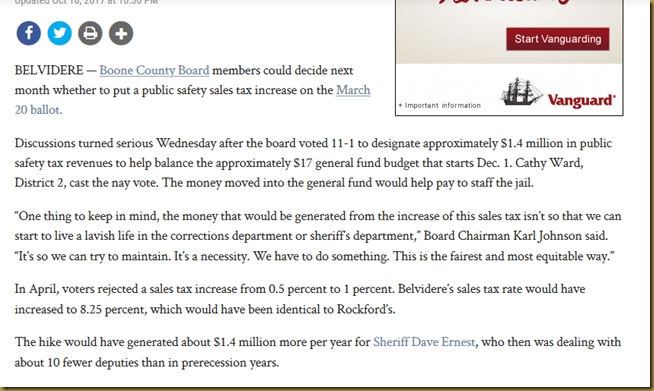
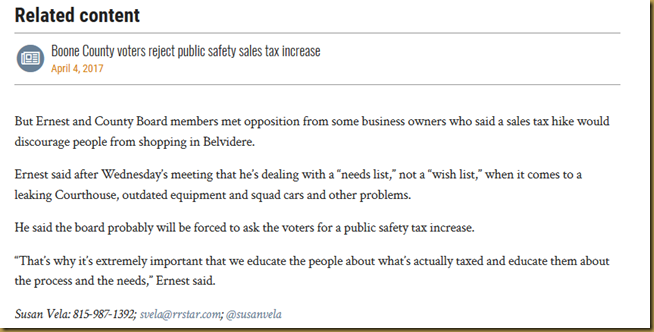
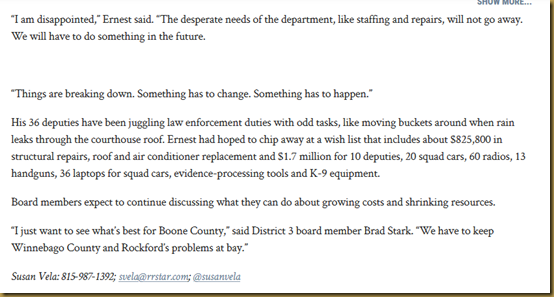
Boone County Public Safety Sales Tax

image


image

Above is from:  http://www.rrstar.com/news/20171018/boone-county-voters-may-see-public-safety-sales-tax-referendum

Previous referendum failed 55.4% to 44.6%

image

image

Above is from:  http://www.rrstar.com/news/20170404/boone-county-voters-reject-public-safety-sales-tax-increase

Boone County Government seeks money from sacred sources?

County Board considers using Maple Crest Memorial funds and a “new” sales tax referendum.  See Cathy Ward’s Facebook postings for details.

Cathy Ward

3 hrs ·

BOONE COUNTY NEWS - Maple Crest Memorials safe for now! Board Chair Karl Johnson last night (Wednesday) quickly moved the plan to use Maple Crest Memorial funds for seed money to a community board back to committee for further review. No vote was taken on the proposed plan - yet. I thank Karl and all of you who responded so quickly to the plan to transfer (raid) these memorials which total about $131,000. I did not hear any support for it except from a few board members. I had called Karl the day after three Admin Committee members approved the plan to express my staunch disapproval. Karl said he had no knowledge of this idea prior to the committee vote. He has never showed any support for this option. However, I am also convinced that your many, many comments on facebook (and in the community) in opposition played a huge part in this move. I am meeting today with the Maple Crest Auxiliary to hear their ideas for these memorials. Many auxiliary members did not know the county had been holding these funds and have for at least a decade. I am relieved by the new review, but I will watch closely to see what happens at the next Adm meeting and share it with you.

.....Also, the board voted to once again to use about $1.3 million of public safety sales tax money to balance the budget. I again voted no. I still don't believe you taxpayers had this in mind when you approved building the new jail. So far, about $22 million has been collected for the jail that cost $9 million. All other jail costs were supposed to be paid from our general fund. While it might be legal, it was not the promise that was made when the referendum was passed about 20 years ago. Other board members argued that we need the money for public safety and other county needs. I have heard that the whole legality of these transfers is being reviewed.

The board also expressed strong support for trying again to pass another public safety sales tax. If approved that would double the amount collect, about $1.3 million more for county coffers each year. The last attempt was defeated last spring. It has been tried three times and failed each time, but supporters say it is getting closer to passing. More to come on that.

Saturday, October 14, 2017

Why (Almost) No One Is Charged With Gun Trafficking in Illinois

Why (Almost) No One Is Charged With Gun Trafficking in Illinois

It’s how the laws are written, and trafficking is hard to prove.

by Mick Dumke

Oct. 13, 6 a.m. CDT

Oliver Munday, special to ProPublica Illinois

To understand why it’s so hard to stop the flow of guns across state lines and into cities like Chicago, you have to start with a simple, well-established fact: Firearms are legal products.

Guns aren’t like cocaine. As the Supreme Court has repeatedly ruled, most American adults are allowed to have them. That means there are millions of people who can acquire guns legally — and millions of potential sources of guns that may later be illegally sold, traded, loaned or stolen.

ProPublica Illinois

ProPublica Illinois is ProPublica’s first regional operation. We publish investigative journalism on key issues across the state of Illinois and in the city of Chicago.

Sign up for our Illinois stories by email.

Regulations and restrictions vary by city and state, and most are loose. As we reported in a story Tuesday, the majority of the guns seized by Chicago police were originally bought out of state.

But even when authorities know a gun has changed hands unlawfully, they often can’t determine its ownership history.

“What comes between that first sale and the recovery is the question,” said Philip Cook, a researcher with the University of Chicago Crime Lab and a professor at Duke University.

It adds up to what some officials describe as a kind of law enforcement version of whack-a-mole: Police and prosecutors spend significant resources targeting people caught possessing illegal guns — who are usually at the end of a lengthy chain of ownership — with little hope of thwarting the illicit gun markets.

In the face of a two-year spike in violence in Chicago, authorities have stepped up their efforts to prosecute gun offenders. Through Oct. 4 of this year, federal prosecutors in the Northern District of Illinois had already brought more gun charges than in any other year over the last decade — with almost three months still to go.

But the vast majority of the defendants were charged with illegal gun possession, according to federal court records. In some cases the guns were allegedly brought to the Chicago area from out of state, but no one was charged with trafficking. The reason: No federal trafficking statute exists.

Local law enforcement officials, meanwhile, lock up thousands of gun offenders every year, almost always on possession charges. Like federal officials, they rarely arrest or prosecute people for trafficking firearms, though such charges carry far stiffer sentences.

While a state trafficking law is on the books, prosecutors say the cases are hard to prove.

Numbers tell the story:

Felon-in-Possession Charge Increased to Nearly 75 Percent of All Gun Charges in 2017

Without a trafficking statute, the "Possession of a Firearm By a Felon" charge is often the best tool federal prosecutors have. See how possession charges have increased to become the majority of all gun charges over the last decade.

NOTES: 2017 figures are through Oct. 4. Three cases that were filed prior to 2007 but reopened during or after 2007 are omitted. SOURCE: United States District Court for the Northern District of Illinois. (David Eads/ProPublica Illinois)

The most common charge: being a felon in possession of a firearm, which accounts for 73 percent of all gun charges in 2017. The others: using a gun in connection with drug trafficking (17 percent); selling guns without a license (8 percent); and making a false statement in a gun purchase (2 percent).

Over the last decade, the portion of gun defendants facing possession charges has doubled.

Neither the ATF nor the U.S. attorney’s office in Chicago would comment to ProPublica Illinois about their approaches to attacking underground gun markets.

Some federal authorities and lawmakers want to create another tool. U.S. Rep. Robin Kelly, the Democrat whose district includes parts of Chicago’s South Side and some adjacent suburbs, has cosponsored the Gun Trafficking Prevention Act of 2017, which would ban the purchase or sale of a gun with the intent to transfer it illegally.

She said such a measure would be critical for the Chicago area because surrounding states have looser gun laws than Illinois. Only three Republicans have signed on as co-sponsors, though, and the bill has been buried in committee since it was introduced in March.

“It’s so frustrating,” Kelly said.

At the state level, Illinois prohibits both trafficking guns from out of state and gunrunning, which is the illegal transfer of at least three guns. But police and prosecutors in Chicago almost never charge anyone with those offenses:

  • Since 2007, nine of every 10 weapons arrests by Chicago police have been for illegal gun possession, according to the city’s reported crimes database.
  • During that time, Chicago police have made more than 27,000 arrests for illegal gun possession, formally known as “unlawful use of a weapon” under state law. But the police have made just 142 arrests for illegal gun sales — and none for gun trafficking or gunrunning — in the last decade.
  • Similarly, since 2013, Cook County prosecutors have brought unlawful use of a weapon charges 9,724 times, according to data from the state’s attorney’s office. During the same period, they’ve charged defendants with gunrunning 12 times, and they haven’t charged anyone with gun trafficking.

The Chicago Police Department works with the ATF to trace every illegal gun it recovers, said Anthony Guglielmi, a department spokesman. But most have been sold, stolen or loaned out repeatedly.

“They can be on the street for years,” Guglielmi said. People “don’t get rid of guns here. They bounce around.”

Federal laws limit the ability of authorities to keep records, so no national gun registry exists. Because each state has its own regulations, officials are often unable to determine the entire ownership history of a gun. Without that history, it’s a challenge for local prosecutors to show gun trafficking occurred.

Read More

How Chicago Gets Its Guns
It’s not big trafficking rings. Mostly, it’s through little guys like John Thomas.

“If a car is used in a shooting or robbery, I can easily find out, in a matter of minutes, who owned that car,” said Eric Sussman, a former federal prosecutor who’s now the top deputy to Cook County State’s Attorney Kim Foxx. “Gun laws are intentionally set up where there is no searchable database.”

Even when authorities learn a gun’s history, building a trafficking or gunrunning case can be tough. The cases take significant time and resources to investigate, and the laws are narrowly written — for instance, only residents of Illinois can be charged with trafficking here, even though most guns in Chicago come from out of state.

“You have to prove that they’re transferring to someone who’s not allowed to have them or they’re transferring them for illegal purposes,” Sussman said. “And that’s a high burden.”

Above is fromhttps://www.propublica.org/article/gun-trafficking-charges-illinois