
How tax cuts changed Wisconsin
Wisconsin has become a testing ground for GOP economic policy enshrined since Reagan. The results have been average.
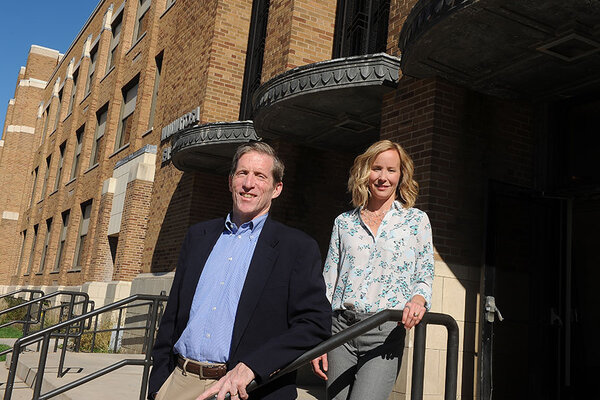

Dennis McBride (left) and Mary Young stand on the steps of Wauwatosa East High School in Wauwatosa, Wis., on Oct. 18.
Michael Thomas McLoone/Special to The Christian Science Monitor
Wauwatosa, Wis. — It’s just one block from Dennis McBride’s modest Arts and Crafts house to Jefferson Elementary School, where two of the recently retired federal attorney’s three children once attended. Joyous screams from the candy-colored apparatus of the school playground echo across Mr. McBride’s yard.
It’s also just a short walk to the white three-bedroom Colonial on North 68th Street where Republican Gov. Scott Walker used to live. McBride says he’s known “Scott” for 20 years – both as parents whose paths crossed at the local grocery store and at public events back when Governor Walker was a member of the state Assembly.
But now, the two men are on opposite sides of a battle over Wisconsin’s future.
As governor, Walker has made Wisconsin a prime testing ground for Republican economic principles: He has cut the top rates of income and corporate taxes in hopes of unleashing strong economic growth.
As a resident of Wauwatosa, McBride has stepped up to say that vision has failed in a crucial way: The tax cuts are straining Jefferson and other schools across the state. What began in Wauwatosa as a small parents’ advocacy group resisting school cutbacks in this middle-class suburb of Milwaukee has reverberated in other districts.
The scuffle is over money for public schools. But at its core, it is an ideological tussle over the low-tax, anti-union brand of economics that Walker has pushed here since the 2010 election gave the Republicans, infused with tea party vim, unbridled control of Wisconsin’s government for the first time since 1938.
For most in the national Republican establishment, such as House Speaker Paul Ryan, Walker’s supply-side economics are suffused with the golden glow of the Reagan era. And the party’s donor class has a direct interest in lower taxation.
But with a deadlocked Congress barely able to pass a budget, let alone rewrite the tax code, Republican-led states such as Wisconsin, Kansas, and North Carolina have taken the lead – all sharply reducing taxes on individuals and businesses in pursuit of growth and jobs.
The results have ranged from poor to middling, suggesting that the most oft-cited success story – Texas – is more the result of the state’s energy economy than its fiscal policy.
Kansas, for example, was forced to raise its sales tax in 2014 after income tax cuts and lackluster growth led to a costly debt downgrade.
In Wisconsin, the report card is more mixed. In fact, Wisconsin looks a lot like the rest of the country: The economy is starting to hum and unemployment is low. But Wisconsin has not outperformed in growth and jobs, as Walker promised it would. And other states in the same economic tier didn’t cut taxes and reduce social spending to get their economies going again.
The question: Was it worth it?
How parents see it
SOS (Support Our Schools) Wauwatosa began with anxious parents talking on school playgrounds. It was February 2015 and Walker, who had been reelected in November, had proposed a two-year budget that would strip $127 million from K-12 schools. The superintendent had written to parents to explain that this would cut $900,000 from his budget.
Among the anxious parents was Mary Young. She wrote back to the superintendent to thank him and ask what this meant for her two children who were in kindergarten and second grade. Soon she was coordinating with other parents, and former Jefferson school parents like McBride, to put up SOS yard signs and bombard lawmakers with thousands of signed postcards opposing cuts. They showed up at town hall meetings – a first for Ms. Young, an educator at a Roman Catholic university – to press lawmakers, mostly Republicans, about where they stood on the budget.
“There were many other parents who felt like I did. We chose to buy our homes here, to live here. And a lot of it is about the neighborhood schools,” she says.
For many in the education community, the 2015 budget was just the latest blow. First in that line was Act 10, the controversial 2011 law that ended collective bargaining for teachers and other public employees.
In an interview with the Monitor, Walker defends Act 10 as a powerful tool for improving the state’s finances. At a time of public disquiet over recession-hit state finances, including pension liabilities, Act 10 saved taxpayers more than $5 billion by shifting costs onto teachers, Walker says.
In addition to allowing districts to pay less for health care and pensions, it also revoked union seniority and tenure rules.
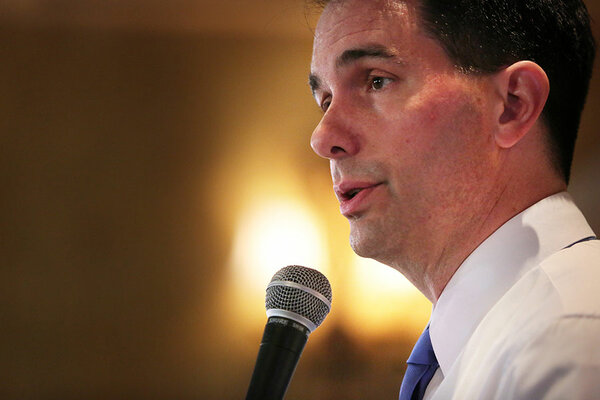
Wisconsin Gov. Scott Walker delivers keynote remarks at the DuPage County GOP Summer Reception in Downers Grove, Ill., in this 2015 file photo. Anthony Souffle/Chicago Tribune/AP/File
Act 10 is “one of the most significant education reforms in our history,” he says. “Schools can hire and fire based on performance. They can pay based on performance as well.... We’ve seen school districts have tremendous success.”
But others argue that along with Act 10, Walker has defunded school districts and universities and demoralized educators.
McBride has nothing against Walker personally, but he argues that the governor’s sweeping reforms have undermined a long tradition of bipartisan support for public schools and teachers – and abiding pride in the results – without a signpost to a better destination. “It’s a wild experiment without controls,” he says.
McBride, an elected alderman, takes pride in Wauwatosa’s history – how it has evolved from a reliably Republican streetcar suburb of Milwaukee into a semi-urban college town of more vibrancy and political diversity. That vibrancy gives the town a certain centrist political ethic. As an independent, McBride says he has respect for Republican governors who supported public education, ticking off a list that includes Warren Knowles and Tommy Thompson.
“We voted for moderate people who cared about the things that we cared about,” he says.
Last July, SOS’s work paid off when lawmakers restored the $127 million in K-12 cuts. But some of the money went to an expanded voucher program for low-income students. And lawmakers cut $250 million from the University of Wisconsin system, an 11 percent drop, to an all-time low.
Walker says the university’s overall pool of money – including federal grants – is bigger than ever, and a move to cap fees has made higher education more accessible. “Students and families that support them do not want higher tuition. It’s one of their biggest burdens,” he says.
Property taxes, which are tied to state aid to school districts, have also been capped by Walker, a point of pride.
For her part, Young says she could have done without the extra $13. “Having a good public school for my kids to attend is worth more than $13 a year.”
How businesses see it
On a warm September night, the setting sun bronzes the private planes parked on the tarmac at Appleton International Airport, an aspirational name for a regional gateway. Inside a gym-sized hangar where two business jets are conspicuously positioned behind a buffet table of nachos, baked chicken, and chocolate fondue, an event planner is giving a pep talk to 20 or so men and women.
The bus, they are told, is on its way. On the bus is the reason they came tonight – 89 engineering and IT students from 23 universities.
Here in the valley of the Fox River, a confluence of highways and industries that serves as a bellwether for manufacturing in Wisconsin, the mantra is talent, not taxes.
Wisconsin’s population is aging, and the state will need to bring in roughly 300,000 workers in the next 20 years just to maintain its existing labor force. Not only that, it needs to convince multinationals that this workforce will stick around.
So it’s all the event planner can do to keep the attendees from salivating.
“The students will come in here. Now let’s not stare at them,” says the manager, eyeing the company reps, who smile awkwardly and shuffle their feet on the concrete. “We want to intermingle with them.” He advises them to join the students in the buffet line, just not all at once. “You’ll get some good line-talking with them,” he promises.
Among the attendees are businesses that have benefited from the governor’s new economic regime and applaud it.
In May, Werner Electric, which supplies electrical materials to factories and builders, moved into a new $20 million 200,000-square-foot distribution center in Appleton. It got a $2 million, five-year tax credit for the facility. And it indirectly benefits from a production credit introduced by Walker that virtually eliminates state taxes on manufacturers and agribusiness.
The tax credits help Werner invest in equipment that underpins its long-term expansion, including new hires at its new facility, says Craig Wiedemeier, Werner’s vice president of operations.
“I see more manufacturers willing to take a risk.... The support we get helps us to invest and that flows out as well,” he says.
This is the core supply-side proposition: Lighten the tax burden on entrepreneurs and their investments will seed a larger economy, benefiting those who don’t get the tax breaks.
And there is some evidence that it’s working. State unemployment was at 4.2 percent in August. Last year Wisconsin ranked fourth in growth in average household income, and some data show a stronger rebound than after the 2001 recession, when Wisconsin grew more slowly than the national average.
But the Appleton event also points to what tax breaks can’t deliver: a pipeline of educated workers.
While fiscal policy can encourage investment, quality of life and good schools are a greater draw, says Dale Knapp, research director at the Wisconsin Taxpayers Alliance.
“You can have all of these policies to attract businesses, but you have to attract the workers to help the economy grow and that’s going to be a challenge.”
So far, Walker’s tax credits have mostly been a boon for existing manufacturers but aren’t bringing in many new investors. The Ewing Marion Kauffman Foundation ranks Wisconsin last for start-up activity, citing a lack of entrepreneurs and new businesses.
John Torinus, whose midsize company builds car console panels in Mexico and Wisconsin, disputes this ranking. He praises Walker, comparing him to a “turnaround CEO” who takes over in a crisis.
But Mr. Torinus acknowledges that he doesn’t see any new thinking on the economy and worries that cuts to higher education will handicap future start-ups.
Tax cuts vs. education
Democratic state Sen. Kathleen Vinehout has actually put a number on the cost of all income and property tax cuts, manufacturing credits, and other tax breaks: $1.7 billion. To her, these are giveaways that may not even sway the decisions companies make about where to invest. That investment would do much more for the state’s long-term economic health if it went to public schools, she argues.
“We may be recovering but our recovery is slow. The governor has been taking credit for the sun coming up,” says Senator Vinehout, an organic dairy farmer and former college professor.
A 2015 study by the nonpartisan Tax Policy Center came to the same general conclusion, finding no strong evidence, positive or negative, that tax cuts affected states’ economic growth.
“There’s no evidence that what [Walker has] done has been good for growth. And there’s potential for what he’s done to be bad for growth,” says Kim Rueben, coauthor of the study.
One prominent counterexample is next door. In 2013, Minnesota raised the top rate of income tax over protests that it would hurt the economy and lead to lower tax revenues. Now lawmakers are debating what to do with a budget surplus.
Back in Wauwatosa, SOS has begun a new campaign, calling for an increase in state aid to public schools and a freeze on voucher programs. Wauwatosa has dipped into its reserves to make sure that it doesn’t cut programs or lose in-demand teachers. At some point, though, it will have to ask local taxpayers to pay more.
“We’re not politicians,” says Young. SOS’s strength lies in the bonds that form between parents, she adds. “We have the power of the playground.”
Walking past the elementary school, McBride strikes a hopeful note. Some Republican legislators support a hike in the gas tax to plug the budget gap, and that could free up money for education.
He stops to take in the joyful mayhem of lunchtime recess. An empty nester, he no longer gets to chew the fat with other parents. “I miss being on the playground.”
Above is from: http://www.csmonitor.com/USA/Politics/2016/1103/How-tax-cuts-changed-Wisconsin?cmpid=ema:nws:Weekly%2520Newsletter%2520%2811-05-2016%29&utm_source=Sailthru&utm_medium=email&utm_campaign=20161105_Newsletter:%20Weekender&utm_term=Weekend_Best_of_Web


