Wednesday, February 5, 2025

How much do Illinois school districts rely on federal funding?

WNIJ News

How much do Illinois school districts rely on federal funding?

Northern Public Radio | By Peter Medlin

Published February 4, 2025 at 2:21 PM CST

Listen • 0:54

DeKalb High School

Spencer Tritt

DeKalb High School

President Trump says he wants Congress to close the Department of Education.

Illinois school districts count on federal funds for 12% of their revenue. The majority of school revenue comes from local taxes and a smaller chunk comes from the state.

And that 12% is actually higher than usual due to pandemic relief funding over the past few years. Pre-COVID, it made up around 7 or 8% of school revenues.

But that percentage can vary a lot, depending on the district. The federal government’s Title I program sends out billions of dollars a year to low-income schools across the country.

Rockford Public Schools, for example, receives 22% of their revenue from the federal government, while a wealthier district like Oak Park-River Forest gets just 3% from the feds.

But the big question is, if the U.S. Department of Education gets axed, does all of this federal money disappear? Not necessarily. Certain programs can be cut, but the Title I program existed before the Department of Education and it would take a separate congressional act to end it.

Would that be a priority for Trump? Well, the conservative policy playbook Project 2025, co-authored by current and former Trump staffers, calls for Title 1 to be wound down and ended.

Federal funding doesn't just come to school districts through Title I either. Schools receive federal grants to help fund lots of initiatives including mental health services and career & technical education programming.

Even if federal funds make up a relatively small percentage of school district revenue, losing it would mean steep cuts at some of the poorest school districts.

Sunday, February 2, 2025

Trump 180 on Fed Rates Cuts

President Trump says the Fed was right to stop cutting interest rates

President Donald Trump stunned reporters on Sunday night when he praised the Federal Reserve’s decision to hit pause on its rate cuts. “I’m not surprised,” he said as he arrived in Washington aboard Air Force One. “Holding the rates at this point was the right thing to do.”

Now this is a complete 180 for a man who spent much of the past year relentlessly demanding that the Fed cut rates immediately. During his second day back in office, Trump flatout said he was gonna force chair Jerome Powell into cutting rates one way or another.

Read whole story at:  President Trump says the Fed was right to stop cutting interest rates

.

Saturday, February 1, 2025

Catholic Bishops Call for Immigration Reform

Migrants run Jan. 28, 2025, after entering the United States undetected through a hole in a section of the U.S.-Mexico border wall at in Sunland Park, N.M. (OSV News photo/Jose Luis Gonzalez, Reuters)

Bishops across U.S. defend migrants, calling for immigration reform in ‘justice and mercy’

January 31, 2025
By Gina Christian
OSV NewsFiled Under: Catholic Social Teaching, Feature, Immigration and Migration, News, World NewsShare

Share

The United States is a “nation with a proud legacy of welcome to immigrants” that also “needs secure, safe, sturdy borders,” said Cardinal Timothy M. Dolan of New York.

But in a video message released Jan. 28 through The Good Newsroom, the media platform of the Archdiocese of New York, the cardinal declared the Catholic Church “should not be blasted for simply obeying the Bible and caring for those immigrants” who have entered the country through its “clumsy, fractured” immigration system.

The cardinal — a successor to New York Archbishop “Dagger John” Hughes, the 19th-century defender of Irish Catholic immigrants who laid the cornerstone of today’s St. Patrick’s Cathedral — is among the many U.S. prelates to weigh in on sweeping changes newly inaugurated President Donald Trump has made in recent days to the nation’s immigration policies.

Migrants run Jan. 28, 2025, after entering the United States undetected through a hole in a section of the U.S.-Mexico border wall at Sunland Park, N.M. (OSV News photo/Jose Luis Gonzalez, Reuters)

Trump administration officials sparred with Catholic organizations after pushback on some of their immigration policies.

In her debut press briefing as White House press secretary Jan. 28, Karoline Leavitt suggested the Trump administration would strip federal funds from Catholic Charities. The comments came two days after Vice President JD Vance questioned the motives of the U.S. bishops’ criticism of the new immigration policies in a Jan. 26 interview — including raids on churches and schools — suggesting the bishops are actually concerned about receiving federal resettlement funding and “their bottom line.”

Fulfilling campaign pledges to tighten border security and ensure mass deportations of unauthorized migrants, Trump issued a slew of executive orders following his Jan. 20 inauguration. Refugee travel to the U.S. has been canceled; policies preventing immigration arrests at houses of worship, schools and other “sensitive locations” have been scrapped; and a program enabling private U.S. citizens to sponsor refugees has been halted. Some 1,600 U.S. troops have also been dispatched to the U.S.-Mexico border to assist with immigration enforcement.

Trump also ordered an end to the 14th Amendment’s provision for birthright citizenship, effective Feb. 19 — although that action has since been temporarily blocked by a federal judge in Seattle, who described the move as “blatantly unconstitutional.”

Archbishop Timothy P. Broglio of the U.S. Archdiocese for the Military Services, who is president of the U.S. Conference of Catholic Bishops, said in a Jan. 22 statement that some of Trump’s executive orders “focused on the treatment of immigrants and refugees” are “deeply troubling and will have negative consequences.”

Bishop Mark J. Seitz of El Paso, Texas, chair of the USCCB’s Committee on Migration, issued multiple statements, warning some of the executive orders seek to “eviscerate humanitarian protections enshrined in federal law and undermine due process, subjecting vulnerable families and children to grave danger” and that immigration enforcement could only be carried out morally “in a targeted, proportional, and humane way.”

Catholic social teaching on immigration balances three interrelated principles — the right of persons to migrate in order to sustain their lives and those of their families, the right of a country to regulate its borders and control immigration, and a nation’s duty to regulate its borders with justice and mercy.

Referencing this teaching, the Colorado Catholic bishops issued a statement condemning an “open borders policy” while temporary or permanent legal immigration “takes years and is expensive.”

“This is not conducive for families who need to migrate quickly to sustain their lives or the lives of their families,” they said.

The bishops also stressed, “Mass deportation is not the solution to our present situation in the United States, especially when it may separate parents and children.”

A reference point for that teaching can be found in the Second Vatican Council’s teaching in “Gaudium et Spes” — reaffirmed verbatim in two encyclicals on truth and the dignity of human life by St. John Paul II — that names deportation (“deportatio”) along with abortion in a list of specific acts offensive to human life and dignity. The council teaches they “are a disgrace, and so long as they infect human civilization they contaminate those who inflict them more than those who suffer injustice, and they are a negation of the honor due to the Creator.”

Catholic bishops’ conferences from several states — among them Texas, Maryland and Michigan — have also issued statements on the immigration changes, assuring immigrants of their solidarity and pastoral concern. They called upon the new administration to address the immigration crisis with a focus on human dignity, root causes of migration and the need to fix the nation’s troubled immigration legal system.

The Texas bishops emphasized their support of the USCCB’s statements, and underscored the importance of the government respecting the life of the church.

“In exercising the basic human right of religious liberty, all Catholics, regardless of national origin or citizenship status, have a right to gather for the celebration of Mass and to receive the Sacraments without harassment or intimidation,” they said.

Maryland’s bishops committed to advocating for policies that protect migrants’ rights and dignity, while also declaring the church’s “parishes, schools, and ministries are here for you, offering spaces where you can find community and grow in faith.”

Michigan’s bishops pleaded with elected officials “to support policies that keep immigrant and undocumented families safe and united, and to protect those who arrived as children.”

Like Cardinal Dolan, other U.S. bishops have also spoken out individually as well, pledging the church’s firm solidarity with immigrants while also calling on the nation’s leaders to make a deal on immigration within moral parameters.

In a Jan. 21 statement, Archbishop John C. Wester of Santa Fe, N.M., said that he felt “a profound obligation to speak on behalf of immigrants,” particularly those whose countries of origins are in dire straits, and called for “a bipartisan effort to enact immigration reform that honors both citizens and immigrants, addressing the intricate issues at hand.”

Likewise, in a Jan. 24 letter to the faithful of northwest Iowa, Bishop R. Walker Nickless of Sioux City, said the Catholic Church stands “ready to work with our national leaders on responsible immigration reform, including smart border security, (and) pathways to lawfully being present in our country and towards citizenship.”

But he also said the church and the nation had a “duty” from Jesus Christ, defined in Scripture, to “value each and every person created by our loving God and give them the dignity they deserve as sons and daughters of God our Father.”

He said, “All of this must be done in justice and mercy.”

Above is from:  Bishops across U.S. defend migrants, calling for immigration reform in 'justice and mercy' - Catholic Review

ICE and Illinois Law Enforcement==the guide

image


SEE Full document at:  ImmigrationLawGuidancetoLawEnforcement.pdf

This maybe an important to understanding Illinois news in the coming days.

Head Start is it open or not? And for how long?

WNIJ News

Now-rescinded Trump federal grant freeze causes chaos for childcare programs

Northern Public Radio | By Peter Medlin

Published January 29, 2025 at 4:52 PM CST

Kids at Taylor's Tots in Rockford

Peter Medlin

Kids at Taylor's Tots in Rockford

Leer en espaƱol

On Tuesday, the Trump administration’s broad freeze on federal grants caused chaos for northern Illinois child care providers and families.

Two Rivers Head Start operates child care programs in Aurora, Elgin, and Sycamore. Executive director Kelly Neidel had to tell her staff they’d been laid off, and had to tell her 200-plus families that their services were shutting down.

“It's affecting so many people, it's literally just heartbreaking,” she said.

A few hours later, a federal judge stopped the freeze. Neidel then had to backtrack and tell everyone they were staying open. The administration has since rescinded the freeze.

She says the situation caused a lot of undue stress for their low-income families who had to spend the afternoon scrambling to find new childcare. And even though they’ve had some reassurances that they shouldn’t be impacted by the freeze, it’s difficult for staff to believe their jobs are totally safe.

Neidel says they’ve also briefly lost access to their Community Services Block Grant which helped fund food pantries, assisting families in crisis with rental assistance or car repairs, a senior food and clothing initiative and more. Now, they can draw down on those funds again.

She says they conduct federal audits every year, so she doesn’t buy that there’s any waste in the program.

*

Peter Medlin

Peter joins WNIJ as a graduate of North Central College. He is a native of Sandwich, Illinois.

See stories by Peter Medlin

Wednesday, January 29, 2025

Trump’s Resignation Email Offer

U.S. Office of Personnel Management logo

            This article is from:  Fork in the Road


    Fork in the Road

    Frequently Asked Questions

    Below is the email that was sent to federal employees on January 28, 2025 presenting a deferred resignation offer. If you did not respond to that email and wish to accept the deferred resignation offer, you may do so by following these steps.

    1)
    Send an email to hr@opm.gov from your government account. Only an email from your .gov or .mil account will be accepted.

    2)
    Type the word "Resign" into the "Subject" line of the email. Hit "Send".

    Deferred Resignation Email to Federal Employees

    January 28, 2025

    During the first week of his administration, President Trump issued a number of directives concerning the federal workforce. Among those directives, the President required that employees return to in-person work, restored accountability for employees who have policy-making authority, restored accountability for senior career executives, and reformed the federal hiring process to focus on merit. As a result of the above orders, the reform of the federal workforce will be significant.
    The reformed federal workforce will be built around four pillars:

    1)
    Return to Office: The substantial majority of federal employees who have been working remotely since Covid will be required to return to their physical offices five days a week. Going forward, we also expect our physical offices to undergo meaningful consolidation and divestitures, potentially resulting in physical office relocations for a number of federal workers.

    2)
    Performance culture: The federal workforce should be comprised of the best America has to offer. We will insist on excellence at every level — our performance standards will be updated to reward and promote those that exceed expectations and address in a fair and open way those who do not meet the high standards which the taxpayers of this country have a right to demand.

    3)
    More streamlined and flexible workforce: While a few agencies and even branches of the military are likely to see increases in the size of their workforce, the majority of federal agencies are likely to be downsized through restructurings, realignments, and reductions in force. These actions are likely to include the use of furloughs and the reclassification to at-will status for a substantial number of federal employees.

    4)
    Enhanced standards of conduct: The federal workforce should be comprised of employees who are reliable, loyal, trustworthy, and who strive for excellence in their daily work. Employees will be subject to enhanced standards of suitability and conduct as we move forward. Employees who engage in unlawful behavior or other misconduct will be prioritized for appropriate investigation and discipline, including termination.

    Each of the pillars outlined above will be pursued in accordance with applicable law, consistent with your agency's policies, and to the extent permitted under relevant collective-bargaining agreements.
    If you choose to remain in your current position, we thank you for your renewed focus on serving the American people to the best of your abilities and look forward to working together as part of an improved federal workforce. At this time, we cannot give you full assurance regarding the certainty of your position or agency but should your position be eliminated you will be treated with dignity and will be afforded the protections in place for such positions.
    If you choose not to continue in your current role in the federal workforce, we thank you for your service to your country and you will be provided with a dignified, fair departure from the federal government utilizing a deferred resignation program. This program begins effective January 28 and is available to all federal employees until February 6. If you resign under this program, you will retain all pay and benefits regardless of your daily workload and will be exempted from all applicable in-person work requirements until September 30, 2025 (or earlier if you choose to accelerate your resignation for any reason). The details of this separation plan can be found below.
    Whichever path you choose, we thank you for your service to The United States of America.

    *********************************************************************

    Upon review of the below deferred resignation letter, if you wish to resign:

    1)
    Select “Reply” to this email. You must reply from your government account. A reply from an account other than your .gov or .mil account will not be accepted.

    2)
    Type the word “Resign” into the body of this reply email. Hit “Send”.

    THE LAST DAY TO ACCEPT THE DEFERRED RESIGNATION PROGRAM IS FEBRUARY 6, 2025.
    Deferred resignation is available to all full-time federal employees except for military personnel of the armed forces, employees of the U.S. Postal Service, those in positions related to immigration enforcement and national security, and those in any other positions specifically excluded by your employing agency.

    *********************************************************************

    DEFERRED RESIGNATION LETTER
    January 28, 2025

    Please accept this letter as my formal resignation from employment with my employing agency, effective September 30, 2025. I understand that I have the right to accelerate, but not extend, my resignation date if I wish to take advantage of the deferred resignation program. I also understand that if I am (or become) eligible for early or normal retirement before my resignation date, that I retain the right to elect early or normal retirement (once eligible) at any point prior to my resignation date.

    Given my impending resignation, I understand I will be exempt from any “Return to Office” requirements pursuant to recent directives and that I will maintain my current compensation and retain all existing benefits (including but not limited to retirement accruals) until my final resignation date.

    I am certain of my decision to resign and my choice to resign is fully voluntary. I understand my employing agency will likely make adjustments in response to my resignation including moving, eliminating, consolidating, reassigning my position and tasks, reducing my official duties, and/or placing me on paid administrative leave until my resignation date.

    I am committed to ensuring a smooth transition during my remaining time at my employing agency. Accordingly, I will assist my employing agency with completing reasonable and customary tasks and processes to facilitate my departure.

    I understand that my acceptance of this offer will be sent to the Office of Personnel Management (“OPM”) which will then share it with my agency employer. I hereby consent to OPM receiving, reviewing, and forwarding my acceptance.

    Upon submission of your resignation, you will receive a confirmation email acknowledging receipt of your email. Any replies to this email shall be for the exclusive use of accepting the deferred resignation letter. Any other replies to this email will not be reviewed, forwarded, or retained other than as required by applicable federal records laws.

    Once your resignation is validly sent and received, the human resources department of your employing agency will contact you to complete additional documentation, if any.

    OPM is authorized to send this email under Executive Order 9830 and 5 U.S.C. §§ 301, 1103, 1104, 2951, 3301, 6504, 8347, and 8461. OPM intends to use your response to assist in federal workforce reorganization efforts in conjunction with employing agencies. See 88 Fed. Reg. 56058; 80 Fed. Reg. 72455 (listing routine uses). Response to this email is voluntary. Although you must respond to take advantage of the deferred resignation offer, there is no penalty for nonresponse.

    Friday, January 24, 2025

    CPS response to ICE threat


    January 24, 2025

    A Note From CPS Leadership

    Click here to view this letter in Spanish, Arabic, Simplified Chinese, Filipino, Polish, Ukrainian, Urdu, or Vietnamese. Use the Google Translate feature at the top of the page to change the language.

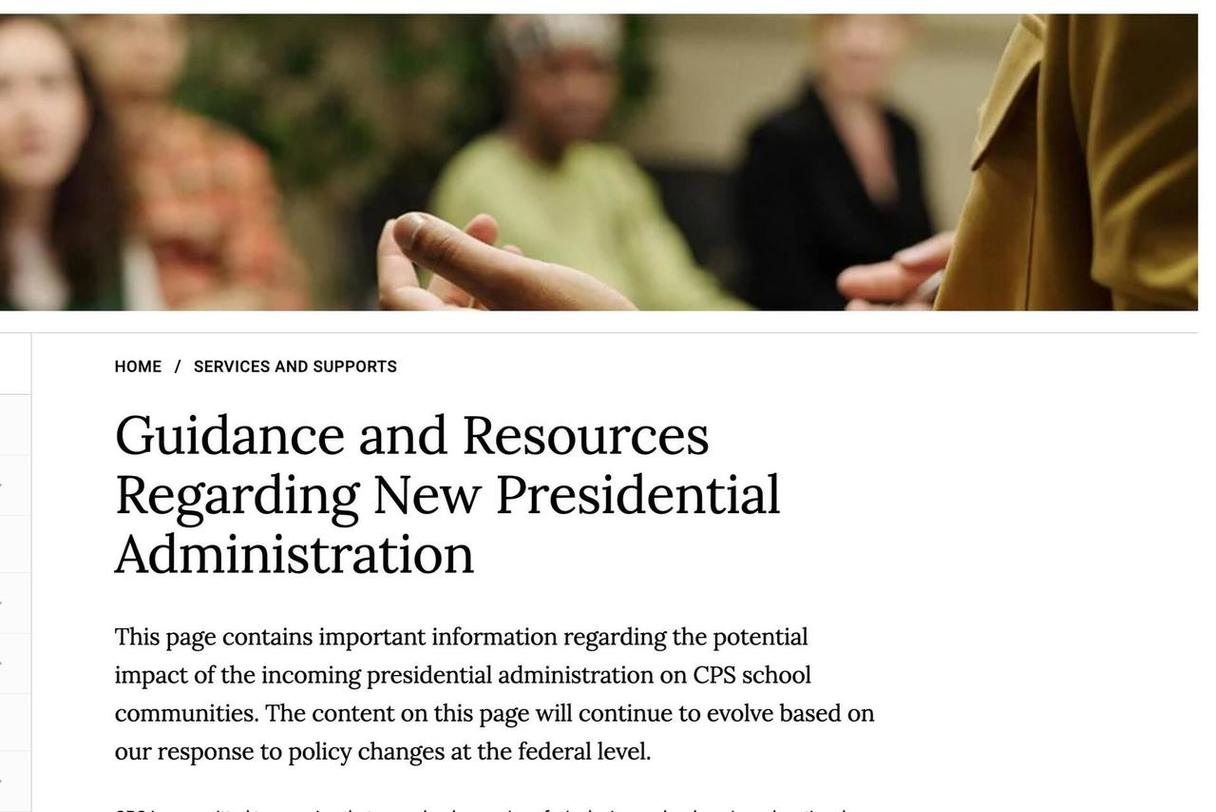
    Screenshot of the New Administration Guidance website

    Dear CPS Colleagues, Families, and Supporters,

    Much has happened in just the first week of the new presidential administration, including the elimination of a long-held policy that named schools as “sensitive spaces” when it comes to immigration enforcement. I know that this has many in our CPS community feeling deeply unsettled, and I am truly sorry for the unfair burden of fear and anxiety that is being placed on our immigrant families right now.

    I want to speak directly to our CPS parents. Even with everything that’s happening, the best, safest place for your children is at school. First off, school is where they will receive the high-quality education they need and deserve. But beyond that, each CPS school is FILLED with adults who will go above and beyond every day to protect and care for your children.

    As we’ve said many times, CPS DOES NOT ask for the immigration status of our students or families, and WILL NOT cooperate with Immigration and Customs Enforcement (ICE) agents who come to our schools unless they have a criminal judicial warrant signed by a federal judge. Even in that rare instance, we have a team of lawyers available at all times to review those warrants.

    I want families to know that our District, city, and state are completely aligned on this issue. There are laws and policies, including the Illinois Trust Act and Chicago Welcoming City Ordinance, that are in place to protect our children, regardless of any changes that are made at the federal level.

    The one thing we are asking of our families is to make sure your school has updated emergency contact information on file. Beyond that, we simply want you to send your kids to school every day with the confidence that we will protect and care for them.

    Families can find a wealth of resources on immigration services, including a schedule of free “Know Your Rights” trainings and workshops, on our website at cps.edu/newadminguidance.