
Wednesday, March 10, 2021


Costanza repeatedly “diss” by Edgar County Watchdog


Support
Our Mission

MARCH 10, 2021
FEATURE, POPLAR GROVE
Poplar Grove Candidate’s Run-in with Insurance Licenses In Three States -
BY JOHN KRAFT & KIRK ALLEN
POPLAR GROVE, IL. (ECWd) -
Update: Owen Costanza responded to this article: (Read it here)
Mayoral Candidate’s Run-in with Insurance Licenses In Three States: Fined $31,500
When a candidate, any candidate, touts their public service and their honesty, without revealing the truth in their past dealings with state regulatory agencies, we believe the people have a right to know.
Such is the case with Owen Costanza, current Mayor, and 2021 Mayoral Candidate, for the Village of Poplar Grove.
His campaign webpage talks about his “work ethic” and applying his business management experience to village operations.
Below, we discuss his “work ethic” and “business management experience” as observed through the eyes of Insurance regulators in Indiana, Wisconsin, and Illinois.
Some of this includes lying on applications for business insurance licenses by failing to disclose criminal convictions and failing to disclose termination of his company for allegations of misconduct. Paying civil penalties of $31,500.00 to various state departments of insurance, failing to tender paid premiums to insurance providers, and improper withdrawals from several accounts, among others.
We have asked Owen Costanza to provide comments on these issues, he has yet to respond.
ILLINOIS
On February 18, 2015, a “STIPULATION AND CONSENT ORDER” was signed by Costanza, Licensee and representative of RMS Service Group, Inc., d/b/a as Alliance Insurance Agency, which supersedes the Order of Revocation dated April 3, 2014. This matter was on the Revocation of licensing authority of RMS Service Group d/b/a as Alliance Insurance Agency
In this signed ORDER:
- Respondent shall pay a civil penalty of $30,000 to the Director of the Illinois Department of Insurance
- Voluntarily agree to revocation of the Business Entity license of RMS Service Group, Inc. d/b/a/ as Alliance Insurance Agency
- The Premium Fund Trust Account (“PTFA”) was deficient for 117 days and pertained to 17 consumers, ranging from $200.14 to $24,574.16 with an average of $15,240.35
- Collected insurance premiums from three customers between Aug 2, 2010 and Oct 21, 2010, and failed to forward the premiums to the insurer within the required timeframe – holding four premiums for an average of 301 days
- During March 2010, made unlawful withdrawals totaling $9,400 from the PTFA account, $10,733.97 from the Main account, and $16,385.66 from the Operating account
- On Sep 22, 2010, deposited $365.83 from a consumer for homeowner’s insurance policy, then paid the insurer $196.40, but did not repay the $169.43 to the consumer until more than a year later
- Charging service fees without a service fee agreement
- Check register did not include positive running balances after each deposit or disbursement – and had a negative balance on 32 separate dates
- Maintaining a Bond of $2500.00 when, in 2010, the minimum amount of the Bond for 2011 should have been $7342.00
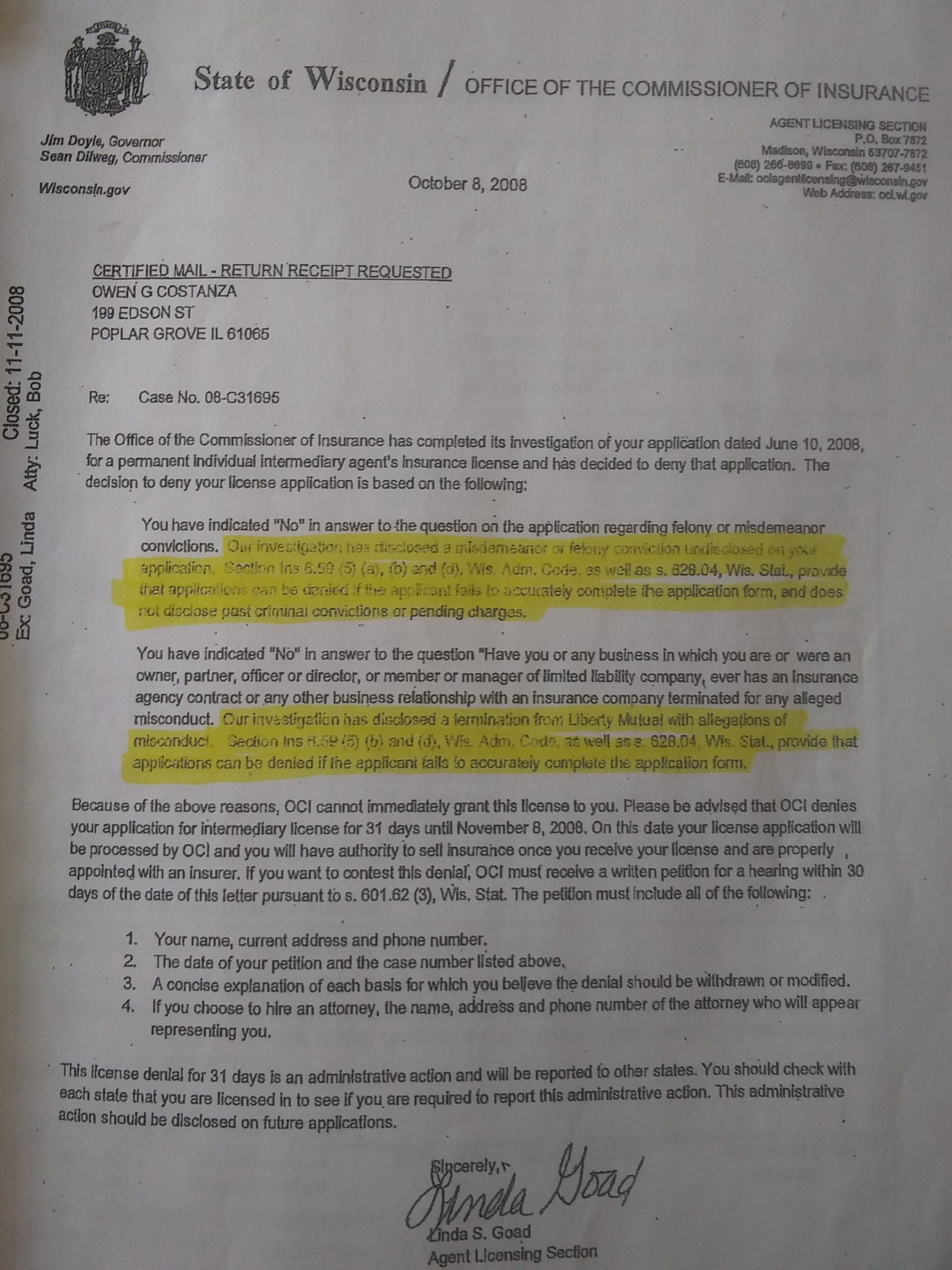
- Failed to disclose the 2008 denial of a Business Entity and Licensee’s application in the State of Wisconsin for failing to disclose previous criminal convictions on an insurance license application and failing to disclose a company termination for allegations of misconduct
- Failed to disclose the 2010 State of Indiana civil penalty against the Licensee for failing to disclose previous criminal convictions, having judgment withheld or deferred, pending criminal investigation, or being named in an administrative proceeding
- Falsely answered “NO” to question #2 of the application about their involvement in an administrative proceeding, regarding whether administrative action was taken by another State on their 2010 and 2012 application for renewals for a license
- Conducting business in a name other than the name on the license issued for a Business Entity
- Check register examined by the Department did not have all check issues listed and was not accurate as the actual checks issued with the correct check number
- Other issues with listings of deposits or monies received
- No bank reconciliations between 2008 and 2011
- Bank accounts listed as Premium Trust Account and a check was written from that account on Sep 9, 2010 (we cannot locate any more information about this check to report who it was written to)
INDIANA
On September 21, 2010, the Indiana Commissioner of Insurance filed a “FINAL ORDER AND APPROVAL” and another filing labeled “AGREED ENTRY” in Cause Number 9384-AG10-0831-135, which is labeled as “Enforcement Action” naming Owen Costanza as the Agent/Respondent to Indiana Insurance License Number 425943.
In the signed filings for this Cause:
- Respondent shall pay a $1500 civil penalty to the Indiana Department of Insurance
- Respondent falsely indicated “NO” to the question of whether he had ever been convicted of a crime, had a judgment withheld or deferred, or was currently charged with committing a crime
- Respondent falsely indicated “NO” to the question of whether he had ever been named as a party in an administrative proceeding regarding any professional or occupational license or registration
- Respondent falsely indicated “NO” to the question of whether he had ever had an insurance agency contract or any business relationship with an insurance company terminated for any alleged misconduct
WISCONSIN
- Licensed DENIED for 31 days based on allegations of failing to disclose previous criminal convictions on an insurance license application and failing to disclose a company termination for allegations of misconduct. November 2008 (See page 41
**************************************************************************************************************************************
Search
MARCH 10, 2021
FEATURE, POPLAR GROVE
Owen Costanza's Response Misleading; Doesn't Match Public Records -
BY JOHN KRAFT & KIRK ALLEN
POPLAR GROVE, IL. (ECWd) -
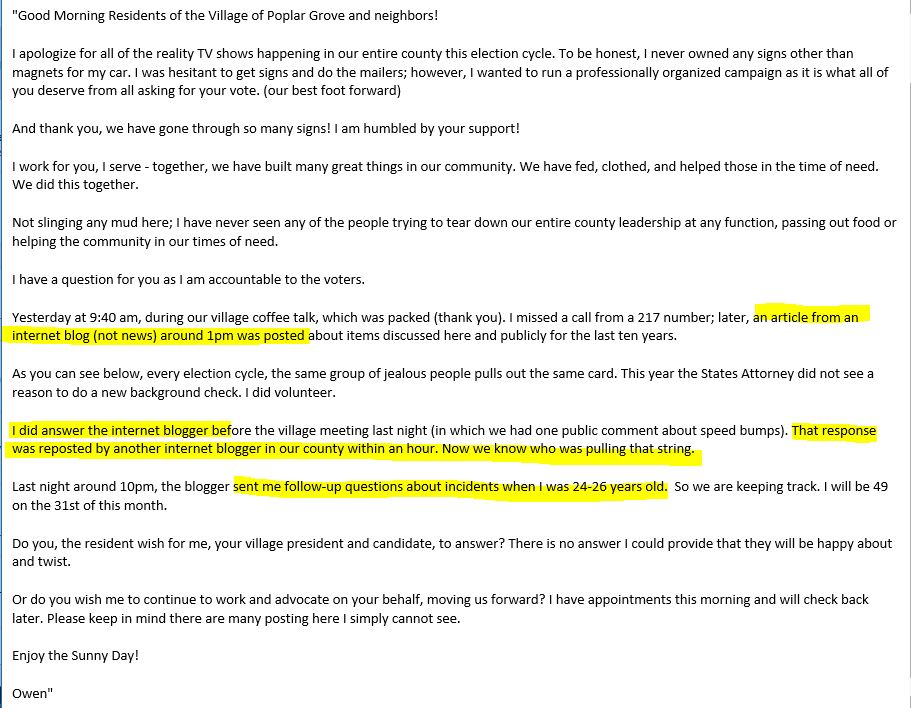
Yesterday we published complaints against Owen Costanza by the Illinois, Indiana, and Wisconsin State Insurance Licensing Regulators, and Costanza responded with his version of what he was willing to tell us.
These were as recent as 2011 and 2015 (Stipulation and Consent Order) - not things that happened "in his 20s".
The problem is, his response does not match with public records obtained from state regulatory agencies.
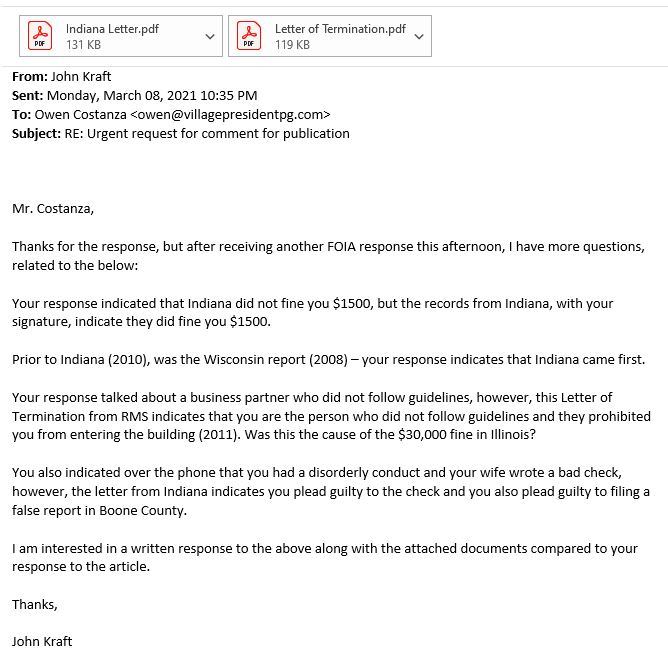
Last night I sent him follow-up questions, but instead of answering them, he took to social media to gain sympathy and peddle misinformation. In the social media post, he conveniently "forgets" to mention the most important part of the questions I sent him, which was the Letter of Termination, his blaming other people, and his claims of disorderly conduct instead of what it actually was.
In Costanza's response letter to our article:
- he blamed employees for "accidentally" lying on the license applications in two states
- claimed the conviction was a "disorderly conduct" when he was 24 years old
- he blamed a business partner on his issues in Illinois, claiming the business partner did not follow guidelines and there was money that needed to be replaced, and since he [Costanza] was the one with the license, he was the one responsible
In the FOIA responses:
- Indiana Director of Fraud Investigations sent a letter detailing Costanza's convictions, which include:
- pleading guilty to false reporting in 1995 in Boone County (withhold judgment)
- pleading guilty to writing a bad check in 1999 in Boone County
- terminated for cause in 1995 from Liberty Mutual with allegations that he filed a false insurance claim - and also noted that the Illinois Department of Unemployment Insurance ruled there was insufficient evidence to support the allegation
- that Costanza's 2008 application for insurance license in Wisconsin was denied for 31 days for failure to disclose the criminal convictions and for failing to disclose his termination for cause from Liberty Mutual
- RMS Service Group issued a Letter of Termination to Costanza in 2011 (related to the $30,000 penalty from Illinois) accusing him of the following:
- immediately terminating Costanza's employment with RMS Service Group, effective January 27, 2011
- that Costanza altered access to the Applied Systems TAM application, access to the phones, and changed company passwords at their insurance company databases
- that Costanza opened an unauthorized business account at Poplar Grove State Bank
- that Costanza conducted a mass deletion of emails without permission or authorization
- that these actions were done following being confronted on January 15, 2011, with unauthorized disbursements made to [Costanza] and on Costanza's behalf from the Premium Fund Trust Account maintained at National City Bank
- that he was confronted with and asked to explain altered customer premiums that did not reconcile with insurance policies issued to said customers
- that he formed RMS Insurance Services, Inc. on January 16, 2011, in Poplar Grove and that the RMS Service Group will make sure [Costanza] is held personally liable for any misappropriation of confidential information or trade secrets from it
- that Costanza is no longer permitted to enter the premises of the company unless escorted by Rashid Sindhu
These are the two vastly differing explanations about his dealings with the State of Illinois Insurance Licensing regulators and his dealings with his past employer.
Just look at the timeline on his termination letter from his employer:
- January 15, 2011 Costanza is confronted with certain evidence against him
- January 16, 2011 Costanza starts a new company with a similar name as his current employer's company
- January 27, 2011 Costanza received the termination letter
Add to that, the State of Illinois Department of Insurance investigation against him, which ended with a $30,000 civil penalty and voluntary revocation of his Business Entity License. This investigation and resolution closely align with the Letter of Termination.
All we asked for was honest responses, and after further review, his response was far from honest.
We ask you, our readers, to click on the links provided and read the documents for yourselves.
Above is from: https://edgarcountywatchdogs.com/2021/03/owen-costanzas-response-misleading-doesnt-match-public-records/?highlight=Owen%20Costanza
*********************************************************************************************************************************************************
Search
MARCH 10, 2021
FEATURE, POPLAR GROVE
Village of Poplar Grove's Electioneering Communications -
BY JOHN KRAFT & KIRK ALLEN
Poplar Grove, IL. (ECWd) -
It has come to our attention that the Village of Poplar Grove has been using its official Facebook page for electioneering purposes - in favor of the current Village President, Owen Costanza.
Use of official government communications, like email and social media, for electioneering purposes, is wrong and we urge residents of Poplar Grove to file an official complaint to either the Village's Ethics Commission (if there is one) or the Illinois State Board of Elections.
This gives an unfair disadvantage to other candidates and gives the impression that the Village is taking sides in the upcoming election. No amount of couching it as an informative listening session or "coffee talk" while advertising it as a "Re-elect Costanza" event could bring it into compliance.
These advertisements also pulled Illinois State Representative Joe Sosnowski into the electioneering issue, since his name is listed as a speaker at this event. He should have known better.
Screencaps of electioneering communications on Poplar Grove's official Facebook page:


Above is from: https://edgarcountywatchdogs.com/2021/03/village-of-poplar-groves-electioneering-communications/?highlight=Owen%20Costanza
Tuesday, March 9, 2021
March 9: Johns Hopkins COVID 19 Report


COVID-19
Updates on the COVID-19 pandemic from the Johns Hopkins Center for Health Security.
Additional resources are available on our website.
The Center also produces US Travel Industry and Retail Supply Chain Updates that provide a summary of major issues and events impacting the US travel industry and retail supply chain. You can access them here.
EPI UPDATE The WHO COVID-19 Dashboard reports 116.9 million cases and 2.6 million deaths as of 11:00am EST on March 9. The weekly global incidence remained steady from the previous week, with 2.70 million new cases. The weekly global mortality declined for the fifth consecutive week, down to 59,786 deaths—a 6.9% decrease from the previous week.
On March 7, Brazil surpassed the US as #1 globally in terms of total daily incidence. The US had held the #1 position since October 21, 2020, and it is still the only country to average more than 100,000; 150,000; and 200,000 new cases per day—it also fell just short of 250,000 at its highest peak (249,360 on January 11). Brazil is now reporting 66,381 new cases per day, and except for the weeks of Christmas and New Year’s, its daily incidence has increased steadily since early November 2020. Notably, Brazil’s daily incidence has increased 41% over the past 2 weeks, up from 46,921 new cases per day on February 22.
The WHO added cumulative vaccination data to its COVID-19 dashboard. In total, 268.2 million vaccine doses have been administered globally, including 156.3 million individuals with at least 1 dose. The dashboard does not yet include daily vaccinations.
Global Vaccination
Our World in Data reports that 312.2 million vaccine doses have been administered globally, an 18% increase compared to this time last week. The daily average fell slightly over the past week, from 7.2 million to 7.0 million doses (-4%). Vaccination efforts have been reported in at least 125 countries and territories.
UNITED STATES
The US CDC reported 28.81 million cumulative cases and 523,850 deaths. Daily incidence and mortality continue to decrease, but at a much slower rate than over the past several weeks. The US is averaging fewer than 60,000 new cases per day for the first time since October 20, 2020. The average mortality appears to have leveled off at slightly more than 1,700 deaths per day. As of March 4, the 806 previously unreported deaths in Los Angeles County, California, moved out of the 7-day window, which caused the average to decrease by nearly 200 deaths per day.
In addition to the overall national epidemiological trends, long-term care facilities (LTCFs) have also seen steady declines in COVID-19 incidence and mortality over the past several months, for both residents and staff. Due to the high risk of infection and severe disease, LTCFs were among the earliest priorities for SARS-CoV-2 vaccination. Through March 4, 2021, more than one-third of all US COVID-19 deaths* were among LTCF residents.
*Not including Arizona, which does not report LTCF COVID-19 deaths.
Since the start of the US vaccination effort in mid-December, weekly COVID-19 incidence and mortality has decreased substantially. At the peak (the week of December 20, 2020), the CDC reported 34,251 new cases among LTCF residents, and the weekly total has declined since then. During the week of February 28, 2021, the US reported only 1,474 new cases, a decrease of more than 95% from the peak. Similarly, the US reported 7,049 deaths among LTCF residents during the week of December 20, 2020, which fell to 1,350 the week of February 28, 2021—a decrease of more than 80%.
Beyond the residents, similar trends are evident in the LTCF staff population. At the peak (week of December 13, 2020), the US reported 29,181 new cases among LTCF staff. During the week of February 28, 2021, there were only 2,157 cases among LTCF staff, a decrease of 92% from the peak. The mortality data for LTCF staff is a little more difficult to analyze due to relatively low numbers and delayed holiday reporting, However, from the most recent peak of 63 deaths during the week of January 10, 2021, mortality fell to 26 deaths the week of February 28, 2021—a decrease of 58%.
For comparison, the national daily incidence and mortality have decreased by 77% and 49% since their peaks in mid-January 2021. The decline in weekly incidence and mortality among LTCF residents began in late December 2020, several weeks before the national epidemic peaked, and the weekly incidence peaked among LTCF staff at approximately the same time. The magnitude and timing of the COVID-19 decline in LTCF residents and staff provide evidence that the vaccination campaign is making a direct impact on this vulnerable population.
US Vaccination
The US CDC has distributed 116.4 million doses of SARS-CoV-2 vaccines and administered 92.1 million doses nationwide. In total, 60.0 million people (18.1% of the entire US population; 23.5% of the adult population) have received at least 1 dose of the vaccine, and 31.5 million (9.5%; 12.3%) have received both doses. The US continues to set new records for daily doses administered, up to 1.98 million doses per day*, including 815,748 individuals receiving their second dose. The breakdown of doses by manufacturer remains relatively steady, with slightly more Pfizer-BioNTech doses (46.8 million) than Moderna (44.9 million) administered nationwide. The CDC reported the first data for the J&J-Janssen vaccine, with 208,590 doses administered**.
*The US CDC does not provide a 7-day average for the most recent 5 days due to anticipated reporting delays for vaccine administration. This estimate is the most current value provided.
**As a 1-dose vaccine, all individuals receiving the J&J-Janssen vaccine are fully vaccinated.
The Indian Health Service (IHS) has administered 665,997 million doses, including 439,930 individuals with at least 1 dose (21.1% of the total population covered by IHS) and 219,925 individuals who have been fully vaccinated (10.6%). If IHS were a state, it would rank #9 nationally in terms of 1+ doses per capita and #13 for full vaccination per capita.
The Johns Hopkins CSSE dashboard reported 29.1 million US cases and 524,169 deaths as of 12:30pm EST on March 9.
VACCINE DISINFORMATION A spokesperson for the US Department of State’s Global Engagement Center discussed efforts by Russia to perpetuate disinformation about SARS-CoV-2 vaccines manufactured in the US. According to a report by The Wall Street Journal, the GEC identified 4 online media outlets that it believes serve as fronts for Russian intelligence agencies. These outlets have cooperated to share reports that emphasize the Pfizer-BioNTech and Moderna vaccines’ side effects, question their efficacy, and raise doubts about the accelerated development timeline. While the individual publications’ readership is small, social media platforms enable them to widely disseminate the disinformation. State Department officials did not elaborate on how the publications were controlled by Russian intelligence agencies, and the Russian government denies the allegations. An August 2020 GEC special report examined 7 disinformation proxy sites and organizations linked to the Russian government and their activities in amplifying information critical of the US and favorable to Russia, particularly related to COVID-19.
GUIDANCE FOR VACCINATED INDIVIDUALS The US CDC published guidance for individuals who have been fully vaccinated. The guidance defines fully vaccinated individuals as those who have received the full course of doses for their vaccine—i.e., 2 doses of a 2-dose vaccine or 1 dose of a single-dose vaccine—and at least 2 weeks having passed since receiving the final dose. The highly anticipated guidance provides information for vaccinated individuals regarding activities and precautions, including among other vaccinated individuals and unvaccinated individuals.
In public settings, vaccinated individuals are recommended to follow existing COVID-19 risk mitigation measures, including physical distancing (e.g., 6-foot separation) and mask use, because much of the public remains unvaccinated and still at risk for COVID-19. In private settings, fully vaccinated individuals can meet with other fully vaccinated individuals or with unvaccinated individuals from one other household without wearing masks or physically distancing, as long as all unvaccinated individuals are at low risk for severe disease. Gatherings of more than 2 households or gatherings with unvaccinated high-risk individuals should still employ COVID-19 prevention measures, such as mask use, physical distancing, enhanced hygiene, and meeting in a well-ventilated space. The CDC has not yet issued travel-related guidance for vaccinated individuals, and health officials continue to recommend against non-essential travel for everyone, regardless of vaccination status.
Vaccinated individuals do not need to quarantine or get tested if exposed to a known COVID-19 case, as long as they remain asymptomatic, with the exception of those living in congregate settings (e.g., long-term care facilities [LTCFs], correctional facilities). If a vaccinated individual does test positive or exhibit COVID-19 symptoms, s/he should self-isolate for 10 days.
In addition to the guidance itself, the CDC published information regarding the underlying evidence, including from animal studies, human clinical trials, and real-world data collected since the initiation of mass vaccination operations. The CDC emphasized that the guidance will continue to be updated as vaccination coverage increases, the epidemiological situation evolves, and researchers more fully characterize vaccine’s effectiveness, particularly with respect to the vaccines’ impact on transmission.
CANADA AUTHORIZES J&J-JANSSEN VACCINE On March 5, Health Canada authorized the J&J-Janssen SARS-CoV-2 vaccine for use in adults, making it the country’s fourth SARS-CoV-2 vaccine, along with the Pfizer-BioNTech, Moderna, and AstraZeneca-Oxford vaccines. Canada is the third country to authorize the J&J-Janssen vaccine for public use, following Bahrain and the US, and South Africa is reportedly administering it to healthcare workers as part of a Phase 3b clinical trial.
Vaccine deliveries to Canada have lagged behind many other countries, despite ordering more doses per capita than any other country. Canadian Prime Minister Justin Trudeau indicated that Pfizer has agreed to deliver 3.5 million doses to Canada in May, originally scheduled for this summer. Canada now expects to receive 36.5 million total doses by the end of June, enough to fully vaccinate nearly half of its population (38 million). To date, Canada has administered at least 1 dose to 3.6% of its population, including 1.4% who have been fully vaccinated.
J&J-Janssen has also submitted an application to the European Medicines Agency for conditional marketing authorization.
US COVID-19 STIMULUS On Saturday, theUS Senate approved an updated version of the American Rescue Plan, the US$1.9 trillion COVID-19 economic relief package. The vote passed 50-49 (1 Senator absent), with all Democratic Senators voting in favor and no Republican support. The US House of Representatives isexpected to vote on the new version of the bill tomorrow, andUS President Joe Biden could potentially sign it this week. The Internal Revenue Service could begin distributingstimulus checks to qualified individuals as early as next week, based on the timeline for the previous round of stimulus checks.
The American Rescue Plan has gone through multiple iterations, and thecurrent version includes US$1,400 stimulus checks for individuals earning US$75,000 or less and US$2,800 for married couples earning US$150,000 or less as well as their dependents. One notable change from previous stimulus packages is that individuals and married couples earning US$80,000 or US$160,000 or more, respectively, will not be eligible for the direct payments. The package also extends expanded federal unemployment benefits of US$300 per week through September 2021. Additionally, the federal child tax credit will temporarily increase by 50% or more per child, from US$2,000 to US$3,000 or US$3,600, depending on age. Additional funding will be allocated to support SARS-CoV-2 testing and sequencing capacity, state and local COVID-19 response activities, and small businesses.
COVID-19 THERAPEUTICS On March 2, the WHO published updated guidance for COVID-19 therapeutics. The guidance was published in The BMJ as part of an ongoing compendium of official WHO COVID-19 guidance. The WHO issued a strong recommendation against using hydroxychloroquine as COVID-19 prophylaxis. The guidance draws on results from 6 clinical trials with more than 6,000 participants, leading the WHO to conclude with “high evidence quality” that hydroxychloroquine has little or no effect in reducing the risk of COVID-19 incidence or SARS-CoV-2 infection compared, including “small or no effect” on death or hospitalization. Additionally, hydroxychloroquine has been associated with increased risk of adverse events severe enough to discontinue use of the drug.
The same day, the US NIH announced it halted a clinical trial evaluating the safety and effectiveness of SARS-CoV-2 convalescent plasma to treat emergency department COVID-19 patients with mild-to-moderate symptoms. An independent data and safety monitoring board (DSMB) concluded that while the treatment caused no harm, it was unlikely to provide any benefit to this group of patients. The DSMB recommended that NIH stop enrolling new patients for the study. According to a NIH press release, the Clinical Trial of COVID-19 Convalescent Plasma of Outpatients was being conducted at 47 hospital emergency departments across the US and had enrolled 511 of 900 intended participants.
A clinical trial conducted by researchers at the Centro de Estudios en Infectologia Pediatrica in Cali, Colombia, demonstrated that the antiparasitic drug ivermectin did not significantly shorten duration of COVID-19 symptoms among adults with mild disease. The study, published in JAMA, included nearly 400 total patients—200 randomly assigned to receive a 5-day course of ivermectin and 198 patients in the placebo group. Among the treatment group, the median time to symptom resolution was 10 days, compared to 12 days in the placebo group. Additionally, by Day 21, 82% of the treatment group had fully recovered, compared to 79% of the placebo group. Neither of these results were statistically significant, and the researchers concluded the findings do not support the use of ivermectin for the treatment of mild COVID-19 disease.
COVID-19 MORTALITY Researchers from the University of California, Irvine Medical Center (US) published findings in JAMA: Network Open from a study on outcomes of hospitalized COVID-19 patients early in the US epidemic. The study included data for nearly 200,000 COVID-19 patients from 555 hospitals across the US who were hospitalized from March 1-August 31, 2020. In-hospital mortality was strongly associated with age, with the case fatality ratio ranging from 1.4% for adults aged 18-29 years to 26.6% for adults aged 80 years and older. The researchers also analyzed the cost of care for these patients and found a median of US$10,520 for non-ICU patients and US$39,825 for those admitted to the ICU.
The overall in-hospital mortality was 13.6%, but the monthly average decreased significantly over time. In March 2020, the case fatality ratio was 22.1%, and it fell steadily to only 6.5% in August 2020. The elevated mortality early in the US epidemic illustrates the effect from both the intense patient surge on hospitals and limited initial understanding of clinical care best practices. Early in the US epidemic, the vast majority of cases were concentrated in a few major urban areas—including Boston, Detroit, New Orleans, and New York City—so while the overall national peak during the initial surge is similar to the summer 2020 peak and much lower than the fall/winter 2020 peak, the burden was concentrated in relatively few health systems, which threatened to overwhelm available resources. Additionally, many health systems faced shortages of critical equipment and supplies early in the US epidemic, including mechanical ventilators, which negatively affected patient care. As the epidemic spread across the country, the supply of critical equipment and supplies increased, and clinicians’ understanding of how to treat COVID-19 improved, the case fatality ratio decreased dramatically in hospitalized patients.
VACCINE DIPLOMACY Countries around the world continue to craft new partnerships with allies in an effort to secure adequate supply of SARS-CoV-2 vaccines for their domestic populations. Late last week, Israel, Austria, and Denmark established a joint fund for research and development and potential production of SARS-CoV-2 vaccines. The coalition aims to provide long-term stability for booster shots, in the event that emerging SARS-CoV-2 variants that reduce vaccine effectiveness become more widespread. Delays in distributing SARS-CoV-2 vaccines to EU member states may have played a role in Denmark and Austria seeking the partnership with Israel, particularly in light of the success of Israel’s national vaccination effort. Global health organizations have raised concerns over equitable global vaccine distribution during the COVID-19 pandemic, and multilateral efforts such as COVAX may not be sufficient to ensure sufficient access for lower-income countries.
Vaccine supplies and donations have been used as political tools in the past, and early vaccine distribution efforts during the COVID-19 pandemic appear to follow historical patterns and alliances. China and Russia have long been active players in the global vaccination space, fostering relationships with both neighboring and distant countries in an effort to distribute their domestically-produced vaccines. Some experts and news outlets have expressed concern that China and Russia may be overselling their vaccination resources, both in terms of efficacy and production capacity, in an effort to gain political support.
RUSSIAN VACCINE PRODUCTION Russia reportedly finalized an agreement tomanufacture its Sputnik V SARS-CoV-2 vaccine in Italy. This would be the first time that the Russian vaccine would be manufactured in an EU country. The contract aims to produce 10 million doses of the vaccine in Italy by the end of 2021, leveraging the production capacity of anItalian subsidiary of Adienne, a Swiss pharmaceutical company. Italian Minister of Health Roberto Speranza indicated that he is open to introducing the Russian vaccine in Italy, but only after it receives approval from the European Medicines Agency (EMA). TheEMA began a rolling review of the Sputnik V vaccine last week. Russia also announced that it is currently working on 20 additional production collaborations in Europe.
COVID-19 RISK MITIGATION The US CDC COVID-19 Response Team published findings from a study on the impact of state-level mask mandates and in-person dining restrictions on COVID-19 incidence and mortality. The study, published in the US CDC’s MMWR, evaluated county-level COVID-19 data from March 1-December 31, 2020, and compared counties in states that implemented mask mandates and restricted in-person dining to those in states without state-issued restrictions. To account for changes in state-level policies over the study period, the researchers evaluated COVID-19 incidence and mortality at multiple intervals following statewide changes—ranging from 1-20 days to 81-100 days after they took effect.
State-issued mask mandates were associated with significant decreases in both COVID-19 daily incidence and mortality. The daily incidence growth rate decreased 0.5% for Days 1-20, with the magnitude of the effect increasing over subsequent intervals, up to a 1.8% decrease for Days 81-100. The daily mortality growth rate decreased 0.7% for Days 1-20 and as high as 1.9% for Days 81-100. Similarly, lifting state-issued prohibitions on in-person dining was significantly associated with increased COVID-19 incidence and mortality, although not immediately after the policy change. The daily incidence growth rate increased by 0.9% for Days 41-60 and up to 1.1% for Days 81-100 after lifting the restrictions, and the daily mortality growth rate increased by 2.2% for Days 61-80 and 3.0% for Days 81-100. The researchers suggest that not all restaurants resumed in-person service immediately after state-level restrictions were lifted. Additionally, the public’s comfort with in-person dining may have been initially low and then increased over time following changes to state-level policy, which could potentially explain the limited effect on COVID-19 incidence and mortality soon after the changes.


Subscribe to:
Posts (Atom)