
Tuesday, October 27, 2020


Boone County Republican Officials gang up on school board
Great timing—as county reaches new infection numbers.


Above is from: https://www.wifr.com/2020/10/26/syverson-sosnowski-send-letter-to-belvidere-school-district-supporting-in-person-instruction/
Boone County Health Department waded in with the following graphs. They did not recommend a return to in person classes. SEE: https://www.boonecountyil.org/sites/default/files/images/file/10-26-2020%20School%20Metrics%2010_26_2020.pdf
Is this the answer to Chief Justice Barrett?
The Other Tool Democrats Have to Rein in the Supreme Court

By Kia Rahnama
,
Politico•October 26, 2020

The Other Tool Democrats Have to Rein in the Supreme Court
More
After the fast-tracked confirmation process of Supreme Court Justice Amy Coney Barrett, Democrats have offered up a now-familiar solution to a court dominated by conservatives: packing the court if they win the White House and the Senate in 2020. The idea was famously endorsed by President Franklin D. Roosevelt, when his New Deal initiatives faced opposition from a conservative bench. In response, Roosevelt simply tried to add more liberal justices to the court, which would have paved the way for decisions more favorable to his administration. His court-packing bill ultimately failed in Congress, but today, the idea has resurfaced with new popularity among liberals—even if it remains unpopular among most Americans.
But there might be another way to block a hard, sudden swing to the right on the Supreme Court. Legal theorists largely agree that the Constitution actually allows Congress to restrict the Supreme Court’s authority to hear cases on a specific subject matter, such as abortion. Lawmakers have tried to use this power by passing legislation declaring certain topics off-limits for the court, but they have failed to rally the necessary majorities to pass those bills. Now, with what some see as a nakedly political play by Republicans to shape the ideology of the court, the American public and lawmakers might be more open to such a strategy, which might be a more palatable option to Americans for safeguarding precedent on issues like abortion.
The legislative maneuver could come in handy after the election. If Democrats keep control of the House and take over the Senate in November, they could be the first to put this little-known power of Congress to the test.
Article III of the U.S. Constitution lays out not only the structure of the Supreme Court but what cases the court has the authority to decide—in other words, the court’s “jurisdiction.” The Constitution also separates the court’s jurisdiction into two distinct categories. For some rare cases that are highly-sensitive to national interest, such as cases involving U.S. diplomats or disputes among the states, the parties involved can take the dispute directly to the Supreme Court, skipping all lower courts and benefiting from what is called the court’s “original jurisdiction.” For everything else, the Supreme Court is actually not given the power to decide the case on its own, but instead is granted only the power to review a lower’s court’s decision. This is what is referred to as the court’s “appellate review” jurisdiction.
-
Although the court’s original jurisdiction is clearly spelled out in this part of the Constitution, with a clear list of the limited types of cases the court can decide on its own, the text takes an indirect route to explain the court’s appellate jurisdiction. And this section also contains something known as the Exceptions Clause, which gives Congress the power to make exceptions to the court’s appellate jurisdiction. In the original text: “In all the other Cases before mentioned, the supreme Court shall have appellate Jurisdiction, both as to Law and Fact, with such Exceptions, and under such Regulations as the Congress shall make.”
Stripping the Supreme Court of jurisdiction over certain classes of cases, such as abortion cases, would not mean that Americans would not have access to a judicial tribune for resolving cases. In the absence of Supreme Court jurisdiction over such cases, the final say on these issues would rest with the highest state courts or any of the 13 federal courts of appeal, each of which have jurisdiction over certain parts of the U.S. territory.
It is perhaps the strongest tool in the legislative arsenal that has not yet been used in American history and is fodder for many disputes among giants of the legal academy. If the Constitution gives Congress the power to make exceptions to the court’s appellate jurisdiction, can Congress pass a law to prevent the highest court from reviewing lower courts’ decisions on certain subject matters?
Not only has the legal academy leaned towards an affirmative answer, but Congress itself on several occasions has attempted to exercise this power. During the antebellum period, those in favor of state interposition or nullification—the belief that federal laws could not be imposed on the states without their consent—raised the idea of stripping the Supreme Court of its jurisdiction over all state court decisions interpreting federal laws. The brash polemicist John C. Calhoun was a leading proponent of this argument. In 1827, Calhoun, then vice president, began lobbying congressional members to introduce legislation that would take away the Supreme Court’s power to review state courts’ decisions interpreting federal laws. Largely due to his efforts, the House Judiciary Committee in 1831 issued a report calling on Congress to do just that. Ultimately, those in favor of preserving the Supreme Court’s power over state courts were able to convince the House to not take up any such legislation.
In 1957, and at the height of the Second Red Scare, the Supreme Court was pitted against a staunchly anti-Communist Republican majority in Congress. The court, in a series of decisions, drastically limited the Republicans’ efforts to investigate and punish Communist sympathizers, e.g. by holding that government agencies could not discharge employees deemed to be disloyal, by preventing federal prosecutors from keeping relevant evidence hidden from the courts in criminal cases if such evidence implicated national security, and by greatly increasing the court’s purview over how congressional investigations were conducted.
In response, Senator William Jenner introduced legislation that would have stripped the Supreme Court’s appellate jurisdiction over such cases and others involving subversive activities. Despite the Senate’s serious consideration, the bill was ultimately defeated, to no small degree because then-President Dwight Eisenhower’s attorney general opposed its passage.
The next period of Court-Congress high drama arrived in 1964, when a congressional proposal aimed to remove the Supreme Court’s jurisdiction over cases involving apportionment of representation in state legislative bodies. This time, Congress was reacting to the Supreme Court decisions in Baker v. Carr and Reynolds v. Sims—two cases through which the court formally introduced the idea of “one person, one vote” and prevented states from apportioning seats in their state legislatures in a way that clearly discriminated against their Black population. The bill passed the House but was not taken up by the Senate.
The 1980s proved to be yet another highly contentious period in the court’s history, when a string of cases touching on sensitive social issues greatly increased public pressure on the court. As a result, up to 30 bills were introduced in Congress to strip the court of its jurisdiction on cases involving flag burning, school prayers, and abortion. But once again, legislative support for such bills faltered after Reagan’s attorney general at the time, William French Smith, wrote letters to the House and Senate Judiciary Committee communicating the DOJ’s hesitation on any legislation that would restrict Supreme Court review based on subject matter.
Although those letters played a big role in the bills’ ultimate demise, Reagan’s DOJ did not reach its final conclusion easily. In fact, in a bizarre twist, the current chief justice of the Supreme Court, John Roberts, who was serving as a special assistant to the Attorney General in 1981, was one of the main dissenters to the DOJ’s position. Roberts himself penned a memo for the department arguing in favor of Congress’ power to remove the court’s jurisdiction over certain subjects—reiterating the arguments advanced by many other conservative legal thinkers, including Antonin Scalia.
Even if such a law passes Congress, it could throw the U.S. system of checks and balances into chaos. It is still unclear what would happen if the Supreme Court itself is called upon to review the constitutionality of the law and finds it to be unconstitutional. Although many believe that Congress and the White House could simply ignore such a decision, the Supreme Court’s refusal to simply accede to a jurisdiction-stripping law would impose a tough test on the political branches.
Regardless of these residual ambiguities, jurisdiction-stripping has its advantages over court-packing. Packing the court would involve confirming new justices that upon confirmation would be subject to life tenure and protection against removal, subject only to impeachment for cause. This makes the court-packing decision rather difficult to reverse. Jurisdiction-stripping on, the other hand is achieved through normal legislative procedures, and can therefore be easily reversed should the voters decide to change the political makeup of Congress and the White House again. In this way, jurisdiction-stripping measures are far more responsive to the will of the electorate.
Despite these legal uncertainties, the main impediment to passing such laws has always been political and not legal. In all instances, the party in control of Congress ultimately faced a reluctant White House which, at the last minute, saw the political damage to the administration’s credibility as serious enough to dissuade them from working with their party in Congress to move jurisdiction-stripping legislation through. Today, though, many people could see the confirmation of Barrett and the sudden rightward shift of the court as an overtly political takeover, and thus might be more disposed to viewing jurisdiction-stripping legislation as an antidote to hostility rather than hostility itself.
If Democrats are in control of Congress after the 2020 election, it might all come down to whether the White House would stop them.

Monday, October 26, 2020
Dr. Atlas called out by Stanford Colleagues
September 9, 2020
Dear Colleagues,
As infectious diseases physicians and researchers, microbiologist and immunologists, epidemiologists and health policy leaders, we stand united in efforts to develop and promote science-based solutions that advance human health and prevent suffering from the coronavirus pandemic. In this pursuit, we share a commitment to a basic principle derived from the Hippocratic Oath: Primum Non Nocere (First, Do No Harm).
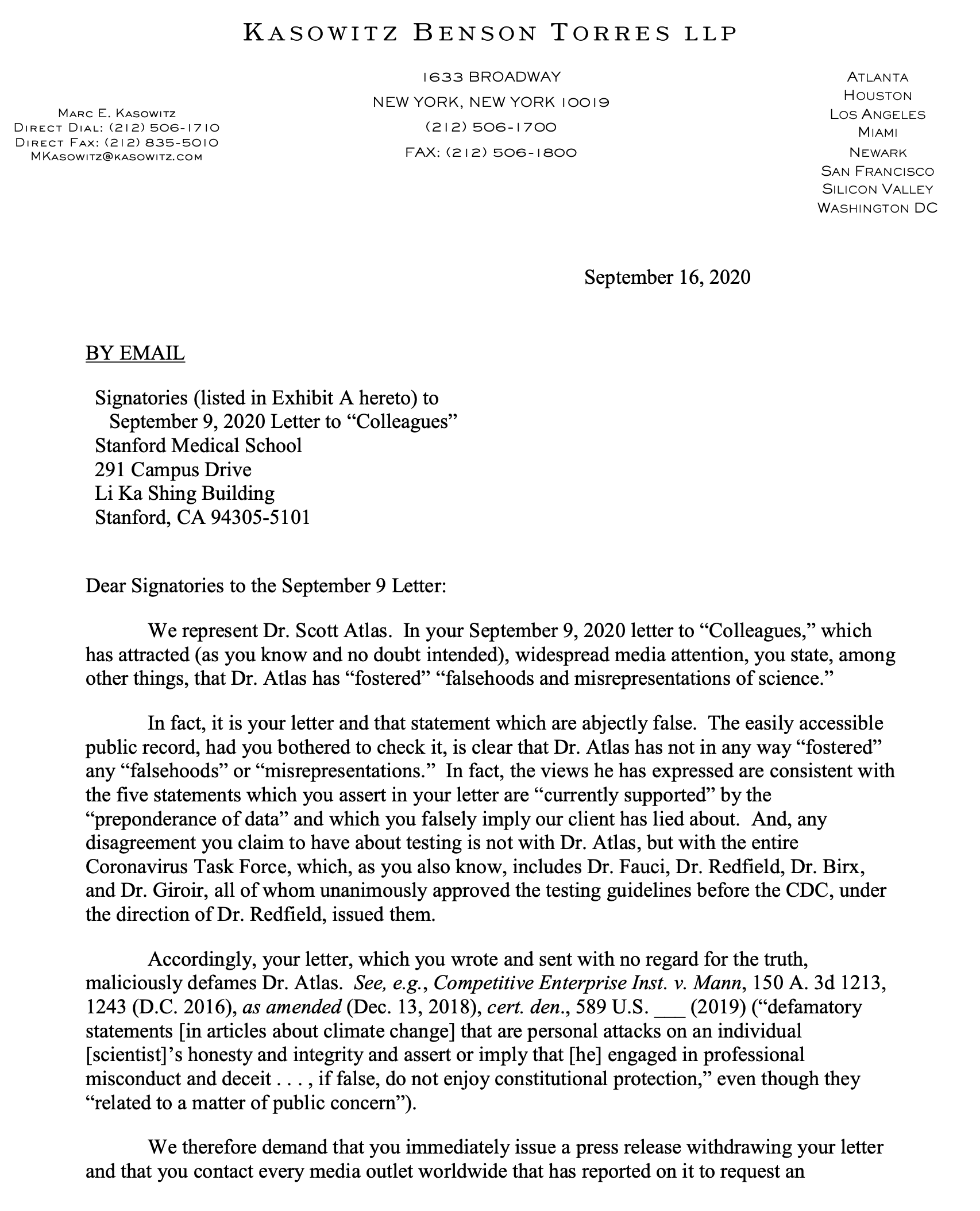
To prevent harm to the public’s health, we also have both a moral and an ethical responsibility to call attention to the falsehoods and misrepresentations of science recently fostered by Dr. Scott Atlas, a former Stanford Medical School colleague and current senior fellow at the Hoover Institute at Stanford University. Many of his opinions and statements run counter to established science and, by doing so, undermine public-health authorities and the credible science that guides effective public health policy. The preponderance of data, accrued from around the world, currently supports each of the following statements:
● The use of face masks, social distancing, handwashing and hygiene have been shown to substantially reduce the spread of Covid-19. Crowded indoor spaces are settings that significantly increase the risk of community spread of SARS-CoV-2. ● Transmission of SARS-CoV-2 frequently occurs from asymptomatic people, including children and young adults, to family members and others. Therefore, testing asymptomatic individuals, especially those with probable Covid-19 exposure is important to break the chain of ongoing transmission.
● Children of all ages can be infected with SARS-CoV-2. While infection is less common in children than in adults, serious short-term and long-term consequences of Covid-19 are increasingly described in children and young people.
● The pandemic will be controlled when a large proportion of a population has developed immunity (referred to as herd immunity) and that the safest path to herd immunity is through deployment of rigorously evaluated, effective vaccines that have been approved by regulatory agencies.
● In contrast, encouraging herd immunity through unchecked community transmission is not a safe public health strategy. In fact, this approach would do the opposite, causing a significant increase in preventable cases, suffering and deaths, especially among vulnerable populations, such as older individuals and essential workers.
Commitment to science-based decision-making is a fundamental obligation of public health policy. The rates of SARS-CoV-2 infection in the US, with consequent morbidity and mortality, are among the highest in the world. The policy response to this pandemic must reinforce the science, including that evidence-based prevention and the safe development, testing and delivery of efficacious therapies and preventive measures, including vaccines, represent the safest path forward. Failure to follow the science -- or deliberately misrepresenting the science – will lead to immense avoidable harm.
We believe that social and economic activity can reopen safely, if we follow policies that are consistent with science. In fact, the countries that have reopened businesses and schools safely are those that have implemented the science-based strategies outlined above.
As Stanford faculty with expertise in infectious diseases, epidemiology and health policy, our signatures support this statement with the hope that our voices affirm scientific, medical and public health approaches that promote the safety of our communities and nation.
SIGNED BY SEVENTY Faculty Members
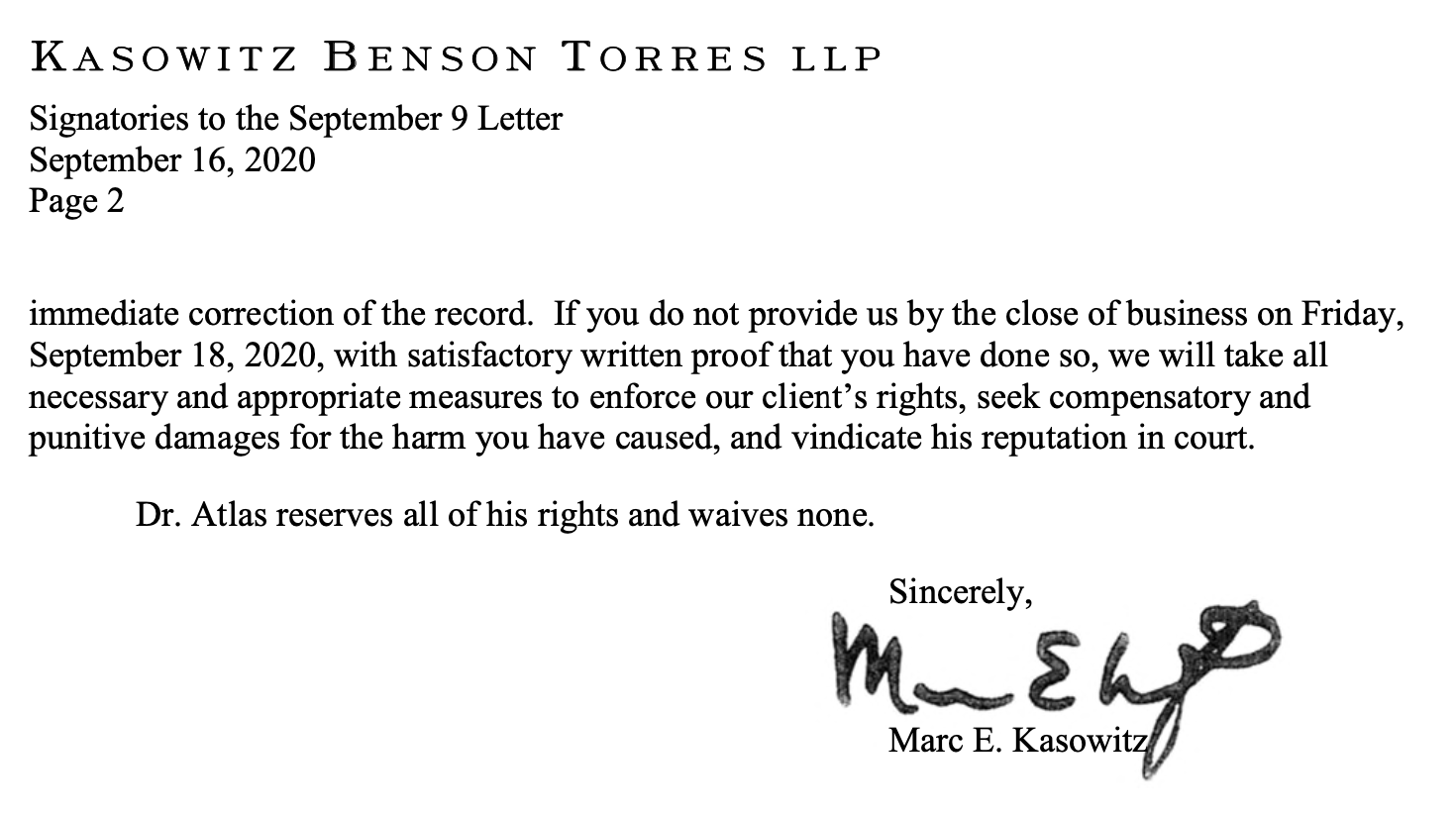
The signees received the following letter from Dr. Atlas’s attorney
The following is from: https://www.cnbc.com/2020/09/24/stanford-researchers-say-they-wont-be-silenced-after-criticizing-trumps-coronavirus-advisor-dr-scott-atlas.html
Following the legal threat, a larger group from Stanford University has now signed another letter stating that they will not be intimidated or silenced.
“We believe that his statements and the advice he has been giving fosters misunderstandings of established science and risks undermining critical public health efforts,” reads the letter, which was signed by 105 doctors, scientists, public health experts and faculty members.
“In addition, we are deeply troubled by the legal threats that Dr. Atlas has made against us in an attempt to intimidate and silence us in the midst of a pandemic.”
The group also sent their own letter defending their position from the firm Kaplan Hecker & Fink, which was addressed to Atlas’ legal team.
October 26: Johns Hopkins COVID-19 Report


COVID-19
Updates on the COVID-19 pandemic from the Johns Hopkins Center for Health Security.
Additional resources are available on our website.
The Johns Hopkins Center for Health Security also produces US Travel Industry and Retail Supply Chain Updates that provide a summary of major issues and events impacting the US travel industry and retail supply chain. You can access them here.
SYSTEMIC RACISM & COVID-19 The Johns Hopkins Center for Health Security’s journal, Health Security, issued a call for papers for an upcoming Special Feature on systemic racism in the context of the COVID-19 pandemic (scheduled for May/June 2021). The COVID-19 pandemic’s impacts on health, economies, and social structures have disproportionately impacted racially marginalized populations. Racial and ethnic minority communities are experiencing elevated COVID-19 morbidity and mortality, stemming in part from ineffective response efforts and longstanding barriers to accessing healthcare and public health programs and services. Evidence-based and peer-reviewed research is urgently needed to examine the root causes and impacts of systemic and pervasive racial and ethnic inequities in the context of COVID-19 as well as how systemic racism manifests in the practice of health security, including in preparedness for, response to, and recovery from COVID-19. The journal is actively encouraging submissions from women, underrepresented minority scholars in health security, and scholars with disabilities. Additional information is available here.
EPI UPDATE The WHO COVID-19 Dashboard reports 42.75 million cases and 1.15 million deaths as of 5:15am EDT on October 26. The WHO reported a new record high for global weekly incidence for the sixth consecutive week. The global total reached 2.85 million cases—an increase of more than 14% over the previous week. Additionally, the WHO reported 223,026 new cases on Monday.
Total Daily Incidence (change in average incidence; change in rank, if applicable)
1. USA: 68,795 new cases per day (+12,788; ↑ 1)
2. India: 51,383 (-10,007; ↓ 1)
3. France: 34,496 (+11,344)
4. Brazil: 22,683 (+2,631)
5. United Kingdom: 21,627 (+4,671)
6. Russia: 16,363 (+1,989)
7. Italy: 15,934 (+7,464; ↑ 2)
8. Spain: 15,653* (+3,441; ↑ 1)
9. Argentina: 14,415 (+776; ↓ 2)
10. Belgium: 12,199** (+2,017; new)
Per Capita Daily Incidence (change in average incidence; change in rank, if applicable)
1. Andorra: 1,222 daily cases per million population (-36)
2. Czech Republic: 1,123 (+366)
3. Belgium: 1,052 (+174; ↑ 2)
4. French Polynesia: 1,017 (+455 ; new)
5. Luxembourg: 811*** (+518 ; new)
6. Armenia: 680 (+283; ↓ 2)
7. Slovenia: 673 ( +366; ↑ 1)
8. France: 528 (+173; ↓ 1)
9. Liechtenstein: 528 (+206)
10. Netherlands: 522 (+74 ;↓ 6)
*Spain’s average daily incidence is not reported for today; these values correspond to the previous day’s averages.
**Belgium’s average daily incidence is not reported for today; these values correspond to the daily average two days ago.
***Liechtenstein is a member of the UN, but not the WHO. Liechtenstein’s COVID-19 data is reported by Switzerland.
This week, the US retook the number one global position for cumulative incidence and is reporting the highest number of global daily cases. The US, India, and Brazil remain significantly higher than any other country in terms of cumulative incidence with little signs of leveling off. While India’s daily cumulative incidence remains high, their daily incidence decreased by 16% compared to last week.
Belgium has moved into the top 10 countries for daily incidence this week, replacing the Czech Republic. Italy’s daily incidence grew the most this week, moving up to position 7 from position 9 last week. This growth represents an 88% increase over last week. In keeping with the past 3 weeks, France’s daily incidence has approximately doubled again at a 49% increase from last week. Argentina and Montenegro fell out of the top 10 in terms of per capita daily incidence, and they were replaced by French Polynesia and Luxembourg. Not only did these two countries enter the top 10 per capita daily incidence group, but they also jumped to #4 and #5 globally, respectively. French Polynesias’s daily incidence increased by 81% compared to the previous week, Luxembourg’s increased by 177%, and Slovenia’s increased by 119%. However, #1 position Andorra’s daily per capita incidence decreased by 3% this week compared to last week.
UNITED STATES
The US CDC reported 8.55 million total cases and 224,221 deaths. The daily COVID-19 incidence continues to increase, now up to 83,851 new cases per day, the highest since August 3. Last week, the US set a new record peak for new daily incidence with 85,329 cases on October 24. Following the expected dip in reporting over this past weekend, we will continue to track whether a new record peak will be set later this week.
The US COVID-19 mortality continues to hover around 900 deaths per day. Last week on October 22, daily new deaths reached 1,135, making it the worst day since September 24 when 1,104 deaths were recorded. It is still too early to determine if this is the beginning of a longer-term trend, but it is concerning that the mortality deviated to such a degree from a trend that persisted for nearly 3 weeks.
More than half of all US states have reported more than 100,000 cases, including 11 with more than 200,000 cases:
>800,000: California, Texas
>700,000: Florida
>400,000: New York
>200,000: Arizona, New Jersey, North Carolina, Tennessee, Wisconsin
The Johns Hopkins CSSE dashboard reported 8.64 million US cases and 225,247 deaths as of 10:24am EDT on October 26.
WHITE HOUSE INFECTIONS Marc Short, the US Vice President’s Chief of Staff, tested positive on Saturday. Four other aides have also tested positive, including political adviser Marty Obst and personal aide Zach Bauer. While Vice President Mike Pence and his wife have thus far tested negative on Saturday and Sunday. Devin O’Malley, a spokesperson for the Vice President, recently announced that the Vice President does not plan to quarantine and will continue campaigning as he is considered “essential personnel” - a reasoning typically only applicable to critical infrastructure workers who cannot work remotely, such as firefighters and police officers. These essential personnel may defer quarantine after exposure as long as they remain asymptomatic and additional precautions are put in place such as mask usage and social distancing. Health experts have condemned the Vice President’s decision to skip quarantine and continue attending in-person events - including his presence at a Sunday evening rally in North Carolina and his expected attendance at the Senate vote to confirm Judge Amy Coney Barrett to the Supreme Court today. Concerns have specifically been based on the Vice President’s past behavior of inconsistent mask wearing and from recorded increases in COVID-19 cases associated with campaign rallies.
US COUNTY HOTSPOTS A recent publication from CDC’s Morbidity and Mortality Weekly Report explored the potential association between social vulnerability and COVID-19. Authors compared COVID-19 incidence for counties to their score with the CDC’s 2018 Social Vulnerability Index - an index that scores counties on fifteen social factors, such as the prevalence of poverty or crowded housing, in order to identify vulnerable counties that may require additional assistance to respond to disasters or outbreaks. Findings noted that counties with crowded housing and a high proportion of racial and ethnic minority residents were significantly more likely to be identified as a COVID-19 hotspot; although, other social vulnerability factors also showed positive associations with likelihood to be identified as a COVID-19 hotspot. Authors recommended that leaders at the local, state and federal level take additional measures to address social vulnerability factors in the context of COVID-19 such as culturally sensitive risk communication messaging, provision of temporary housing, and other supportive measures for COVID-19 patients residing in crowded housing units.
EFFECTIVENESS OF CONTROL MEASURES A recently published article in Lancet Infectious Diseases has taken a look at potential associations between country-level reproduction numbers (R) and non-pharmaceutical interventions introduced and lifted throughout the course of the pandemic. For context, R is an epidemiological metric that calculates the average number of people infected by one infected individual; an R value of 1 or higher indicates sustained transmission leading to a growing outbreak while an R value under 1 indicates a shrinking outbreak. Findings from the modeling study noted decreases in R associated with school closures, business or office closures, public event bans, stay-at-home orders and other movement restrictions. However, public event bans were the only measure significantly associated with a reduction of R to a value of 1 or less.
Increases in R were associated with relaxing of the following measures: school closures, public event bans, bans on gatherings greater than ten people, stay-at-home orders and other movement restrictions. However, the only significant associations for increases in R above 1 were school reopening and lifting bans on gatherings over 10 people. Authors noted that the full effect of introducing or lifting non-pharmaceutical interventions took 1-3 weeks on average from the date of implementation. Authors made further recommendations regarding the use of non-pharmaceutical interventions by national governments, noting that other factors, such as population compliance, also influence the success of non-pharmaceutical interventions and may not be fully captured in the study.
SPAIN As of last night, Prime Minister Pedro Sánchez has announced that Spain has declared a national state of emergency and implemented an evening curfew in response to a new rise in COVID-19 cases in the country. The evening curfew will be in place from 11pm to 6am nightly. Businesses and other establishments open to the public will need to close by 9pm each night to meet curfew requirements. Other new measures to control the spread of COVID-19 include a ban on travel between regions and a limit on gatherings to six people. These new measures will remain in place for at least the next 15 days, but may be extended to six months if parliament allows. Local officials will have some flexibility on implementation of measures, but thus far reactions to the new measures have been positive with some localities seeking greater restrictions. Madrid has imposed a ban on mixing households for overnight stays. The Canary Islands, a tourist destination, have been excluded from the newly implemented measures.
CONVALESCENT PLASMA A study published last week in BMJ discussed the results of an open-label, Phase 2 PLACID trial of convalescent plasma in adults in India. In this multi-center, randomized control trial, 464 adult patients with moderate COVID-19 were separated into intervention and control groups and followed for 28 days post-enrollment. Despite general public hope for the use of convalescent plasma in treating COVID-19, this study found no evidence that convalescent plasma was associated with a reduction in disease severity or a reduction in all-cause mortality for their study population. This study is one of the first full RCTs for convalescent plasma rather than an observational study. While convalescent plasma transfusion appears to be a safe procedure, the actual benefits for COVID-19 patient recipients remains questionable. However, convalescent plasma transfusion is not without risks of its own; blood clotting is a potential risk of the procedure, and is particularly concerning among COVID-19 patients since blood clots are already a clinical manifestation of COVID-19. The authors of the study have called for more randomized control trials of convalescent plasma to further evaluate its efficacy in COVID-19 patients, even as its use has been authorized in many countries.
VACCINE TRIAL RESTART Two major vaccine trials, those of AstraZeneca and Johnson & Johnson, are positioned to restart after being paused over potential safety concerns. The AstraZeneca trial was paused on September 6th, but after independent monitoring of the adverse event several trial sites in other countries resumed later in September. The US FDA held off on restarting AstraZeneca trial sites in the US through October in order to further investigate the event with their own team. The Johnson & Johnson vaccine trial was paused on October 11 after a participant suffered a stroke. This adverse event was also independently reviewed and a final report was sent to the US FDA that recommends the vaccine trial continue. The Johnson & Johnson trial can start re-enrolling participants as early as next week. This vaccine is of particular interest to many since it is a one-dose vaccine which would greatly simplify the process of quickly inoculating millions of people. The AstraZeneca vaccine has already shown promising preliminary results and seems to produce an immunogenic response in elderly participants as well as in younger ones. It is important that any eventual vaccine can produce immunogenic responses in the eldery, in children, and in those with underlying conditions. The Pfizer vaccine has begun to enroll a cohort of children between the ages of 12-18 to test its efficacy in this age group. 16- and 17-year-old volunteers are the first to be enrolled in this study, with researchers soon looking to enroll their younger peers.
TOCILIZUMAB A recently published study in the New England Journal of Medicine assessed the efficacy of the drug tocilizumab, an interleukin-6 receptor blockade, in patients hospitalized with COVID-19 in a randomized, double-blind placebo-controlled trial. It was hypothesized that administration of this drug could potentially disrupt the cytokine storm associated with COVID-19. The study involved 243 patients, 45% of whom were Hispanic or Latino, and about half of participants had a BMI above 30 and hypertension. Additionally about 31% of the participants had known diabetes mellitus. Patients were randomized 2:1 to receive standard care and a simple dose of tocilizumab or placebo, and key outcomes assessed included receiving time to intubation or death. A total of 11.2% of patients were intubated within 28 days or had died prior to intubation. The proportion of patients who experienced these outcomes in the tocilizumab group was about 2% lower than in the control group, though these results were not statistically significant. The authors concluded that the study data do not provide sufficient evidence supporting early administration of tocilizumab as an effective treatment for moderately ill patients hospitalized with COVID-19. Given the wide confidence intervals, the authors stated they could not draw any conclusions about whether the drug exhibits benefits or harms for COVID-19 treatment, and acknowledged that their study yielded different results than open label trials and non-randomized case series that had shown more positive results for using the treatment.
POOLED TESTING A pre-print publication has recently reported on findings from a large-scale trial aimed at assessing the efficiency of using a pooled-testing strategy within an Israeli population from April to September 2020. The study analyzed 133,816 samples using 17,945 pools to determine how many tests could be spared compared to traditional testing approaches (efficiency), the diagnostic sensitivity, and the operational feasibility of implementing this approach. Despite fluctuating prevalence in the study population, the authors concluded that they spared 76% of potential PCR reactions compared to individual testing; however, the authors noted that there was an “acceptable” reduction in sensitivity. As the prevalence rate increased from 1% to 6% in the population, they switched from 8 sample pooling to 5 sample pooling, with about 9% of the 8 sample pools and 22% of the 5 sample pools testing positive. The sensitivity decreased by 3 cycle threshold levels (Cts), which the authors believed was a clinically acceptable and expected reduction as a result of pooling. The study, though not peer-reviewed, indicates the possibility for using pooled-testing strategies to use limited testing resources with greater efficiency without sacrificing on sensitivity of testing.
DOWN SYNDROME A new paper from the Annals of Internal Medicine aimed to assess the mortality risk of COVID-19 in individuals with Down syndrome. The study examined over 8 million individuals from the UK using a population-level primary care database, 4,053 of whom had Down syndrome. After adjusting for key demographic variables, the researchers estimated that individuals with Down Syndrome had a 4-fold increase of COVID-19 hospitalization and a 10-fold increase of death. The researchers emphasize that this estimated association between Down syndrome and COVID-19 is not a claim of a causal relationship, but argue that they warrant further investigation. Down syndrome is not currently listed as a COVID-19 risk factor within the United Kingdom or United States.
October 26: 4729 New COVID 19 Cases in Illinois
Boone County is reporting 87 new cases of COVID-19 Boone’s case count represents cases reported into our electronic reporting system from 12:01 a.m. on Saturday, October 24th through today, October 26th at 12:01 a.m. The Illinois Department of Public Health (IDPH) today reported 4,729 new confirmed cases of coronavirus disease (COVID-19) in Illinois, including 17 additional deaths.


Subscribe to:
Posts (Atom)