Michael Bloomberg
From Wikipedia, the free encyclopedia
Michael Bloomberg

108th Mayor of New York City
In office
January 1, 2002 – December 31, 2013
Deputy
Patricia Harris
Preceded by
Rudy Giuliani
Succeeded by
Bill de Blasio
Personal details
Born
Michael Rubens Bloomberg
February 14, 1942 (age 77)
Boston, Massachusetts, U.S.
Political party
Democratic (before 2001, 2018–present)
Other political
affiliations
Independent (2007–2018)
Republican (2001–2007)
Spouse(s)
Susan Brown-Meyer
(m. 1975; div. 1993)
Domestic partner
Diana Taylor (2000–present)
Children
2, including Georgina
Education
Johns Hopkins University (BS)
Harvard University (MBA)
Net worth
US$61.8 billion (January 2020)[1]
Signature
Bloomberg grew up in Medford, Massachusetts and attended Johns Hopkins University and Harvard Business School. He began his career at the securities brokerage Salomon Brothers, before forming his own company in 1981, Bloomberg L.P., a global financial services, software and mass media company that bears his name, and is known for its Bloomberg Terminal, a computer software system providing financial data widely used in the global financial services industry. He spent the next twenty years as its chairman and CEO. As of November 2019, this made him the ninth-richest person in the United States and the 14th-richest person in the world; his net worth was estimated at $58 billion.[3] Since signing The Giving Pledge whereby billionaires pledge to give away at least half of their wealth, Bloomberg has given away $8.2 billion.[4]
Bloomberg served as the 108th mayor of New York City, holding office for three consecutive terms beginning his first in 2002. A lifelong Democrat before seeking elective office, Bloomberg switched his party registration in 2001 to run for mayor as a Republican. He defeated opponent Mark J. Green in a close election held just weeks after the September 11 terrorist attacks. He won a second term in 2005 and left the Republican Party two years later. Bloomberg campaigned to change the city's term limits law and was elected to his third term in 2009 as an independent on the Republican ballot line. His final term as mayor ended on December 31, 2013. Bloomberg also served as chair of the board of trustees at his alma mater, Johns Hopkins University, from 1996 to 2002. After a brief stint as a full-time philanthropist, Bloomberg re-assumed the position of CEO at Bloomberg L.P. by the end of 2014.
Bloomberg officially launched his campaign for the Democratic Party's nomination in the 2020 presidential election on November 24, 2019, following weeks of speculation that he would join the race as a late entry.[5]
Early life and education
Bloomberg was born at St. Elizabeth's Hospital, in Brighton, a neighborhood of Boston, Massachusetts, on February 14, 1942, to William Henry Bloomberg (1906–1963), a bookkeeper for a dairy company,[6] and Charlotte (Rubens) Bloomberg (1909–2011).[7][8] The Bloomberg Center at the Harvard Business School was named in William Henry's honor.[9] His family is Jewish. He is a member of the Emanu-El Temple in Manhattan.[10] Bloomberg's paternal grandfather, Alexander "Elick" Bloomberg, was an immigrant from Russia.[2] Bloomberg's maternal grandfather, Max Rubens, was an immigrant from what is present-day Belarus.[11][12]
The family lived in Allston until Bloomberg was two years old, when they moved to Brookline, Massachusetts, for the next two years, finally settling in the Boston suburb of Medford, Massachusetts, where he lived until after he graduated from college.[13]
Bloomberg is an Eagle Scout.[14][15] Bloomberg graduated from Medford High School in 1960.[16]
Bloomberg attended Johns Hopkins University, where he joined the fraternity Phi Kappa Psi. In 1962, as a sophomore, he constructed the school mascot's (the blue jay's) costume.[17] He graduated in 1964 with a Bachelor of Science degree in electrical engineering. In 1966, he graduated from Harvard Business School with a Master of Business Administration.[18][19]
Business career

Michael Bloomberg in the 1980s with an early version of the Bloomberg Terminal
In 1973, Bloomberg became a general partner at Salomon Brothers, a large Wall Street investment bank, where he headed equity trading and, later, systems development. In 1981, Salomon Brothers was bought[20] by Phibro Corporation, and Bloomberg was laid off from the investment bank.[21] He was given no severance package, but owned $10 million worth of equity as a partner at the firm.[22]
Using this money, Bloomberg, having designed in-house computerized financial systems for Salomon, went on to set up a company named Innovative Market Systems (IMS). His business plan was based on the realization that Wall Street (and the financial community generally) was willing to pay for high-quality business information, delivered as quickly as possible and in as many usable forms possible, via technology (e.g., graphs of highly specific trends).[23]
Bloomberg, along with Thomas Secunda, Duncan MacMillan, and Charles Zegar, developed and built a computerized system to provide real-time market data, financial calculations and other financial analytics to Wall Street firms. The machines were first called "Market Master Terminals" and later on became known as "Bloomberg Terminals." In 1983, Merrill Lynch became the company's first customer, investing $30 million in IMS to help finance the development of "the Bloomberg" terminal computer system and by 1984, IMS was selling machines to all of Merrill Lynch's clients.
The company was renamed Bloomberg L.P. in 1987.[24] By 1990, it had installed 8,000 terminals.[25] Over the years, ancillary products including Bloomberg News, Bloomberg Radio, Bloomberg Message, and Bloomberg Tradebook were launched.[26]
During this time, colleagues published a pamphlet entitled Portable Bloomberg: The Wit and Wisdom of Michael Bloomberg. The work included off-color and misogynistic sayings that were attributed to him.[27][28]

A 2012 Bloomberg Terminal with a multi-monitor set-up composed of six screens
As of October 2015, the company had more than 325,000 terminal subscribers worldwide.[29] Subscriptions cost $24,000 per year, discounted to $20,000 for two or more.[30] As of 2019, Bloomberg employs 20,000 people in dozens of locations.[30] The company earned approximately $10 billion in 2018, loosely $3 billion more than Thomson Reuters, now Refinitiv, its nearest competitor.[30]
Employees reportedly bragged in the company's office about their sexual exploits.[28] The company was sued three times by female employees for sexual harassment, including one incident in which an employee said she was raped. In a deposition concerning the alleged rape, Bloomberg said that he would believe the charge only if it were supported by “an unimpeachable third-party” witness.[31][32]
When he left the position of CEO to pursue a political career as the mayor of New York City, Bloomberg was replaced as CEO by Lex Fenwick.[33] During Bloomberg's three mayoral terms, the company was led by president Daniel L. Doctoroff, a former deputy mayor under Bloomberg.[34] After completing his final term as the mayor of New York City, Bloomberg spent his first eight months out of office as a full-time philanthropist. In fall 2014, he announced that he would return to Bloomberg L.P. as CEO at the end of 2014,[35] succeeding Doctoroff, who had led the company since retiring from the Bloomberg administration in February 2008.[35][36][37] Bloomberg still owns the business but resigned as CEO of Bloomberg L.P. to run for president in 2019.[30]
Bloomberg is a member of Kappa Beta Phi.[38] He wrote an autobiography, with help from Bloomberg News Editor-in-Chief Matthew Winkler, called Bloomberg by Bloomberg.[39]
Wealth
In March 2009, Forbes reported Bloomberg's wealth at $16 billion, a gain of $4.5 billion over the previous year, the world's biggest increase in wealth in 2009.[40] At that time, there were only four fortunes in the U.S. that were larger (although the Walmart family fortune is split among four people). He had moved from 142nd to 17th in the Forbes list of the world's billionaires in only two years.[41][42] Subsequently, Forbes reported his wealth at $22 billion, then $31 billion, then $43.3 billion, and ranked him 11th, then 10th, then 6th richest in the U.S.[24][43][44] As of November 2019, Bloomberg was the 14th richest person in the world, with a net worth estimated at $58 billion.[3]
Political career
Mayor of New York City
Main article: Mayoralty of Michael Bloomberg

This section needs additional citations for verification. Please help improve this article by adding citations to reliable sources. Unsourced material may be challenged and removed.
Find sources: "Michael Bloomberg" – news · newspapers · books · scholar · JSTOR (December 2019) (Learn how and when to remove this template message)
_the_Honorable_Ray_Mabus_and_New_York_City_Mayor_Michael_Bloomberg_share_a_laugh_prior_to.jpg)
Secretary of the Navy Ray Mabus with Bloomberg
Bloomberg assumed office as the 108th Mayor of New York City on January 1, 2002. He won re-election in 2005 and again in 2009. As mayor, Bloomberg initially struggled with a low approval rating from the public; however, he subsequently developed and maintained high approval ratings.[45] His re-election meant the Republicans had won the previous four mayoral elections (although Bloomberg's decision to leave the Republican Party and be declared an independent on June 19, 2007, resulted in the Republican Party's losing the mayor's seat prior to the expiration of his second term). Bloomberg joined Rudy Giuliani and Fiorello La Guardia as re-elected Republican mayors in the mostly Democratic city.
Bloomberg stated that he wanted public education reform to be the legacy of his first term and addressing poverty to be the legacy of his second.[46] According to the National Assessment of Educational Performance, fourth-grade reading scores from 2002 to 2009 rose nationally by 11 points, but in May 2010, The New York Times reported that eighth-graders had shown no significant improvement in math or reading.
Bloomberg chose to apply a statistical, results-based approach to city management, appointing city commissioners based on their expertise and granting them wide autonomy in their decision-making. Breaking with 190 years of tradition, he implemented what New York Times political reporter Adam Nagourney called a "bullpen" open office plan, similar to a Wall Street trading floor, in which dozens of aides and managerial staff are seated together in a large chamber. The design is intended to promote accountability and accessibility.[47]
In efforts to create "cutbacks" in the New York City Spending Bracket, Bloomberg declined to receive a city salary. He accepted a remuneration of $1 annually for his services.[48]
Mayoral elections
2001 election
Main article: 2001 New York City mayoral election
In 2001, the incumbent mayor of New York City, Rudy Giuliani, was ineligible for re-election, as the city limited the mayoralty to two consecutive terms. Several well-known New York City politicians aspired to succeed him. Bloomberg, a lifelong member of the Democratic Party, decided to run for mayor as a member of the Republican Party ticket. Voting in the primary began on the morning of September 11, 2001. The primary was postponed later that day, due to the September 11 attacks. In the rescheduled primary, Bloomberg defeated Herman Badillo, a former Democratic congressman, to become the Republican nominee. Meanwhile, the Democratic primary did not produce a first-round winner. After a runoff, the Democratic nomination went to New York City Public Advocate Mark J. Green.
In the general election, Bloomberg received Giuliani's endorsement. He also had a huge spending advantage. Although New York City's campaign finance law restricts the amount of contributions that a candidate can accept, Bloomberg chose not to use public campaign funds and therefore his campaign was not subject to these restrictions. He spent $73 million of his own money on his campaign, outspending Green five to one.[49] One of the major themes of his campaign was that, with the city's economy suffering from the effects of the World Trade Center attacks, it needed a mayor with business experience.
In addition to serving as the Republican nominee, Bloomberg had the ballot line of the controversial Independence Party, in which "Social Therapy" leaders Fred Newman and Lenora Fulani exert strong influence. Some[who?] say that endorsement was important, as Bloomberg's votes on that line exceeded his margin of victory over Green. (Under New York's fusion rules, a candidate can run on more than one party's line and combine all the votes received on all lines. Green, the Democrat, had the ballot line of the Working Families Party). Bloomberg also created an independent line called Students First whose votes were combined with those on the Independence line. Another factor was the vote in Staten Island, which has traditionally been far friendlier to Republicans than the rest of the city. Bloomberg handily beat Green in that borough, taking 75 percent of the vote. Overall, Bloomberg won 50 percent to 48 percent.[citation needed]
Bloomberg's election marked the first time in New York City history that two different Republicans had been elected mayor consecutively. New York City has not been won by a Republican in a presidential election year since Calvin Coolidge won in 1924. Bloomberg is considered a social liberal, who is pro-choice, in favor of legalizing same-sex marriage and an advocate for stricter gun control laws.
Although 68 percent of New York City's registered voters are Democrats, Bloomberg decided the city should host the 2004 Republican National Convention. The convention drew thousands of protesters, many of them local residents angry over the Iraq war and other issues. The New York Police Department arrested approximately 1,800 protesters, but according to The New York Times, more than 90 percent of the cases were later dismissed or dropped for lack of evidence.[50]
2005 election
Main article: 2005 New York City mayoral election
Bloomberg was re-elected mayor in November 2005 by a margin of 20 percent, the widest margin ever for a Republican mayor of New York City.[51] He spent almost $78 million on his campaign, exceeding the record of $74 million he spent on the previous election. In late 2004 or early 2005, Bloomberg gave the Independence Party of New York $250,000 to fund a phone bank seeking to recruit volunteers for his re-election campaign.[52]
Former Bronx Borough President Fernando Ferrer won the Democratic nomination to oppose Bloomberg in the general election. Thomas Ognibene sought to run against Bloomberg in the Republican Party's primary election.[53] The Bloomberg campaign successfully challenged enough of the signatures Ognibene had submitted to the Board of Elections to prevent Ognibene from appearing on ballots for the Republican primary.[53] Instead, Ognibene ran on only the Conservative Party ticket.[54] Ognibene accused Bloomberg of betraying Republican Party ideals, a feeling echoed by others.[55][56][57][58]
Bloomberg opposed the confirmation of John Roberts as Chief Justice of the United States.[59] Though a Republican at the time, Bloomberg is a staunch supporter of abortion rights and did not believe that Roberts was committed to maintaining Roe v. Wade.[59] In addition to Republican support, Bloomberg obtained the endorsements of several prominent Democrats: former Democratic Mayor Ed Koch; former Democratic governor Hugh Carey; former Democratic City Council Speaker Peter Vallone, and his son, Councilman Peter Vallone Jr.; former Democratic Congressman Floyd Flake (who had previously endorsed Bloomberg in 2001), and Brooklyn Borough President Marty Markowitz.[60]
.jpg)
Bloomberg in 2007
2009 election
Main article: 2009 New York City mayoral election
On October 2, 2008, Bloomberg announced he would seek to extend the city's term limits law and run for a third mayoral term in 2009, arguing a leader of his field was needed following the financial crisis of 2007–08. "Handling this financial crisis while strengthening essential services ... is a challenge I want to take on," Bloomberg said at a news conference. "So should the City Council vote to amend term limits, I plan to ask New Yorkers to look at my record of independent leadership and then decide if I have earned another term."[61]
Ronald Lauder, who campaigned for New York City's term limits in 1993 and spent over 4 million dollars of his own money to limit the maximum years a mayor could serve to eight years,[62] sided with Bloomberg in running for a third term and agreed to stay out of future legality issues.[63] In exchange, he was promised a seat on an influential city board by Bloomberg.[64]
Some people and organizations objected and NYPIRG filed a complaint with the City Conflict of Interest Board.[65] On October 23, 2008, the City Council voted 29–22 in favor of extending the term limit to three consecutive four-year terms, thus allowing Bloomberg to run for office again.[66] After two days of public hearings, Bloomberg signed the bill into law on November 3.[67]
Bloomberg's bid for a third term generated some controversy. Civil libertarians such as former New York Civil Liberties Union Director Norman Siegel and New York Civil Rights Coalition Executive Director Michael Meyers joined with local politicians such as New York State Senator Eric Adams to protest the term-limits extension.[68]
Bloomberg's opponent was Democratic and Working Families Party nominee Bill Thompson, who had been New York City Comptroller for the past eight years and before that, president of the New York City Board of Education.[69] Bloomberg defeated Thompson by a vote of 51% to 46%.[70]
After the release of Independence Party campaign filings in January 2010, it was reported that Bloomberg had made two $600,000 contributions from his personal account to the Independence Party on October 30 and November 2, 2009.[71] The Independence Party then paid $750,000 of that money to Republican Party political operative John Haggerty Jr.[72]
This prompted an investigation beginning in February 2010 by the office of New York County District Attorney Cyrus Vance Jr. into possible improprieties.[73] The Independence Party later questioned how Haggerty spent the money, which was to go to poll-watchers.[74] Former New York State Senator Martin Connor contended that because the Bloomberg donations were made to an Independence Party housekeeping account rather than to an account meant for current campaigns, this was a violation of campaign finance laws.[75] Haggerty also spent money from a separate $200,000 donation from Bloomberg on office space.[76]
2020 presidential election campaign
Main article: Michael Bloomberg 2020 presidential campaign
On March 5, 2019, Bloomberg had announced that he would not run for president in 2020; instead he encouraged the Democratic Party to "nominate a Democrat who will be in the strongest position to defeat Donald Trump."[77] However, due to his dissatisfaction with the Democratic field, Bloomberg reconsidered. He officially launched his campaign for the 2020 Democratic nomination on November 24, 2019.[78]
Bloomberg is financing his campaign personally and has said he won't accept donations.[79] As of December 31, 2019 - five weeks after declaring his candidacy - he had spent or committed $200 million, mostly on television advertising, producing "an onslaught of campaign commercials with no precedent in Democratic politics".[80] As of 12 February 2020, Bloomberg was polling at 13-14% nationally.[81][82]
Political positions
Bloomberg has been a registered Democrat for most of his life. He is regarded as socially liberal or progressive on multiple issues, supporting abortion rights, same-sex marriage, strict gun control measures, environmentalism and a pathway to citizenship for illegal immigrants. On economics and foreign policy issues, Bloomberg has tended towards a moderate stance. He opposed a timeline for withdrawal from the Iraq War, and criticized those who favored one. Economically, he supports government involvement in issues such as public welfare while being strongly in favor of free trade and being pro-business, describing himself as a fiscal conservative because he balanced New York City's budget.[83] He is concerned about climate change and has touted his mayoral efforts to reduce greenhouse gases.[84] Bloomberg has been criticized for not allowing many emergency officials who responded to the September 11, 2001, attacks to attend the tenth anniversary observation of that day.[85] He was also at odds with many around the U.S. for not inviting any clergy to the ceremony marking the anniversary of the 9/11 attacks.[86]
Social issues
Bloomberg supports abortion rights, stating, "Reproductive choice is a fundamental human right and we can never take it for granted. On this issue, you're either with us or against us." He has criticized "pro-choice" politicians who support "pro-life" candidates.[87]
Bloomberg supports governmental funding for embryonic stem cell research, calling the Republican position on the issue "insanity".[88] He supports same-sex marriage with the rationale that "government shouldn't tell you whom to marry."[89]
Bloomberg supports the strict drug laws of New York City. He has stated that he smoked marijuana in the past, and was quoted in a 2001 interview as saying "You bet I did. I enjoyed it." This led to a reported $500,000 advertising campaign by NORML, featuring his image and the quote. Bloomberg stated in a 2002 interview that he regretted the remark and did not believe that marijuana should be decriminalized.[90] In 2012, Bloomberg backed an effort by Governor Andrew Cuomo to decriminalize the possession of small amounts of marijuana.[91] In January 2019, Bloomberg said “Last year, in 2017, 72,000 Americans OD’d [overdosed] on drugs. In 2018, more people than that are OD-ing on drugs, have OD’d on drugs, and today, incidentally, we are trying to legalize another addictive narcotic, which is perhaps the stupidest thing anybody has ever done."[92][93] In December 2019, Bloomberg came out in favor of marijuana decriminalization and allowing states to legalize it without federal intervention.[94]
Crime and punishment
In April 2006, along with Boston mayor Thomas Menino, Bloomberg co-founded Mayors Against Illegal Guns.[95][96] A December 2013 press release by the group said the bipartisan coalition included over 1,000 mayors.[95] In 2014, the organization merged with Moms Demand Action For Gun Sense in America to form Everytown for Gun Safety,[97] which in 2018 in collaboration with student groups organized the March For Our Lives.[98] When asked in an April 2014 interview why he was devoting so many of his personal resources to supporting gun control, restrictive food choice and smoking cessation, his concern was about his mortality, replying "I am telling you if there is a God, when I get to heaven I’m not stopping to be interviewed. I am heading straight in. I have earned my place in heaven. It’s not even close.”[99]
As mayor, Bloomberg increased the mandatory minimum sentence for illegal possession of a loaded handgun, saying, "Illegal guns don't belong on our streets and we're sending that message loud and clear. We're determined to see that gun dealers who break the law are held accountable, and that criminals who carry illegal loaded guns serve serious time behind bars."[100] He opposes the death penalty, saying he would "rather lock somebody up and throw away the key and put them in hard labor".[100] He has called the death penalty "murder by the state".[101]
Bloomberg was a staunch proponent of stop-and-frisk in New York City and has argued that it lowered the murder rate.[102] The manner in which the NYPD utilized the practice was ruled unconstitutional in 2013, but the practice itself was not deemed unconstitutional.[103][104] There is no evidence that the practice reduced the crime rate.[105] In June 2013, Bloomberg pushed back against accusations that the stop-and-frisk practice disproportionately targeted minorities. Bloomberg argued that the demographic data of police stops should be assessed based on suspects' descriptions and not the population as a whole, saying, "it’s not a disproportionate percentage of those who witnesses and victims describe as committing the [crime]. In that case, incidentally, I think we disproportionately stop whites too much and minorities too little."[106]
In 2015, Bloomberg defended New York City's stop-and-frisk practices, saying:
Ninety-five percent of murders- murderers and murder victims fit one M.O. You can just take the description, Xerox it, and pass it out to all the cops. They are male, minorities, 16-25. That’s true in New York, that’s true in virtually every city (inaudible). And that’s where the real crime is. You’ve got to get the guns out of the hands of people that are getting killed. So you want to spend the money on a lot of cops in the streets. Put those cops where the crime is, which means in minority neighborhoods.
So one of the unintended consequences is people say, ‘Oh my God, you are arresting kids for marijuana that are all minorities.’ Yes, that’s true. Why? Because we put all the cops in minority neighborhoods. Yes, that’s true. Why do we do it? Because that’s where all the crime is. And the way you get the guns out of the kids’ hands is to throw them up against the wall and frisk them… And then they start… ‘Oh I don’t want to get caught.’ So they don’t bring the gun. They still have a gun, but they leave it at home.
— Michael Bloomberg, speech to the Aspen Institute, February 2015[107][108]
However, in 2018, Bloomberg walked back his stance on stop-and-frisk, saying, "The history of the decline in police stops is misunderstood. As crime hit historic lows, and more than a year before any court ruling, I pledged to a Sunday congregation in Brooklyn and to all New Yorkers that 'we must and will do better' by reforming police practices while continuing to drive down crime. And that's exactly what we did, on our own accord. We cut police stops by 94 percent, while continuing to reduce crime and incarceration."[109] On November 17, 2019, while speaking in Brooklyn's non-denominational Christian Cultural Center, Bloomberg renounced his previous support for stop-and-frisk and issued an apology.[110][111] New York Mayor Bill de Blasio responded to Bloomberg's apology by stating "This is LONG overdue and the timing is transparent and cynical."[112] Police Benevolent Association President Patrick Lynch also criticized Bloomberg's apology, noting in a statement that, "We said in the early 2000s that the quota-driven emphasis on street stops was polluting the relationship between cops and our communities,” and that the "[Bloomberg] administration’s misguided policy inspired an anti-police movement that has made cops the target of hatred and violence, and stripped away many of the tools we had used to keep New Yorkers safe.”[113]
In February 2020, comments defending stop-and-frisk made by Bloomberg in 2015 resurfaced and drew criticism.[114][115][116][117]
Education
Bloomberg replaced New York City's school board set up by the state of New York with a setup providing direct mayoral control over public education.[118][119] This was criticized by some, such as former U.S. Assistant Secretary of Education Diane Ravitch who has argued that mayoral control led to further privatization of education.[120] Bloomberg states that he raised the salaries of teachers by fifteen percent while boosting test scores and graduation rates.[121][122] Some, such as the United Federation of Teachers, dispute these claims, criticizing Bloomberg for including things that do not show up on a paycheck, such as increased spending on teachers' pensions and healthcare, which they say inflate the amount teachers' salaries were raised; they also accuse him of exaggerating the boost in graduation rates and the role his administration played in it, pointing out that New York City's graduation rates still far lagged behind the rest of New York State.[123][124][125]
Bloomberg opposes social promotion, stating that students should be promoted only when they are adequately prepared for the next grade level. Some educators disagree, however, arguing that leaving children behind stigmatizes them as failures, only to face failure again as they repeat the grade.[126] He favors after-school programs to help students who are behind. As mayor, Bloomberg strengthened the cellphone ban in schools.[127] In Los Angeles, Bloomberg waded into the controversy over the proliferation of charter schools, donating over $1 million to elect pro-charter school board candidates opposed by United Teachers of Los Angeles (UTLA).[128]
Environment
During his second term as the mayor of New York City, Bloomberg unveiled PlaNYC: A Greener, Greater New York on April 22, 2007, to fight global warming, protect the environment and prepare for the projected 1 million additional people expected to be living in the city by the year 2030.[129]
Under PlaNYC, in just six years New York City reduced citywide greenhouse gas emissions by 19% since 2005 and was on track to achieve a 30% reduction ahead of the PlaNYC 2030 goal.[130] In October 2007, as part of PlaNYC, Bloomberg launched the Million Trees NYC initiative, which aimed to plant and care for one million trees throughout the city in the next decade. In November 2015, New York City planted its one millionth tree, two years ahead of the original 10-year schedule.[131]
In 2008, Bloomberg convened the New York City Panel on Climate Change (NPCC), an effort to prepare the city for climate change.[132] In 2012, Travel + Leisure readers voted New York City the "Dirtiest American City," for having the most extant litter.[133] Bloomberg has been involved in motivating other cities to make changes and has spoken about reducing carbon dioxide emissions, using cleaner and more efficient fuels, using congestion pricing in New York City, and encouraging public transportation.[134]
Bloomberg unveiled the Special Initiative for Rebuilding and Resiliency (SIRR) in June 2013, after the city was affected by Hurricane Sandy in October 2012. The $20 billion initiative laid out extensive plans to protect New York City against future impacts of climate change.[135] On September 26, 2013, Bloomberg announced that his administration's air pollution reduction efforts had resulted in the best air quality in New York City in more than 50 years.[136] The majority of the air quality improvement was attributed to the phasing out of heavy polluting heating oils through New York's "Clean Heat" program.[137] As a result of the improved air quality, the average life expectancy of New Yorkers had increased three years during Bloomberg's tenure, compared to 1.8 years in the rest of the country.[138]
By 2017, Bloomberg donated 100 million dollars to the campaign Beyond Coal, that helped close over half of the US coal power stations, since 2011 when it was expanded due to his financial help. In 2017 he donated 64 million dollars more, the day after EPA head Scott Pruitt began to abolish President Barack Obama's Clean Power Plan.[139]
In 2019, Bloomberg, with the Sierra Club and other organizations, launched "Beyond Carbon," an initiative to complete the USA's transition to non-fossil energy sources.[140]
Bloomberg and former California Governor Jerry Brown launched and are leading America's Pledge, a coalition of cities, businesses, states and more in the US to reduce greenhouse gas emissions.[141][142] The organization covers 68% of the GDP and 65% of the population of the United States. In COP25 it presented a report named "ACCELERATING AMERICA’S PLEDGE," in which it stated that already existing commitments can cut USA greenhouse gas emissions by 19% by 2025 and by 25% by 2030. Accelerating local action can lower emissions by 37% by the year 2030, and if federal support will be adjusted, by 49% by the same year relative to the level of the year 2005.[143][144]
Illegal immigration and border security
Bloomberg has criticized those who advocate for mass deportation of illegal immigrants, calling their stance unrealistic, "We're not going to deport 12 million people, so let's stop this fiction. Let's give them permanent status."[145] He supports a federal ID database that uses DNA and fingerprint technology to keep track of all citizens and to verify their legal status.[146] Bloomberg has held that illegal immigrants should be offered legalization and supported the congressional efforts of John McCain and Ted Kennedy in their attempt at immigration reform in 2007.[147]
Regarding border security, he compared it to the tide, stating, "It's as if we expect border control agents to do what a century of communism could not: defeat the natural market forces of supply and demand ... and defeat the natural human desire for freedom and opportunity. You might as well as sit in your beach chair and tell the tide not to come in. As long as America remains a nation dedicated to the proposition that 'all Men are created equal, endowed by their Creator with certain unalienable Rights, that among these are Life, Liberty and the pursuit of Happiness', people from near and far will continue to seek entry into our country."[148]
In 2006, Bloomberg stated on his weekly WABC radio show that illegal immigration does not strain the financial resources of New York City, since many immigrants are hard working and "do not avail themselves of services until their situation is dire."[149][citation needed]
Health regulations
In January 2011, city schools began a pilot program which allows girls over 14 years old to be provided with Plan B emergency contraception without parental consent, unless parents opt out in writing. Beginning with five schools, the pilot had been expanded to thirteen schools by September 2012.[150][151]
On December 5, 2006, New York City under Bloomberg became the first city in the United States to ban trans fat from all restaurants. This went into effect in July 2008.[152]
In September 2012, the city passed a law limiting the practice of circumcision among Orthodox Jews. The legislation requires that at each event, the mohel receives signed consent forms from the parents, acknowledging that they were notified of health risks associated with cleaning the wound by sucking blood from the male baby's organ. This regulation caused an outcry among certain Orthodox Jewish communities on this alleged infringement of their religious freedom,[153][154] and the matter was taken to federal court.[155]
During the same month, the NYC Board of Health approved Bloomberg's proposal to ban the sale of many sweetened drinks more than 16 ounces (473ml) in volume. The limit would have applied to businesses such as restaurants and movie theaters, but did not apply to grocery stores, including 7-Eleven. Diet varieties of sweetened drinks were unaffected.[156]
On March 12, 2013, hours before the ban was scheduled to take effect, State Supreme Court Justice Milton Tingling struck it down, ruling that the Board of Health lacked the jurisdiction to enforce it and that the rule was "arbitrary and capricious". The city appealed the decision.[157] On July 30, the Appellate Division upheld the lower court's ruling, stating the Board of Health "failed to act within the bounds of its lawfully delegated authority" and the ban was a violation of the separation of powers doctrine, which reserves legislative power to the legislature and does not allow the board to "exercise sweeping power to create whatever rule they deem necessary". Bloomberg announced that the city would appeal the decision.[158]
Bloomberg has been criticized for some of his policies which have been described by many as facilitating the creation of a nanny state.[159] Comedian Bill Maher, while on Jimmy Kimmel Live, said that Bloomberg's soda ban "gives liberals a bad name".[160] In response to the soda ban, The Center for Consumer Freedom ran a full-page ad in The New York Times featuring an image of Bloomberg's face superimposed on an elderly female body wearing a dress and scarf, with the title "The Nanny", and the tagline "New Yorkers Need a Mayor, Not a Nanny."[161] Others have pointed out that the smoking rate dropped quickly during Bloomberg's time in office (which has involved the banning of smoking in certain areas).[159]
Criticism of Bloomberg's attempt to ban the sale of large soft drinks was picked up, mostly by Republican and libertarian commentators and politicians, as a line of attack in political campaigns around the United States. In one example, Virginia Attorney General Ken Cuccinelli and Kentucky Senator Rand Paul brought Big Gulps to a joint appearance for Cuccinelli's ultimately unsuccessful 2013 gubernatorial campaign to symbolize Bloomberg's efforts to restrict soft drink sales, criticizing the mayor for wanting "to buy the governor's office down here", a reference to pro-gun control advertisements his political action committee was running in the state.[162] Republican legislators in Wisconsin reacted to the ban by inserting language to prohibit communities from restricting the sale of large soft drinks throughout the state in a 2013 budget bill.[163]
Response to 9/11
Bloomberg believes that the September 11, 2001 attacks were not intended to be solitary events. When he assumed office, he set up a Counterterrorism Bureau which works along with the NYPD intelligence division to gather information about worldwide terrorism affecting New York City.[164] He believes that funding for Homeland Security by the federal government should be distributed by risk, where cities that are considered to have the highest threat for a terrorist attack would get the most money.[165] Bloomberg is also a supporter of the USA PATRIOT Act.[166]
After the April 15, 2013, Boston Marathon bombings, Bloomberg said that laws and the interpretation of the Constitution have to change to provide greater security against such attacks, "the people who are worried about privacy have a legitimate worry, but we live in a complex world where you're going to have a level of security greater than you did back in the olden days, if you will ... our laws and our interpretation of the Constitution, I think, have to change."[167]
Economic issues
Bloomberg characterizes himself as a fiscal conservative for turning the city's $6 billion deficit into a $3 billion surplus; however, conservative PAC Club for Growth has criticized him because he increased property taxes and spending while doing so.
Being a fiscal conservative is not about slashing programs that help the poor, or improve health care, or ensure a social safety net. It's about insisting services are provided efficiently, get to only the people that need them, and achieve the desired results. Fiscal conservatives have hearts too – but we also insist on using our brains, and that means demanding results and holding government accountable for producing them.
To me, fiscal conservatism means balancing budgets – not running deficits that the next generation can't afford. It means improving the efficiency of delivering services by finding innovative ways to do more with less. It means cutting taxes when possible and prudent to do so, raising them overall only when necessary to balance the budget, and only in combination with spending cuts. It means when you run a surplus, you save it; you don't squander it. And most importantly, being a fiscal conservative means preparing for the inevitable economic downturns – and by all indications, we've got one coming.
— Michael Bloomberg, speech at Conservative Party Conference (UK), September 30, 2007[83]
Bloomberg has expressed a distaste for taxes, stating, "Taxes are not good things, but if you want services, somebody's got to pay for them, so they're a necessary evil."[168] As mayor, he did raise property taxes to fund budget projects; however, in January 2007, he proposed cuts in property taxes by five percent and cuts in sales taxes, including the elimination of taxes on clothing and footwear. Bloomberg pointed to the Wall Street profits and the real estate market as evidence that the city's economy is booming and could handle a tax break.[169]
Bloomberg's self-described fiscal conservatism also led him to eliminate the existing $6 billion deficit when he assumed office. Bloomberg balanced the budget of New York City by raising property taxes and making cuts to city agencies.[170]
Bloomberg is in favor of providing tax breaks to big corporations for the good of the whole community. As mayor, Bloomberg lobbied the CEO of Goldman Sachs to establish its headquarters across from Ground Zero by promising $1.65 billion in tax breaks. Regarding this deal, Bloomberg stated, "This [New York City] is where the best want to live and work. So I told him [CEO of Goldman Sachs], 'We can help with minimizing taxes. Minimizing your rent. Improving security. But in the end, this is about people.'"[171]
Bloomberg had less cordial relations with unions as mayor. In 2002, when New York City's transit workers threatened to strike, Bloomberg responded by riding a mountain bike through the city to show how the city could deal with the transit strike by finding alternate means of transportation and not pandering to the unions.[172] Three years later, a clash over wages and union benefits led to a three-day strike. Negotiations led to the end of the strike in December 2005.[173]
Bloomberg is a staunch advocate of free trade and is strongly opposed to protectionism, stating, "The things that we have to worry about is this protectionist movement that has reared its head again in this country. ... " He worries about the growth of China and fears the lessening gap between the United States and other countries, "The rest of the world is catching up, and, there are people that say, surpassing us. I hope they are wrong. I hope those who think we are still in good shape are right. But nevertheless, the time to address these issues is right now."[174]
Bloomberg has placed a strong emphasis on public health and welfare, adopting many liberal policies. As the mayor he made HIV, diabetes, and hypertension all top priorities. He extended the city's smoking ban to all commercial establishments and implemented a trans fat ban in restaurants.[175] Bloomberg has been a strong supporter of the New York City Health and Hospitals Corporation – the largest urban healthcare agency in the United States – serving over 1.3 million New Yorkers, and has touted its use of information technology and Electronic Health Records to increase efficiency and enhance patient care.[176] He launched a program called Opportunity NYC, the nation's first-ever conditional cash transfer pilot program, designed to help New Yorkers break the cycle of poverty in the city. He instituted a $7.5 billion municipal affordable housing plan, the largest in the nation, that is supposed to provide 500,000 New Yorkers with housing.[177]
Bloomberg has expressed concern about poverty and growing class divisions, stating, "This society cannot go forward, the way we have been going forward, where the gap between the rich and the poor keeps growing."[174]
Foreign policy
As mayor, Bloomberg made trips to Mexico, the United Kingdom, Ireland, and Israel in the first four months of 2007.[178] In late 2007 he conducted an Asia trip that brought him to China, where he called for greater freedom of information to promote innovation. He attended the United Nations Climate Conference in Bali.
Initially, Bloomberg strongly supported the war in Iraq and the rationale for going in. He stated, "Don't forget that the war started not very many blocks from here,"[179] alluding to Ground Zero. In regard to the global War on Terrorism including Iraq he said, "It's not only to protect Americans. It's America's responsibility to protect people around the world who want to be free." During the 2004 presidential election campaign, New York City hosted the Republican National Convention at which Bloomberg endorsed President George W. Bush for President of the United States.[180]
His enthusiasm seemed to have lessened somewhat over the course of the war. In August 2005, he said, "I think everybody has very mixed emotions about the war that was started to find weapons of mass destruction and then they were not found."[181] Bloomberg expressed criticism of Democrats in Congress who wanted to set a timetable for withdrawal from Iraq, calling them "irresponsible".[182]
In September 2019, Bloomberg said that the Communist Party of China "listens to the public" on pollution and stated Xi Jinping is not a dictator because he has to "satisfy his constituents, or he's not going to survive..." Bloomberg argued governments, even non-democratic governments, are not able to operate without the will of the majority of their people, so he predicted China will take further action to combat climate change.[183] In January 2020, Bloomberg came out in favor of sanctions on Chinese officials for "human rights violations in both Hong Kong and Xinjiang."[184]
Preservation and development issues
.jpg)
Bloomberg delivering a speech in 2004
Bloomberg is a proponent of large-scale development. He has repeatedly supported projects such as the Pacific Park mega-development, the Hudson Yards Redevelopment and associated rail-yard development (even supporting a subway extension to Hudson Yards), and the Harlem rezoning proposal.[185] On smaller-scale issues, Bloomberg usually takes the side of development as well. He favors the demolition of Admiral's Row[186] to build a supermarket parking lot. However, Bloomberg has occasionally sided with preservation, most notably in vetoing landmark revocation for the Austin Nichols warehouse.[187] This move was widely applauded by architectural historians. The City Council overruled the veto shortly thereafter, however.[188]
2013 election endorsements
Main article: 2013 New York City mayoral election
On September 13, 2013, Bloomberg announced that he would not endorse any of the candidates to succeed him.[189][190] On his radio show, he stated, "I don't want to do anything that complicates it for the next mayor. And that's one of the reasons I've decided I'm just not going to make an endorsement in the race." He added, "I want to make sure that person is ready to succeed, to take what we've done and build on that."[191]
Prior to the announcement in an interview in New York magazine, Bloomberg praised The New York Times for its endorsement of Christine Quinn and Joe Lhota as their favorite, respective, candidates in the Democratic and Republican primaries.[192][193] Quinn came in third in the Democratic primary and Lhota won the Republican primary.
Earlier in the month, Bloomberg was chastised in the press for his remarks regarding Democratic mayoral candidate Bill de Blasio's campaign methods.[194] Bloomberg said initially in a New York magazine interview that he considered de Blasio's campaign "racist," and when asked about his comment, Bloomberg explained what he meant by his remark.[195]
Well, no, no, I mean he's making an appeal using his family to gain support. I think it's pretty obvious to anyone watching what he's been doing. I do not think he himself is racist. It's comparable to me pointing out I'm Jewish in attracting the Jewish vote. You tailor messages to your audiences and address issues you think your audience cares about.[195]
On January 1, 2014, de Blasio became New York City's new mayor, succeeding Bloomberg.[196]
2018 elections and re-registration as Democrat
In June 2018, Bloomberg made plans to give $80 million to support Democratic congressional candidates in the 2018 election, with the goal of flipping control of the Republican-controlled House to Democrats. In a statement, Bloomberg said that Republican House leadership were "absolutely feckless" and had failed to govern responsibly. Bloomberg advisor Howard Wolfson was chosen to lead the effort, which was to target mainly suburban districts.[197] By early October, Bloomberg had committed more than $100 million to returning the House and Senate to Democratic power, fueling speculation about a presidential run in 2020.[198] On October 10, 2018, Bloomberg announced that he had changed his political party affiliation to Democrat, which he had previously been registered as prior to 2001.[199]
Campaign speculation beyond New York City before 2019
Bloomberg was frequently mentioned as a possible centrist candidate for the presidential elections in 2008 and 2012, as well as for governor of New York in 2010. He declined to seek either office, opting to continue serving as the mayor of New York City.
There was widespread speculation that he would run as a third-party candidate in the 2016 presidential election, though he chose not to, later endorsing Democratic nominee Hillary Clinton for president. In October 2018, Bloomberg changed his political party affiliation back to the Democrats.[200]
2008 presidential campaign speculation
See also: Draft Bloomberg movement
On February 27, 2008, Bloomberg announced that he would not run for president in 2008, and that he would endorse a candidate who took an independent and non-partisan approach.[201] He had also stated unequivocally, live on Dick Clark's New Year's Rockin' Eve, on December 31, 2007, that he was not going to run for president in 2008.[202] Despite prior public statements by Bloomberg denying plans for a presidential run,[203] many pundits believed Bloomberg would announce a campaign at a later date. On January 7, 2008, he met at the University of Oklahoma with a bipartisan group, including (now former) Nebraska Senator Chuck Hagel and former Georgia Senator Sam Nunn, both of whom had been frequently mentioned as possible running mates, to pressure the major-party candidates to promote national unity and reduce partisan gridlock. Speculation that Bloomberg would choose this forum to announce his candidacy proved to be unfounded.[204][205]
In summer 2006, he met with Al From of the Democratic Leadership Council, a centrist group, to talk about the logistics of a possible run.[206] After a conversation with Bloomberg, Republican Senator Chuck Hagel of Nebraska suggested that he and Bloomberg could run on a shared independent ticket for the presidency.[207]
On This Week on June 10, 2007, anchor George Stephanopoulos included panelist Jay Carney, who mentioned a conversation between Bloomberg and top staffers where he heard Bloomberg ask approximately how much a presidential campaign would cost. Carney said that one staffer replied, "Around $500 million." According to a Washington Post article, a $500-million budget would allow Bloomberg to circumvent many of the common obstacles faced by third-party presidential candidates.[208] On June 19, 2007, Bloomberg left the Republican Party, filing as an independent after a speech criticizing the current political climate in Washington.[209][210]
On August 9, 2007, in an interview with former CBS News anchor Dan Rather that aired on August 21, Bloomberg categorically stated that he was not running for president, that he would not be running, and that there were no circumstances in which he would, saying, "If somebody asks me where I stand, I tell them. And that's not a way to get elected, generally. Nobody's going to elect me president of the United States. What I'd like to do is to be able to influence the dialogue. I'm a citizen."[211]
Despite continued denials, a possible Bloomberg candidacy continued to be the subject of media attention, including a November Newsweek cover story.[212] During a private reception in December 2007, Bloomberg conducted a version of bingo in which guests were to guess the meaning of the numbers on a printed card. When Bloomberg asked the significance of 271, one guest answered correctly: the number of electoral votes received by George W. Bush in 2000.[213] In January 2008, CNN reported that a source close to Bloomberg said that the mayor had launched a research effort to assess his chances of winning a potential presidential bid. According to the report, the unidentified source also stated that Bloomberg had set early March as a timetable for making a decision as to whether or not to run.[214] On January 16, 2008, it was reported that Bloomberg's business interests were placed in "a sort of blind trust" because of his possible run for the presidency. His interests were put under the management of Quadrangle Group, co-founded by reported Bloomberg friend Steven Rattner, though Bloomberg would continue to control particular investment decisions.[215]
In January 2008, the Associated Press reported that Bloomberg met with Clay Mulford, a ballot-access expert and campaign manager for Ross Perot's third-party presidential campaigns. Bloomberg denied that the meeting concerned a possible presidential campaign, and said the following month, "I am not – and will not be – a candidate for president." He added that he is "hopeful that the current campaigns can rise to the challenge by offering truly independent leadership. The most productive role that I can serve is to push them forward, by using the means at my disposal to promote a real and honest debate."[201]
At the same time, there was also some speculation that Bloomberg could be a candidate for the vice presidency in 2008. In a blog posting of June 21, 2007, Ben Smith of The Politico asked the question of whether a vice-presidential candidate can self-finance an entire presidential ticket.[216]
Bloomberg did not publicly endorse a candidate for the 2008 U.S. presidential election, but it has since been revealed that he voted for Barack Obama.[217]
Rumored gubernatorial campaign
In November 2007, the New York Post detailed efforts by New York State Republicans to recruit Bloomberg to oppose Governor Eliot Spitzer in the 2010 election. Early polls indicated Bloomberg would defeat Spitzer in a landslide. (The potential 2010 match-up became moot when Spitzer resigned on March 17, 2008.)[218] A March 2008 poll of New York voters showed that, in a hypothetical 2010 gubernatorial matchup, Bloomberg would defeat Governor David Paterson (who became governor after Spitzer's resignation) and former New York City Mayor Rudy Giuliani for the 2010 gubernatorial election.[219] Bloomberg did not run for governor.[220]
2012 presidential campaign speculation and role
In March 2010, Bloomberg's top political strategist Kevin Sheekey resigned from his mayoral advisory position and returned to Bloomberg LP, Bloomberg's company. It was speculated that the move would allow Sheekey to begin preliminary efforts for a Bloomberg presidential campaign in the 2012 election. An individual close to Bloomberg said, "the idea of continuing onward is not far from his [Bloomberg's] mind."[221]
In October 2010, the Committee to Draft Michael Bloomberg – which had attempted to recruit Bloomberg to run for the presidency in 2008 – announced it was relaunching its effort to persuade Bloomberg to wage a presidential campaign, in 2012.[222][223] The committee members insisted that they would persist in the effort in spite of Bloomberg's repeated denials of interest in seeking the presidency.[223][224]
In a December 2010 appearance on Meet the Press, Bloomberg ruled out a run for the presidency in 2012.[225] In July 2011, in the midst of Democrats' and Republicans' inability to agree on a budget plan and thus an increase in the federal debt limit, the Washington Post published a blog post about groups organizing third party approaches. It focused on Bloomberg as the best hope for a serious third-party presidential candidacy in 2012.[226]
In the immediate aftermath of Hurricane Sandy in November 2012, Bloomberg penned an op-ed officially endorsing Barack Obama for president, citing Obama's policies on climate change.[227][228]
2016 presidential campaign speculation and role

Bloomberg speaking at the 2016 DNC
On January 23, 2016, it was reported that Bloomberg was again considering a presidential run, as an independent candidate in the 2016 election.[229][230] This was the first time he had officially confirmed he was considering a run.[231] Bloomberg supporters believed that Bloomberg could run as a centrist and capture many voters who were dissatisfied with the likely Democratic and Republican nominees.[232] However, on March 7, Bloomberg announced he would not be running for president.[233][234]
In July 2016, Bloomberg delivered a speech at the 2016 Democratic National Convention in which he called Hillary Clinton "the right choice".[235][236][237] In the speech, Bloomberg warned of the dangers a Donald Trump presidency would pose. He said Trump "wants you to believe that we can solve our biggest problems by deporting Mexicans and shutting out Muslims. He wants you to believe that erecting trade barriers will bring back good jobs. He's wrong on both counts." Bloomberg also said Trump's economic plans "would make it harder for small businesses to compete" and would "erode our influence in the world". Trump responded to the speech by condemning Bloomberg in a series of tweets.[235][238]
Philanthropy
Environmental advocacy
Bloomberg is a dedicated environmentalist and has advocated policy to fight climate change at least since he became the mayor of New York City. At the national level, Bloomberg has consistently pushed for transitioning the United States' energy mix from fossil fuels to clean energy. In July 2011, Bloomberg donated $50 million through Bloomberg Philanthropies to Sierra Club's Beyond Coal campaign, allowing the campaign to expand its efforts to shut down coal-fired power plants from 15 states to 45 states.[239][240] On April 8, 2015, to build on the success of the Beyond Coal campaign, Bloomberg announced an additional Bloomberg Philanthropies investment of $30 million in the Beyond Coal initiative, matched with another $30 million by other donors, to help secure the retirement of half of America's fleet of coal plants by 2017.[241]
Bloomberg's personal life was criticized by InsideSources for contradicting his environmentalist image. Bloomberg owns a $30 million private jet, a $4.5 million helicopter that burns 72 gallons of fuel per hour, and several low-mpg vehicles, including an SUV and sports car. Bloomberg owns about ten properties, including at least three mansions. He flies to his waterfront mansion in Bermuda several times per month.[242][243]
Bloomberg, through Bloomberg Philanthropies, awarded a $6 million grant to the Environmental Defense Fund in support of strict regulations on fracking, in the 14 states with the heaviest natural gas production.[244]
In October 2013, Bloomberg and Bloomberg Philanthropies launched the Risky Business initiative with former Treasury Secretary Hank Paulson and hedge-fund billionaire Tom Steyer. The joint effort worked to convince the business community of the need for more sustainable energy and development policies, by quantifying and publicizing the economic risks the United States faces from the impact of climate change.[245] In January 2015, Bloomberg led Bloomberg Philanthropies in a $48-million partnership with the Heising-Simons family to launch the Clean Energy Initiative. The initiative supports state-based solutions aimed at ensuring America has a clean, reliable, and affordable energy system.[246]
Since 2010, Bloomberg has taken an increasingly global role on environmental issues. From 2010 to 2013, he served as the chairman of the C40 Cities Climate Leadership Group, a network of the world's biggest cities working together to reduce carbon emissions.[247] During his tenure, Bloomberg worked with President Bill Clinton to merge C40 with the Clinton Climate Initiative, with the goal of amplifying their efforts in the global fight against climate change worldwide.[248] He serves as the president of the board of C40 Cities.[249] In January 2014, Bloomberg began a five-year commitment totaling $53 million through Bloomberg Philanthropies to the Vibrant Oceans Initiative. The initiative partners Bloomberg Philanthropies with Oceana, Rare, and Encourage Capital to help reform fisheries and increase sustainable populations worldwide.[250] In 2018, Bloomberg joined Ray Dalio in announcing a commitment of $185 million towards protecting the oceans.[251]
On January 31, 2014, United Nations Secretary General Ban Ki-moon appointed Bloomberg as his first Special Envoy for Cities and Climate Change to help the United Nations work with cities to prevent climate change.[252] In September 2014, Bloomberg convened with Ban and global leaders at the UN Climate Summit to announce definite action to fight climate change in 2015.[253] Noting in March 2018 that "climate change is running faster than we are," Ban's successor António Guterres appointed Bloomberg as UN envoy for climate action.[254][255] He resigned on November 11, 2019, in the run-up to his presidential campaign.[256]
In late 2014, Bloomberg, Ban Ki-moon, and global city networks ICLEI-Local Governments for Sustainability (ICLEI), C40 Cities Climate Leadership Group (C40) and United Cities and Local Governments (UCLG), with support from UN-Habitat, launched the Compact of Mayors, a global coalition of mayors and city officials pledging to reduce local greenhouse gas emissions, enhance resilience to climate change, and track their progress transparently.[257] To date, over 250 cities representing more than 300 million people worldwide and 4.1% of the total global population, have committed to the Compact of Mayors,[258] which was merged with the Covenant of Mayors in June 2016.[259][260]
On June 30, 2015, Bloomberg and mayor of Paris Anne Hidalgo jointly announced the creation of the Climate Summit for Local Leaders, which convened on December 4, 2015.[261] The Climate Summit assembled hundreds of city leaders from around the world at Paris City Hall,[262][263] marking the largest recorded gathering of local leaders on the subject of fighting climate change.[264] The Summit concluded with the presentation of the Paris Declaration, a pledge by leaders from assembled global cities to cut carbon emissions by 3.7 gigatons annually by 2030.[265]
During the 2015 UN Climate Change Conference in Paris, Mark Carney, Governor of the Bank of England and chair of the Financial Stability Board, announced that Bloomberg will lead a new global task force designed to help industry and financial markets understand the growing risks of climate change.[266]
Bloomberg and former Sierra Club Executive Director Carl Pope co-authored a book on climate change, "Climate of Hope: How Cities, Businesses, and Citizens Can Save the Planet,"[267] published by St. Martin's Press.[268] The book was released 18 April 2017 and appeared on the New York Times hardcover nonfiction best seller list.[269]
Following the announcement that the U.S. government would withdraw from the Paris climate accord, Bloomberg outlined a coalition of cities, states, universities and businesses that had come together to honor America's commitment under the agreement through 'America's Pledge.'[270] Through Bloomberg Philanthropies, he offered "up to $15 million to support the U.N. agency that helps countries implement the agreement."[271][272]
About a month later, Bloomberg and California Governor Jerry Brown announced that the America's Pledge coalition would work to "quantify the actions taken by U.S. states, cities and business to drive down greenhouse gas emissions consistent with the goals of the Paris Agreement."[273][274] In announcing the initiative, Bloomberg said "the American government may have pulled out of the Paris agreement, but American society remains committed to it."[275]
Two think-tanks, World Resource Institute and the Rocky Mountain Institute, will work with America's Pledge to analyze the work cities, states and businesses do to meet the U.S. commitment to the Paris agreement.[276]
In May 2019, Bloomberg announced a 2020 Midwestern Collegiate Climate Summit in Washington University in St. Louis with the aim to bring together leaders from Midwestern universities, local government and the private sector to reduce climate impacts in the region.[277][278]
In early June 2019, Bloomberg pledged $500 million to reduce climate impacts and shut remaining coal-fired power plants by 2030 via the new Beyond Carbon initiative.[279][280]
Leadership
On August 25, 2016, Bloomberg Philanthropies and Harvard University announced the creation of the joint Bloomberg Harvard City Leadership Initiative.[281] Funded by a $32 million gift from Bloomberg, the Initiative will host up to 300 mayors and 400 staff from around the world over the next four years in executive training programs focused on increasing effective public sector management and innovation at the city level.[282]
Bloomberg hosted the Global Business Forum on September 20, 2017. The event was held during the annual meeting of the United Nations General Assembly and featured international CEOs and heads of state.[283] The forum "took place during the elite space once held by the Clinton Global Initiative Annual Meeting," and former President Bill Clinton served as the first speaker.[284][285] The mission of the event was to discuss "opportunities for advancing trade and economic growth, and the related societal challenges ..."[285] In addition to Clinton and Bloomberg, speakers included Microsoft co-founder and philanthropist Bill Gates, Apple CEO Tim Cook, World Bank President Jim Kim, IMF head Christine Lagarde, Canadian Prime Minister Justin Trudeau, and French President Emmanuel Macron.[286][283]
Other causes
According to a profile of Bloomberg in Fast Company, his Bloomberg Philanthropies foundation has five areas of focus: public health, the arts, government innovation, the environment, and education.[287] According to the Chronicle of Philanthropy, Bloomberg was the third-largest philanthropic donor in America in 2015.[288] Through his Bloomberg Philanthropies Foundation, he has donated and/or pledged $240 million in 2005, $60 million in 2006, $47 million in 2007, $150 million in 2009, $332 million in 2010, $311 million in 2011, and $510M in 2015.[288][289]
2011 recipients included the Campaign for Tobacco-Free Kids; Centers for Disease Control and Prevention; Johns Hopkins Bloomberg School of Public Health; World Lung Foundation and the World Health Organization. In 2013 it was reported that Bloomberg had donated $109.24 million in 556 grants and 61 countries to campaigns against tobacco.[24] According to The New York Times, Bloomberg was an "anonymous donor" to the Carnegie Corporation from 2001 to 2010, with gifts ranging from $5 million to $20 million each year.[290] The Carnegie Corporation distributed these contributions to hundreds of New York City organizations ranging from the Dance Theatre of Harlem to Gilda's Club, a non-profit organization that provides support to people and families living with cancer. He continues to support the arts through his foundation.[291]
In 1996, Bloomberg endowed the William Henry Bloomberg Professorship at Harvard with a $3 million gift in honor of his father, who died in 1963, saying, "throughout his life, he recognized the importance of reaching out to the nonprofit sector to help better the welfare of the entire community."[292] Bloomberg also endowed his hometown synagogue, Temple Shalom, which was renamed for his parents as the William and Charlotte Bloomberg Jewish Community Center of Medford.[293]
Bloomberg reports giving $254 million in 2009 to almost 1,400 nonprofit organizations, saying, "I am a big believer in giving it all away and have always said that the best financial planning ends with bouncing the check to the undertaker."[294]
In July 2011, Bloomberg launched a $24 million initiative to fund "Innovation Delivery Teams" in five cities. The teams are one of Bloomberg Philanthropies' key goals: advancing government innovation.[295] In December 2011, Bloomberg Philanthropies launched a partnership with online ticket search engine SeatGeek to connect artists with new audiences. Called the Discover New York Arts Project, the project includes organizations HERE, New York Theatre Workshop, and the Kaufman Center.[296] In his final term as mayor, Bloomberg earmarked a substantial appropriation to The Shed, a new arts center planned for Hudson Yards on the far west side of Manhattan.[297] He continued his support for The Shed after his time as mayor with a philanthropic donation of $75 million.[298] The Shed "will present performances, concerts, visual art, music and other events."[299]
On March 22, 2012, Bloomberg announced his foundation was pledging $220 million over four years in the fight against global tobacco use.[300]
Bloomberg has donated $200 million toward the construction of new buildings at Johns Hopkins Hospital, the teaching hospital and biomedical research facility of Johns Hopkins University School of Medicine. In January 2013, Johns Hopkins University announced that with a recent $350 million gift, Bloomberg's total giving to his undergraduate alma mater surpassed $1.1 billion; his first gift to the school, 48 years prior, had been a $5 donation.[301] Five-sevenths of the $350 million gift is allocated to the Bloomberg Distinguished Professorships, endowing 50 Bloomberg Distinguished Professors (BDPs) whose interdisciplinary expertise crosses traditional academic disciplines.[302]
In June 2015, Bloomberg donated $100 million to Cornell Tech, the applied sciences graduate school of Cornell University, to construct the first academic building on the school's Roosevelt Island campus. The building is named "The Bloomberg Center."[303]
In September 2016, on the School of Public Health's centennial anniversary Bloomberg Philanthropies contributed $300 million to establish the Bloomberg American Health Initiative, bringing his total lifetime contribution to the university to $1.5 billion.[304]
On March 29, 2016, Bloomberg joined Vice President Joe Biden at Johns Hopkins University to announce the creation of The Bloomberg–Kimmel Institute for Cancer Immunotherapy at Johns Hopkins School of Medicine in East Baltimore.[305][306] The institute was launched with a $50 million gift by Bloomberg, a $50 million gift by philanthropist Sidney Kimmel, and $25 million from other donors.[307] It will support cancer therapy research, technology and infrastructure development, and private sector partnerships.[308] The institute embraces the spirit of Vice President Biden's "cancer moonshot" initiative, which seeks to find a cure for cancer through national coordination of government and private sector resources.[305]
.jpg)
Bloomberg speaking at an Everytown for Gun Safety event in August 2019
He is the founder of Everytown for Gun Safety (formerly Mayors Against Illegal Guns), a gun control advocacy group. On August 17, 2016, the World Health Organization appointed Bloomberg as its Global Ambassador for Noncommunicable Diseases.[309] In this role, Bloomberg will mobilize private sector and political leaders to help the WHO reduce deaths from preventable diseases, traffic accidents, tobacco, obesity, and alcohol. WHO Director-General Margaret Chan cited Bloomberg's ongoing support for WHO anti-smoking, drowning prevention, and road safety programs in her announcement of his new role.[310][311]
In a ceremony on October 18, 2016, the Museum of Science, Boston announced a $50 million gift from Bloomberg.[312] The donation marks Bloomberg's fourth gift to the museum, which he credits with sparking his intellectual curiosity as a patron and student during his youth in Medford, Massachusetts.[313] The endowment will support and rename the museum's education division as the William and Charlotte Bloomberg Science Education Center, in honor of Bloomberg's parents. It is the largest donation in the museum's 186-year history.[314]
On December 5, 2016, Bloomberg Philanthropies became the largest funder of tobacco-control efforts in the developing world. The group announced a $360 million commitment on top of their pre-existing commitment, bringing his total contribution close to $1 billion. This new donation will help expand its previous work, such as having monitor tobacco use, introduce strong tobacco-control laws, and create mass media campaigns to educate the public about the dangers of tobacco use. The program includes 110 countries, among them China, India, Indonesia and Bangladesh.[315]
On November 18, 2018, Johns Hopkins announced a further gift of $1.8 billion from Bloomberg, marking the largest private donation in modern history to an institution of higher education and bringing Bloomberg's total contribution to the school in excess of $3.3 billion. Bloomberg's gift allows the school to practice need-blind admission and meet the full financial need of admitted students.[316]
Bloomberg will spend $10 million on advertisements defending Democratic congresspersons who expect to suffer reelection difficulties for having voted for the impeachment of Donald Trump.[317]
Personal life
Family and relationships
In 1975, Bloomberg married Susan Elizabeth Barbara Brown, a British national from Yorkshire, United Kingdom.[318] They had two daughters: Emma (born c. 1979) and Georgina (born 1983), who were featured on Born Rich, a 2003 documentary film about the children of the extremely wealthy. Bloomberg divorced Brown in 1993, but he has said she remains his "best friend."[24] Since 2000, Bloomberg has lived with former New York state banking superintendent Diana Taylor.[319][320][321]
Bloomberg's staff told the New York Times that he now regrets having made "disrespepctful" remarks concerning women.[32][322]
Bloomberg's younger sister, Marjorie Tiven, has been Commissioner of the New York City Commission for the United Nations, Consular Corps and Protocol, since February 2002.[323] His daughter Emma is married to Christopher Frissora, son of multimillionaire businessman Mark Frissora.[324]
Religious beliefs
Although he attended Hebrew school, had a Bar Mitzvah, and his family kept a kosher kitchen, Bloomberg today is relatively secular, attending synagogue mainly during the High Holidays.[325] Neither of his daughters were raised Jewish.[325]
Public image and lifestyle
Bloomberg maintains a public listing in the New York City phone directory.[326] During his term as mayor, he lived at his own home on the Upper East Side of Manhattan instead of Gracie Mansion, the official mayoral residence.[327] In 2013, he owned 13 properties in various countries around the world, including a $20 million Georgian mansion in Southampton, New York.[328][329] In 2015, he acquired a historical property in London that once belonged to writer George Eliot.[330] Bloomberg and his daughters own houses in Bermuda and stay there frequently.[331][332]
Bloomberg stated that during his mayoralty, he rode the New York City Subway on a daily basis, particularly in the commute from his 79th Street home to his office at City Hall. An August 2007 story in The New York Times stated that he was often seen chauffeured by two New York Police Department-owned SUVs to an express train station to avoid having to change from the local to the express trains on the IRT Lexington Avenue Line.[333] He supported the construction of the 7 Subway Extension and the Second Avenue Subway; on December 20, 2013, Bloomberg took a ceremonial ride on a train to the new 34th Street station to celebrate a part of his legacy as mayor.[334][335]
During his tenure as mayor, Bloomberg made cameos playing himself in the films The Adjustment Bureau and New Year's Eve, as well as in episodes of 30 Rock, Curb Your Enthusiasm, The Good Wife, and two episodes of Law & Order.[336]
Bloomberg is a private pilot[337] and owns an AW109 helicopter, and as of 2012 was near the top of the waiting list for an AW609 tiltrotor aircraft.[338] In his youth he was a licensed amateur radio operator, was proficient in Morse code, and built ham radios.[339]
Awards and honors
At the 2007 commencement exercises for Tufts University, Bloomberg delivered the commencement address.[340] He was awarded an honorary degree in Public Service from the university. Likewise, Bloomberg delivered the 2007 commencement address at Bard College, where he was also awarded an honorary degree of Doctor of Humane Letters.[341] In February 2003, he received the "Award for Distinguished Leadership in Global Capital Markets" from the Yale School of Management.[342] Bloomberg was named the 39th most influential person in the world in the 2007 and 2008 Time 100.[343] In October 2010, Vanity Fair ranked him #7 in its "Vanity Fair 100: The New Establishment 2010."[344]
In May 2008, Bloomberg was awarded an honorary doctorate of laws from the University of Pennsylvania, where he delivered the commencement speech to the class of 2008.[345] Bloomberg delivered the commencement address to the class of 2008 at Barnard College, located in New York City, after receiving the Barnard Medal of Distinction, the college's highest honor.[346]
In 2009, he received the honorary degree of Doctor of Humane Letters from Fordham University.[347] In May 2011, Bloomberg was the speaker for Princeton University's 2011 baccalaureate service.[348]
In June 2014, Bloomberg was the speaker for Williams College's 2014 commencement.[349] He received an honorary degree as doctor of laws.[350] Bloomberg was given a tribute award at the 2007 Gotham Awards, a New York City-based celebrator of independent film.[351] On November 19, 2008, Bloomberg received The Hundred Year Association of New York's Gold Medal "in recognition of outstanding contributions to the City of New York".[352] Additionally, he was awarded an honorary doctorate at Fordham University's 2009 commencement ceremonies.[353]
In 2009, Bloomberg received a Healthy Communities Leadership Award from Leadership for Healthy Communities – a Robert Wood Johnson Foundation national program – for his policies and programs that increase access to healthful foods and physical activity options in the city.[354] For instance, to increase access to grocery stores in underserved areas, the Bloomberg administration developed a program called FRESH that offers zoning and financial incentives to developers, grocery store operators and land owners.[355] His administration also created a Healthy Bodega initiative, which provides healthful food samples and promotional support to grocers in lower-income areas to encourage them to carry one-percent milk and fruits and vegetables.[356] Under Bloomberg's leadership, the city passed a Green Carts bill,[357] which supports mobile produce vendors in lower-income areas; expanded farmers' markets using the city's Health Bucks program, which provides coupons to eligible individuals to buy produce at farmers' markets in lower-income areas;[358] and committed $111 million in capital funding for playground improvements.[359] New York also was one of the first cities in the nation to help patrons make more informed decisions about their food choices by requiring fast-food and chain restaurants to label their menus with calorie information.[360]
In 2010, Bloomberg received the U.S. Senator John Heinz Award for Greatest Public Service by an Elected or Appointed Official, an award given out annually by the Jefferson Awards.[361]
In 2013, Bloomberg was chosen as the inaugural laureate of the Genesis Prize, a $1-million award to be presented annually for Jewish values.[362] He will invest his US $1M award in a global competition, the Genesis Generation Challenge, to identify young adults' big ideas to better the world.[363]
In 2014, Bloomberg was bestowed the honorary degree of Doctor of Laws from Harvard University in recognition of his public service and leadership in the world of business.[364]
On October 6, 2014, Queen Elizabeth II awarded Bloomberg as Honorary Knight Commander of the Order of the British Empire for his "prodigious entrepreneurial and philanthropic endeavors, and the many ways in which they have benefited the United Kingdom and the U.K.-U.S. special relationship." As Bloomberg is not a citizen of the United Kingdom, he cannot use the title "Sir", but may, at his own discretion, use the post-nominal letters "KBE".[365]
In 2015, the Bloomberg Terminal was featured prominently in the "Tools of the Trade" financial technology exhibit in Silicon Valley's Computer History Museum, as well as the Smithsonian National Museum of American History.[29]
In March 2017, Bloomberg was ranked sixth on the UK-based company Richtopia's list of 200 Most Influential Philanthropists and Social Entrepreneurs.[366][367]
In May 2019, Bloomberg was awarded an honorary doctorate of laws degree from Washington University in St. Louis, where he delivered the commencement speech to the class of 2019, and announced he would fund a conference at Washington University in early 2020 that will focus on mitigating the effects of climate change


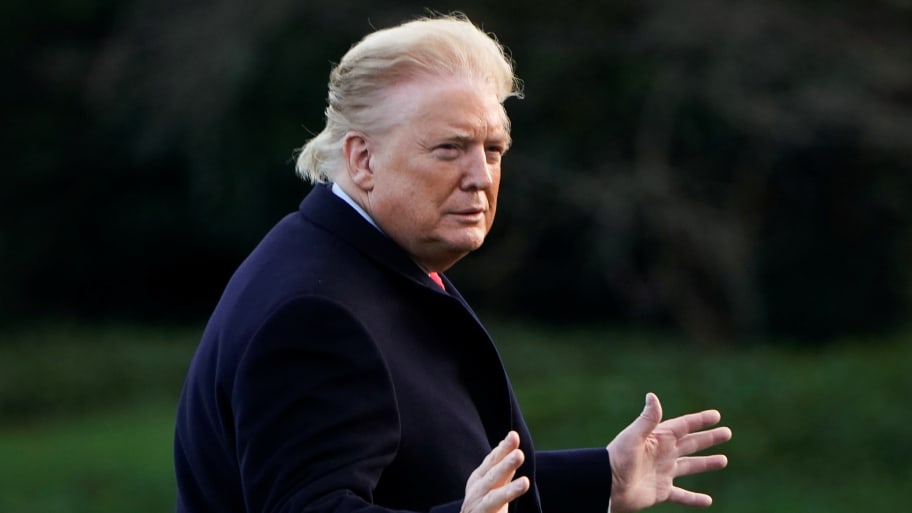
 A Secret Service agent stands watch at Mar-a-Lago.CAROLYN KASTER / AP
 Phil McCausland