That information for FY 2019 is now available at: https://www.boonecountyil.org/sites/default/files/images/Boone%20County%20Employee%20Compensation%20FY%202019.pdf
Tuesday, August 6, 2019


Monday, August 5, 2019
Parents Are Giving Up Custody of Their Kids to Get Need-Based College Financial Aid
First, parents turn over guardianship of their teenagers to a friend or relative. Then the student declares financial independence to qualify for tuition aid and scholarships.
by Jodi S. Cohen and Melissa Sanchez
July 29, 4:07 p.m. CD

The University of Illinois Urbana-Champaign campus pictured on Monday. (Kristen Norman for ProPublica Illinois)
ProPublica Illinois is an independent, nonprofit newsroom that produces investigative journalism with moral force. Sign up for our newsletter to get weekly updates written by our journalists.
Dozens of suburban Chicago families, perhaps many more, have been exploiting a legal loophole to win their children need-based college financial aid and scholarships they would not otherwise receive, court records and interviews show.
Coming months after the national “Varsity Blues” college admissions scandal, this tactic also appears to involve families attempting to gain an advantage in an increasingly competitive and expensive college admissions system.
Parents are giving up legal guardianship of their children during their junior or senior year in high school to someone else — a friend, aunt, cousin or grandparent. The guardianship status then allows the students to declare themselves financially independent of their families so they can qualify for federal, state and university aid, a ProPublica Illinois investigation found.
“It’s a scam,” said Andy Borst, director of undergraduate admissions at the University of Illinois at Urbana-Champaign. “Wealthy families are manipulating the financial aid process to be eligible for financial aid they would not be otherwise eligible for. They are taking away opportunities from families that really need it.”
While ProPublica Illinois uncovered this practice in north suburban Lake County, where almost four dozen such guardianships were filed in the past 18 months, similar petitions have been filed in at least five other counties and the practice may be happening throughout the country. ProPublica Illinois is still investigating.
Borst said he first became suspicious when a high school counselor from an affluent Chicago suburb called him about a year ago to ask why a particular student had been invited to an orientation program for low-income students. Borst checked the student’s financial aid application and saw she had obtained a legal guardian, making her eligible to qualify for financial aid independently.
The University of Illinois has since identified 14 applicants who did the same: three who just completed their freshman year and 11 who plan to enroll this fall, Borst said.
Read the Latest Coverage

Illinois Lawmakers Call Hearing to “Demand Answers” and Find Ways to Close a Loophole in College Financial Aid Scandal
Legislators said parents who turn over guardianship of their children to get financial aid engaged in a “manipulative practice.” They’re exploring whether they can subpoena parents to testify.

U.S. Department of Education Wants to Stop “Student Aid Fraud Scheme” Where Parents Give Up Custody Through Dubious Guardianships
One day after our reporting, the department’s inspector general said it wants to close financial aid loopholes.
Contact Us

Illinois Parents Are Helping Their Children Get College Financial Aid They Wouldn’t Otherwise Qualify For. Help Us Figure Out How They Do It.
ProPublica Illinois found more than 40 guardianship cases fitting this profile filed between January 2018 and June 2019 in the Chicago suburbs of Lake County alone. The parents involved in these cases include lawyers, a doctor and an assistant schools superintendent, as well as insurance and real estate agents. A number of the children are high-achieving scholars, athletes and musicians who attend or have been accepted to a range of universities, from large public institutions, including the University of Wisconsin, the University of Missouri and Indiana University, to smaller private colleges.
ProPublica Illinois reached parents or guardians in 15 of these cases and none agreed to speak on the record. Some hung up, others declined to comment and some demanded anonymity.
Borst said the university told the three students midway through last school year that their university-based financial aid would be reduced. “We didn’t hear any complaint, and that is also a big red flag,” Borst said. “If they were needy, they would have come in to talk with us.”
The university now asks more questions of students who have recently entered into a guardianship, including whether they have contact with their parents, who they live with and who pays for their health insurance and cellphone bill. The questions have deterred some families from continuing to seek university aid, Borst said.
While the university has discretion over offering institutional aid, it is obligated to distribute the federal and state grants for needy students, known as the Pell Grant and the state Monetary Award Program, or MAP grant in Illinois, Borst said. Combined, they can total about $11,000 a year.
He said the university has alerted the U.S. Department of Education and officials at the Illinois agency that administers state financial aid, the Illinois Student Assistance Commission. An ISAC spokeswoman said the agency has not yet been told about a specific case, but that it would alert the state attorney general and the U.S. Department of Education if necessary. A U.S. Department of Education spokesman said he could neither confirm nor deny current or potential investigations.
In Illinois last year, about 82,000 students who were eligible for the MAP grant, up to about $5,000, did not receive it because there wasn’t enough money. The grant is awarded on a first-come, first-served basis.
When filling out the application for financial aid, called the Free Application for Federal Student Aid, or FAFSA, students have to prove formal separation from their parents to qualify as an independent. One of the few ways to do that is through a legal guardianship change. Students cannot just declare financial independence — even in cases where parents are able to pay but refuse to do so, Borst said.
 Andy Borst, director of undergraduate admissions for the University of Illinois Urbana-Champaign. (Kristen Norman for ProPublica Illinois)
According to the U.S. Department of Education website, “a student in legal guardianship does not need to report parent information on the FAFSA form because he or she is considered an independent student.” Independent students are evaluated for financial aid based on their own income and resources and not that of their parents.
“It’s not like these families are close or on the tipping point” of being eligible for the aid, Borst said. “I don’t know how big this is, but I hope we can nip this in the bud now. … If it is legal, at what point is it wrong?”
The process starts in the courthouse.
Nearly all the cases identified by ProPublica Illinois were handled by one of two law firms: The Rogers Law Group in Deerfield, which handled most of them, and the Kabbe Law Group in Naperville. The only case filed by a different firm involved the family of Rick Rogers, of the Rogers Law Group.
The petitions filed by Rogers, whose firm specializes in real estate, are very similar, with language saying the guardianship would be in the minors’ “best interest” and typically citing educational reasons.
Many, for example, say: “The Guardian can provide educational and financial support and opportunities to the minor that her parents could not otherwise provide.”
Reached by phone, Rogers declined several times to comment about the families he represented, the process or why he sought a legal guardian for his son.
The Illinois Probate Act, the law that governs guardianship, does not specify circumstances in which guardianship should be denied. According to Illinois law, a court can appoint a guardian if the parents consent, the minor agrees and the court determines it is in the minor’s best interest. Even if a parent is able to care for the child, the court can approve the guardianship if the parents voluntarily relinquish custody of the child.
 Lake County court records show parents giving up their rights to someone they say can provide their children with “financial and educational support” better than they can. The children can then get financial aid they wouldn’t otherwise get.
That is what was happening routinely in the Lake County courthouse until late last month, when Judge Joseph Salvi, who recently began hearing guardianship cases, questioned a petition involving a high school student who lives with his parents in suburban Long Grove. The judge denied guardianship and, in response, the attorney for the guardian, a “close family friend” of the student, wrote a brief arguing why the judge should use his “broad authority” to grant the guardianship.
In the brief, attorney Mari Berlin argued that the student’s parents are finalizing a divorce and can’t afford to support his college education. It said that the family is “working with a Certified College Planner to help him find a way to independently support himself through college, with specific focus on how to afford tuition.”
Berlin wrote in the brief that the student, who dreams of becoming a doctor, would be best served by a guardianship “that would allow him to attain the independent status necessary to achieve his goal.”
Berlin, of the Kabbe Law Group, said the firm has represented families in about a dozen cases in Lake County. She said the firm has filed between 20 and 30 cases in all, with varying success, throughout the Chicago area during the past two years, including in Kane, Will, DuPage, Cook and McHenry counties.
Berlin said families who are going this route are in a financial position where their income is too high to qualify for financial aid but they still will struggle to pay for college. While this is an atypical use of guardianship, Berlin said, families have a strong legal basis for bringing the cases. The law doesn’t preclude it, she said.
“It’s a solution they have been able to find as college costs go up and they are unable to pay,” she said. “It is in the best interest of the minor, which is the statute’s purpose.”
In typical guardianship cases, an adult is stepping in to care for a child after an unexpected or troubling event: Mothers are homeless, seeking mental health care or working two jobs and can’t care for a child, fathers are in prison, addicted to drugs or deported. One Lake County guardianship case describes a child suffering from “severe physical and emotional abuse” by a parent, while another pleads: “He is a good kid. He is alone. He needs someone to take care of him.”
Those are the types of cases Rebekah Rashidfarokhi usually deals with at Chicago Volunteer Legal Services, a legal aid group that she said handles more than 300 guardianship cases in Cook County annually. While she said she hasn’t seen the so-called college guardianship cases, she said the law is intended to address the life of a child as a minor and who will care for the child on a day-to-day basis, not an “11th-hour petition” right before the teen turns 18.
“That’s not the way guardianship is supposed to be used,” she said. “If someone is trying to do that at the very last minute, it seems that they might be trying to take advantage of the system.”
The children obtaining guardianships for educational opportunities have attended some of the area’s most prestigious schools, including Stevenson High School in Lincolnshire and Glenbrook North High School in Northbrook. Others go to high schools in Vernon Hills, Grayslake, Libertyville and Lake Forest.
A guardian interviewed by ProPublica Illinois said he felt conflicted when some family friends asked him to be their daughter’s guardian. He wanted to help the girl, whose work ethic and grades he admires.
“I did wrestle with this,” said the man, who agreed to speak as long as he was not identified. He said his wife works at a university and “knows it from the other side,” he said. “And her comment was, ‘Is it going to deprive someone else of … financial aid?’ And so that’s the issue. I was told it does not.”
“It’s one of these gray areas, and my heart wanted me to do it for the family,” the man said. “But I also have a conscience. I wanted to make sure we were doing the right thing.”
The man eventually agreed to become the teenager’s guardian, though the guardianship lasted only about a month, until she turned 18. He said that he did not provide financial support for her, and that she did not live in his home.
The man said he asked “a lot” of questions of Rogers, the attorney on the case, and a college consultant named Lora Georgieva with whom the family worked.
Georgieva runs a Lincolnshire-based college consulting company, Destination College, which offers “strategies to lower tuition expenses.” The company’s logo is a graduation cap with dollar bills spilling out of it. In video testimonials, clients praise the company for saving them money.
She is tied to at least several of the families, as well as to Rogers, the attorney, who is also featured in the video.
The description for the company’s “premier” services includes a “College Financial Plan, Using Income and Asset Shifting Strategies to Increase Your Financial and Merit Aid and Lower Out of Pocket Tuition Expenses.”
Reached Monday morning, Georgieva said she was “in the middle of something” and would call later. She then contacted an attorney, Phillip Zisook, who called ProPublica Illinois on her behalf to say she was worried about being depicted in a false light.
Zisook said he would relay ProPublica Illinois’ questions to Georgieva. As of publication time, she had not responded.
Mark Kantrowitz, a leading financial aid expert and publisher and vice president of research for savingforcollege.com, called the guardianship changes “an extreme measure.”
“This is the first time I have heard of something so brazen,” Kantrowitz said. “It’s completely unethical.”
Universities began responding Monday afternoon to the ProPublica Illinois investigation.
Christian Basi, a University of Missouri spokesman, said the school is investigating to ensure that guardianships are not filed “simply to try and gain financial advantage.” He said university officials are flagging accounts that may have benefited from this practice and have been in contact with other schools in the Midwest.
“We are and would be extremely disappointed with anyone who would try to change their information with the sole purpose of taking money from a need-based program when they would typically not be eligible,” he said.
A spokeswoman for the University of Wisconsin-Madison said the university may review and adjust its financial aid award at any point if evidence emerges that a student is actually receiving parental or other financial support not reported on the FAFSA.
ProPublica Illinois reporter Duaa Eldeib contributed to this story
Above is from: .https://www.propublica.org/article/university-of-illinois-financial-aid-fafsa-parents-guardianship-children-students
Saturday, August 3, 2019
Trump’s farm bailout only helps big farmers?
USDA Bailout for Impact of Trump’s Tariffs Goes to Biggest, Richest Farmers
By Donald Carr, Senior Advisor and Chris Campbell, VP, Information Technology
TUESDAY, JULY 30, 2019

Farm bailout payments designed to offset the impacts of President’s Trump’s trade war have overwhelmingly flowed to the largest and most successful farmers, according to EWG’s analysis of the latest Department of Agriculture data.
EWG today released updated data on payments made through the first two rounds of the Market Facilitation Program, or MFP. Through April, total MFP payments for 2018-19 were $8.4 billion. The data was obtained from the USDA through a Freedom of Information Act request and has now been added to EWG’s online Farm Subsidy Database.
EWG’s analysis of the data found:
- The top one-tenth of recipients received 54 percent of all MFP payments.
- Eighty-two farmers have so far received more than $500,000 in MFP payments.
- One farm, DeLine Farm Partnership, of Charleston, Mo., has so far received $2.8 million in MFP payments.
- The top 1 percent of MFP recipients received, on average, $183,331. The bottom 80 percent received, on average, less than $5,000.
- Thousands of residents of the nation’s largest cities received MFP payments.
- MFP payments continue to leave out minority farmers.
Until now, MFP payments have been linked to crop production, favoring the largest producers of certain crops. Although USDA initially said it would place a $125,000 cap on MFP payments, the department chose to apply rules that allow relatives who do not contribute meaningful work on the farm to receive farm payments, allowing many farm businesses to evade the cap.
Changes to the second round of MFP payments, announced last week by Agriculture Secretary Sonny Purdue, will further favor the largest farmers by linking payments to the number of acres, not the number of bushels or bales produced. The bigger the farm, the bigger the government check.
MFP payments are made in addition to other farm subsidies, including multiple layers of commodity subsidies, crop insurance subsidies, and disaster payments. Nearly 28,000 farms have received subsidies from these programs for 32 years continuously.
Total subsidy payments across all programs in 2018, including MFP, totaled more than $18 billion. This means that, in combination, these payments could exceed World Trade Organization caps on farm subsidies, potentially opening a new front in Trump’s trade war. China responded to Trump’s tariffs on Chinese aluminum and steel products by placing retaliatory tariffs on more than 800 U.S. food and farm products, which led in turn to the MFP bailout program.
ABOVE IS FROM: https://www.ewg.org/agmag/2019/07/usda-bailout-impact-trump-s-tariffs-goes-biggest-richest-farmers
Monday, July 29, 2019
Illinois National Guard sending 400 to Afghanistan
Illinois National Guard sending 400 to Afghanistan
- By Benjamin Yount | The Center Square
- 4 hrs ago
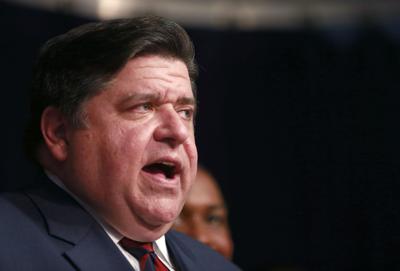
Gov. J.B. Pritzker speaks during a bill signing Wednesday, June 5, 2019 at the Thompson Center in downtown Chicago.
Amr Alfiky / AP Photo
Illinois is sending its largest contingent of National Guard troops in about a decade to Afghanistan.
Nearly 400 troops with the 178th Infantry Regiment left over the weekend. They will stop in Texas for training, then they will spend the next year or in Afghanistan as part of Operation Freedom's Sentinel.
It's the first time Illinois Gov. J.B. Pritzker has sent troops overseas. And it's the largest deployment to Afghanistan for the Illinois Guard in almost 10 years.
"Serving as Commander and Chief of Illinois' citizen soldiers is a humbling endeavor for me because you represent the very best of this state," Pritzker said over the weekend. "The service you and your families give every day to the people of Illinois, that service to defend this nation, will always be a source of inspiration and respect."
The 178th is mainly based in the Chicago area, but members from as far south as Joliet and as far north as Woodstock are also part of the regiment.
Lt. Co. Matt Garrison said the troops will be providing security for coalition forces in Afghanistan.
"Know that this unit and this battalion is ready to meet the mission in Afghanistan," Garrison said. "We have the training, we have the right personnel, and we have the equipment to accomplish the mission."
Garrison said the troops will spend about a year in Afghanistan.
Suburbanites among the 400 Illinois Army National Guardsmen off to Afghanistan

Wood Dale police officer Thomas Nickelson on Friday, his last day on duty before he will be deployed to Afghanistan with the Illinois Army National Guard. He will be on an overseas mission for at least the next year. Courtesy of Wood Dale Police Department
The largest mobilization of Illinois Army National Guardmen in nearly a decade, including from companies in Elgin and Woodstock, starts Saturday.
The guardsmen are with the 1st Battalion, 178th Infantry Regiment headquartered in Chicago and including companies in Elgin, Woodstock, Chicago, Bartonville and Kankakee, and a detachment in Joliet, said Barbara Wilson, public affairs specialist for the Illinois Army National Guard.
The guardsmen are being mobilized in support of Operation Freedom's Sentinel, which followed the Operation Enduring Freedom combat mission in Afghanistan and was designed to focus on training and counterterrorism efforts. They will train at Fort Bliss, Texas, before deploying to Afghanistan.
A mobilization ceremony takes place at 10 a.m. Saturday at Elgin Community College, 1700 Spartan Drive, Elgin, and another one at 4 p.m. Saturday at Woodstock High School, 501 W. South St., Woodstock.
Other ceremonies take place Sunday in Chicago and Kankakee, and Monday in Peoria.
Among those deployed is Wood Dale police officer Thomas Nickelson, whom the Wood Dale Police Department feted Friday.
"Today we were honored to thank Ofc. Nickelson for his service during his upcoming deployment with the U.S. Army," the department posted on Facebook. "He will be on an overseas mission for at least the next year. Today was his last day on the street prior to his report date this weekend."
"We look forward to welcoming him back to our family when he completes his tour of duty."
Above is from: https://www.dailyherald.com/news/20190726/suburbanites-among-the-400-illinois-army-national-guardsmen-off-to-afghanistan
Friday, July 26, 2019
JOHN KELLY CASHES IN ON CHILD SEPARATION POLICY HE PUSHED
JOHN KELLY CASHES IN ON CHILD SEPARATION POLICY HE PUSHED
By Linnaea Honl-Stuenkel
May 9, 2019
John Kelly was the Secretary of the Department of Homeland Security (DHS) when President Trump’s zero tolerance policy was under consideration, and chief of staff at the White House when the policy was implemented. Now, he is on the board of Caliburn International, which runs the largest facility housing migrant children separated from their families at the border. The effects of the zero tolerance policy have been catastrophic, and as many as 55 children still have still not been reunited with their families–with no existing records that would link them. That hasn’t stopped Kelly from cashing in on the policy he supported now that he has left the government.
Just a few months into Trump’s presidency, then-Secretary Kelly confirmed that the administration was considering a hard line approach to illegal immigration that would include separating children from their families if they crossed the southern border illegally. He said the approach could deter immigration and assured the public that “we have tremendous experience of dealing with unaccompanied minors. We turn them over to (Health and Human Services) and they do a very, very good job of putting them in foster care or linking them up with parents or family members in the United States.”
The zero tolerance policy was officially announced on April 6, 2018, when Kelly was White House chief of staff. After backlash about the policy, Kelly defended it on NPR, saying “it could be a tough deterrent” and that he would not characterize the policy as cruel, saying that “[the] children will be taken care of — put into foster care or whatever. But the big point is they elected to come illegally into the United States and this is a technique that no one hopes will be used extensively or for very long.”
As we have seen in the past year, in his advocacy for the policy Kelly overstated the administration’s ability to care for unaccompanied children and link them with their parents. Many children are still separated from their families, with no records that can be used to reunite them. CREW is in litigation against the administration about the recordkeeping failures that have kept children separated from their families.
On May 8, 2019, in an interview about his time at the White House, he went out of his way to describe the detention centers in positive terms, explaining that they are “purely for humanitarian purposes.” Kelly did not mention that he is now on the board of Caliburn International, which runs the largest of the facilities that he praised. That Kelly now stands to profit from the continued effects of a disastrous policy that he advocated for while he was DHS Secretary and White House chief of staff demonstrates how the revolving door spins between government and industry.
Kelly is just the latest in a pattern of former Trump administration officials leaving their government jobs to work in the private sector in industries they regulated. Former Interior Secretary Ryan Zinke is now working for a gold mining company. Former EPA head Scott Pruitt is now lobbying for coal companies. Though President Trump ran on a promise to drain the swamp, his former senior officials instead are examples of exactly how the swamp works–at the expense of families and the environment.
Above is from: https://www.citizensforethics.org/john-kelly-child-separation-policy/
How Trump's businesses are booming with lobbyists, donors and governments
How Trump's businesses are booming with lobbyists, donors and governments
The president has refused to sever ties with his hotels, golf courses and condos – raising conflict of interest and corruption concerns
Peter Stone in Washington
Fri 19 Jul 2019 00.00 EDTLast modified on Fri 19 Jul 2019 00.06 EDT
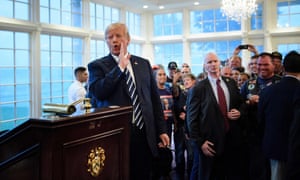
Donald Trump meets with supporters during a Bikers for Trump event at the Trump National Golf club in Bedminster, New Jersey, on 11 August 2018. Photograph: Brendan Smialowski/AFP/Getty Images
From Florida to New York to Scotland and many other places, Donald Trump’s business empire has attracted a growing clientele of lobbyists, foreign governments, big donors and other Trump allies looking to curry favor, and helping generate hundreds of millions of dollars for his golf course resorts, condos and hotels.
While much attention has focused on Trump’s Washington DC hotel as a honeypot for those seeking to influence the administration, Trump’s broader property empire across the US – and overseas – also concerns critics who say the president is using his office for financial benefit.

Inside Trump's DC hotel, where allies and lobbyists flock to peddle their interests
During his first two full years as president, Trump’s revenues from his far-flung real estate business, which his two eldest sons are running while he is president, totaled at least $886m, according to Trump’s annual financial disclosures.
Trump’s controversial decision not to completely sever ties to his real estate interests in the US and overseas, or put his assets in a blind trust to limit conflicts of interest, has sparked strong condemnation from ethics watchdog groups, political analysts and congressional Democrats.
The financial web of ties between the president and his various properties is underscored by all manner of fundraising bashes, lobbyist meetings and foreign stays at Trump’s properties, spawning legal and ethics complaints.
“Whether accepting money from political candidates, lobbyists or foreign governments, the president’s businesses seem all too willing to promote the message that the presidency is for sale,” Congressman Elijah Cummings, the chairman of the House oversight and reform committee, said in a statement.
According to his annual financial disclosures, Trump’s top revenue-producing properties have done handsomely by hosting fundraisers, lobbyist meetings and foreign delegations. They include:
• The Trump National Doral Golf Club in Miami, a favorite hangout for lobbyists and donors with ties to Trump, is a leading revenue source, yielding close to $151m in his first two years as president. Notably, the Doral club hosted annual meetings in 2018 and 2019 for a business group of payday lenders whose exorbitant interest rates sparked a regulatory crackdown by the Obama administration, but have been cheered by recent Trump administration rollbacks.
• Trump’s self styled “summer White House” in Bedminster, New Jersey, had revenues of $30.8m in the same two-year period. On 19 July, Trump’s campaign and the Republican National Committee are slated to host a big fundraiser in Bedminster where donors who pony up $100,000 can get their picture taken with Trump, enjoy a roundtable chat with him and other perks.
• Mar-a-Lago, the swanky Palm Beach club where Trump doubled the annual membership fee to $200,000 when he became president, pulled in revenues totaling $48m in the two-year period. As ProPublica first revealed, a trio of wealthy Mar-a-Lago members, who are friends of Trump, played a big role in shaping policy at the Department of Veterans Affairs, spurring a House panel to look into allegations of “improper influence”.
• Trump’s Turnberry golf resort in Scotland, which Trump has visited and promoted in tweets while in office as “incredible”, notched revenues of $43.8m in 2017 and 2018.
Robert Maguire, the research director of the nonpartisan ethics watchdog Crew, said the web of influence peddling at Trump’s properties poses “…unprecedented conflicts of interest. President Trump’s continued financial ties to his businesses including his hotel have been received by his administration and political allies not with scorn, but enthusiastic support.”


Donald Trump exits the Trump International Hotel after attending the 2019 Maga Leadership Summit in Washington on 28 January 2019. Photograph: Shawn Thew/EPA
Little wonder Trump’s financial ties to his businesses have prompted congressional scrutiny by the House oversight committee and other panels, plus a lawsuit by more than 200 Democrats alleging the foreign business at his properties violate an anti-corruption clause in the constitution designed to curb improper foreign influence on federal officials.
Data compiled by Crew sheds further light on the web of ties between the president and his businesses.
Recent Crew data found that through mid-2019, Trump has made at least 345 visits to properties that he continues to profit from while in office. Further, Trump personally mentioned or referred to his company at least 143 times since taking office, the Crew data also showed.
Some powerful lobbyists, such as Florida’s Brian Ballard, who is known to have good ties to Trump, have also helped boost business at Trump properties via his clients. One example: Geo Group, a private prison company that Ballard lobbies for, won a $110m contract in 2017 to build an immigration detention facility in Texas and soon after moved its annual leadership meeting to Trump’s Doral golf club.
Other Ballard clients, including Nigerian officials, have hosted meetings or stayed at the Trump hotel in DC.
Foreign government patronage of Trump properties has been especially notable, sparking separate lawsuits by some 200 Democrats in Congress, as well as attorneys general from Maryland and DC, who allege that they violate the foreign emoluments clause in the constitution. The clause bars foreign payments or gifts to federal officials without authorization by Congress.


Donald Trump dines with the Japanese prime minister, Shinzo Abe, and their wives, along with Robert Kraft at Mar-a-Lago in 2017. Photograph: Nicholas Kamm/AFP/Getty Images
The justice department has fought the suits, arguing the clause should only apply to direct payments to the president and not foreign patronage of his properties, a position very similar to one expressed in early 2017 by Trump’s own lawyers.
NBC News recently calculated that representatives of at least 22 foreign governments – including some facing charges of corruption or human rights abuses such as Saudi Arabia, Malaysia, Turkey and the Philippines – seem to have spent funds at Trump properties while he has been president.
Foreign spending at Trump properties mainly includes meetings, overnight stays and rentals or purchases.
Trump pledged to donate foreign profits from his properties to the government while he is in office, and the Trump Organization has written checks totaling $343,000 to the treasury for 2017 and 2018. But critics have said it’s impossible to verify if these checks fully cover foreign payments to Trump properties in part because Trump – unlike other presidents – has refused to release his tax returns.
Cummings, who leads one of a few House panels that have issued subpoenas or gone to court to obtain financial information on Trump’s income sources and businesses, says more sunlight on Trump’s foreign and domestic revenues is badly needed.
“The American people deserve complete transparency over these payments and the identities of those attempting to curry favor with the administration,” Cummings said.
If you’re reading us a little…
… or you’re reading us a lot, we hope you’ll consider supporting us with a contribution, however big or small. More people are reading and supporting The Guardian’s independent, investigative journalism than ever before. And unlike many news organisations, we have chosen an approach that allows us to keep our journalism accessible to all, regardless of where they live or what they can afford. But we need your ongoing support to keep working as we do.
The Guardian will engage with the most critical issues of our time – from the escalating climate catastrophe to widespread inequality to the influence of big tech on our lives. At a time when factual information is a necessity, we believe that each of us, around the world, deserves access to accurate reporting with integrity at its heart.
Our editorial independence means we set our own agenda and voice our own opinions. Guardian journalism is free from commercial and political bias and not influenced by billionaire owners or shareholders. This means we can give a voice to those less heard, explore where others turn away, and rigorously challenge those in power.
Above is from: https://www.theguardian.com/us-news/2019/jul/19/donald-trump-businesses-hotels-conflict-of-interest
Wednesday, July 24, 2019
Robert Mueller’s use of “I take your question,” as defined by a legal expert

REUTERS/JOHNATHAN ERNST
Taking your questions.
IT'S QUIZZICAL
Robert Mueller’s use of “I take your question,” as defined by a legal expert
By Ephrat Livni7 hours ago
Robert Mueller’s testimony before two House committees didn’t resolve many questions about Russian meddling into the 2016 US presidential election or Donald Trump’s efforts to thwart the special prosecutor’s probe. And it has raised yet another query: What does it mean, technically, when Mueller responds to a lawmaker with the formulation “I take your question”?
M. Tia Johnson, a visiting law professor at Georgetown Law School and former assistant secretary for legal affairs at the US Department of Homeland Security, tells Quartz that this is a standard legal response.
“‘I take your question’ is used often when the witness doesn’t know the answer to the question,” she said. It’s distinct from a straight “no” because it indicates that the answer may well be knowable, just that this witness doesn’t know it.
From a technical perspective, the answer can preserve the question for follow-up on the record. After the hearings, committee chairpersons give their colleagues a deadline for submitting additional questions based on the witness’s testimony and Mueller might be asked to provide a more substantive response.
Johnson notes that in the context of today’s hearings, and specifically the first instance when Mueller said “I take your question” after what she calls “a rant” by Republican Louie Gohmert of Texas, the response is also a way of saying, “I got you. I hear you.” But it doesn’t mean Mueller has an answer, and in this case it seemed to mean that the former special counsel wasn’t happy that Gohmert left no obvious question for Mueller to answer.
“My sense was, based on special counsel’s demeanor, with him just kind of sitting there, that it was almost like ‘I’ve had enough’ or ‘I got it.'”
Certainly, that’s how the response was interpreted by some viewers.
Johnson points out that in the afternoon hearing with the House Intelligence Committee, there were instances when the response seemed to be more official. Asked by Republican Devin Nunes of California how many times a Russian lawyer met with Glenn Simpson of Fusion GPS, Mueller also said, “I take your question.” In that case, it appeared more likely to indicate that he doesn’t know the answer but that it’s theoretically knowable, rather than indicating his distaste for the query.
Witnesses prepped for testimony are often given a series of possible responses designed to defuse tension. The last thing Mueller would want to do in a situation like the one with Gohmert is to get in a back and forth dialogue. Johnson believes he likely used “I take your question” to acknowledge there was one but also to deflect the rant.
“It’s a way of saying ‘noted,’” she explains. “There are different ways in which you can use that, so we still have to interpret. But I think Gohmert could put in a question.”
Above is from: https://qz.com/1674164/muellers-i-take-your-question-as-defined-by-a-legal-expert/
Subscribe to:
Posts (Atom)