Friday, December 21, 2018

Christopher Steele Gave Copies of Trump Dossier to a McCain Pal, a Paul Ryan Aide, and a GOP Rep. in Late 2016

The GOP Rep was our Adam Kinzinger.

By Debra Heine December 20, 2018

chat 182 comments

Speaker of the House Rep. Paul Ryan, R-Wis., greets President Donald Trump at the National Republican Congressional Committee March Dinner on Tuesday, March 20, 2018, in Washington. (AP Photo/Evan Vucci)

Christopher Steele gave copies of his discredited dirty dossier on then-candidate Donald Trump to a Republican congressman, the chief of staff to House Speaker Paul Ryan, and a longtime associate of John McCain in December 2016, well before BuzzFeed published the infamous report, according to court documents released Wednesday.

David Kramer, a former State Department official who was an executive at the McCain Institute, is the person who provided a copy of the dossier to BuzzFeed News. He met with BuzzFeed reporter Ken Bensinger on December 29, 2016, according to the court filing submitted by U.S. District Court Judge Ursula Ungaro in the BuzzFeed dossier-related defamation lawsuit.

BuzzFeed and Kramer disagree about how Bensinger obtained a copy of the dossier, according to a footnote in Ungaro's court filing.

“The parties dispute whether Kramer gave Bensinger a copy or whether Bensinger took photos of the Dossier when Kramer was not looking,” the judge wrote.

“Kramer testified that Bensinger took photos of the Dossier when Kramer was out of the room, even though he asked Bensinger not to,” Ungaro continued, adding that “in a later declaration, Kramer stated that he had no objection to Bensinger taking a hard copy and had provided hard copies to other journalists.”

The other journalists Kramer provided copies of the dossier to were not identified.

Ungaro also stated that Christopher Steele provided at least one memo from the dossier to Rep. Adam Kinzinger (R-Ill.) and longtime Paul Ryan aide Jonathan Burks.

“Steele gave Report 166 to Kramer, an unnamed senior British security official, Ms. Wallender [sic] at the NSC, Representative Adam Kinzinger (R-Ill.), and House Speaker Paul Ryan’s Chief of Staff, John Burks,” Ungaro wrote.

Ungaro also stated that Christopher Steele provided at least one memo from the dossier to Rep. Adam Kinzinger (R-Ill.) and longtime Paul Ryan aide Jonathan Burks.

“Steele gave Report 166 to Kramer, an unnamed senior British security official, Ms. Wallender [sic] at the NSC, Representative Adam Kinzinger (R-Ill.), and House Speaker Paul Ryan’s Chief of Staff, John Burks,” Ungaro wrote.

That report, which is one of 17 written by Steele, accused Russian businessman Aleksej Gubarev of using his companies to hack Democrats’ computer systems during the 2016 campaign. Gubarev vehemently denied the allegations and sued BuzzFeed for defamation, claiming that the website failed to investigate Steele’s claims.

Ungaro noted in her filing Wednesday that BuzzFeed did not reach out to Gubarev prior to its publication of the dossier on Jan. 10, 2017. The website apologized to Gubarev and redacted his name from its report after the Russian sued.

Ungaro ultimately ruled in favor of BuzzFeed on the grounds that its decision to publish the dossier was protected by the fair report privilege.

Sponsored

Steele also apparently supplied copies of his dossier to Celeste Wallander, the Obama National Security Council’s top official on Russia-related matters.

Though Ungaro wrote that Steele provided Burks and the others with parts of the dossier, a spokeswoman for Ryan’s office said that Burks never met Steele and did not receive information directly from the former British spy.

“Burks has never met Christopher Steele nor received any document directly from him. However, he was aware of and had read the dossier prior to its publication,” AshLee Strong told The Daily Caller News Foundation.

She did not respond to follow-up questions about how Burks obtained the report, whether he disseminated it, and whether Ryan knew he had received the document.

Inquiring minds would like to know exactly when Burks got the Steele dossier and what he did with it. And did he tell Republicans on the House Intelligence Committee or any other committees about it?

Kinzinger’s office did not respond to the Daily Caller's request for comment.

Above is from:  https://pjmedia.com/trending/christopher-steele-gave-copies-of-trump-dossier-to-a-mccain-pal-a-paul-ryan-aide-and-a-gop-rep-in-late-2016/

Above is from: 

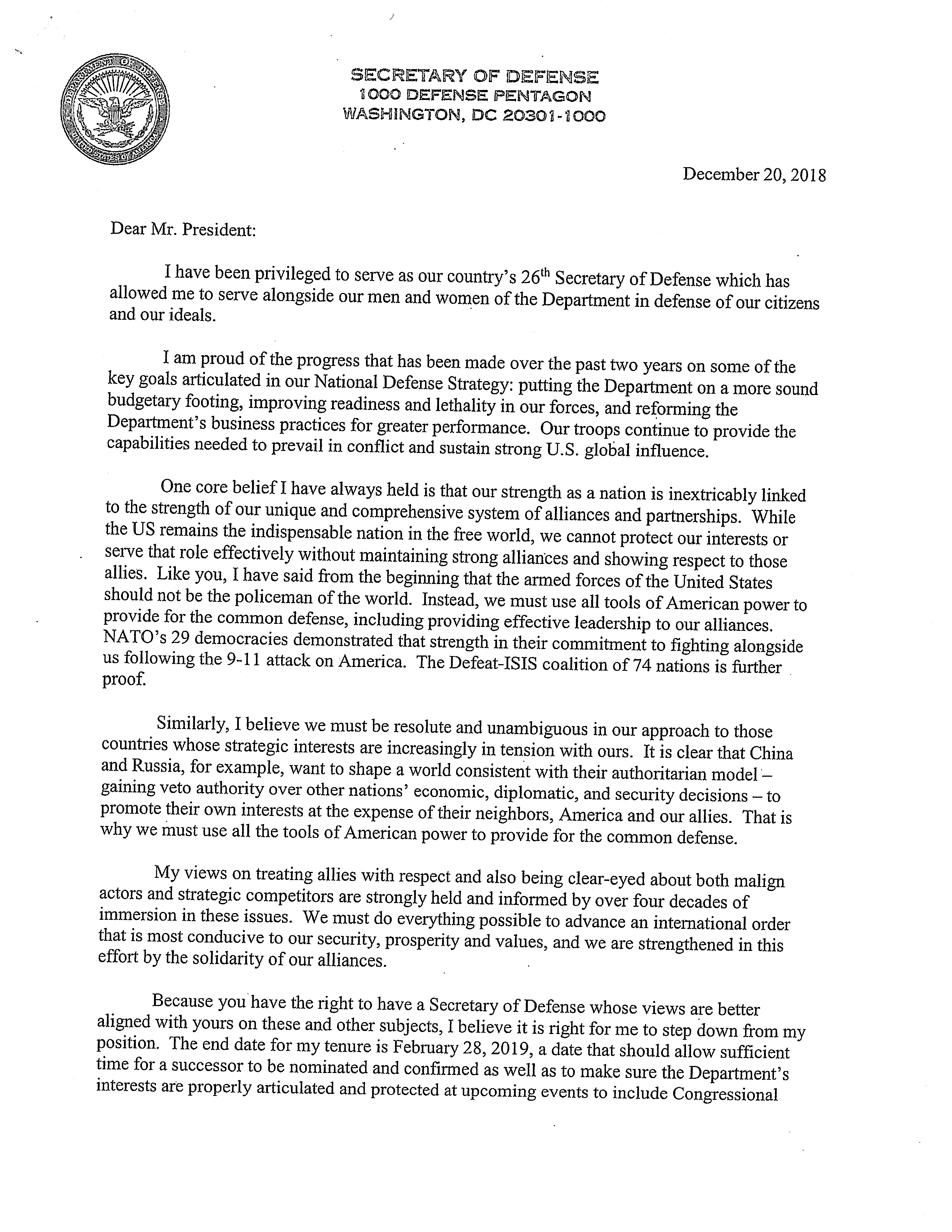
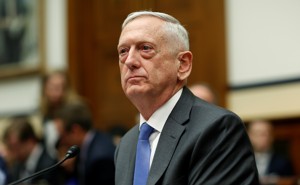
Gen Mattis resignation letter

image

Dear Mr. President:

I have been privileged to serve as our country’s 26th Secretary of Defense which has allowed me to serve alongside our men and women of the Department in defense of our citizens and our ideals.

I am proud of the progress that has been made over the past two years on some of the key goals articulated in our National Defense Strategy: putting the Department on a more sound budgetary footing, improving readiness and lethality in our forces, and reforming the Department’s business practices for greater performance. Our troops continue to provide the capabilities needed to prevail in conflict and sustain strong US global influence.

One core belief I have always held is that our strength as a nation is inextricably linked to the strength of our unique and comprehensive system of alliances and partnerships. While the US remains the indispensable nation in the free world, we cannot protect our interests or serve that role effectively without maintaining strong alliances and showing respect to those allies. Like you, I have said from the beginning that the armed forces of the United States should not be the policeman of the world. Instead, we must use all tools of American power to provide for the common defense, including providing effective leadership to our alliances. NATO’s 29 democracies demonstrated that strength in their commitment to fighting alongside us following the 9-11 attack on America. The Defeat-ISIS coalition of 74 nations is further proof.


  • James Mattis

Similarly, I believe we must be resolute and unambiguous in our approach to those countries whose strategic interests are increasingly in tension with ours. It is clear that China and Russia, for example, want to shape a world consistent with their authoritarian model—gaining veto authority over other nations’ economic, diplomatic, and security decisions—to promote their own interests at the expense of their neighbors, America and our allies. That is why we must use all the tools of American power to provide for the common defense.

My views on treating allies with respect and also being clear-eyed about both malign actors and strategic competitors are strongly held and informed by over four decades of immersion in these issues. We must do everything possible to advance an international order that is most conducive to our security, prosperity and values, and we are strengthened in this effort by the solidarity of our alliances.

Because you have the right to a Secretary of Defense whose views are better aligned with yours on these and other subjects, I believe it is right for me to step down from my position. The end date for my tenure is February 28, 2019, a date that should allow sufficient time for a successor to be nominated and confirmed as well as to make sure the Department’s interests are properly articulated and protected at upcoming events to include Congressional posture hearings and the NATO Defense Ministerial meeting in February. Further, that a full transition to a new Secretary of Defense occurs well in advance of the transition of Chairman of the Joint Chiefs of Staff in September in order to ensure stability within the Department.

I pledge my full effort to a smooth transition that ensures the needs and interests of the 2.15 million Service Members and 732,079 DoD civilians receive undistracted attention of the Department at all times so that they can fulfill their critical, round-the-clock mission to protect the American people.

I very much appreciate this opportunity to serve the nation and our men and women in uniform.

James N. Mattis

Tuesday, December 18, 2018

Mexico’s Strategy for Dealing With Trump: Warn Him About China


The New York Times

Mexico’s Strategy for Dealing With Trump: Warn Him About China

By AZAM AHMED and ELISABETH MALKIN

2 hrs ago


  • Donald Trump wearing a suit and tie: Mexican officials say they will not force a confrontation with President Trump on migration. Instead, they are proposing an investment plan for Central America.

  • a group of people sitting at a dock: A sports center in Tijuana, Mexico, that has become a shelter for migrants. Thousands of migrants have amassed at the border with the United States..

MEXICO CITY — Mexico’s new government has a strategy for dealing with President Trump.

Don’t anger him. Don’t cave in to him. Try to get him to help fund an ambitious investment plan to stem migration by creating jobs in Central America.

And if Mr. Trump cannot be persuaded, Mexican officials said in interviews that they would remind him that there is another player in the region willing to step into the vacuum: China.


That, in a nut shell, is the approach the Mexican government is betting can defuse the standoff over the thousands of migrants amassed at its border with the United States, hoping to make it across.

Mexico’s plan to try to raise money to develop Central America and southern Mexico was announced last week, when Andrés Manuel López Obrador, the country’s new president, introduced what he called a “Marshall Plan” to address the root causes of Central American migration: a $30 billion initiative to invest in the region and welcome migrants into Mexico with visas, health care and employment.

Mexican officials have compared the proposal to the plan to rebuild postwar Europe. This approach would represent a break with Mr. López Obrador’s predecessor, who considered giving in to Mr. Trump’s demands and allowing people seeking asylum in the United States to remain in Mexico while they wait.

And Mexico’s new plan is, in many respects, the opposite of Mr. Trump’s vow to crack down on migration, which includes building a wall, deploying the military and cutting aid to Central America.

In speaking about the contours of their new policy, Mexican officials told The New York Times that they would not force a confrontation with Mr. Trump by demanding that he accept the migrants onto American soil; that would only anger the American president, and he would not do it anyway, they said.

But at the same time, they said they were not going to strike a deal with the United States to keep asylum seekers on the Mexican side of the border. That would allow Mr. Trump to claim a victory Mexican officials are not willing to give him. The officials spoke on the condition of anonymity because they did not want to aggravate already strained relationships with the Trump administration.

Instead, they want to change the focus of the conversation to expanding the economy of Central America and the south of their country by marshaling public and private investment to build infrastructure, develop the energy sector and create jobs in the region so people do not have to stream north in the first place.

They acknowledge that it may be difficult to convince the Trump administration to invest large sums in the region, a proposal they have only recently broached with American officials.

Buy they are hoping the perceived threat of China’s growing presence in the region can be used as leverage to bring the United States on board.

While it is unclear how much more China would be willing to invest in the region, in recent years it has increased its presence throughout Latin America, financing infrastructure projects, tightening ties with governments and even convincing a handful of Central American nations to switch their diplomatic recognition of Taiwan to China — a sticking point with the Americans.

The Mexican strategy to rely on the United States’ concerns about China’s expanding influence in the region reflects a growing sense in Mexico that it can no longer take cooperation with the United States for granted.

Both the White House and State Department declined to comment on the Mexican proposal.

“For a long time there has been this competition within Latin America for influence, where China is willing to invest billions in infrastructure and energy that the United States simply isn’t,” said Duncan Wood, the director of the Mexico Institute at the Wilson Center.

The proposal is also a reflection of the distinct personalities of Mr. López Obrador and Mr. Trump: Both are mavericks — albeit on opposite sides of the political spectrum — and both are willing to break with long-established conventions.

“Partly because of Trump and partly because of Andrés Manuel, there is an opening there,” Mr. Wood said.

Unlike his predecessor, Mr. López Obrador is willing to chart an independent course in his response to the Trump administration — partly because of Mr. Trump’s hard line on migration and partly out of a conviction that the only way to tackle the matter is to go after its root causes.

And to do that, Mexico will look for help wherever it can find it, including China, which has already expressed an interest in Mr. López Obrador’s plan to lay hundreds of miles of track for a tourist train in the Yucatán Peninsula — a project widely opposed by environmental advocates.

Of course, that does not mean Mexico will make a sharp turn to China, given its longstanding relationship with the United States. Nor does floating the idea that China may participate make Mexico’s costly proposal any more plausible.

“The money is just not there,” said Mark Feierstein, the former senior director for Western Hemisphere affairs at the National Security Council during the Obama administration. He noted that the United States was spending more than $650 million a year in Central America’s Northern Triangle, which is composed of Guatemala, Honduras and El Salvador.

But that may be beside the point.

“If nothing else, it is a good bargaining chip,” said Doris Meissner, a senior fellow at the Migration Policy Institute in Washington, of the idea that China could increase its investment in the region. “Both sides are laying down their frameworks and their points of view as to how they should proceed.”

The idea that China could increase its influence in Mexico emerged even before Mr. López Obrador came into office.

“I heard from senior Mexican officials during the transition that if the United States is not going to treat Mexico with respect, don’t be surprised if you see a Chinese submarine in a Mexican port,” said Juan Gonzalez, who was an adviser to Vice President Joseph R. Biden on Central America.

“I think it was hyperbolic,” he said of the outgoing officials’ warning, before adding, “I think Mexico sees increased political risk coming from the political process in the United States and they are diversifying their interests.”

Since taking office on Dec. 1, Mr. López Obrador has done nothing if not shake up the establishment.

He has announced the cancellation of the construction of a new airport, a multibillion-dollar project that was well underway, and temporarily suspended new auctions for oil exploration in Mexico. He has also cut salaries for government employees and proposed a measure to dismantle a much-vaunted education overhaul.

As he did on the campaign trail, Mr. López Obrador has focused on domestic issues — an inward-looking vision that differs from recent Mexican presidents who saw the global stage as the nation’s future.

But the migrant crisis forced its way to the top of the agenda, proving a frustrating first test for Mr. López Obrador.

The arrival of thousands of migrants traveling in caravans from Honduras and other Central American countries raised the profile of an existing problem, increasing the stakes and forcing Mr. López Obrador to decide how to manage it just days after taking office.

For decades, Mexico kept its head down as hundreds of thousands of migrants — many of them Mexican — made their way into the United States. But in recent years, the nation’s status as a transit country has changed.

Mexico is becoming a destination, not just a portal to the United States. Every year, more people apply for asylum in Mexico, and many more choose to stay and seek work. A bottleneck in the United States has meant that thousands of migrants are stuck waiting months at the border for their initial asylum interview with the American authorities.

In 2014, at the urging of the Obama administration, Mexico adopted a tough policing strategy along its southern border with Guatemala that essentially amounted to detention and deportation. But that also failed to curtail the flow of migrants.

Today, with about 10,000 migrants having entered Mexico in caravans that focused global media attention on their plight, mass roundups and deportations are not an option, officials say. Nor is striking a deal with the Trump administration to host the migrants indefinitely.

So Mr. López Obrador’s government is trying to fold them into Mexican society — and raise money to invest in projects that would boost employment and prosperity in the region.

“It’s not enough just to point out that the causes of migration have to be dealt with,” said Marcelo Ebrard, Mexico’s foreign secretary, adding that Mexico wants to counter the idea “that the best way to confront migration is through exclusion and control.”

This is, in part, a recognition that Mexico forms a part of a busy migration corridor and that, with or without help from the United States, it has to deal with the issue.

“Finally, the issue of the Northern Triangle and migration is seen as a regional issue,” said Rafael Fernández de Castro, the director of the Center for U.S.-Mexican Studies at the University of California, San Diego, and a former Mexican presidential adviser. “There is a window of opportunity. The knowledge and awareness have never been as clear as they are now.”

Mr. López Obrador is also signaling an interest in playing a broader leadership role in the region, as Mexico did during the 1970s and 1980s.

“Mexico wants to take back leadership in the region,” said Rodolfo Cruz Piñeiro, director of the department for population studies at the College of the Northern Border in Tijuana. “Mexico is telling the U.S.: ‘I can control this region for you, but I need your economic help.’”

“What will the U.S. ask?’’ he added. “That’s the great unknown.”

Above is from:  https://www.msn.com/en-us/news/world/mexico’s-strategy-for-dealing-with-trump-warn-him-about-china/ar-BBR5mtZ?ocid=spartandhp

Thursday, December 13, 2018

5 people arrested in Boone County following bust at massage parlors


BOONE COUNTY (WREX) — Five women are arrested and charged after a 3-month-long investigation in to criminal activity at Belvidere massage parlors, according to the Belvidere Police Department.

Police Chief Shane Woody says in a news release that on Monday, the police department and Department of Homeland Security, executed a search warrant at four massage parlors in Belvidere, including the Hot Stone Spa at 2184 N. State St.; Angel Spa at 998 Belvidere Road Suite 3; Ming’s Spa at 120 N. State St.; and Good Luck Relax Center at 404 S. State St.

Five women have been arrested and charged:

— Lisa Yu, age 60 of Lincolnshire, was charged with promoting prostitution within 1,000 feet of a school and prostitution.

— Tina King, age 53 of Chicago, was charged with two counts of promoting prostitution and prostitution.

— Ssang Tretbar, age 52 of Van Buren, Ariz., was charged with prostitution and violation of the massage license act

— Jin Xiaolan, age 54 of Chicago, was charged with violation of the massage license act.

— Seng Yang, age 50 of West Palm Beach, Fla., was charged with violation of the massage license act.

Chief Woody says the investigation is ongoing and additional charges are possible.

13 News will follow this story and bring you more information as it becomes available.

Seng Yang, age 50 of West Palm Beach, Fla., was charged with violation of the massage license act.

Tina King, age 53 of Chicago, was charged with two counts of promoting prostitution and prostitution.

Ssang Tretbar, age 52 of Van Buren, Ariz., was charged with prostitution and violation of the massage license act

Lisa Yu, age 60 of Lincolnshire, was charged with promoting prostitution within 1,000 feet of a school and prostitution.

Jin Xiaolan, age 54 of Chicago, was charged with violation  of the massage license act.

Above is fromhttps://wrex.com/category/2018/12/12/5-people-arrested-in-boone-county-following-bust-at-massage-parlor/

How The Koch Brothers Broke Democracy & Stuck Taxpayers With The Bill


How The Koch Brothers Broke Democracy & Stuck Taxpayers With The Bill


This is a story of how a small group of wealthy white men can hijack an entire nation, destroy its founding principles, and force those most affected by their deeds to pay for the damage. The background for this piece is Jane Mayer’s extraordinary book Dark Money, which came out earlier this year. The subtitle says it all: The Hidden History Of The Billionaires Behind The Rise Of The Radical Right.

If you follow the link above, you can read the entire book in PDF form but be warned — the subject matter deals with such sleaze, so much self dealing, and so many crooked dealings in the halls of power, you will need a strong stomach not to feel sick to your stomach as you read it.

The principle characters in Mayer’s book are Charles and David Koch. Taken together, they are the richest people on the face of the Earth. They are also the sons of Fred Koch, who made his fortune supplying gasoline and diesel fuel to Josef Stalin and later Adolf Hitler. In December, 1958, the elder Koch became one of the founders of the John Birch Society, a radical right wing organization that has metastasized over the decades into dozens of right wing propaganda organizations, think tanks, and so-called “institutes.”

Weaponized Philanthropy

You may never have heard of Charles and David Koch, but they have touched the lives of every American. Many of the coded phrases that have infected political discourse over the past 50 years are attributable to them — “trickle down economics,” “welfare Cadillac,” “shrink the size of government until it’s small enough to drown in a bathtub,” “Citizens United,” “the death tax,” “death panels,” “I’m from the government and I’m here to help,” “the Federalist Society,” and the “Tea Party” are phrases familiar to us all that trace their lineage to the Kochs.

Trickle Down EconomicsHow did this happen? According to Mayer, the Kochs were making little headway with their ultra right wing ideas until they figured out how to turn the tax code to their advantage. For generations, wealthy people were encouraged to donate to charities like hospitals, the Red Cross, and humanitarian causes because they could deduct their contributions from their taxable income.

What the Kochs did was take the charitable deduction process and stand it on its head.  They created their own “charities,” then funded them lavishly with money that qualified for tax deductions. Non-profits with patriotic sounding names like the Heartland Institute, the Heritage Foundation, Americans For Prosperity, and the Cato Institute have become powerful lobbying groups supported by non-taxable contributions.

Their methodology is always the same. Hire well-paid “researchers” who are smart enough to produce reports that support the positions espoused by the Koch Brothers and keep their mouths shut. Those reports, studies, and white papers are disseminated throughout the highest levels of government to elected officials who owe their seats to campaign contributions from the Koch Brothers. It’s a nice little sweetheart deal that was called racketeering when the Mafia did it, but is considered perfectly appropriate today.

Out Of Sight And Underground

Writing in The Guardian this week, columnist George Monbiot prefaced a story about how the Kochs have exported their ultra right wing agenda to the UK with this summary.

“Dark money is among the greatest current threats to democracy. It means money spent below the public radar, that seeks to change political outcomes. It enables very rich people and corporations to influence politics without showing their hands.

“Among the world’s biggest political spenders are Charles and David Koch, co-owners of Koch Industries, a vast private conglomerate of oil pipelines and refineries, chemicals, timber and paper companies, commodity trading firms and cattle ranches. If their two fortunes were rolled into one, Charles David Koch, with $120bn, would be the richest man on Earth.

“In a rare public statement, in an essay published in 1978, Charles Koch explained his objective. ‘Our movement must destroy the prevalent statist paradigm.’ As Jane Mayer records in her book Dark Money, the Kochs’ ideology — lower taxes and looser regulations — and their business interests ‘dovetailed so seamlessly it was difficult to distinguish one from the other.’

“Over the years, she notes, ‘the company developed a stunning record of corporate malfeasance’. Koch Industries paid massive fines for oil spills, illegal benzene emissions and ammonia pollution. In 1999, a jury found that Koch Industries had knowingly used a corroded pipeline to carry butane, which caused an explosion in which two people died. Company Town, a film released last year, tells the story of local people’s long fight against pollution from a huge paper mill owned by the Koch brothers.

“The Kochs’ chief political lieutenant, Richard Fink, developed what he called a three-stage model of social change. Universities would produce ‘the intellectual raw materials.’ Think tanks would transform them into ‘a more practical or usable form.’ Then ‘citizen activist’ groups would ‘press for the implementation of policy change.’

To these ends the Kochs set up bodies in all three categories themselves, such as the Mercatus Center at George Mason University, the Cato Institute and the “citizens’ group” Americans for Prosperity. But for the most part they funded existing organisations that met their criteria. They have poured hundreds of millions of dollars into a network of academic departments, think tanks, journals. and movements. And they appear to have been remarkably successful.

“As researchers at Harvard and Columbia universities have found, Americans for Prosperity alone now rivals the Republican party in terms of size, staffing and organisational capacity (emphasis added). It has pulled ‘the Republican party to the far right on economic, tax and regulatory issues’. It was crucial to the success of the Tea Party movement, the ousting of Democrats from Congress, and the staffing of Trump’s transition team. The Koch network has helped secure massive tax cuts, the smashing of trade unions, and the dismantling of environmental legislation.

“But their hands, for the most part, remain invisible. A Republican consultant who has worked for Charles and David Koch told Mayer that ‘to call them under the radar is an understatement. They are underground.'”

Funding The End Of Democracy

Koch-inspired and funded groups have led the campaign to gerrymander voting districts in states such as Wisconsin, Michigan, Ohio, and North Carolina. The current maps were drawn by ultra right wing partisans using artificial intelligence. The intent was to make it impossible for Democrats to gain a majority of seats in the legislatures of those states no matter how many people voted for them.

The strategy has been phenomenally successful. In the election last month, Republican Scott Walker was given his walking papers by the voters, but even though Democrats got 54% of the votes cast, they were able to win only 36 of the 99 seats in the state assembly thanks to the anti-democratic bias created by gerrymandering.

Writing in The Guardian, law professor Lawrence Douglas says, “Pundits have described these actions as Republicans playing ‘hardball,’ though the description obscures a noxious reality: Republicans aren’t playing ball at all — they are rejecting the basic rules of the game. The notion that elections count only when our side wins is nothing short of a repudiation of democracy. Republicans, on both the national and state level, are essentially staging minor coups.”

Democracy Is Socialism

We hear a lot of talk from conservatives reactionaries these days about socialism. Most of them have no idea they are spouting Koch Brothers-inspired dogma that has been injected into the national conversation at the highest levels and become part of the political landscape. But democracy itself is socialism. It is a contract between the people of a nation that says the government will be elected by the will of the majority. Any policy that interferes with that core principle is undemocratic and an affront to America’s heritage.

Asked in Philadelphia “What sort of government have you given us?” Benjamin Franklin reportedly said, “A republic — if you can keep it.” Largely through the unrelenting efforts of the Kock Brothers — efforts that have been generously subsidized by American taxpayers — the prospect of America ceasing to be a republic is becoming more real every day.

Republic is another way of saying a representative democracy. Since all 330 million Americans cannot assemble in one place for a national conversation, they elect people to represent their interests. But the Kochs have broken the link between the people and their representatives.

Today, most government officials are looking out for the interests of the Kochs and their super rich colleagues, not those of the people who elected them. The only way to make America great again is to restore the democratic system of government the Founding Fathers envisioned.

Above is from:  https://cleantechnica.com/2018/12/11/how-the-koch-brothers-broke-democracy-stuck-taxpayers-with-the-bill/

Trump Moves to Deport Vietnam War Refugees


Trump Moves to Deport Vietnam War Refugees

Charles Dunst

13 hrs ago

Donald Trump et al. posing for the camera© Jonathan Ernst / Reuters

The Trump administration is resuming its efforts to deport certain protected Vietnamese immigrants who have lived in the United States for decades—many of them having fled the country during the Vietnam War.

This is the latest move in the president’s long record of prioritizing harsh immigration and asylum restrictions, and one that’s sure to raise eyebrows—the White House had hesitantly backed off the plan in August before reversing course. In essence, the administration has now decided that Vietnamese immigrants who arrived in the country before the establishment of diplomatic ties between the United States and Vietnam are subject to standard immigration law—meaning they are all eligible for deportation.

The new stance mirrors White House efforts to clamp down on immigration writ large, a frequent complaint of the president’s on the campaign trail and one he links to a litany of ills in the United States.

The administration last year began pursuing the deportation of many long-term immigrants from Vietnam, Cambodia, and other countries who the administration alleges are “violent criminal aliens.” But Washington and Hanoi have a unique 2008 agreement that specifically bars the deportation of Vietnamese people who arrived in the United States before July 12, 1995—the date the two former foes reestablished diplomatic relations following the Vietnam War.

The White House unilaterally reinterpreted this agreement in the spring of 2017 to exempt people convicted of crimes from its protections, allowing the administration to send a small number of pre-1995 Vietnamese immigrants back, a policy it retreated from this past August. Last week, however, a spokesperson for the U.S. embassy in Hanoi said the American government was again reversing course.

Washington now believes that the 2008 agreement fails to protect pre-1995 Vietnamese immigrants from deportation, the spokesperson, who asked not to be identified by name because of embassy procedures, told The Atlantic.

“The United States and Vietnam signed a bilateral agreement on removals in 2008 that establishes procedures for deporting Vietnamese citizens who arrived in the United States after July 12, 1995, and are subject to final orders of removal,” the spokesperson said. “While the procedures associated with this specific agreement do not apply to Vietnamese citizens who arrived in the United States before July 12, 1995, it does not explicitly preclude the removal of pre-1995 cases.”

The about-turn came as a State Department spokesperson confirmed that the Department of Homeland Security had met with representatives of the Vietnamese embassy in Washington, D.C., but declined to provide details of when the talks took place or what was discussed. Spokespeople for the Vietnamese embassy and DHS did not immediately respond to requests for comment.

But the Southeast Asia Resource Action Center, a Washington, D.C., advocacy group, said in a statement that the purpose of the meeting was to change the 2008 agreement. That deal had initially been set to last for five years, and was to be automatically extended every three years unless either party to it opted out. Under those rules, it had been set to renew automatically next month. Since 1998, final removal orders have been issued for more than 9,000 Vietnamese nationals.

When it first decided to reinterpret the 2008 deal, Donald Trump’s administration argued that only pre-1995 arrivals with criminal convictions were exempt from the agreement’s protection and eligible for deportation. Vietnam initially conceded and accepted some of those immigrants before stiffening its resistance; about a dozen Vietnamese immigrants ended up being deported from the United States. The August decision to change course, reported to a California court in October, appeared to put such moves at least temporarily on ice, but the latest shift now leaves the fate of a larger number of Vietnamese immigrants in doubt. Now no pre-1995 arrivals are exempt from the 2008 agreement’s protection. That means all such people are subject to standard immigration law, rendering them eligible for deportation.

Many pre-1995 arrivals, all of whom were previously protected under the 2008 agreement by both the administrations of Presidents George W. Bush and Barack Obama, were refugees from the Vietnam War. Some are the children of those who once allied with American and South Vietnamese forces, an attribute that renders them undesirable to the current regime in Hanoi, which imputes anti-regime beliefs on the children of those who opposed North Vietnam. This anti-Communist constituency includes minorities, such as the children of the American-allied Montagnards, who are persecuted in Vietnam for both their ethnicity and Christian religion.

The Trump administration’s move reflects an entirely new reading of the agreement, according to Ted Osius, who served as the United States ambassador to Vietnam from December 2014 through October 2018. Osius said that while he was in office, the 2008 agreement was accepted by all involved parties as banning the deportation of all pre-1995 Vietnamese immigrants.

“We understood that the agreement barred the deportation of pre-1995 Vietnamese. Both governments—and the Vietnamese-American community—interpreted it that way,” Osius told The Atlantic in an email. The State Department, he added, had explained this to both the White House and the Immigration and Customs Enforcement agency.

News of the Trump administration’s renewed hard line quickly made the rounds on Vietnamese American social media, with advocacy groups warning of potentially increased deportations.

“Forty-three years ago, a lot of the Southeast Asian communities and Vietnamese communities fled their countries and their homeland due to the war, which the U.S. was involved in, fleeing for their safety and the safety of their families,” said Kevin Lam, the organizing director of the Asian American Resource Workshop, an advocacy group. “The U.S. would do well to remember that.”

Above is from:  https://www.msn.com/en-us/news/us/trump-moves-to-deport-vietnam-war-refugees/ar-BBQRpss?ocid=spartanntp

Boy Scouts of America may file for bankruptcy following lawsuits over sexual abuse allegations


Is this the reason for recruiting girls to the BSA?


Boy Scouts of America may file for bankruptcy following lawsuits over sexual abuse allegations

KATE FELDMAN

7 hrs ago

a close up of a bag© Tony Gutierrez / AP

Amid falling membership and rising costs of battling lawsuits, the Boy Scouts of America is reportedly weighing filing for bankruptcy.

The decades-old youth organization has hired a law firm to look into chapter 11 bankruptcy filing, according to the Wall Street Journal.

The group plans to “explore all options available to ensure that the local and national programming of the Boy Scouts of America continues uninterrupted,” according to a letter sent to its employees Wednesday and acquired by the Wall Street Journal.

Since its peak in the 1970s, the Boy Scouts has seen massive drops in membership, including 610,000 in the last two years when the Mormon Church yanked its scouts from the rank.

But the larger issue at work is the influx of lawsuits related to sexual assault allegations; dozens of suits have been filed stemming from hundreds of claims of abuse in the ‘70s and ‘80s.

Legal fees have also gone to fight a lawsuit from the Girl Scouts, who sued the Boy Scouts in November after the group tried to expand recruitment to girls and transgender scouts.

Last year alone, the Boy Scouts paid $7.6 million to an outside law firm to help fight legal battles, according to the Wall Street Journal.

Above is from: