A recent insert to locally delivered Rockford REGISTER STAR newspapers.


A recent insert to locally delivered Rockford REGISTER STAR newspapers.
Politics
 Jay Willis,GQ Thu, Oct 18 11:48 AM CDT
Despite their dominance of Congress and the White House, Republicans failed last year to overturn former President Barack Obama’s signature healthcare law, known as Obamacare. McConnell called it “the one disappointment of this Congress from a Republican point of view.”
He said, “If we had the votes to completely start over, we’d do it. But that depends on what happens in a couple weeks ... We’re not satisfied with the way Obamacare is working.”
Right now, there is a seven-point spread between those who favor the Affordable Care Act and those who disfavor it, and the law reached its peak approval ratings in 2017, when Republicans' diligent repeal efforts went down on the thumb of the late John McCain. Especially for Democratic senators scrapping to defend their seats in deep-red Trump states—and there are plenty of them—this makes for a fine stretch-run pitch to voters: Remember when Republicans nearly succeeded at taking health care away from poor people? If given the opportunity next year, they'll happily try it again.
Apparently not content to bring up just one plank of his party's wildly unpopular platform, McConnell also floated the idea of slashing Social Security and Medicaid benefits—a hot topic in Washington this week, after it was announced that the federal deficit had ballooned to a cool $779 billion, a 17 percent hike over the fiscal year. "Entitlements are the long-term drivers of the debt," he told Reuters; in a conversation with Bloomberg News, he blamed this figure on Democrats' unwillingness to negotiate entitlement reforms on a bipartisan basis in this most recent Congress. Curiously, the potential culpability of the $1.5 trillion tax cut for the wealthy, which the GOP assured skeptics would not affect the deficit because it would pay for itself via economic growth, seems not to have occurred to him.
The Republican Party's most vexing problem is always that the thing about which its elected officials care the most—reducing the effective corporate tax rate—is also deeply unpopular with critical chunks of the electorate on which they depend for political power. This need to cobble together a viable election-winning coalition is why Donald Trump promised not to touch entitlements during his campaign, and why his party is so fond of championing various forms of bigotry and xenophobia whenever they find it politically expedient. McConnell's vision for the 116th Congress is the subtler, more insidious half of their approach to governance: Slash vital social programs on the grounds that they are too expensive; pass the ensuing savings on to the wealthy; and then, when doing so blasts a new hole in the deficit, find some other line-item to cross out, and resume the performance from the beginning.
It is not the case that this country "cannot" afford Medicare, or Medicaid, or Social Security, or food stamps, or low-cost insurance, or the like. It is that the Republican Party chooses not to pay for them. Over the past six-ish decades, its politicians have worked to gradually whittle down the tax base on behalf of their donors, taking every opportunity to hamstring the government's ability to ensure that the most vulnerable Americans can lead healthy, dignified lives. McConnell's proclamations are disingenuous lies, and his promises about his agenda for 2019 and beyond are great reasons to vote people like him out of office forever.
Above is from: https://www.yahoo.com/lifestyle/mitch-mcconnell-makes-compelling-argument-164823745.html
Belvidere, Ill. (WIFR) - A small Boone County town is creating quite a large stir, causing the county board to work deep into the night to discuss a proposed Union Pacific rail connection.

The meeting went on past ten o'clock Wednesday night before the Boone County Board ultimately voted to send the proposal back to the Zoning Board of Appeals. Boone County Board Chairman Karl Johnson says that action was taken to make sure all adjacent landowners were notified of the proposed rail connection.
The owner of DeLong Co. Inc., out of Clinton, Wisconsin applied for a Special Use permit to build a Union Pacific rail connection in Garden Prairie. Bo DeLong says this will allow local farmers the ability to transport grain and corn more quickly to customers in the southern United States. The 122-acre project includes five grain bins, a grain elevator and looped rail track. While lawyers for DeLong promise quicker deliveries without noise or traffic issues; Garden Prairie resident Mike Hollander says there are plenty of reasons why he feels this rail connection is a bad idea.
"You don't have crossing guards on the railroad system, you don't have lights," says Hollander. "The pollution. If there's dumping there's no safeguards put into place for the contamination of the river. The devaluation of our homes is immense"
"It's coming in off of Highway 20, significantly far away from the crossroads where the Class 1A line already runs," said DeLong Co. Inc., Attorney Nathan J. Nobel. "So the idea of it slowing down traffic is probably slim to none. There's already plenty of other trains to slow down traffic that already currently go by that same rail."
Above is from: https://www.wifr.com/content/news/Boone-County-Board-sends-Rail-Connection-plan-back-to-Zoning-Board-497886381.html
By:
Posted: Oct 17, 2018 10:33 PM CDT
BOONE COUNTY - Boone County leaders consider adding on to an existing railroad. The farmer behind the push says it'll make things easier for him to transport grain.
But some residents say they have concerns about the plan, multiple spoke against a special permit for the rail loop at the board meeting Wednesday. They say it could negatively impact the community they live in.
"We don't know the intent, the real intent [of the loop]," said Garden Prairie resident Mike Hollander.
The Boone County Board considered the special use permit to allow The DeLong Company to begin construction on the controversial rail loop in Garden Prairie. But, sent the permit application back to the zoning board of appeals for further consideration.
Hollander, who lives across from the proposed project, says the loop could be damaging to their community.
"What is the truck traffic [going to be like]," asked Hollander. "The roads they have to give a waiver for the weight limit on the roads, we don't have crossing guards on the railroad system, we don't have lights, the pollution."
Those fighting for the rail loop say it wouldn't directly affect anyone negatively.
DeLong's attorney Nathan Noble says the purpose of the loop will be to haul around 120 rail carts of grain. He says DeLong made sure to let surrounding residents know about the project.
"My client would like to use it to, at this point, to haul some grain," said Noble. "He has gone out to almost every single adjacent property owner. This is the first night I heard any strong opposition."
Hollander says not enough notice was given and believes residents need more time to look into the intent of the rail loop.
"It's happening really fast," said Hollander. "No one had notice, we found out a week ago. There was no letters sent, people on Route 20 adjoining it never got letters. People on Garden Prairie Road never got letters."
Noble says his client hopes a decision can be made soon, adding as a farmer, it's a different way to make a living.
"The property has just been siting vacant and just used as farm land for a long period of time until my client became aware of it and became interested in pursuing to develop this rail loop."
The measure was sent back to the Boone County Zoning Board of Appeals on a vote of 8 to 4.
Above is from: https://www.mystateline.com/news/boone-county-board-considers-controversial-garden-prairie-railroad-loop/1532264996
Candidates Forum Candidates attending are:Candidates running for the Representative in the General Assembly 69th Representative District: Angelique “Angie” Bodine Joe Sosnowski
Candidates running for Boone County Clerk: Diann Helnore Julie A Stapler October 23, 2018 | Meet the Candidates that represent our Community.Submit QuestionsCandlewick Lake Rec Center1812 Candlewick Drive *Event open to the Public |
Senate Majority Leader Mitch McConnell blamed rising federal deficits and debt on a bipartisan unwillingness to contain spending on Medicare, Medicaid and Social Security, and said he sees little chance of a major deficit reduction deal while Republicans control Congress and the White House.
“It’s disappointing, but it’s not a Republican problem,” McConnell said Tuesday in an interview with Bloomberg News when asked about the rising deficits and debt. “It’s a bipartisan problem: unwillingness to address the real drivers of the debt by doing anything to adjust those programs to the demographics of America in the future.”
McConnell’s remarks came a day after the Treasury Department said the U.S. budget deficit grew to $779 billion in Donald Trump’s first full fiscal year as president, the result of the GOP’s tax cuts, bipartisan spending increases and rising interest payments on the national debt. That’s a 77 percent increase from the $439 billion deficit in fiscal 2015, when McConnell became majority leader.
McConnell said it would be “very difficult to do entitlement reform, and we’re talking about Medicare, Social Security and Medicaid,” with one party in charge of Congress and the White House.
“I think it’s pretty safe to say that entitlement changes, which is the real driver of the debt by any objective standard, may well be difficult if not impossible to achieve when you have unified government,” McConnell said.
Shrinking those popular programs -- either by reducing benefits or raising the retirement age -- without a bipartisan deal would risk a political backlash in the next election. Trump promised during his campaign that he wouldn’t cut Social Security, Medicare or Medicaid, even though his budget proposals have included trims to all three programs.
McConnell said he had many conversations on the issue with former President Barack Obama, a Democrat.
“He was a very smart guy, understood exactly what the problem was, understood divided government was the time to do it, but didn’t want to, because it was not part of his agenda,” McConnell said.
“I think it would be safe to say that the single biggest disappointment of my time in Congress has been our failure to address the entitlement issue, and it’s a shame, because now the Democrats are promising ‘Medicare for all,”’ he said. “I mean, my gosh, we can’t sustain the Medicare we have at the rate we’re going and that’s the height of irresponsibility.”
McConnell said the last major deal to overhaul entitlements occurred in the Reagan administration, when a Social Security package including an increase in the retirement age passed under divided government.
McConnell said he was the GOP Senate whip in 2005 when Republican President George W. Bush attempted a Social Security overhaul and couldn’t find any Democratic supporters.
“Their view was, you want to fix Social Security, you’ve got the presidency, you’ve got the White House, you’ve got the Senate, you go right ahead,” McConnell said. The effort collapsed.
The Office of Management and Budget has projected a deficit in the coming year of $1.085 trillion despite a healthy economy. And the Congressional Budget Office has forecast a return to trillion-dollar deficits by fiscal 2020.
During Trump’s presidency, Democrats and Republicans agreed to a sweeping deal to increase discretionary spending on defense and domestic programs, while his efforts to shrink spending on Obamacare mostly fell flat.
Republicans in December 2017 also passed a tax cut projected to add more than $1 trillion to the debt over a decade after leaders gave up on creating a plan that wouldn’t increase the debt under the Senate’s scoring rules.
At the time, McConnell told reporters, “I not only don’t think it will increase the deficit, I think it will be beyond revenue-neutral.” He added, “In other words, I think it will produce more than enough to fill that gap.”
Senate Minority Leader Chuck Schumer of New York responded Tuesday by saying McConnell and other Republicans “blew a $2 trillion hole in the federal deficit to fund a tax cut for the rich. To now suggest cutting earned middle-class programs like Medicare, Social Security and Medicaid as the only fiscally responsible solution to solve the debt problem is nothing short of gaslighting."
House Minority Leader Nancy Pelosi of California said in a statement, “Under the GOP’s twisted agenda, we can afford tax cuts for billionaires, but not the benefits our seniors have earned.”
— With assistance by Erik Wasson
Above is from: https://www.bloomberg.com/news/articles/2018-10-16/mcconnell-blames-entitlements-not-gop-for-rising-deficits
October 16, 2018
Contact: Alisa Kaplan - alisa@reformforillinois - 312-436-1274

Third Quarter Campaign Finance Report:
The Final Stretch to Election 2018
With the midterm elections less than a month away, candidates up and down the ballot have been focused on pulling in enough cash to pay for pricey political ads and voter outreach operations. Fundraising and spending details were made public in reports due on Monday, October 15, for the quarter covering July 1 to September 30. Reform for Illinois’ team analyzed the financial reports for some of the state’s most watched races.
Illinois Governor
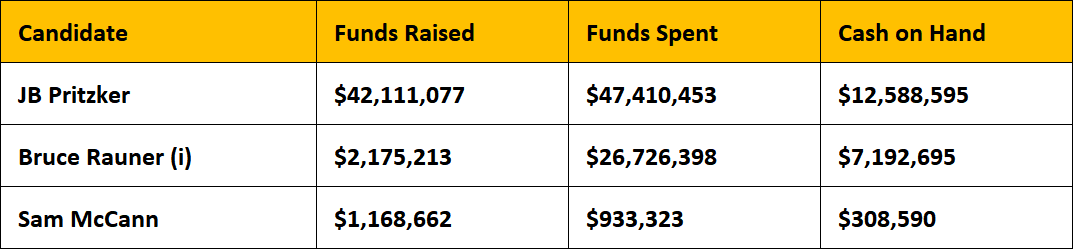
Turn on the TV or radio or surf the Web, and you will likely see or hear a J.B. Pritzker ad. Given Pritzker’s massive self-funded advertising budget, nobody in the Land of Lincoln can escape the Democratic gubernatorial candidate’s talking points. Voters have also probably noticed an increasing number of ads in the mail and across the airwaves for local candidates. Pritzker and his Republican opponent, Gov. Bruce Rauner, are the indirect source of many of those as well.
Advertising and party building are the two main expenses for Pritzker and Rauner. The candidates’ wealth makes them a major factor in races across the state.
Read a full analysis of the fundraising and spending in the gubernatorial race by clicking the chart below.
Chicago Mayor
Mayor Rahm Emanuel’s early September announcement that he would not seek re-election sent shockwaves through Chicago politics and spurred new candidates to enter the contest. Shortly after the announcement, Bill Daley, the son and brother of two former Chicago mayors; Toni Preckwinkle, Cook County Board president; and Gery Chico, former Chicago Public Schools board president, all declared their candidacy.
As the third largest city in the country, the Chicago mayoral race represents a campaign to lead a population larger than 15 states and preside over a city government with an $8.6 billion budget. The position has drawn campaign contributors from across the country vying to influence this important position. So far, more than $5 million has been raised by 12 declared candidates.
Read a full analysis of the fundraising and spending in the mayoral race by clicking the chart below.

Illinois Attorney General
The race for attorney general has seen large fundraising figures and more media attention following incumbent Lisa Madigan’s September 2017 decision not to seek a fifth term. Since the election of President Donald Trump, Democratic state attorneys general, including Madigan, have increased their role on the national stage, in part by suing the federal government to challenge Republican policies.
As a result, this race may be viewed as pivotal to either party’s ability to influence national events from Illinois. Democratic state Sen. Kwame Raoul and Republican attorney Erika Harold garnered considerable financial support from various sources, including their respective party’s gubernatorial candidates.
Read a full analysis of the fundraising and spending in the attorney general race by clicking the chart below.

Illinois Congressional Delegation
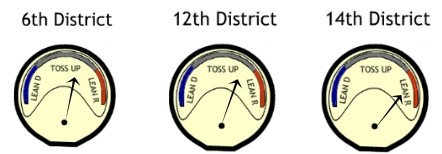
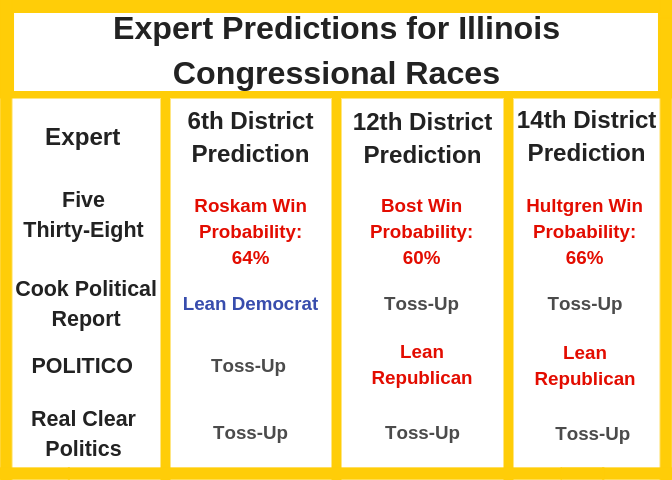
Democrats are hoping for a “blue wave” to retake the U.S. House of Representatives. Currently, Republicans control the House 235 to 193, and Democrats are targeting key GOP-held districts in Illinois as potential flips in November. Three of the district races drawing significant spending are the northwest suburban 6th, the southwestern downstate 12th, and the exurban 14th.
Last week, the Cook Political Report ranked U.S. Rep. Peter Roskam’s 6th District as “Leans Democrat” and deemed U.S. Rep. Mike Bost’s 12th District and U.S. Rep. Randy Hultgren’s 14th District to be “Toss-Ups.” While other analysts are slightly more optimistic about Republican chances, these seats have garnered enough national attention to draw a recent campaign visit by Vice President Mike Pence. Read about these races here.
By Sara Dady and Michael Rothman
Posted Oct 14, 2018 at 1:00 PM
Less than a year ago, U.S. Rep. Adam Kinzinger and his Republican colleagues in the House voted for a tax bill that gave over a trillion dollars in tax cuts to millionaires, billionaires and wealthy corporations.
With a country facing so many important and expensive problems, from out-of-control health care costs to a crumbling infrastructure to a woefully underfunded education system, this Congress decided that tax cuts for the rich were their No. 1 priority. They made their choice, and this November, voters in Illinois’ 16th District have a choice of their own to make. Do they want a Congress that’s going to help working families, or do they want one that’s going to focus on making the rich richer?
This Congress has shown that it cannot be trusted to act with the interests of average American families in mind. Despite what many of them claim, last year’s tax bill wasn’t a middle-class tax cut, it was a massive handout to the ultra-wealthy.
Take it from one of us, a wealthy businessman who knows better than most just how much preferential treatment the top 1 percent get in this new Republican tax code: the entire thing was designed to funnel even more money towards those at the top, money that we don’t need. With 83 percent of the bill’s $1.9 trillion in tax cuts projected to go to the top 1 percent, there’s barely more than crumbs left for the rest of the population. And instead of leading to higher wages for workers, the huge corporate tax cuts in this bill have led to higher bonuses for CEOs and nearly $1 trillion in stock buybacks that just make wealthy investors richer.
Even worse, the Republican tax bill doesn’t just give too much to the wealthy and too little to working families — it actually makes life harder, and sicker, for millions of Americans. In order to free up more money for corporate tax cuts, Republicans eliminated the Affordable Care Act’s individual mandate, deliberately sabotaging American healthcare markets. With this change, the nonpartisan Congressional Budget Office estimates that the Republican tax bill will, over the next decade, cause 13 million fewer Americans to have health insurance and increase premiums by as much as an additional 10 percent each year. Rising healthcare costs are already hurting Illinois families, and if Republicans in Congress get their way, things are about to get much worse.
House Republicans are already using the deficit that they themselves created as an excuse to make massive cuts to programs that millions of Americans rely on. But don’t take our word for it, look at what they themselves have proposed. Earlier this year the Republican House budget proposal, their vision for what government spending “should” look like, included over $500 billion in cuts to Medicare and $1.5 trillion in cuts to Medicaid and other health programs, all in the name of fiscal responsibility.
There’s nothing responsible about giving away $2 trillion in tax cuts to millionaires and corporations and then trying to pay for it by taking healthcare away from poor and elderly Americans who rely on those programs to survive. Those are massive cuts to programs that are absolutely essential to modern American life, and there’s simply no world in which this is an acceptable tradeoff to the American people or the people of Illinois’ 16th.
With rising healthcare costs and Medicare and Medicaid in jeopardy, thousands of families in Illinois’ 16th District are at risk of losing access to life-saving treatment because Adam Kinzinger and his colleagues in Washington decided that their health was less important than corporate profits. This is unacceptable. Health care is already too expensive for too many Illinoisans without our elected officials working against us. We need a Congress focused on making health care cheaper and more accessible, not taking it away from the most vulnerable among us.
Simply put, last year’s Republican tax bill was a disaster for our country that we can’t afford to repeat. This Congress, Rep. Kinzinger included, has shown itself to be either incapable or unwilling to actually work to make life better for normal Americans. We need legislation coming out of Washington that puts working families first, not their billionaire donors. It’s time we had a government that worked for the people, and to get there, we need new leadership in Congress.
Sara Dady of Rockford is the Democratic candidate for U.S. representative in the 16th district. Michael Rothman is CEO of Conger Management and a member of the Patriotic Millionaires.
Above is from: http://www.rrstar.com/opinion/20181014/their-view-tax-cuts-for-rich-health-care-cuts-for-everyone-else


