Saturday, September 29, 2018

Sosnowski works to lower the wages of Illinois’ skilled tradespeople


Rockford Register Star


Opinion

Letter: Rep Sosnowski works to lower the wages of Illinois’ skilled tradespeople


Posted Sep 28, 2018 at 6:45 PM Updated Sep 28, 2018 at 6:45 PM

In a letter read to the Boone County Board last week, Representative Joe Sosnowski, IL-69th District, detailed the ways he has tried and failed to weaken or end Illinois’ Prevailing Wage law. In short, the law states when biding to be the contractor/subcontractor on a public works project you must pay skilled workers the wage most common in the area of the project as set by the state. Contractors must keep proof they’ve done so or pay a financial penalty.

He points to HB 3675 with pride as an example of his efforts. Amongst a laundry list of items in the bill is one item where building schools would be exempt from prevailing wage laws. Generally, tradespeople who are willing to work for less than the prevailing wage are less skilled or experienced. Tradespeople who are less experienced make more mistakes. Who wants their child in a school built by less-skilled workers?

Rather than paying a wage that increases buying power and increases taxes paid, Rep. Sosnowski favors paying in wasted materials and delays. When paying less than the prevailing wage taxpayers pay more because some workers are forced to rely on food stamps and other government assistance. The Boone County Board should be focused on paying wages that allow our citizens to prosper helping our county grow. What Rep .Sosnowski favors increasing profits for construction companies by Illinois subsidizing them and keeping tradespeople from earning a fair day’s pay for a fair day’s work.

— Wendy LaFauce, Belvidere

Above is from:  http://www.rrstar.com/opinion/20180928/letter-rep-sosnowski-works-to-lower-wages-of-illinois-skilled-tradespeople

Friday, September 28, 2018

Why US public transportation is so bad — and why Americans don’t care


How American mass transit measures up against the rest of the world’s.

By Aditi Shrikantaditi.shrikant@voxmedia.com Sep 26, 2018, 6:30am EDT


 Mass transit ridership has decreased in every major US city except New York.

The US has bad public transit, but you probably already know that. While some cities do have impressive webs of efficient rail, for the most part, we are a car-dependent society because Americans largely don’t understand how transit should work and see no need to prioritize it.

So what it would take to bring US transit up to par? To answer that question, you have understand the differences between US transit systems and those in the rest of the world.

The state of American public transportation

According to a recent study, New York is the only US city with a significant rail network where ridership has increased since 2012 — in several other US cities included in the survey, ridership fell. Already, North America carries the fewest rail passengers per year of any world region, only accounting for 3.7 billion of the 53 billion passengers worldwide. Ridership in Asia increased by 9 billion to 26 billion between 2012 and 2017; Europe now accounts for 10 billion riders, and Latin America 6 billion.

While there are major American cities with popular public transit systems, they’re often northern and coastal, like Washington, DC, New York City, Chicago, Boston, San Francisco, and Seattle. The only Southern city to rank within the top 25 cities with good transit systems is Houston, Texas, even though many large Southern cities like Dallas and Atlanta have traffic congestion problems.

Existing mass transit systems are plagued with safety and function problems; just this week, San Francisco officials who rode the light rail to the city’s Transit Week kickoff event were held up when trains broke down on two Muni lines. And the Chicago Tribune reported that CTA bus drivers have noticed an uptick in passenger violence.

Transit problems have roots in politics too. A recent Times article followed Koch-financed activists in Nashville who went door to door, recruiting locals to vote down plans to build light-rail trains, a traffic-easing tunnel, and new bus routes as part of the Koch brothers’ goals of lowering taxes and shrinking the government. (It also benefits the Koch brothers’ companies which produce gasoline and asphalt, and make seat belts, tires, and other automotive parts.)

Joseph Stromberg reported for Vox that Americans view public transit as a welfare system for those who can’t afford to drive. And, of course, many see it as a party issue where conservative align themselves with the freedom of the automobile and liberals the benefits of the train.

What other cities are getting right about public transit

The most common myth on why Americans doesn’t have great mass transit is that the country is too spread out, but a look at Canada quickly unravels this theory. Toronto, Montreal, and Vancouver all have buses, rapid transit, and commuter rails. Though sprawling, Canada still manages to have adequate transport in all its major cities. According to the aforementioned study, Canada ridership grew significantly between 2012 and 2017.

Jarrett Walker, a consultant in public transit network design, says that Canadians have more widespread, consistent service, which means more voters care about transit systems and more policy makers understand how they work.

“I tend to find when I’m working in the US, I spend a lot more time explaining the fundamentals,” Walker says. “But when I’m working in comparable city in Canada, I find that I need to do less of that because there is more understanding on the part of everyone at the table.”

Walker also says most American customers mistakenly prioritize reach over frequency; they want buses or trains everywhere, on every block, as opposed to a few trains that come all the time. “There is a distinctly American idea to have infrequent trains from the suburb into the city,” he says. “That’s an example where you put a line on map and people say, ‘Oh, [transit] exists,’ and someone who doesn’t understand frequency is going to think an area is being serviced when it is not.” Those who are more familiar with public transit understand that it’s better to have a few lines with frequent trains, rather than many lines that leave once every two hours.

Another reason the US lags behind when it comes to improving and building mass transit may be what Robert Cervero calls “delayed modernization.” Cervero, a professor emeritus of regional and city planning at University of California Berkeley, says that in many Asian countries, the trains were built or updated in the ’90s and 2000s, allowing the integration of sophisticated systems. (Four of the five busiest metro systems worldwide are in Asia: Tokyo, Shanghai, Beijing, and Seoul.)

DC’s subway system was the most recent in the US to be fully built out, and the final pieces of its initial system were placed in 2001. According to Governing.com, no major city has expressed interest in building a subway system since this time, but many have opted for light rails, which do provide transportation but can’t accommodate the volume of passengers that a subway can.

“We’ve been in a political quagmire [over US public transport] for 25 years; meanwhile, China has built miles of high-speed railway,” Cervero says. One example of this effort is the Speed-Up Campaign, a 10-year initiative by China’s Ministry of Railways that sought to improve the speed of railways. From 1997 to 2007, the country converted 4,800 miles of track, increasing the average speed of a commercial train from 30 miles per hour to 100.

A CityLab article broke down how Europeans get to work, noting that increased ridership in Europe has less to do with population density than with “a combination of wealth and closeness to power that gets a city endowed with a public transit system good enough to attract large majorities of workers.”

According to CityLab, in capitals like Lisbon and Dublin, less than 30 percent of commuters use public transit, but in a smaller metro area like Vienna, 74 percent of commuters use public transit. In the 1950s, Europe also spent much more money preserving its systems, whereas America demolished them and invested in highways (though Cervero notes that suburbs of cities like London and Paris are less transit-centric).

How to meaningfully improve public transportation

Although 2018 birthed some new transit projects in the US, including a high-speed rail line from New Haven to Hartford, Connecticut, and the TEXRail, which will travel from downtown Fort Worth to DFW Airport, major improvement is unlikely without changes at the policy level.

Walker says the way to get more ridership is to provide service so people understand how it works and what they are investing in. “I’m not saying Americans are stupid,” he says. “It’s understandable, considering there is so much less transit, that they don’t get it.”

But Cervero says it has more to do with the economy. He believes a rise in gas prices, or “auto disincentives,” would drive up ridership more than creating more mass transit. This could look like the low-emissions zone in London, where cars are charged a fee for driving in a select area in order to limit pollution and traffic. There could also be a limit to how much car ownership growth is allowed per year, like in Singapore. Cervero suggests that even those who support investing in public transit don’t always walk the walk (or ride the ride?), and rarely is investment in public transit an effective political bargaining chip.

“You ask the typical liberal on the street and they are pro-public transit, but when push comes to shove, the money generally doesn’t end up there,” he says. “They would like to see more public transit to clean the air and decongest the roads and help the poor, but when it comes to trip-to-trip decision-making, most people weigh the choices and just end up driving

Above is from:  https://www.vox.com/the-goods/2018/9/26/17903146/mass-transit-public-transit-rail-subway-bus-car

American Bar Association: Delay Kavanaugh Confirmation Vote Until FBI Investigates


American Bar Association: Delay Kavanaugh Confirmation Vote Until FBI Investigates

HuffPost Nick Visser,HuffPost 52 minutes ago


The American Bar Association late Thursday called on the Senate Judiciary Committee to delay a confirmation vote on Supreme Court nominee Brett Kavanaugh until an FBI investigation can be completed into several claims of sexual misconduct.

“We make this request because of the ABA’s respect for the rule of law and due process under law,” reads the letter, a copy of which was obtained by HuffPost. “The basic principles that underscore the Senate’s constitutional duty of advice and consent on federal judicial nominees require nothing less than a careful examination of the accusations and facts by the FBI.”

The move is extraordinary in that the ABA gave Kavanaugh a unanimous “well-qualified” rating for the Supreme Court nomination, and the federal judge has boasted that he was “thoroughly vetted” by the lawyers’ group.

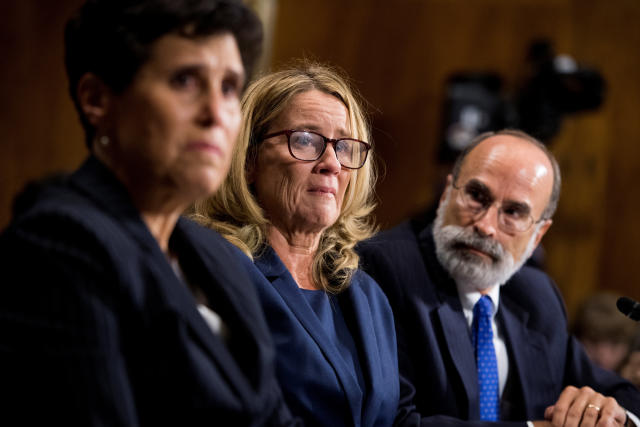
The letter, signed by ABA President Robert Carlson, came just hours after Kavanaugh testified before the judiciary panel in light of recent allegations that he sexually assaulted Christine Blasey Ford at a gathering when they were both teenagers in the 1980s. Blasey, who also spoke on Thursday, claimed that a young Kavanaugh pinned her to a bed, attempted to take off her clothes and put his hand over her mouth to the point that she thought he was “accidentally going to kill” her.

Kavanaugh has vehemently denied the allegation, telling lawmakers on Thursday that the claim, alongside those of two other women, were “a calculated and orchestrated political hit fueled with apparent pent-up anger about President Trump and the 2016 election.”

Christine Blasey Ford gave emotional but restrained testimony in front of the Senate Judiciary Committee on Thursday. (Tom Williams/Pool via REUTERS)

Republican members of the judiciary commitee said they still planned to move forward with a vote on Kavanaugh’s confirmation Friday morning. After the tally, the nomination will move to a procedural vote in the full Senate on Saturday, although it’s unclear if the judge has the 50 votes needed to open debate on his confirmation on the chamber floor.

The ABA signaled in its letter that the nomination process was being rushed through without an appropriate investigation, effectively siding with Democrats who have called for the Justice Department to look into Blasey’s claims. 

“Each appointment to our nation’s Highest Court (as with all others) is simply too important to rush to a vote,” the letter, shown above, says. “Deciding to proceed without conducting additional investigation would not only have a lasting impact on the Senate’s reputation, but it will also negatively affect the great trust necessary for the American people to have in the Supreme Court.”

It concludes: “It must remain an institution that will reliably follow the law and not politics.”

Thursday, September 27, 2018

Belvidere looks to tax out-of-state gas suppliers


image

By Susan Vela
Staff writer

Posted Sep 26, 2018 at 6:12 PM Updated at 4:52 PM

BELVIDERE — Officials are considering a proposal that would allow the city to tax natural gas purchased from out-of-state suppliers, a move that could generate $1 million a year.

“That’s a lot of road projects. That’s a lot of storm sewer work that could be done,” said Becky Tobin, the city’s budget and finance officer. “This has just been a loophole. It’s a loophole that we’re trying to close.”

The proposal would require natural gas consumers who buy from out of state to pay a certain number of cents per therm used. A therm is a unit of heat. Nicor Gas customers relying on in-state suppliers would continue paying a 5 percent tax.

Nicor Gas is the only natural gas distributor in Belvidere. The city collects a 5 percent tax from Belvidere addresses relying on in-state suppliers, a tax permitted by the Illinois Municipal Code.

Gas transported by interstate pipelines is considered interstate commerce, and the Illinois Municipal Code does not give Belvidere the right to tax out-of-state suppliers, said Michael Drella, the city attorney.


“There’s a loophole here,” Belvidere Mayor Mike Chamberlain said.

Belvidere officials hope they can use the city’s home rule authority to close the loophole. Home rule gives cities of more than 25,000 people expanded authority to tax and regulate themselves.

“We have to do our homework,” Drella said.

Rockford, a non-home rule community, hasn’t calculated the percentage of natural gas customers who choose out-of-state suppliers and how much the city is losing.

“We’re aware of this situation,” Rockford Finance Director Carrie Hagerty said.

Increasing revenues for capital improvements has been one of Belvidere’s priorities in recent months. Council members approved a new 2-cent-per-gallon gas tax and a sales tax increase.

Some city officials were shocked Monday to hear a report delivered by Scott Shamberg of Chicago-based Azavar Government Solutions, which, according to its website, ensures municipalities receive “every penny due to them from taxes, franchise fees and utility providers.”

Shamberg said there are a growing number of Illinois entities purchasing natural gas from out-of-state suppliers — perhaps 75 percent of Belvidere’s users.

“They’re not paying the same tax that their neighbor is,” Shamberg said. “That’s creating inequality.”

The state deregulated the natural gas industry in 2002, allowing purchase of gas in other states.

Susan Vela: 815-987-1392; svela@rrstar.com; @susanvela

Above is from:  http://www.rrstar.com/news/20180926/belvidere-looks-to-tax-out-of-state-gas-suppliers

Sunday, September 23, 2018

Looped RR Grain Spur in Bonus Township?


image


Posted Sep 22, 2018 at 10:00 AMUpdated Sep 22, 2018 at 10:20 PM

BONUS TOWNSHIP — Bo DeLong wants to build a Union Pacific rail connection in Boone County that will allow local farmers to transport their grain more quickly to customers in the southern United States and Mexico.

The owner of DeLong Co. Inc. in Clinton, Wisconsin, promises quicker delivery for local farmers without any disruptive noise or traffic issues for neighbors living in the shadows of the 122-acre project’s five grain bins, grain elevator and looped rail track.

He has submitted plans to Boone County officials, who are now considering a special-use permit, along with other requests, so DeLong can connect to the Union Pacific rail lines. Across the nation, grain shuttle trains have been replacing older methods of delivery that include trains carrying other products besides grain.

Deliveries can take two weeks because of stops and starts. The trains DeLong would fill would get to their destinations in two to three days.

“This ... is so much more efficient,” DeLong said. “There’s no switching cars in between.”

Boone County’s Zoning Board of Appeals advanced DeLong’s special-use permit, text amendment and variance requests Monday. DeLong will next state his case to the Planning, Zoning and Building Committee. Then it goes to the County Board.

Board Chairman Karl Johnson favors the project, commending DeLong for committing millions of dollars for construction, which could begin later this year.

If the project is approved, nonstop shuttle trains would begin arriving in May at the site on the northwest corner of U.S. 20 and Garden Prairie Road.

“It’s an exciting time in Boone County,” Johnson told the ZBA members Monday. “This is a great opportunity. It’s a big, big step and a great opportunity for us as a whole community.”

DeLong Co. Inc. began operations nearly 90 years ago to build one of the largest elevator/feed mills in the state. The company now has facilities in seven states and employs more than 300 people.

DeLong’s northeast Illinois operations entail seven grain elevators and two container export facilities. Its Garden Prairie and Marengo facilities are within miles of the Union Pacific rail lines.

Grain from local farmers would pile up in the silos. The 110-car trains would start arriving, spending about 12 to 15 hours to load. A total of about 27 loads would take place per year.

Having the new rail loop would reduce the need for transporting some of the grain by truck. Company officials estimate 1.2 million less miles by truck transportation per year.

County Board member Denny Ellingson has farmed grains. He has no profound problems with DeLong’s plans, but he would like to do some more research about how close the rail track should be to property lines.

Right now, the proposal involves 20-foot setbacks on all sides except to the south.

“Their plan is fine,” he said. “It could actually help Boone County. (But) I’ve really got to study it more.”

Neighbors don’t seem to mind.

“This noise is going to be no worse,” said Mary Brubach, owner of Susie’s Garden Patch in Garden Prairie. “It will actually be better than the Chrysler train that currently comes by there. We are completely in favor of having this railroad loop there.”

Susan Vela: 815-987-1392; svela@rrstar.com; @susanvela

Above is from:  http://www.rrstar.com/news/20180922/boone-countys-bonus-township-could-get-looped-rail-track

Saturday, September 22, 2018

Congressman Kinzinger backed ‘backdoor attack on Social Security’

image

To the editor:

Earlier this year, Rep. Kinzinger voted for the so-called Balanced Budget Amendment. On the surface this might seem like a good idea, but in reality it is actually a backdoor attack on Social Security. Let me explain.

By design, the Social Security Trust Fund has built up a reserve account for the time when “baby boomers” start retiring in record numbers and put a large demand on the Social Security system. This planning goes back to President Reagan when responsible parties saw the need for additional revenue in the future and raised Social Security taxes to provide for it.

This reserve account was built up over time by lending money every year to the federal government in the form of treasury securities backed by the full faith and credit of the United States government. Those of us who have paid into the Social Security Trust Fund over decades have built up a huge reserve fund of $2.9 trillion today to cover future needs.

Well, the future is almost here, and that money will be needed soon to help pay full Social Security benefits for retirees like me. However, the Balanced Budget Amendment proposes that federal expenses for a given year cannot exceed federal taxes received in that year. Therefore, the Social Security reserves could not be used to help pay current benefits because they were collected in previous years.

The net effect is that Social Security would not be allowed to use its own $2.9 trillion savings account that was created exactly for this purpose! This, in turn, would force cuts in Social Security payments because there would not be enough money to pay full benefits without using some money from the reserves.

This is obviously wrong. Seniors would be denied their full, earned benefits that have been fully paid for over a lifetime of work. A bill like the Balanced Budget Amendment is so bad that it should not even see the light of day in the United States Congress.

Fortunately, this bill, which was supported by Congressman Kinzinger, did not pass. But it raises the disturbing question: who does he represent? Clearly, Adam Kinzinger does not represent seniors.

Barry J. Mayworm

Princeton

Above is from:  http://www.bcrnews.com/2018/09/20/congressman-backed-backdoor-attack-on-social-security/akzgdh9/

Boone County Board approves third solar farm, they say 10 more in the works


image


News

Boone County Board approves third solar farm, they say 10 more in the works

By:

Posted: Sep 19, 2018 10:57 PM CDT

Updated: Sep 19, 2018 10:57 PM CDT


BOONE COUNTY - As concerns over global climate change and limited resources rise, the race to provide renewable energy has come to Illinois. In the Stateline, companies pitch their plans to make local fields the source of that energy.
The Boone County Board is among many other local counties to be inundated with solar farm applications. County leaders tell us if green energy comes to the Stateline -- it could mean more money for local governments.

Wednesday, a third solar farm was approved by the Boone County Board. The project is one of thirteen applications. Some board members say it's been surprising to see the amount of interest they're receiving.

"However they have to come get approval here [first]," said Boone County Board Denny Ellingson. "[That's] before they can get on the state list to even be in the lottery drawing to determine who will put up solar farms next summer."

Ellingson says the applications are in land all over Boone County.

"One in the northern end of the county," said Ellingson. "The one that got approved a month ago is out near the fairgrounds."

County Board Member Marshall Newhouse says with every vote, they learn something about the relatively unknown energy concept. Because of the uncertainty, he says the board is being very careful as they review each proposal.

"Since as of today, we do not have specific code regulating these projects," said Newhouse. "We are definitely taking them case by case."

Newhouse says according to the developers, solar farms could mean a huge jump in property tax revenue.

"The taxes could be anywhere in the area of 7-10 times per acre what the county and the taxing bodies have been used to getting."

Newhouse says the county wouldn't be the only one's reaping economic benefit from solar farms.

"To the farmer, it is a different and additional source of income," said Newhouse. "For those acres, that are going to be devoted to the project, it's probably going to be quite lucrative for them."

County board members say they're listening to any resident concerns through the process as well. One controversial 200-acre proposal is up for a full county board vote on October 3rd.

Above is from:  https://www.mystateline.com/news/boone-county-board-approves-third-solar-farm-they-say-10-more-in-the-works/1461001373