Tuesday, September 18, 2018

Boone County ZBA OKs 200-acre solar farm

Boone County ZBA OKs 200-acre solar farm

MOST POPULAR

13


Sep 15 at 10:09 PM

9

By Susan Vela
Staff writer

Posted Sep 17, 2018 at 10:47 PMUpdated Sep 17, 2018 at 10:51 PM

BELVIDERE — A proposed 200-acre solar farm — the largest solar power development that’s been pitched in Boone County so far — advanced out of the Zoning Board of Appeals Monday with a whopping 42 conditions.

Included was one where nearby homeowners selling their properties could challenge their appraisals and demand monetary compensation from solar developer Hendricks Solar LLC if the appraisals weren’t to their liking.

“The question is, ‘Will they still proceed with these conditions?’” said Boone County Board member Cathy Ward,who attended the meeting as an observer.

Cypress Creek Renewables of North Carolina indirectly owns Hendricks Solar LLC, which wants to invest $36.4 million to build a solar farm near the intersection of Genoa and Reeds Crossing roads. The project would generate enough power for 2,900 to 3,000 homes.

″(The conditions are) definitely more than we’re accustomed to,” Project Developer Scott Novack said after the ZBA’s 3-1 vote in favor of the project. “We’ll be reviewing them in detail.”


He hopes Hendricks Solar can begin construction by 2020. Construction should take up to 26 weeks.

The company’s proposed solar farm is forecast to generate more than $129,000 in annual property tax revenue. County officials say most of that revenue would aid public schools, though about 10 percent would flow into county coffers.

Request for a special-use permit next goes to the Planning, Zoning & Building Committee, as does the county’s proposed solar ordinance.

Zoning Board of Appeals member Joan Krumm cast the lone nay vote against Hendricks Solar’s request.

Zoning Board of Appeals members did not come to consensus on a solar ordinance that would lay out rules and regulations for solar development proposals. Without a guiding ordinance, the ZBA has been dealing with solar development requests on a case-by-case basis. The solar ordinance received a 2-2 vote, which meant it failed. It still goes to the PZB for consideration. Voting for the solar ordinance were Tony Savino and Brad Fidder. Voting against were Krumm and Steve Schabacker.

Susan Vela: 815-987-1392; svela@rrstar.com; @susanvela

Above is from:  RRSTAR


Boone County Zoning Board of Appeals recommends solar farm

By Courtney Bunting |

Posted: Mon 10:22 PM, Sep 17, 2018  |

Updated: Tue 4:28 AM, Sep 18, 2018

BELVIDERE, Ill. (WIFR) -- The Boone County Zoning Board of Appeals recommended a 200-acre solar farm Monday night.

Developers Cypress Creek Renewables will have to abide by 42 conditions, according to the board's recommendations on Monday.

People living near the development site discussed concerns tonight about a potential decrease in property values and quality of land.

However, developers say they prioritize maintaining quality of land and property and don't think the solar farm will harm those things.

This could be Boone County's largest solar farm. It would be located at the northeast corner of Reeds Crossing and Genoa Road.

The company will have to abide by strict guidelines laid out by the Zoning Board of Appeals tonight.

"So we've had appraisal firms all over the country weigh in on this, and they have a very methodical way of evaluating the impact of property values that are adjacent to various uses. But especially solar, and what they've found, very consistent with the studies they've done in Illinois and Indiana, is that there is no negative impact," said Cypress Creek Renewables Senior Developer Scott Novack.

One of the proposals Cypress Creek Renewables said they would consider tonight would be covering the difference between any changes in property values.

The Boone County Board will consider this solar farm on October 17th at their full board meeting.

If it's approved, developers say it could take around 22 to 26 weeks to construct and would start in either 2019 or 2020.

Above is from:  https://www.wifr.com/content/news/Boone-County-Zoning-Board-of-Appeals-recommends-solar-farm--493548001.html

Tuesday, September 11, 2018

Americans Want to Believe Jobs Are the Solution to Poverty. They’re Not.


image


U.S. unemployment is down and jobs are going unfilled. But for people without much education, the real question is: Do those jobs pay enough to live on?


By Matthew Desmond

  • Sept. 11, 2018

  • Vanessa Solivan and her three children fled their last place in June 2015, after a young man was shot and killed around the corner. They found a floor to sleep on in Vanessa’s parents’ home on North Clinton Avenue in East Trenton. It wasn’t a safer neighborhood, but it was a known one. Vanessa took only what she could cram into her station wagon, a 2004 Chrysler Pacifica, letting the bed bugs have the rest.

    At her childhood home, Vanessa began caring for her ailing father. He had been a functional crack addict for most of her life, working as a landscaper in the warmer months and collecting unemployment when business slowed down. “It was something you got used to seeing,” Vanessa said about her father’s drug habit. “My dad was a junkie, but he never left us.” Vanessa, 33, has black hair that is usually pulled into a bun and wire-framed glasses that slide down her nose; a shy smile peeks out when she feels proud of herself.

    Vanessa’s father died a year after Vanessa moved in. The family erected a shrine to him in the living room, a faded, large photo of a younger man surrounded by silk flowers and slowly sinking balloons. Vanessa’s mother, Zaida, is 62 and from Puerto Rico, as was her husband. She uses a walker to get around. Her husband’s death left her with little income, and Vanessa was often broke herself. Her health failing, Zaida could take only so much of Vanessa’s children, Taliya, 17, Shamal, 14, and Tatiyana, 12. When things got too loud or one of her grandchildren gave her lip, she would ask Vanessa to take her children somewhere else.

    If Vanessa had the money, or if a local nonprofit did, she would book a motel room. She liked the Red Roof Inn, which she saw as “more civilized” than many of the other motels she had stayed in. It looked like a highway motel: two stories with doors that opened to the outside. The last time the family checked in, the kids carried their homework up to the room as Vanessa followed with small grocery bags from the food pantry, passing two men sipping Modelos and apologizing for their loud music. Inside their room, Vanessa placed her insulin in the minifridge as her children chose beds, where they would sleep two to a mattress. Then she slid into a small chair, saying, “Y’all don’t know how tired Mommy is.” After a quiet moment, Vanessa reached over and rubbed Shamal’s back, telling him, “I wish we had a nice place like this.” Then her eye spotted a roach feeling its way over the stucco wall.

    “Op! Not too nice,” Vanessa said, grinning. With a flick, she sent the bug flying toward Taliya, who squealed and jerked back. Laughter burst from the room.

    When Vanessa couldn’t get a motel, the family spent the night in the Chrysler. The back of the station wagon held the essentials: pillows and blankets, combs and toothbrushes, extra clothes, jackets and nonperishable food. But there were also wrinkled photos of her kids. One showed Taliya at her eighth-grade graduation in a cream dress holding flowers. Another showed all three children at a quinceaƱera — Shamal kneeling in front, with a powder blue clip-on bow tie framing his baby face, and Tatiyana tucked in back with a deep-dimpled smile.

    Image

    Vanessa Solivan at her mother’s house with Tatiyana and Shamal.CreditDevin Yalkin for The New York Times

    So that the kids wouldn’t run away out of anger or shame, Vanessa learned to park off Route 1, in crevices of the city that were so still and abandoned that no one dared crack a door until daybreak. Come morning, Vanessa would drive to her mother’s home so the kids could get ready for school and she could get ready for work.

    In May, Vanessa finally secured a spot in public housing. But for almost three years, she had belonged to the “working homeless,” a now-necessary phrase in today’s low-wage/high-rent society. She is a home health aide, the same job her mother had until her knees and back gave out. Her work uniform is Betty Boop scrubs, sneakers and an ID badge that hangs on a red Bayada Home Healthcare lanyard. Vanessa works steady hours and likes her job, even the tougher bits like bathing the infirm or hoisting someone out of bed with a Hoyer lift. “I get to help people,” she said, “and be around older people and learn a lot of stuff from them.” Her rate fluctuates: She gets $10 an hour for one client, $14 for another. It doesn’t have to do with the nature of the work — “Sometimes the hardest ones can be the cheapest ones,” Vanessa said — but with reimbursement rates, which differ according to the client’s health care coverage. After juggling the kids and managing her diabetes, Vanessa is able to work 20 to 30 hours a week, which earns her around $1,200 a month. And that’s when things go well.


    These days, we’re told that the American economy is strong. Unemployment is down, the Dow Jones industrial average is north of 25,000 and millions of jobs are going unfilled. But for people like Vanessa, the question is not, Can I land a job? (The answer is almost certainly, Yes, you can.) Instead the question is, What kinds of jobs are available to people without much education? By and large, the answer is: jobs that do not pay enough to live on.

    In recent decades, the nation’s tremendous economic growth has not led to broad social uplift. Economists call it the “productivity-pay gap” — the fact that over the last 40 years, the economy has expanded and corporate profits have risen, but real wages have remained flat for workers without a college education. Since 1973, American productivity has increased by 77 percent, while hourly pay has grown by only 12 percent. If the federal minimum wage tracked productivity, it would be more than $20 an hour, not today’s poverty wage of $7.25.

    American workers are being shut out of the profits they are helping to generate. The decline of unions is a big reason. During the 20th century, inequality in America decreased when unionization increased, but economic transformations and political attacks have crippled organized labor, emboldening corporate interests and disempowering the rank and file. This imbalanced economy explains why America’s poverty rate has remained consistent over the past several decades, even as per capita welfare spending has increased. It’s not that safety-net programs don’t help; on the contrary, they lift millions of families above the poverty line each year. But one of the most effective antipoverty solutions is a decent-paying job, and those have become scarce for people like Vanessa. Today, 41.7 million laborers — nearly a third of the American work force — earn less than $12 an hour, and almost none of their employers offer health insurance.

    The Bureau of Labor Statistics defines a “working poor” person as someone below the poverty line who spent at least half the year either working or looking for employment. In 2016, there were roughly 7.6 million Americans who fell into this category. Most working poor people are over 35, while fewer than five in 100 are between the ages of 16 and 19. In other words, the working poor are not primarily teenagers bagging groceries or scooping ice cream in paper hats. They are adults — and often parents — wiping down hotel showers and toilets, taking food orders and bussing tables, eviscerating chickens at meat-processing plants, minding children at 24-hour day care centers, picking berries, emptying trash cans, stacking grocery shelves at midnight, driving taxis and Ubers, answering customer-service hotlines, smoothing hot asphalt on freeways, teaching community-college students as adjunct professors and, yes, bagging groceries and scooping ice cream in paper hats.

    America prides itself on being the country of economic mobility, a place where your station in life is limited only by your ambition and grit. But changes in the labor market have shrunk the already slim odds of launching yourself from the mailroom to the boardroom. For one, the job market has bifurcated, increasing the distance between good and bad jobs. Working harder and longer will not translate into a promotion if employers pull up the ladders and offer supervisory positions exclusively to people with college degrees. Because large companies now farm out many positions to independent contractors, those who buff the floors at Microsoft or wash the sheets at the Sheraton typically are not employed by Microsoft or Sheraton, thwarting any hope of advancing within the company. Plus, working harder and longer often isn’t even an option for those at the mercy of an unpredictable schedule. Nearly 40 percent of full-time hourly workers know their work schedules just a week or less in advance. And if you give it your all in a job you can land with a high-school diploma (or less), that job might not exist for very long: Half of all new positions are eliminated within the first year. According to the labor sociologist Arne Kalleberg, permanent terminations have become “a basic component of employers’ restructuring strategies.”

    Home health care has emerged as an archetypal job in this new, low-pay service economy. Demand for home health care has surged as the population has aged, but according to the latest data from the Bureau of Labor Statistics, the 2017 median annual income for home health aides in the United States was just $23,130. Half of these workers depend on public assistance to make ends meet. Vanessa formed a rapport with several of her clients, to whom she confided that she was homeless. One replied, “Oh, Vanessa, I wish I could do something for you.” When Vanessa told her supervisor about her situation, he asked if she wanted time off. “No!” Vanessa said. She needed the money and had been picking up fill-in shifts. The supervisor was prepared for the moment; he’d been there before. He reached into a drawer and gave her a $50 gas card to Shell and a $100 grocery card to ShopRite. Vanessa was grateful for the help. She thought Bayada was a generous and sympathetic employer, but her rate hadn’t changed much in the three years she had worked there. Vanessa earned $9,815.75 in 2015, $12,763.94 in 2016 and $10,446.81 last year.


    To afford basic necessities, the federal government estimates that Vanessa’s family would need to bring in $29,420 a year. Vanessa is not even close — and she is one of the lucky ones, at least among the poor. The nation’s safety net now strongly favors the employed, with benefits like the earned-income tax credit, a once-a-year cash boost that applies only to people who work. Last year, Vanessa received a tax return of around $5,000, which included earned-income and child tax credits. They helped raise her income, but not above the poverty line. If the working poor are doing better than the nonworking poor, which is the case, it’s not so much because of their jobs per se, but because their employment status provides them access to desperately needed government help. This has caused growing inequality below the poverty line, with the working poor receiving much more social aid than the abandoned nonworking poor or the precariously employed, who are plunged into destitution.

    When life feels especially grinding, Vanessa often rings up Sheri Sprouse, her best friend since middle school. “She’s like me,” Vanessa said. “She’s strong.” Sheri is a reserve of emotional support and perspective, often encouraging her friend to be patient and grateful for what she has. But Sheri herself is also just scraping by, raising two daughters on a fixed disability check. And because Sheri’s housing is subsidized through a federally administered voucher, it is also monitored. “With Section 8, you can’t have people staying with you,” Vanessa said. “So I wouldn’t want to mess that up.” When Vanessa was homeless, Sheri couldn’t offer her much else besides love.

    Vanessa received some help last year, when her youngest child, Tatiyana, was approved for Supplemental Security Income because of a learning disability. Vanessa began receiving a monthly $766 disability check. But when the Mercer County Board of Social Services learned of this additional money, it sent Vanessa a letter announcing that her Supplemental Nutrition Assistance Program benefits would be reduced to $234 from $544. Food was a constant struggle, and this news didn’t help. A 2013 study by Oxfam America found that two-thirds of working poor people worry about being able to afford enough food. When Vanessa stayed at a hotel, her food options were limited to what she could heat in the microwave; when she slept in her car, the family had to settle for grab-and-go options, which tend to be more expensive. Sometimes Vanessa stopped by a bodega and ordered four chicken-and-rice dishes for $15. Sometimes her kids went to school hungry. “I just didn’t have nothing,” Vanessa told me one morning. For dinner, she planned to stop by a food pantry, hoping they still had the mac-and-cheese that Shamal liked.

    In America, if you work hard, you will succeed. So those who do not succeed have not worked hard. It’s an idea found deep in the marrow of the nation. William Byrd, an 18th-century Virginia planter, wrote of poor men who were “intolerable lazy” and “Sloathful in everything but getting of Children.” Thomas Jefferson advocated confinement in poorhouses for vagabonds who “waste their time in idle and dissolute courses.” Leap into the 20th century, and there’s Barry Goldwater saying that Americans with little education exhibit “low intelligence or low ambition” and Ronald Reagan disparaging “welfare queens.” In 2004, Bill O’Reilly said of poor people: “You gotta look people in the eye and tell ’em they’re irresponsible and lazy,” and then continued, “Because that’s what poverty is, ladies and gentlemen.”

    Americans often assume that the poor do not work. According to a 2016 survey conducted by the American Enterprise Institute, nearly two-thirds of respondents did not think most poor people held a steady job; in reality, that year a majority of nondisabled working-age adults were part of the labor force. Slightly over one-third of respondents in the survey believed that most welfare recipients would prefer to stay on welfare rather than earn a living. These sorts of assumptions about the poor are an American phenomenon. A 2013 study by the sociologist Ofer Sharone found that unemployed workers in the United States blame themselves, while unemployed workers in Israel blame the hiring system. When Americans see a homeless man cocooned in blankets, we often wonder how he failed. When the French see the same man, they wonder how the state failed him.

    If you believe that people are poor because they are not working, then the solution is not to make work pay but to make the poor work — to force them to clock in somewhere, anywhere, and log as many hours as they can. But consider Vanessa. Her story is emblematic of a larger problem: the fact that millions of Americans work with little hope of finding security and comfort. In recent decades, America has witnessed the rise of bad jobs offering low pay, no benefits and little certainty. When it comes to poverty, a willingness to work is not the problem, and work itself is no longer the solution.

    Image

    Vanessa in the living room of her mother’s house with Tatiyana.CreditDevin Yalkin for The New York Times

    Until the late 18th century, poverty in the West was considered not only durable but desirable for economic growth. Mercantilism, the dominant economic theory of the early modern period, held that hunger incentivized work and kept wages low. Wards of public charity were jailed and required to work to eat. In the current era, politicians and their publics have continued to demand toil and sweat from the poor. In the 1980s, conservatives wanted to attach work requirements to food stamps. In the 1990s, they wanted to impose work requirements on subsidized-housing programs. Both proposals failed, but the impulse has endured.


    Advocates of work requirements scored a landmark victory with welfare reform in the mid-1990s. Proposed by House Republicans, led by Speaker Newt Gingrich, and signed into law by President Bill Clinton, welfare reform affixed work requirements and time limits to cash assistance. Caseloads fell to 4.5 million in 2011 from 12.3 million in 1996. Did “welfare to work” in fact work? Was it a major success in reducing poverty and sowing prosperity? Hardly. As Kathryn Edin and Laura Lein showed in their landmark book, “Making Ends Meet,” single mothers pushed into the low-wage labor market earned more money than they did on welfare, but they also incurred more expenses, like transportation and child care, which nullified modest income gains. Most troubling, without guaranteed cash assistance for the most needy, extreme poverty in America surged. The number of Americans living on only $2 or less per person per day has more than doubled since welfare reform. Roughly three million children — which exceeds the population of Chicago — now suffer under these conditions. Most of those children live with an adult who held a job sometime during the year.

    A top priority for the Trump administration is expanding work requirements for some of the nation’s biggest safety-net programs. In January, the federal government announced that it would let states require that Medicaid recipients work. A dozen states have formally applied for a federal waiver to affix work requirements to their Medicaid programs. Four have been approved. In June, Arkansas became the first to implement newly approved work requirements. If all states instated Medicaid work requirements similar to that of Arkansas, as many as four million Americans could lose their health insurance.

    In April, President Trump issued an executive order mandating that federal agencies review welfare programs, from the Supplemental Nutrition Assistance Program to housing assistance, and propose new standards. Although SNAP already has work requirements, in June the House passed a draft farm bill that would deny able-bodied adults SNAP benefits for an entire year if they did not work or engage in work-related activities (like job training) for at least 20 hours a week during a single month. Falling short a second time could get you barred for three years. The Senate’s farm bill, a bipartisan effort, removed these rules and stringent penalties, setting up a showdown with the House, whose version Trump has endorsed. The Congressional Budget Office estimates that work requirements could deny 1.2 million people a benefit that they use to eat.

    Work requirements affixed to other programs make similar demands. Kentucky’s proposed Medicaid requirements are satisfied only after 80 hours of work or work-related training each month. In a low-wage labor market characterized by fluctuating hours, tenuous employment and involuntary part-time work, a large share of vulnerable workers fall short of these requirements. Nationally representative data from the Survey of Income and Program Participation show that among workers who qualify for Medicaid, almost 50 percent logged fewer than 80 hours in at least one month.

    In July, the White House Council of Economic Advisers issued a report enthusiastically endorsing work requirements for the nation’s largest welfare programs. The council favored “negative incentives,” tying aid to labor-market effort, and dismissed “positive incentives,” like tax benefits for low-income workers, because the former is cheaper. The council also claimed that America’s welfare policies have brought about a “decline in self-sufficiency.”

    Is that true? Researchers set out to study welfare dependency in the 1980s and 1990s, when this issue dominated public debate. They didn’t find much evidence of it. Most people started using cash welfare after a divorce or separation and didn’t stay long on the dole, even if they returned to welfare periodically. One study found that 90 percent of young women on welfare stopped relying on it within two years of starting the program, but most of them returned to welfare sometime down the road. Even at its peak, welfare did not function as a dependency trap for a majority of recipients; rather, it was something people relied on when they were between jobs or after a family crisis. A 1988 review in Science concluded that “the welfare system does not foster reliance on welfare so much as it acts as insurance against temporary misfortune.”


    Image

    Vanessa and her client Laura at Laura’s home in Hamilton, N.J.CreditDevin Yalkin for The New York Times

    Today as then, the able-bodied, poor and idle adult remains a rare creature. According to the Brookings Institution, in 2016 one-third of those living in poverty were children, 11 percent were elderly and 24 percent were working-age adults (18 to 64) in the labor force, working or seeking work. The majority of working-age poor people connected to the labor market were part-time workers. Most couldn’t take on many more hours either because of caregiver responsibilities, as with Vanessa, or because their employer didn’t offer this option, rendering them involuntary part-time workers. Among the remaining working-age adults, 12 percent were out of the labor force owing to a disability (including some enrolled in federal programs that limit work), 15 percent were either students or caregivers and 3 percent were early retirees. That leaves 2 percent of poor people who did not fit into one of these categories. That is, among the poor, two in 100 are working-age adults disconnected from the labor market for unknown reasons. The nonworking poor person getting something for nothing is a lot like the cheat committing voter fraud: pariahs who loom far larger in the American imagination than in real life.

    When Vanessa was not working for Bayada, she was running after her kids. Vanessa worried over Shamal the most. At more than six feet tall, his size made him both a tool and a target in the neighborhood. Smaller kids wanted him to be their enforcer or trouble-starter. Harder kids saw him as a threat. Last year, Shamal was suspended twice for fighting. As punishment, Vanessa made him shave off his prized Afro. But she also set her children’s outbursts against a larger backdrop. “How’s their behavior supposed to be when we’re out here on these streets?” she asked me in frustration. Shamal once told me that outsiders “probably think I’m selling drugs. But I’m not. I’m just a cool person that likes hanging out and making people laugh.” He wanted to become a chef. Vanessa wondered if she could get Shamal a police-issued ankle bracelet, which would track his movements. It was impossible, of course, but Shamal liked the idea. “It could help me when my friends want me to go somewhere,” he told me. That is, the bracelet would give him a good excuse to back down when his friends nudged him toward a risky path.

    Shamal and Tatiyana’s father had recently moved back to Trenton, “carrying a sack like a hobo,” Vanessa remembered. Other than erratic child-support payments and a single trip to Chuck E. Cheese’s, he doesn’t play much of a role in his children’s lives. Taliya’s father went to prison when she was 1. He was released when she was 8 and was killed a few months later, shot in the chest. Sometimes Vanessa’s three kids teased one another about their fathers. “Your dad is dead,” Tatiyana would say. “Yeah? Your dad’s around, but he don’t give a crap about you,” Taliya would shoot back.

    Other times, though, the siblings offered soft reassurances that their fathers’ absence wasn’t their fault. “I don’t have time for him,” Tatiyana said once, as if it were her choice. “I have time for my real friends.” Taliya looked at her baby sister and replied: “Watch. When you’re doing good, he gonna start coming around.”

    If Vanessa clocked more hours, it would be difficult to keep up with all the ways she manages her family: doing the laundry, arranging dentist appointments, counseling the children about sex, studying their deep mysteries to extract their gifts and troubles. Yet our political leaders tend to refuse to view child care as work. During the early days of welfare reform, some local authorities thought up useless jobs for single mothers receiving the benefit. In one outrageous case, recipients were made to sort small plastic toys into different colors, only to have their supervisor end the day by mixing everything up, so the work could start anew the next morning. This was thought more important than keeping children safe and fed.

    Caring for a sick or dying parent doesn’t count either. Vanessa spooned arroz con gandules into her ailing father’s mouth, refilled his medications and emptied his bedpan. But only when she does these things for virtual strangers, as a Bayada employee, does she “work” and therefore become worthy of concern. As Evelyn Nakano Glenn argues in her 2010 book, “Forced to Care,” industrialization caused American families to become increasingly reliant on wages, which had the effect of reducing tasks that usually fell to women (homemaking, cooking, child care) to “moral and spiritual vocations.” “In contrast to men’s paid labor,” Glenn writes, “women’s unpaid caring was simultaneously priceless and worthless — that is, not monetized.” She continues: “To add insult to injury, because they could not live up to the ideal of full-time motherhood, poor women of color were seen as deficient mothers and caregivers.”

    Vanessa attributed her own academic setbacks — a good student in middle school, she began cutting class and courting trouble in high school — to the fact that her parents were checked out. At a critical juncture when Vanessa needed guidance and discipline, her father was using drugs and her mother seemed always to be at work. She didn’t want to make the same mistake with her kids. Vanessa’s life revolved around a small routine: drop the kids off at school; work; try finding an apartment that rents for less than $1,000 a month; pick the kids up; feed them; sleep. She didn’t spend her money on extras, including cigarettes and alcohol. She was trying to save “the little money that I got,” she told me, “so when we do get a place, I can get the kids washcloths and towels.”

    Image

    Vanessa and Laura going to buy groceries.CreditDevin Yalkin for The New York Times

    We might think that the existence of millions of working poor Americans like Vanessa would cause us to question the notion that indolence and poverty go hand in hand. But no. While other inequality-justifying myths have withered under the force of collective rebuke, we cling to this devastatingly effective formula. Most of us lack a confident account for increasing political polarization, rising prescription drug costs, urban sprawl or any number of social ills. But ask us why the poor are poor, and we have a response quick at the ready, grasping for this palliative of explanation. We have to, or else the national shame would be too much to bear. How can a country with such a high poverty rate — higher than those in Latvia, Greece, Poland, Ireland and all other member countries of the Organization for Economic Cooperation and Development — lay claim to being the greatest on earth? Vanessa’s presence is a judgment. But rather than hold itself accountable, America reverses roles by blaming the poor for their own miseries.

    Here is the blueprint. First, valorize work as the ticket out of poverty, and debase caregiving as not work. Look at a single mother without a formal job, and say she is not working; spot one working part time and demand she work more. Transform love into laziness. Next, force the poor to log more hours in a labor market that treats them as expendables. Rest assured that you can pay them little and deny them sick time and health insurance because the American taxpayer will step in, subsidizing programs like the earned-income tax credit and food stamps on which your work force will rely. Watch welfare spending increase while the poverty rate stagnates because, well, you are hoarding profits. When that happens, skirt responsibility by blaming the safety net itself. From there, politicians will invent new ways of denying families relief, like slapping unrealistic work requirements on aid for the poor.

    Democrats may scoff at Republicans’ work requirements, but they have yet to challenge the dominant conception of poverty that feeds such meanspirited politics. Instead of offering a counternarrative to America’s moral trope of deservedness, liberals have generally submitted to it, perhaps even embraced it, figuring that the public will not support aid that doesn’t demand that the poor subject themselves to the low-paying jobs now available to them. Even stalwarts of the progressive movement seem to reserve economic prosperity for the full-time worker. Senator Bernie Sanders once declared, echoing a long line of Democrats who have come before and after him, “Nobody who works 40 hours a week should be living in poverty.” Sure, but what about those who work 20 or 30 hours, like Vanessa?

    Because liberals have allowed conservatives to set the terms of the poverty debate, they find themselves arguing about radical solutions that imagine either a fully employed nation (like a jobs guarantee) or a postwork society (like a universal basic income). Neither plan has the faintest hope of being actually implemented nationwide anytime soon, which means neither is any good to Vanessa and millions like her. When so much attention is spent on far-off, utopian solutions, we neglect the importance of the poverty fixes we already have. Safety-net programs that help families confront food insecurity, housing unaffordability and unemployment spells lift tens of millions of people above the poverty line each year. By itself, SNAP annually pulls over eight million people out of poverty. According to a 2015 study, without federal tax benefits and transfers, the number of Americans living in deep poverty (half below the poverty threshold) would jump from 5 percent to almost 19 percent. Effective social-mobility programs should be championed, expanded and stripped of draconian work requirements.

    While Washington continues to require more of vulnerable workers, it has required little from employers in the form of living wages or job security, creating a labor market in which the biggest disincentive to work is not welfare but the lousy jobs that are available. Judging from the current state of the nation’s poverty agenda, it appears that most people creating federal and state policy don’t know many people like Vanessa. “Half of the people in City Hall don’t even live in Trenton,” Vanessa once told me, flustered. “They don’t even know what goes on here.” Meanwhile, this is the richest Congress on record, with one in 13 members belonging to the top 1 percent. From such a high perch, poverty appears a smaller problem, something less gutting, and work appears a bigger solution, something more gratifying. But when we shrink the problem, the solution shrinks with it; when small solutions are applied to a huge problem, they don’t work; and when weak antipoverty initiatives don’t work, many throw up their hands and argue that we should stop tossing money at the problem altogether. Cheap solutions only cheapen the problem.


    This month, I had dinner with first-year honors students at a university in Massachusetts. Some leaned right, others left. But all of them were united in their inability to explain poverty in a way that didn’t somehow hold the poor responsible for their predicament. Poor people lacked work ethic, they told me, or maybe a strong backbone or a commitment to a better life. I began to regret that alcohol hadn’t been served when one student brought up the movie “The Pursuit of Happyness,” in which Will Smith’s character performs superhumanly well at his job to leap from homelessness to affluence. The student was no senator’s son: He told us that times were lean after his parents divorced. As I watched this young man identify with Smith’s character, it dawned on me that what his parents, preachers, teachers, coaches and guidance counselors had told him for motivation — “Study hard, stick to it, dream big and you will be successful” — had been internalized as a theory of life.

    We need a new language for talking about poverty. “Nobody who works should be poor,” we say. That’s not good enough. Nobody in America should be poor, period. No single mother struggling to raise children on her own; no formerly incarcerated man who has served his time; no young heroin user struggling with addiction and pain; no retired bus driver whose pension was squandered; nobody. And if we respect hard work, then we should reward it, instead of deploying this value to shame the poor and justify our unconscionable and growing inequality. “I’ve worked hard to get where I am,” you might say. Well, sure. But Vanessa has worked hard to get where she is, too.

    Matthew Desmond is a contributing writer for the magazine and the author of “Evicted,” which won the 2017 Pulitzer Prize for general nonfiction.

    Sign up for our newsletter to get the best of The New York Times Magazine delivered to your inbox every week.

  • Above is from:  https://www.nytimes.com/2018/09/11/magazine/americans-jobs-poverty-homeless.html

  • Saturday, September 8, 2018

    Vulnerability in America’s lower income brackets poses a risk to the economy


    Sheila Bair 4 hours ago

    Vulnerability in America’s lower income brackets poses a risk to the economy

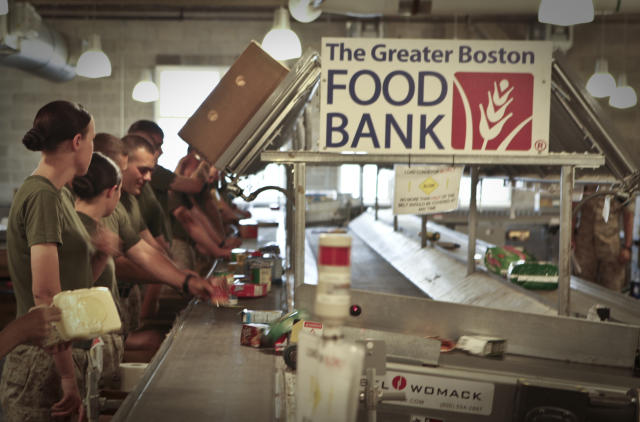
    Image: US Marines

    Sheila Bair, former chair of the FDIC, will appear at Yahoo Finance’s All Markets Summit on Sept. 20.

    There are lies, damn lies, and then there are statistics. This famous saying popularized by American humorist Mark Twain aptly describes the current use of economic statistics to paint an overly rosy picture of our economic health.

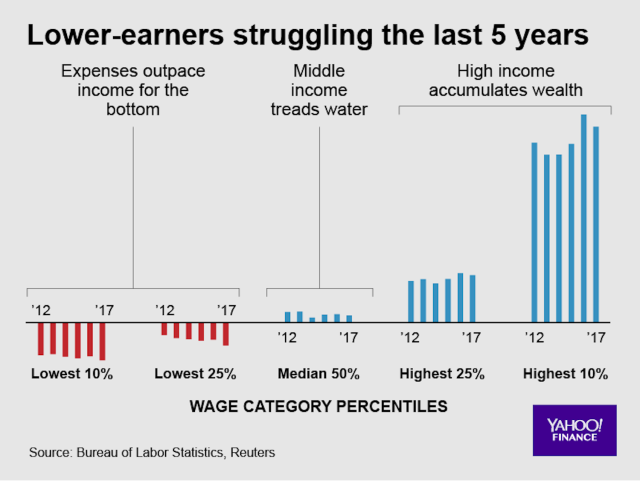
    Too often, we rely on aggregate numbers or averages which camouflage the uneven distribution of economic progress (or lack thereof) among lower income families. For instance, the use of aggregates in calculating GDP masks the fact that those economic gains remain heavily skewed toward the rich. Similarly, the use of averages in reporting wage gains conceals distortions caused by booming wages among higher paid workers and the fact that by traditional measures, hourly real wages for most middle-class workers have slightly declined.

    Credit: David Foster/Yahoo Finance

    This same type of distortion was at work in some recent Wall Street analysis of statistics released by the New York Fed on household borrowing. The NY Fed reported that household borrowing had hit a new peak of $13.29 trillion in the second quarter of 2018, far surpassing its peak of $12.68 trillion in the frothy years preceding the financial crisis. Some analysts argued that this was actually good news because while household borrowing was up, so was consumers’ disposable (after-tax) income, which hit $15.46 trillion in the second quarter.

    This put the debt-to-income ratio (DTI) at 86%, significantly lower than its all-time high of 116% in 2008 at the peak of the housing bubble. Thus, American households were financially healthy and had plenty of room to borrow even more, or so the argument went.

    Lower-income groups have more trouble paying off debt

    It is true that household debt in nominal dollars doesn’t tell you whether American households are over-extended without comparing that debt to the income available to repay it. However, to use the go-go years leading up to the crisis as the benchmark for sustainable rates of household borrowing is questionable, to say the least. In fact, household DTI’s were substantially lower than today’s levels throughout the post-war years. It wasn’t until the early 2000s that they started to escalate with the subprime lending craze. So by historical norms, even at 86%, household DTIs are quite high.

    More importantly, aggregate debt-to-income ratios tell us little about the affordability of that debt among various income levels. Rich people may be borrowing a lot but then, they can afford it. Lower income households living near subsistence have scant capacity to absorb any debt. Unfortunately, detailed data about household borrowing among income groups is notoriously difficult to obtain.

    Credit: David Foster/Yahoo Finance

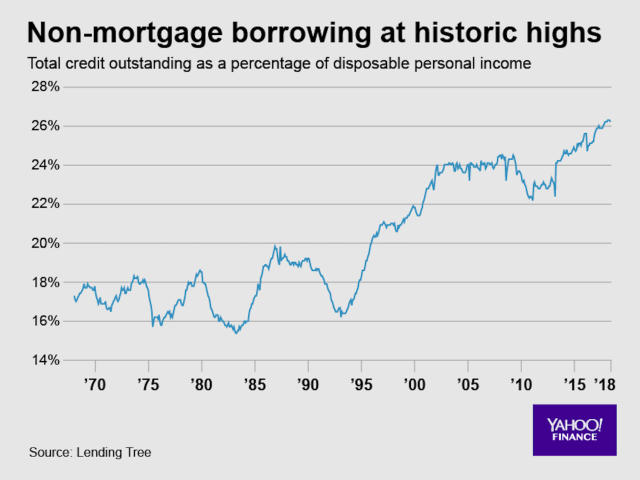
    The New York Fed does provide some data on household debt growth rates by income level. This data show that non-mortgage household borrowing (primarily credit cards, auto, and student loans) has grown significantly over the past 5 years among lower income families, while mortgage loans have declined. Mortgage lending standards have tightened since the crisis, but now those families may be getting in over their heads with non-mortgage borrowing. Indeed, non-mortgage debt has grown by a whopping 38% over the past 5 years and its ratio to disposable income is even higher than during the pre-crisis years.

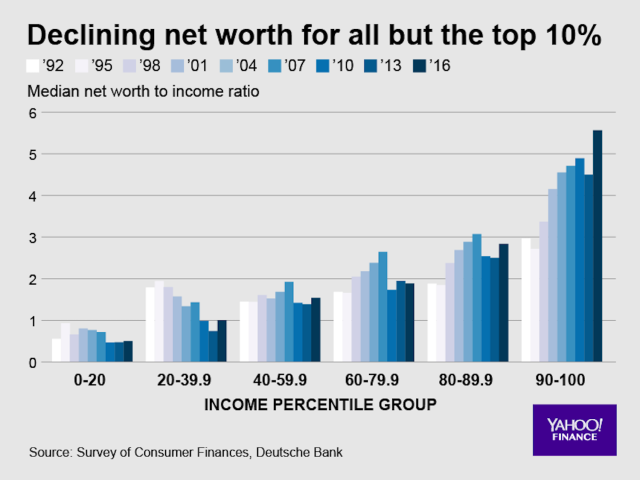
    Another statistic Wall Street analysts have cited to argue that American households are not over-borrowing is the sharp increase in household net-worth relative to income, a common measure of balance sheet health. However, here again, to get an accurate picture, you must get behind aggregate numbers and look at the distribution of wealth by income level.

    Credit: David Foster/Yahoo Finance
    A more sophisticated analysis by Deutsche Bank found that net-worth to income ratios are distorted by rich households who have benefited mightily from appreciating home prices and an exuberant stock market. Net-worth to income ratios have actually fallen for households at all income levels except for the top 10%. The Deutsche analysis also found that “leverage”— the ratio of a family’s debt to its assets — had increased significantly for households in the bottom 40% of income, while decreasing for families in the upper income tiers. Given the massive loss of home ownership following the crisis among low- and middle-income families and their lack of equity ownership, they now have little in the way of assets to buffer them against financial stress. These lower income families are more fragile than ever, suffering from increased debt, stagnant or declining wages, and lack of assets.

    Credit: David Foster/Yahoo Finance

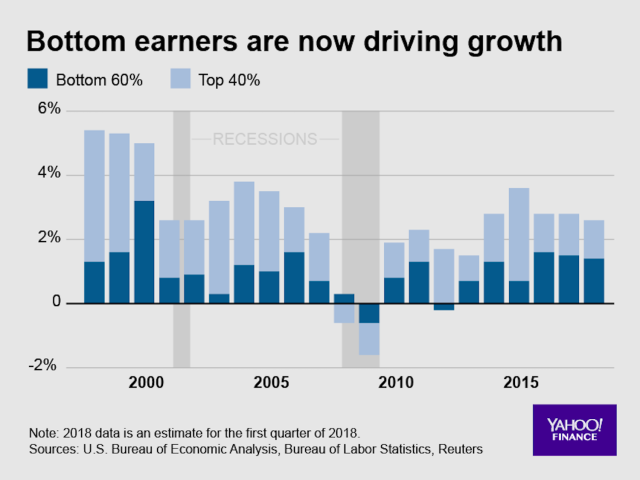
    While noting these troubling trends among lower income families, Deutsche analysts concluded that they would not pose a threat to consumer spending as wealthier households represent a greater share of total consumption. However, a recent Reuters analysis reached a different conclusion, finding that spending by the bottom 60% of earners has accounted for most of the rise in consumer spending over the past two years. This breaks a decades-old trend of upper income households accounting for the lion’s share of consumer spending and portends trouble for the economy, as consumer spending accounts for over two-thirds of GDP growth. Reuters also found that spending increases among lower income households far outpaced their meager wage gains and that given their scant savings, they were presumably funding much of this increased consumption with debt.

    The financial resilience of our lower income households matters to the health of our overall economy. It also matters to our financial stability. Rapid growth in consumer debt, particularly among economically distressed populations, can be a harbinger of recession and financial crisis. A growing body of research, led by the International Monetary Fund and others, shows that while high levels of consumer borrowing can provide short-term stimulus to an economy, in the long term, it will slow growth and risk financial crisis. As overburdened households are eventually forced to curb consumer spending to service their debt, the economy will slow and defaults will increase, leading banks to pull back on credit — severely if the banks themselves are over leveraged and lack the capacity to absorb credit losses. This is precisely the cycle we experienced in 2008.

    Things are not as bad as they were during the subprime crisis — yet. But if we are to avoid repeating the mistakes of the past, we need to stop deluding ourselves with Twain’s damnable statistics. We need a clear-eyed understanding of the fragile financial condition of our most vulnerable households with better data and policies that would increase their disposable income. Regressive payroll taxes, high health care premiums, escalating education costs, poorly designed means testing of programs — all weigh on the purchasing power of working families and cry out for forceful policy responses. 

    We cannot keep trying to fulfill working families’ financial needs with more and more consumer borrowing. Economic growth sustained by broadly shared prosperity will be lasting. Growth supported by unaffordable debt will eventually collapse. 


    Sheila Bair is the former Chair of the FDIC and has held senior appointments in both Republican and Democrat Administrations. She currently serves as a board member or advisor to a several companies and is a founding board member of the Volcker Alliance, a nonprofit established to rebuild trust in government.

    Above is from:  https://www.yahoo.com/finance/news/vulnerability-americas-lower-income-brackets-poses-risk-economy-122920739.html

    Friday, September 7, 2018

    Opinion on Rep Adam Kinzinger

    image

    Opinions need more than a 'small space'

    By Susan Kerr Dixon

    Sept. 4, 2018

    I recently received a mailing from my 16th District representative to the U.S. House of Representatives, Adam Kinzinger, asking my opinion on two very important issues dealing with immigration and opioid addiction.

    I was asked to select “yes” or “no” with a very small space to write my opinion.

    I do have opinions and questions and would appreciate the opportunity to hear his response. Unfortunately, Rep. Kinzinger will not appear in an open forum.

    How can representative democracy survive if open exchange of information between a representative and his constituency isn’t happening?


    Above is from:  http://www.saukvalley.com/2018/08/22/opinions-need-more-than-a-small-space/ax5ydp8/

    Wednesday, September 5, 2018

    “I Am Part of the Resistance Inside the Trump Administration”


    image

    Opinion

    I Am Part of the Resistance Inside the Trump Administration

    I work for the president but like-minded colleagues and I have vowed to thwart parts of his agenda and his worst inclinations.

    Sept. 5, 2018

    The Times today is taking the rare step of publishing an anonymous Op-Ed essay. We have done so at the request of the author, a senior official in the Trump administration whose identity is known to us and whose job would be jeopardized by its disclosure. We believe publishing this essay anonymously is the only way to deliver an important perspective to our readers. We invite you to submit a question about the essay or our vetting process here.


    President Trump is facing a test to his presidency unlike any faced by a modern American leader.

    It’s not just that the special counsel looms large. Or that the country is bitterly divided over Mr. Trump’s leadership. Or even that his party might well lose the House to an opposition hellbent on his downfall.

    The dilemma — which he does not fully grasp — is that many of the senior officials in his own administration are working diligently from within to frustrate parts of his agenda and his worst inclinations.

    I would know. I am one of them.

    To be clear, ours is not the popular “resistance” of the left. We want the administration to succeed and think that many of its policies have already made America safer and more prosperous.

    But we believe our first duty is to this country, and the president continues to act in a manner that is detrimental to the health of our republic.

    That is why many Trump appointees have vowed to do what we can to preserve our democratic institutions while thwarting Mr. Trump’s more misguided impulses until he is out of office.

    The root of the problem is the president’s amorality. Anyone who works with him knows he is not moored to any discernible first principles that guide his decision making.

    Although he was elected as a Republican, the president shows little affinity for ideals long espoused by conservatives: free minds, free markets and free people. At best, he has invoked these ideals in scripted settings. At worst, he has attacked them outright.

    In addition to his mass-marketing of the notion that the press is the “enemy of the people,” President Trump’s impulses are generally anti-trade and anti-democratic.

    Don’t get me wrong. There are bright spots that the near-ceaseless negative coverage of the administration fails to capture: effective deregulation, historic tax reform, a more robust military and more.

    But these successes have come despite — not because of — the president’s leadership style, which is impetuous, adversarial, petty and ineffective.

    From the White House to executive branch departments and agencies, senior officials will privately admit their daily disbelief at the commander in chief’s comments and actions. Most are working to insulate their operations from his whims.

    Meetings with him veer off topic and off the rails, he engages in repetitive rants, and his impulsiveness results in half-baked, ill-informed and occasionally reckless decisions that have to be walked back.

    “There is literally no telling whether he might change his mind from one minute to the next,” a top official complained to me recently, exasperated by an Oval Office meeting at which the president flip-flopped on a major policy decision he’d made only a week earlier.

    The erratic behavior would be more concerning if it weren’t for unsung heroes in and around the White House. Some of his aides have been cast as villains by the media. But in private, they have gone to great lengths to keep bad decisions contained to the West Wing, though they are clearly not always successful.

    It may be cold comfort in this chaotic era, but Americans should know that there are adults in the room. We fully recognize what is happening. And we are trying to do what’s right even when Donald Trump won’t.

    The result is a two-track presidency.

    Take foreign policy: In public and in private, President Trump shows a preference for autocrats and dictators, such as President Vladimir Putin of Russia and North Korea’s leader, Kim Jong-un, and displays little genuine appreciation for the ties that bind us to allied, like-minded nations.

    Astute observers have noted, though, that the rest of the administration is operating on another track, one where countries like Russia are called out for meddling and punished accordingly, and where allies around the world are engaged as peers rather than ridiculed as rivals.

    On Russia, for instance, the president was reluctant to expel so many of Mr. Putin’s spies as punishment for the poisoning of a former Russian spy in Britain. He complained for weeks about senior staff members letting him get boxed into further confrontation with Russia, and he expressed frustration that the United States continued to impose sanctions on the country for its malign behavior. But his national security team knew better — such actions had to be taken, to hold Moscow accountable.

    This isn’t the work of the so-called deep state. It’s the work of the steady state.

    Given the instability many witnessed, there were early whispers within the cabinet of invoking the 25th Amendment, which would start a complex process for removing the president. But no one wanted to precipitate a constitutional crisis. So we will do what we can to steer the administration in the right direction until — one way or another — it’s over.

    The bigger concern is not what Mr. Trump has done to the presidency but rather what we as a nation have allowed him to do to us. We have sunk low with him and allowed our discourse to be stripped of civility.

    Senator John McCain put it best in his farewell letter. All Americans should heed his words and break free of the tribalism trap, with the high aim of uniting through our shared values and love of this great nation.

    We may no longer have Senator McCain. But we will always have his example — a lodestar for restoring honor to public life and our national dialogue. Mr. Trump may fear such honorable men, but we should revere them.

    There is a quiet resistance within the administration of people choosing to put country first. But the real difference will be made by everyday citizens rising above politics, reaching across the aisle and resolving to shed the labels in favor of a single one: Americans.

    The writer is a senior official in the Trump administration.

    Follow The New York Times Opinion section on Facebook and Twitter (@NYTopinion).


    Above is from:  https://www.nytimes.com/2018/09/05/opinion/trump-white-house-anonymous-resistance.html

    Monday, September 3, 2018

    What President Trump can get away with?


    image


    Opinion

    What if Trump Did Actually Shoot Someone on Fifth Avenue?


    Thomas L. Friedman

    By Thomas L. Friedman

    Opinion Columnist

    • Aug. 28, 2018


  • Sept. 3 (AP) — President Trump stopped his motorcade in Manhattan today, jumped out of his limousine and shot a man on Fifth Avenue who was shouting anti-Trump epithets. The shooting was recorded by the White House press pool as well as by dozens of bystanders with cellphones and by security cameras in the area. When asked for his reaction, House Speaker Paul Ryan said, “We will need more information than is available at this point.”

    Senate Majority Leader Mitch McConnell said through pursed lips that he “was not going to comment on every up and down with this president.”House Intelligence Committee Chairman Devin Nunes said he already had information indicating that the man whom Trump shot “worked for the Clinton Foundation and may have been a relative of former Hillary Clinton aide Huma Abedin.”

    Fox News did not cover Trump’s shooting at the top of its broadcast, which focused instead on the killing of an Iowa woman by an undocumented immigrant. Fox’s only reference to the fact that the president shot a man on Fifth Avenue was that “a New York City man died today when he ran right into a bullet fired by the president.”

    Senator Lindsey Graham quipped that “Trump shoots as well as he putts”and that this incident would not cause the South Carolina senator to cancel his coming golf round with the president at his Bedminster, N.J., course.

    White House spokeswoman Sarah Huckabee Sanders told reporters that she was looking the other way when the shooting happened so she had no comment, adding: “I haven’t had a chance to discuss it with the president. I’ll get back to you if I have something. But the president has stated many times that he could shoot someone on Fifth Avenue and get away with it. So he’s just keeping a campaign promise. He did nothing wrong. There are no charges against him. And even though I have no comment, and he has no comment, we’ve commented on this extensively.”

    Hours later, though, the president tweeted: “Actually, some people are saying that a man who looked a lot like Barack Obama did the shooting. I’m not saying that — but some people are. It also could have been somebody sitting on their bed that weighs 400 pounds who fired that shot. Like Rudy said: Truth is not truth — unless I say so.”


    Jerry Falwell Jr., a top evangelical leader, announced that his movement would be holding a vigil this evening, praying that the president had not stressed himself too much by having to shoot a man on Fifth Avenue. Falwell added, “This would never have happened if Jeff Sessions were doing his job.”

    The day ended with Education Secretary Betsy DeVos declaring that the fact that the president could shoot someone on Fifth Avenue in broad daylight “only proves again why we need to arm all our schoolteachers.”

    My biggest challenge in writing all of the above? Worrying that readers wouldn’t realize it was made up.


    That’s because we all now know that Trump was right when he said he could shoot someone on Fifth Avenue and his supporters would stick with him. We’ve seen him get away with too much by now. No restraint on Trump will ever come from his party or his base — especially after the passing of John McCain. So save your breath. Trump will be restrained only if his party loses the House or the Senate. That’s what is at stake in the midterm elections — so vote accordingly.

    And for those Republican moderates, independents and suburban white women who voted for Trump in 2016 and are considering voting against G.O.P. House and Senate candidates in November to put some limits on the president and show their disapproval at G.O.P. lawmakers’ failure to act as an independent branch of government, let me describe the stakes in another way:

    America, we all know, won the Cold War. Our values and economic system proved superior to Russia’s. But what is at stake in the 2018 midterms is who is going to win the post-Cold War.

    Yes, that question is back on the table. Because what we are seeing in the behavior of Trump and his toadies in the G.O.P. is the beginnings of the Russification of American politics. Vladimir Putin could still win the post-Cold War.

    At the Cold War’s height, noted Marina Gorbis, executive director of the Institute for the Future and an immigrant from the Soviet Union, Americans took seriously the notion that we had to serve “as a contrast” to the Russians.

    Because the Soviets claimed to have built a worker’s paradise, it was important that we had strong unions, a strong middle class, less inequality and an adequate social safety net. The Soviets did not have the rule of law. So we had to have it more than ever.

    “I came here from Russia in ’75,” Gorbis added, “and it was remarkable to me that in this society there were laws and norms and principles, and people abided by them. The idea that people actually paid their taxes was kind of remarkable to me.” In the Russia she grew up in, said Gorbis, “we did not have that; if there was a law, there was always a way to bribe and get around it.”

    But with the Cold War now far back in our rearview mirror, Trump has not only insisted on bringing America closer to Putin’s Russia geopolitically, but also politically. This, despite the fact that our intelligence agencies and biggest internet companies have confirmed multiple times that Russia interfered in our 2016 election and continues to meddle.


    Trump still refuses to show us his tax returns long after his “audit,” which can only mean he is hiding something. His campaign chairman Paul Manafort is a convicted tax cheat who was trying to keep Putin’s stooge in power in Ukraine. Trump’s lawyer Michael Cohen is another confessed tax cheat.

    And the first two House Republicans to endorse Trump in 2016 — Duncan Hunter and Chris Collins — were both just indicted on corruption charges. They are hardly the first government officials to be arrested; Democrats have not been immune to fittings for handcuffs. But one has a stronger feeling than ever that with a moral vacuum at the heart of the Trump White House — and with the president assaulting the media and the judiciary on a regular basis, not unlike Putin — everything goes, so grab what you can, because no one’s looking. The cat’s away.

    “The Russification of America under Trump, it’s not just about collusion, corruption and money laundering,” said Gorbis. “It is about his behavior” — crass language, simplistic slogans reminiscent of the Soviet rhetoric, use of terms such as “enemy of the people,” and his insistence on personal loyalty over loyalty to the Constitution or institutions.

    Maybe that’s why Trump and Putin understand and appreciate each other — and why so many Russians like Trump. They say, “He is just like us — no better and no worse.”

    There are other parallels between Trumpism and Putinism: the glorification of oil, gas and mining over science and technology; the elevation of white, Christian, nationalist values; and the neutering of the legislative branch — today’s G.O.P.-dominated Congress behaves just like the rubber-stamp Russian Duma. Worse, this Russification of politics is also spreading — to the Philippines, Turkey, Hungary, Poland and maybe soon to Brazil.

    A few more years of this Russification of America and the rot will be everywhere. Russia will have won the post-Cold War, and the fictional story at the top of this column will become nonfiction — just like that. Remember that when you vote in the midterms.

    Update: Several readers have asked me why I did not credit a Guardian op-ed by Lawrence Douglas and Alexander George, which took a similar faux news approach to the question of what would happen if President Trump actually did shoot someone on Fifth Avenue. The simple answer is because I did not see it. However, it turns out that a columnist in the Atlanta Journal-Constitution, perhaps in addition to others, beat us in this approach with a column using this style on April 20. I think the Guardian and A.J.C. articles aregreat and am linking to both of them for readers to enjoy. Let a thousand flowers bloom.


    Thomas L. Friedman is the foreign affairs Op-Ed columnist. He joined the paper in 1981, and has won three Pulitzer Prizes. He is the author of seven books, including “From Beirut to Jerusalem,” which won the National Book Award. @tomfriedman • Facebook

  • Above is from:  https://www.nytimes.com/2018/08/28/opinion/trump-midterms-shoot-fifth-avenue.html

  • Sunday, September 2, 2018

    Tibbett family reacts to Trump Jr.’s Opinion piece


    image

    Mollie was nobody's victim. Nor is she a pawn in others' debate


    Ten days ago, we learned that Mollie would not be coming home. Shattered, my family set out to celebrate Mollie’s extraordinary life and chose to share our sorrow in private. At the outset, politicians and pundits used Mollie’s death to promote various political agendas. We appealed to them and they graciously stopped. For that, we are grateful.

    Sadly, others have ignored our request. They have instead chosen to callously distort and corrupt Mollie’s tragic death to advance a cause she vehemently opposed. I encourage the debate on immigration; there is great merit in its reasonable outcome. But do not appropriate Mollie’s soul in advancing views she believed were profoundly racist. The act grievously extends the crime that stole Mollie from our family and is, to quote Donald Trump Jr., “heartless" and "despicable.”

    Make no mistake, Mollie was my daughter and my best friend. At her eulogy, I said Mollie was nobody’s victim. Nor is she a pawn in others’ debate. She may not be able to speak for herself, but I can and will. Please leave us out of your debate. Allow us to grieve in privacy and with dignity. At long last, show some decency. On behalf of my family and Mollie’s memory, I’m imploring you to stop.

    Throughout this ordeal I’ve asked myself, “What would Mollie do?” As I write this, I am watching Sen. John McCain lie in state in the Capitol Rotunda and know that evil will succeed only if good people do nothing. Both Mollie and Senator McCain were good people. I know that both would stand up now and do something.

    The person who is accused of taking Mollie’s life is no more a reflection of the Hispanic community as white supremacists are of all white people. To suggest otherwise is a lie. Justice in my America is blind. This person will receive a fair trial, as it should be. If convicted, he will face the consequences society has set. Beyond that, he deserves no more attention.  

    To the Hispanic community, my family stands with you and offers its heartfelt apology. That you’ve been beset by the circumstances of Mollie’s death is wrong. We treasure the contribution you bring to the American tapestry in all its color and melody. And yes, we love your food.

    My stepdaughter, whom Mollie loved so dearly, is Latina. Her sons — Mollie’s cherished nephews and my grandchildren — are Latino. That means I am Hispanic. I am African. I am Asian. I am European. My blood runs from every corner of the Earth because I am American. As an American, I have one tenet: to respect every citizen of the world and actively engage in the ongoing pursuit to form a more perfect union.

    Given that, to knowingly foment discord among races is a disgrace to our flag. It incites fear in innocent communities and lends legitimacy to the darkest, most hate-filled corners of the American soul. It is the opposite of leadership. It is the opposite of humanity. It is heartless. It is despicable. It is shameful.

    We have the opportunity now to take heed of the lessons that Mollie, John McCain and Aretha Franklin taught — humanity, fairness and courage. For most of the summer, the search for Mollie brought this nation together like no other pursuit. There was a common national will that did transcend opinion, race, gender and geography. Let’s not lose sight of that miracle. Let’s not lose sight of Mollie.

    Instead, let’s turn against racism in all its ugly manifestations both subtle and overt. Let’s turn toward each other with all the compassion we gave Mollie. Let’s listen, not shout. Let’s build bridges, not walls. Let’s celebrate our diversity rather than argue over our differences. I can tell you, when you’ve lost your best friend, differences are petty and meaningless.

    My family remains eternally grateful to all those who adopted Mollie so completely and showered us with so much care, compassion and generosity. Please accept our desire to remain private as we share our loss. We love Mollie with all our hearts and miss her terribly. We need time.

    Mollie Tibbetts' father Rob Tibbetts talks about the search for the missing 20-year-old University of Iowa student during an interview Thursday, Aug. 2, 2018, in Grinnell, Iowa.Buy Photo

    Mollie Tibbetts' father Rob Tibbetts talks about the search for the missing 20-year-old University of Iowa student during an interview Thursday, Aug. 2, 2018, in Grinnell, Iowa. (Photo: Rodney White/The Register)

    Rob Tibbetts is the father of Mollie Tibbetts.

    Above is from:  https://www.desmoinesregister.com/story/opinion/columnists/2018/09/01/mollie-tibbetts-father-common-decency-immigration-heartless-despicable-donald-trump-jr-column/1163131002/


    This is opinion piece which Rob TIbbett speaks 

    Donald Trump Jr.: Democrats' reaction to Mollie Tibbetts' death is heartless, despicable

    Donald Trump Jr., Guest columnist Published 9:33 a.m. CT Aug. 31, 2018 | Updated 11:58 a.m. CT Aug. 31, 2018

    Register artist Mark Marturello attended a benefit concert for Justin Rood at The Greenwood Lounge in Des Moines on Aug. 19, 2018. Stark Raving Madge and Heath Pattschull performed. Marturello said, "It was a nice gathering of family, friends and co-workers pitching in to help out Justin," who was injured this summer when he fell off a ladder. Marturello's sketchbook from the benefit, animated here, appears in the Aug. 26, 2018 Register.Mark Marturello/The Register, Wochit

    Don Trump Jr.

    (Photo: Special to the Register)


    The reaction from some Democrats and others on the left to the murder of Mollie Tibbetts is as despicable as it is revealing.

    The mask is off and the true radical face of the Democrats has been exposed. They are seemingly more concerned with protecting their radical open-borders agenda than the lives of innocent Americans.

    When asked about Mollie’s murder, Sen. Elizabeth Warren — who is for some reason considered a leading contender for the Democrats’ 2020 ticket — played down the killing and said the focus should be on the “real problems” of our immigration system, such as the separation of families at our border.

    Think about that for a minute. She apparently believes that illegal alien parents being separated from their children is a bigger problem than American parents having to bury theirs.

    Editors' note:  Here's what Warren said on CNN:  “I’m so sorry for the family here, and I know this is hard not only for her family, but for people in her community, the people throughout Iowa. But one of the things we have to remember is we need an immigration system that is effective, that focuses on where real problems are.”  In the same interview, speaking about the separation of children from their parents, she said, “I think we need immigration laws that focus on people who pose a real threat and I don’t think mamas and babies are the place we should be spending our resources.”

    But at least Warren could muster some semblance of humanity, saying she was "so sorry for the family here.” MSNBC commentator Christina Greer, on the other hand, dismissed Mollie and her tragic story as “a girl in Iowa,” while CNN commentator Symone Sanders tweeted that the murder had nothing at all to do with illegal immigration and everything to do with “toxic masculinity.”

    Liberal media outlets went through great pains to cover the story without actually covering the story. Instead of truthful headlines such as “Illegal immigrant arrested in connection with murder of Mollie Tibbetts,” multiple outlets ran headlines such as “Man arrested in connection to disappearance of Mollie Tibbetts.” They don’t want you to know what happened to her — and they certainly don’t want you to know who is responsible.

    Worse still, a number of media outlets and pundits insisted that conservatives and Republicans were “politicizing” Mollie’s murder — an absurd claim coming from the same people who used family separation at the border to call for the abolishment of ICE and jump at the opportunity to exploit any tragedy involving guns to call for the end of the Second Amendment as we know it.

    The most ridiculous response came from journalist Chris Riotta, who claimed in the Independent that “Russian bots used Mollie Tibbetts' death to distract from Michael Cohen and Paul Manafort.” Riotta and his ilk simply can’t face the fact that the murder of an innocent girl at the hands of an illegal alien is news that Americans actually care about.

    It’s not hard to understand why. The Left is so ideologically committed to open borders that they can’t be honest about the consequences of illegal immigration. If the mainstream media reported objectively about illegal alien crime — not to mention the effects of cheap illegal immigrant labor on the labor market — the wall would have been built years ago and my dad’s policies at the border would be implemented immediately.

    Despite what some Democrats may wish in the depths of their hearts, Mollie was murdered by an illegal alien and her murder would never have happened if we policed our southern border properly.


    Unfortunately, Mollie was not the first casualty of the left’s love for open borders. The radical policies of the Democrats have left a trail of human wreckage in pursuit of their open borders dream. Yet they continue to act like violent illegal alien crime is a myth concocted by the right, despite the fact that a Washington Times report released in January indicated that 44 percent of people convicted of federal crimes in 2011-2016 were non-citizens.

    Fact check: Here are the facts on immigrants committing crimes in US

    The murder of Mollie Tibbetts is not a myth. It happened. So did the murders of Kate Steinle, Dominic Durden, Sarah Root, Ronald Da Silva, Grant Ronnebeck, Jamiel Shaw, and countless other innocent Americans sacrificed on the Democrats’ altar of open borders.

    Enough is enough. The Democrats are pushing policies that are a direct existential threat to the lives of innocent Americans. If they refuse to abandon the pursuit of open borders, they must be called out and voted out. The memories of those we’ve lost to illegal alien violence deserve nothing less.

    Donald Trump Jr. is the executive vice president at The Trump Organization.

    Above is from:  https://www.desmoinesregister.com/story/opinion/columnists/2018/08/31/donald-trump-jr-democrats-reaction-mollie-tibbetts-death-heartless-illegal-immigration-border-wall/1143005002/