Thursday, August 9, 2018

In “closed meeting” Rep Kinzinger says farmers not irate over Trump trade policies


image


By Paul Westermeyer

Posted Aug 8, 2018 at 9:25 AM

U.S. Rep. Adam Kinzinger attended a closed Livingston County Farm Bureau roundtable meeting Tuesday morning with area agriculturalists. After the meeting’s end, he fielded questions from the press about the meeting, one of the chief subject’s of which was the trade war the U.S. is currently engaged in with China and the detrimental effect it’s had on the trading price of soy.
Kinzinger, R-Channahon, told the media that while the mood of farmers was less than optimistic, he believed they were willing to give the Trump administration a chance to right wrongs the president believes China has committed in terms of unfair trade practices.
“A couple of the points I made in the meeting was that it seemed like, at the beginning, we were fixing to fight the whole world on this (trade war) issue — Canada, Mexico, Europe and China,” he said. “My biggest concern with these is that, if we’re going to fight unfair trading practices, let’s do it one at a time with different nations.
“The good news is that we appear to be closer to a deal with Mexico for a NAFTA renegotiation, which I think is going to drive Canada closer to our position, so we may get a NAFTA renegotiation.”
Kinzinger clarified that he had “very mixed feelings of where we are at.” On the one hand, he opposes tariffs as a roadblock for free trade and that their cavalier usage by President Donald Trump has hurt agricultural communities; however, he did align with Trump on wanting to correct trade imbalances that they believe has resulted from China’s alleged theft of intellectual property.
“There have been some massive abuses by China,” he said. “We understand that the Chinese may have taken aim at ag because these are the people that voted for Donald Trump, so we’ll see ... One of the good things is that the Europeans announced that they would buy more soy, but obviously Europe is ‘x’ population and China is four times that.”
The representative noted that while farmers were appreciative of the Trump administration’s promised $12 billion bailout being used to offset the tanking soy market, he was also aware that they had more of an interest in a long-term solution.
“I think people are grateful for that, but ag doesn’t want that,” he stated. “They ultimately don’t want a situation where they survive because the government’s writing checks. So in the short term, it’s a good thing, but the long-term hope is that since the Chinese economy is on the bubble in certain areas, we think, it would probably behoove them to instead of having all of their imports sanctioned, frankly, or tariffed, to actually come to the table and negotiate.
“We’re not asking for handouts from China; we’re asking that the Chinese be fair and quit stealing our intellectual property.”
Still, the mood among farmers, Kinzinger admitted, was not quite optimistic that the trade war would be resolved sooner before later. He had hopes, however, that other bartering avenues the U.S. was exploring could offset the damage done to the soy trading market.
“I think if we can get NAFTA done and if we can have this kind of detente with Europe, there will be some optimism from that,” he said. “What I’m sensing is that they trust this president and they believe in him. They’re nervous, but they’re willing to give him a little space.
“As of today, I’m not hearing a lot of people in the ag community irate, but if this goes on for a year or two, you might see them get irate, but the hope is that we can come to a deal and end all this.”

Above is from:   http://www.pontiacdailyleader.com/news/20180808/kinzinger-discusses-ag-trade-situation

Friday, August 3, 2018

Trump has built a pyramid scheme of public fraud. It's a taxpayer-backed cash grab.


image

Mindy Finn, Opinion contributor Published 10:49 a.m. ET Aug. 3, 2018

Donald Trump is pulling off a taxpayer-backed cash grab. It's an orchestrated, unprecedented scheme to enrich a president, his family and his friends.

AP TRUMP HOTEL A USA DC

(Photo: Alex Brandon/AP)

CONNECTTWEETLINKEDIN 10 COMMENTEMAILMORE

Even after warnings that tariffs would wreak havoc on the economy, Donald Trump has staked his presidency on a series of trade wars that are now coming home to roost. With economic ruin looming over American farmers — a key constituency — he refuses to change course. Instead, he’s mulling a policy of clientelism, a $12 billion cash handout to the victims of his own bad ideas.

It’s a surprising development for many, especially the conservatives who have long lamented bailouts and subsidies, but it’s hardly out of character. On the contrary, it’s a natural fit for a White House that encourages corruption, exploitation and fraud in exchange for loyalty. As with his cabinet officials, he expects that the allure of taxpayer-funded kickbacks will be enough to keep farmers from holding him accountable for his own corruption and failures. It’s not an accident, it’s a strategy: grease the wheels of government so heavily that they spin in place.

Far from draining the swamp, Trump and his coterie of grifters, fraudsters and co-conspirators have filled it in entirely, dividing the land into personal fiefdoms to exploit.

Team Trump has been playing dirty

The result has been an open season for public funds, private payoffs, and abuses of office. It’s almost quaint to remember that Health and Human Services Secretary Tom Price was fired for using private jets for official travel. The now-resigned Environmental Protection Agency Director Scott Pruitt exclusively travels in first class, while Interior Secretary Ryan Zinke is fond of chartered flights. To say nothing of Treasury Secretary Mnuchin’s use of military planes to see a solar eclipse with his wife.

It isn’t just about luxury. Zinke’s involved in a land deal with Halliburton which is likely to benefit him directly. Pruitt reveled in petty grift, taking discounted rent from lobbyists and using his government security and employees as personal servants. Pruitt even used his position to try to find his wife a job.

Following the president’s lead, Commerce Secretary Wilbur Ross has been less than honest about divesting his assets. The man helming Trump’s global trade war is profiting from it, even short-selling his stocks in a Kremlin-backed shipping company when he learned reporters were writing a story about it.

More: Who pays for Trump's contempt for ethics? USA. USA. USA.

Would Kavanaugh be a check on Trump if he tried to abuse his power?

Scott Pruitt removes his ethical swamp from EPA

The taxpayer-backed cash grab radiates even outside government officials. Former campaign manager Corey Lewandowski opened a business selling his access to the president, even potentially to foreign governments. Trump lawyer Michael Cohen did similarly, trading a direct connection to Trump for six-figure checks.

All of this is not only permissible to the president, it’s encouraged. That’s what makes our current situation unprecedented. This is an orchestrated effort to enrich the president, his family, and his friends. That’s why the Trump hotel in Washington is now a favorite location for foreign emissaries, reaping tens of millions of dollars from those seeking audience with the president. Membership at Mar-a-Lago doubled in price, because lobbyists and influence peddlers will pay anything to catch the president’s ear. And Trump condos are flying off the market as foreign governments pay exorbitant prices to gain the president’s favor. Even his own party pays the piper. The GOP and affiliated political groups have spent over $3 million at Trump properties since he took office.

In short, Trump has built a clearly organized machine for largesse and corruption. It’s a pyramid scheme of public fraud, and the president gleefully sits at its top, reaping the rewards and doling out the shares.

A new level of corruption in Washington

Still, the president and his defenders deny anything is wrong. Many throw up their hands and say “Washington has always been this way.” That’s certainly what Trump would have us believe. In truth, this level of corruption is rampant in dictatorships across the globe, but unprecedented here.

It’s disturbing to see the president ripping this page from the authoritarian textbook, though entirely in character. All around him he’s traded his blessing of corrupt dealings for a weakening of the agencies which might hold some check on him. Now, as key voters threaten to rebel over his policies, it’s only natural that he’d seek the same bargain with them.

But the American people aren’t so easily bought. We’ve already waged and won numerous battles against the president’s corruption, but our fight is far from over. We must reinvigorate the institutions of transparency and accountability in our government. We must hold our leaders to an even higher ethical standard. And, especially when it starts to feel fruitless, we must do so with Donald Trump.

Mindy Finn, co-founder of Stand Up Republic and founder of Empowered Women, ran for vice president with Independent presidential candidate Evan McMullin in 2016 and was an aide in the 2004 George W. Bush and 2012 Mitt Romney presidential campaigns. Follow her on Twitter: @mindyfinn

You can read diverse opinions from our Board of Contributors and other writers on the Opinion front page, on Twitter @usatodayopinion and in our daily Opinion newsletter. To respond to a column, submit a comment to letters@usatoday.com.

Above is from:  https://www.usatoday.com/story/opinion/2018/08/03/donald-trump-taxpayer-cash-grab-unprecedented-corruption-column/871902002/

Koch Bro study shows “Medicare for All” could save money

image

image

2017 in Washington DC last September. Alex Wong / Getty

Our spring issue, looking at the democratic revolts of 1968, is out now! Subscribe or renew today.

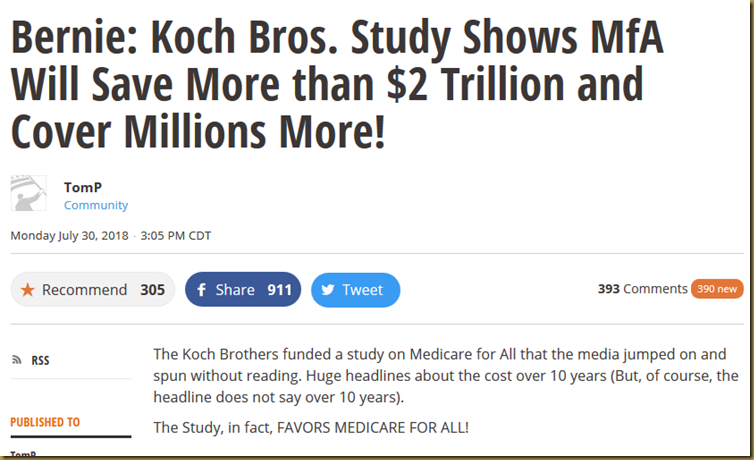
The US could insure 30 million more Americans and virtually eliminate out-of-pocket health care expenses while saving $2 trillion in the process, according to a new report about Medicare for All released by the libertarian Mercatus Center.

In the report, Charles Blahous attempts to roughly score Bernie Sanders’s most recent Medicare-for-All bill and reaches the somewhat surprising (for Mercatus) conclusion that, if the bill were enacted, the new costs it creates would be more than offset by the new savings it generates through administrative efficiencies and reductions in unit prices.

The report’s methods are pretty straightforward. Blahous starts with current projections about how much the country will spend on health care between 2022 and 2031. From there, he adds the costs associated with higher utilization of medical services and then subtracts the savings from lower administrative costs, lower reimbursements for medical services, and lower drug prices. After this bit of arithmetic, Blahous finds that health expenditures would be lower for every year during the first decade of implementation. The net change across the whole ten-year period is a savings of $2.054 trillion.

When talking about Medicare for All, it is important to distinguish between two concepts: national health expenditures and federal health expenditures. National health expenditures refer to all health spending from any source whether made by private employers, state Medicaid programs, or the federal government. It is national health expenditures that, according to the report, will decline by $2.054 trillion.

Federal health expenditures refer to health spending from the federal government in particular. Since the federal government takes on nearly all health spending under Medicare for All, federal health expenditures will necessarily go up a lot, $32.6 trillion over the ten-year period according to Blahous. But this is more of an accounting thing than anything else: rather than paying premiums, deductibles, and co-pays for health care, people will instead pay a tax that is, on average, a bit less than they currently pay into the health care system and, for those on lower incomes, a lot less.

At first glance, it is strange that the Mercatus Center, which is libertarian in its orientation and heavily funded by the libertarian Koch family, would publish a report this positive about Medicare for All. The claim that “even the Koch organizations say it will save money while covering everyone” provides a useful bit of rhetoric for proponents of the policy.

But the real game here for Mercatus is to bury the money-saving finding in the report’s tables while headlining the incomprehensibly large $32.6 trillion number in order to trick dim reporters into splashing that number everywhere and freaking out. This is a strategy that already appears to be working, as the Associated Press headline reads: “Study: ‘Medicare for all’ projected to cost $32.6 trillion.”

Messaging strategy aside, there is room to quibble with Blahous’s positive findings. He assumes administrative costs will only drop from 13 percent to 6 percent for those currently privately insured. But, according to the Kaiser Family Foundation, Medicare’s administrative costs have consistently been below 2 percent. He assumes utilization of health services will increase by 11 percent, but aggregate health service utilization is ultimately dependent on the capacity to provide services, meaning utilization could hit a hard limit below the level he projects.

But even if you take the report’s headline figures at face value, the picture it paints is that of an enormous bargain. We get to insure every single person in the country, virtually eliminate cost-sharing, and save everyone from the hell of constantly changing health insurance all while saving money. You would have to be a fool to pass that offer up.


Above is from:  https://www.dailykos.com/stories/2018/7/30/1784653/-Bernie-Koch-Bros-Study-Shows-MfA-Will-Save-More-than-2-Trillion-and-Cover-Millions-More?detail=emaildkre

Wednesday, August 1, 2018

Time to bring congressman’s tenure to an end


image

By Sharon McLane Grand Detour

July 30, 2018

Who is Adam Kinzinger’s boss? You are!

You pay his $174,000 salary. You have sent him to Washington, D.C., the past 6 years to represent your interests. Yet, he feels no obligation to meet you in a public forum where you can ask questions that are of interest to you.

Imagine telling your boss that you have no interest in hearing his opinions or thoughts about how you are doing your job!

Have you sent Rep. Kinzinger a letter or email? Have you posted on his Facebook page about an issue that concerns you? Then you have received the same impersonal form letter response that I have! Clearly, he thinks he knows better than you, his boss, how to do his job.

You don’t have to put up with being represented in Congress by someone who has no interest in knowing who his boss is. You don’t have to put up with a representative who doesn’t represent you, or who takes his orders from people who have probably never been to the Sauk Valley! 

Please give Kinzinger a serious performance review. You can terminate him for failure to perform on Nov. 6! I encourage you to do so.

Above is from:: http://www.saukvalley.com/2018/07/19/time-to-bring-congressmans-tenure-to-an-end/axvvbt4/

Sunday, July 29, 2018

Why haven't all the families been reunited? Cruelty, pure and simple


image

Why haven't all the families been reunited? Cruelty, pure and simple

By Brian Schatz

Jul 27, 2018 | 3:00 AM

Why haven't all the families been reunited? Cruelty, pure and simple

Shoes and toys left by migrants at the Tornillo Port of Entry in Tornillo, Texas. (Brendan Smialowski/ AFP/Getty Images)

The failure of the U.S. government to reverse the kidnapping of thousands of children from their parents has been chalked up to incompetence. People want to believe that this act of extraordinary cruelty — and the Trump administration’s inability to fix it — stems from our leaders’ lack of experience or common sense.

But this too is a failure — of our collective imagination. The separation of children from their parents at the Southwest border is not simply a policy that has resulted in immeasurable harm, but a policy designed to inflict it. The government blew its Thursday deadline to reunite these families because it never intended to do so.


How else can we explain what has happened to these families? Some 14 million checked bags are managed by the Transportation Security Administration — and that’s just during Thanksgiving weekend. Even high school students can manage a coat check for an evening without losing everyone’s coats. They match each coat and owner with corresponding tickets, and do not store the coats outside the building, or even thousands of miles away from the event.

This administration will harm children in order to force Congress to agree to its absurd immigration policies.


The administration did not take even these basic measures when it began to separate children — not coats! — from their parents. It did not use corresponding numbers for the files of parents and children, or take photos of families together, or hand out hospital-style bracelets. It did not house families near one another, choosing instead to hold mothers in California and daughters in Chicago, fathers in Texas and sons in New York City.

In fact, the administration seems to have taken a comprehensive inventory of confiscated items — sneakers, toothpaste, rosaries — everything except which child belongs to which parent.

These are the actions of a government that intended to separate families but did not intend to reunite them. It meant to inflict so much suffering that other families wouldn’t make the dangerous trek. No matter how bad the violence might be in Central America, surely these families would choose to stay united rather than come and be separated.

In fact, through all the blather, the Trump administration has admitted as much.

“I would do almost anything to deter the people from Central America,” White House Chief of Staff John F. Kelly said in 2017. Even separate children from their parents, asked CNN’s Wolf Blitzer? “Yes.”

“We expect that the new policy will result in a deterrence effect,” Health and Human Services Assistant Secretary Steven Wagner told reporters in June.

“Hopefully people will get the message,” Atty. Gen. Jeff Sessions said casually on Fox News in June.

But according to the Department of Homeland Security, no one has been deterred. The number of families stopped at the border actually increased by 64% in the months after the administration began to separate families. So even if you could stomach traumatizing toddlers, this policy did not accomplish Sessions’ objective of sending a warning across the desert.

Still, cruelty has its uses. Across the country, Republicans have made the Trump administration’s immigration stance their rallying cry for reelection, running more than 14,000 campaign ads this year bragging about their efforts to “stop illegals.” And last month, Sessions spelled out the administration’s plan to use all the bad press for good.

“We do not want to separate parents from their children,” he clarified. “If we build the wall, if we pass legislation to end the lawlessness, we won’t face these terrible choices.”

In other words, this administration will harm children in order to force Congress to agree to its absurd immigration policies. But let’s be clear: No lawmaker of any party should ever accede to a legislative demand in response to the intentional infliction of harm.


The American people must also speak up. Our government has kidnapped children from their parents. It forces these lost boys and girls to say the Pledge of Allegiance while they are held captive in building wings named for U.S. presidents. (It is not hard to believe that President Reagan would be aghast.)

This is not who we are, we want to say, but that isn’t quite true. This policy reveals a darker side of America that has dehumanized black and brown people since our nation’s founding. Americans have stolen and enslaved black people, killed indigenous peoples and imprisoned Japanese Americans. The reason why this administration has pumped out racist rhetoric casting people as fish to be caught, infestations to be eradicated, and animals to be caged is because it has worked before.

Will it work again? That’s up to us.

Brian Schatz represents Hawaii in the U.S. Senate.

Above is from:  http://www.latimes.com/opinion/op-ed/la-oe-schatz-family-reunification-20180727-story.html#nws=mcnewsletter

Brian Schatz

United States Senator

Image result for brian schatz

<?XML:NAMESPACE PREFIX = "[default] http://www.w3.org/2000/svg" NS = "http://www.w3.org/2000/svg" />schatz.senate.gov

Brian Emanuel Schatz is an American politician serving as the senior United States Senator from Hawaii since 2012. Schatz was appointed by Governor Neil Abercrombie to replace Senator Daniel Inouye after his death. Wikipedia

Born: October 20, 1972 (age 45 years), Ann Arbor, MI

Spouse: Linda Kwok

Office: Senator (D-HI) since 2012

Previous office: Lieutenant Governor of Hawaii (2010–2012)

Education: Pomona College

Current position: United States Senator

How Did the End of the World Become Old News?

July 26, 2018 9:40 am

How Did the End of the World Become Old News?

By David Wallace-Wells
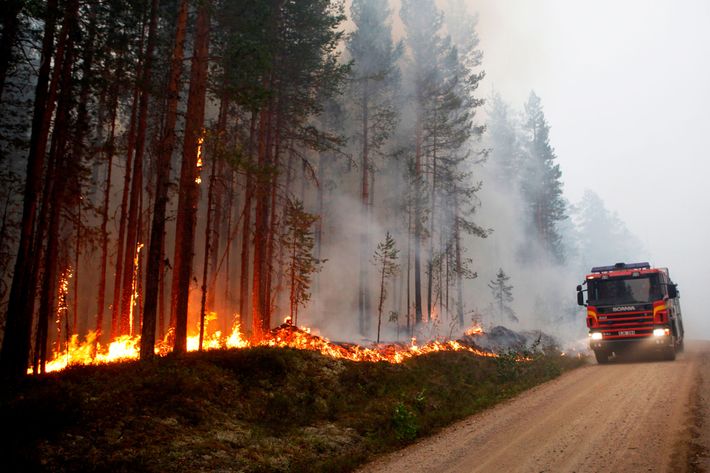
The fire this time (in Sweden). Photo: Mats Andersson/AFP/Getty Images

There has been a lot of burning lately. Last week, wildfires broke out in the Arctic Circle, where temperatures reached almost 90 degrees; they are still roiling northern Sweden, 21 of them. And this week, wildfires swept through the Greek seaside, outside Athens, killing at least 80 and hospitalizing almost 200. At one resort, dozens of guests tried to escape the flames by descending a narrow stone staircase into the Aegean, only to be engulfed along the way, dying literally in each other’s arms.

Last July, I wrote a much-talked-over magazine cover story considering the worst-case scenarios for climate change — much talked over, in part, because it was so terrifying, which made some of the scenarios a bit hard to believe. Those worst-case scenarios are still quite unlikely, since they require both that we do nothing to alter our emissions path, which is still arcing upward, and that those unabated emissions bring us to climate outcomes on the far end of what’s possible by 2100.

But, this July, we already seem much farther along on those paths than even the most alarmist climate observers — e.g., me — would have predicted a year ago. In a single week earlier this month, dozens of places around the world were hit with record temperatures in what was, effectively, an unprecedented, planet-encompassing heat wave: from Denver to Burlington to Ottawa; from Glasgow to Shannon to Belfast; from Tbilisi, in Georgia, and Yerevan, in Armenia, to whole swaths of southern Russia. The temperature of one city in Oman, where the daytime highs had reached 122 degrees Fahrenheit, did not drop below 108 all night; in Montreal, Canada, 50 died from the heat. That same week, 30 major wildfires burned in the American West, including one, in California, that grew at the rate of 10,000 football fields each hour, and another, in Colorado, that produced a volcano-like 300-foot eruption of flames, swallowing an entire subdivision and inventing a new term — “fire tsunami” — along the way. On the other side of the planet, biblical rains flooded Japan, where 1.2 million were evacuated from their homes. The following week, the heat struck there, killing dozens. The following week.

In other words, it has been a month of historic, even unprecedented, climate horrors. But you may not have noticed, if you are anything but the most discriminating consumer of news. The major networks aired 127 segments on the unprecedented July heat wave, Media Matters usefully tabulated, and only one so much as mentioned climate change. The New York Times has done admirable work on global warming over the last year, launching a new climate desk and devoting tremendous resources to high-production-value special climate “features.” But even their original story on the wildfires in Greece made no mention of climate change — after some criticism on Twitter, they added a reference.

Over the last few days, there has been a flurry of chatter among climate writers and climate scientists, and the climate-curious who follow them, about this failure. In perhaps the most widely parsed and debated Twitter exchange, MSNBC’s Chris Hayes — whose show, All In, has distinguished itself with the seriousness of its climate coverage — described the dilemma facing every well-intentioned person in his spot: the transformation of the planet and the degradation may be the biggest and most important story of our time, indeed of all time, but on television, at least, it has nevertheless proven, so far, a “palpable ratings killer.” All of which raises a very dispiriting possibility, considering the scale of the climate crisis: Has the end of the world as we know it become, already, old news?

If so, that would be really, really bad. As I’ve written before, and as Wen Stephenson echoed more recently in The Baffler, climate change is not a matter of “yes” or “no,” not a binary process where we end up either “fucked” or “not fucked.” It is a system that gets worse over time as long as we continue to emit greenhouse gases. We are just beginning to see the horrors that climate change has in store for us —but that does not mean that the story is settled. Things will get worse, almost certainly much, much worse. Indeed, the news about what more to expect, coming out of new research, only darkens our picture of what to expect: Just over the past few weeks, new studies have suggested heat in many major Indian cities would be literally lethal by century’s end, if current warming trends continue, and that, by that time, global economic output could fall, thanks to climate effects, by 30 percent or more. That is an impact twice as deep as the global Great Depression, and it would not be temporary.

These are not the kinds of findings it is easy to ignore, or dismiss, or compartmentalize, even though we have all become exquisitely skilled lately in compartmentalizing the threat. Neither is it easy to forget the stories of the Greek wildfires, or the Japanese heat wave. Which is why it is perhaps important to remember that the media did not ignore these stories, or the month of global climate horrors that gave rise to them. Television networks covered those heat waves 127 times. That is, actually, a very lot! They just utterly failed to “connect the dots,” as Emily Atkin put it incisively at The New Republic —broadcasters told the story of the historic temperatures, but chose not to touch the question of why we were seeing so many of them, all at once, with the atmosphere more full of carbon, and the planet hotter, than it has ever been at any point in human history.

When you think about it, this would be a very strange choice for a producer or an editor concerned about boring or losing his or her audience — it would mean leaving aside the far more dramatic story of the total transformation of the planet’s climate system, and the immediate and all-encompassing threat posed by climate change to the way we live on Earth, to tell the pretty mundane story of some really hot days in the region.

Which is why this all sounds to me a lot more like self-censorship than ratings-chasing — by which I mean self-censorship of two kinds. The first is the intuitive one — the kind done in anticipation of political blowback, an especially acute problem for would-be neutral, would-be centrist platforms like network news. This self-censorship in fear of right-wing backlash is a familiar story, and most of those concerned about global warming know the villains already: oil companies, climate deniers, indifferent (at best) politicians, and constituents who see science as a culture-war front.

But public apathy, and its cousin climate complacency, is as big a problem — perhaps bigger. And this problem, too, is connected to self-censorship on the part of storytellers who feel intimidated from attributing what we used to know as natural disasters to global warming because scientists are so excruciatingly careful about attributing cause. As NPR’s science editor Geoff Brumfiel told Atkin, “You don’t just want to be throwing around, ‘This is due to climate change, that is due to climate change.’”

Well — why not? The stated reason, when a reason is stated, is that scientists can take years to definitively conclude that a particular disaster was impossible without the effects of warming, and often only speak with certainty about specific events a decade or more in the past— the 2003 European heat wave, for instance, which killed tens of thousands. But wildfires are “not caused by climate change” only in the same way that hurricanes are not caused by climate change — which is to say they are (only) made more likely by it, which is to say the distinction is semantic. The same is true, even more so, for heat waves: We know global warming will cause many more deadly temperatures, and should not be confused, at all, when we suddenly encounter an unprecedented number of them. The fact that most climate scientists would say something like, “These disasters are consistent with what we would expect, given global warming,” rather than “these disasters were caused by global warming” is not a reason to elide discussion of climate change. Doing so is an evasion, even if it is made with a scientific alibi.

It is also a dangerous one. Decades of bad-faith debates about whether climate change is “real” and good-faith questions about whether it is “here” have dramatically foreshortened our collective imagination and provided an unfortunately limited picture of what global warming will yield. Treating every climate disaster as a discrete event only compounds the problem, suggesting that impacts will be discrete. They won’t be, and the longer-view story is much more harrowing: not just more months like July, but an unfolding century when a month like this July has become a happy memory of a placid climate. That it is almost hard to believe only makes it a more important story to tell.

Above is from:  http://nymag.com/daily/intelligencer/amp/2018/07/climate-change-wildfires-heatwave-media-old-news-end-of-the-world.html?__twitter_impression=true

Friday, July 27, 2018

How China's tariffs on soybeans fueled the US GDP bump

Soybeans are a weak spot in President Donald Trump’s trade war with China as the country has imposed retaliatory tariffs to hit his voter base — American farmers. To defend against these tariffs, Trump has offered a short-term assistance of $12 billion to producers of soybeans, sorghum and other crops.

But on Friday, soybean tariffs may have actually given Trump a boost. They contributed to the robust GDP growth that the president touted — “We’ve accomplished an economic turnaround of historic proportions,” he said.

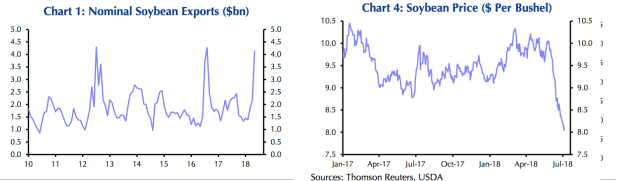
The U.S. economy grew 4.1% in the second quarter, partly due to a burst in soybean and corn exports, according to economists. In May, the latest data available, soybean exports nearly doubled compared to in April. Producers were in a rush to beat tit-for-tat sanctions, soybean exports are up 26% for the year compared to 2017.

The burst in soybean export has sent quarter GDP growth higher. (Screenshot/Capital Economics)
In the second quarter, the U.S. recorded an 80% annualized jump in food, feed and beverage exports, mainly from soybeans and corn. Without that surge, exports would have increased 5.3% instead of 9.3%, which means the GDP growth would have been around 3.6%, according to Paul Ashworth, the chief U.S. economist at Capital Economics.

David Rosenberg, the chief economist of Gluskin Sheff, argues trade disputes may play an even bigger role in inflating GDP. “At least half the growth is coming from two trade-related issues — a soybean-led export burst and inventory accumulation. Net these out and we remain near 2%”, he tweeted on Thursday.

How sustainable could the growth be?

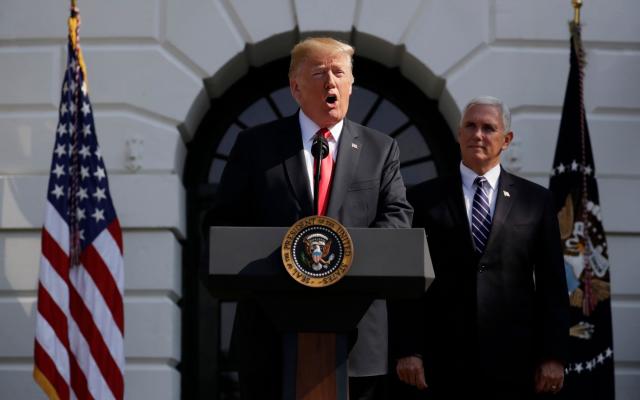
President Trump speaks in White House after the second quarter GDP number is released. (Credit: The Telegraph)

Trump seized the opportunity to boast about the strong economic results. “These numbers are very, very sustainable— this isn’t a one-time shot,” he said during a White House press conference on Friday.

But economists caution that the growth rate is hard to maintain. This is not the first time that soybeans have fueled a short-term bump in GDP. Back in mid-2016, U.S exporters experienced a boom when the Brazilian crop disappointed. The impact on nominal export growth was drastic — it hit 10% annualized growth in August, but fell to near-zero in December. Excluding soybeans and corn, the export growth was steady at around 5% in the second half of 2016.

Ashworth doesn’t expect this time to be different. He projects soybean exports to plummet in July, dragging nominal exports down by 1.8% compared with June, and the GPD number will be back to normal — at about 2.6% in the third quarter.

The trade truce between the U.S. and EU earlier this week doesn’t change his view. “In the global soybean market, the demand and supply are roughly balanced,” Ashworth told Yahoo Finance. He thinks the U.S. will end up exporting to a different country rather than China to mitigate the impact of the tariffs. “If you’re looking at the year as a whole, it doesn’t have any impact at all,” he said. “It just has an impact in one quarter and will be reversed in the next.”

Krystal Hu covers technology and economy for Yahoo Finance. Follow her on Twitter.

Above is from:  https://www.yahoo.com/finance/news/chinas-tariffs-soybeans-fueled-us-gdp-bump-225326578.html