Wednesday, July 25, 2018

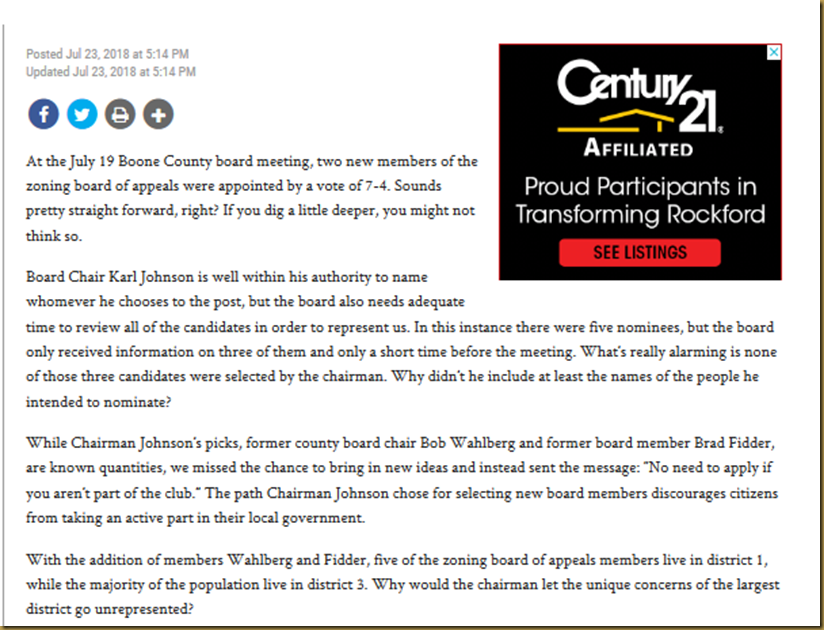
How representative are Boone County’s various boards?


image


image

image


Above is from:  http://www.rrstar.com/opinion/20180723/letter-boone-county-board-needs-to-be-more-representative


Facebook © 2018

Cathy Ward 

Yesterday (7/26/2018) at 9:41 AM ·

BOONE COUNTY BOARD NOTES - Decisions made by county board members CAN BE reversed. Here is how it can work, for example. Last week, the board voted 7-4 to approve the appointments for the Zoning Board of Appeals recommended by board chair Karl Johnson. Those appointments were former board chair Bob Walberg and former board member Brad Fidder. Those appointments were questioned for many reasons. Now to reverse that, at the next meeting, any of the seven who voted for Walberg and Fidder can ask that those appointments be reconsidered. Then the board can vote again on whether to approve the appointments. Those voting for the appointments were Sherry Giesecke, Denny Ellingson, Marshall Newhouse, Jeff Carlisle, Bernard O'Malley, Carl Larson and Karl Johnson. If you like those appointments, you can call any of those seven and thank them. If you would like those appointments to be reconsidered, you can call any of the seven and ask them to make the motion to reconsider. Those of us opposed were Brad Stark, Sherry Branson, Jessica Muellner and me. You
can also call and thank us for voting no or tell us those appointments were in the best interest of the county. Love to hear from you on either side of any issue.

image

Tuesday, July 24, 2018

NO—Yes—NO—YES but benefiting Democrats

President Donald Trump said Tuesday he's "very concerned" that Russia will attempt to meddle in the upcoming midterm elections to the benefit of the Democrats because he says he's been so tough on Russia.

The expression of concern about Russian meddling is a change in tone for the president, who has repeatedly expressed doubts about Russia's role in interfering in the 2016 U.S. election.

As recently as Sunday night, President Trump again referred to the concept of Russian election meddling as a “big hoax.” White House press secretary Sarah Sanders has since sought to argue that the president was only “referring to the claim that his campaign had anything to do with it.”

Standing next to Russian President Vladimir Putin last Monday, President Trump said he had “confidence in both parties,” referring to the U.S. and Russia.

“President Putin, he just said it’s not Russia. I will say this: I don’t see any reason why it would be,” the president said last Monday.

PHOTO: President Donald Trump, left, and Russian President Vladimir Putin, right, shake hands at the beginning of a meeting at the Presidential Palace in Helsinki, Finland, July 16, 2018. (Pablo Martinez Monsivais/AP, FILE)

Then on Tuesday, Trump issued a rare clarification and said he misspoke.

"In a key sentence in my remarks I said the word would instead of wouldn't, the sentence should have been, ‘I don't see any reason why it wouldn't,’ or why it wouldn't be Russia,” he said.

The president's expression of concern for future meddling also stands in contrast to previous comments.

Just last week,the president twice said "no" when ABC News' Cecilia Vega asked if he believed Russia was still targeting the U.S. Such as response would seem to contradict the president's Director of National Intelligence Dan Coats who had recently warned that "the warning lights are blinking red again" when it came to the threat of Russian cyber attacks.

The White House later said the president was saying "no" to taking reporters' questions and was not answering Vega's question.

PHOTO: President Donald Trump departs the White House, July 20, 2018. (Michael Reynolds/EPA via Shutterstock, file)

There is currently no publicly available evidence to support the president's claim that the Kremlin is interested in helping Democrats in the fall election.

In Helsinki last week, Putin said he did want Trump to win the election because Trump had "talked about bringing the U.S.-Russia relationship back to normal."

Democratic Leader Sen. Chuck Schumer seized on Putin's past comment as a counter-point to the president's tweet, blasting out the video clip with the caption "let's go to the videotape (again)."

Above is from:  https://www.yahoo.com/gma/president-trump-says-hes-very-concerned-russia-meddle-190803034--abc-news-topstories.html

Saturday, July 21, 2018

Teamster’s Pension Bankrupt in seven years?

Who will save Central States?

By MARIANNE LEVINE

06/15/2016 10:06 AM EDT

Share on Facebook Share on Twitter

The fate of the financially troubled Central States Pension Fund is once again in Congress' hands.

Last month the Treasury Department rejected a rescue strategy for the Teamsters’ multiemployer pension plan under a 2014 law passed largely to make it possible. Suspicions ran high that election-year politics came into play. Treasury had changed its procedures 10 days before the rejection — and seven months after Central States’ trustees submitted their application.

Was the Obama administration simply disinclined in an election year to approve, however necessary, pension cuts for about 270,000 Teamsters?

Former Rep. George Miller thinks so. The California Democrat, who sponsored the 2014 legislation with House Education and the Workforce Chairman John Kline (R.-Minn.), said Treasury’s decision “was a calculated response to sort of stop the discussion in this political year. ... I just don’t understand how you can arrive at another conclusion.”

Central States will not submit another application to Treasury, according to Thomas Nyhan, the pension’s executive director. “Our options are rather limited at this point,” Nyhan said. “Absent some form of legislative change, we’re going to become insolvent probably around the latter part of 2025.”

That leaves Congress to sort matters out. But if Treasury has little enthusiasm for resolving this crisis, Congress has even less.

Legislators thought they fixed this problem late in 2014 when they attached bipartisan legislation to the so-called “cromnibus” spending bill. The pensions amendment allowed trustees for financially troubled multiemployer pension plans to cut vested benefits, provided they could demonstrate to Treasury that doing so would prevent the plan from going bust. The idea was that the cuts would prevent a far worse fate — a Central States bailout by the Pension Benefit Guaranty Corporation, which would pay only pennies on the dollar (and which had solvency problems of its own). According to a recent PBGC report, “it is more likely than not that PBGC’s multiemployer fund will be exhausted by 2025.”


Joshua Gotbaum, former director of the PBGC, called the Treasury Department’s decision an “act of political cowardice” that will result in “more and deeper benefit cuts” to Central States beneficiaries.

But opponents to the 2014 law said the deal violated benefits guarantees under the Employee Retirement Income Security Act, and that it was arrived at without sufficient input from the public. Through 2015 Congress became ever more reluctant to defend its pension fix, even though many other multiemployer plans faced potential insolvency as well. (Multiemployer pensions are pensions set up by multiple companies through collective bargaining agreements.)

After Central States filed its application to Treasury, congressional lawmakers on both sides of the aisle urged Treasury to reject it. In April, 46 senators — including Harry Reid (D-Nev.), Ron Wyden (D-Ore.), Patty Murray (D.-Wash.), Sherrod Brown (D-Ohio), Elizabeth Warren (D-Mass.) — wrote Treasury Secretary Jack Lew, urging the agency “to conduct a thorough analysis and carefully check every aspect of [Central States’] application and their assumptions.” Sen. Rob Portman (R-Ohio) also urged Treasury to reject the application and said it was time for the Senate “to come up with a fair solution.”

Treasury’s subsequent rejection of the Central States rescue plan drew praise even from Democratic presidential candidate Hillary Clinton, who called on Congress to “come together around an alternative solution that maintains the financial health of ... our pension system and ensures workers and retirees can enjoy the secure retirement they’ve earned.”

But critics of Treasury’s decision say it was arrived at in bad faith. Final regulations implemented little more than a week before the department’s Central States decision changed the requirements for applicants’ actuarial assumptions. That made rejection of the Central States rescue plan all but a foregone conclusion.

“They did have the opportunity to sit down with Central States,” said Randy DeFrehn, executive director of the National Coordinating Committee for Multiemployer Plans. “Instead, they dropped this on them at the last minute. … I think that’s unconscionable.”

Opponents of the 2014 law say Treasury should be taken at its word. In rejecting the Central States plan, Treasury said the application failed to comply with the 2014 law’s requirement that benefit cuts be “reasonably estimated” to ensure future solvency. If the plan was going bust anyway, what point was there in making cuts that wouldn’t save it?

Some opponents to the 2014 law support a bailout bill from Bernie Sanders and Rep. Marcy Kaptur (D-Ohio). Central States’ Nyhan also supports this bill. Indeed, Nyhan says it’s only right that Congress should bail out the Teamsters pension, given that it was Congress’ decision to deregulate the trucking industry and Wall Street that led to Central States’ insolvency in the first place.

Over the four decades since trucking was deregulated, Nyhan said, "nearly 700 contributing employers formally declared bankruptcy and thousands went out of business without a formal bankruptcy filing." Many of these companies, he said, did not pay their liability to Central States. As for Wall Street deregulation, Nyhan said that the 2008 financial crash — which many attribute to inadequate banking regulation — had "a devastating effect on the Fund's financial status."

But congressional Republicans view a bailout as a slippery slope. A spokesperson for the House Education and the Workforce Committee said bailout supporters “have to explain why it would be limited to just those in multiemployer pensions and not extended to other pension plans — including public pension plans — that also face severe financial hardship.”

Not that Democrats have much enthusiasm for a Central States bailout, either. Miller said that even in 2010, when Democrats still controlled both houses of Congress and the White House, “there was radio silence” on the prospect of a bailout. “Everybody in Washington has a plan to close somebody else’s loophole to do something else,” Miller said, “and I just don’t think that’s going to happen.”

John Murphy, international vice president for the Teamsters, said the union has been working on an alternative to the 2014 law that wouldn’t require a bailout, but he declined to disclose details because it’s “still a work in progress.” Treasury's decision, he said, “has brought members of Congress to understand the depth of the problem.” Murphy said the Teamsters’ proposal would likely be out before the end of this year.

In all likelihood Murphy means "after Nov. 7." Treasury’s rejection “buys time to enable all the stakeholders to come around the table ... to find a solution,” said Karen Friedman, executive vice president and policy director at the Pension Rights Center.

She added that Central States could also benefit from a bipartisan push to pass legislation that would shore up the United Mine Workers’ multiemployer pension fund by using excess funds from the Abandoned Mine Reclamation Fund. Senate Democrats last month urged Senate Majority Leader Mitch McConnell to move the legislation before the start of the summer recess. “Perhaps that will open up a door to also address this issue,” Friedman said.

Meanwhile, Central States is willing to work on smaller proposals, Nyhan said, such as increasing PBGC premiums or providing some form of relief to future retirees now contributing to the pension fund who are at risk of not getting much back.

Gotbaum said Central States might use another provision of the 2014 law to ask the PBGC to take over its so-called “orphan obligations,” or obligations to employees whose employers withdrew from the pension plan. That, he said, would improve Central States’ chances of remaining solvent.

But Miller warned that time was running out. The 2014 law, he said, was supposed to give employers certainty that they could work with employees and retirees to prevent Central States from ending up at the PBGC. Without certainty, Miller said, more employers may pull out of Central States and weaken the plan further.

“The problem with stopping this process is that the clock continues to run,” Miller said. “The deficits continue to get bigger, the losses in pension benefits continue to compile every day.”

Above is from:  https://www.politico.com/story/2016/06/who-will-save-teamsters-central-states-pension-fund-224363

Fiat Chrysler chooses Jeep exec Manley to replace ailing CEO


Fiat Chrysler chooses Jeep exec Manley to replace ailing CEO

Photo Credit: AP Photo/Carlos Osorio

FILE - In this file photo dated Monday, Jan. 15, 2018, Mike Manley, head of Jeep brand, addresses the media during the North American International Auto Show, in Detroit, USA. The Fiat Chrysler's board on Saturday July 20, 2018, has recommended Jeep executive Mike Manley to replace seriously ill CEO Sergio Marchionne. (AP Photo/Carlos Osorio)

Fiat Chrysler chooses Jeep exec Manley to replace ailing CEO

July 21, 2018 7:13 AM

Updated: July 21, 2018 7:13 AM

Photo Credit: AP Photo/Carlos Osorio

ROME -  Jeep executive Mike Manley will be the new CEO of Fiat Chrysler Automobile after longtime leader Sergio Marchionne's health suddenly deteriorated following surgery, the company announced Saturday.

Marchionne, a 66-year-old Italian-Canadian, joined Fiat in 2004 and led the Turin-based company's merger with bankrupt U.S. carmaker Chrysler. Manley, 54, had been heading the Jeep brand since June 2009 and the Ram brand from October 2015 and has been with the company since 2000.

The announcement, at the end of an emergency board meeting Saturday, marked the end of the Marchionne era, which included the turnaround of failing Fiat, the takeover of bankrupt U.S. automaker Chrysler and the spinoffs of the heavy machinery and truck maker CNH and supercar maker Ferrari.

Marchionne, who is also a lawyer, was holding multiple leadership roles in the companies, notably as CEO of FCA — Fiat Chrysler Automobiles, as well as CEO and chairman of Ferrari.

Fiat Chrysler said in a statement that due to his health Marchionne "will be unable to return to work."

Marchionne had already announced he would step down from FCA in early 2019, so the board's decision, to be confirmed at an upcoming shareholders' meeting, will "accelerate" the CEO transition process, the statement said.

Ferrari announced that Louis Camilleri, an Egypt-born Maltese and longtime executive at tobacco company Philip Morris International, would replace Marchionne as CEO of the sports car maker.

The England-born Manley had been one of Marchionne's closest collaborators at Fiat Chrysler Automobiles, and in a previous role had been responsible for product planning and all sales activities outside of North America.

Manley took over management of the Jeep brand in 2009, just after Chrysler emerged from bankruptcy protection. At the time, the all-SUV Jeep mainly was a U.S. brand, where annual sales languished at around 232,000. By 2017, though, sales had nearly quadrupled to more than 828,000 as Americans snapped up all-wheel-drive SUVs.

The brand also grew internationally, especially in China, under Manley.

Marchionne put Manley in charge of the Ram brand as well as Jeep in 2015. Much of Fiat Chrysler's profits come from the Ram pickup, especially in the U.S.

FCA didn't give details about Marchionne's medical condition, which was reported to be surgery for a shoulder problem three weeks ago. But questions arose after it appeared his recovery was taking longer than expected.

Fiat is considered a close-knit family, and FCA chairman John Elkann said he was "profoundly saddened to learn of Sergio's state of health. It was a situation that was unthinkable until a few hours ago, and one that leaves us all with a sense of injustice."

Adding that his "first thoughts go to Sergio and his family," Elkann asked everyone to respect Marchionne's "privacy and that of all those who are dear to him."

Elkann is a grandson of the late Gianni Agnelli, the longtime Fiat dynasty chieftain.

Analysts praised the choice of Manley even as they noted the challenges he will face.

"It's an end of an era with the iconic, highly quotable, sweater-wearing Sergio Marchionne stepping down, with significant very concerns about his ailing health," said Rebecca Lindland, executive analyst at Kelley Blue Book.

She called Manley a "worthy replacement at FCA, but it's a huge job to not only fill Sergio's shoes, but to run many brands that are facing capricious fortunes in a variety of markets."

Lindland added that Manley's "masterful management of Jeep and RAM will serve him well as he moves into this huge, global role."

The boards of Ferrari and CNH Industrial, which makes heavy machinery and trucks, were also called to emergency meetings Saturday in Turin, Fiat's headquarters.

CNH Industrial said its interim CEO, Derek Neilson, will continue on pending the selection of a permanent replacement for Marchionne. The board of CNH also named Suzanne Heywood as chairwoman, tapping a managing director of the Fiat-founding Agnelli family's Exor investment holding company.

Marchionne made his last major presentation as CEO of Fiat Chrysler in June, unveiling the company's plans through 2022. He announced a major investment thrust to make more electrified cars even though he said traditional engines will continue to dominate production.

Brands that have been driving the company's revenues include Jeep SUVs, Ram trucks and the premium brands, Maserati and Alfa Romeo. Those brands were expected to account for 80 percent of revenues by 2022, compared to 65 percent currently.

The passenger-car brands of Fiat and Chrysler have been less profitable.

At the time, Marchionne said Fiat was poised to eliminate its debt. The next corporate results are to be released on July 25.

"Marchionne did an extraordinary job," tweeted former Italian Premier Paolo Gentiloni.

Then in apparent reference to Italian autoworkers unions' protests over layoffs and restructuring, Gentiloni added: "Many criticized him, but those who remember the Fiat crisis of 20 years ago realize what courage and vision can do."

Marchionne is passionate about the Ferrari racing team, and even after his planned retirement from Fiat Chrysler he had said he wanted to stay at the helm of the sports car company with the iconic horse symbol for a few more years.

The Ferrari racing team now leads the drivers' and constructors' championship this year and could end four years of Mercedes dominance.

On the eve of the running of the F1 Grand Prix in Germany on Sunday, Mercedes head of motorsport Toto Wolff expressed concern about his rival Marchionne.

"He's a character and an important personality for Formula One, and I've always appreciated sparring with him," Wolff said.

___

Milan-based AP business writer Colleen Barry, AP Auto Writer Tom Krisher and AP sports writer Jerome Pugmire in Hockenheim, Germany contributed

Above is from:  .https://www.houstonchronicle.com/business/technology/article/Fiat-Chrysler-board-meets-in-light-of-CEO-s-13093758.php

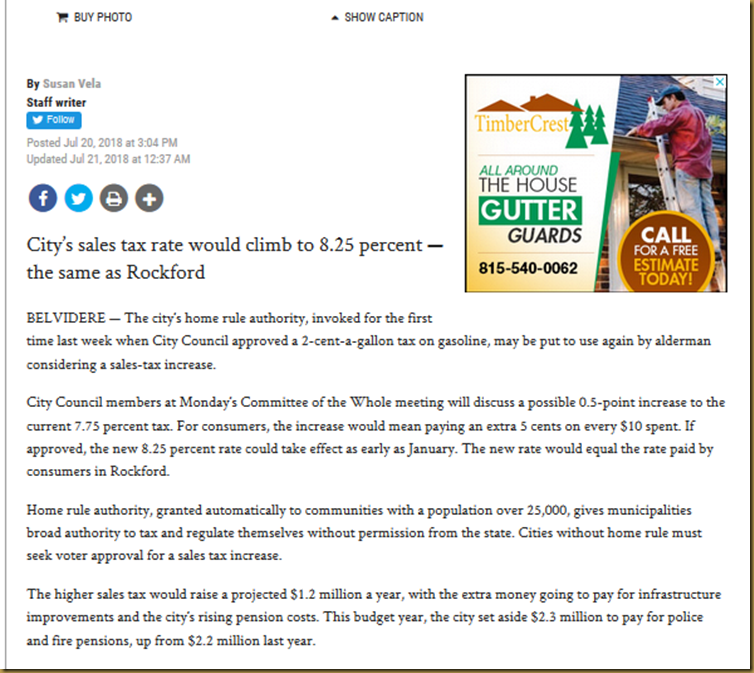
Increase in general sales tax in Belvidere?


image


image


image


image

Above is from:  http://www.rrstar.com/news/20180720/not-all-sold-on-proposed-belvidere-sales-tax-hike

GOP tax cuts aren't boosting wages


Michael Rainey

2 days ago


Inflation-adjusted wages have fallen for three straight quarters on a year-over-year basis, according to data released by the Labor Department Tuesday. MarketWatch’s Steve Goldstein provided a chart that shows a dismal picture for real wages this year:

a screenshot of a cell phone© Provided by The Fiscal Times

Bloomberg’s Noah Smith said that while it’s too soon to reach a definitive conclusion, it does appear that the Republican tax cuts are failing to provide much of a boost for American workers. The only thing that’s booming is stock buybacks, while business investment is only moderately higher and wages are falling. “Huge, immediate gains for wealthy shareholders combined with tepid increases in business investment and decreases in real wages don’t paint a flattering picture of the tax cut’s impact so far,” Smith wrote.

While it’s still possible that the corporate tax cuts will boost long-term growth in a way that significantly benefits American workers, the lackluster results so far suggest another possibility: “Corporate taxes were really the last hope for the tax-cutting strategy,” Smith said. “But if even that doesn’t provide more than a small momentary fiscal stimulus, then we’ve reached the end of that approach’s usefulness.”

Above is from:  https://www.msn.com/en-us/money/markets/gop-tax-cuts-arent-boosting-wages/ar-AAAgLtL?ocid=sf

Friday, July 20, 2018

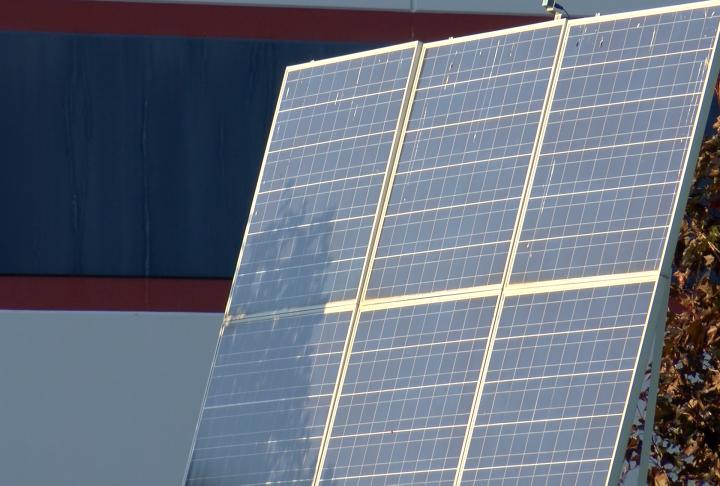
Boone County approves solar farm project in Flora Township

Boone County approves solar farm project0
Posted: Jul 18, 2018 11:02 PM CDT

BELVIDERE (WREX) -

The Boone County Board has approved a new solar farm project.

The board voted 8-3 in favor of the solar farm on Wednesday. The company in charge of the project is Syncarpha Solar LLC and it's looking at 12 acres of land in Flora Township. This is the second solar farm coming to the area.  The county board already approved a solar farm built by Borrego Solar.

With the proposal passing, the project will bring in money for Boone County as soon as 2020.

Above is from:  http://www.wrex.com/story/38679644/2018/07/19/boone-county-approves-of-solar-farm-project