Thursday, March 8, 2018

Solar Panel Farm Proposed to Replace Landfill in Boone County


image


Solar Panel plans discussed to send recommendation to county board

By: Jerrica Valtierra

Posted: Mar 07, 2018 11:16 PM CST

Updated: Mar 07, 2018 11:16 PM CST

AddThis Sharing Buttons

Share to Facebook<?XML:NAMESPACE PREFIX = "[default] http://www.w3.org/2000/svg" NS = "http://www.w3.org/2000/svg" />Share to Google BookmarkShare to TwitterShare to PrintShare to More38

Invisible placeholder

BELVIDERE - Boone County Board Members are trying to turn an abandoned field, into an energy source.  They met Wednesday night to discuss installing solar panels on a landfill near Squaw Prairie and Fairgrounds Roads.  This is a new idea that has a lot of people excited, some county board members say it's a promising project. But some at the meeting had worries about the property surrounding the landfill.

The landfill closed about 25 years ago.  It's located just East of  Route 76 and Spring Creek Road in Belvidere, but soon, it could be the home of a new solar panel farm.

Jeff Carlisle, Boone County Board Member - Dist 2
"The goal is revenue," said Boone County Board Member Jeff Carlisle.  "The goal is to functionally work with some type of revenue to bring to the county. Solar farms are a valuable part of so we're looking at it."

As of right now, Boone County is in negotiations with a handful of companies that could build the solar farm.  Until the board picks one, It's unclear how much the project will cost, but Carlisle says the panels will provide power for the City of Belvidere and Boone County buildings, which could help them to save on energy costs.

"If we take down some of the costs in our city, [and] county buildings together that's also going to those budgets there ultimately it helps everybody in the long run."

County Administrator Ken Terrinoni says Boon County would earn money through whichever company ultimately ends up building the solar farm.

"It would bring in some lease payment money for county, for the taxpayers, and the company would pay the cost of getting the permits from the Illinois EPA to have a solar farm," said Terrinoni.

"We're getting zero money from the mound and and now were getting small amount of money for the farmland behind it," said Carlisle.  "We're looking at earning 62% on the farmland more, if we put a [solar] panel on it."

Utility providers must adhere to State of Illinois environmental mandates by creating 'green space' like solar farms

"They create these tax incentives that are causing private industries to step forward and say 'hey maybe I can do something with this property, turn it into some value for the landowner as opposed to just being an environmental site that's closed," said Terrinoni. 

Terrinioni adds that the approval for the project is on a tight schedule. Therefore, when the joint City and County Committee meet next week they hope to bring a recommendation to the Boone County Board meeting on the 21st.

Above is from:  http://www.mystateline.com/news/solar-panel-farm-proposed-to-replace-landfill-in-boone-county/1019802629

Wednesday, March 7, 2018

Boone County government announces vacancies

Posted Mar 6, 2018 at 2:22 PM Updated Mar 6, 2018 at 2:22 PM

BELVIDERE — The Boone County government recently announced vacancies on various volunteer boards.

The board of health has one vacancy that expires July 1; the Belvidere cemetery association has five vacancies that have six-year terms; the sanitary district has one vacancy that has a three-year term and one vacancy that expires May 1, 2019; fire protection districts No. 1, 2, 3 and 5 that have three-year terms; and the Garden Prairie Street Light District has one vacancy has a three-year term.

Interested parties are asked to send a letter and/or resume expressing their interest and qualifications along with their contact information by March 23 to Boone County Board Chairman Karl Johnson, Administration Campus, 1212 Logan Ave., Suite 102, Belvidere, IL 61008.

Above is fromhttp://www.rrstar.com/news/20180306/boone-county-government-announces-vacancies

Monday, March 5, 2018

Tension Between IL Trustees, Firefighters Could Impact Voting


image

Residents in Boone County say enough is enough in the personal matter has gone public.

Susan Vela

March 4, 2018

Rockford Register Star, Ill.

0

Tweet

Share

Boone County Fire

BELVIDERE — Discord between the Boone County Fire Protection District 2 board of trustees and firefighters has some residents saying enough is enough, and could influence the outcome of a March 20 referendum.

Tensions have been running high since March 2017, when trustees fired Brad Bartell as chief. Then, in February, firefighters were riled by a vulgar sign posted by Trustee Kevin Stark outside his trucking and concrete business in Marengo.

At a board meeting on Monday, trustees accepted Stark's resignation after Belvidere resident Charmaine Cornwell and others in the audience said they were offended by the sign.

"There seems to be some personal issues going on," said Cornwell, a Belvidere resident. "In order for your organization to run smoothly, you need to leave those off the table.

"We're talking about a fire department here that's here to serve and protect our community. The community doesn't care about your personal issues. I'm sure you don't care about mine."

Trustees Jim Marrs and Jack Ryan declined to comment for this story. But their futures are now in the hands of voters, who will decide in a March 20 referendum whether trustees should continue to be appointed by the County Board or elected, beginning in April 2019.

Boone County Board member Cathy Ward, who represents District 2, plans to vote for elected trustees.

"I like elections," she said. "I'm in favor of giving more people the choice to elect who they want."

County Board member Sherry Giesecke, District 1, does not live in the fire district. But she knows what she would like to see in the next trustee.

"I would like to see a trustee that puts the safety of the citizens first before any personal motivations or any political motivations," she said. "That's how I feel. The safety of the citizens is paramount. That has to be the No. 1 reason for anything we do."

Stark's three-year term was set to expire in April.

Stark has declined to comment about the sign controversy.

County Board Chairman Karl Johnson said he'll advertise for the vacant position in the next few weeks.

"It's time for people to start acting like adults," he said. "Let's do what's best for the community as a whole. It needs to be about the community, not about any one group or individual.

"I'm looking for somebody that's going to be level-headed — that's going to evaluate all sides of an issue (and) then make a determination of what's in the best interest of the department."

Boone County Fire Protection District 2 Chief Kent Hulett declined to comment. The district covers about 150 square miles, including the unincorporated communities of Irene, Herbert and Garden Prairie.

Susan Vela: 815-987-1392; svela@rrstar.com; @susanvela

———

©2018 Rockford Register Star, Ill.

Visit Rockford Register Star, Ill. at www.rrstar.com

Distributed by Tribune Content Agency, LLC.

Above is fromhttps://www.firehouse.com/leadership/news/20994820/tension-between-boone-county-trustees-firefighters-could-impact-voting

Thursday, March 1, 2018

Melania Trump entered US with 'Einstein' visa designated for people with 'extraordinary ability'


AOL.com Christina Gregg,AOL.com 1 hour 6 minutes ago

Melania Trump entered US with &#39;Einstein&#39; visa designated for people with &#39;extraordinary ability&#39;

Melania Trump entered the United States in 2001 after receiving a green card visa designated for people with "extraordinary ability," according to a new Washington Post report.

The wife to President Trump was one of only five people from Slovenia who entered the United States in March of 2001 under the EB-1 program, which has been described as the "Einstein visa." This detail surrounding the first lady's immigration journey comes after Melania's own parents recently faced criticism for potentially relying on an immigration process referred to by some as "chain migration" that their son in law wants to end.

In the late '90s and earlier 2000's, a then Melania Knauss could be seen gracing runway shows in Europe, billboard cigarette ads and the pages of Sports Illustrated's swimsuit edition. The EB-1 program, which was written into U.S. immigration policy via the Immigration Act of 1990, was built to let in researchers, business executives and others who demonstrated "sustained national and international acclaim."

According to the Post, over one million green cards were granted in 2001 alone, and only 3,376 were issued to immigration with "extraordinary ability."

Above is from:  https://www.yahoo.com/lifestyle/melania-trump-entered-us-apos-154111962.html

Wednesday, February 28, 2018

Are Hospitals Becoming Obsolete?

Opinion | Op-Ed Contributor

image

By EZEKIEL J. EMANUELFEB. 25, 2018


Credit Ángel Franco/The New York Times

Hospitals are disappearing. While they may never completely go away, they will continue to shrink in number and importance. That is inevitable and good.

The reputation of hospitals has had its ups and downs. Benjamin Rush, a surgeon general of the Continental Army, called the hospitals of his day the “sinks of human life.” Through the 19th century, most Americans were treated in their homes. Hospitals were a last resort, places only the very poor or those with no family went. And they went mainly to die.

Then several innovations made hospitals more attractive. Anesthesia and sterile techniques made surgery less risky and traumatic, while the discovery of X-rays in 1895 enhanced the diagnostic powers of physicians. And the understanding of germ theory reduced the spread of infectious diseases.

Middle- and upper-class Americans increasingly turned to hospitals for treatment. Americans also strongly supported the expansion of hospitals through philanthropy and legislation.

Today, hospitals house M.R.I.s, surgical robots and other technological wonders, and at $1.1 trillion they account for about a third of all medical spending. That’s nearly the size of the Spanish economy.


And yet this enormous sector of the economy has actually been in decline for some time.

Consider this: What year saw the maximum number of hospitalizations in the United States? The answer is 1981.

That might surprise you. That year, there were over 39 million hospitalizations — 171 admissions per 1,000 Americans. Thirty-five years later, the population has increased by 40 percent, but hospitalizations have decreased by more than 10 percent. There is now a lower rate of hospitalizations than in 1946. As a result, the number of hospitals has declined to 5,534 this year from 6,933 in 1981.


This is because, in a throwback to the 19th century, hospitals now seem less therapeutic and more life-threatening. In 2002, researchers from the Centers for Disease Control and Prevention estimated that there were 1.7 million cases of hospital-acquired infections that caused nearly 100,000 deaths. Other problems — from falls to medical errors — seem too frequent. It is clear that a hospital admission is not a rejuvenating stay at a spa, but a trial to be endured. And those beeping machines and middle-of-the-night interruptions are not conducive to recovery.

The number of hospitals is also declining because more complex care can safely and effectively be provided elsewhere, and that’s good news.

When I was training to become an oncologist, most chemotherapy was administered in the hospital. Now much better anti-nausea medications and more tolerable oral instead of intravenous treatments have made a hospital admission for chemotherapy unusual. Similarly, hip and knee replacements once required days in the hospital; many can now be done overnight in ambulatory surgical centers. Births outside of hospitals are also increasing, as more women have babies at home or at birthing centers.

Studies have shown that patients with heart failure, pneumonia and some serious infections can be given intravenous antibiotics and other hospital-level treatments at home by visiting nurses. These “hospital at home” programs usually lead to more rapid recoveries, at a lower cost.

As these trends accelerate, many of today’s hospitals will downsize, merge or close. Others will convert to doctors’ offices or outpatient clinics. Those that remain will be devoted to emergency rooms, high-tech services for premature babies, patients requiring brain surgery and organ transplants, and the like. Meanwhile, the nearly one billion annual visits to physicians’ offices, imaging facilities, surgical centers, urgent-care centers and “doc in the box” clinics will grow.

Special interests in the hospital business aren’t going to like this. They will lobby for higher hospital payments from the government and insurers and for other preferential treatment, often arguing that we need to retain the “good” jobs hospitals offer. But this is disingenuous; the shift of medical services out of hospitals will create other good jobs — for home nurses, community health care workers and staff at outpatient centers.

Hospitals will also continue consolidating into huge, multihospital systems. They say that this will generate cost savings that can be passed along to patients, but in fact, the opposite happens. The mergers create local monopolies that raise prices to counter the decreased revenue from fewer occupied beds. Federal antitrust regulators must be more vigorous in opposing such mergers.

Instead of trying to forestall the inevitable, we should welcome the advances that are making hospitals less important. Any change in the health care system that saves money and makes patients healthier deserves to be celebrated.

Ezekiel J. Emanuel is a vice provost at the University of Pennsylvania, the author of “Prescription for the Future” and a partner at Oak HC/FT, a health care investment company.

Follow The New York Times Opinion section on Facebook and Twitter (@NYTopinion), and sign up for the Opinion Today newsletter.

Above is fromhttps://www.nytimes.com/2018/02/25/opinion/hospitals-becoming-obsolete.html

A History of the Federal Gas Tax


Why Trump may usher in the biggest gas tax hike ever

February 27, 2018 6.29am EST


The Conversation

The White House aims to boost what the federal government spends on big public works projects by about US$200 billion over the next decade as a part of its plan to fix the nation’s ailing infrastructure. So far, it’s unclear how the Trump administration plans to pay for most of this spending surge at a time when revenue is about to fall due to massive tax cuts.

As the director of energy studies at the University of Florida’s Public Utility Research Center, I’ve studied both taxes on energy and how the government leverages what it spends on infastructure through public-private partnerships. I believe there’s a chance President Donald Trump will usher in the first federal gas tax increase in 25 years to cover the cost of new roads and bridges.

He has, after all, already said he supports a 25-cent-per-gallon increase the U.S Chamber of Commerce is backing, even if that sounds hard to sell to his own political base and other conservatives.

To explain why the government may finally adjust the 18.4-cent-a-gallon tax, here’s a historical snapshot.

The first 40 years

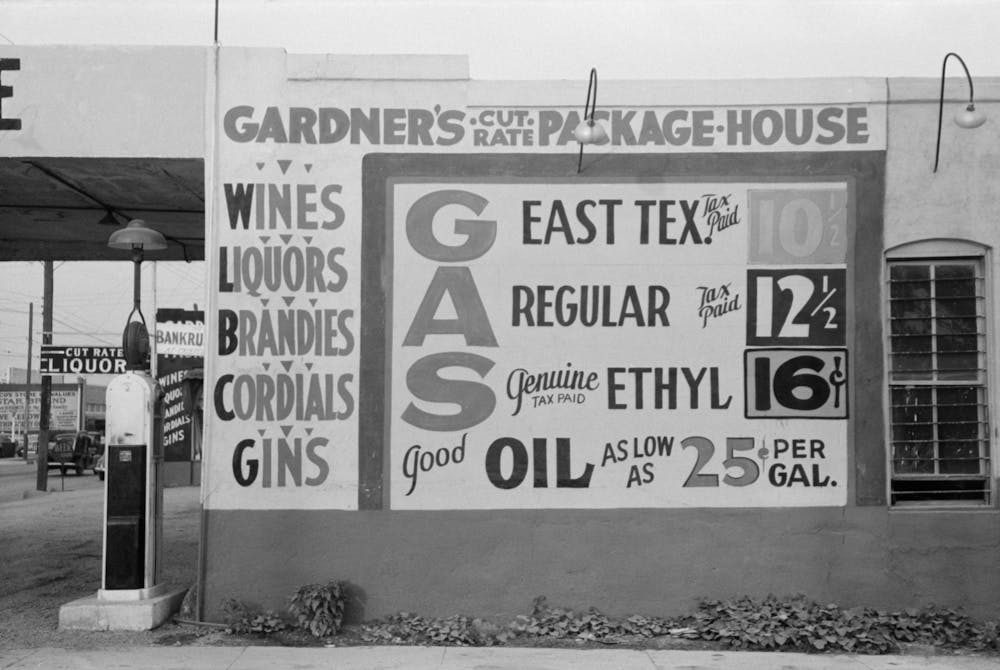
This resilient levy is a major source of U.S. funding for roads and transit today. It originated during the Great Depression as a “temporary” penny-per-gallon gasoline tax. At the time, a gallon cost about 18 cents, or $2.61 in 2015 dollars.

As he signed the Revenue Act of 1932 into law, President Herbert Hoover lauded “the willingness of our people to accept this added burden in these times in order impregnably to establish the credit of the federal government.”

The original gas tax, an emergency measure intended to bolster the budget and fund national defense spending, not meet transportation needs, was slated to expire in 1933. Instead, it remained in force throughout Franklin D. Roosevelt’s administration over the objections of the oil, automotive and travel industries due to persistent budget deficits throughout the New Deal and World War II. It became a permanent 1.5-cent levy in 1941.

Multiple efforts to do away with the gas tax ever since have failed.

The first gas tax had been in effect for seven years before this 1939 photo of a Waco, Texas, gas station was shot. Everett Historical

For example, Congress again scheduled the tax’s repeal in 1951 when it increased it to 2 cents as source of revenue related to the Korean War. Instead, lawmakers agreed to keep the tax on the books to help pay for one of President Dwight D. Eisenhower’s top priorities, the national interstate highway system.

In 1956 the levy rose once more, to 3 cents, when Americans were paying about 30 cents for a gallon of gas. At the same time, the government established the Highway Trust Fund to pay for building and maintaining the new interstates.

The tax rose to 4 cents per gallon in 1959 and froze at that level for more than two decades.

Running on empty

Gas tax revenue stopped keeping up with the expenses it was supposed to cover in the early 1970s following a severe bout of inflation and OPEC’s oil embargo. U.S. gas prices soared from about 36 cents per gallon in 1972 to $1.31 in 1981.

Responding to what members of both major political parties saw as a transportation infrastructure crisis, Congress more than doubled the tax to 9 cents per gallon as part of the Surface Transportation Assistance Act of 1982. The same law split the Highway Trust Fund and its revenue stream into two parts: The first 8 cents would finance roadwork while the other penny would finance mass transit projects.

Nine cents may have struck drivers as a sharp increase, but public spending on transportation infrastructure would continue to fall as a percentage of all outlays.

In 1984, Congress increased spending on highways by funneling proceeds from fines and other penalties that businesses pay for safety violations, such as failing to label hazardous materials or forcing drivers to work too many hours in a row.

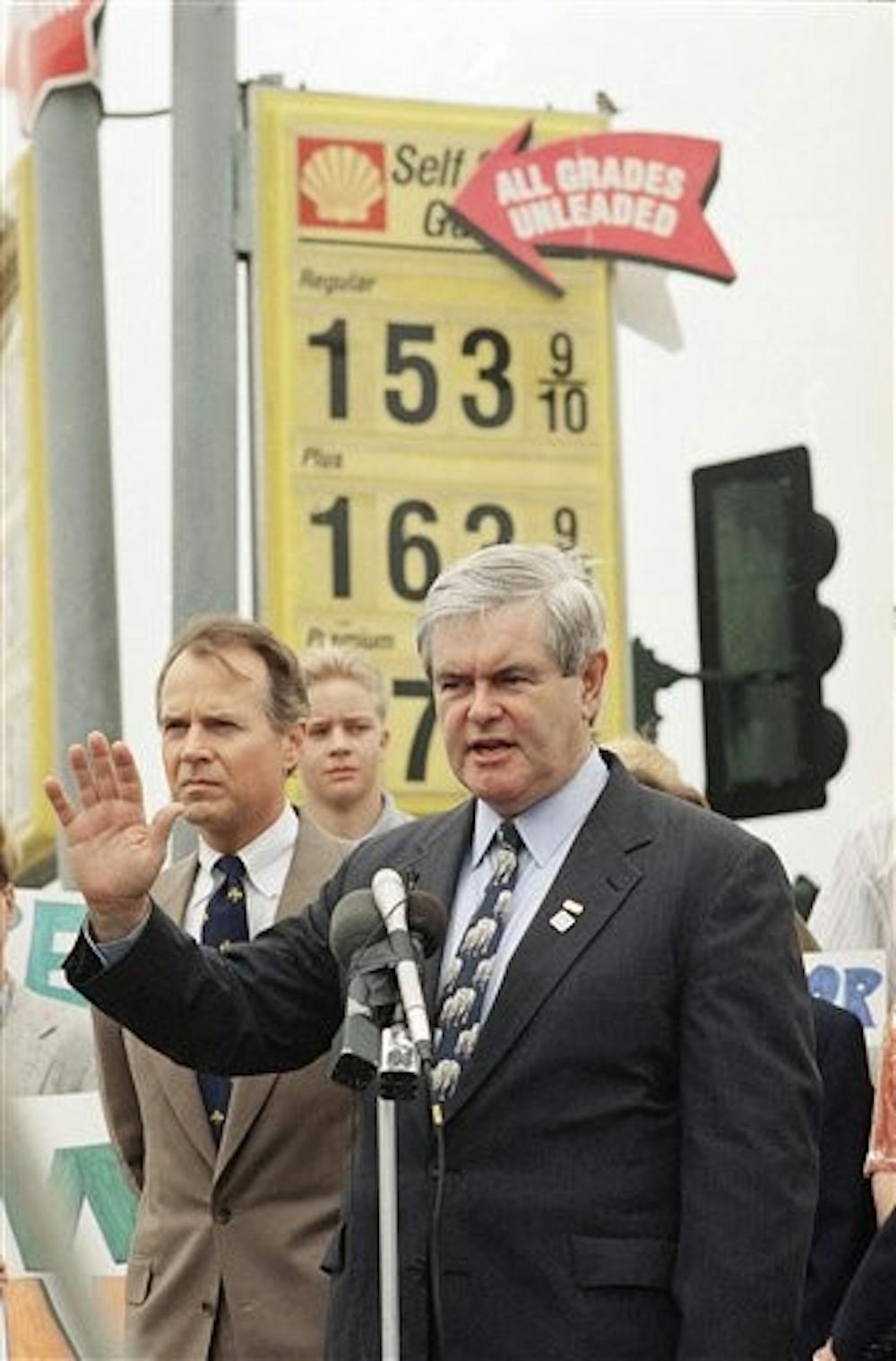
Congress boosted the tax twice more in the 1990s but primarily to reduce the then-ballooning federal deficit. Only half of a 5-cent increase in 1990 went to highways and transit, while a 4.3-cent lift three years later went entirely to lowering the deficit.

Newt Gingrich, right, in 1996. The then-House speaker was predicting incorrectly that Congress might repeal a gasoline tax hike that took effect three years earlier. AP Photo/Tammy Lechner

By 1997, the government had redirected all gas tax revenue reserved for deficit reduction to the Highway Trust Fund, where it still flows today.

Along the way, other federal fuel taxes arose, including a 24.4 cent-per-gallon diesel tax and taxes on methanol and compressed natural gas. And state fuel taxes, which in most cases began before the federal gas tax, range from as low as 8.95 cents per gallon in Alaska to as high as 57.6 cents per gallon in Pennsylvania.

Making do

Since 1993, when the federal gas tax was first parked at 18.4 cents, inflation and rising construction costs have eroded its effectiveness as a transportation-related revenue source. In addition, U.S. vehicles have grown more fuel-efficient overall – which means Americans use less fuel for every mile they drive.

As a result, highway and transit spending have significantly outpaced the revenue collected from the gas tax and other sources. Since 2008, the government has spent $80 billion on highways that it had to take from other sources.

But it’s still not enough. The American Society of Civil Engineers, which gives U.S. infrastructure a D+, is calling on the government and private sector to increase spending on roads and bridges by at least $1 trillion within a decade.

Unusual politics

Like the sharp gas tax increase during the Reagan administration, a 25-cent hike that Trump might sign into law would come at a time when the tax is relatively low as a percentage of the retail price of gasoline.

And like that early 1980s precedent, it would come at a politically surprising moment. Anti-tax conservatives were ascendant then. Now, Republicans, who say they believe in keeping taxes low, control the White House and Congress.

However, Trump has pledged to spend billions of federal dollars on new roads and bridges when there’s no money in the Highway Trust Fund for that. The money has to come from somewhere, and the Chamber of Commerce projects that raising the tax by a quarter could generate more than $375 billion in new revenue over a decade.

Above is from:  https://theconversation.com/why-trump-may-usher-in-the-biggest-gas-tax-hike-ever-92007?utm_medium=email&utm_campaign=Latest%20from%20The%20Conversation%20for%20February%2028%202018%20-%2095718225&utm_content=Latest%20from%20The%20Conversation%20for%20February%2028%202018%20-%2095718225+CID_b06f3972c1ad24b69c7a521f9e96fcea&utm_source=campaign_monitor_us&utm_term=Why%20Trump%20may%20usher%20in%20the%20biggest%20gas%20tax%20hike%20ever