Sunday, February 4, 2018

China launches dumping probe into U.S. sorghum imports amid rising trade tension


Reuters Reuters 17 hours ago


By Dominique Patton

BEIJING (Reuters) - China has launched an anti-dumping and anti-subsidy investigation into imports of sorghum from the United States, the Ministry of Commerce said on Sunday, less than a fortnight after U.S. President Donald Trump slapped steep tariffs on imports of solar panels and washing machines.

Beijing's action is expected to immediately hit demand for the upcoming U.S. sorghum crop, exports of which are largely used to feed China's huge livestock sector, and send shivers through the entire U.S. farm sector.

China is the top buyer of U.S. sorghum as well as soybeans, the United States' most valuable export to the world's No. 2 economy.

"I personally believe this is China's response to Trump's action on washing machines," said Li Qiang, chief analyst at agriculture consultancy Shanghai JC Intelligence Co Ltd.

"If he takes any further measures, they will consider soybeans," he added.

The U.S. shipped 4.76 million tonnes of sorghum to China in 2017, the bulk of China's roughly 5 million tonnes of imports of the grain that year, and worth around $1.1 billion, according to Chinese customs data.

That makes it almost twice as valuable as exports of Chinese aluminium alloy sheet to the U.S., also subject to recent trade action by Washington, which is being seen as another possible trigger for Beijing's move.

Like the U.S. aluminium investigation, China's commerce ministry investigation into sorghum was self-initiated.

The ministry said it had initiated the investigation because the local industry included a large number of small growers who were unable to prepare the necessary documentation.

Preliminary evidence and information found that imported sorghum from the U.S. had been exported at a lower than normal value, it said, damaging local producers.

The trade action comes a year after Beijing slapped hefty anti-dumping and anti-subsidy duties on imports of distillers dried grains (DDGS) from the U.S., another product used as a feed ingredient, although it recently reduced VAT on DDGS imports.

Exports of U.S. soybeans to China are also under pressure from stiff competition from rival exporter Brazil, with export sales hitting a seven-month low last week.

The investigation into sorghum dumping will be carried out for the period from Nov. 1, 2016 until Oct. 31, 2017, while an investigation of industrial injury will be from Jan. 1, 2013 until Oct. 31, 2017, said the commerce ministry statement.

The investigation should be complete by Feb. 4, 2019, it said, but can be extended until Aug. 4, 2019.

Above is from:  https://www.yahoo.com/finance/news/china-launch-anti-dumping-investigation-081415570.html

Saturday, February 3, 2018

The U.S. government is set to borrow nearly $1 trillion this year, an 84 percent jump from last year

The U.S. government is set to borrow nearly $1 trillion this year, an 84 percent jump from last year

By Heather Long

February 3, 2018 at 7:00 AM

The National Debt Clock in New York City is shown last November. The total is about $100 billion higher now. (Shannon Stapleton/Reuters).

It was another crazy news week, so it's understandable if you missed a small but important announcement from the Treasury Department: The federal government is on track to borrow nearly $1 trillion this fiscal year — Trump's first full year in charge of the budget.

That's almost double what the government borrowed in fiscal year 2017.

Here are the exact figures: The U.S. Treasury expects to borrow $955 billion this fiscal year, according to a documents released Wednesday. It's the highest amount of borrowing in six years, and a big jump from the $519 billion the federal government borrowed last year.

Treasury mainly attributed the increase to the “fiscal outlook.” The Congressional Budget Office was more blunt. In a report this week, the CBO said tax receipts are going to be lower because of the new tax law.

President Trump said during a Jan. 18 speech in Coraopolis, Pa., that Republicans’ tax overhaul is already benefiting the U.S. economy. Here are his full remarks. (The Washington Post)

The uptick in borrowing is yet another complication in the heated debates in Congress over whether to spend more money on infrastructure, the military, disaster relief and other domestic programs. The deficit is already up significantly, even before Congress allots more money to any of these areas.

“We're addicted to debt,” says Marc Goldwein, senior policy director at Committee for a Responsible Federal Budget. He blames both parties for the situation.

What's particularly jarring is this is the first time borrowing has jumped this much (as a share of GDP) in a non-recession time since Ronald Reagan was president, says Ernie Tedeschi, a former senior adviser to the U.S. Treasury who is now head of fiscal analysis at Evercore ISI. Under Reagan, borrowing spiked because of a buildup in the military, something Trump is advocating again.

Trump didn't mention the debt — or the ongoing budget deficits — in his State of the Union address. The absence of any mention of the national debt was frustrating for Goldwein and others who warn that America has a major economic problem looming.

“It is terrible. Those deficits and the debt that keeps rising is a serious problem, not only in the long run, but right now,” Harvard economist Martin Feldstein, a former Reagan adviser, told Bloomberg.

A strong jobs report and disappointing earnings slammed Wall Street on Feb. 2. The Dow suffered its worst percentage drop since June 2016. (Reuters)

The White House got a taste of just how problematic this debt situation could get this week. Investors are concerned about all the additional borrowing and the likelihood of higher inflation, which is why the interest rates on U.S. government bonds hit the highest level since 2014. That, in turn, partly drove the worst weekly sell-off in the stock market in two years.

The belief in Washington and on Wall Street has long been that the U.S. government could just keep issuing debt because people around the world are eager to buy up this safe-haven asset. But there may be a limit to how much the market wants, especially if inflation starts rising and investors prefer to ditch bonds for higher-returning stocks.

“Some of my Wall Street clients are starting to talk recession in 2019 because of these issues. Fiscal policy is just out of control,” says Peter Davis, a former tax economist in Congress who now runs Davis Capital Investment Ideas.

The Federal Reserve was also buying a lot of U.S. Treasury debt since the crisis, helping to beef up demand. But the Fed recently decided to stop doing that now that the economy has improved. It's another wrinkle as Treasury has to look for new buyers.

Tedeschi, the former Treasury adviser to the Obama administration, calls it “concerning, but not a crisis.” Still, he says it's a “big risk” to plan on borrowing so much in the coming years.

Trump's Treasury forecasts borrowing over $1 trillion in 2019 and over $1.1 trillion in 2020. Before taking office, Trump described himself as the “king of debt,” although he campaigned on reducing the national debt.

The Committee for a Responsible Federal Budget predicts the U.S. deficit will hit $1 trillion by 2019 and stay there for a while. The latest borrowing figure — $955 billion — released this week was determined from a survey of bond market participants, who tend to be even faster to react to the changing policy landscape and change their forecasts.

Both parties claim they want to be “fiscally responsible,” but Goldwein says they both pass legislation that adds to the debt. Politicians argue this is the last time they'll pass a bill that makes the deficit worse, but so far, they just keep going.

The latest example of largesse is the GOP tax bill. It's expected to add $1 trillion or more to the debt, according to nonpartisan analysis from the Joint Committee on Taxation (and yes, that's after accounting for some increased economic growth).

But even before that, Goldwein points to the 2015 extension of many tax cuts and the 2014 delays in Medicare reimbursement cuts.

“Every time you feed your addiction, you grow your addiction,” says Goldwein.

There doesn't seem to be any appetite for budgetary restraint in Washington, but the market may force Congress' hand.

Above is from:  https://www.washingtonpost.com/amphtml/news/wonk/wp/2018/02/03/the-u-s-government-is-set-to-borrow-nearly-1-trillion-this-year/

My Great-Grandparents Weren’t ‘Illegal’ When They Came To The U.S. They Would Be Now.

My Great-Grandparents Weren’t ‘Illegal’ When They Came To The U.S. They Would Be Now.

HuffPost Kari Hong,HuffPost Fri, Feb 2 4:59 AM CST


Descendants of Norwegian immigrants pose at the Minnesota State Fairgrounds by the sloop on which their ancestors came to America in 1925. 

Around 1905, when Norway would have been considered a “shithole,” my great-grandmother sailed to the United States. She was 16 years old, without family and money, and found work as a house cleaner. My great-grandfather was a Norwegian sailor who jumped ship and just started living in Chicago.

Fortunately for me, the immigration laws we had then let them get green cards and earn citizenship. My mother recounts her grandparents as kind and decent, suffering humiliation and enduring hardship to provide opportunities for their children. They were frugal and bought a house. Both of their sons served in WWII; one was shot down and was a POW. Their granddaughter, my mother, was the first in their family to attend college.

Their story, an immigrant story, exemplifies the American dream.

Our immigration laws have been a bit more complicated. We have a restrictionist past, having excluded people based on race and nationality, including people from China, Japan and Italy. The country moved to rectify these exclusionary policies with the passage of the 1965 Immigration and Nationality Act.

We have also had important chapters in our immigration story when we calculated “merit” properly: not by measuring a person’s worth based on what they lacked upon their arrival, but by valuing the future contributions that arise from their hopes, grit and gratitude.

Over two decades ago, Congress passed a law that changed that calculus. In the same month that he cravenly appealed to the right by “reforming” welfare and signing DOMA, former President Bill Clinton also signed the Illegal Immigration Reform and Immigrant Responsibility Act of 1996.

IIRIRA was neither a solution to an existing problem nor a pragmatic compromise. Rather, the Republicans wanted to look tough on immigration, and the Democrats were afraid to look soft, despite knowing the law was bad policy. The law closed many doors that used to let people stay. Previously, someone who crossed the border earned a green card if they had spent seven years paying taxes, demonstrated good character and proved a citizen needed them here. For those who married citizens, they got status if they paid a $1,000 fine. IIRIRA instead elevated a border crossing into an unforgivable sin, deporting the same people who used to get green cards.

If that law had been in place in 1905, both my great-grandparents would be “illegal” — one overstayed her visa, the other crossed a border without one. My great-grandparents would be placed in detention and scheduled for immediate deportation, likely without a hearing. The old immigrants did not have superior character; our laws just were not captured by right-wing talking points.  

The old immigrants did not have superior character; our laws just were not captured by right-wing talking points.

With his “shithole” comments earlier this month, President Donald Trump exposed the moral deficiency and logical fallacy of IIRIRA’s restrictionism. But Republicans defend it with politer language ― think “merit,” “chain-migration,” and “self-deportation” ― and Democrats continue to acquiesce with spineless silence.

What the immigration hard-liners get wrong is that it is this heightened, senseless immigration enforcement, not legal or “illegal” immigrants, that is hurting our country.

Immigration violations often involve minor and unintentional conduct, and are intended to be forgiven. When someone breaks a criminal law, they are convicted, punished and could face a lifetime of collateral consequences arising from being a felon. But when someone violates immigration law, they appear before an immigration judge, and will sometimes be given (or restored with) a green card or asylum status.

Half of the people who get immigration hearings are granted legal status. For those with attorneys, that number is much higher: in 2017, in one courthouse that found a lawyer for every detained case, the grant rate went from 4 percent to 24 percent, and is predicted to be 77 percent when all pending cases are counted. A national study of 1.2 million cases showed that, for those outside of detention, grant rates went from 13 percent to 63 percent if the non-citizen had an attorney. The more accurate term would be “pre-legal” not “illegal,” immigrants.

The term “illegal immigrant,” however, serves to justify billions of dollars spent on arresting, detaining and deporting people who sound dangerous. Under former President Barack Obama, the federal government spent $18 billion each year on immigration enforcement.  By contrast, the agencies targeting actual criminals — the FBI, DEA, Secret Service, and ATF — got only $14 billion. 

Trump wants to spend billions more — each year — on more arrests ($1.3 billion more on new officers), more detention centers ($1.5 billion increase over the $2 billion currently spent), and more wall (starts at $21.5 billion and estimates are as high as $67 billion). There simply is no justification for this amount of wasted money. 

While Trump’s crackdown that has resulted in a 40 percent increase in immigration arrests, fewer than 6 percent have any criminal conviction. And among those with convictions is the Polish doctor with a green card whose misdemeanor offenses were decades old.

Across all sectors, our economy will not thrive or grow without immigrants: rural hospitals face a shortage without foreign-born doctors. Up to 50 to 70 percent of farmworkers are undocumented. Society Security will be insolvent unless more immigrants live in our country. And Trump’s current immigration crackdown is proving that immigrant deportations do not create a single American job.

The term 'illegal immigrant' serves to justify billions of dollars spent on arresting, detaining and deporting people who sound dangerous.

To the contrary, it is costing tens of thousands of Americans their livelihood: a labor shortage is “choking” Idaho’s dairy industry, lost tourism has resulted in 40,000 layoffs, and a decline in foreign students is forcing numerous colleges to cut programs and faculty. Immigration hard-liners wish to spend $400 billion to $600 billion to deport a population that is expected to contribute over $5 trillion to our economy in the next 10 years. That’s the party of fiscal responsibility?

What Trump’s rhetoric, and IIRIRA’s deeds, miss most with their attack on immigrants is that being American is both a noun and a verb. I first became patriotic when, as an immigration lawyer, I saw my own country through the eyes of my clients: A Yemeni Muslim shared with me how much fun he and his wife had attending their first gay pride parade. A Salvadoran teenager who was granted asylum after fleeing gangs asked how he could enlist in the U.S. military. A Mexican man and his wife raised a child as their own after the biological parents had left the child for an intended temporary period that became 15 years.

People who want to curb legal immigration based on “merit” fail to understand that immigrants — skilled and unskilled — contribute character, values, and economic growth that our country needs as much today as it did in 1905.

If a state stopped issuing driver licenses, there would be a sudden glut in “illegal drivers.” A state then could either try to arrest and jail all of them, blow up the highway for all drivers, or just start re-issuing licenses as they had in the past. These are the same choices we have in immigration. Waves of “illegal immigrants” did not and are not scrambling over the border.  The undocumented population more than doubled when IIRIRA irrationally cut off all means for people who were already in this country a chance to get status. 

We now can continue to spend billions each year to deport those who are contributing to our communities, families and taxes. Or, we can work to repeal IIRIRA and let those who are contributing continue to do so. The latter choice is not radical. To the contrary, it has been proven to work and is the common sense that our country needs.

Kari Hong, an assistant professor at Boston College Law School, teaches immigration and criminal law. She founded a clinic representing non-citizens with criminal convictions in the 9th U.S. Circuit Court of Appeals.

This piece has been updated with additional information on the history of U.S. immigration laws.

What did Boone County promise in the 1999 Tax Referendum


Here is what was published by Boone County Government in 1999 regarding the referendum.

See “What will it cost me”. It leads the reader believe funds will only be used for bond payments and ( if possible) the tax will sunset before the 20 years?

Image may contain: text

Here is the advertising handout regarding the 1999 Referendum

It clearly states the tax will sunset.  See the third page below regarding will the tax end.  The answer is: “ YES YES YES  The tax will end after 20 years or an earlier date by a vote of the county board”

[PSB%2520tax%25201%2520of%25203%255B4%255D.png]

1PSB tax 3 of 3

PSB tax 2 of 3

How many dollars has been received and how were they used?

This ad by Greg Kelm in the February 1, 2018 SHOPPER gives some of the numbers. Just under half of all the taxes went towards items other than the mortgage and interest payment.

image


Friday, February 2, 2018

Nunes’ MEMO

Illinois expected to file for REAL ID compliance


Illinois expected to file for REAL ID compliance

  • Illinois News Network
  • 16 hrs ago

FILE- Illinois driver's license, REAL ID

Image from Illinois Secretary of State Jesse White's YouTube channel


Officials in Illinois said the state is expected to apply to join the federal government’s REAL ID law later this year.

The federal REAL ID Act was enacted in 2005 after the 9/11 Commission recommended creating minimum security standards for state identification cards. The license allows access into federal buildings and commercial flights.

Illinois currently has an extension in place, so residents still can board domestic flights with their current forms of ID.

Nathan Maddox, senior legal adviser at the Illinois Secretary of State’s office, said the state has been working toward implementation of REAL ID for several years

After the state joins the REAL ID program, Illinois residents will have a grace period to obtain a new license. There will be no increase in the license fee, Maddox said.

“You can either apply for a standard driver’s license, renew your current driver’s license and get that, or you can apply for a REAL ID-compliant driver’s license,” Maddox said.

Maddox said the state will apply for the program in October.

“Once we become fully compliant, we expect to start issuing REAL ID-compliant driver’s licenses and identification cards in January of 2019,” Maddox said.

Maddox said if residents do not want a REAL ID license, they still can opt to obtain a traditional identification card and driver’s license.

“If you do not travel in the air, you do not go to federal facilities, or you have a passport and do not want to bother getting a REAL ID, you can certainly get by with just a standard driver’s license or identification card,” Maddox said.

Maddox said it is important for residents to remember they will need to bring in proof of identity, proof of Social Security number and proof of address in order to receive the new license.

“You will have to bring in certain documents again to get the license, but as long as you have those documents, there should not be any more effort involved than a normal renewal,” Maddox said.

Above is from:  https://www.ilnews.org/news/statewide/illinois-expected-to-file-for-real-id-compliance/article_829c163c-076b-11e8-a95a-4f681df47767.html

Thursday, February 1, 2018

Trump aide, SJU alum quits over resume lies


Trump aide, SJU alum quits over resume lies 1

LINKEDIN PHOTO / TAYLOR WEYENETH

Trump aide, SJU alum quits over resume lies 1

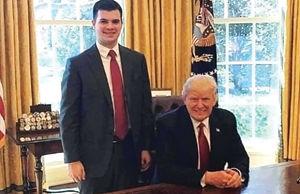
Taylor Weyeneth and President Trump in the Oval Office.


Posted: Thursday, February 1, 2018 10:30 am

Trump aide, SJU alum quits over resume lies by Christopher Barca, Editor Queens Chronicle | 0 comments

Taylor Weyeneth, a 24-year-old St. John’s University alum, resigned Wednesday from President Trump’s administration after the Washington Post reported the resume of the Office of National Drug Control Policy’s deputy chief of staff was full of falsehoods.

According to the newspaper, the class of 2016 graduate said on his resume that he worked for Manhattan law firm O’Dwyer and Bernstien from late 2014 until April 2016, shortly before taking a paid position on Donald Trump’s presidential campaign.

But Brian O’Dwyer, the firm’s partner, told the Post that Weyeneth was actually fired in August 2015 for repeatedly not showing up to work.

Weyeneth resubmitted his resume to the administration last year, while also amending the number of hours he volunteered at a Queens monastary during his time at St. John’s from 275 to 150.

But when he sent in yet another revised resume shortly after, he had removed the section about volunteering entirely.

Fordham University officials said Weyeneth did not have a master’s degree from that school as he claimed. A Kappa Sigma fraternity spokesman also said the Trump aide was only vice president of SJU’s branch for 18 months, not three years as listed on his resume.

Last month, 10 Democratic senators wrote to Trump to express their “extreme concern” over the 24-year-old’s meteoric rise from low-level staffer to deputy chief of staff.

The Office of National Drug Control Policy has been tasked with battling the country’s opioid addiction epidemic.


  • Posted in Queenswide, South Queens News, Eastern/Southeast Queens News, Central/Mid Queens News, North/Northeast Queens News, Western Queens News on Thursday, February 1, 2018 10:30 am. Government