Monday, November 20, 2017

17th Circuit Selects Debra D. Shafer as New Associate Judge


Print
E-mail

Image

Marcia M. Meis, Director of the Administrative Office of Illinois Courts, and Joseph G. McGraw, Chief Judge of the Seventeenth Judicial Circuit Court, are pleased to announce that the 17th Circuit Judges voted to select local attorney Debra D. Schafer as Associate Judge of the 17th Judicial Circuit.  This associate judge vacancy was created as result of the retirement of Associate Judge Fernando L. Engelsma.  Ms. Schafer will take her oath of office on Monday, December 11, 2017.

Commenting on the selection, Chief Judge Joseph G. McGraw stated, “Ms. Schafer is a talented and respected attorney with twenty-six years of legal experience. Her extensive trial experience and professional demeanor makes her well suited for judicial office.  We look forward to her service as a judge within the Seventeenth Circuit Court.”

Ms. Schafer received her undergraduate degree in Criminal Justice from Illinois State University in 1988, and a Juris Doctor from the University of Illinois in 1991.  Ms. Schafer served as an assistant state’s attorney in the Winnebago County State’s Attorney’s Office between 1991 and 1996. In 1996, she joined the law firm of Sreenan & Cain, P.C. where she focused her practice on state and federal criminal defense.  In May 2017, Sreenan & Cain, P.C. was reorganized as Schafer DeRango & Cain, LLP, recognizing Ms. Schafer as a partner of the firm.

The Winnebago County Bar Association, Boone County Bar Association and the Illinois State Bar Association conducted a poll of local attorneys to evaluate candidates for this associate judge position.  Ms. Schafer received the highest rating of any of the 27 applicants, with 86.66% of respondents finding that she met requirements of the office.  The poll evaluates candidates in areas including legal ability, integrity, and impartiality.

In addition to her law practice, Ms. Schafer has served as an adjunct professor at Northern Illinois University College of Law since 2008.  She currently teaches Advanced Trial Advocacy and has helped coach several teams of law students in scholastic trial competitions. Ms. Schafer has also served as a volunteer mentor in connection with the court’s Lawyer to Lawyer Mentoring Program.

Debra Schafer is a member of the Winnebago County Bar Association, Illinois State Bar Association, the Trial Bar for the U.S. District Court for the Northern District of Illinois, and the National Association of Criminal Defense Attorneys.

Saturday, November 18, 2017

Investigation: Radioactive leaks at Illinois nuclear plants

image

Investigation: Radioactive leaks at Illinois nuclear plants

  • By Brett Chase and Madison Hopkins • Better Government Association
  • Nov 17, 2017

Radioactive waste continues to pour from Exelon's Illinois nuclear power plants more than a decade after the discovery of chronic leaks led to national outrage, a $1.2 million government settlement and a company vow to guard against future accidents, an investigation by a government watchdog group found.

Since 2007, there have been at least 35 reported leaks, spills or other accidental releases in Illinois of water contaminated with radioactive tritium, a byproduct of nuclear power production and a carcinogen at high levels, a Better Government Association review of federal and state records shows.

No fines were issued for the accidents, all of which were self-reported by the company.

The most recent leak of 35,000 gallons occurred over two weeks in May and June at Exelon's Braidwood plant, southwest of Chicago. The same facility was the focus of a community panic in the mid-2000s after a series of accidents stirred debate over the safety of aging nuclear plants.

A 2014 incident at Exelon's Dresden facility in Grundy County involved the release of about 500,000 gallons of highly radioactive water. Contamination was later found in the plant's sewer lines and miles away in the Morris, Ill., sewage treatment plant.

Another leak was discovered in 2007 at the Quad Cities plant in Cordova. It took eight months to plug and led to groundwater radiation readings up to 375 times of that allowed under federal safe drinking water standards.

Exelon had threatened to close the Quad Cities plant, but relented last year after Gov. Bruce Rauner signed bailout legislation authorizing big rate hikes.

Representatives of Exelon and its government overseers — the U.S. Nuclear Regulatory Commission, the Illinois Emergency Management Agency and the Illinois Environmental Protection Agency — say the leaks posed no public danger and did not contaminate drinking water. Exelon said to prevent leaks it has spent $100 million over the last decade on upgrades at all of its U.S. plants.

Michael Pacilio, chief operating officer of the power generating arm of Exelon, said no one in or around the plants was harmed by radioactivity from the leaks, which he described as minor compared with everyday exposures.

"We live in a radioactive world," Pacilio said.

Critics say that's little cause for relief.

"Best that we can tell, that's more luck than skill," said David Lochbaum, an analyst with the nonprofit Union of Concerned Scientists. "Leaks aren't supposed to happen. Workers and the public could be harmed. There is a hazard there."

Among the 61 nuclear power plants operating in the U.S., more than half have reactors that are at or near the end of their originally expected lifespans — including the Dresden and Quad Cities plants.

Industry watchdogs and government whistleblowers contend oversight is compromised by a cozy relationship between companies and the NRC.

Government regulators concede they must balance the safety needs of aging plants, which require more maintenance, versus ordering cost-prohibitive upgrades at facilities that inherently are just a slip-up away from catastrophe.

No player in the nuclear industry is bigger than Exelon, the Chicago-based energy company that last year reported $31 billion in revenue and operates 14 nuclear plants in Illinois, New York, New Jersey, Pennsylvania and Maryland.

Five of the six Illinois plants reported leaks over the last decade, records show. Clinton, in DeWitt County, had no leaks and Byron, in Ogle County, reported only one that contained low levels of radioactivity.


The Byron nuclear plant leaked radioactive waste into groundwater under the plant's property in 2014. Byron is one of five nuclear plants in Illinois that reported similar leaks over the past decade. Exelon's Illinois nuclear power plants more than a decade after discovery of chronic leaks led to national outrage, a $1.2 million government settlement and a company vow to guard against future accidents, according to federal and state record reviewed by Better Government Association. (Madison Hopkins/BGA via AP)

The accidents included in the BGA analysis are separate from government-approved releases into large bodies of water. The state allows Exelon to discharge controlled amounts of tritium into rivers and lakes, where radioactive material gets diluted.

Other releases of tritium, however, can be illegal and subject to fines and government lawsuits — though no accidents from the past decade resulted in either. Government officials say small amounts of tritium — a radioactive form of hydrogen and a potential marker for more dangerous nuclear contaminants — are not harmful to humans but exposure to higher levels may increase the risk of cancer.

At least seven of the 35 documented accidents since 2007 involved contamination of groundwater. Other contamination was found in sewers and other water systems where it isn't supposed to be.

The recent leaks echo the controversy in 2006 when it was revealed that leaks at Braidwood over many years spilled 6 million gallons of radioactive water, some of which found its way onto private properties and at least one private drinking well.

At the time, Exelon and state regulators assured the public radioactivity levels in the private well were far below limits deemed a danger. Neighbors of the Braidwood plant were skeptical then and remain so.

"The NRC gets all its numbers from the nuclear plant. How can NRC trust the numbers?" asked Monica Mack, who lives in Braceville near the Braidwood plant.

Radioactive waste continues to pour from Exelon's Illinois nuclear power plants more than a decade after discovery of chronic leaks led to national outrage, a $1.2 million government settlement and a company vow to guard against future accidents, according to federal and state record reviewed by Better Government Association. The recent leaks echo the controversy in 2006 when it was revealed leaks at Braidwood over many years spilled 6 million gallons of radioactive water, some of which found its way onto private properties and at least one private drinking well. Neighbors of the Braidwood plant were skeptical then and remain so.(Madison Hopkins/BGA via AP)

The BGA investigation also found:

• Of the 35 documented incidents, 27 occurred at Dresden. Following the big 2014 leak, which emanated from an aboveground storage tank, Exelon asked a state inspector whether the public would have access to the incident report under open records laws, a state report showed.

• An NRC report on the 2007 Quad Cities leak noted radiation levels went "well beyond that seen anywhere else in the industry" and that plant staff estimated the leak had been active for years before it was discovered.

• In 2010, Exelon's Marseilles generating plant in LaSalle County reported a spill from a storage tank, initially estimated at more than 150 gallons but later classified as "unknown." Groundwater tritium tests later showed levels 59 times the EPA's drinking water limit. Exelon said no tritium left the plant's boundaries, but records show plant workers continued to monitor a body of highly contaminated groundwater sitting on plant property at least five years after the accident.

• In 2009, Dresden reported another hole in a storage tank led to a leak of as much as 272,000 gallons of radioactive water. Onsite groundwater testing showed levels of tritium 160 times higher than allowed under federal standards for drinking water.

This report was provided to The Associated Press by the nonprofit, nonpartisan Better Government Association of Chicago.

Above is from:  http://www.stltoday.com/news/local/illinois/investigation-radioactive-leaks-at-illinois-nuclear-plants/article_5afd12ac-e54b-5b20-be98-b72233c1075c.html

Thursday, November 16, 2017

Boone County voters must decide on another public safety sales tax hike

By Susan Vela
Staff writer

Posted Nov 15, 2017 at 10:01 PM Updated Nov 15, 2017 at 10:01 PM

BELVIDERE — For the second time in less than a year, Boone County voters must decide whether putting money toward public safety is more important than plunking down more dollars at cash registers.

Board members voted unanimously, 12-0, Wednesday to put a question on the March 20 ballot that asks if the public safety sales tax should be increased from 0.5 percent to 1 percent.

“It’s going to take a lot of hard work by a lot of people, and hopefully we have a lot of volunteers,” Board Chairman Karl Johnson said. “The first thing we have to do is we have to get some of our business leaders involved, get them on board and understanding how important better public safety is to Boone County as a whole.”

“While nobody wants to raise taxes, this is the most fair and equitable way that we can improve our public safety.”

The increase would generate about $1.4 million a year for public safety purposes that include building repairs, hiring new deputies and purchasing squad cars and equipment.

Above is from:  http://www.rrstar.com/news/20171115/boone-county-voters-must-decide-on-another-public-safety-sales-tax-hike

Wednesday, November 15, 2017

Medicare cuts under new federal tax proposal


CBO: House GOP tax plan triggers $25 billion in Medicare cuts

Ethan Wolff-Mann 19 hours ago


House Minority Whip Steny Hoyer, D-Md. clarified effects of the current House GOP tax legislation with the Congressional Budget Office. (AP Photo/Pablo Martinez Monsivais)

If the House GOP tax plan passes, it is projected to cut revenue significantly, likely increasing the deficit by $1.456 trillion from 2018 to 2027, according to the Joint Committee on Taxation and Congressional Budget Office (CBO).

With a number that large, Congress’s “pay as you go” rules that prevent unchecked spending would fall into place, a move that could cut Medicare’s budget by as much as $25 billion for 2018.

In a letter to House minority whip Steny Hoyer (D-MD), the CBO explained that without any more money to offset the fall in revenue, the Office of Management and Budget (OMB) would be required to issue a “sequestration order” to reduce spending in 2018 by $136 billion.

The effects of this sequestration order would trigger automatic cuts to various programs, including Medicare. According to the CBO, this could be as much as 4% for Medicare, which amounts to $25 billion in 2018. Furthermore, all non-exempt programs would be eliminated, which include some farming subsidies, border security, and student loan help. Others, like Social Security, would remain untouched.

At the same time, the tax plan’s changes to the estate and gift taxes would cut revenue $151 billion from 2018 to 2027, according to the JCT. Only 4,700 estates were large enough to be subject to the estate tax as the 2017, since the exemption is over $5 million.

Because of the rules exempting or limiting how much can be cut from certain programs, the CBO also estimated that the reductions would not make up for the need for money to pay for what Congress “bought.”

Touching Medicare has been traditionally considered explosive, and some have noted the “pay as you go” rules give Democrats leverage in the tax bill debates.

In a response to the CBO’s letter, Rep. Hoyer issued a statement, noting the broad impact beyond the deficit on the program cuts, adding that he actually wrote the “pay as you go” law, and called for a bipartisan lawmaking process.

According to the Committee for a Responsible Federal Budget, the “pay as you go rules” were passed with bipartisan support.

Ethan Wolff-Mann is a writer at Yahoo Finance. Follow him on Twitter @ewolffmann. Confidential tip line: emann[at]oath[.com].

Above is from:  https://www.yahoo.com/finance/news/cbo-house-gop-tax-plan-triggers-25-billion-medicare-cuts-195501778.html

Shep Smith Breaks From Fox News Coverage, Tears ‘Uranium One’ Scandal To Shreds

Politics

Shep Smith Breaks From Fox News Coverage, Tears ‘Uranium One’ Scandal To Shreds

HuffPost Alana Horowitz Satlin,HuffPost 2 hours 8 minutes ago


Fox News anchor Shep Smith broke from his network’s hyperventilating coverage of the “Uranium One” pseudoscandal to debunk allegations of wrongdoings by Hillary Clinton.

Smith, never one to blindly toe the party line, took to task President Donald Trump ― and, implicitly, his cable news network of choice ― over the “inaccurate” portrayal of the sale of a Canadian mining company with major U.S. holdings to a Russian company.

“Here’s the accusation,” Smith explained Tuesday. “Nine people involved in the deal made donations to the Clinton Foundation totaling more than $140 million. In exchange, Secretary of State Clinton approved the sale to the Russians — a quid pro quo.”

It’s a claim that has dominated Fox News in recent weeks after The Hill published a deeply flawed report about a “Russian bribery plot” involving the sale. Following pressure from the president and several Republican members of Congress, Attorney General Jeff Sessions announced earlier this week that the Justice Department would consider appointing a special counsel to review the deal as well as other matters involving Clinton and other Democrats.

There’s never been any evidence that Clinton acted inappropriately and, as Smith notes, “the Clinton State Department had no power to approve or veto that transaction. It could do neither.” Indeed, the State Department was just one of nine agencies that signed off on the deal and Clinton herself wasn’t even on the committee. 

“The accusation is predicated on the charge that Secretary Clinton approved the sale,” Smith said. “She did not. A committee of nine evaluated the sale, the president approved the sale, the Nuclear Regulatory Commission and others had to offer permits, and none of the uranium was exported for use by the U.S. to Russia. That is Uranium One.”

Since Smith’s segment, Uranium One has been mentioned over 40 times on various Fox News shows.

Saturday, November 11, 2017

Letter: Governor Rauner fortunate to live in Illinois


image


Letter: Governor Rauner fortunate to live in Illinois

Posted at 8:00 PM

If Gov. Bruce Rauner were chief executive of any of Illinois’ contiguous states he would have paid at least $1.4 million to $2.7 million more on his state income tax form than he did on his Illinois 1040. The governor’s recently released form indicated he paid $3,248,605 on a net income of $91,354,858. The 2016 tax rate was 3.75 percent.

Wisconsin, one of Rauner’s paragons of governmental virtue, has a top individual rate of 7.65 percent. As best I can tell without the governor’s backup forms, his Wisconsin bill would have been nearly $6 million.

Indiana, another state the governor seems to find virtuous, has a flat state rate of 3.3 percent, but the state form also includes a county income tax of 1.77 percent applicable in the state capital for a total 2016 rate of 5.07 percent. The governor would have paid about $4.6 million in Indiana.

Missouri and Kentucky have top rates of 6 percent and Iowa’s top rate is 8.98 percent! His bill would have been millions higher in those states.

Illinois has raised its rate to 4.95 percent, but that still is lower than the rates the governor would have paid in any of Illinois’ neighbors. And I thought Illinois was supposed to be the high-tax state.

Brent Bohlen

Springfield

Above is from:  http://www.sj-r.com/opinion/20171111/letter-governor-rauner-fortunate-to-live-in-illinois

Tuesday, November 7, 2017

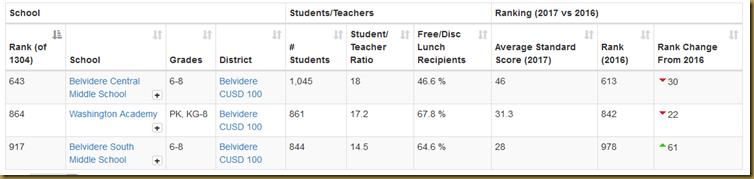
Belvidere Middle Schools Ranking

Illinois Middle School Rankings

JUST IN! Illinois PARCC test scores and updated rankings for the 2016-17 school year were posted to SchoolDigger this week!

Belvidere Schools

image


Above is from:   https://www.schooldigger.com/go/IL/schoolrank.aspx?level=2

Rockford Schools

image

Rockton

image

Loves Park

image