Tuesday, February 14, 2017

Trump national security adviser Michael Flynn resigns


1 / 15

Associated Press logoAssociated Press

Associated Press

JULIE PACE, ERIC TUCKER and JILL COLVIN, Associated Press1 hr ago


WASHINGTON (AP) — President Donald Trump's embattled national security adviser Michael Flynn resigned following reports he misled Vice President Mike Pence and other officials about his contacts with Russia. His departure upends Trump's senior team after less than a month in office.

In a resignation letter, Flynn said he gave Vice President Mike Pence and others "incomplete information" about his calls with Russia's ambassador to the U.S. The vice president, apparently relying on information from Flynn, initially said the national security adviser had not discussed sanctions with the Russian envoy, though Flynn later conceded the issue may have come up.

Trump named retired Lt. Gen. Keith Kellogg as the acting national security adviser. Kellogg had previously been appointed the National Security Council chief of staff and advised Trump during the campaign. Trump is also considering former CIA Director David Petraeus and Vice Admiral Robert Harward, a U.S. Navy SEAL, for the post, according to a senior administration official. FILE- In this Monday, Feb. 6, 2017, file photo, President Donald Trump passes Joint Chiefs Chairman Gen. Joseph Dunford, left, and National Security Adviser Michael Flynn as he arrives via Air Force One at MacDill Air Force Base in Tampa, Fla. A top White House aide sidestepped repeated chances Sunday, Feb. 12, to publicly defend Flynn following reports that he engaged in conversations with a Russian diplomat about U.S. sanctions before Trump's inauguration. (AP Photo/Susan Walsh, File)© The Associated Press FILE- In this Monday, Feb. 6, 2017, file photo, President Donald Trump passes Joint Chiefs Chairman Gen. Joseph Dunford, left, and National Security Adviser Michael Flynn as he arrives via Air Force One at Ma…

The Trump team's account of Flynn's discussions with the Russian envoy changed repeatedly over several weeks, including the number of contacts, the dates of those contacts and ultimately, the content of the conversations.

Late last month, the Justice Department warned the White House that Flynn could be in a compromised position as a result of the contradictions between the public depictions of the calls and what intelligence officials knew to be true based on recordings of the conversations, which were picked up as part of routine monitoring of foreign officials' communications in the U.S.

A U.S. official told The Associated Press that Flynn was in frequent contact with Ambassador Sergey Kislyak on the day the Obama administration slapped sanctions on Russia for election-related hacking, as well as at other times during the transition.

An administration official and two people with knowledge of the situation confirmed the Justice Department warnings on condition of anonymity because they were not authorized to discuss the matter publicly. It was unclear when Trump and Pence learned about the Justice Department outreach.

The Washington Post was the first to report the communication between former acting attorney general Sally Yates, a holdover from the Obama administration, and the Trump White House. The Post also first reported last week that Flynn had indeed spoken about sanctions with the Russian ambassador.

Trump never voiced public support for Flynn after that initial report and continued to keep his national security adviser close.

But White House officials sent contradictory messages about Flynn's status. Counselor Kellyanne Conway said Trump had "full confidence" in Flynn, while press secretary Sean Spicer said the president was "evaluating the situation" and consulting with Pence about his conversations with the national security adviser.

Asked whether the president had been aware that Flynn might have planned to discuss sanctions with the Russian envoy, Spicer said, "No, absolutely not."

The Kremlin had confirmed that Flynn was in contact with Kislyak but denied that they talked about lifting sanctions. On Tuesday, Russian lawmakers mounted a fierce defense of Flynn.

Konstantin Kosachev, chairman of the foreign affairs committee at the upper chamber of the Russian parliament, said in a post on Facebook that firing a national security adviser for his contacts with Russia is "not just paranoia but something even worse." Kosachev also expressed frustration at the Trump administration:

"Either Trump hasn't found the necessary independence and he's been driven into a corner... or russophobia has permeated the new administration from top to bottom," he said.

Kosachev's counterpart at the lower chamber of the Russian parliament, Alexei P ushkov, tweeted shortly after the announcement that "it was not Flynn who was targeted but relations with Russia."

Flynn's discussions with the Russian raised questions about whether he offered assurances about the incoming administration's new approach. Such conversations would breach diplomatic protocol and possibly violate the Logan Act, a law aimed at keeping citizens from conducting diplomacy.

Administration officials said that misleading Pence was ultimately Flynn's downfall, though they insisted he resigned and was not fired by Trump.

California Rep. Adam Schiff, the top Democrat on the House Intelligence Committee, said Flynn's resignation "does not end questions over his contacts with the Russians." He said the White House has yet to be forthcoming about whether Flynn was acting at the behest of the president or others.

Flynn's resignation comes as Trump and his top advisers seek to steady the White House after a rocky start. The president, who seeks input from a wide range of business associates, friends and colleagues, has been asking people their opinions on his senior team, including Spicer and chief of staff Reince Priebus.

Flynn was a loyal Trump supporter during the campaign, but he was viewed skeptically by some in the administration's national security circles, in part because of his ties to Russia. In 2015, he was paid to attend a gala dinner for Russia Today, a Kremlin-backed television station, and sat next to Russian President Vladimir Putin during the event.

Flynn apologized to Pence about the matter on Friday, according to an administration official. The official said Pence was relying on information from Flynn when he went on television and denied that sanctions were discussed with Kislyak.

Above is from:  http://www.msn.com/en-us/news/politics/trump-national-security-adviser-michael-flynn-resigns/ar-AAmS0ZI?li=BBmkt5R&ocid=spartandhp


Sally Yates

From Wikipedia, the free encyclopedia https://en.wikipedia.org/wiki/Sally_Yates

Sally Yates

Sally Q. Yates.jpg

United States Attorney General
Acting

In office
January 20, 2017 – January 30, 2017

President
Donald Trump

Preceded by
Loretta Lynch

Succeeded by
Dana Boente (acting)

United States Deputy Attorney General

In office
January 10, 2015 – January 30, 2017

Succeeded by
John Horn

Personal details

Born
Sally Caroline Quillian
August 20, 1960 (age 56)
Atlanta, Georgia, U.S.

Education
University of Georgia (BA, JD)

Sally Caroline Yates (née Quillian; born August 20, 1960) is an American lawyer. She served as a United States Attorney and later United States Deputy Attorney General, having been appointed to both positions by President Barack Obama.

Following the inauguration of Donald Trump and the departure of Attorney General Loretta Lynch, Yates served as Acting Attorney General from January 20, 2017, until being dismissed by President Trump on January 30, following her instruction to the Justice Department not to defend Trump's immigration-related executive order in court.[1][2]

Early life and education

Yates was born in Atlanta to J. Kelley Quillian, an attorney and judge who served as a judge on Georgia Court of Appeals between 1966-84, and Xara Terrell Quillian.[3] Her grandmother had been one of the first women admitted to the Georgia Bar, however, she was not hired as an attorney, instead working as a legal secretary for Yates' grandfather.[4]

She attended the University of Georgia, receiving her Bachelor of Arts degree in journalism in 1982. In 1986, she earned a law degree from the University of Georgia School of Law, graduating magna cum laude. While in law school, Yates served as the executive editor of the Georgia Law Review.[5][6]

Career

From 1985-89, Yates practiced with the law firm King & Spalding in Atlanta. In 1989, she was hired as Assistant U.S. Attorney by Bob Barr for the U.S. Attorney's Office for the Northern District of Georgia.[7] Early in her career at the Department of Justice, Yates prosecuted a variety of types of cases including white-collar fraud and political corruption.[6] In 1994, she became Chief of the Fraud and Public Corruption Section. She was the lead prosecutor in the case of Eric Rudolph, who committed the Centennial Olympic Park bombing,[8] a terrorist convicted for a series of anti-abortion and anti-gay bombings across the southern United States between 1996 and 1998, which killed two people and injured over 120 others.[9] She rose to First Assistant U.S. Attorney in 2002 and to Acting U.S. Attorney in 2004. In the U.S. Attorney's office she held leadership positions under both Republican and Democratic administrations.[10]

President Barack Obama nominated Yates to be U.S. Attorney in the Northern District of Georgia. She was confirmed by the Senate on March 10, 2010.[7] Yates was the first woman to hold that position in the Northern District of Georgia.[6] During her time as a U.S. Attorney, Yates was appointed by Attorney General Eric Holder to serve as Vice Chair of the Attorney General's Advisory Committee.[7]

Deputy Attorney General

On May 13, 2015, the United States Senate voted 84–12 to confirm Yates as Deputy Attorney General of the United States, the second-highest-ranking position in the Justice Department;[11][12] during her confirmation hearing, when questioned by Senator Jeff Sessions if she would disobey a president's unlawful orders, she responded that she would have an obligation to follow the law and the Constitution, and to give an independent legal advice to the president.[13] She served under Attorney General Loretta Lynch, who took office shortly before Yates's confirmation.[6][14]

Yates, in her confirmation hearing, when questioned by Senator Sessions on disobeying lawful orders by the president, responded that she will have an obligation to follow the law and the Constitution, and to give and independent legal advice to the president.[15]

As Deputy Attorney General, Yates was responsible for the day-to-day operations of the Justice Department, which included approximately 113,000 employees. In 2015, she authored the policy, known as the "Yates memo", prioritizing the prosecution of executives for corporate crimes.[16][17] During the final days of the Obama administration, she oversaw the review of 16,000 petitions for executive clemency, making recommendations to the President.[18]

Acting United States Attorney General

In January 2017, according to a Justice Department spokesman, Yates accepted a request from the incoming Trump Administration to serve as Acting Attorney General, beginning on January 20, 2017, and until the successor for Attorney General Lynch would be confirmed by the United States Senate.[19]

In late January, Yates warned the Trump Administration that National Security Advisor Michael T. Flynn had not been truthful about his contacts with Russia related to sanctions and that he was vulnerable to blackmail by Russian intelligence. This led to Flynn's resignation on February 13, 2017.[20][21]

On January 30, 2017, Yates ordered the Justice Department not to defend Trump's executive order on travel and immigration, writing in a letter to DOJ staff:

At present, I am not convinced that the defense of the executive order is consistent with these responsibilities of the Department of Justice, nor am I convinced that the executive order is lawful...I am responsible for ensuring that the positions we take in court remain consistent with this institution’s solemn obligation to always seek justice and stand for what is right. For as long as I am the acting Attorney General, the Department of Justice will not present arguments in defense of th[is] executive order, unless and until I become convinced that it is appropriate to do so.[22][23][24]

In response to her decision not to defend the order, former Attorney General Eric Holder tweeted that he trusted her judgment.[25]
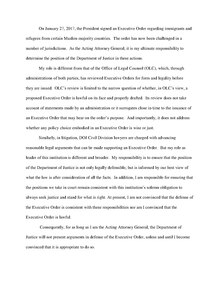
Letter from Sally Yates explaining her view of Executive Order 13769

Later that day, via hand-delivered letter, she was dismissed by the Trump administration and replaced with Dana Boente, the United States Attorney for the Eastern District of Virginia.[26][16] In a White House statement, Yates was said to have "betrayed the Department of Justice by refusing to enforce a legal order designed to protect the citizens of the United States".[27]

Reactions to dismissal

Main article: Monday Night Massacre

White House Press Release about dismissal

Senate Minority Leader Chuck Schumer called Yates's actions "a profile in courage. It was a brave act and a right act", while Rep. John Conyers criticized the decision to fire her: "If dedicated government officials deem [Trump's] directives to be unlawful and unconstitutional, he will simply fire them as if government is a reality show."[28]

Law professor Jonathan Adler said, however, that "Yates did not claim she was convinced the order was unlawful, but only that it was not 'wise or just'" and that he was "not aware of any instance in which the Justice Department has refused to defend a presumptively lawful executive action on this basis". Adler argued that she should have resigned.[29] (Yates is reported to have considered resigning, but said she did not want to leave her successor facing the same question.)[30][31]

The editors of National Review said her defiance of the executive order was "inappropriate", since Yates was unelected and "every official in the Justice Department knows, if one disagrees with the law one is called upon to apply, or the policy one is bound to enforce, one is free to resign".[32]

The New York Times and others drew comparisons to U.S. President Richard Nixon's dismissal of special prosecutor Archibald Cox in the Saturday Night Massacre and "some cable networks"[33] began calling Yates's dismissal the "Monday Night Massacre".[34][33][35] Watergate investigative journalist Carl Bernstein, however, speaking on CNN, rejected the comparison. "There’s a big difference, because the Saturday Night Massacre was really about firing the attorney general when Nixon was the target of an investigation and was actively obstructing justice", he said. "I think the president is within his rights here to fire the attorney general, that he has that ability."[36]

Following Yates' dismissal, Representative Jackie Speier nominated her for the John F. Kennedy Profile in Courage Award.[37]

Personal life

Yates's husband, Comer Yates, is a school administrator who unsuccessfully ran for Congress in 1996.[38][39] The couple have two children.

Monday, February 13, 2017

Flynn Is Said to Have Misled White House on Russian Talks


By MATTHEW ROSENBERG, GLENN THRUSH, MICHAEL S. SCHMIDT and MARK MAZZETTIFEB. 13, 2017


Michael T. Flynn, the national security adviser, during a news conference on Monday. Credit Stephen Crowley/The New York Times

WASHINGTON — Michael T. Flynn, the embattled national security adviser, faced an uncertain future on Monday as White House officials delivered conflicting messages about whether he still enjoys the confidence of President Trump and Vice President Mike Pence.

The Justice Department had warned the White House that Mr. Flynn had misled senior Trump administration officials about whether he had discussed American sanctions against Vladimir V. Putin’s regime during a phone call with Russia’s ambassador to the United States weeks before the inauguration, and that he could be open to blackmail by Russia, said a former senior official.

At the same time, Mr. Pence has told administration officials that he believes Mr. Flynn lied to him by saying he had not discussed the topic of sanctions on a call with the ambassador in late December. Even the mere discussion of policy — and the apparent attempt to assuage the concerns of an American adversary before Mr. Flynn took office — represents a remarkable breach of protocol.

The F.B.I. has been examining Mr. Flynn’s phone calls as he has come under growing questions about his interactions with Russian officials and his management of the National Security Council. In addition, the Army has been investigating whether Mr. Flynn received money from the Russian government during a trip he took to Moscow in 2015, according to two defense officials.


Such a payment might violate the Emoluments Clause of the Constitution, which prohibits former military officers from receiving money from a foreign government without consent from Congress. The defense officials said there was no record that Mr. Flynn, a retired three-star Army general, filed the required paperwork for the trip.

“The president is evaluating the situation,” Sean Spicer, the White House press secretary, told reporters on Monday. Mr. Spicer said Mr. Trump would be talking to Mr. Pence and others about Mr. Flynn’s future.

In a sign of the internal confusion over Mr. Flynn’s status, the statement from Mr. Spicer came shortly after the president’s counselor, Kellyanne Conway, said in an interview on MSNBC that Mr. Flynn had the “full confidence of the president.”

The White House has examined a transcript of a wiretapped conversation that Mr. Flynn had with Sergey I. Kislyak, the Russian ambassador, in December, according to administration officials. Mr. Flynn originally told Mr. Pence and others that the call was limited to small talk and holiday pleasantries.

But the conversation, according to officials who have seen the transcript of the wiretap, also included a discussion about sanctions imposed on Russia after intelligence agencies determined that President Putin’s regime tried to interfere with the 2016 election on Mr. Trump’s behalf.

Gen. Michael T. Flynn served in the military for 33 years before becoming a singular and divisive figure in the intelligence community during the Obama administration. Matthew Rosenberg looks at Donald J. Trump’s choice for his national security adviser.


Still, current and former administration officials familiar with the call said the transcript was ambiguous enough that Mr. Trump could justify both firing or retaining Mr. Flynn.

Mr. Trump, however, has become increasingly concerned about the continued fallout over Mr. Flynn’s behavior, according to people familiar with his thinking, and has told aides that the media storm around Mr. Flynn will damage the president’s image on national security issues.

White House officials have begun discussing the possibility of replacements, and President Trump is consulting Jim Mattis, the secretary of defense and a retired four-star general. Among the options are David H. Petraeus, the former C.I.A. director, and Thomas P. Bossert, head of Mr. Trump’s domestic security council. Mr. Petraeus, a retired four-star general, was forced out as director of the C.I.A. because of an affair with his biographer, to whom he passed classified information. Mr. Petraeus would not need confirmation by the Senate as national security adviser.

Mr. Petraeus is expected to be at the White House on Tuesday, said a senior administration official who was not authorized to discuss the meeting and spoke on condition of anonymity.

Even if he stays, Mr. Flynn’s concealment of the call’s content, combined with questions about his management of his agency and reports of a demoralized staff, has put him in a precarious position less than a month into Mr. Trump’s presidency.

Few members of Mr. Trump’s team are more skeptical of Mr. Flynn than the vice president, numerous administration officials said. Mr. Pence, who used the false information provided by Mr. Flynn to defend him in a series of television appearances, was incensed at Mr. Flynn’s lack of contrition for repeatedly embarrassing him by withholding the information, according to three administration officials familiar with the situation.

Mr. Flynn and Mr. Pence have spoken twice in the past few days about the matter, but administration officials said that rather than fully apologize and accept responsibility, the national security adviser blamed it on his faulty memory — which irked the typically slow-to-anger Mr. Pence.

The slight was compounded by an incident late last year when Mr. Pence went on television to deny that Mr. Flynn’s son, who had posted conspiracy theories about Hillary Clinton on social media, had been given a security clearance by the transition team. The younger Mr. Flynn had, indeed, been given such a clearance, even though his father had told Mr. Pence’s team that he hadn’t.

Mr. Pence has relayed his complaints directly to Mr. Trump but has told White House officials that he will abide by whatever Mr. Trump decides about Mr. Flynn’s fate.

Officials said classified information did not appear to have been discussed during the conversation between Mr. Flynn and the ambassador, which would have been a crime. The call was captured on a routine wiretap of diplomat’s calls, the officials said.


But current Trump administration officials and former Obama administration officials said that Mr. Flynn did appear to be reassuring the ambassador that Mr. Trump would adopt a more accommodating tone on Russia once in office.

Former and current administration officials said that Mr. Flynn urged Russia not to retaliate against any sanctions because an overreaction would make any future cooperation more complicated. He never explicitly promised sanctions relief, one former official said, but he appeared to leave the impression that it would be possible.

During his 2015 trip to Moscow, Mr. Flynn was paid to attend the anniversary celebration of Russia Today, a television network controlled by the Kremlin. At the banquet, he sat next to Mr. Putin.

Mr. Flynn had notified the Defense Intelligence Agency, which he once led, that he was taking the trip. He received a security briefing from agency officials before he left, which is customary for former top D.I.A. officials when they travel overseas.

Still, some senior agency officials were surprised when footage of the banquet appeared on RT, and believed that General Flynn should have been more forthcoming with D.I.A. about the nature of his trip to Russia.

The following month, the D.I.A. director, Lt. Gen. Vincent Stewart, sent a memo to agency staff members saying agency officials should not provide briefings to former agency leaders during the presidential campaign.

James Kudla, a D.I.A. spokesman, said the memo was not directly the result of Mr. Flynn’s trip to Russia, but rather an effort by General Stewart to ensure that the agency was not becoming enmeshed in politics.

“Was the Russia trip one element of it? Yes,” he said. “But it was more broadly to ensure that other former senior officials and D.I.A. staff knew what the rules are to avoid the perception of taking sides.”

Defense officials said the White House would have to determine what penalty, if any, Mr. Flynn should face if he were found to have violated the Emoluments Clause.

Capt. Jeff Davis, a Defense Department spokesman, declined to comment.

Above is from:  https://www.nytimes.com/2017/02/13/us/politics/donald-trump-national-security-adviser-michael-flynn.html?emc=edit_na_20170213&nl=breaking-news&nlid=53444314&ref=cta&_r=0

Justice Department warned White House that Flynn could be vulnerable to Russian blackmail, officials say


The Washington Post logoWashington Post - Washington Post

The Washington Post


Vice President Pence greets national security adviser Michael Flynn before Japanese Prime Minister Shinzo Abe and President Trump arrived for their joint news conference at the White House on Feb. 10.© Joshua Roberts/Reuters Vice President Pence greets national security adviser Michael Flynn before Japanese Prime Minister Shinzo Abe and President Trump arrived for their joint news conference at the White House on Feb. 10.

The acting attorney general informed the Trump White House late last month that she believed Michael Flynn had misled senior administration officials about the nature of his communications with the Russian ambassador to the United States, and warned that the national security adviser was potentially vulnerable to Russian blackmail, current and former U.S. officials said.

The message, delivered by Sally Q. Yates and a senior career national security official to the White House counsel, was prompted by concerns that ­Flynn, when asked about his calls and texts with the Russian diplomat, had told Vice ­President-elect Mike Pence and others that he had not discussed the Obama administration sanctions on Russia for its interference in the 2016 election, the officials said. It is unclear what the White House counsel, Donald McGahn, did with the information.

In the waning days of the Obama administration, James R. Clapper Jr., who was the director of national intelligence, and John Brennan, the CIA director at the time, shared Yates’s concerns and concurred with her recommendation to inform the Trump White House. They feared that “Flynn had put himself in a compromising position” and thought that Pence had a right to know that he had been misled, according to one of the officials, who, like others, spoke on the condition of anonymity to discuss intelligence matters.

A senior Trump administration official said that the White House was aware of the matter, adding that “we’ve been working on this for weeks.”

The current and former officials said that although they believed that Pence was misled about the contents of Flynn’s communications with the Russian ambassador, they couldn’t rule out that Flynn was acting with the knowledge of others in the transition.

The FBI, Yates, Clapper and Brennan declined to comment on the matter. The White House said in a statement Monday that Trump was “evaluating the situation” regarding Flynn.

In a Feb. 8 interview with The Washington Post, Flynn categorically denied discussing sanctions with Russian Ambassador Sergey Kislyak, repeating public assertions made in January by top Trump officials. One day after the interview, Flynn revised his account, telling The Post through a spokesman that he “couldn’t be certain that the topic never came up.”

Two officials said a main topic of the relevant call was the sanctions. Officials also said there was no evidence that Russia had attempted to exploit the discrepancy between public statements by Trump officials and what Flynn had discussed.

Flynn told The Post earlier this month that he first met Kislyak in 2013, when Flynn was director of the Defense Intelligence Agency and made a trip to Moscow.

U.S. intelligence reports during the 2016 presidential campaign showed that Kislyak was in touch with Flynn, officials said. Communications between the two continued after Trump’s victory on Nov. 8, according to officials with access to intelligence reports on the matter.

Kislyak, in a brief interview with The Post, confirmed having contacts with Flynn before and after the election, but he declined to say what was discussed.

For Yates and other officials, concerns about the communications peaked in the days after the Obama administration on Dec. 29 announced measures to punish Russia for what it said was the Kremlin’s interference in the election to help Trump.

After the sanctions were rolled out, the Obama administration braced itself for the Russian retaliation. To the surprise of many U.S. officials, Russian President Vladimir Putin announced on Dec. 30 that there would be no response. Trump praised the decision on Twitter.

Intelligence analysts began to search for clues that could help explain Putin’s move. The search turned up Kislyak’s communications, which the FBI routinely monitors, and the phone call in question with Flynn, a retired Army lieutenant general with years of intelligence experience.

From that call and subsequent intercepts, FBI agents wrote a secret report summarizing ­Flynn’s discussions with Kislyak.

Yates, then the deputy attorney general, considered Flynn’s comments in the intercepted call to be “highly significant” and “potentially illegal,” according to an official familiar with her thinking.

Yates and other intelligence officials suspected that Flynn could be in violation of an obscure U.S. statute known as the Logan Act, which bars U.S. citizens from interfering in diplomatic disputes with another country.

At the same time, Yates and other law enforcement officials knew there was little chance of bringing against Flynn a case related to the Logan Act, a statute that has never been used in a prosecution. In addition to the legal and political hurdles, Yates and other officials were aware of an FBI investigation looking at possible contacts between Trump associates and Russia, which now included the Flynn-Kislyak communications.

Word of the calls leaked out on Jan. 12 in an op-ed by Post columnist David Ignatius. “What did Flynn say, and did it undercut U.S. sanctions?” Ignatius wrote, citing the Logan Act.

The next day, a Trump transition official told The Post, “I can tell you that during his call, sanctions were not discussed whatsoever.”

White House press secretary Sean Spicer, in a conference call with reporters on Jan. 13, said that the conversation between Flynn and Kislyak had “centered on the logistics” of a post-inauguration call between Trump and Putin. “That was it, plain and simple,” Spicer added.

On Jan. 15, Pence was asked about the phone call during an appearance on CBS’s “Face the Nation.” Citing a conversation he had with Flynn, Pence said the incoming national security adviser and Kislyak “did not discuss anything having to do with the United States’ decision to expel diplomats or impose censure against Russia.”

Before the Pence statement on Jan. 15, top Justice Department and intelligence officials had discussed whether the incoming Trump White House should be notified about the contents of the Flynn-Kislyak communications.

Pence’s statement on CBS made the issue more urgent, current and former officials said, because U.S. intelligence agencies had reason to believe that Russia was aware that Flynn and Kislyak had discussed sanctions in their December call, contrary to public statements.

The internal debate over how to handle the intelligence on Flynn and Kislyak came to a head on Jan. 19, Obama’s last full day in office.

Yates, Clapper and Brennan argued for briefing the incoming administration so the new president could decide how to deal with the matter. The officials discussed options, including telling Pence, the incoming White House counsel, the incoming chief of staff or Trump himself.

FBI Director James B. Comey initially opposed notification, citing concerns that it could complicate the agency’s investigation.

Clapper and Brennan left their positions when Trump was sworn in, but Yates stayed on as acting attorney general until Jan. 30, when Trump fired her for refusing to defend his executive order temporarily barring refugees and people from seven majority-Muslim countries — an action that had been challenged in court.

A turning point came after Jan. 23, when Spicer, in his first official press briefing, again was asked about Flynn’s communications with Kislyak. Spicer said that he had talked to Flynn about the issue “again last night.” There was just “one call,” Spicer said. And it covered four subjects: a plane crash that claimed the lives of a Russian military choir; Christmas greetings; Russian-led talks over the Syrian civil war; and the logistics of setting up a call between Putin and Trump. Spicer said that was the extent of the conversation.

Yates again raised the issue with Comey, who now backed away from his opposition to informing the White House. Yates and the senior career national security official spoke to McGahn, the White House counsel, who didn’t respond to a request for comment.

Trump has declined to publicly back his national security adviser since the news broke.

On Monday afternoon, Kellyanne Conway, counselor to the president, said Trump had “full confidence” in Flynn. Minutes later, however, Spicer delivered a contradictory statement to reporters.

“The president is evaluating the situation,” Spicer’s statement read. “He’s speaking to Vice President Pence relative to the conversation the vice president had with Gen. Flynn and also speaking to various other people about what he considers the single most important subject there is: Our national security.”

Karen DeYoung and Greg Miller contributed to this report.

Above is from:  http://www.msn.com/en-us/news/politics/justice-department-warned-white-house-that-flynn-could-be-vulnerable-to-russian-blackmail-officials-say/ar-AAmU2uq?li=BBmkt5R&ocid=spartandhp

General Flynn—some controversy for some time?

Michael T. Flynn

From Wikipedia, the free encyclopedia


Michael Thomas "Mike" Flynn (born December 1958) is a retired United States Army lieutenant general who was the 18th Director of the Defense Intelligence Agency, and is the 25th and current National Security Advisor to President Donald Trump.[1]

Flynn's military career was primarily operational, with numerous combat arms, conventional and special operations senior intelligence assignments. He co-authored a report in January 2010 through the Center for a New American Security entitled Fixing Intel: A Blueprint for Making Intelligence Relevant in Afghanistan.[2] In addition, Flynn served as the commander of the Joint Functional Component Command for Intelligence, Surveillance and Reconnaissance, chair of the Military Intelligence Board, Assistant Director of National Intelligence,[3][4] and the senior intelligence officer for the Joint Special Operations Command. He retired with 33 years service in the Army, a year before he was scheduled to leave his position.

On November 18, 2016, President-elect Donald Trump announced that Flynn would serve as National Security Advisor in his coming administration. As a member of the Executive Office of the President, Flynn will not require the advice and consent of the United States Senate.[5] Flynn has drawn criticism for his purported close relations with Russia,[6][7][8] and for his promotion and popularization of anti-Clinton conspiracy theories and fake news during the 2016 presidential campaign.[9][10] The Wall Street Journal reported on January 22, 2017, that Flynn was under investigation by U.S. counterintelligence agents for his communications with Russian officials.

Contents

[hide] 

Early life and education

Flynn was born in December 1958 in Middletown, Rhode Island,[4] the son of Helen Frances (Andrews), who worked in real estate, and Charles Francis Flynn, a banker.[11][12][13][14]

Michael Flynn graduated from the University of Rhode Island with a Bachelor of Science degree in management science in 1981 and was a Distinguished Military Graduate of the Reserve Officers' Training Corps. He also earned a Master of Business Administration in Telecommunications from Golden Gate University, a Master of Military Art and Science from the United States Army Command and General Staff College, and a Master of Arts in National Security and Strategic Studies from the Naval War College.[1]

Flynn is a graduate of the Military Intelligence Officer Basic Course, Military Intelligence Officer Advanced Course, Army Command and General Staff College, the School of Advanced Military Studies, and Naval War College.[1]

Military career

U.S. Army

General Stanley McChrystal and Flynn in Afghanistan, 2010

Flynn was commissioned in the U.S. Army as a second lieutenant in military intelligence, in 1981.[1] His military assignments included multiple tours at Fort Bragg, North Carolina, with the 82nd Airborne Division, XVIII Airborne Corps, and Joint Special Operations Command, where he deployed for the invasion of Grenada in Grenada and Operation Uphold Democracy in Haiti.[15] He also served with the 25th Infantry Division at Schofield Barracks, Hawaii, and at the Joint Readiness Training Center at Fort Polk, Louisiana, and the Army Intelligence Center at Fort Huachuca, Arizona.[1]

Flynn served as the assistant chief of staff, G2, XVIII Airborne Corps at Fort Bragg, North Carolina, from June 2001 and the director of intelligence, Joint Task Force 180 in Afghanistan until July 2002. He commanded the 111th Military Intelligence Brigade from June 2002 to June 2004.[1] He was the director of intelligence for Joint Special Operations Command from July 2004 to June 2007, with service in Afghanistan (Operation Enduring Freedom) and Iraq (Operation Iraqi Freedom). He served as the director of intelligence, United States Central Command from June 2007 to July 2008, as the director of intelligence, Joint Staff from July 2008 to June 2009, then the director of intelligence, International Security Assistance Force in Afghanistan from June 2009 to October 2010.[1][16]

Defense Intelligence Agency, Director

Flynn speaks during the change of directorship for the Defense Intelligence Agency on Joint Base Anacostia-Bolling in Washington, D.C.

In September 2011, Flynn was promoted to Lieutenant General and assigned to the Office of the Director of National Intelligence. On April 17, 2012, President Barack Obama nominated Flynn to be the 18th director of the Defense Intelligence Agency.[17][18] Flynn took command of the DIA in July 2012.[19] In October 2012, Flynn announced plans to release his paper "VISION2020: Accelerating Change Through Integration", a broad look at how the Defense Intelligence Agency must transform to meet the national security challenges for the 21st Century.[20] It was meant to emphasize “integration, interagency teamwork and innovation of the whole workforce, not just the technology but the people.” [21]

Retirement

On April 30, 2014, Flynn announced his retirement effective later in 2014, about a year earlier than he had been scheduled to leave his position. He was reportedly effectively forced out of the DIA after clashing with superiors over his allegedly chaotic management style and vision for the agency.[22][23][24][25] In a private email which was leaked online, Colin Powell said that he had heard in the DIA (apparently from later DIA director Vincent R. Stewart) that Flynn got fired because he was "Abusive with staff, didn’t listen, worked against policy, bad management, etc."[24] According to the New York Times, Flynn exhibited a loose relationship with facts, leading his subordinates to refer to Flynn's repeated dubious assertions as "Flynn facts".[26]

According to what Flynn had told in one final interview as DIA director, he felt like a lone voice in thinking that the United States was less safe from the threat of Islamic terrorism in 2014 than it was prior to the 9/11 attacks; he went on to believe that he was pressed into retirement for questioning the Obama administration’s public narrative that Al Qaeda was close to defeat.[27] Journalist Seymour Hersh wrote that "Flynn confirmed [to Hersh] that his agency had sent a constant stream of classified warnings ... about the dire consequences of toppling [Syrian President] Assad." Flynn recounted that his agency was producing intelligence reports indicating that radical Islamists were the main force in the Syrian insurgency and "that Turkey was looking the other way when it came to the growth of the Islamic State inside Syria." According to Flynn, these reports "got enormous pushback from the Obama administration," who he felt "did not want to hear the truth." According to former DIA official W. Patrick Lang: "Flynn incurred the wrath of the White House by insisting on telling the truth about Syria ... they shoved him out. He wouldn't shut up."[28] In an interview with Al Jazeera, Flynn criticized the Obama administration for its delay in supporting the opposition in Syria, thereby allowing for the growth of Al Nusra and other extremist forces: "when you don’t get in and help somebody, they’re gonna find other means to achieve their goals" and that "we should have done more earlier on in this effort, you know, than we did."[29]

Flynn retired from the U.S. Army with 33 years of service on August 7, 2014.[30]

Post-retirement

Consulting firm

Main article: Flynn Intel Group

Flynn, along with son Michael G. Flynn, runs Flynn Intel Group which provides intelligence services for business and governments.[31] Several sources, including Politico, have written that Flynn's consulting company is allegedly lobbying for Turkey. A company tied to Erdogan's government, which supports Muslim Brotherhood, is known to have hired Flynn's lobbying firm.[32][33][34][35][36][37] On election day 2016, Flynn wrote an op-ed calling for U.S. backing for Erdogan's government and criticized the regime's opponent, Fethullah Gulen; Flynn did not disclose that Flynn's consulting firm had received funds from a company with ties to Erdogan's government.[38] In July 2016, Flynn said that the coup attempt against Erdogan was something “worth clapping for”, but two months later, when a company tied to Erdogan's government hired Flynn's firm, Flynn hailed Erdogan as a critical U.S. ally.[39]

Flynn sat in on classified national security briefings with then-candidate Trump at the same time that Flynn was working for foreign clients, which raises ethical concerns and conflicts of interest.[40]

Attendance of RT Gala Dinner

In 2015, Flynn attended a gala dinner in Moscow in honor of RT, a Russian government-owned English-language media outlet on which he made semi-regular appearances as an analyst after he retired from U.S. government service. Before the gala, Flynn gave a paid talk on world affairs.[7][8] Flynn defended the Russian payment in an interview with Michael Isikoff.[8] Journalist Michael Crowley of Politico reported that "at a moment of semi-hostility between the U.S. and Russia, the presence of such an important figure at Putin's table startled" U.S. officials, in reference to president Vladimir Putin's attendance of the dinner as the guest of honor.[7]

2016 U.S. presidential election

Flynn at a campaign rally for then-Republican Presidential nominee Donald Trump, in October 2016.

During one of the debates in the 2015 GOP primaries, presidential candidate Carly Fiorina promised that, if she is elected, she would bring back into the government “the warrior class” of generals, including David Petraeus, Jack Keane, James Mattis, Stanley McChrystal and Flynn.

Having already been consulted regarding national security by Fiorina as well as other candidates, including Scott Walker, Ben Carson, Ted Cruz, and Donald Trump,[41] Flynn was asked in February 2016 to serve as an adviser to the Trump campaign.[42] In July 2016, it was reported he was being considered as Trump's running mate; Flynn later confirmed that he had submitted vetting documents to the campaign and was willing to accept the Republican vice-presidential nomination if chosen.[43][44] Trump instead selected Indiana Governor Mike Pence.

As one of the keynote speakers during the first night of the 2016 Republican National Convention Flynn gave what the Los Angeles Times described as a "fiery" speech, in which he stated: "We are tired of Obama's empty speeches and his misguided rhetoric. This, this has caused the world to have no respect for America's word, nor does it fear our might";[45] he also accused Obama of choosing to conceal the actions of Osama bin Laden and ISIS.[46] Flynn went on to critically address political correctness and joined the crowd in a chant of "U-S-A! U-S-A!". During the chants he told those in the audience, "Get fired up! This is about our country."[45][47] During the speech, Flynn launched a blistering attack on Democratic nominee Hillary Clinton. He led the crowd in chants of "Lock her up!" and called for her to withdraw from the race, saying that "if I did a tenth of what she did, I'd be in jail today."[48][49] He repeated in subsequent interviews that she should be "locked up".[50] While campaigning for Trump, Flynn also referred to Clinton as the "enemy camp".[48] Six days after the speech Flynn stirred up a controversy by retweeting anti-semitic remarks, which he later apologized for and claimed was unintentional.[51] During the election campaign, Flynn used Twitter to post links to negative stories about Clinton, including fake news.[9]

Flynn was once opposed to waterboarding and other extreme interrogation techniques that have now been banned; however, according to an August 2016 Washington Post article, he said at one point, in the context of Trump's apparent openness to reinstating such techniques, that "he would be reluctant to take options off the table."[48] In May 2016, Flynn was asked by an Al Jazeera reporter if he would support Trump's stated plan to "take out [the] families"[52][53] of suspected terrorists. In response, Flynn stated, "I would have to see the circumstances of that situation".[48] In an interview with Al Jazeera, Flynn criticized the reliance on drones as a "failed strategy", stating that "what we have is this continued investment in conflict. The more weapons we give, the more bombs we drop, that just … fuels the conflict.”[54][29]

National Security Advisor

On November 18, 2016, Flynn accepted president-elect Donald Trump's offer of the position of National Security Advisor.[55]

After the election of Donald Trump, Flynn met with Freedom Party of Austria leader Heinz-Christian Strache.[56] The Freedom Party of Austria announced on December 19, 2016, that it has signed a "cooperation agreement with Russia’s ruling party." The Freedom Party of Austria was founded by in the 1950s by ex-Nazis. The Trump campaign refused to comment on the meeting.[56]

On December 29, 2016, Flynn spoke with Russian ambassador Sergey Kislyak, the same day the Obama administration announced retaliatory measures in response to Russia's interference in the 2016 presidential campaign; if there was intent to interfere with or defeat said measures, this may constitute a felony under the Logan act. Trump's incoming press secretary, Sean Spicer, said he doubted that Flynn and Kislyak discussed the retaliatory measures.[57]

The Wall Street Journal reported on January 22, 2017, that Flynn was under investigation by U.S. counterintelligence agents for his communications with Russian officials.[58] On February 9, 2017, U.S. intelligence officials shared an account of Flynn's interactions with Kislyak, which indicated that he did discuss the sanctions placed on Russia by the Obama administration,[59] and Flynn's spokesman released a statement that Flynn “indicated that while he had no recollection of discussing sanctions, he couldn’t be certain that the topic never came up.”[60]

Political views

Flynn is a registered Democrat, having grown up in a "very strong Democratic family".[61] However, he was a keynote speaker during the first night of the 2016 Republican National Convention,[45] and he is a surrogate and top national security adviser for President Donald Trump.

During a July 10, 2016, interview on ABC News' This Week, when asked by host Martha Raddatz about the issue of abortion, Flynn stated, "women have to be able to choose."[61][62] The next day, Flynn said on Fox News that he is a "pro-life Democrat".[63]

Flynn has been a board member of ACT! for America,[55] and sees the Muslim faith as one of the root causes of Islamist terrorism.[26] He has described Islam as a political ideology and a cancer.[26][64] He stated in a Twitter post that "fear of Muslims is RATIONAL"[55] and included a video link claiming that Islam wants “80% of people enslaved or exterminated”.[65] Initially supportive of Trump's proposal to ban Muslims from entering the US, Flynn later told Al Jazeera that a blanket ban was unworkable and has called instead for "vetting" of entrants from countries like Syria.[55] Flynn has stated the U.S. "should extradite Fethullah Gülen" to Turkey and "work constructively with Russia" in Syria.[28][66] In 2016, he said that he had personally seen photos of signs in the Southwest border area that were in Arabic to help Muslims entering the United States illegally. An officer of the National Border Patrol Council responded that he had never seen any signs delineating smuggling routes, let alone any in Arabic.[67]

Books

Flynn is the author of The Field of Fight: How We Can Win the Global War Against Radical Islam and Its Allies, co-authored with Michael Ledeen, which was published by St. Martin's Press in 2016.[68] In reviewing the book, Will McCants of the Brookings Institution described Flynn's worldview as a confused combination of neoconservatism (an insistence on destroying what he sees as an alliance of tyranny, dictatorships, and radical Islamist regimes) and realism (support for working with "friendly tyrants"), although he acknowledged that this could be due to the book having two authors (it being co-authored by Michael Ledeen).[69]

Above is from:  https://en.wikipedia.org/wiki/Michael_T._Flynn

After vowing to do the opposite, Trump settles fraud case


image

After vowing to do the opposite, Trump settles fraud case

02/13/17 12:23 AM

By Steve Benen

One week from today, President-elect Donald Trump was scheduled to take the stand in a fraud case surrounding his scandal-plagued “Trump University,” which has been accused of ripping off students and making ridiculous claims about the value of its lessons. The Republican was poised to be the first president-elect to ever give sworn testimony in his own fraud case.
As it turns out, Trump won’t have to take the stand after all. As Politico reported, the controversial businessman who vowed not to settle this case ended up settling this case.

President-elect Donald Trump, who once declared “I don’t settle lawsuits,” took to Twitter Saturday to justify his decision to pay $25 million to settle fraud lawsuits over his now-defunct Trump University real estate seminar program. He also hinted that had he not been so busy preparing to take office, he might not have settled.
“The ONLY bad thing about winning the Presidency is that I did not have the time to go through a long but winning trial on Trump U. Too bad!,” Trump tweeted.

The settlement resolves a class-action case and an investigation launched by New York Attorney General Eric Schneiderman.
Note, as recently as March, Trump boasted during a GOP debate, “This is a case I could have settled very easily, but I don’t settle cases very easily when I’m right.” After boasting that the Better Business Bureau gave Trump University an “A” rating – a claim that turned out to be a brazen lie – Trump added, “Again, I don’t settle cases. I don’t do it because that’s why I don’t get sued very often, because I don’t settle, unlike a lot of other people.”
The assertion that doesn’t “get sued very often” also turned out to be a demonstrable falsehood, as was the boast about never settling.
To the extent that reality still matters, it’s worth remembering that the case against Trump was quite strong. The Washington Post reported in September that the New York Republican was the namesake of a “university,” where students sometimes “max[ed] out their credit cards to pay tens of thousands of dollars for insider knowledge they believed could make them wealthy.”

Never licensed as a school, Trump University was in reality a series of real estate workshops in hotel ballrooms around the country, not unlike many other for-profit self-help or motivational seminars. Though short-lived, it remains a thorn in Trump’s side nearly five years after its operations ceased: In three pending lawsuits, including one in which the New York attorney general is seeking $40 million in restitution, former students allege that the enterprise bilked them out of their money with misleading advertisements.
Instead of a fast route to easy money, these Trump University students say they found generic seminars led by salesmen who pressured them to invest more cash in additional courses. The students say they didn’t learn Trump’s secrets and never received the one-on-one guidance they expected.

“He’s earned more in a day than most people do in a lifetime,” a 2009 ad, featuring Trump’s photograph, said. “He’s living a life many men and women only dream about. And now he’s ready to share – with Americans like you – the Trump process for investing in today’s once-in-a-lifetime real estate market.”
As regular readers may recall, Trump’s attorneys insisted that aspiring investors learned valuable lessons with which most students were satisfied. But the Post’s article also highlighted a Texas man, Louie Liu, who said he paid “$1,495 for a three-day seminar, then felt lured into paying $24,995 for more classes, an online training program and a three-day in-person mentorship.”
He now believes that the Trump University program was a “scam.”
Another man, Bob Guillo, paid nearly $35,000 for the “Trump Gold Elite package,” which amounted to very little. “I really felt stupid that I was scammed by Trump,” Guillo said.
Indeed, the campaign parallels are hard to miss: a group of Americans, looking for easy solutions and wowed by a celebrity making too-good-to-be-true promises, put their faith in an accused scam artist, only to learn that Donald Trump had no intention of delivering on outlandish pledges that never really made any sense.
Rank-and-file voters, however, do not have the option of filing a class-action lawsuit.
Postscript: Take a moment to consider the political world’s reaction if Barack Obama or Hillary Clinton faced credible allegations of defrauding members of the public, and then quietly settled the case – late on a Friday – writing a big check to make the accusations go away.
How many congressional hearings would there be? How many calls for a special prosecutor would we hear?
Post-Postscript: This is the same controversy in which Trump faced allegations of bribery when Florida Attorney General Pam Bondi (R) dropped a probe into “Trump University” after the Trump Foundation made an illegal campaign contribution to the Florida Republican. Bondi is now a member of Trump’s transition team.

Above is from:  http://www.msnbc.com/rachel-maddow-show/after-vowing-do-the-opposite-trump-settles-fraud-case

Saturday, February 11, 2017

Congressman: Rarely used law could make Trump tax returns public

Congressman: Rarely used law could make Trump tax returns public


Herb Jackson, The (Bergen County, N.J.) Record Published 1:44 p.m. ET Feb. 11, 2017


Rep. Bill Pascrell wants Congress to use a rarely invoked 1924 law to examine President Donald Trump's tax returns for possible conflicts of interest and Constitutional violations, and maybe make them public.

AP TRUMP SUPREME COURT A USA DC

President Trump speaks during a meeting with senators on Feb. 9, 2017, in the Roosevelt Room of the White House. (Photo: Evan Vucci, AP)


A New Jersey congressman says a rarely invoked 1924 law could be used to examine President Donald Trump's tax returns for possible conflicts of interest and Constitutional violations.

Rep. Bill Pascrell, a Democrat who serves on the Ways and Means Committee, has asked the committee’s chairman, Rep. Kevin Brady of Texas, to order the Treasury Department to provide tax returns to the committee. Brady's office did not respond to a request for comment Friday.

After privately examining returns — Pascrell is seeking 10 years' worth — the committee could decide to share them with the full House, which would in effect make them public. The 1924 law gives congressional committees that set tax policy the power to examine tax returns. It was used in 1974 when Congress looked at President Richard Nixon's returns, and in 2014 when the Ways and Means Committee released confidential tax information as part of its investigation into the Internal Revenue Service's handling of applications for nonprofit status.

Trump said during the campaign he would not release his returns because he was being audited. After the inauguration, adviser Kellyanne Conway said he would not release them because the public did not care.

Pascrell said what happened in the election does not matter.

)

“This isn’t for the Democrats or the Republicans, and it’s not to embarrass anybody," he said. "This is to make sure the American people know the facts, and if there are conflicts, they need to be resolved.”

Asked if he thought he would succeed, Pascrell said he believes many Republicans in the House and Senate "are absolutely intimidated by this president."

But on a different issue, the top Republican and Democrat on a key committee asked a top ethics regulator on Thursday to investigate whether Conway, a senior aide to Trump, violated ethics rules when she said in a television interview that people should buy the president's daughter's clothing line.

Pascrell said he did not believe Trump has turned over control of his companies to his children, and even if he did, Pascrell agreed with ethics officials who oversee the executive branch that that is not sufficient to avoid conflicts.

Pascrell also said he believes Trump is violating the “emoluments clause” of the Constitution, which bars federal officials from receiving gifts or other things of value from foreign governments. He raised that issue in a Feb. 1 letter to Brady.

We know that state-owned enterprises in China and the United Arab Emirates are involved in his businesses, and that his business ties stretch to India, Turkey and the Philippines and beyond,” Pascrell wrote. “Russia, Saudi Arabia and Taiwan may also have ties to his businesses.”


Pascrell said foreign governments are paying rents, licensing fees, and issuing permits for Trump Organization projects, all of which could be used to influence the president.The letter asked Brady to reply by Wednesday.

“If I get a ‘no’ answer on this, I’ll be very honest with you: If these guys think I’m walking away from this, they’re absolutely nuts," Pascrell said. "The calls we’re getting, the calls other congressmen are getting, it’s unbelievable, we never expected this.”

Members of Congress are not required to release their tax returns, but must file financial disclosure forms, similar to one Trump had to file when he ran for president, outlining sources of income and the value of certain assets.


Pascrell, who is in his 11th term in the House, does not regularly release his own tax returns. In January 2012, when he was running in a competitive Democratic primary, he released his 2010 return after learning his opponent had also done so.

It showed Pascrell, now 80, had $267,518 in income in 2010, including his congressional salary and New Jersey pension from service as a state legislator, mayor and Paterson employee. He and his wife paid $57,740 in federal taxes, or an effective tax rate of 22 percent.

Above is from:  https://www.yahoo.com/news/m/43fb6201-21fc-3914-b9c1-63f871bc670c/congressman%3A-rarely-used-law.html