


The above is from: http://thesouthern.com/news/local/state-and-regional/illinois-residents-finding-the-exits/article_ce022070-b84e-579d-9cd9-de1417cd183e.html
Friday, December 25, 2015


UPDATE 1-Illinois dodges rating downgrades ahead of January bond sale
(Adds Moody's rating, details on bond sale from governor's office, comments on bond sale from muni market participants, size of unfunded pension liability, Pennsylvania credit spread)
By Karen Pierog
CHICAGO Dec 23 Illinois on Wednesday avoided downgrades of its relatively low credit ratings ahead of the state's $480 million bond sale next month.
Standard & Poor's removed the immediate threat of a downgrade of Illinois' A-minus rating, but placed a negative outlook on it. Fitch Ratings affirmed a BBB-plus general obligation rating with a stable outlook, while Moody's Investors Service assigned Illinois' current Baa1 rating with a negative outlook to the new bonds.
An impasse between Illinois' Republican governor and Democrats who control the legislature has left the state without a budget for the fiscal year that began on July 1. The stalemate contributed to October downgrades by Fitch and Moody's of Illinois' ratings, which were already the lowest among the 50 states, to just three steps above "junk."
All three credit rating agencies warned on Wednesday that Illinois' ratings could be downgraded if the state fails to enact measures to address its fiscal problems.
"The negative outlook reflects our view that we could lower our rating to the 'BBB' category should Illinois reach a budgetary agreement that does not make significant improvements to its budgetary alignment," S&P analyst John Sugden said in a statement.
S&P, which said a downgrade was a possibility over the next six months, projected Illinois will end fiscal 2016 with a $4 billion to $5 billion operating deficit and that its unpaid bill pile, a gauge of the state's structural budget imbalance, would hit $10 billion. Due to court orders, Illinois has been spending at fiscal 2015 levels when revenue was higher because of a temporary hike in income tax rates.
Governor Bruce Rauner's office said the state will offer $480 million of GO bonds in a Jan. 14 competitive sale to raise money for construction projects. Illinois, once a top issuer of municipal bonds, has been absent from the public debt market since May 2014.
The new deal will mark the first bond sale under Rauner, who took office last January.
"I think overall there will be a concession to the current market. The size of the concession depends on what's going on in other parts of the marketplace," said Robert Amodeo, who heads municipals at Western Asset, referring to other muni deals competing with Illinois' for investors.
Dan Heckman, senior fixed income strategist at US Bank, said Illinois' bonds will be attractive to high-yield and non-investment-grade debt buyers "if spreads are wide and the issue is priced correctly."
Even before its ratings fell into the low-investment grade triple-B level, Illinois was paying a hefty penalty to sell debt given its huge unfunded pension liability, which grew to $111 billion in fiscal 2015, and chronic and large structural budget deficit.
Illinois' so-called credit spread over Municipal Market Data's benchmark triple-A yield scale stood at 170 basis points for bonds due in 10 and 30 years. By contrast, the credit spread for Pennsylvania, the only other state without a fiscal 2016 budget, is 47 basis points for 10-year bonds.
(Editing by Matthew Lewis)
Above is from: http://www.reuters.com/article/illinois-ratings-idUSL1N14C1K520151223
Could a new Illinois law end the budget impasse?
Governor Bruce Rauner still has the final say with his veto power.
SPRINGFIELD, Ill.
Illinois lawmakers will have a lighter threshold to clear when they come back in session in January.
One that should make it easier for them to pass a budget. Once the new year starts, the rule in both Houses of the General Assembly goes to back to only needing a simple majority to pass a budget.
Since lawmakers missed the July 1st deadline this year, they had to clear a 3/5th majority for the rest of the year. Of course, Governor Bruce Rauner still has the final say with his veto power.
The 6 month stalemate will be the longest Illinois has gone without a budget in modern state history. Lawmakers are scheduled to be back in session January 13th. Republicans said the simple majority might not make much of a difference for democrats.
"At the end of the day, you're still going to need the support of the Governor," said Rep. Tim Butler. "If the Governor vetoes it, you still need 71 votes to override the veto of the Governor. The Speaker has yet to prove on a big bill that he can manage all his Democrats to override a veto."
The leaders and Governor have met three times this month and those meetings are expected to continue after the new year.
Gov. Rauner makes his State of the State address in January and is supposed to release next year's budget proposal in February.
Above is from: http://www.ourquadcities.com/news/could-a-new-illinois-law-end-the-budget-impasse
Rauner Left U.S. For The Holidays, But Staff Won’t Say Where
CHICAGO (AP) — Illinois Gov. Bruce Rauner left the country for the holidays , but his staff won’t say where he went or even why they don’t want to disclose his whereabouts.
The wealthy businessman-turned-governor left the U.S. last weekend for a two-week vacation with family, spokeswoman Catherine Kelly said Wednesday. She said he is paying for the trip himself and plans to return to Illinois on Jan. 3, but she declined to comment further.
Rauner’s staff has made clear they don’t believe his schedule is public information, despite pre-election pledges of transparency. Since he became governor in January, his office has released only limited information about his public appearances, typically hours before they begin — a policy that has prompted a legal fight.
Not sharing information about his travel outside the country is just the latest example of Rauner’s secrecy.
David Melton, executive director of the Illinois Campaign for Political Reform, called it “a little odd” for a chief executive who’s away for an extended period.
“I don’t think he’s reconciled himself to the fact he’s a public figure at this point, with all the downsides that may come with that,” Melton said.
There may be valid reasons for not releasing information, whether it’s security concerns or family members’ privacy, Melton said.
It’s also possible Rauner and his staff are concerned about the optics of the governor — who owns multiple homes, though all are in the U.S. — vacationing in a foreign country when Illinois is in the midst of a budget crisis that has hit the state’s poorest residents particularly hard.
Lawmakers in Illinois and elsewhere have a mixed track record of making their travels public.
Former Illinois Gov. Pat Quinn took several trips to Germany to visit troops at a medical center around Christmas — well-publicized visits that he paid for with private funds. But earlier this month, Chicago Mayor Rahm Emanuel ripped into a Politico reporter during a public question-and-answer session for revealing the mayor and his family planned to travel to Cuba over the holiday break, saying his family’s trips are private.
Associated Press reporters in several states — including Iowa, New Mexico, Washington and Texas — said their governor’s offices typically announce out-of-state or overseas travel, though some do so only if the trips are taxpayer-funded.
Even then, some governors have kept a lid on their travels — and made news nonetheless.
In January, Georgia Gov. Nathan Deal’s office said he was taking an economic development trip overseas, but wouldn’t say to which country because they were worried it could hurt his business recruiting efforts. That sparked several stories speculating on Deal’s “mysterious” adventures, including a Washington Post blog item titled “The governor of Georgia is missing.”
When Lincoln Chafee was governor of Rhode Island, he took a two-day trip on a nuclear submarine off the coast of New England — a jaunt that was only disclosed days after the fact, when Chafee mentioned it to a radio reporter.
When news outlets including the AP have filed Freedom of Information Act requests for Rauner’s schedule his office takes several weeks to release them, and then redacts much of the information so it’s impossible to see where he’s been or with whom he has been meeting.
In September the Illinois Times, a Springfield-based newspaper, sued the governor in Sangamon County court. The lawsuit came after Attorney General Lisa Madigan’s office said Rauner must turn over his appointment calendar as requested by the newspaper.
Above is from: http://chicago.cbslocal.com/2015/12/24/rauner-left-u-s-for-the-holidays-but-staff-wont-say-where/
Boone County increases court security fee by $10
By Adam Poulisse
Staff writer
Posted Dec. 24, 2015 at 3:00 PM
BELVIDERE — Court fees in Boone County will rise as law enforcement looks to cover the cost of courthouse security, including new safety measures.
The court security fee for civil, felony, misdemeanor and DUI cases has been raised from $15 to $25. Traffic, ordinance and conservation fees will remain at $8.
The fee is charged in civil cases at the time of the first appearance. It's due in criminal cases after a guilty plea or conviction.
Boone County Sheriff David Ernest outlined the need for the increase in a letter sent to Chief Judge Joseph G. McGraw.
"The current fee, which has not been increased in over 15 years, does not generate sufficient funds to maintain the current level of security," Ernest said in the letter. "Over the past year, we have increased the level of security by providing armed bailiffs at the front entrance and in each courtroom. We are also currently looking at a camera system for the entire court house."
The Boone County Board approved the increase at its Dec. 16 meeting.
"With the concerns of our country now, this is something that's necessary for the safety of operating the courthouse," board Chairman Bob Walberg said.
In August, Gov. Bruce Rauner signed a law that allowed counties to charge more than the maximum court security fee rate of $25, so long as the fee is set in accordance to a sufficient cost study.
The fee previously generated about $55,000 a year in Boone County. With the increase, the county can expect an additional revenue of about $30,000, according to County Administrator Ken Terrinoni.
"We already have security personnel but (funds do not) cover the total cost of people," he said. "This will cover the cost of what we currently have plus increased hours and security cameras. It's another revenue stream to pay for costs we're already having. It's all designed to keep the courthouse building safe."Adam Poulisse: 815-987-1344; apoulisse@rrstar.com; @adampoulisse
Above is from: http://www.rrstar.com/article/20151224/NEWS/151229744
Wednesday, December 23, 2015
Governor's Office Plans to Issue New Bonds to Continue Road Program
 The Illinois Association of Aggregate Producers (IAAP) and other groups participated in a conference call hosted by Governor Rauner’s budget office recently. The Illinois Association of Aggregate Producers (IAAP) and other groups participated in a conference call hosted by Governor Rauner’s budget office recently in which Budget Director Tim Nuding indicated that the administration intends to issue $400 million in new bonds in January dedicated to transportation. The bond issuance is intended to prevent any delays in the $1.75 billion FY16 IDOT maintenance program. An additional bond sale will likely be needed in the spring. Nuding indicated that despite recent media reports, the Governor is not looking at additional fund sweeps to help resolve the state’s current budget impasse. He reiterated that transportation infrastructure is a priority for Governor Rauner and the administration remains intent on passing a capital construction plan after the budget impasse is resolved. Above is from: http://www.constructionequipmentguide.com/governoraposs-office-plans-to-issue-new-bonds-to-continue-road-program/26935
Solar blowback hits Reid's Nevada
POLITICO
Solar blowback hits Reid's Nevada
The Nevada ruling is the latest skirmish in a nationwide green energy battle that pits the Senate Democratic leader against the Kochs.
12/22/15 06:14 PM EST
Harry Reid’s home state dealt a lethal blow Tuesday to rooftop solar power — the latest skirmish of a nationwide green energy battle that has pitted the Senate Democratic leader against his favorite target, the Koch brothers.
The move by Nevada’s utility regulator, which voted to slash the economic incentives for homeowners to install solar panels, was most immediately a showdown between billionaires Warren Buffett, owner of the state’s largest power company, and Elon Musk, whose SolarCity is the nation’s largest installer of panels that create electricity from the sun. But it also served as a proxy fight in a national struggle about states’ green energy programs, in which free-market groups backed by industrialists Charles and David Koch have fought to roll back incentives that they argue distort the marketplace and force some customers to subsidize other people’s power choices.
Story Continued Below
The Kochs’ advocacy groups didn’t directly enter the fight in Nevada, although they have campaigned in states such as neighboring Arizona to cut back programs that allow solar-owning residents to sell their excess power back to the electric grid. And Reid has singled out the Kochs’ opposition to solar incentives as part of his litany of complaints about the billionaire brothers, whom he has accused of “trying to buy the country” to promote their pro-fossil-fuel, anti-regulation agenda.
“The Koch brothers are worth more than 135 million Americans combined," Reid told the Las Vegas Sun in August. “Why are they interested in stopping rooftop solar? It hurts their bottom line.”
Reid had no immediate comment on Tuesday’s action by the Nevada Public Utilities Commission.
The three-member panel, responding to a law signed last spring by Republican Gov. Brian Sandoval, voted to slash the payments that Buffett-owned NV Energy must pay to homeowners whose rooftop solar panels feed electricity into the grid, and to hike the fees for homeowners to connect their panels to the wider power system. Companies like SolarCity and rival solar-leasing firm Sunrun have said the decision will most likely prompt them to stop operating in the state, which is the nation's fifth largest in solar power capacity.
Even more galling to solar advocates, the commission made the decision retroactive — meaning the payments will stop and the fees will rise even for homeowners who had installed their panels under the previous program.
The American Energy Alliance, a Koch-funded group that opposes these kinds of “net metering” programs, said Tuesday’s move “makes positive changes to protect all ratepayers.”
“Folks who have rooftop solar tend to be wealthier homeowners, so you have a situation where the poor and middle class are paying for the wealthy to have solar power,” AEA spokesman Chris Warren said.
Solar companies like SolarCity and Sunrun have blossomed in recent years by installing panels on homeowners' roofs at no cost, and then charging a monthly leasing fee that is typically lower than residents' monthly utility bill. But those energy cost savings will disappear after the state commission decided to cut the payment to homeowners by 75 percent, from the retail power price to the wholesale level. NV Energy can also charge rooftop solar owners a fee for allowing them to sell power to the grid.
Sunrun quickly blasted the Public Utility Commission, saying it "ignored months of public input and over 30,000 public comments and voted in favor of solar fees."
The company, which has lodged a lawsuit against Sandoval to obtain records about his interactions with NV Energy, said its industry group The Alliance for Solar Choice planned to file a lawsuit challenging Tuesday's PUC action.
The Nevada utility commission's decision does not affect large-scale solar power plants that supply electricity to utilities, like the $1 billion Crescent Dunes solar project partly financed by President Barack Obama's stimulus program, and NV Energy is a major purchaser from them.
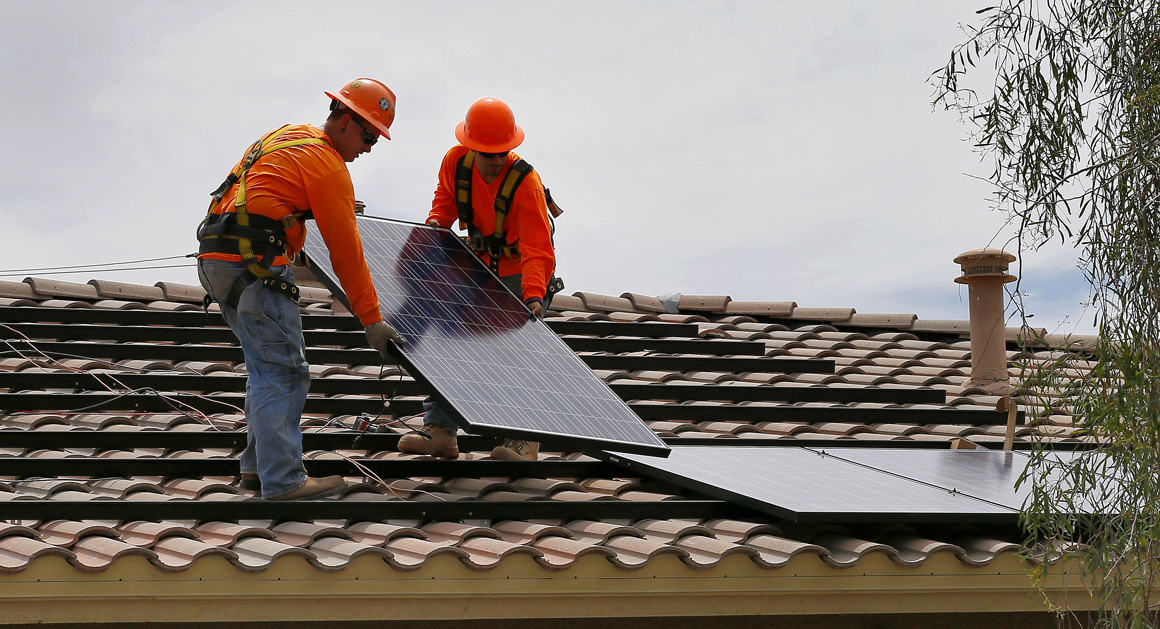
Electricians install solar panels on a roof for Arizona Public Service company in Goodyear, Arizona. | AP Photo
Earlier this month, Congress agreed as part of the omnibus budget package to extend a federal tax credit for solar power to 2022, an incentive the industry has said was crucial to keeping it on a path that would make it economically viable without subsidies.
That federal victory for solar power comes as a rising number of states try to adapt their energy policies to accommodate the rising pressure from homeowners and greens — as well as libertarian groups like Georgia's Green Tea movement — to foster more growth of rooftop solar.
Another fight is playing out in Florida where a group of tea-party, environmental and solar advocates are seeking a ballot measure for 2016 that would prevent the state from regulating small solar installation. Utilities there are pushing a rival ballot initiative that would keep in place the current system that requires homeowners to sell power to the utility.
The cost to install rooftop solar installations has dropped by half in the past five years, and the rooftop companies had put panels on nearly 800,000 homes and business across the country by mid-2015.
But the success of leasing business mode has prompted utilities to push back against the net metering policies, which threaten to eat away at their business growth while increasing their costs.
By the end of 2015, total solar power capacity in the United States is expected to be near 28,000 megawatts, or enough to supply some 5.6 million homes. Still, even with the fast-paced growth, solar power provides less than 2 percent of the electricity consumed in the United States.
Read more: http://www.politico.com/story/2015/12/solar-blowback-hits-reids-home-state-217084#ixzz3vAM5KhSl
Subscribe to:
Posts (Atom)