Tuesday, June 7, 2016

Republican U.S. Senator Kirk withdraws support for Donald Trump

Republican U.S. Senator Kirk withdraws support for Donald Trump


Republican U.S. Senator Mark Kirk, who had previously vowed to support Donald Trump, says he has decided not to do so in light of the businessman's "un-American" statements about the judge handling the Trump University case. James Valles reporting (BNO News)

Mayor Mike Chamberlain: Belvidere has become the place to be

By Susan Vela
Staff writer

Posted Jun. 6, 2016 at 10:31 PM
Updated Jun 6, 2016 at 10:38 PM

BELVIDERE — Mayor Mike Chamberlain said tonight that good things are coming to the city, especially in light of the recent announcement that Belvidere's Fiat Chrysler Automobiles assembly plant has landed the top-selling Jeep Cherokee line.
“Belvidere has become the place to be,” he said during tonight's State of the City address. “Financially, the city is secure.”
The mayor is campaigning for re-election against challenger Ric Brereton, city treasurer and son of former mayor Fred Brereton, who led the city for 16 years.
Chamberlain highlighted several happenings of the past year during his annual address, which came about two months after aldermen approved an annual spending plan of $18 million.
Accomplishments, he said, include U.S. 20 ramp improvements for Genoa and Irene roads, State Street improvements, remodeling of St. James Church, the relocation of Manley Motors to 1800 N. State St., and a $60 million General Mills Inc. expansion at its Belvidere plant.
There’s also the possibility of four Swedish companies partnering with local companies.
“Together we have accomplished much and the future is bright.” Chamberlain said. “Our recent recognition as No. 6 on the list of the 25 best small cities in Illinois to start a small business was a welcome accolade for all of our hard work.
“Let’s keep the ball rolling.”
Aldermen declined to comment after the council session, during which they approved a resolution stating opposition to the proposed $8 billion, 275-mile Great Lakes Basin Railroad that would would transport cargo through the county as part of a bypass around the Chicago area.
“I was a little disappointed that he didn’t mention anything about the school district,” Belvidere resident Patty Bowley said. “The school system is a big part of the city.”

— Susan Vela: 815-987-1392; svela@rrstar.com; @susanvela

Above is from: http://www.rrstar.com/article/20160606/NEWS/160609648

Trump's latest property tax bill, out June 3, shows he once again received a middle-class tax break


image


The self-proclaimed billionaire gets a tax break for New Yorkers whose incomes are $500,000 a year or less

By Aaron Elstein


Photo: Associated Press

Donald Trump just keeps on getting a tax break for the middle class.

Donald Trump's New York City property tax bill, published June 3, shows he once again received a tax break aimed at middle-class New Yorkers.

The presumptive GOP presidential nominee’s latest property tax bill shows he was awarded a credit under the STAR program, or the New York State School Tax Relief Program. To be eligible for STAR, a married couple must have annual income of $500,000 or less. You wouldn’t think a guy as rich as Trump claims to be would qualify, but he has received the credit for several years and records filed over the weekend with the city’s Department of Finance show he received a $304 STAR tax break for his Trump Tower penthouse.

While the amount of the credit is trivial for a high-roller, the fact that Trump gets it calls into question his claims that he's "really rich" with a fortune worth in excess of $10 billion. Trump's tax bill comes to around $96,611 after receiving a condo abatement worth $20,493.

Trump spokeswoman Hope Hicks said the city made an error in providing the tax credit and a correction "is in process." When Crain’s first reported on the STAR credit in March, a spokeswoman for the mayor’s office agreed an error had been made, though she wouldn’t explain how it happened. On Monday, however, a  city spokeswoman told CNN that it was "reviewing Mr. Trump's exemption status," which suggests the city isn't so sure it made a mistake.

The city’s Department of Finance has said it checks with New York state tax authorities every year to make sure applicants for the STAR benefit have income under $500,000. The state receives a list of STAR recipients every year and notifies the city of who is eligible. The state defines income for STAR purposes as federal adjusted gross income minus the taxable amount of total distributions from annuities or individual retirement accounts.

To try to sort it out, in March Crain’s asked for copies of Trump’s STAR applications under New York’s Freedom of Information Law. But after a two-month search, the Department of Finance said that no documents could be found. So the mystery of the billionaire and his middle-class tax break continues.

Because Trump has refused to release his income tax returns, for now his property-tax bills are about the only available window into his finances that doesn’t come from him. It’s conceivable that Trump is in fact very wealthy, thanks to his property holdings and licensing agreements, and manages to lower his annual income to under $500,000 by taking advantage of loopholes in the tax code that give real estate professionals many ways to minimize income.

Such maneuvers may comply with tax law, but could be difficult to explain to voters. Or his fortune may simply be much smaller than he's claimed.

For what it's worth, Trump's accountant appears to be an expert in the STAR program. The accountant, Donald Bender of the firm WeiserMazars, in 2013 posted an article on his LinkedIn page explaining some changes in STAR that required eligible recipients to re-register.

Above is from:  http://www.crainsnewyork.com/article/20160606/BLOGS02/160609931/trumps-persistent-mystery-once-again-the-billionaire-gets-a-middle-class-tax-break

Monday, June 6, 2016

Democrat for District 3 seat replacement


image

By Adam Poulisse
Staff writer

Posted Jun. 1, 2016 at 8:58 PM

BELVIDERE — The Boone County Board is accepting candidacies to fill the seat left vacant by District 3 Democrat Craig Schultz following his unexpected death last month.
The candidate must be a registered Democrat and live in District 3. Those interested should send a letter or a resume expressing their interest and qualifications to Boone County Board Chairman Bob Walberg at 1212 Logan Ave., Belvidere, 61008. The deadline is June 24.
The position’s term expires in November, when the seat will be up for re-election.
“I’m very much of the persuasion that we work together to fill both (terms with the same candidate) and have a little more continuity,” Walberg said.
The Boone County Democratic Central Committee is going through the vetting process to find the best candidate that they will recommend to the County Board, committee Chairman John Gedney said. He wants the appointee to run for re-election in November.
"We don't want any kind of disruption," Gedney said. "We want to make sure the person who fills the vacant seat is willing to run in November."

Adam Poulisse: 815-987-1344; apoulisse@rrstar.com; @adampoulisse

Above is from:  http://www.rrstar.com/news/20160601/boone-county-board-seeking-democrat-for-district-3-seat-replacement

Sunday, June 5, 2016

Hey, Rauner and Madigan: Do your job and not the other guy's


image


Bloomberg News

Photo by Bloomberg News

As a Republican legislator told me the other day, the chief cause of this long state government impasse is that we have a House speaker who also wants to be the governor and a governor who also wants to be the speaker.

This isn't a new phenomenon.

As far back as the 1980s, House Speaker Michael Madigan tried to get legislators a role in state union contract negotiations. He didn't trust Gov. Jim Thompson to negotiate affordable contracts, so he wanted a way to reject the deals or at least influence them.

 -

Way back in 1991, rookie Republican Gov. Jim Edgar wouldn't agree to renewing a tax hike and passing a state budget until Madigan agreed to a statewide cap on property tax increases. Governors have no formal authority to introduce and pass bills. That power belongs exclusively to the General Assembly. But within weeks Madigan and Edgar agreed on a collar county-only tax cap and they moved ahead.

The lengths to which each side has gone this time around most certainly are new, however.

Just look at what's commonly known around the Statehouse as the “AFSCME bill.” The legislation would force the state union contract talks into binding arbitration to avoid a public employee strike. Madigan says Gov. Bruce Rauner can't be trusted to negotiate in good faith with the American Federation of State, County and Municipal Employees, but the bill amounts to overturning decades of legal precedent and vastly reducing the governor's powers during the negotiating process—which Madigan thought was too union-friendly decades ago.

Like Edgar before him, Rauner refuses to support a tax hike and a state budget until he gets some economic reforms. For example, he wants to reduce workers' compensation benefits and rein in union rights to help local governments and school districts deal with his proposed property tax freeze.

But unlike Edgar, Rauner hasn't been able to impose his will on the legislative branch, even after more than a year of trying. His repeated demands that House Democrats rise up against their leader and side with him have been waved off as pipe dreams. Aside from maybe Donald Trump, Rauner is the least popular Republican in this state among Democratic voters. No way are those legislators going to jump in bed with him.

Meanwhile, without a budget, vital groups like Lutheran Social Services of Illinois have closed down huge numbers of invaluable programs, such as drug treatment centers. Sexually abused children can't get help, and neither can runaway teens. More and more students are choosing out-of-state universities for fear that Illinois colleges will close.

What we need here is a timeout. Everybody needs to go back to their own corners—and their own constitutionally mandated roles—for a while.

A few days before the spring session's official conclusion, Senate President John Cullerton told the governor that the two sides just weren't close enough to a deal. Cullerton proposed a temporary budget to get the state past the November elections, when Democrats might feel more free to negotiate items that unions would oppose.

Rauner flatly rejected that, believing they were closer to an agreement on nonbudget items than Cullerton admitted. On the very last day of session, though, the governor flip-flopped and demanded his own temporary budget. The General Assembly adjourned without taking action, partly because Madigan refused to allow the governor to dictate another legislative action.

A temporary budget is not a solution. It's not even all that responsible. And a brutal, divisive election may very well make it much more difficult to work out a compromise.

But it's the only way to prevent a complete governmental collapse. If they can't at least do this, we're doomed.

A contributing columnist to Crain's, Rich Miller publishes Capitol Fax, a daily political newsletter, and CapitolFax.com.

Above is from:  http://www.chicagobusiness.com/article/20160604/ISSUE11/306049990/hey-rauner-and-madigan-do-your-job-and-not-the-other-guys

Saturday, June 4, 2016

2018 Election: Gov. Rauner vs. President Kennedy’s nephew?


image

The next election for governor of Illinois is not until November 2018, but already Chris Kennedy is making the rounds for a possible campaign, sources told NBC Chicago. Mary Ann Ahern reports. (Published Friday, June 3, 2016)

The next election for governor of Illinois is not until November 2018, but already Chris Kennedy is making the rounds for a possible campaign, sources told NBC Chicago.

Kennedy, the eighth of 11 children of Robert and Ethel Kennedy, has lived in the Chicago suburbs for nearly 30 years.

  •  

He had previously considered a run for the U.S. Senate in 2009, but opted out shortly after. Instead, Gov. Pat Quinn appointed Kennedy Chairman of the University of Illinois Board of Trustees.

He and his wife now run Top Box Foods, a nonprofit providing fresh food options in the inner city.

  •  

Sources tell NBC 5 Kennedy has been meeting privately with key Democratic leaders and possible donors.

“I have heard that Chris is more serious this time,” said Eric Adelstein, a Democratic strategist. “Look, I think we have a unique situation, and here’s why -- I believe Rauner is a failed governor.” 

  •  

However, Republican strategist Chris Robling disagreed, saying “the concern over politics 2 and a half years from now reflect the fear over discomfort.”

Robling is well aware that lawmakers and Gov. Bruce Rauner have been unable to reach a budget deal now for the second year in a row. Robling says “things have to change and change is very, very trying.”

  •  

Republicans are launching online ads attacking House Speaker Michael Madigan. The governor is fighting back as Democrats say no grand compromise will happen until after the November election. 

Rauner, speaking to reporters Thursday, said, “we should not let elections or electioneering get in the way of doing the right thing for the families of our state.”

  •  

Other names mentioned as potential Democratic candidates for governor include U.S. Senator Dick Durbin, but he has said he’s not interested. If Chris Kennedy does run, it would be the 50th anniversary of his father’s 1968 campaign for president.

“Chris is a guy who will not just run on that name, I think he’s going to run on accomplishments and a vision,” Adelstein said.

  •  

Robling, however, notes, “he has had relatives who’ve done well and he’s had other relatives who’ve done terribly and Chris might be on one side of the family or the other, who knows?”

NBC 5 has reached out to Kennedy but he declined to comment.

Source: Sources: Chris Kennedy Considering Possible Run for Illinois Governor in 2018 | NBC Chicago http://www.nbcchicago.com/blogs/ward-room/Sources-Chris-Kennedy-Considering-Run-for-Illinois-Governor-381829801.html#ixzz4Aff55tba
Follow us: @nbcchicago on Twitter | nbcchicago on Facebook

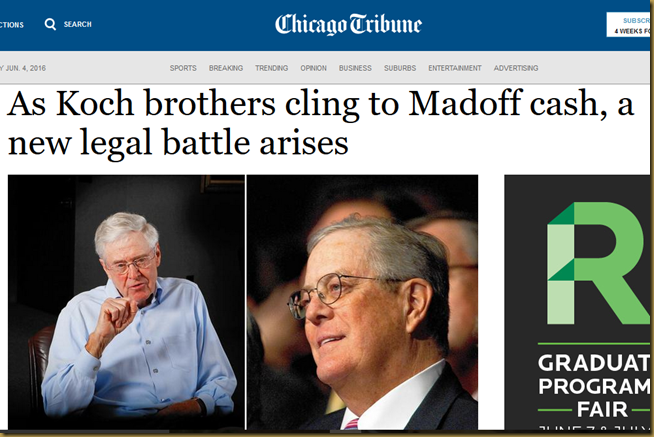
As Koch brothers cling to Madoff cash, a new legal battle arises


image

Billionaire brothers Charles and David Koch have made plenty of good business decisions over the years. Placing millions of dollars with Ponzi-scheme mastermind Bernard Madoff may have been one of them.

Koch Industries Inc. invested an unknown sum with the con man's now-defunct securities firm years ago, and walked away with $21.5 million in profits before Madoff's arrest in 2008. But since 2012 the company run by the conservative-activist brothers, worth today a combined $109 billion, has refused legal demands to return the money.

Irving Picard, the trustee liquidating Madoff's firm, contends in a suit that the cash is fraudulent proceeds of the fraud and should be shared among the thousands of victims. Koch Industries, and dozens of other early investors named in 87 other lawsuits, argue the company can keep the profits because the money was sent overseas and is beyond U.S. jurisdiction. At stake: a total of $2 billion.

The battle is coming to a head in Manhattan bankruptcy court, where Judge Stuart Bernstein could rule within weeks on a key issue affecting Picard's suit. The defendants claimed a victory in 2014 when U.S. District Judge Jed Rakoff said that money transferred overseas is generally out of Picard's reach. In the Koch case, the $21.5 million was sent in 2005 to a fund based in the British Virgin Islands, and then to a Koch entity in Britain, filings show.

Picard is claiming the transactions were essentially domestic transfers made to appear foreign.

"The trustee is not crazy — he has a very decent argument," said John Pottow, a bankruptcy law professor at the University of Michigan Law School.

Koch Industries has said the suit lacks merit. "The Koch entity involved made an investment in an entirely separate fund," Koch spokesman Rob Carlton said in an email. "That Koch entity no longer exists, and its investment was redeemed in 2005, long before anyone knew of Madoff's fraud." The Koch brothers are controlling shareholders in the company, and have other investors.

Picard's spokeswoman, Amanda Remus, declined to comment.

Picard isn't accusing Koch and the other defendants of wrongdoing. As in his many prior suits to recover cash, he contends the returns aren't legitimate because Madoff used money from new investors to cover the fake profits of older ones. He has used that argument successfully in mostly domestic cases to claw back more than $11 billion for victims, who lost $17.5 billion in principal. (Some foreign defendants settled with Picard and moved on.)

Most of the $2 billion involves transfers from funds that were operated by Fairfield Greenwich Group — by far the biggest feeder fund that channeled investors' money to Bernard L. Madoff Investment Securities, or BLMIS. Several other suits involve funds run by Tremont Group Holdings. Both are based in New York and dealt with their shareholders from their offices in Manhattan, even though they had feeder funds based in the Caribbean to capture foreign investments for Madoff, Picard says.

"Regardless of where these feeder funds maintained operations, their transactions related to BLMIS were predominantly domestic," Picard has said in filings in federal court in New York. Moreover, the customers knew their investments were subject to U.S. law, he argued.

If Picard wins on this issue, his fight to recover the $2 billion isn't over. He must then prove that the transfer in each defendant's case was "domestic." Then, for transfers that occurred more than two years before Madoff's arrest, Picard must establish one more thing: that the feeder fund in which the defendant invested had "actual knowledge" of the fraud.

"We're strongly of the view that the extraterritoriality defense applies to the Fairfield Greenwich defendants," Mark Cunha, a lawyer for Fairfield, said in an interview. "We look forward to the judge's decision."

Koch Industries, an industrial conglomerate and one of the biggest private companies in the U.S., started investing with Madoff in the mid-1990s, court records show. At first, it invested with a Fairfield fund in the U.S., Greenwich Sentry.

In 2003, the company set up the entity in Britain, Koch Investment (U.K.) Co., to invest through a different fund that Fairfield set up in the British Virgin Islands that was exclusively for foreigners, called Fairfield Sentry. Two years later Koch Industries withdrew the cash that's now at the center of the trustee's lawsuit. (Koch also withdrew $58 million from Greenwich Sentry that same year, according to the fund's Chapter 11 filings.)

"Although registered in the United Kingdom, Koch Investment had no employees or operations in the United Kingdom, and was operated and managed entirely from the United States," the trustee said.

Picard's legal team has also cited the bankruptcy of Maxwell Communication Corp. in the 1990s. The judge in that case noted the "dangerous implications" of automatically labeling a transfer as foreign just because it involved foreign participants.

Picard's plan "makes sense since it's so easy to move money outside the United States," said Joelle Scott, of investigative due diligence firm Corporate Resolutions Inc. "I'd be surprised if the judge shut him down."

Madoff is serving a 150-year sentence in a federal prison in North Carolina for running the Ponzi scheme.

Bloomberg

Above is from:  http://www.chicagotribune.com/business/ct-koch-brothers-madoff-20160603-story.html