Sunday, March 29, 2020

Forecasting COVID-19 impact on hospital bed-days, ICU-days, ventilator days and deaths by US state in the next 4 months


Great forecasting model for US and individual states.  It is updated daily.  Click on following to find current data:  http://www.healthdata.org/research-article/forecasting-covid-19-impact-hospital-bed-days-icu-days-ventilator-days-and-deaths


Forecasting COVID-19 impact on hospital bed-days, ICU-days, ventilator days and deaths by US state in the next 4 months


Publication date:

March 26, 2020

View the COVID-19 US projections data visualization

IMPORTANCE

This study presents the first set of estimates of predicted health service utilization and deaths due to COVID-19 by day for the next 4 months for each state in the US.

OBJECTIVE

To determine the extent and timing of deaths and excess demand for hospital services due to COVID-19 in the US.

DESIGN, SETTING, AND PARTICIPANTS

This study used data on confirmed COVID-19 deaths by day from WHO websites and local and national governments; data on hospital capacity and utilization for US states; and observed COVID-19 utilization data from select locations to develop a statistical model forecasting deaths and hospital utilization against capacity by state for the US over the next 4 months.

EXPOSURE(S)

COVID-19.

MAIN OUTCOME(S) AND MEASURE(S)

Deaths, bed and ICU occupancy, and ventilator use.

RESULTS

Compared to licensed capacity and average annual occupancy rates, excess demand from COVID-19 at the peak of the pandemic in the second week of April is predicted to be 64,175 (95% UI 7,977 to 251,059) total beds and 17,309 (95% UI 2,432 to 57,584) ICU beds. At the peak of the pandemic, ventilator use is predicted to be 19,481 (95% UI 9,767 to 39,674). The date of peak excess demand by state varies from the second week of April through May. We estimate that there will be a total of 81,114 deaths (95% UI 38,242 to 162,106) from COVID-19 over the next 4 months in the US. Deaths from COVID-19 are estimated to drop below 10 deaths per day between May 31 and June 6.

CONCLUSIONS AND RELEVANCE

In addition to a large number of deaths from COVID-19, the epidemic in the US will place a load well beyond the current capacity of hospitals to manage, especially for ICU care. These estimates can help inform the development and implementation of strategies to mitigate this gap, including reducing non-COVID-19 demand for services and temporarily increasing system capacity. These are urgently needed given that peak volumes are estimated to be only three weeks away. The estimated excess demand on hospital systems is predicated on the enactment of social distancing measures in all states that have not done so already within the next week and maintenance of these measures throughout the epidemic, emphasizing the importance of implementing, enforcing, and maintaining these measures to mitigate hospital system overload and prevent deaths.

Citation:

IHME COVID-19 health service utilization forecasting team. Forecasting COVID-19 impact on hospital bed-days, ICU-days, ventilator days and deaths by US state in the next 4 months. MedRxiv. 26 March 2020. doi:

Related Content
Data visualizations

COVID-19 US STATE-BY-STATE PROJECTIONS

IHME’s COVID-19 projections were developed in response to requests from the University of Washington School of Medicine and other US hospital systems and state governments working to ...

******************************************************************************************************************************************


Below is a commentary on the University of Washington study by Rich Miller of Capitol Fax.

A look at that University of Washington COVID-19 study and how Illinois fares

Sunday, Mar 29, 2020

* A new study by the University of Washington’s Institute for Health Metrics and Evaluation is quite sobering. Let’s start with the press release

In a forecast based on new data analyses, researchers find demand for ventilators and beds in US hospital intensive care units (ICUs) will far exceed capacity for COVID-19 patients as early as the second week of April. Deaths related to the current wave of COVID-19 in the US are likely to persist into July, even assuming people protect themselves and their communities by strongly adhering to social distancing measures and by taking other precautions advised by public health officials.

The study uses a range of outcomes with a 95 percent uncertainty (or confidence) interval (UI). This produces a lower- and upper-bound estimate. The result should appear between those two bounds in 95 out of 100 simulations. This a very tricky thing to model, as they state in their methods section

Uncertainty in the model estimates is driven by two components: (1) uncertainty from fixed effect estimation and (2) uncertainty from random effects, with the latter dominant because of the high variation between locations.

That “variation between locations” also applies to individual states. So far, though, their numbers are holding up.

* Deaths per day. The study projects the United States will hit its peak of deaths per day on April 14th at 2,341, (or between 1,149 and 4,844 at 95% UI). The study projected 437 national deaths for March 28 (with a range between 380 and 508). The actual number on the 28th was 447, so that’s well within the expected range.

You can also look at the numbers by state. Illinois is expected to hit 91 deaths per day at its peak on April 17th, (or between 18 and 177 at 95% UI). The study projected 11 deaths per day for Illinois by March 28, (or between 6 and 17). Illinois reported 13 deaths yesterday.

According to the projection, Illinois will not return to yesterday’s death level until around May 11th. But it could come earlier (late April) considering the projected range, or later (beginning of June). You can clearly see the difficulty here in predicting when Illinois should lift its stay at home order.

* Cumulative deaths. By March 28, the study had forecast 1,979 cumulative deaths in the US, a number derived from a range of 1,842 to 2,137. The actual total was 2,038. That’s well within the expected range.

For Illinois, the study projected 47 cumulative deaths by March 28, (or between 34 and 63). The actual number was 47.

Point being, each day’s projected number won’t be exactly right, but it will likely be in the expected ballpark over time at a 95 percent UI. Its projection for New York of 722 deaths by March 28 was also pretty spot on. New York reported 728 deaths as of that day.

* In all, the study projects 81,114 total deaths in the United States by July 15th, (or between 38,242 and 162,106). Things start to level off around the first week of June or thereabouts.

Illinois can expect to experience 2,453 deaths by June 4, (or between 507 and 5,850). As noted above, Illinois is projected to start leveling off in earlyish May or so.

* Peak resource use. The study projects peak resources will be needed in the nation as a whole by April 14th. By that point, the nation will be short 49,292 hospital beds and 14,601 ICU beds and 18,767 ventilators will be needed (the researchers could not estimate existing ventilator capacity). But because this is such a large country and the trajectories are different for various regions, let’s focus on Illinois.

Illinois will hit its peak resource day on April 16. We should have 14,552 hospital beds available by that day. The study projects we’ll need 8,885. So, we’re good, right? Well, that number is derived from a range of 1,998 to 16,986, so don’t get too comfortable. Also - and this is very, very important - Illinois is a big and diverse state. Some hospitals may have excess capacity while several may not. It could be a real nightmare for some areas and/or individual hospitals.

Also, just because we have bed capacity doesn’t mean that hospitals have enough gloves, masks, etc. And, partly because of the national PPE and testing shortages and lack of a vaccine, hospital/ambulance/first responder staffing levels could crash as more and more workers contract the virus.

And then there’s the ICU bed issue. Illinois will have 1,131 ICU beds available on April 16, but it will need 1,335, or 204 more than existing capacity (the projected ICU bed range need is between 180 and 2,700). That obviously needs to be addressed, particularly when you factor in any regional disparity.

We’ll also need 721 ventilators by that time, but the expected range could push that number as high as 1,447.

Indiana is in much worse shape. They’ll need an additional 1,973 hospital beds, 876 ICU beds and 854 ventilators. Missouri’s is even worse. Michigan is about to get clobbered. By April 8th, that state is projected to need 10,563 additional hospital beds, 2,564 ICU beds and 1,785 ventilators. New York is a disaster. By April 6th it’s projected to need 35,301 more hospital beds than it had, 6,949 ICU beds and 4,141 ventilators.

* Now, on to some visuals. When you hear people say “flatten the curve,” it means we have to keep the following graph’s curving purple dotted line (hospital beds needed) beneath that straight solid purple line (existing hospital beds available). Same goes for needed and existing ICU beds with the green dotted and straight lines. As noted above, Illinois achieves the flattening goal for hospital beds, but not for ICU beds. A shortage of existing ICU beds will begin on April 7 and last what could be two very long weeks…
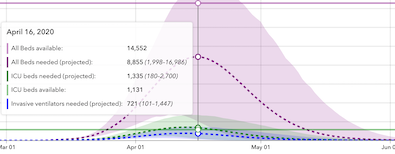
Keep in mind that the feds are becoming quite concerned about a spike in Chicago and Cook. As emphasized above, some hospitals will have excess capacity while some will not.

* Indiana will not sufficiently flatten the curve. The state goes above existing hospital bed capacity on April 8th and won’t have excess beds until April 21. Existing ICU capacity is breached on March 31 and that will last through April 24…
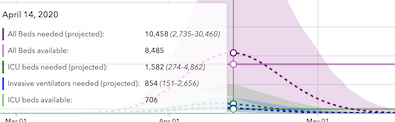
* New York went above existing capacity days ago and won’t have available hospital beds and ICU beds until April 22nd…
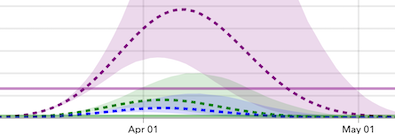
* Michigan appears to already be above existing ICU capacity and will be above existing hospital bed capacity on March 30. It won’t have an excess capacity of existing ICU and hospital beds until April 19…
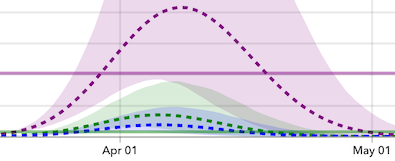
* Missouri will be above existing hospital bed capacity from April 12-29 and above existing ICU capacity from April 2 through May 4…
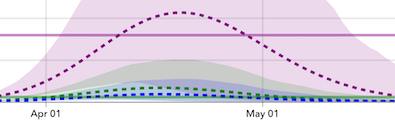
According to the projection, Wisconsin doesn’t hit peak resource needs until May 22nd, so it has time to beef up its existing ICU beds, which are projected to exceed capacity from May 4 through June 4. Ohio, like Wisconsin and Illinois, should have enough hospital beds, but it will experience an ICU bed shortage based on existing capacity from April 9-19. Minnesota will have a shortage of existing ICU beds from April 11 through May 6.

Bottom line: We’re better off than some other states, but it’s still gonna be bad. Please, stay inside.

…Adding… Fauci believes the situation will be worse than the UW study indicates

The U.S. government’s foremost infection disease expert, Dr. Anthony Fauci, says the U.S. will certainly have “millions of cases” of COVID-19 and more than 100,000 deaths.

As the U.S. tops the world in reported infections from the new coronavirus, the director of the National Institute of Allergy and Infectious Diseases predicts 100,000-200,000 deaths from the outbreak in the U.S.

- Posted by Rich

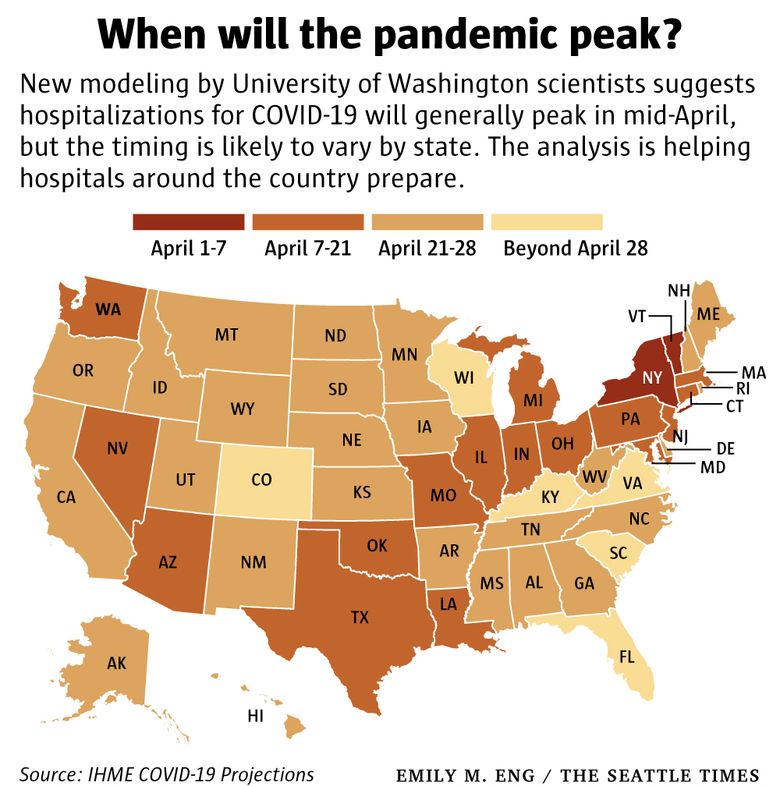
Projected peaks of COVID 19 across the US

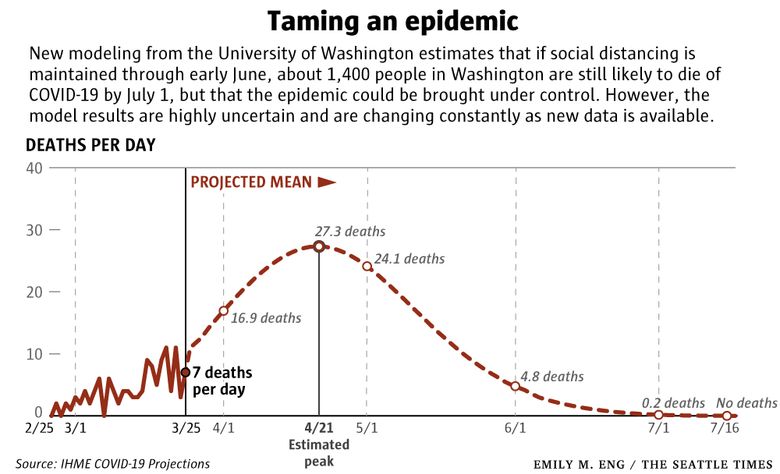
UW model says social distancing is starting to work — but still projects 1,400 coronavirus deaths in the state

March 26, 2020 at 7:25 pm Updated March 27, 2020 at 10:01 am

Tents sit at Harborview Medical Center’s emergency room on Thursday to keep respiratory patients separate from others in the hospital while they are evaluated.    (Steve Ringman / The Seattle Times)

A temporary field hospital is being set up on a soccer field in Shoreline for people unable to isolate and recover from COVID-19, the disease caused by coronavirus, in their own homes. The 200-bed hospital was erected by King County.  (Ken Lambert / The Seattle Times)

1 of 2 | Tents sit at Harborview Medical Center’s emergency room on Thursday to keep respiratory patients separate from others in the... (Steve Ringman / The Seattle Times) More

Sandi Doughton

By

Sandi Doughton

Seattle Times staff reporter

A new analysis from the University of Washington projects that even with strict social distancing from coast to coast, more than 81,000 people in the U.S. — and more than 1,400 in Washington state — could die from COVID-19 by the first of July.

Hospitals and intensive care units across the country are likely to be overwhelmed beginning in the second week of April.

Modeling from the UW’s Institute for Health Metrics and Evaluation (IHME) forecasts that hospitalizations will generally peak in mid-April, with 64,000 more patients than licensed beds nationwide. The shortfall in ICU beds is estimated at more than 17,000. Demand will be much higher if all states do not adopt and maintain social distancing, says the report, which also examines the anticipated strain on medical systems for every state.

In Washington, there’s no predicted shortage in overall hospital beds, though some individual facilities — including the UW Medical system — will need extra capacity and have already geared up to provide it. The statewide shortage in ICU beds is forecast to reach almost 100 by April 19, the model’s approximate date for when hospitalizations are expected to peak in Washington.

The findings suggest measures to slow the epidemic are making a difference locally. But restrictions will need to continue into late May or early June in Washington and the rest of the country to bring the disease under control, said IHME Director Dr. Christopher Murray.

“The trajectory of the pandemic will change — dramatically for the worse — if people ease up on social distancing or relax other precautions.”

Gov. Jay Inslee acknowledged as much in a briefing on Thursday, saying the stay-at-home order he issued Monday will probably have to be extended beyond the two-week period initially specified as a minimum.

The UW analysis differs from most modeling of the new coronavirus, partly because it relies on the number of deaths across the U.S. and in other countries — which is a more reliable gauge of the epidemic’s course than confirmed infections, which depends on intensity of testing, Murray said. It also takes into account the impact of social distancing measures, something few other modelers have yet quantified.

Still, all of the UW estimates come with a huge measure of uncertainty, the researchers caution. Each model run is based on a thousand projections, which zero in on the most likely result. But the range of possible outcomes remains wide. For example, while 1,430 represents the best projection of total deaths in Washington by July 1, the statistical range extends from 316 to 2,535.

As of March 26, the state had 3,207 confirmed infections and 147 deaths.

“There’s a tremendous amount we don’t know or understand about what explains the variation across communities,” Murray said. “Every day we get more data, we learn more and the forecast will get better and better and more accurate.”

Earlier in the epidemic, the model’s forecasts for Washington were much more ominous, Murray pointed out. But it seems as if the state’s early actions — including companies shifting to remote work, school closures and limits on gatherings — have already had an impact. Hospitals across the state also moved quickly to cancel most elective surgeries and free up beds.

“If you go back even a week ago or 10 days ago, the case predictions from those models suggested we should have had many more cases by now,” Murray said.

Ten days ago, the models were predicting that the UW Medicine System could expect as many as 950 patients hospitalized with COVID-19 at the the epidemic’s peak, said Lisa Brandenburg, president of UW Medicine Hospitals & Clinics. The latest modeling shows a 20 to 30 percent reduction, or an expected maximum of 750 to 650 patients with COVID-19, the respiratory disease caused by the novel coronavirus.

Since UW Medicine and its four hospitals already prepared for the earlier, worst-case scenario — identifying where to squeeze in extra beds and how to mobilize additional staff — Brandenburg said she’s increasingly confident they will be able to handle the surge.

“Generally speaking, it’s very good news for us that the curve seems to be flattening here in Washington state, but it doesn’t mean we don’t still have a substantial amount of work to be done, in terms of taking care of people in the region.”

Hospitals across the state reported 254 admissions of people with COVID-19-like symptoms in the third week of March. That’s double the number two weeks earlier, but only a 10% increase over the week before.

Many medical facilities and hospitals still don’t have enough protective gear, said Cassie Sauer, president and chief executive officer of the Washington State Hospital Association. Another big unknown is whether there will be enough ventilators for critically ill patients, she said.

The UW analysis estimates nearly 20,000 patients nationwide will need ventilators to keep them alive when hospitalizations peak. In Washington, the estimate is 236, and it’s not clear whether the state will have enough of the vital machines, Sauer said.

“I remain massively worried about this whole thing,” she said. “We don’t know enough about the disease. We don’t know enough about how seriously people are taking the ‘stay home and stay healthy’ order.”

However, Sauer also said some hospitals may soon reopen their operating rooms to a limited number of elective surgeries for people with the most urgent medical needs.

The UW projections show that the “first wave” of the epidemic should begin to wane by the end of May or the first week of June. But if social distancing measures are lifted before then, infections and deaths will surge again, Murray warned.


For example, if the number of deaths in Washington peaks around April 20 then begins to decline, as the model currently projects, public pressure to lift the restrictions will become fierce.

“I think the big issue will be in May,” Murray said. “We’ll still have plenty of infections and cases and deaths, but some people will say: ‘We’ve [gone] past the peak. Why can’t we stop social distancing?’

“But if we do stop, and there are still plenty of cases in the community, we can go right back to exponential growth.”

It remains to be seen whether there will be a second wave of infections in the fall, Murray added. Models predicted one during the 2003 SARS epidemic, but it never materialized.

Beginning Monday, Murray and his colleagues will be updating their model daily and posting the results on IHME’s website: healthdata.org.

From:  https://www.seattletimes.com/seattle-news/health/uw-model-says-social-distancing-is-starting-to-work-but-still-projects-1400-coronavirus-deaths-in-the-state/?utm_source=marketingcloud&utm_medium=email&utm_campaign=Sunday+Morning+03-29-20_3_29_2020&utm_term=

Saturday, March 28, 2020

March 28: 3,491 COVID-19 cases in Illinois

Coronavirus Disease 2019 (COVID-19)

In response to the COVID-19 pandemic, Gov. JB Pritzker has ordered Illinois residents to stay at home. Executive Order No. 10 requires all residents to stay home, with exceptions for essential needs or business activities. Gatherings of 10 people or more are prohibited. The order extends through April 7, 2020.
 

Coronavirus Disease 2019 (COVID-19) in Illinois Test Results

Positive

3,491 (3,026  3-27-2020)

Deaths

47  (34 3-27-2020)

Total Persons Tested*

25,429  (21,542  3-27-2020)


*Total number of people reported electronically for testing of COVID-19 at IDPH, commercial or hospital laboratories. Deaths are included in the number of positive cases
All numbers displayed are provisional and subject to change.

Information regarding the number of people under investigation updated on 3/28/2020.
Information to be updated daily.

COVID-19 Illinois Positive Cases

Above is from:  http://www.dph.illinois.gov/topics-services/diseases-and-conditions/diseases-a-z-list/coronavirus

*************************************************************************************************************************************************************

Site showing monthly graph on COVID-19 for each state go tohttps://www.politico.com/interactives/2020/coronavirus-testing-by-state-chart-of-new-cases/

daily

***********************************************************************************************************************************************************


National Numbers from Johns Hopkins University

A look at the updated dashboard for Johns Hopkins University's coronavirus-tracking map, which now shows granular data for counties and cities.

JOHNS HOPKINS UNIVERSITY

Above fromhttps://www.bizjournals.com/louisville/news/2020/03/25/johnshopkins-coronavirus-tracking-map-now-shows.html#i/11634126

**************************************************************************************************************************************

Cases in U.S. per CDC

Other Languages

On This Page


Updated March 28, 2020

This page will be updated daily. Numbers close out at 4 p.m. the day before reporting.

***On Saturday and Sunday, the numbers in COVID-19: U.S. at a Glance and the figure describing the cumulative total number of COVID-19 cases in the United States will be updated. These numbers are preliminary and have not been confirmed by state and territorial health departments. CDC will update weekend numbers the following Monday to reflect health department updates.***

CDC is responding to an outbreak of respiratory illness caused by a novel (new) coronavirus. The outbreak first started in Wuhan, China, but cases have been identified in a growing number of other locations internationally, including the United States. In addition to CDC, many public health laboratories are now testing for the virus that causes COVID-19.

COVID-19: U.S. at a Glance*†

  • Total cases: 103,321
  • Total deaths: 1,668
  • Jurisdictions reporting cases: 54 (50 states, District of Columbia, Puerto Rico, Guam, and US Virgin Islands)

* Data include both confirmed and presumptive positive cases of COVID-19 reported to CDC or tested at CDC since January 21, 2020, with the exception of testing results for persons repatriated to the United States from Wuhan, China and Japan. State and local public health departments are now testing and publicly reporting their cases. In the event of a discrepancy between CDC cases and cases reported by state and local public health officials, data reported by states should be considered the most up to date.

† Numbers updated Saturday and Sunday are not confirmed by state and territorial health departments. These numbers will be modified when numbers are updated on Monday.

Cases of COVID-19 Reported in the US, by Source of Exposure*†

Cases of COVID-19 Reported in the US, by Source of Exposure

Travel-related
712

Close contact
1,326

Under investigation
83,318

Total cases
85,356

* Data include both confirmed and presumptive positive cases of COVID-19 reported to CDC or tested at CDC since January 21, 2020, with the exception of testing results for persons repatriated to the United States from Wuhan, China and Japan. State and local public health departments are now testing and publicly reporting their cases. In the event of a discrepancy between CDC cases and cases reported by state and local public health officials, data reported by states should be considered the most up to date.

† CDC is no longer reporting the number of persons under investigation (PUIs) that have been tested, as well as PUIs that have tested negative. Now that states are testing and reporting their own results, CDC’s numbers are not representative of all testing being done nationwide.

Above is from:  https://www.cdc.gov/coronavirus/2019-ncov/cases-updates/cases-in-us.html


U of Washington study: “WA medical system will handle the load”


28 More Coronavirus Deaths In Washington, Over 500 New Cases

Washington's department of health confirms that 3,723 people have been infected with the coronavirus statewide, and 175 people have died.

By Charles Woodman, Patch Staff
Mar 27, 2020 4:55 pm PT | Updated Mar 27, 2020 5:46 pm PT

Reply

0

Tourist destinations like Pike Place Market remain shuttered by the governments order, though the market is offering delivery services.Tourist destinations like Pike Place Market remain shuttered by the governments order, though the market is offering delivery services. (Shutterstock / Jesse T Collins)

SEATTLE, WA — A little over 500 new cases of coronavirus were confirmed in Washington Friday, and 28 additional deaths were reported, according to the Washington State Department of Health. Now more than 52,000 residents have been tested statewide, with about 7 percent of those tests coming back positive.

Friday's numbers mark another significant increase in COVID-19 cases, though about 100 less new cases than Thursday brought. However it does represent a bigger increase in deaths, including 16 new deaths in King County alone. In Snohomish County, 7 additional deaths were reported.

More than 6,000 new patients were tested for the coronavirus statewide Friday. 200 of the confirmed cases reported were found in King County. Public Health - Seattle & King County says they've successfully expanded testing in the homeless population and are focusing on getting more tests to high risk communities like first responders and assisted living homes.

Of the patients killed by the virus, 54 percent were 80 or older, 28 percent were between 70-79, and 11 percent were between 60 and 69. Doctors studying the virus say it is most deadly for patients older than 60, though pregnant women or anyone else with underlying health factors can also be at risk

UW study finds cases may peak soon


A new model produced by The University of Washington's Institute for Health Metrics now predicts Washington could see a peak in coronavirus cases around April 19. The model also predicts about 1,400 deaths in Washington by August. If the study holds true, the state is well equipped to handle the medical load, and needs just under 100 more ICU beds to support patients with severe symptoms.

However doctors and government leaders warn against getting too complacent. The model's predictions change rapidly day-to-day depending on external factors, and assumes social distancing and other preventative measures continue and remain effective.

Army to turn CenturyLink Field into field hospital

Seattle Mayor Jenny Durkan's office announced Friday that the US Army Corps of Engineers and FEMA had agreed to set up a military field hospital at Seattle's CenturyLink field.

The field hospital will be staffed by 300 soldiers from the 627th Army Hospital at Fort Carson, Colorado. The deployed medics are expected to run a 150-bed hospital which will work as an expanded support system, handling routine medical cases while medical professionals in Washington continue to focus their efforts on COVID-19.

School to resume remotely Monday as teachers consider relaxing graduation requirements.

State Superintendent Chris Reykdal ordered all public schools statewide to begin teaching remotely by Monday, March 30, but some school officials remain concerned that the disruption in regular classes will cause some students who would have graduated under normal conditions to miss or fail classes and be held back.

The education board is now considering waiving some graduation requirements to keep students from falling behind. If passed, the waivers would only impact current seniors who had already enrolled in all the courses they needed to graduate this year. The education board is expected to vote on the waived graduation requirements by April 8.

Seattle City Council Member calls for moratorium on rent and mortgage

Seattle City Councilmember Tammy Morales has issued a resolution calling for a moratorium on commercial and residential rents and mortgage payments. Her office argues such measures are necessary to help Seattle residents and business owners who are struggling to stay afloat during the coronavirus outbreak.

Morales says that studies show 47 percent of Seattle residents are rent-burdened, and warns that asking them to pay rent when many have been laid off amid the outbreak could cause an economic free-fall and worsen the homelessness crisis.

Seattle Mayor Jenny Durkan and the Council previously passed a 60-day moratorium on residential evictions for missing rent payments.

Above is from:  https://patch.com/washington/kirkland/s/h2bcm/28-more-coronavirus-deaths-in-washington-over-500-new-cases?utm_source=alert-breakingnews&utm_medium=email&utm_campaign=alert

Friday, March 27, 2020

March 27: 3,026 Cases of COVID 19 in Illinois

Coronavirus Disease 2019 (COVID-19)

In response to the COVID-19 pandemic, Gov. JB Pritzker has ordered Illinois residents to stay at home. Executive Order No. 10 requires all residents to stay home, with exceptions for essential needs or business activities. Gatherings of 10 people or more are prohibited. The order extends through April 7, 2020.
 

Coronavirus Disease 2019 (COVID-19) in Illinois Test Results

Positive

3,026 (2,538    3-26-2020)

Deaths

34  (26  3-26-2020)

Total Persons Tested*

21,542  (16,631 3-26-2020)

*Total number of people reported electronically for testing of COVID-19 at IDPH, commercial or hospital laboratories. Deaths are included in the number of positive cases
All numbers displayed are provisional and subject to change.

Information regarding the number of people under investigation updated on 3/27/2020.
Information to be updated daily.

COVID-19 Illinois Positive Cases

What is the status of the Defense Production Act?


Day after day, Trump has said different things about ventilators and the Defense Production Act

Ben Werschkul

DC Producer

,

Yahoo FinanceMarch 27, 2020

Ad: 26s

Last Wednesday, March 18, President Trump walked into the White House briefing room at 12:06 pm with a significant announcement.

“We'll be invoking the Defense Production Act, just in case we need it. In other words, I think you all know what it is, and it can do a lot of good things if we need it. And we will – we will have it all completed, signing it in just a little while. Right after I'm finished with this conference, I'll be signing it. It's prepared to go. So we will be invoking the Defense Production Act.”

Hours later, he seemed to backtrack in a tweet about whether the law, which gives him the ability to compel companies to manufacture critically needed items in times of national need, had actually been invoked.

Donald J. Trump

@realDonaldTrump

I only signed the Defense Production Act to combat the Chinese Virus should we need to invoke it in a worst case scenario in the future. Hopefully there will be no need, but we are all in this TOGETHER!

207K

4:37 PM - Mar 18, 2020

Twitter Ads info and privacy

90.5K people are talking about this

The next day, March 19, he clarified a bit during the daily coronavirus task force briefing.

Q: Mr. President, if I could, a question for you and then a question for Dr. Hahn. You “enabled” – I guess, is probably the best way to put it – the Defense Production Act yesterday, but you didn’t pull the trigger on it.

THE PRESIDENT: No, because we hope we're not going to need that.

Later in the briefing, he added this:

Q: Under what conditions would you put the Defense Production Act into action?

THE PRESIDENT: Well, if we were desperately in need of something – and we, frankly, will know about that very shortly. We want to be ahead of – we don't want to do it as it happens but before it happens. We're going to know a lot over the next two or three days. We'll know a lot.

The next morning, Senate Minority Leader Chuck Schumer had a call with Trump and asked him to invoke the act. Schumer’s spokesman later told reporters, using the acronym for President of the United States, that "POTUS told Schumer he would, and then POTUS yelled to someone in his office to do it now."

At the daily briefing later that day, on March 20, Trump was again saying he had “invoked” the act.

Q: You had a call with Senator Schumer. He says you've now agreed to invoke the Defense Production Act to actually make those medical supplies that hospitals say are in severe shortage. So two questions: Is that what you're doing now?

THE PRESIDENT: It is. I did it yesterday. We invoked it, I think, the day before we signed it – the evening of the day before – and invoked it yesterday. We have a lot of people working very hard to do ventilators and various other things. Yes.

The next day, on March 21, Trump clarified again that the White House had not actually compelled any companies using the act.

Q: One of the things we're hearing from governors: They can't find supplies and prices have gone up. So you've talked about the act, sir, but you have not yet compelled any companies. Why not?

THE PRESIDENT: Because we have so many companies making so many products – every product that you mentioned, plus ventilators and everything else. We have car companies – without having to use the act. If I don't have to use – specifically, we have the act to use, in case we need it. But we have so many things being made right now by so many – they've just stepped up.

A few days later, on March 23, he said he invoked the act in regard to vital medical equipment.

Earlier today, I signed an executive order invoking presidential authority under Section 4512 of the Defense Production Act to prohibit the hoarding of vital medical equipment and supplies such as hand sanitizers, face masks, and personal protective equipment.

The next day, he tweeted that that act was in “full force.”

Donald J. Trump

@realDonaldTrump

The Defense Production Act is in full force, but haven’t had to use it because no one has said NO! Millions of masks coming as back up to States.

107K

7:00 AM - Mar 24, 2020

By March 25, he was describing it as a “negotiating tool” at a White House briefing.

I spoke to the governor – Governor Cuomo – last night and this morning, and he mentioned that, in his remarks, that he's using the – that we are using – and I think he feels, because he understands negotiation – he thinks we're using very appropriately the Defense Production Act. And we are. We're using it where needed. It's a great point of leverage; it's a great negotiating tool.

The next day, March 26, he repeated, saying “We use it as leverage.”

$1 billion for Defense Production Act procurement.  We are, as you know, using the Act, but we use it only when necessary. We use it as leverage.  We generally don't have to use it to accomplish what we want to accomplish.

On March 27 Trump repeatedly tweeted at General Motors and again suggested he might invoke the act.

Donald J. Trump

@realDonaldTrump

As usual with “this” General Motors, things just never seem to work out. They said they were going to give us 40,000 much needed Ventilators, “very quickly”. Now they are saying it will only be 6000, in late April, and they want top dollar. Always a mess with Mary B. Invoke “P”.

61.5K

10:16 AM - Mar 27, 2020

Donald J. Trump

@realDonaldTrump

Invoke “P” means Defense Production Act!

49.8K

10:29 AM - Mar 27, 2020

Twitter Ads info and privacy

18.2K people are talking about this

Trump’s attacks come as GM and Ford both announced this week that they are working with companies to help boost ventilator production. And soon after Trump’s first tweet, GM and Ventec announced they’ll build ventilators at the automaker’s parts plant in Indiana. GM sent Yahoo Finance this statement:

Ventec Life Systems and General Motors have been working around the clock to implement plans to build more critical care ventilators. With GM’s support, Ventec is now planning exponentially higher ventilator production as fast as possible.

Ben Werschkul is a producer for Yahoo Finance in Washington, DC.

Above is from:

A very bleak view of 2021 under Trump


Trump has never been worse — but his approval is surging. Why?


Damon Linker

,

The WeekMarch 27, 2020

My estimation of President Trump has never been lower than it is right now. And his approval rating has never been higher.

That disjunct has become familiar to lots of liberal-leaning journalists, intellectuals, and academics over the past three years. Though this hasn't kept plenty of them from trying to deny or explain it away. Unwaveringly convinced that the president and his party are inept, corrupt, ignorant, and brutally callous, they have written and published article after article under headlines like, "This is the end of the Trump presidency."

We saw this when Trump fired FBI Director James Comey. It happened again in the months surrounding the midterm elections, when Republicans took a big hit in Congress and lost control of the House. The headlines reappeared repeatedly before and during Trump's impeachment trial and subsequent acquittal. And we've seen it in the midst of a global pandemic, the seriousness of which the president at first dismissed, then grudgingly conceded, and now seems eager to deny once again, this time in the name of "restarting the economy."

Over and over again, those who report on and analyze politics at close range have documented the president's lies, exposed his schemes to enrich himself, taken note of his errors and their consequences, and highlighted his incompetence and cruelty — and at every step of the way they have assumed this would make a political difference. But it hasn't.

Maybe it's time to recognize that it won't.

Accepting this is hard. Journalists, academics, and intellectuals tend to be idealists. They went into this line of work not because they wanted to be rich but because they wanted to make the world a better place in some way. This doesn't mean their ideas on improving things would always have positive outcomes if they were enacted, or that their favored policy proposals deserve to take priority in our public life. Not at all. But it does mean they tend to assume that most people will recoil from outright lies, deception, malice, injustice, sleaze, and thuggish imbecility when it is exposed and demonstrated to them.

But maybe that isn't true.

Maybe most of what has been written about the president and his party in the mainstream media is true — and yet it won't mean that this produces "the end of the Trump presidency" at all. Maybe enough Americans in enough states just don't care. Or maybe enough of them do care but in an affirmative way. They like politics conducted like pro-wrestling. They smile at the vulgarity. They approve of a president who acts and thinks like a mob boss and prefer a politics of clientalistic corruption to an administrative state of well-trained experts and bureaucrats who aspire to scrupulous competence and ideological neutrality (while sometimes falling short of achieving it). Maybe instead of responding to evidence that Trump is a clownish demagogue, they respond by saying, "Good, and thanks for noticing."

Maybe they like these things because they're Republicans and Republicans benefit from the Republican president ruthlessly pursuing policies that Republicans want. (Every faction of the GOP has enjoyed victories and gains during the Trump administration.) Maybe they also like these things because they follow politics for the entertainment and the Trump presidency is fun. He spews rhetorical sulfuric acid at their political and cultural enemies, and he does it with relish and humor. And the victims of his vitriol typically respond by flying off into an indignant, self-important, and self-defeating rage. What could be politically sweeter than that?

Now let me be clear: This is bad. Very bad. It means that a large and politically potent segment of the American public is both actively contemptuous of expertise, specialized knowledge, and the effort to combat political corruption when it benefits them, and beyond the reach of being persuaded otherwise.

It will of course be even worse if they happen to get their president re-elected.

In that case, America's relative decline in the world will not only continue apace (as it almost surely would under any president at this point) but be managed terribly. We'll still be able to bully weaker countries to get our way for a while. But anything resembling the "American century" will be over and done. We'll be a declining hegemon in a world increasingly dominated by rising regional powers while being led by a carnival barker who takes his cues entirely from rabblerousing media personalities who know and care nothing about the wider world. Having turned ourselves into global laughingstocks, other countries will increasingly go their own way, bypassing the United States on trade and alliances and other international pursuits as we slowly founder.

At home our country will be marked by crumbling infrastructure and a tottering system of health-care provision to an aging and unhealthy population. Our government will be sagging under a crushing debt burden, our former efforts to soften the blows of capitalism's creative destruction being dismantled along with the regulatory regime that sought to protect citizens against externalities of corporate greed. Our courts will be dominated by right-wing Social Darwinists, with civil liberties in retreat and our public life polluted by a miasma of lies and disinformation designed to protect the powerful from oversight. Meanwhile "red" America will cheer it on, believing our national greatness has been restored and wildly entertained by nasty presidential tweets trolling the libs, while Trump and his party actively screw the disloyal "blue" states, enriching themselves along the way.

In such a pitch-black prophesy, what's the opposition to do?

Of course it still needs to try and win national elections. But if such efforts fail, one option would be for it to continue doing what it has for these past three years — allowing itself to be continually provoked into lashing out, living in a fantasy that voters can be persuaded to eject the ringmaster from his place at the center of the circus, and giving in to conspiracies to explain how we got here.

But there's another way to respond — and that is to disconnect from the spectacle. Use America's federalist system to circle the wagons, creating an archipelago of cities and suburbs that seek to govern themselves the way the country as a whole attempted to do through the middle decades of the 20th century: with a commitment to helping those less fortunate and protecting the vulnerable from harm, to bringing policy expertise to bear on solving common problems, and to building a system of public institutions that aspire to fairness for all.

This is really no solution and certainly nothing to romanticize. It would be a concession to our civic brokenness, a giving in to how divided we are as a polity, and how disinclined to find common ground. In that respect it could well intensify our divisions further. It would also demonstrate beyond any doubt that the time for grand, ambitious national projects — like fighting climate change in a systematic way or overhauling the health-care system to make it more equitable — is behind us. The most that liberals could hope for in such a scenario would be regional accomplishments that may well feel like little more than well-managed defeats.

But really, what's the alternative when contemplating the future of the center-left in a country that re-elects Donald Trump to the presidency? Continuing to jump up and down, pointing at the president while screaming, "Look at how bad he is!," while nearly half the country rolls its eyes and turns its backs in indifference?

Wake-up American liberals: We have no one to save but ourselves.

Above is from:  https://news.yahoo.com/trump-never-worse-approval-surging-095500857.html