Showing posts with label Governor Rauner. Show all posts

Thursday, December 22, 2016

Rauner contributes $50M to his re-election campaign fund


  • Tina Sfondeles

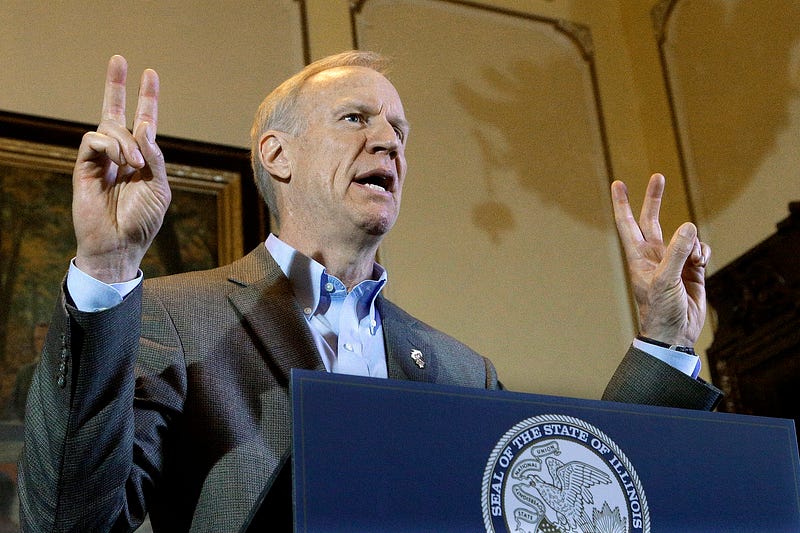
Gov. Bruce Rauner

Gov. Bruce Rauner | Sun-Times file photo

Although he’s been coy publicly about his re-election campaign, Gov. Bruce Rauner made a big-money statement about his desire to serve a second term, contributing $50 million to his campaign fund this week.

It’s a surefire sign the 2018 gubernatorial campaign may become the most expensive on record. And a Rauner operative called the massive contribution “a first installment.”

Rauner contributed $50 million on Tuesday to Citizens for Rauner, Inc, his campaign committee, according to filings with the state’s Board of Elections.

The contribution is the largest individual contribution in Illinois history. The second largest is also from Rauner, when he donated $10 million to his campaign in 2014, according to Sarah Brune, executive director of the Illinois Campaign for Political Reform.

Brune also noted the timing and amount is also unprecedented in Illinois elections.

The Illinois Republican Party is already launching attacks on potential gubernatorial challengers, including Democrats Chris Kennedy and J.B. Pritzker. A top Rauner operative said having a good chunk of early money allows them to determine when to begin the race and gives them “tactical flexibility.”

Hanah Jubeh, a Kennedy consultant, countered that the contribution is not a surprise.

“It’s no surprise that the governor is attempting to buy his re-election, because he sure hasn’t earned it,” Jubeh said. “If he believes his Christmas gift to himself intimidates anyone, he’s sorely mistaken.”

Steve Brown, spokesman for Illinois House Speaker Michael Madigan, on Thursday said the contributions show Rauner can’t run on his accomplishments alone.

“Looks like he’s running scared to me,” Brown said. “If you had the accomplishments, why would you have to spend that kind of money?”

A money war was also at play during the November election when Rauner spent record amounts to add Republican seats to the Illinois House and Senate.

Rauner spent a record $65 million during his 2014 campaign against former Gov. Pat Quinn. He contributed almost $28 million of his own money during that run.

The campaign jumpstart comes as a budget stalemate between Rauner and legislative leaders rages on, with a stopgap budget set to expire on Jan. 1.

Above is from:  http://chicago.suntimes.com/politics/rauner-contributes-50m-to-his-re-election-campaign-fund/amp/

Wednesday, December 14, 2016

Rauner's GOP launches 2018 governor's race with robocalls attacking Democrat Pritzker

Republican Gov. Bruce Rauner fired the first shots of the 2018 governor's race with robocalls attacking Democratic foe J.B. Pritzker.

image


(Phil Velasquez, Kristen Norman / Chicago Tribune)

Rick PearsonChicago Tribune

Gov. Bruce Rauner fired the first shots of the 2018 governor's race on Tuesday with an Illinois Republican Party automated telephone call attempting to tie potential Democratic foe J.B. Pritzker to imprisoned former Gov. Rod Blagojevich.

The attack was unprecedented for two reasons: The next election is nearly two years away. And Pritzker, who is largely unknown outside Chicago business and political circles, is only considering a run for governor and isn't a candidate at this point.

The robocall stands as an early signal from Rauner as to what awaits those who might challenge his re-election bid. But it's also an acknowledgment that Rauner's team at this stage views Pritkzer, a wealthy entrepreneur and investor, as a top threat. Pritkzer, listed at No. 190 on Forbes' annual list of the 400 wealthiest Americans with a net worth of $3.4 billion, is one of the few in Illinois who could self-fund a campaign and outspend Rauner.

Giving new meaning to the term "season's greetings," the Rauner-funded state GOP launched the slickly produced automated phone call that lasts just over a minute on Tuesday. The call seeks to link Pritzker to Blagojevich as well as to Democratic House Speaker Michael Madigan. Rauner has continued to target the longtime Southwest Side politician, even in the weeks after the governor spent millions of dollars to defeat Democratic legislative candidates by associating them with the speaker.

.

"J.B. Pritzker wants to run for governor. But how well do we really know Pritzker? We know that political boss Mike Madigan likes Pritzker and his billion-dollar fortune as much as disgraced and imprisoned Governor Rod Blagojevich did," a narrator says in the call.

"Pritzker told Blagojevich he wanted to be appointed to the U.S. Senate, and in exchange Blagojevich wanted J.B. to personally raise tens of millions of dollars for him," the narrator says.

The call features portions of an FBI recording of Blagojevich speaking to then-confidant Doug Scofield on Nov. 11, 2008. At the time, Blagojevich was looking for ways to leverage his appointment to fill President Barack Obama's U.S. Senate seat for personal gain — among the issues that led to Blagojevich's federal corruption conviction.


"I betcha J.B. can raise me money like that," Blagojevich says in the recording. "If I can get J.B. to do somethin' like that is it worth, ah, givin' him the Senate seat? Incidentally, he, he asked me for it. Don't repeat that."

The call goes on to play a portion of Blagojevich discussing his desire for "10 million dollars, 15 million dollars" for the creation of a social advocacy group so he can leave the governor's office. Then the call plays Blagojevich saying, "J.B. can do it, couldn't he?" before splicing in the then-governor's earlier comment, "Don't repeat that."

In between Blagojevich's statements, the narrator calls Pritzker "just another crooked insider who seeks to screw over Illinois taxpayers."

Not mentioned in the robocall was another section of the FBI-recorded conversation in which Blagojevich asks Scofield about Pritzker: "Who knows him, that we know that's close to him?" Scofield responds, "Mmm, that I don't know" and later tells Blagojevich, "I'll find out who's close to J.B."

A Pritzker spokesman criticized Rauner over the state budget impasse as well as the robocall tactic.

"You would think a governor who has failed to pass a budget for two years and has allowed human services to be gutted would have better things to do with his time than to dredge up the crazy rantings of Rod Blagojevich," Pritzker spokesman David Lundy said in a statement.

After Lundy's statement came out, the state Republican Party doubled down. In a news release, the state GOP contended Pritzker was close politically to Blagojevich and Blagojevich's estranged father-in-law, former Ald. Richard Mell, and had donated more than $100,000 to Blagojevich's campaign fund.

"We will continue to highlight Pritzker's ties to both Rod Blagojevich and Mike Madigan until he makes a final decision concerning a run for the Democratic nomination for governor," said Aaron DeGroot, a state GOP spokesman. He said the robocall was being made to "Democratic donors, Democratic elected officials and Democratic Party activists."

Christopher Mooney, director of the Institute of Government and Public Affairs at the University of Illinois, said the state GOP's effort — and the depth to its early opposition research — may represent a pre-emptive strike to Pritzker and other Democrats considering a challenge to Rauner.

"This could be an attempt at a chilling effect for people to read between the lines and see how much money they have and how willing they are to go negative so early," Mooney said.

The timing of the robocall during the holiday season, as well as coming after often bitter state legislative campaigns and a controversy-filled national election, may give it limited impact, Mooney said.

"Normal rules would say it's a big waste of money, coming during the holidays, with fatigue from the last election, with it coming so far in advance of the next election," Mooney said. "But it's only a waste of money if money matters to you. Even if they get a little bit of benefit out it, maybe it's worth it because they don't care about the money."

Pritzker has been among several names mentioned as possible Democratic contenders to challenge Rauner, a wealthy former private equity investor. Also among those pondering a run are businessman Christopher Kennedy and U.S. Rep. Cheri Bustos, of East Moline.

rap30@aol.com

Above is from:   http://www.chicagotribune.com/news/local/politics/ct-bruce-rauner-jb-pritzker-met-1215-20161213-story.html

Sunday, October 23, 2016

Rauner spends Huge on 2016 election

image

The latest influx comes after Rauner’s campaign fund about a week earlier sent $3 million to Durkin, to be funneled to individual Republican House campaigns.

Durkin’s campaign fund also benefited from a $3 million donation Friday from billionaire hedge-fund founder Ken Griffin, a Rauner ally.

All told, Rauner, his family and his campaign fund have doled out $45.8 million in political contributions this year. Of the $29 million the Illinois Republican Party has raised this year, nearly $21 million has come from Rauner and $4 million this month through Durkin’s campaign fund.

It's the latest spate of spending for Rauner, who became wealthy as an equity investor. In his 2014 win over then-Democratic Gov. Pat Quinn, Rauner spent more than $65 million, including $27.6 million in personal funds.

With Madigan now Rauner's target, Durkin’s campaign fund has collected nearly $18 million this year, $12 million from Rauner and $5 million from Griffin, the founder and CEO of Citade

Griffin on Friday also wrote an additional $2 million check to Republican Comptroller Leslie Geissler Munger, who is seeking election to the office against Democratic Chicago City Clerk Susana Mendoza.

Like the battle for legislative seats, the statewide contest between Munger and Mendoza for the comptroller’s office is similarly viewed as a proxy war for Rauner and Madigan. Munger was appointed to serve as comptroller by Rauner following the death of Judy Baar Topinka.

Munger has raised $8.6 million for the special election, mainly from five sources: $5 million from Griffin; $2 million from conservative GOP donor Richard Uihlein; $1 million from Rauner’s campaign; $260,000 from a loan from Munger’s husband, John; and $120,500 from the state Republican Party.

All other sources to her campaign added up to $267,997, records showed.

Mendoza, a former state lawmaker, has raised just more than $2 million for her campaign. The state Democratic Party, which Madigan chairs, provided $150,000; a number of labor unions have contributed as well.

All told, Griffin has made more than $11.1 million in donations this year — $5 million apiece to Durkin and Munger, and $1 million to the Liberty Principles political action committee that is allied with Rauner in several GOP legislative campaigns.

Above is from:  http://www.chicagotribune.com/news/local/politics/ct-rauner-pours-in-nearly-46-million-in-bid-to-cut-madigan-s-power-20161022-story.html

Sunday, August 14, 2016

Games being played on Illinois insurance bill?


On Sunday August 14, 2016 CBS Sixty Minutes re-broadcast a report on life insurance companies not informing beneficiaries when an insured is known to be deceased with a death benefit available. It appears that Illinois’ legislature has done something about the situation but the Governor has yet to sign the bill even though the bill was sent to his office on June 27, 2016. 

This editorial was originally published in June.  The actual legislation HR 4633 is shown below the editorial.


  • Their View: Rauner should sign life insurance bill

    •  


  • Many, perhaps most of us, have life insurance policies that we believe will provide a modicum of security to our loved ones when we die.
    But did you know that unless your beneficiary files a claim for the benefits provided by that policy, the insurance company doesn't have to pay out, even though the Social Security Administration keeps an up-to-date Master Death File to inform everyone promptly who has died?
    It's true. Indeed, the company doesn't even have to notify the executor of your estate that a policy exists.
    Now, it's true that most couples communicate with each another and are well aware of each other's policies. But not always. Say you've taken out a second policy just to make sure your family is secure when you're gone and you just never mentioned it.
    When you've died, unless your spouse or your will's executor finds it promptly and files a claim, the insurer can keep the money. If you've taken out an annuity, the insurer can keep the money you've built up in your account, too.
    To correct this legal loophole in Illinois, State Treasurer Michael Frerichs had legislation introduced in the General Assembly to change state law to make insurance companies straighten up and fly right. Frerichs explained the bill in a June 1 news release:
    "House Bill 4633 requires insurers to periodically match their policies, annuity contracts and retained asset accounts against the Death Master File. If an insurer runs the (master file) more frequently to stop annuity payments, it must do the same for death benefits. If a match is found and the beneficiaries do not file a claim within 120 days, the insurer must make a good-faith effort to locate the beneficiaries. If the insurer locates the beneficiaries, they must provide them with the proper forms to claim the proceeds. If the insurer does not locate the beneficiaries and no one claims the proceeds from the insurer within the statutory five-year period, the money must be turned over to the state so the treasurer can continue attempting to locate the beneficiaries."
    The bill passed the House 118-0. It passed the Senate 54-0.
    How bad is the situation? Frerichs said that "since 2011, Illinois has used audits to identify more than $550 million in life insurance proceeds that should have been paid to beneficiaries in Illinois."
    The bill is now on Gov. Bruce Rauner's desk. We urge him to sign it — without monkeying around with it using his amendatory veto.
    This bill is obviously popular with the people we send to Springfield, which is why no one voted against the measure. But the insurance industry is a powerful lobby in Illinois, and it isn't giving up.
    Frerichs has been sued by Chicago-based Kemper Corp. and three insurance companies under its umbrella. Kemper said it shouldn't be required to take steps to find out whether someone has died and that benefits are payable.
    Still, signing a bill that passed unanimously should be a no-brainer for the governor, right?
    Wrong. We have sent quite a few no-brainers to Springfield, and lots of shape-shifters, too. Shape-shifters pretend to be for something but are actually against it.
    Based on the Editorial Board's decades of collective experience following the antics of the General Assembly, here's what we fear could happen:
    The governor uses his amendatory veto to weaken the bill while claiming he's improving it. Then, Speaker of the House Michael Madigan says he won't bring up bills on which Rauner has used his amendatory veto.
    Presto! The bill dies without anyone's fingers on it. Everyone can campaign for re-election claiming, "I was for this bill, but the governor (or speaker) spiked it."
    Meanwhile, the governor and the speaker can blame each other — and the insurance lobby wins quietly.
    This shouldn't happen, and we don't know that it will, but it could, which is why we again urge Gov. Rauner to be a hero, not a zero, and sign the bill as it was written and passed.
    — GateHouse News Service. This editorial originally appeared in the Rockford Register-Star.
  • Above is from:  http://www.sj-r.com/opinion/20160627/their-view-rauner-should-sign-life-insurance-bill
  •  

image

New Act

215 ILCS 5/424
from Ch. 73, par. 1031

Synopsis As Introduced
Creates the Unclaimed Life Insurance Benefits Act. Provides that the purpose of the Act is to require all authorized insurers regulated by the Department of Insurance to undertake good faith efforts, as specified in the Act, to locate and pay beneficiaries' proceeds under unclaimed life insurance policies, annuity contracts, and retained asset accounts issued in the State or remit such proceeds as unclaimed property to the appropriate jurisdiction if the beneficiaries are unable to be located or paid. Requires insurers to implement the certain policies and procedures for performing a comparison of its policies, annuity contracts, and retained asset accounts against the United States Social Security Administration's Death Master File. Provides that failure to meet any requirement of the Act is an unfair trade practice under the Illinois Insurance Code, and amends the Illinois Insurance Code to make a corresponding change.
Senate Committee Amendment No. 1
Replaces everything after the enacting clause. Reinserts the provisions of the engrossed bill with the following changes: Makes changes to provisions setting forth the purpose of the Act. Requires insurers to complete an initial comparison of its records with the Death Master File by December 31, 2017 and then on a semi-annual basis thereafter. Provides that in the event that one of the insurer's lines of business conducts a search for matches more frequently than semi-annually, then all lines of the insurer's business shall conduct searches for matches with the same frequency. Removes provisions concerning partial matches. Makes changes to the procedure for potential matches and searches an insurer must perform. Provides that nothing in the Act shall be construed to amend, modify, or supersede the Uniform Disposition of Unclaimed Property Act. Requires the Department of Insurance to develop and implement a lost policy finder to assist requesters with locating unclaimed life insurance benefits. Provides that the Department may limit an insurer's Death Master File comparisons to the insurer's electronic searchable files or approve a plan and timeline for conversion of the insurer's files to searchable electronic files upon a demonstration of hardship by the insurer. Removes and makes changes to certain definitions. Changes various references from "insureds" to "insureds, annuitants, and retained asset account holders." Makes other changes.

Full Text of HB4633


Introduced Engrossed Enrolled
Senate Amendment 001
Printer-Friendly Version PDF Bill Status


HB4633 Enrolled
LRB099 18214 JLS 44479 b

1
AN ACT concerning business.

2
Be it enacted by the People of the State of Illinois,

3
represented in the General Assembly:

4
Section 1. Short title. This Act may be cited as the

5
Unclaimed Life Insurance Benefits Act.

6
Section 5. Purpose. This Act shall require recognition of

7
the Uniform Disposition of Unclaimed Property Act and require

8
the complete and proper disclosure, transparency, and

9
accountability relating to any method of payment for life

10
insurance, annuity, or retained asset agreement death

11
benefits.

12
Section 10. Definitions. As used in this Act:

13
"Annuity contract" does not include an annuity contract

14
used to fund an employment-based retirement plan or program

15
where (1) the insurer does not perform the record keeping

16
services or (2) the insurer is not committed by the terms of

17
the annuity contract to pay death benefits to the beneficiaries

18
of specific plan participants.

19
"Date of death" means the date on which an insured, annuity

20
owner, or retained asset account holder died.

21
"Date of death notice" means the date the insurer first has

22
notice of the date of death of an insured, annuity owner, or

HB4633 Enrolled
- 2 -
LRB099 18214 JLS 44479 b

1
retained asset account holder. "Date of death notice" includes,

2
but is not limited to, the date the insurer received

3
information or gained knowledge of a Death Master File match or

4
any other source or record maintained or located in insurer

5
records of the death of an insured, annuity owner, or retained

6
asset account holder.

7
"Death Master File" means the United States Social Security

8
Administration's Death Master File or any other database or

9
service that is at least as comprehensive as the United States

10
Social Security Administration's Death Master File for

11
determining that a person has reportedly died.

12
"Death Master File match" means a match of the social

13
security number or the name and date of birth of an insured,

14
annuity owner, or retained asset account holder resulting from

15
a search of the Death Master File.

16
"Department" means the Department of Insurance.

17
"Lost policy finder" means a service made available by the

18
Department on its website or otherwise developed by the

19
Department to assist consumers with locating unclaimed life

20
insurance benefits.

21
"Policy" means any policy or certificate of life insurance

22
that provides a death benefit. "Policy" does not include any

23
policy or certificate of credit life or accidental death

24
insurance or health coverages, including, but not limited to,

25
disability and long-term care arising from the reported death

26
of a person insured under the coverage, or any policy issued to

HB4633 Enrolled
- 3 -
LRB099 18214 JLS 44479 b

1
a group master policyholder for which the insurer does not

2
provide record keeping services.

3
"Record keeping services" means services provided under

4
circumstances in which the insurer has agreed with a group

5
policy or annuity contract customer to be responsible for

6
obtaining, maintaining, and administering its own or its

7
agents' systems information about each individual insured

8
under an insured's group insurance contract, or a line of

9
coverage thereunder, including, but not limited to, the

10
following: (1) social security number or name and date of

11
birth, (2) beneficiary designation information, (3) coverage

12
eligibility, (4) benefit amount, and (5) premium payment

13
status.

14
"Retained asset account" means any mechanism whereby the

15
settlement of proceeds payable under a policy or annuity

16
contract is accomplished by the insurer or an entity acting on

17
behalf of the insurer depositing the proceeds into an account

18
with check or draft writing privileges, where those proceeds

19
are retained by the insurer or its agent pursuant to a

20
supplementary contract not involving annuity benefits other

21
than death benefits.

22
Section 15. Insurer conduct.

23
(a) An insurer shall initially perform a comparison of its

24
insureds', annuitants', and retained asset account holders'

25
in-force policies, annuity contracts, and retained asset

HB4633 Enrolled
- 4 -
LRB099 18214 JLS 44479 b

1
accounts by using the full Death Master File. The initial

2
comparison shall be completed on or before December 31, 2017,

3
unless extended by the Department pursuant to administrative

4
rule. Thereafter, an insurer shall perform a comparison on at

5
least a semi-annual basis using the Death Master File update

6
files for comparisons to identify potential matches of its

7
insureds, annuitants, and retained asset account holders. In

8
the event that one of the insurer's lines of business conducts

9
a search for matches of its insureds, annuitants, and retained

10
asset account holders against the Death Master File at

11
intervals more frequently than semi-annually, then all lines of

12
the insurer's business shall conduct searches for matches

13
against the Death Master File with the same frequency.

14
An insured, an annuitant, or a retained asset account

15
holder is presumed dead if the date of his or her death is

16
indicated by the comparison required in this subsection (a),

17
unless the insurer has competent and substantial evidence that

18
the person is living, including, but not limited to, a contact

19
made by the insurer with the person or his or her legal

20
representative.

21
For those potential matches identified as a result of a

22
Death Master File match, the insurer shall within 120 days

23
after the date of death notice, if the insurer has not been

24
contacted by a beneficiary, determine whether benefits are due

25
in accordance with the applicable policy or contract and, if

26
benefits are due in accordance with the applicable policy or

HB4633 Enrolled
- 5 -
LRB099 18214 JLS 44479 b

1
contract:

2
(1) use good faith efforts, which shall be documented

3
by the insurer, to locate the beneficiary or beneficiaries;

4
the Department shall establish by administrative rule

5
minimum standards for what constitutes good faith efforts

6
to locate a beneficiary, which shall include: (A) searching

7
insurer records; (B) the appropriate use of First Class

8
United States mail, e-mail addresses, and telephone calls;

9
and (C) reasonable efforts by insurers to obtain updated

10
contact information for the beneficiary or beneficiaries;

11
good faith efforts shall not include additional attempts to

12
contact the beneficiary at an address already confirmed not

13
to be current; and

14
(2) provide the appropriate claims forms or

15
instructions to the beneficiary or beneficiaries to make a

16
claim, including the need to provide an official death

17
certificate if applicable under the policy or annuity

18
contract.

19
(b) Insurers shall implement procedures to account for the

20
following when conducting searches of the Death Master File:

21
(1) common nicknames, initials used in lieu of a first

22
or middle name, use of a middle name, compound first and

23
middle names, and interchanged first and middle names;

24
(2) compound last names, maiden or married names, and

25
hyphens, blank spaces, or apostrophes in last names;

26
(3) transposition of the "month" and "date" portions of

HB4633 Enrolled
- 6 -
LRB099 18214 JLS 44479 b

1
the date of birth; and

2
(4) incomplete social security numbers.

3
(c) To the extent permitted by law, an insurer may disclose

4
the minimum necessary personal information about the insured,

5
annuity owner, retained asset account holder, or beneficiary to

6
a person whom the insurer reasonably believes may be able to

7
assist the insurer with locating the beneficiary or a person

8
otherwise entitled to payment of the claims proceeds.

9
(d) An insurer or its service provider shall not charge any

10
beneficiary or other authorized representative for any fees or

11
costs associated with a Death Master File search or

12
verification of a Death Master File match conducted pursuant to

13
this Act.

14
(e) The benefits from a policy, annuity contract, or a

15
retained asset account, plus any applicable accrued interest,

16
shall first be payable to the designated beneficiaries or

17
owners and, in the event the beneficiaries or owners cannot be

18
found, shall be reported and delivered to the State Treasurer

19
pursuant to the Uniform Disposition of Unclaimed Property Act.

20
Nothing in this subsection (e) is intended to alter the amounts

21
reportable under the existing provisions of the Uniform

22
Disposition of Unclaimed Property Act or to allow the

23
imposition of additional statutory interest under Article XIV

24
of the Illinois Insurance Code.

25
(f) Failure to meet any requirement of this Section with

26
such frequency as to constitute a general business practice is

HB4633 Enrolled
- 7 -
LRB099 18214 JLS 44479 b

1
a violation of Section 424 of the Illinois Insurance Code.

2
Nothing in this Section shall be construed to create or imply a

3
private cause of action for a violation of this Section.

4
Section 20. Uniform Disposition of Unclaimed Property Act.

5
Nothing in this Act shall be construed to amend, modify, or

6
supersede the Uniform Disposition of Unclaimed Property Act,

7
including the authority of the State Treasurer to examine the

8
records of any person if the State Treasurer has reason to

9
believe that such person has failed to report property that

10
should have been reported pursuant to the Uniform Disposition

11
of Unclaimed Property Act.

12
Section 25. Lost policy finder.

13
(a) The Department shall develop and implement a lost

14
policy finder to assist requesters with locating unclaimed life

15
insurance benefits. The lost policy finder shall be available

16
online and via other means. The Department shall assist a

17
requester with using the lost policy finder, including

18
informing the requester of the information that an insurer may

19
need to facilitate responding to the request.

20
(b) As soon as practicable, but no later than 30 days after

21
receiving a request from a requester via the lost policy

22
finder, the Department shall:

23
(1) forward the request to all insurers deemed

24
necessary by the Department in order to successfully

HB4633 Enrolled
- 8 -
LRB099 18214 JLS 44479 b

1
respond to the request; and

2
(2) inform the requester that the Department received

3
the request and forwarded the request to all insurers

4
deemed necessary by the Department in order to successfully

5
respond to the request.

6
(c) Upon receiving a request forwarded by the Department

7
through a lost policy finder, an insurer shall search for

8
policies and any accounts subject to this Act that insure the

9
life of or are owned by an individual named as the decedent in

10
the request forwarded by the Department.

11
(d) Within 30 days after receiving the request referenced

12
in subsection (b) of this Section, or within 45 days after

13
receiving the request where the insurer contracts with another

14
entity to maintain the insurer's records, the insurer shall:

15
(1) report to the Department through the lost policy

16
finder the findings of the search conducted pursuant to

17
subsection (c) of this Section;

18
(2) for each identified policy and account insuring the

19
life of, or owned by, the individual named as the decedent

20
in the request, provide to a requester who is:

21
(A) also the beneficiary of record on the

22
identified policy or account, the information

23
necessary to make a claim pursuant to the terms of the

24
policy or account; and

25
(B) not the beneficiary of record on the identified

26
policy or account, the requested information to the

HB4633 Enrolled
- 9 -
LRB099 18214 JLS 44479 b

1
extent permissible to be disclosed in accordance with

2
any applicable law, rule, or regulation and take such

3
other steps necessary to facilitate the payment of any

4
benefit that may be due under the identified policy or

5
account.

6
(e) The Department shall, within 30 days after receiving

7
from all insurers the information required in item (1) of

8
subsection (d) of this Section, inform the requester of the

9
results of the search.

10
(f) When a beneficiary identified in subsection (d) of this

11
Section submits a claim or claims to an insurer, the insurer

12
shall process such claim or claims and make prompt payments and

13
distributions in accordance with all applicable laws, rules,

14
and regulations.

15
(g) Within 30 days after the final disposition of the

16
request, an insurer shall report to the Department through the

17
lost policy finder any benefits paid and any other information

18
requested by the Department.

19
Section 30. Administrative rules.

20
(a) The Department shall adopt rules to administer and

21
implement this Act.

22
(b) The Department may limit an insurer's Death Master File

23
comparisons required under Section 15 of this Act to the

24
insurer's electronic searchable files or approve a plan and

25
timeline for conversion of the insurer's files to searchable

HB4633 Enrolled
- 10 -
LRB099 18214 JLS 44479 b

1
electronic files upon a demonstration of hardship by the

2
insurer.

3
Section 35. Application. The provisions of this Act apply

4
to policies, annuity contracts, and retained asset accounts in

5
force on or after the effective date of this Act.

6
Section 40. The Illinois Insurance Code is amended by

7
changing Section 424 as follows:

8
(215 ILCS 5/424) (from Ch. 73, par. 1031)

9
Sec. 424. Unfair methods of competition and unfair or

10
deceptive acts or practices defined. The following are hereby

11
defined as unfair methods of competition and unfair and

12
deceptive acts or practices in the business of insurance:

13
(1) The commission by any person of any one or more of

14
the acts defined or prohibited by Sections 134, 143.24c,

15
147, 148, 149, 151, 155.22, 155.22a, 155.42, 236, 237, 364,

16
and 469 of this Code.

17
(2) Entering into any agreement to commit, or by any

18
concerted action committing, any act of boycott, coercion

19
or intimidation resulting in or tending to result in

20
unreasonable restraint of, or monopoly in, the business of

21
insurance.

22
(3) Making or permitting, in the case of insurance of

23
the types enumerated in Classes 1, 2, and 3 of Section 4,

HB4633 Enrolled
- 11 -
LRB099 18214 JLS 44479 b

1
any unfair discrimination between individuals or risks of

2
the same class or of essentially the same hazard and

3
expense element because of the race, color, religion, or

4
national origin of such insurance risks or applicants. The

5
application of this Article to the types of insurance

6
enumerated in Class 1 of Section 4 shall in no way limit,

7
reduce, or impair the protections and remedies already

8
provided for by Sections 236 and 364 of this Code or any

9
other provision of this Code.

10
(4) Engaging in any of the acts or practices defined in

11
or prohibited by Sections 154.5 through 154.8 of this Code.

12
(5) Making or charging any rate for insurance against

13
losses arising from the use or ownership of a motor vehicle

14
which requires a higher premium of any person by reason of

15
his physical disability, race, color, religion, or

16
national origin.

17
(6) Failing to meet any requirement of the Unclaimed

18
Life Insurance Benefits Act with such frequency as to

19
constitute a general business practice.

20
(Source: P.A. 99-143, eff. 7-27-15.)

Saturday, August 13, 2016

BREAKING: Illinois Governor Vetoes Law That Would Have Registered 2 Million Voters


image


Illinois Gov. Bruce Rauner (R). CREDIT: AP Photo/Seth Perlman

Late Friday afternoon, Illinois’ Republican Governor Bruce Rauner vetoed a bill that would have made the state the sixth in the nation to automatically register millions of voters.

Rauner had expressed some support for the policy back in May, telling reporters: “I am a big fan of simplifying the voter registration process and trying to get everyone who should be able to vote, to get them registered and vote.”

By early August, he had a different view. While expressing support for the general idea of automatic voter registration, he wrote in his veto notice on Friday: “The consequences could be injurious to our election system.” Urging the legislature to make reforms to the bill before sending it back to him, he cited the threat of non-citizens registering to vote and casting ballots.

Yet study after study has found such voter fraud to be vanishingly rare, and recent federal court rulings asserted that the threat of illegal voting is not a serious enough justification for laws that make it harder for eligible voters to participate.

The non-partisan watchdog group Common Cause Illinois estimates the policy could help add two million new voters to the states rolls. In a statement Thursday, the group’s lead organizer Trevor Gervais accused the governor of “playing politics with something as important as voting rights.”

“He wants to delay implementation until 2019, after the next gubernatorial election,” Gervais said.

Because the Illinois state legislature passed the measure with an overwhelming majority in early June, they can now vote to override the veto.

If they do, the state will launch a program in 2018 that automatically registers Illinois residents to vote every time they visit a Department of Motor Vehicles, office of Human Services, office of Healthcare and Family Services, the Secretary of State’s office, or an Employment Security office.

If Rauner had approved the bill, the state would have followed the lead of Oregon, California, West Virginia, Vermont, and Connecticut, which have all approved the policy over the past few years. In Oregon, the only state so far where the policy has gone into effect, registration and voter participation have surged. The primary had one of the highest number of voters in Oregon’s history, second only to 2008’s historic election. The turnout rate also bested Kentucky’s, which held its primary that same day.

Illinois residents hope the policy could do the same for their state, which has seen dismally low turnout in recent elections, including the one that put Rauner in office. Advocates for the measure also say it will save the state money and make the voting rolls more accurate.

“When I go to the DMV and I’m asked if I want to register to vote, I currently have to fill out a separate form, by hand,” Christian Diaz with the organization Chicago Votes told ThinkProgress. “I then give it to a state worker who types the information from the paper sheet into the computer system, even though the government has already collected that same information. Human error also presents a huge issue. So this will make it a lot more efficient.”

But Illinois Republicans have complained that the policy makes political participation too easy.

“I think it’s important for the voter to have a little bit of initiative to do what they need to do and not just automatically be signed up,” said Rep. David Harris (R-Arlington Heights), adding that he worried if voters effortlessly registered, they wouldn’t do the work of educating themselves about the candidates on the ballot.

Above is from:  https://thinkprogress.org/breaking-illinois-governor-vetoes-law-that-would-have-registered-2-million-voters-c296b0b579a1#.x9qavn27v

Thursday, August 11, 2016

Madigan targets Rauner's support for Trump campaign


image


Madigan targets Rauner's support for Trump campaign

By Marc Filippino on Wednesday, August 10th, 2016 at 5:25 p.m.

House Speaker Michael Madigan, left, Gov. Bruce Rauner, right

Governor Bruce Rauner has stayed decidedly quiet about the 2016 presidential campaign.

Despite Rauner’s reluctance to comment, Democrats are pouncing on the opportunity to try to link the first-term governor to the Republican presidential nominee, Donald Trump. Illinois House Speaker and Democratic Party Chairman Michael Madigan is one of those Democrats. Madigan has compared Rauner to Trump several times and said he feels fully justified grouping the two together.

In an interview with WSIU and WBBM radio stations published Aug. 1, Madigan said:

"Bruce Rauner is of record that he will fully support the Trump candidacy. It's documented. It’s available." 

We wondered if Madigan was right. Does Rauner fully support Trump? What’s Rauner’s take on the Republican presidential nominee? We looked into Madigan’s claim to find out.

Supporting the presidential nominee

When we asked where Madigan found the information backing his claim, Madigan spokesman Steve Brown simply said, "It’s everywhere online. Google it, and it will come up in 9 seconds."
Brown didn’t point to any specific articles, so we took his recommendation and Googled our question. For the record, it only took Google .45 seconds to find articles relating to Rauner and Trump.

In March, Rauner told reporters he would support the Republican presidential nominee, even if it turned out to be Trump. When asked why, Rauner explained, "I’m the leader of the Republican party in Illinois." He added, "I will do everything I can to support that nominee."

That same month, he told students in Wilmette he was "horrified" by the presidential campaign rhetoric. "Democracy is hard, you know, and this presidential election, oh my goodness, I'm appalled by the rhetoric, it's appalling," Rauner said. "And it's ugly and it's nasty and it's weird, and just some of the statements that get made, I'm just, I'm horrified."

Since those public comments, Rauner’s been asked repeatedly about his actions related to the presidential election. Rauner hasn’t said much and doesn’t answer questions about Trump.

On July 12, Rauner did not join Trump during a campaign fundraiser even though the two were both in Chicago that day. A week later, Rauner skipped the Republican National Convention in Cleveland when Trump formally became the party’s presidential nominee.   

Rauner’s aides told the Chicago Tribune the governor wouldn’t formally endorse Trump, and did not explain why not. The Tribune reported, "Rauner repeatedly had sought to stay out of the presidential race, though he did say that as leader of the GOP in Illinois, he would back the eventual nominee. But Rauner aides stressed there are various levels of "support," and that the governor would not be giving Trump a formal endorsement."

Brian Gaines, a political science professor at the University of Illinois, said because Rauner isn’t up for election this year, there’s really no reason for him make any more comments about his relationship with Trump.

"There’s no law saying that a politician needs to endorse their party’s candidate," Gaines said.

"(Sen.) Mark Kirk is the more interesting example. Since he would have more interaction with the president and he’s up for election, he really needs to comment. Rauner’s interaction is somewhat fabricated."

In June, Kirk said publicly he would no longer support Trump. Gaines said Rauner’s language regarding Trump is much more nuanced and purposefully vague.

"(Rauner) could say voting for Trump is a form of support and he wouldn’t have to say another word," Gaines explained. "And as the Trump campaign looks weaker and weaker, Rauner can point back and say ‘I never said I would endorse Trump.’"  

Rauner continues to refuse to answer questions from reporters about the presidential election, and his office did not return multiple requests for comment from PolitiFact Illinois for this story.  

Our ruling

"Bruce Rauner is of record that he will fully support the Trump candidacy. It's documented. It’s available." 

Madigan is correct. In March, Rauner said he would fully support the Republican presidential nominee. When asked by a reporter if he would still support the nominee if it’s Trump, Rauner reiterated his earlier statement, saying: "I will support the Republican Party’s nominee."

But Madigan does not reference any of Rauner’s subsequent comments, including Rauner’s refusal to formally endorse Trump.

We rate this claim Mostly True.

Above is from:  http://www.politifact.com/illinois/statements/2016/aug/10/michael-madigan/Madigan-highlights-Rauners-support-Trump-camp/

Thursday, July 28, 2016

Gov. Rauner calls for term limits for state legislators

By WIFR Newsroom | 

Posted: Tue 5:51 PM, Jul 26, 2016

BELVIDERE, Ill. (WIFR) – Governor Bruce Rauner calls for reform of what he says is a rigged system in Springfield by putting term limits on state legislators.

The governor points out some state politicians have held office for two, three, or even four decades. Only one third of candidates will face an opponent in the upcoming general election and only 12% had an opponent in the primaries. Rauner is encouraging the Illinois General Assembly to vote for a term limits constitutional amendment during the veto session this fall.

"You know when George Washington founded America he could have been president for life. he said no, 8 years and left. We need that mindset. I want a term limit myself, at the max 8 years. I think everybody should leave office after a few years, go back to the real world and let new ideas, fresh faces come into government,” says Governor Bruce Rauner (R) Illinois.

Rauner says term limits won’t fix every problem with state government, but will shift politicians’ focus from power to public service.

Above is from:  http://www.wifr.com/content/news/Gov-Rauner-calls-for-term-limits-for-state-legislators-388319212.html

Friday, July 22, 2016

In 2011 email Gov. Rauner calls half of CPS teachers 'virtually illiterate'


Thursday, July 21, 2016 08:56PM

CHICAGO (WLS) --

An email written by Governor Bruce Rauner has surfaced where he called half of Chicago Public Schools teachers "virtually illiterate."
The email was written in 2011, before Rauner was governor, and was sent to Mayor Rahm Emanuel and other top education reform activists in the city.

A judge ordered the mayor's administration to release a batch of emails Thursday and this email was one of them.
Illinois Federation of Teachers president Dan Montgomery released a statement saying, in part: "Governor Bruce Rauner's statement that half of Chicago teachers are 'virtually illiterate' is a grotesque affront to the thousands of dedicated, hardworking, and talented educators and, indeed, the children who learn from them and love them."
Montgomery continues, "While Rauner publicly claims to love Illinois teachers, his private emails reveal the appalling truth: he holds them in contempt. No public servant, let alone a governor, is fit to oversee the education of our children when he or she has so little regard for those who teach."
A spokesperson for the governor released a statement which read, in part, "This particular email was sent out of frustration at the pace of change in our public school system. The Governor regrets writing it and apologizes to CPS educators for making an unfair, untrue comment."

Above is from:  http://abc7chicago.com/news/in-2011-email-rauner-calls-half-of-cps-teachers-virtually-illiterate/1437489/

Saturday, June 25, 2016

Redistricting reform won't save Illinois

RICH MILLER ON SPRINGFIELD

Redistricting reform won't save Illinois

By Rich Miller

SHARE

redistricting-reform-wont-save-illinois.jpg

Photo by Crain's/ThinkStock

Illinoisans are undeniably furious about the way their government has been running (or, more accurately, not running). They're looking for solutions, and some are grasping at anything within reach.

A downstate newspaper editorial the other day attempted to pin the blame for just about all of our state's fiscal and economic problems on the way politicians in this state draw legislative district maps.

That's just silly.

 -

Reforming the process by taking away map-drawing duties from politicians and handing it to a nonpartisan commission is definitely a good idea. But, don't kid yourself that reforming this one process, where politicians choose their voters instead of voters choosing their politicians, will suddenly make Illinois great again, or whatever.

First of all, it may not work like some think it will. When editorial writers and pundits talk about redistricting reform, they usually focus on the man who draws many of the legislative district maps: Illinois House Speaker Michael Madigan, one of the most disliked politicians in all of Illinois, and the man who is blamed by many for much (or even all) of our problems. Take that power away from him and you'll do away with Madigan, the theory goes.

OK, but take a look at the Illinois Election Data website, which has the 2014 gubernatorial election results by Illinois House district. Those districts were drawn, of course, by Speaker Madigan.

Bruce Rauner won 50.8 percent of the popular vote in 2014. Yet, by my count, Rauner also won 69 of Illinois' 118 House districts that same year, or 58.5 percent.

In other words, the Republican candidate for governor won 22 more House districts than the House Republicans.

That's why Gov. Rauner thinks he has a real shot at picking up some House seats this year. His operation is focusing like a laser on the districts he won.

Why didn't Republican House candidates do as well as Rauner?

Let's step back a couple of years. The House Democrats picked up seats in 2012 after they drew the new map in 2011, but besides creating districts that certainly favored their candidates, the wins were also due to '12 being a hugely favorable (to them) presidential election year. Democrats do much better here in presidential years.

And once people are elected, it's difficult to knock them out. By the time the national GOP wave swept through two years later, in 2014, it ran smack dab into Democratic incumbents who'd been working their new districts hard for two years. That's always something to remember about Madigan. In exchange for his monetary and staff support, he demands rigorous door-to-door work by his candidates. Once they're in, they tend to stay in.

This year, the presidential election means the national trend will likely be the Democrats' friend yet again. If Rauner doesn't net some gains, he'll likely blame Madigan's map, but that won't be totally true.

And just because one party draws the map doesn't mean it has a lock on it. For instance, the Republicans currently control three U.S. House districts that were actually drawn to favor Democrats.

Also, go back to 1991, the last time the Republicans drew the legislative district map. Madigan's Democrats managed to hold on to control in the very next election, when Bill Clinton and Carol Moseley Braun swept the state. But Madigan's Democrats lost the majority two years later in a huge national GOP landslide. Madigan learned some hard lessons in 1994. He regained the majority in 1996, when President Clinton ran again, and managed to hold onto it until he could draw his own map in 2001.

Yet the Senate Republicans held their majority throughout that very same 10-year period.

The lesson here is that getting rid of Madigan, or even clipping his wings, ain't going to be as easy as it looks.

Again, I think that a nonpartisan, independent remap process would be a good thing no matter the Madigan-related outcome. But so would California's open primary system, where the top two vote-getters battle it out in November even if they're from the same party. I'd love to see that brought to Illinois.

There are lots of things we can do to reform the process. But I highly doubt that this one reform will solve all our problems. Don't let anybody tell you otherwise because they're living in an overly simplistic cartoon world. I prefer the real world.

Rich Miller also publishes Capitol Fax, a daily political newsletter, and CapitolFax.com.

Above is from: http://www.chicagobusiness.com/article/20160624/NEWS02/160629877/redistricting-reform-wont-save-illinois

Thursday, June 23, 2016

Rauner lays out his minimum requirements


image

Rauner lays out his minimum requirements

Tuesday, Jun 21, 2016

* Gov. Rauner was asked yesterday where he stood on the “non-budget” talks. Kim Geiger at the Tribune fills us in…

Changes to the rules on civil lawsuits, commonly referred to as “tort reform” is “off the table, for now,” Rauner said.

“The biggies,” Rauner said, are changes to workers’ compensation, the property tax freeze with collective bargaining provisions and legislation to alleviate the pension problem. Asked if that would be enough for him to strike a deal with Democrats, Rauner said: “Yeah, sure.”

That Rauner has set his sights on those items is no secret. There are working groups of lawmakers debating those topics now, and he’s focused much of his public comments on the three items in recent weeks. Still, it was the first time we’ve heard Rauner say specifically what would satisfy his general call for “reforms” alongside a budget deal that includes spending cuts and tax hikes.

Rauner’s answer might provide more clarity to casual observers of the budget impasse, but it’s unlikely to motivate Democratic lawmakers, who say they’ve lost trust in the governor because of his shifting rhetoric over the past year. Also, many Democrats are opposed to the workers’ compensation and collective bargaining proposals, which they contend would hurt the middle class.

Above is from:  http://capitolfax.com/2016/06/21/rauner-lays-out-his-minimum-requirements/

Wednesday, June 22, 2016

Gov. Rauner says he’ll seek reelection in 2018


Gov. Rauner says he’ll seek reelection in 2018


  • Please upgrade your Flash Plugin

    Governor Rauner sounded off on the state budget that never was in a wide ranging interview.

    How dire is the crisis, will Chicago Schools go bankrupt, who's to blame, and will he run again?

    With 10 days left in the fiscal year, the Governor sat down with WGN’s Tahman Bradley.

    Even though he hopes lawmakers soon work out a stop gap spending plan and K-12 education funding, Gov Rauner continues to hammer his chief rival House Speaker Mike Madigan.

    “I think the Speaker is interested in a crisis,” Rauner said.  “At this point there’s a risk that public safety isn’t funded there’s a risk that health care service aren’t funded there’s a risk that our schools don’t open on time. We can’t allow that to happen. That’s not right.”

    And that’s the message the governor has taken on the road.

    All month, he has been traveling from city to city, where he pins the blame for the budget stalemate on Democrats who continue to resist his pro-business, union-weakening agenda.

    “All of us in government are elected to do a job,” Rauner said. “I ran for governor to work for all of the people of the state to change the system so our government works for the people again. We’ve got the highest unfunded pension, hghest debt in America, highest unemployment rate in American, most job losses, worst school funding and the most corruption and cronyism of any state government in America.”

    For Chicago, Gov. Rauner had even harsher words. Recently, the governor said some Chicago Public Schools are like crumbling prisons.

    Chicagoans hit back and hard.  Today, they showed their anger and forced the governor to cancel a Juneteenth celebration at the DuSable Museum.

    With Chicago Public Schools facing a billion dollar budget deficit, Democrats in Springfield are trying to get more money into the district. But the governor’s plan would keep CPS funding at its current level.

    “I care deeply about Chicago Public Schools and the children in those schools,” Rauner said. “Chicago has been mismanaged for years. Our reforms will help them improve the system.”

    In the meantime, the governor is doubling down on his call that the district considers bankruptcy.

    “They could go into a judge and seek court protection and reorganize in bankruptcy under court supervision so that that wouldn’t require any layoffs .  They can redo their contracts, redo their debt and make it more affordable under bankruptcy,” he said.

    Rauner also said he is planning to seek reelection in 2018.

    Above is from:  http://cltv.com/2016/06/20/gov-rauner-says-hell-seek-reelection-in-2018/

    Sunday, June 12, 2016

    Bernard Schoenburg: Rauner cash a big factor in November election


    image


    • Posted Jun. 11, 2016 at 8:10 PM
      Updated at 8:47 PM

      It’s not new that politicians are keeping an eye toward the next election as they battle each other over policy.
      Of course, the fact that Illinois hasn’t had a full state budget in nearly a year creates great pressure — or at least it should — for agreement soon to keep not only government and schools, but social service agencies operating.
      But in addition to saying he wants elements of his pro-business, union-weakening "turnaround agenda" passed by a Democratic legislature before he will agree to more state revenue, Gov. BRUCE RAUNER has also changed the political landscape with his wallet.
      As an example, on May 4, Citizens for Rauner, the governor’s political fund, donated $5 million to the Illinois Republican Party.
      Six days later, the state GOP donated $2 million to the House Republican Organization, which helps GOP House incumbents and candidates.
      Because he poured $27 million of his own money into what turned out to be his $65 million campaign for governor in 2014, we might be getting immune to big numbers.
      But it has not been typical in pre-Rauner years for any state committee to so easily get multiple millions. The former venture capitalist is worth hundreds of millions of dollars, and his family income in 2014 was $57.5 million, his tax return showed.
      KENT REDFIELD, professor emeritus of political science at the University of Illinois Springfield, has long watched campaign finance issues in the state.
      Big transfers to party committees, perhaps from funds run by legislative leaders, in the past might reach $1 million or $1.5 million, he said. But Rauner alone can generate “a much bigger number.”
      “He really does dominate the money on the Republican side, and we assume there’s more where that came from,” Redfield said.
      Redfield said targeted House and Senate races in 2014 involved spending of perhaps $25 million.
      This fall, Redfield said, “We’re probably going to have about the same number of targeted races, and the spending could double.”
      He said spending in a couple of primaries in March in which the governor had an interest broke records from earlier general elections. The spending in those races included independent expenditures, like the more than $3 million spent by Liberty Principles PAC in an attempt to have Illinois State Police Trooper BRYCE BENTON of Springfield defeat state Sen. SAM McCANN, R-Plainview, who voted counter to the governor on a union arbitration bill the governor opposed. McCann won in a race with total spending of about $4 million.
      A Democratic state representative, KEN DUNKIN, D-Chicago, sided with Rauner on some issues and was defeated by JULIANA STRATTON in a primary that Redfield said involved $6 million in spending.
      • Of course, Democrats are also raising money. The Democratic Party of Illinois had $2.4 million in the bank as of March 31. Since then, several donations have been reported, including $25,000 from the Chicago Regional Council of Carpenters.
        House Speaker MICHAEL MADIGAN, D-Chicago, chairs the state Democratic Party. And his Friends of Michael J. Madigan committee had nearly $1.4 million in the bank as of the end of March.
        But Citizens for Rauner had more than $20 million on hand at that time.
        At the end of 2014, after Rauner defeated former Democratic Gov. PAT QUINN, Rauner put $10 million in his own campaign fund; Chicago billionaire KEN GRIFFIN, CEO of the hedge fund Citadel put in $8 million; and RICHARD UIHLEIN, CEO of Uline Corp., added $2 million.
        NICK KLITZING, executive director of the Illinois Republican Party, said about the Rauner money: “Mike Madigan drew the legislative maps and has a seemingly endless supply of special interest money, so we hope to raise the resources to stay on a level playing field with Madigan’s Chicago machine.”
        STEVE BROWN, spokesman for Madigan, said later that the map was not drawn by Madigan alone but by the legislature in compliance with the Voting Rights Act.
        And about campaign money, Brown said, “Democrats expect to be outspent by Rauner and the 1 percenters.”
        As he has seesawed in recent weeks from asking Democrats for cooperation to get at least a short-term budget and attacking their plans as a Chicago bailout, Rauner hasn’t talked much in public about the political side.
        But at the state GOP convention in Peoria in late May, Rauner told delegates that government is “not working for you, the people of Illinois. It’s working for special interests, lobbyists, cronies, patronage workers, folks who make money from the government” and “take your hard-earned tax dollars.”
        “We’re gonna bring in the resources and put together the biggest ground game that’s ever been done for legislative races in Illinois history, and we are gonna pick up seats against the corrupt Chicago machine and Madigan’s Democrats.” He said he wants to bring back government that “works for people not special interests.”
        He often refers to government unions as special interests.
        Brown said he doesn’t like to make election predictions, but said, “We’re hopeful that the message of what we’re trying to do — to protect working families, to not take the state back into the early '80s as it relates to worker rights — will be a good message. Time will tell.”


    Above is from:  http://www.sj-r.com/opinion/20160611/bernard-schoenburg-rauner-cash-big-factor-in-november-election

    Saturday, June 11, 2016

    State budget: Brinksmanship over operations


    image


    Brinksmanship over operations

    Friday, Jun 10, 2016

    * As we’ve discussed before, the governor is accusing Speaker Madigan of creating a crisis in order to leverage a budget deal (and a resulting tax hike). Madigan’s path to this crisis is withholding approval of any appropriations to fund government operations. So, when Team Rauner claimed that the human services stop gap bill had “drafting errors” because the legislation didn’t appropriate any money to administer programs, the HDems countered by saying they had done it deliberately.

    The bill overwhelmingly passed both chambers and Madigan wants Gov. Rauner to sign it…

    Madigan said of a bill that is sitting on Rauner’s desk and would provide a stopgap measure to fund social services. “He refuses to sign that bill because he continues seeking a state of crisis in Illinois.”

    Rauner on Wednesday defended his decision not to sign that bill, saying it doesn’t have “essential services in it.”

    “That bill is designed to still create a government crisis,” Rauner said.

    The measure, approved by both the Illinois House and Senate would have authorized spending about $450 million from a human services fund, and another $250 million from special funds to be spent on items such as foreclosure prevention, and affordable housing.

    * Along those lines, Illinois Department of Corrections Director John Baldwin recently penned an op-ed about his agency’s rapidly approaching crisis…

    Without a budget, the Corrections Department will be hard pressed to continue with critical reforms that improve operations and outcomes, increase safety, and enhance programs aimed at helping offenders be successful once they return to communities across this state. Furthermore, we will be severely challenged to meet our legal obligation to provide constitutionally adequate care to the men and women in our custody who have been diagnosed with mental illness.

    Lack of a balanced budget or stopgap budget will impact the department’s ability to feed offenders, keep the lights on, run water and fulfill other day-to-day duties. Our vendors, including many mom-and-pop businesses, that provide food supplies, fire equipment examination services, building repair parts and maintenance services, depend on our payments. These local businesses will continue to suffer without payment and will eventually have to pull their services. That could cripple the department in a matter of days.

    As subscribers know, the Rauner administration has been trying to pry loose a stopgap for DOC and some other agencies since April. No luck so far.

    I figure a federal judge will probably have to step in if DOC can’t feed its prisoners, or if water, sewer or lights are shut off.

    - Posted by Rich Miller

    Above is from:  http://capitolfax.com/2016/06/10/brinksmanship-over-operations/

    Wednesday, June 8, 2016

    Ex-Gov. Edgar: Civility, compromise, compassion keys to fix mess


    image

    Chicago 06/07/2016, 01:55pm

    Ex-Gov. Edgar: Civility, compromise, compassion keys to fix mess

    Former Illinois Gov. Jim Edgar speaks Tuesday during a luncheon hosted by the Illinois Campaign for Political Reform at the Standard Club of Chicago. | Lou Foglia/Sun-Times

    Former Illinois Gov. Jim Edgar speaks Tuesday during a luncheon hosted by the Illinois Campaign for Political Reform at the Standard Club of Chicago. | Lou Foglia/Sun-Times


    Former Gov. Jim Edgar — one of the state’s most popular Republican governors — said Tuesday that Illinois is in its worst shape in 50 years, and warned that Gov. Bruce Rauner must tone down his “rhetoric” and abandon his “Turnaround Agenda” to get a complete budget done.

    “There’s nothing worse than an old governor telling a new governor what to do,” Edgar joked at the Standard Club in Chicago after offering Rauner a couple of lessons on governing.

    Rauner has for months blamed the state’s fiscal mismanagement on the “cronyism” and “corruption” of the Democratic leaders, particularly Speaker Mike Madigan.

    During a Governor’s Day celebration at the Illinois State Fair last year, the governor celebrated the state electing its first Republican governor in 12 years: “They created a mess from one party rule, from King Madigan and the Chicago political machine,” Rauner said.

    But at the Illinois Campaign for Political Reform luncheon Tuesday, Edgar spoke of the need for civility, compromise and compassion in today’s hostile state government. And he stressed that the governor’s No. 1 goal should be managing the state via a budget.

    “What I had to learn is that I had my point of view. They had their point of view. And I should treat them with civility. Just because they didn’t agree with me, didn’t mean they were ignorant, didn’t mean they were a crook. It just meant we disagreed,” Edgar said. “And it’s critical that in the public arena that we treat our adversaries with civility because one of the things I also learned [is] today’s adversary is tomorrow’s ally, because issues change. But if you just call someone stupid or a crook, it’s going to be a little harder the next day when you need them as allies, to get them as allies.”

    Edgar said budgets were accomplished in the ‘90s, despite many hardships, “because we compromised.” He called negotiations with Madigan during his tenure as governor during a budget impasse tense, but civil in the end because “we both tried to watch our rhetoric.”

    “We might have thought about the other guy, but we didn’t go out and say it,” Edgar said.

    Edgar, who served two terms as governor after a stint as secretary of state, has been critical of Rauner before. He has taken issue with his fellow Republican’s governing style in media interviews, but Tuesday’s speech was perhaps his most detailed critique.

    “You can’t get things done if you’re not willing to meet your adversary halfway, and again we’ve gotten away from that,” Edgar said, noting the state must try something different.

    “It’s obvious what we’ve done the last year hasn’t worked,” Edgar said.

    Edgar noted Madigan ate lunch with him every day during their impasses — joking Madigan only ate an apple — until they came up with an agreement about a temporary tax increase.

    Edgar suggested Rauner do the same with the Democratic leaders, to end a budget impasse that is hurting the state. And he pointed the finger at Rauner’s “Turnaround Agenda” for slowing down a much-needed budget.

    “I do think the Turnaround Agenda part is the biggest obstacle they have to deal with,” Edgar said, noting he still speaks to Madigan, and has spoken to Rauner within the past year.

    He also criticized Rauner’s push for term limits, saying the governor is pushing the reform to target Madigan.

    “I’m not big on term limits. … I don’t think we need term limits. Let’s face it. This whole discussion about term limits is not about the members. It’s about the Speaker and that doesn’t solve it,” Edgar said. “Term limits, if you pass that amendment, Mike Madigan can still be speaker for 10 years. I know Mike Madigan. He’ll do that just to spite everyone.”

    Also on Tuesday, Madigan aide Tim Mapes announced to legislators that a scheduled Illinois House session on Wednesday had been canceled, citing continued talks with the working groups, Republican leaders and the governor’s office.

    “The Speaker is hopeful that progress will continue, as it has over the past few weeks. Given this progress and the need for these discussions among the working groups on the budget and other issues to continue without interruption, the House will not be in session on Wednesday, June 8,” Mapes wrote in a memo.

    Rauner spent some of his Tuesday in Bloomington, where he continued to push for a Republican-sponsored education bill to ensure schools open this fall, while also accusing Democrats of “slow-rolling” the budget process to create a schools crisis.

    “They want a crisis in the government to leverage a Chicago bailout and leverage a big tax hike without any reforms,” Rauner said.”

    And the governor defended his highly controversial description of some CPS schools as “crumbling prisons.”

    “In too many of them, I cry. Tears come into my eyes. No student, no child of Illinois should have to go to school in some of those facilities. They have metal on the windows. They’re dark. They’re depressing. They’re crumbling,” Rauner said, further likening the schools to prisons. “They have metal detectors at every door and they have police officers and security officers everywhere. Our children deserve better than

    Above is from:  http://chicago.suntimes.com/news/edgar-illinois-worst-shape-50-years/

    Sunday, June 5, 2016

    Hey, Rauner and Madigan: Do your job and not the other guy's


    image


    Bloomberg News

    Photo by Bloomberg News

    As a Republican legislator told me the other day, the chief cause of this long state government impasse is that we have a House speaker who also wants to be the governor and a governor who also wants to be the speaker.

    This isn't a new phenomenon.

    As far back as the 1980s, House Speaker Michael Madigan tried to get legislators a role in state union contract negotiations. He didn't trust Gov. Jim Thompson to negotiate affordable contracts, so he wanted a way to reject the deals or at least influence them.

     -

    Way back in 1991, rookie Republican Gov. Jim Edgar wouldn't agree to renewing a tax hike and passing a state budget until Madigan agreed to a statewide cap on property tax increases. Governors have no formal authority to introduce and pass bills. That power belongs exclusively to the General Assembly. But within weeks Madigan and Edgar agreed on a collar county-only tax cap and they moved ahead.

    The lengths to which each side has gone this time around most certainly are new, however.

    Just look at what's commonly known around the Statehouse as the “AFSCME bill.” The legislation would force the state union contract talks into binding arbitration to avoid a public employee strike. Madigan says Gov. Bruce Rauner can't be trusted to negotiate in good faith with the American Federation of State, County and Municipal Employees, but the bill amounts to overturning decades of legal precedent and vastly reducing the governor's powers during the negotiating process—which Madigan thought was too union-friendly decades ago.

    Like Edgar before him, Rauner refuses to support a tax hike and a state budget until he gets some economic reforms. For example, he wants to reduce workers' compensation benefits and rein in union rights to help local governments and school districts deal with his proposed property tax freeze.

    But unlike Edgar, Rauner hasn't been able to impose his will on the legislative branch, even after more than a year of trying. His repeated demands that House Democrats rise up against their leader and side with him have been waved off as pipe dreams. Aside from maybe Donald Trump, Rauner is the least popular Republican in this state among Democratic voters. No way are those legislators going to jump in bed with him.

    Meanwhile, without a budget, vital groups like Lutheran Social Services of Illinois have closed down huge numbers of invaluable programs, such as drug treatment centers. Sexually abused children can't get help, and neither can runaway teens. More and more students are choosing out-of-state universities for fear that Illinois colleges will close.

    What we need here is a timeout. Everybody needs to go back to their own corners—and their own constitutionally mandated roles—for a while.

    A few days before the spring session's official conclusion, Senate President John Cullerton told the governor that the two sides just weren't close enough to a deal. Cullerton proposed a temporary budget to get the state past the November elections, when Democrats might feel more free to negotiate items that unions would oppose.

    Rauner flatly rejected that, believing they were closer to an agreement on nonbudget items than Cullerton admitted. On the very last day of session, though, the governor flip-flopped and demanded his own temporary budget. The General Assembly adjourned without taking action, partly because Madigan refused to allow the governor to dictate another legislative action.

    A temporary budget is not a solution. It's not even all that responsible. And a brutal, divisive election may very well make it much more difficult to work out a compromise.

    But it's the only way to prevent a complete governmental collapse. If they can't at least do this, we're doomed.

    A contributing columnist to Crain's, Rich Miller publishes Capitol Fax, a daily political newsletter, and CapitolFax.com.

    Above is from:  http://www.chicagobusiness.com/article/20160604/ISSUE11/306049990/hey-rauner-and-madigan-do-your-job-and-not-the-other-guys