Sunday, July 26, 2020

July 26: 1541 new COVID-19 cases in Illinois

IL reports 1,541 new cases, 1 additional death as Chicago reimposes tighter coronavirus restrictions

Illinois health officials reported 1,426 new cases, 12 additional deaths Saturday

By Jesse Kirsch

Updated an hour ago


Police and protesters clash violently in Austin, Seattle, Aurora and Portland over the weekend.

CHICAGO (WLS) -- Illinois has reported 1,541 new COVID-19 cases, with only 1 additional death Sunday.

The state's seven-day statewide positivity rate stands at 3.7%, after rising for several days.
The Illinois Department of Public Health announced Saturday that the state's total confirmed COVID-19 cases have reached 171,424 cases, including 7,398 deaths in 102 counties.
The latest death was a 90-year-old man from Bond County.
Within the past 24 hours, laboratories have reported 40,844 specimens for a total of 2,511,567.
As of last Saturday night, 1,394 people in Illinois were reported to be in the hospital with COVID-19. Of those, 345 patients were in the ICU and 119 patients with COVID-19 were on ventilators.
RELATED: 'Shut it down now:' U.S. health experts call for 2nd coronavirus shutdown
Tighter COVID-19 restrictions took effect in Chicago this weekend as the city continues to try and slow the spread of coronavirus infections.
Health officials say the latest concern is the spread of cases among young residents, especially in high-risk environments like bars.
RELATED: Chicago quarantine: Emergency travel order takes effect for travelers from states with high COVID-19 infections

Crossing the border to Wisconsin is par for the course for many Chicagoans, but with rising COVID-19 cases the state could be added to the city's travel quarantine order as soon as

The Chicago Cubs started off the season with a win Friday night against the Milwaukee Brewers and will play again Saturday, however, don't expect any massive crowds around Wrigley Field because no fans are allowed in the ballparks and there will be fewer people in neighborhood bars as well.
RELATED: Chicago White Sox, Cubs begin 2020 season Friday with 60 game schedule

The White Sox and Cubs open their seasons in Chicago Friday.

The same deal is playing out on the South Side at Guaranteed Rate Field as the White Sox host the Minnesota Twins again Saturday afternoon.
Under the newly re-tightened COVID-19 restrictions, bars that don't serve food can only serve people outside, while restaurants can continue with modified indoor service. Part of the change also includes both types of establishments capping groups at six people instead of 10.
RELATED: Burnside bar forced to close again under COVID-19 rollback after patio application denied, citing violence concerns

With a lot less energy in the air, the streets around both of Chicago's ballparks looked different this year for Opening Day.
Despite the loss in crowds, some business owners say they're still hoping for a baseball bump this summer as fans seek ways to turn out for America's pastime.
RELATED: Illinois COVID-19 positivity rate rises but hospitalizations remain flat, Chicago hospitals say

Illinois is seeing more cases of COVID-19, and in the last week the positivity rate has risen to 3.4%, but hospitalizations have remained flat.

The uptick in virus infections has also pushed officials to reimposed other restrictions across the city.
Indoor workout classes will now be capped at 10 people; and personal services that require taking off your face covering, like facials, are also now prohibited.
The city is also asking residential property managers to limit tenants' guests to five visitors in an attempt to limit large gatherings and stop the spread of the coronavirus.
Coronavirus testing: Where to get tested for COVID-19 in Illinois, Chicago area
Illinois health officials also reported Friday that four counties are considered to be at warning level for COVID-19. A county reaches a warning level when "two or more COVID-19 risk indicators that measure the amount of COVID-19 increase," IDPH said.
The counties that are reported at warning level are Adams, LaSalle, Peoria, and Randolph counties, and each saw outbreaks associated with businesses and risky behavior.
IDPH provided the following information about what led to the warning level labeling:
- Adams County: larger social events, health care exposure, travel to hotspots including those in neighboring Missouri and Iowa, places of worship, and youth sports.
- LaSalle County: large family and social gatherings, increase in cases among people younger than 29 years, younger people visiting bars and attending larger social events, and inconsistencies with masking requirements.
- Peoria County: increases in cases among people younger than 29 years, large gatherings including 4th of July parties, and people traveling to Florida, Iowa, Texas, and Wisconsin.
- Randolph County: congregate settings, numerous bars not complying with distancing and masking, a large party with more than 200 people, and among households.
For more information, visit IDPH's county metrics page.
Officials said 1,471 people in Illinois are hospitalized for COVID-19, with 325 patients in the ICU and 115 on ventilators, as of Friday.
COVID-19-related hospital admissions remain low at Loyola Medical Center remain low, but there's concern.
"I think this is an extremely crucial moment," said Dr. Kevin Smith, Chief Medical Officer. "The question that everybody is wondering is, okay, if we're seeing increases in these cases, are we expecting that we're going to see hospitalizations increase?"
The governor's office is continuing to closely monitor the situation, but at this point, no decisions about imposing new restrictions have been made.
On Thursday, residents in six central and southern Illinois counties filed lawsuits against state-ordered restrictions on social interaction prompted by the COVID-19 pandemic.

The actions taken in Bond, Clay, Clinton, Edgar, Richland, and Sangamon counties seek court orders declaring there is no public health emergency as defined by Gov. J.B. Pritzker's Public Health Department. Springfield, the state capital, is in Sangamon County.
Plaintiffs in each case seek injunctions against Pritzker's disaster declaration, which restricts public interaction to slow transmission of the virus.
Pritzker's general counsel said no one should question basic safeguards during a pandemic.
RELATED: Chicago COVID-19 restrictions on bars, restaurants, gyms take effect
A crackdown on bars and breweries begins in Chicago on Friday.
All bars and taverns can no longer serve customers indoors. For restaurants serving indoors, a party of six is the maximum permitted.
New restrictions are also taking effect for Chicago gyms, where indoor classes will be limited to 10 people.
There are also concerns about the spread of COVID-19 in Wisconsin, and its impact on Chicago and the rest of the state.
Wisconsin could be next state on Chicago quarantine list, posing problems for those who cross border often
"I do hope that, as you know the data, that they can turn it around in Wisconsin and quickly, because I know Chicagoans like to go to Wisconsin and Wisconsin folk like to come to Chicago," said Dr. Allison Arwady, commissioner of the Chicago Department of Public Health.
On Wednesday, Governor JB Pritzker held a press conference and said Metro East region, which includes counties in southwestern Illinois, is seeing a rise in cases. Pritzker said the increase could result in the state needing to step in to take mitigating actions.
RELATED: Coronavirus Testing: What you can expect when you get tested for COVID-19
"I have spoken with local leaders and I have asked them to clamp down on the outbreaks where they are occurring so that the state won't have to step in," Pritzker said.
The increase is partly due to businesses and individual behavior, according to state health leaders.
"We are seeing an increase in new COVID-19 cases," said Illinois Department of Public Health Director Dr. Ngozi Ezike. "You have probably seen people crowding into bars, areas where people were not wearing masks, or maintaining 6 feet of distance between one another."
"You can go from 3% positivity to Arizona's 23% positivity in the blink of an eye," Pritzker said. "We've been there. Let's not let that happen again."
Wisconsin could also be the next state added to Chicago's travel quarantine order, with a decision on that expected next week. Wisconsin Governor Tony Evers said he is mulling a mandatory mask order, but is concerned about legal challenges. He is also worried about the impact of a possible travel ban.
"The message for us is if Chicago thinks our people should stay home, then we better put some damn masks on," he said.
The city, for its part, is still working on the logistics should a travel ban include Wisconsin.
"If the risk is high there, people, you know, would be subject to that quarantine unless they're traveling for essential purposes," Arwady said.
The Associated Press contributed to this report.

Above is from:  https://abc7chicago.com/chicago-coronavirus-illinois-covid-covid-19-restrictions-19/6335722/

Big Cities Going with on-line learning

Back to school? Despite CDC recommendations, most major schools going online as COVID-19 cases spike

Elinor Aspegren, USA TODAY

,

USA TODAYJuly 25, 2020

0:59

1:04

Teachers parade through students' neighborhoods

As COVID-19 cases rise in most states, the prospect of in-person learning this fall at the country's major school districts is becoming increasingly remote.

So far, nine of the top 15 school systems by enrollment plan to start the fall semester online, with two more currently planning a hybrid of in-person and online classes, according to Education Week magazine's reopening tracker. Other top districts shifted school schedules later, hoping for cases to decline or for teachers and administrators to have more time to plan for the school year.

As back-to-school season approaches, it's highly likely the majority of big districts will start learning remotely while they work out plans for socially distant reopenings, said Annette Anderson, deputy director of the Johns Hopkins Center for Safe and Healthy Schools.

The biggest factor: whether the community where the school is located is seeing infection rates decrease, said Kristi Wilson, superintendent of the Buckeye Elementary School District in Arizona, who is president of the American Association of School Administrators.

New guidance from the CDC released Thursday gave additional guidelines for opening schools in person, at the request of President Donald Trump. “It is critically important for our public health to open schools this fall,” CDC Director Dr. Robert Redfield said in a statement.

But Anderson doesn't think the guidelines are going to change the trend of schools' moving toward online-only reopenings.

In school buildings, students of all ages and abilities should wear masks, wash their hands frequently and socially distance to protect against COVID-19, the CDC urged in the new guidance documents.

Nevertheless, Anderson said, "a sizable number of parents are still going to want to see transmission levels at zero before their children go back to school." The new CDC guidelines did emphasize that schools should consider online-only courses if their community has "substantial, uncontrolled transmission," but did not define that threshold.

A USA TODAY analysis shows the country's biggest school systems in far worse shape than they were this spring, as the school year waned toward a closing. In all, 11 of the 15 largest U.S. school systems are in communities adding COVID-19 cases at more than three times the rate they were in the two weeks ending May 1.

Florida's Miami-Dade and Broward school systems are in counties adding COVID-19 cases more than twice as fast as New York City was by May 1. USA TODAY analyzed per capita data from Johns Hopkins University.

'Scared for my life': Teachers weigh risks of COVID-19

As case counts worsen, some districts' plans for in-person classes have been superseded by state guidance or called into doubt by health officials. 

Even before California issued guidance that nearly all state school districts must begin the academic year with distance learning, several schools had announced they would begin the term virtually, including the state’s two largest: Los Angeles, the second-largest district in the country, and San Diego.

Orange County School District, whose board had symbolically endorsed having schools open in-person, must move to online learning under this new guidance.

A parent's guide to online school: 9 questions to help vet your school's online program

In Milwaukee, many of the city's private and independent charter schools had been working under the assumption they could reopen with precautions. But the latest version of guidance from the state of Wisconsin bars all schools and universities from opening until the city enters Phase 5 – which won't happen until the city meets several benchmarks, including seeing a downward trend in COVID-19's spread. To reopen before then, schools will have to get individual approval from health officials.

In other districts around the USA, some school plans have clauses to implement online learning should COVID-19 cases grow.

Indianapolis Public Schools' plan notes, "The district must be able to quickly implement e-learning for 100% of students if rolling closures occur," although positive COVID-19 tests will be handled on a "case-by-case basis."

How many cases would close schools? Most don't have an answer

Opening online raises a host of equity issues, exposing deep divides in the American education experience. It's "really more of a temporary solution" to the problems students and teachers face as cases of COVID-19 climb, Wilson said.

"Not all students had equal access to devices and to software and to (Wi-Fi) hot spots and high-speed internet access when schools closed in spring," Anderson said. A study by Microsoft in 2018 estimated that about half of Americans – 163 million people – do not have high-speed internet at home.

Wilson said COVID-19 exposed teacher shortages. Schools are not prepared to cover for a large number of sick teachers, she said. 

Pushing back the start of classes gives schools a chance to prep.

California education chief:Not every school needs to stay away from in-person teaching

Atlanta Public Schools plan to start the first nine weeks of the school year online; public and private schools in Dallas cannot reopen for in-person instruction until after Sept. 8.

In Colorado, about 53,000 students lacked computers, and 66,000 families didn’t have reliable internet at home this spring, according to a survey by the Colorado Education Initiative. This fall, Denver Public Schools will begin the school year remotely with a pushed-back first day. The school ordered thousands of devices and Wi-Fi hot spots, and 93% of students have internet access, Denver Superintendent Susana Cordova told Colorado Public Radio.

In Texas, state leaders said they'll provide $200 million from the federal Coronavirus Aid, Relief and Economic Security Act for computers and internet access.

These all are welcoming signs to Anderson.

"I think it is a sign that the districts want to do a much better job this fall when they reopen virtually than they were able to do" in March, she said.

'This is hell': Parents and kids hate online learning. How can we make it better?

Contributing: Mike Stucka

This article originally appeared on USA TODAY: COVID back to school: Top districts reopening online despite CDC recs

Above is from:  https://www.yahoo.com/news/back-school-most-major-schools-090039400.html

Saturday, July 25, 2020

July 25: Coronavirus In Illinois: 1,426 New COVID-19 Cases, 12 Additional Deaths

Coronavirus In Illinois: 1,426 New COVID-19 Cases, 12 Additional Deaths

By CBS 2 Chicago StaffJuly 25, 2020 at 1:31 pm

Filed Under:Chicago Coronavirus, Illinois Department of Public Health, Tracking Coronavirus In Chiago

CHICAGO (CBS) — The Illinois Department of Public Health reported 1,426 new cases of COVID-19 on Saturday, including 12 additional deaths.


Currently, IDPH is reporting a total of 169,883 cases, including 7,397 deaths, in 102 counties in Illinois since the start of the pandemic.

State officials, on Friday, said four counties — Adams, LaSalle, Peoria, and Randolph — have entered a “warning level” for COVID-19, due to outbreaks associated with large gatherings and other “risky behavior.”

July 24: 1532 new COVID-19 cases in Illinois


Republicans continue to pressure employment security department amid new fraud claims

The graph shows the number of new confirmed COVID-19 cases reported each day by the Illinois Department of Public Health. (Credit: Jerry Nowicki of Capitol News Illinois)

Friday, July 24, 2020

State COVID-19 positivity rate remains at 3.4 percent

By JERRY NOWICKI
Capitol News Illinois
jnowicki@capitolnewsillinois.com

SPRINGFIELD — Republicans on Friday continued to pressure the Illinois Department of Employment Security to resolve issues stemming from record unemployment claims the same day the state reported another 1,532 confirmed cases of COVID-19.

Five months after Gov. JB Pritzker issued his first stay-at-home order in response to the spread of the novel coronavirus, unemployment rates in Illinois remain historically high at 14.6 percent in June, leading to widely reported delays in the Illinois Department of Employment Security’s handling of unemployment claims.

Pritzker has long maintained the state is doing all it can to increase call center capacity, and has said state government’s diminished investment in state agencies caused understaffing at the department to begin with, and finding new specialized call center employees often requires several months of training mandated by the federal government.

In light of news that many Illinoisans were experiencing fraud under the federal government’s new Pandemic Unemployment Assistance program, Illinois House Republicans — joined by U.S. Rep. Rodney Davis, R-Taylorville — made another call to the governor to fix the issues facing the department.

“What we're asking for now is some hearings, a hearing in particular where we would perhaps have members of IDES, the governor's office and of course I would like to have someone there from Deloitte,” Rep. Terri Bryant, R-Murphysboro said in the virtual news conference.

Deloitte is the private firm enlisted to build the state’s Pandemic Unemployment Assistance portal to handle claims for those who would otherwise not be eligible for unemployment but now have access to the benefits as part of the federally-funded program passed in response to COVID-19.

The company received no-bid contracts with the state totaling more than $22 million. Once the portal launched, a reported glitch in the system made the personal information of several thousand claimants viewable. Only one person accessed it before it was fixed, according to IDES, which cited viewer logs of the page where the information was viewable.

In an unrelated announcement this week, IDES said several Illinoisans were victims of fraud through the PUA program, which was designed hastily and does not give employers an opportunity to challenge fraudulent claims because the type of workers applying for the benefit do not technically have employers.

According to IDES, the scam involves filing unemployment claims using false identities and then attempting to have the payment method switched from the debit cards that people receive when they qualify for benefits to a direct deposit account to which scammers have access.

On July 6, the FBI reported that, “U.S. citizens from several states have been victimized by criminal actors impersonating the victims and using the victims’ stolen identities to submit fraudulent unemployment insurance claims online.”

If anyone receives a debit card or correspondence on the unemployment claims they have not initiated, they are instructed to call IDES immediately at 1-800-814-0513. When prompted, select the English or Spanish language option, then select option 1 for claimants and option, followed by 5 to report identity theft.

But Bryant said callers to that line are experiencing the same issues as other claimants — long delays on the phone lines, which take information through an automated process and schedule a callback for the claimant or person reporting fraud. Often those callbacks don’t happen for several days, according to reports.

Multiple readers reached out to Capitol News Illinois reporting delays when they tried to call to rectify fraud or file claims. Rep. Dan Ugaste, R-Geneva, said his mother-in-law, who recently passed away, received a fraudulent debit card in her name on the day of her funeral.

“So as instructed, like every other Illinois citizen, I called the Illinois Department of Employment Security,” he said. “That was July 13, 2020 — 11 days ago. I'm still waiting for a call back. I left a message; I left information. I have not heard from the Illinois Department of Employment Security.”

State Rep. Tim Butler, R-Springfield, called for hearings as well.

“I want to start with hearings, in public, where we can question agency officials and get to the bottom of the failed response, and the data breach and fraud, and make sure something like this can never happen again in Illinois,” Butler said.

Meanwhile, the state’s seven-day rolling positivity rate for COVID-19 tests remained at 3.4 percent Friday after four days of increasing. The 1,532 new cases reported were among 44,330 test results reported, making for a one-day positivity rate of 3.5 percent.

Hospitalizations remained roughly level near their pandemic lows, with 1,471 COVID-19-positive patients in hospital beds, including 325 in intensive care unit beds and 115 on ventilators.

The state announced an additional 19 deaths, bringing the total casualties since the pandemic began to 7,385 among 168,457 confirmed cases. More than 2.4 million tests have been conducted.

Capitol News Illinois is a nonprofit, nonpartisan news service covering state government and distributed to more than 400 newspapers statewide. It is funded primarily by the Illinois Press Foundation and the Robert R. McCormick Foundation.

Above is from: :https://capitolnewsillinois.com/NEWS/republicans-continue-to-pressure-employment-security-department-amid-new-fraud-claims

Friday, July 24, 2020

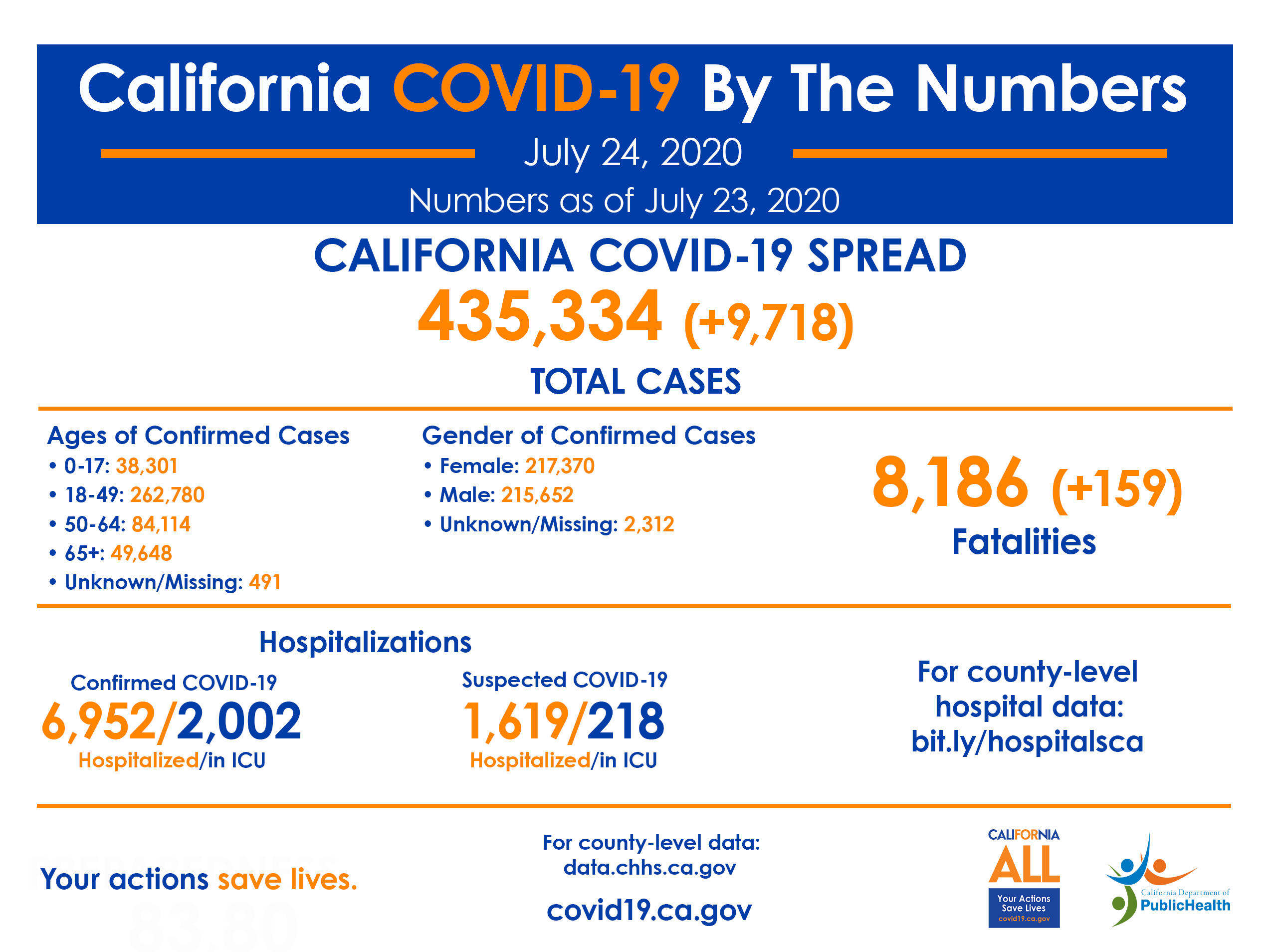
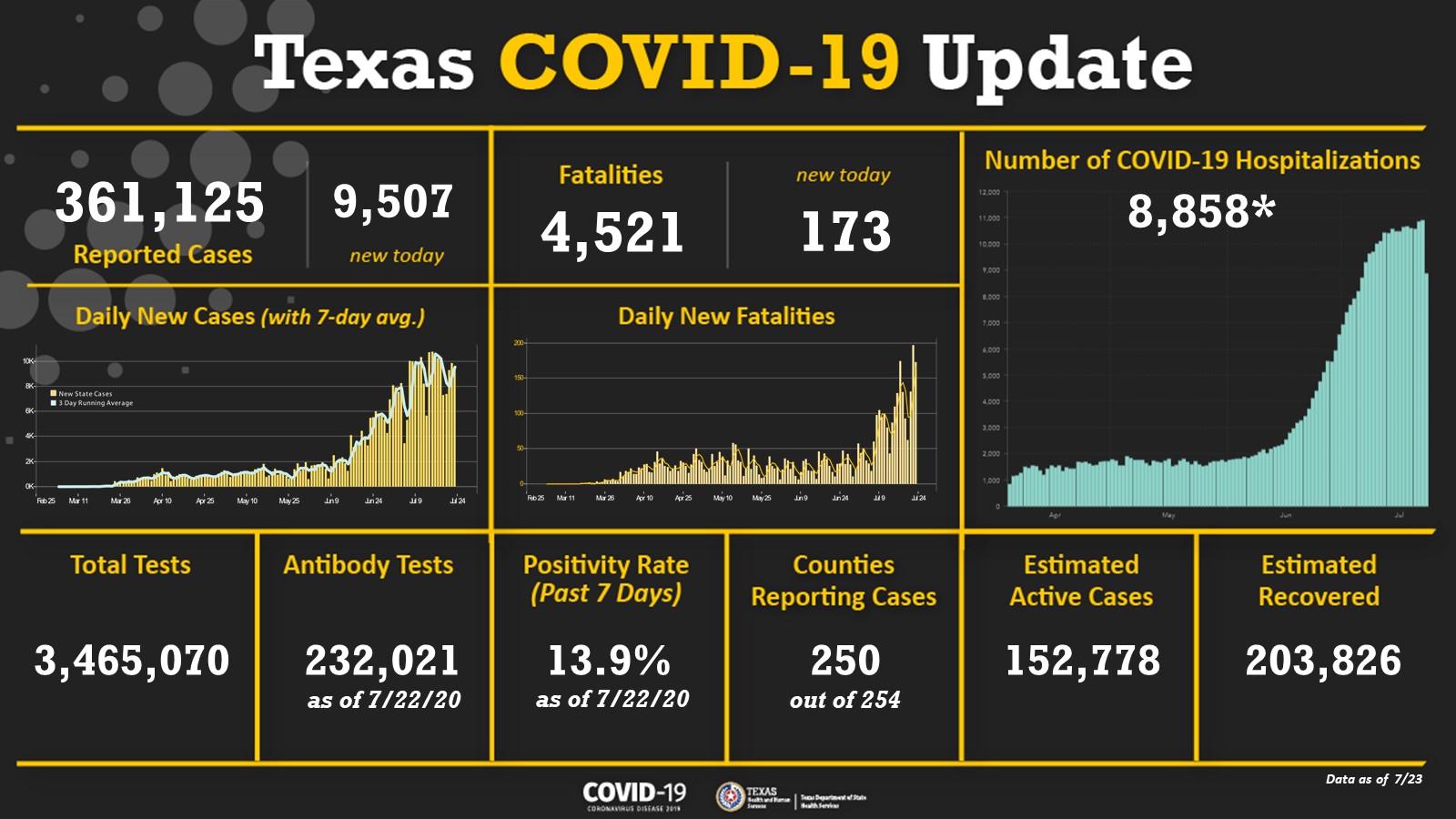
Arizona, California, Florida & Texas COVID-19 dates

July24_CA_COVID-19_ByTheNumbers


^^^^^^^^^^^^^^^^^^^^^^^^^^^^^^^^^^^^^^^^^^^^^^^^^^^^^^^^^^^^^^^^^^^^^^^^^^^^^^^^^^^^^


What you need to know now about COVID-19 in Florida

The elderly and those with underlying medical problems like high blood pressure, heart problems and diabetes are more likely to develop serious illness.


Current Situation in Florida

Positive Residents

397,470

Positive Non-Residents

4,842

Total Cases

402,312

12,379 New Cases in FL Residents

Deaths

5,653

135 New Deaths in FL Residents*

8 Positive Residents Out of State

*Reported since yesterday

Testing Results

Positive

402,312

Negative

2,874,324

Total

3,276,636

Positive Cases by Exposure Source

Traveled

3,300

Contact with confirmed case

103,725

Travel & contact with confirmed case

3,266

Under Investigation

267,136

Total

402,312

Positive Cases by Testing Source

Positive by DOH/CDC

13,438

Positive by private labs

384,032

Total

397,470

*****************************************************************************************************************************************


Image

Wisconsin could be on Chicago Travel Order Soon


Wisconsin Governor Responds as State Nears Inclusion on Chicago Travel Order

The order is assessed on a weekly basis to determine if states should be added or removed from the list of locations travelers must quarantine from

Published July 23, 2020 • Updated on July 23, 2020 at 4:58 pm


Chicago issued an emergency travel order Thursday directing anyone who visits one of 15 states in the U.S. currently experiencing a rise in coronavirus cases to quarantine for 14 days.

With Chicago officials warning that Wisconsin is "very close" to being added to the city's emergency travel order, requiring anyone entering or returning to the city from the state to quarantine for 14 days, Gov. Tony Evers said residents "should take it seriously."

The state was one of several in the U.S. sitting near the cutoff of being added to Chicago's quarantine list, which currently sits at 18 states and is updated every Tuesday.

States are added to the list if they have "a case rate greater than 15 new COVID-19 cases per 100,000 resident population, per day, over a 7-day rolling average."

There were 1,052 newly confirmed COVID-19 cases in Wisconsin on Thursday, the second highest daily total after the record was set on Tuesday. There have been nearly 46,000 confirmed cases and 878 deaths, up by 13 from Wednesday.

"[Chicago] continues to closely monitor the spread of COVID-19 in other regions across the country, including neighboring states such as Wisconsin where the case rate is very close to the cut off for quarantine," Chicago Mayor Lori Lightfoot's office said in a statement Tuesday.

Wisconsin health officials say that the positivity rate of tests reported in the state on both Sunday and Monday was just over 10%.

"When I talk to folks in Wisconsin… we know people are not wearing masks there at the level they are here in Chicago," Chicago Department of Public Health Commissioner Dr. Allison Arwady said at a news conference Tuesday, again encouraging residents to wear face coverings in public.

That guidance was reiterated by Wisconsin's governor Thursday, who said while the order may not keep people from crossing the border between the two states, "it's more of a message issue."

"It's difficult to prognosticate what they're going to do in Chicago, but the fact of the matter is, there are folks - let's put it this way, it's very difficult to regulate state boundaries, or in this case, the city of Chicago boundaries versus the boundaries of Wisconsin," evers said. "There's lots and lots of people that live in Illinois and live in Chicago that do work regularly in Wisconsin and vice versa. And I anticipate that that will continue to move forward. But... a message for us in Wisconsin should be if Chicago thinks our people should stay home, then we better put some damn masks on and make sure that we continue to, or to reverse the course that we're in."

Chicago's travel order, which began on July 6, is assessed every Tuesday to determine if states should be added or removed from the list of locations travelers must quarantine from, meaning Wisconsin could be added to the list as early as next week.

The most recent addition to the travel order, Kansas, will take effect at 12:01 a.m. Friday, city officials said. Last week, Oklahoma and Iowa were added to the order.

Other states included are: Alabama, Arkansas, Arizona, California, Florida, Georgia, Idaho, Louisiana, Mississippi, North Carolina, Nevada, South Carolina, Tennessee, Texas, and Utah.

Arwady said travelers entering or returning to Chicago from "states experiencing a surge in new COVID-19 cases" will need to quarantine "for a 14-day period from the time of last contact within the identified state." Essential workers could be exempt from the quarantine requirement, however, as long as their employer certifies their work in writing.

The order is set to remain in effect until further notice.

CHICAGO TRAVEL ORDERJUL 3

How Will Chicago Enforce New Quarantine Restriction for Travelers?

CHICAGO CORONAVIRUSJUL 2

Chicago Travel Order: What You Need to Know

The move comes as states across the U.S. see surges of coronavirus cases, many shutting down bars and restaurants in an effort to quell or prevent a spike.

New cases have surged in several states across the nation, setting new records almost daily, driven mostly by expanding outbreaks in the American South and West.

New York and New Jersey are also asking visitors from several states from the Carolinas to California to quarantine themselves for two weeks.

CHICAGO CORONAVIRUSJUL 7

DuPage County Health Department Encourages Self-Quarantine for Travelers

CHICAGO TRAVEL ORDERJUL 3

How Chicago Determines Which States Are Listed on Its Travel Order

Still, outside of Chicago, Illinois Gov. J.B. Pritzker said Wednesday the state won't require residents who travel to and from neighboring states to quarantine for two weeks solely because of that travel.

"We don't live in a country where you close the borders between states," Pritzker said during the governor's coronavirus briefing. "And we're not going to stop people who live in Illinois and work in Wisconsin from doing so."

Above is from:   https://www.nbcchicago.com/news/local/illinois-coronavirus-updates-no-more-indoor-bar-service-in-chicago-other-restrictions-return/2310798/

Johns Hopkins’ COVID 19 Update


COVID-19


Updates on the emerging novel coronavirus pandemic from the Johns Hopkins Center for Health Security.

The Center for Health Security is analyzing and providing updates on the emerging novel coronavirus. If you would like to receive these updates, please subscribe below and select COVID-19. Additional resources are also available on our website.


EPI UPDATE The WHO COVID-19 Situation Report for July 23 reports 15.01 million cases (247,225 new) and 619,150 deaths (7,097 new). This is the second highest global daily total to date, and it is 21,044 more new cases than the same day the previous week (226,181 cases on July 16). Based on this trend, we expect the WHO to report record high global incidence today and/or tomorrow.

After recent data indicated that it was reaching a peak or plateau, Brazil reported its 2 highest daily totals over the past 2 days—67,860 and 59,961 new cases, respectively. These are considerably higher than the highest days in recent weeks, which were consistently around 45-46,000 new cases. Brazil remains #3 globally in terms of daily incidence, but it closed the gap with India. Colombia reported 7,945 new cases, its fourth highest daily incidence to date. Colombia is currently #5 globally with respect to daily incidence. Mexico reported 8,438 new cases, its highest daily incidence to date. Mexico is #6 globally in terms of daily incidence. Broadly, the Central and South American regions remain major COVID-19 hotspots. Including Brazil, Colombia, and Mexico, the region represents 5 of the top 10 countries globally in terms of daily incidence, along with Argentina (#8) and Peru (#9). Multiple other countries in the region are reporting more than 1,000 new cases per day. Additionally, the region includes 4 of the top 10 countries in terms of per capita daily incidence—Panama (#3), the US (#5), Brazil (#8), Colombia (#9)—and a number of other countries are reporting more than 100 new daily cases per million population.

India reported nearly 50,000 new cases, doubling its daily incidence since July 9. India remains #2 globally in terms of daily incidence. Bangladesh continues to report slowly decreasing daily incidence; however, it is also reporting decreased testing while its test positivity remains steady, slightly above 20%. This could indicate that Bangladesh's decreased incidence could be driven more by reduced testing than slowing transmission. Bangladesh remains #10 globally in terms of daily incidence.

South Africa reported 13,104 new cases, and it remains among the top countries globally in terms of both per capita (#4) and total daily incidence (#4).

The Eastern Mediterranean region remains a global COVID-19 hotspot, particularly with respect to per capita daily incidence. Oman is currently the only country averaging more than 250 new cases daily per million population*. The region represents 4 of the top 12 countries globally—Oman (#1), Bahrain (#2), Kuwait (#11), and Qatar (#12). Nearby Israel (#6) and Armenia (#10), both in the WHO’s European region, are among the top countries globally as well. While no countries in the region are in the top 10 in terms of total daily incidence, many are reporting more than 1,000 new cases per day.

*With the exception of Kyrgyzstan, which reported a single-day spike on July 18 before returning to its normal level.

Russia continues to report steadily declining daily incidence, but it remains #7 globally. Luxembourg is #7 globally in terms of per capita daily incidence.

UNITED STATES

The US CDC reported 3.95 million total cases (70,106 new) and 142,755 deaths (1,078 new). On July 22, the CDC reported more than 1,000 deaths for the first time since early June, and it has now exceeded that threshold for the second consecutive day. The US could potentially surpass 150,000 deaths by the end of next week. Additionally, both of the last 2 updates exceeded the daily incidence for the corresponding day from the previous week by more than 2,000 cases. The 7-day average daily incidence is 66,920 cases, the country’s highest to date, indicating that daily incidence continues to increase, even if it is potentially beginning to level off.

More than half of US states have reported more than 40,000 total cases, including California and New York with more than 400,000 cases; Florida and Texas with more than 350,000; and 8 additional states with more than 100,000. The US fell to #5 globally in terms of per capita daily incidence, but it remains #1 in terms of total daily incidence.

We expect the US to surpass 4 million cumulative cases in this afternoon’s update. From the first case reported in the US on January 22, it took 81 days to reach 500,000 cases and 98 total days to reach 1 million cases. From there:

1 million to 2 million cases: 44 days

2 million to 3 million cases: 27 days

3 million to 4 million cases: 14 days

California (425,616 cases) surpassed New York (410,450 cases) to become #1 in the US in terms of cumulative COVID-19 incidence. With an average daily incidence of more than 11,000 cases, we expect Florida (402,312 cases) to surpass New York today, and with approximately 10,000 new cases per day, Texas (361,125 cases) could surpass New York by the middle-to-end of next week. California (nearly 10,000 new cases per day) could surpass 500,000 cumulative cases by the end of next week.

The Johns Hopkins CSSE dashboard reported 4.06 million US cases and 144,552 deaths as of 12:30 pm on July 24.

NIH CLINICAL TRIALS The US NIH is initiating several clinical trials as part of the Accelerating COVID-19 Therapeutic Interventions and Vaccines (ACTIV) public-private partnership. Initiated on April 17, the goal of this effort is to develop a coordinated research strategy to speed up the development of COVID-19 candidate pharmaceuticals. ACTIV has 4 fast-track areas of focus, including pre-clinical treatments, accelerating clinical testing for vaccines and treatments, improving clinical trial capacity, and accelerating evaluation of vaccine candidates. The new trials include antiviral monoclonal antibodies, for both hospitalized and at-home patients; drugs to reduce dangerous inflammatory responses to COVID-19; and drugs to treat blood clotting. A principal goal of the program is to ensure coordinated and standardized protocols and study designs across multiple testing sites in order to promote robust analyses. More than 1,200 clinical trials have been registered with the US government for COVID-19 drugs, and nearly 40% of them involved fewer than 100 patients. This disorganized approach likely will not yield robust data to support effective analysis of many candidate drugs, and ACTIV aims to improve consistency and coordination nationwide.

NIH Director Dr. Francis Collins and several NIH colleagues published a special report in The New England Journal of Medicine that outlined the Rapid Acceleration of Diagnostics program (RADx), led by NIH in partnership with other US government entities, including the Biomedical Advanced Research and Development Authority (BARDA) and the Department of Defense. RADx was conceived to support rapid development and production of novel diagnostics, including the use of “innovative diagnostic technologies.” Perhaps most notably, it is “expressly focused on health disparities,” rather than purely technical challenges. The program includes 4 principal components, each with a specific focus. Three of the components focus on technical aspects of product research, development, and production, and the fourth is dedicated to improving equity among underserved populations. Racial and ethnic minorities are disproportionately affected by COVID-19, and this component, RADx-UP, aims to characterize the factors driving this elevated burden and improve access to testing among high-risk populations, including through community engagement activities.

US COVID-19 RESURGENCE The US continues to battle a resurgence of COVID-19, driven largely by states that were not severely affected early in the US epidemic. As noted above, the US reported 1 million cases over the past 2 weeks alone, and numerous states are exhibiting concerning trends. Current data indicate stark regional differences in the severity of the current COVID-19 resurgence. States in the Northeast, including New England and the Mid-Atlantic region—particularly the northern portion, including Connecticut, New Jersey, and New York—appear to be faring considerably better than the South, Southwest, West, and Midwest. These differences are evident across all major indicators, including incidence, mortality, test positivity, and hospitalizations.

Increasing COVID-19 hospitalizations, in particular, have garnered considerable attention, following reports that hospitals and health systems are struggling to meet the COVID-19 patient surge. Newly published data from HHS shows multiple states in these severely affected regions reporting more than 25% of inpatient hospital beds currently occupied by COVID-19 patients, including Arizona, California, Georgia, New Mexico, and Texas. Several other states in the South, Southwest, and West—including Alabama, Arkansas, Louisiana, Mississippi, Nevada, and South Carolina—are reporting that more than 15% of inpatient beds are occupied by COVID-19 patients. Additionally, analysis from the COVID Tracking Project indicates that national COVID-19 hospitalizations are now equal to the country’s first peak in mid-April. In the first peak, COVID-19 cases were largely concentrated in a few major metropolitan areas—including Boston, Detroit, and New York—and overwhelmed local health systems, which accounts, to some degree, for the higher per capita incidence in these areas. Now, the cases are spread out across a much larger geographic area and population, and more hospitals and health systems, and the overall mortality is lower than it was early in the US epidemic (although beginning to increase again). If continued uncontrolled transmission continues, however, it could necessitate spreading limited health resources (eg, mechanical ventilators, investigational treatment drugs) more thinly across the country, which could exacerbate recent increases in mortality. Statistically speaking, some portion of hospitalized patients are expected to die from COVID-19, so as hospitalizations increase, so will COVID-19 mortality, particularly if available resources are exhausted.

These state- and regional-level disparities have driven a number of states to implement domestic travel advisories or restrictions. Some states require arriving travelers to be tested for SARS-CoV-2 and/or provide documentation of a recent negative test, and some require or recommend self-quarantine, typically for 14 days. Some of these requirements pertain to specific states, and others are broadly applied to all out-of-state travelers. Connecticut, New Jersey, and New York previously implemented a joint policy that requires travelers arriving from severely affected states to quarantine themselves for 14 days upon arrival. The initial list was relatively limited, with only 9 affected states; however, it has ballooned to more than 30 states, covering approximately two-thirds of the entire US population. Additionally, the Ohio Department of Health issued a similar travel advisory for any state reporting test positivity of 15% or greater. The new Ohio policy currently covers 9 states. The Ohio Department of Health recommends 14-day self-quarantine and temperature/symptom monitoring for individuals with recent travel to the affected states, but it does not appear to be mandatory. Interestingly, it appears that Florida’s mandatory quarantine for travelers arriving from the New York tri-state area, implemented earlier in the US epidemic, remains in effect, despite the fact that Florida is currently reporting more than 11 times the combined daily incidence of New York, New Jersey, and Connecticut.

In response to surging COVID-19 incidence in Florida, US President Donald Trump announced that activities for the Republican National Convention scheduled in Jacksonville will be cancelled. Some convention activities were originally moved from Charlotte, North Carolina, after disagreements regarding the state’s restrictions on large gatherings; however, Republican delegates will reportedly still meet in Charlotte to announce President Trump as the Republican nominee for the 2020 presidential election.

INTERNATIONAL COVID-19 RESURGENCE In addition to the US, some other countries are beginning to experience their own COVID-19 resurgence. Many countries are still experiencing the effects of their initial wave of transmission; however, some countries that previously contained their epidemic are now facing increased transmission, some on a national scale and others more localized. Both Tokyo, Japan, and Melbourne, Australia, are reporting major outbreaks, which have resulted in the need to re-institute some social distancing restrictions—although not to the level of full “lockdown.” Spain, one of the most severely affected countries early in the pandemic is now exhibiting increased transmission again, following the relaxation of nationwide social distancing policies. These increases are much smaller than those observed in the US, but they are concerning nonetheless. In the absence of a vaccine, any increase in social contact will result in increased transmission, so it is likely that we will continue to observe this trend as national, regional, and local governments attempt to strike the right balance between COVID-19 risk and economic and social benefits.

Despite early success in containing its COVID-19 epidemic, South Africa has also recently exhibited a resurgence of COVID-19. Notably, South Africa is reporting an increase in excess all-cause mortality, which could potentially be the result of redirecting healthcare resources and services toward the COVID-19 response. While the country’s COVID-19 deaths now exceed 6,000, excess deaths related to natural causes have surpassed 17,000. South Africa accounts for more than half of all COVID-19 cases on the African continent. With the surge in COVID-19 incidence, South African President Cyril Ramaphosa decided to close schools for several weeks. President Ramaphosa also implemented a temporary ban on alcohol sales and a mandatory curfew in the hopes that a decrease in alcohol-related incidents will make more hospital beds available for COVID-19 patients and others. Many hospitals in highly populated areas are already reaching their capacity, and oxygen supplies running low.

US ECONOMIC STIMULUS The US government continues to evaluate options for a possible “Phase 5” COVID-19 funding bill, but considerable uncertainty remains regarding the content and timeline. Senate Majority Leader Mitch McConnell was expected to release a draft bill this week as a starting point for debate in the Senate, but it appears that it may be delayed until at least next week as details are finalized. The funding bill could potentially provide support for hospitals and health systems and state and local governments as well as individuals. Individual stimulus payments and expanded federal unemployment benefits are among a long list of high-profile priorities. A report by The Hill indicates that the Senate bill is expected to include similar stimulus payments as the previous phase of funding, possibly US$1,200 per person for everyone with an annual income of $75,000 or less. Senator McConnell previously suggested that the income cap could be lowered for this round to US$40,000, but there are indications that this may have changed.

Considering that the current expanded federal unemployment insurance, an extra US$600 per week, is scheduled to expire next week, it is possible that individuals receiving those benefits could lose that additional funding for a period of weeks while a bill is finalized and implemented. It is unclear if any temporary measures are being evaluated to prevent these payments from lapsing. The Senate bill will reportedly not include a payroll tax cut for businesses, previously a priority for President Trump, following opposition from Republican Senators. Again, these negotiations are ongoing, and the Senate draft has yet to be finalized and released. The House of Representatives passed its own funding bill several weeks ago, but there will likely be substantial differences between the House and Senate proposals. There appears to be pressure to reach an agreement soon in order to provide economic support as states continue to maintain, and in some cases strengthen, social distancing policies, but the exact path forward is not clear at this time.

SAFER NEUTRALIZATION ASSAY There are many different kinds of SARS-CoV-2 serological tests, all of which detect the presence of immune response to previous SARS-CoV-2 infection. Neutralization assays detect neutralizing antibodies, or antibodies that correspond to protective immunity. Because neutralization assays require live virus in order to challenge the patient’s antibodies in culture, most of these tests must be performed in high-containment laboratory settings. High-containment laboratories are less common than those operating under lower biosafety levels, so critical research on protective immunity via neutralizing antibodies has been slow.

A study published in Nature presents a surrogate viral neutralization test (sVNT) that can be performed at the BSL-2 level, as opposed to the BSL-3 level. In the sVNT protocol, conjugated SARS-CoV-2 receptor binding domain and patient blood serum are added to an ELISA plate coated in human ACE-2 receptor. If the patient serum contains neutralizing antibodies, they will block the binding action of the receptor binding domain to the human ACE-2 receptor, which can be quantified using indirect ELISA techniques. The researchers demonstrated that the sVNT protocol exhibited high correlation with results obtained from conventional VNT and pseudovirus VNT techniques. This assay and others like it could accelerate research on protective immunity as the pandemic progresses by allowing it to be conducted in more laboratories and at lower biosafety levels.

US CDC SCHOOL GUIDANCE As the US moves toward the scheduled start of the 2020-21 school year, the US CDC published several updated guidance documents to support schools in preparing for classes in the midst of the COVID-19 pandemic. A number of prominent US government officials, including President Trump, have publicly called for schools to resume in-person classes, but many state governments, school officials and teachers, and health experts warn that might not be feasible or safe in some circumstances. The updated guidance includes information for schools regarding the current understanding of COVID-19 risk to children and their role in driving transmission in the community and at home as well as recommendations for implementing appropriate social and physical distancing (including mask use), enhanced hygiene and sanitation, and disease surveillance and monitoring systems. The guidance also includes considerations based on the current level of community transmission, including the possible need to close schools due to uncontrolled community spread. In addition to schools, the CDC offers tools and information aimed at parents to help evaluate risk.

The updated CDC guidance includes a statement that explicitly emphasizes the importance of in-person school for children. Some media reports have characterized this as a push by the CDC to resume in-person classes during the pandemic, as it focuses primarily on the benefits of in-person learning rather than public health considerations related to COVID-19. The statement highlights the disproportionate impact of remote classes on lower-income students, racial and ethnic minorities, and students with disabilities or special needs as well as the importance of services schools provide beyond education that support these and other students. Notably, the CDC emphasizes repeatedly that the risk to students—including direct health risks to children and risks of spreading the disease at home—are relatively low in communities with low levels of SARS-CoV-2 transmission. The statement largely focuses on the impact for students and does not fully address the risks to teachers, staff, and family members.

COVID-19 IN REFUGEE POPULATIONS As the COVID-19 pandemic continues, it is clear that some populations are at elevated risk of infection, severe disease, and death, in particular, racial and ethnic minorities. Refugee populations face even greater risk, stemming from conditions in densely populated refugee camps, barriers to accessing health services (including investigational treatment drugs), pre-existing health conditions and poor nutrition, other communicable disease risks (eg, cholera), and limited access to reliable infrastructure like clean water. Additionally, the pandemic is limiting international aid for these populations, as donor countries focus resources domestically to control their own epidemics. Reduced humanitarian aid, including for routine immunizations, can compound the health impact of COVID-19, especially for children, who suffer most during humanitarian crises. Experts at Johns Hopkins University will host a webinar on July 29 (1pm EDT/5pm GMT) to discuss the impact that COVID-19 is having on refugee populations and the response efforts needed to protect children, including through routine immunizations and a potential COVID-19 vaccine. The speakers will include Dr. Shaun Truelove from the Johns Hopkins International Vaccine Access Center and Dr. Paul Spiegel, Director of the Johns Hopkins Center for Humanitarian Health. Advance registration is required to participate.