Sunday, March 15, 2020

Trump disbanded NSC pandemic unit that experts had praised


Trump disbanded NSC pandemic unit that experts had praised

By DEB RIECHMANNMarch 14, 2020

1 of 2

President Donald Trump takes questions during a news conference about the coronavirus in the Rose Garden of the White House, Friday, March 13, 2020, in Washington. Vice President Mike Pence, left, and Department of Health and Human Services Secretary Alex Azar, right listen. (AP Photo/Evan Vucci)

WASHINGTON (AP) — Public health and national security experts shake their heads when President Donald Trump says the coronavirus “came out of nowhere” and “blindsided the world.”

They’ve been warning about the next pandemic for years and criticized the Trump administration’s decision in 2018 to dismantle a National Security Council directorate at the White House charged with preparing for when, not if, another pandemic would hit the nation.

“It would be nice if the office was still there,” Dr. Anthony Fauci, the director of the National Institute of Allergy and Infectious Diseases at the National Institute of Health, told Congress this week. “I wouldn’t necessarily characterize it as a mistake (to eliminate the unit). I would say we worked very well with that office.”

The NSC directorate for global health and security and bio-defense survived the transition from President Barack Obama to Trump in 2017.

Trump’s elimination of the office suggested, along with his proposed budget cuts for the CDC, that he did not see the threat of pandemics in the same way that many experts in the field did.

“One year later I was mystified when the White House dissolved the office, leaving the country less prepared for pandemics like COVID-19,” Beth Cameron, the first director of the unit, wrote in an op-ed Friday in The Washington Post.

She said the directorate was set up to be the “smoke alarm” and get ahead of emergencies and sound a warning at the earliest sign of fire — “all with the goal of avoiding a six-alarm fire.”

It’s impossible to assess the impact of the 2018 decision to disband the unit, she said. Cameron noted that biological experts remain at the White House, but she says it’s clear that eliminating the office contributed to what she called a “sluggish domestic response.” She said that shortly before Trump took office, the unit was watching a rising number of cases in China of a deadly strain of the flu and a yellow fever outbreak in Angola.

“It’s unclear whether the decision to disband the directorate, which was made in May 2018, after John Bolton became national security adviser, was a tactical move to downgrade the issue or whether it was part of the White House’s interest in simplifying and shrinking the National Security Council staff,” Cameron says.

The NSC during the Obama administration grew to about 250 professionals, according to Trump’s current national security adviser, Robert O’Brien. The staff has been cut to about 110 or 115 staffers, he said.

When Trump was asked on Friday whether closing the NSC global health unit slowed the U.S. response, the president called it a “nasty” question because his administration had acted quickly and saved lives.

“I don’t know anything about it,” Trump said.

Earlier, when asked about it, he said: “This is something that you can never really think is going to happen.”

On Saturday, John Bolton, a former Trump national security adviser, dismissed claims that “streamlining NSC structures impaired our nation’s bio defense are false.″ In a tweet, he said global health “remained a top NSC priority, and its expert team was critical to effectively handling the 2018-19 Africa Ebola crisis. The angry Left just can’t stop attacking, even in a crisis.″

For many years, the national intelligence director’s worldwide threat assessment has warned that a flu pandemic or other large-scale outbreak of a contagious disease could lead to massive rates of death and disability that would severely affect the world economy. Public health experts have been blowing whistles too.

Back in mid-2018, Fauci told Congress: “When you have a respiratory virus that can be spread by droplets and aerosol and ... there’s a degree of morbidity associated with that, you can have a catastrophe. ... The one that we always talk about is the 1918 pandemic, which killed between 50 and 100 million people. ... Influenza first, or something like influenza, is the one that keeps me up at night.”

The White House says the NSC remains involved in responding to the coronavirus pandemic.

A senior administration official said Friday that the NSC’s global health security directorate was absorbed into another division where similar responsibilities still exist, but under different titles. The work of coordinating policy and making sure that decisions made by Trump’s coronavirus task force are implemented is still the job of the NSC.

Some lawmakers aren’t convinced.

Rep. Gerald Connolly, D-Va., and Rep. Steve Chabot, R-Ohio, have introduced a bill that would require future administrations to have experts always in place to prepare for new pandemics.

“Two years ago, the administration dismantled the apparatus that had been put in place five years before in the face of the Ebola crisis,” Connolly said. “I think, in retrospect, that was an unwise move. This bill would restore that and institutionalize it.”

Connolly said the bill is not meant to be critical of the Trump administration. He said it’s a recognition that Trump had to name a coronavirus responder just like Obama had to name one for Ebola in 2014. “We can’t go from pandemic to pandemic,” Connolly said.

The House Foreign Affairs Committee on March 4 passed the measure, which is co-sponsored by 37 Democrats and five Republicans. The full House has not yet voted on the bill.

Chabot said one of the bill’s main goals is to would require personnel to be permanently in place preparing for pandemics.

“Specifically, we need someone, preferable at the NSC, to quarterback the U.S. government’s response since that response inevitably involves several agencies across the government,” Chabot said. “Our bill would make this position permanent.”

Former Obama administration officials insist that the Trump White House would have been able to act more quickly had the office still been intact.

“I think if we’d had a unit and dedicated professionals looking at this issue, gaming out scenarios well before ... we might have identified some of these testing issues,” says Lisa Monaco, President Obama’s homeland security adviser, said at a recent forum on coronavirus. “There would have been folks sounding the alarm in December when we saw this coming out of China, saying ’Hey, what do we need to be doing here in this country to address it?”

Ron Klain, who managed the government response to contain and mitigate the spread of Ebola in 2014, agreed.

“If I were back in my old job at the White House ... I’d be pushing to have us do 30 million tests — to test people in nursing homes, to test people with unexplained respiratory ailments, to test the people who regularly visit nursing homes, to test healthcare workers,” Klain said recently at the event hosted by the Center for American Progress in Washington.

Above is from:  https://apnews.com/ce014d94b64e98b7203b873e56f80e9a

Government official: Coronavirus vaccine trial starts Monday

Government official: Coronavirus vaccine trial starts MondayAP NEWS


By ZEKE MILLERan hour ago

A gun store customer that gave his name only at John waits in line, Sunday, March 15, 2020, in Burbank, Calif. As consumers are buying all kinds of goods in large quantities amid coronavirus concerns, putting pressure on inventories, John stated that he was there to buy ammunition because most other stores were out and he wanted to stock up. (AP Photo/Mark J. Terrill)

WASHINGTON (AP) — The first participant in a clinical trial for a vaccine to protect against the new coronavirus will receive an experimental dose on Monday, according to a government official.

The National Institutes of Health is funding the trial, which is taking place at the Kaiser Permanente Washington Health Research Institute in Seattle. The official who disclosed plans for the first participant spoke on condition of anonymity because the move has not been publicly announced.

Public health officials say it will take a year to 18 months to fully validate any potential vaccine.

Testing will begin with 45 young, healthy volunteers with different doses of shots co-developed by NIH and Moderna Inc. There’s no chance participants could get infected from the shots, because they don’t contain the virus itself. The goal is purely to check that the vaccines show no worrisome side effects, setting the stage for larger tests.

Dozens of research groups around the world are racing to create a vaccine as COVID-19 cases continue to grow. Importantly, they’re pursuing different types of vaccines — shots developed from new technologies that not only are faster to produce than traditional inoculations but might prove more potent. Some researchers even aim for temporary vaccines, such as shots that might guard people’s health a month or two at a time while longer-lasting protection is developed.

Also in the works: Inovio Pharmaceuticals aims to begin safety tests of its vaccine candidate next month in a few dozen volunteers at the University of Pennsylvania and a testing center in Kansas City, Missouri, followed by a similar study in China and South Korea.

Even if initial safety tests go well, “you’re talking about a year to a year and a half” before any vaccine could be ready for widespread use, according to Dr. Anthony Fauci, director of NIH’s National Institute of Allergy and Infectious Diseases.

That still would be a record-setting pace. But manufacturers know the wait — required because it takes additional studies of thousands of people to tell if a vaccine truly protects and does no harm — is hard for a frightened public.

President Donald Trump has been pushing for swift action on a vaccine, saying in recent days that the work is “moving along very quickly” and he hopes to see a vaccine “relatively soon.”

Today, there are no proven treatments. In China, scientists have been testing a combination of HIV drugs against the new coronavirus, as well as an experimental drug named remdesivir that was in development to fight Ebola. In the U.S., the University of Nebraska Medical Center also began testing remdesivir in some Americans who were found to have COVID-19 after being evacuated from a cruise ship in Japan.

For most people, the new coronavirus causes only mild or moderate symptoms, such as fever and cough. For some, especially older adults and people with existing health problems, it can cause more severe illness, including pneumonia. The worldwide outbreak has sickened more than 156,000 people and left more than 5,800 dead. The death toll in the United States is more than 50, while infections neared 3,000 across 49 states and the District of Columbia.

The vast majority of people recover. According to the World Health Organization, people with mild illness recover in about two weeks, while those with more severe illness may take three weeks to six weeks to recover.

___

The Associated Press receives support for health and science coverage from the Howard Hughes Medical Institute’s Department of Science Education. The AP is solely responsible for all content.

Above is from:  https://apnews.com/8089a3d0ec8f9fde971bddd7b3aa2ba1

Friday, March 13, 2020

500,000 Americans have COVID-19


'Don't believe the numbers you see': Johns Hopkins professor says up to 500,000 Americans have coronavirus

Adriana Belmonte

Associate Editor

,

Yahoo Finance•March 13, 2020

Ad: 1s

The World Health Organization (WHO) declared COVID-19, also known as the new coronavirus, to be a pandemic on March 11.

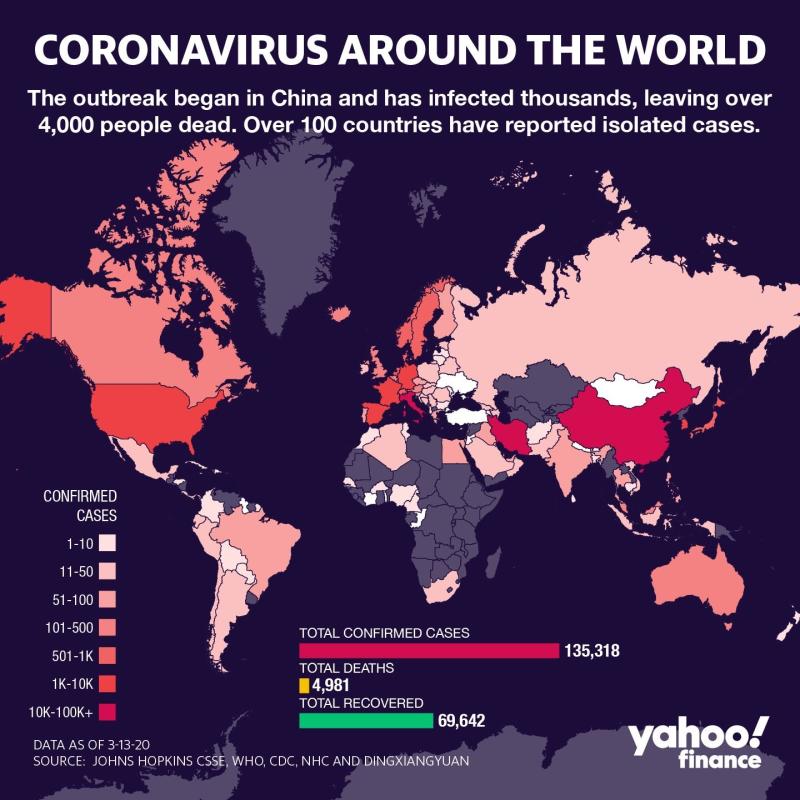
The virus has killed thousands of people worldwide, with over 135,000 confirmed cases and over 5,000 deaths. Public reaction has been mixed — many people have been rushing to grocery stores to stock up for a potential quarantine, while others have called the responses to be an overreaction.

According to Dr. Marty Makary, a medical professor at Johns Hopkins University, the coronavirus is something that “people need to take seriously.”

“I’m concerned when I hear a neighbor or a friend say that they’re planning to go to a kid’s swim meet in three weeks or going on vacation next week,” Makary said on Yahoo Finance’s “On the Move” (video above) on Friday. “No — we’re about to experience the worst public health epidemic since polio.”

Over 4,000 people have died from coronavirus so far. (Graphic: David Foster/Yahoo Finance)

Over 4,000 people have died from coronavirus so far. (Graphic: David Foster/Yahoo Finance)

More

‘Don’t believe the numbers you see’

In the U.S. there are over 1,600 confirmed cases, according to the Centers for Disease Control and Prevention (CDC), with 41 deaths. Makary said that the number of cases, though, is likely much higher.

“Don’t believe the numbers when you see, even on our Johns Hopkins website, that 1,600 Americans have the virus,” he said. “No, that means 1,600 got the test, tested positive. There are probably 25 to 50 people who have the virus for every one person who is confirmed.”

He added: “I think we have between 50,000 and half a million cases right now walking around in the United States.”

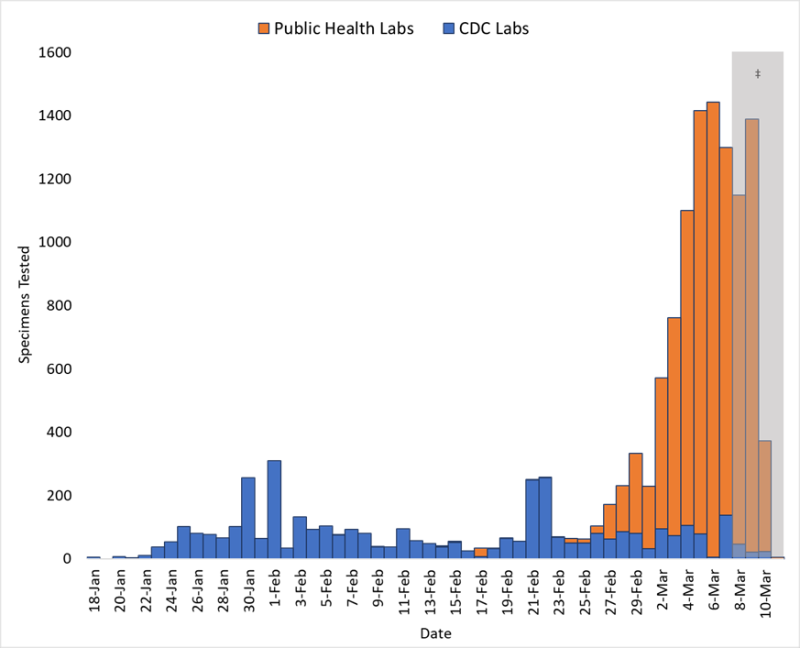
Part of the reason the number of cases might be higher without people realizing it is because of the shortage of coronavirus testing kits from the CDC. Between Jan. 18 and March 12, there were 13,624 tests for COVID-19 conducted in the U.S. Meanwhile, South Korea has conducted over 100,000 tests, and the U.K. has tested nearly 25,000 people.

The U.S. has conducted over 13,000 tests for coronavirus since Jan. 18. (Chart: CDC)

The U.S. has conducted over 13,000 tests for coronavirus since Jan. 18. (Chart: CDC)

More

“The CDC did admit to a mistake in the rollout of the testing and let’s face it — they went with the wrong testing system,” Makary said. “It was an early decision. It lived deep within the CDC and they have acknowledged that mistake.”

Despite issues with having enough testing kits for coronavirus, Makary said this didn’t change how he and other health professionals have been treating their patients.

“If we see you with coronavirus, we treat you the same regardless of that test result,” he said. “If it’s influenza or coronavirus, we give you respiratory support when it is needed. We recommend the same precautions. It’s helpful to mitigate the spread but that’s where the testing situation stands now.”

‘We could see 200,000 new patients ... up to 2 million’

There are other ways to slow down the contagion that don’t involve a medical background, like regularly washing your hands, avoiding touching your face, and practicing social distancing. This can help ease the burden on health care workers and try to prevent hospitals from being overwhelmed with patients.

“Our American hospitals have had very little room to take on increased capacity,” Makary said. “Most ICUs function at full capacity or near full capacity. We only have 100,000 ICU beds in the United States. We could see 200,000 new patients that need critical care up to 2 million.”

Above is from:  https://finance.yahoo.com/news/marty-makary-on-coronavirus-in-the-us-183558545.html

Monday, March 9, 2020

What do President Trump And Emperor Nero share?

Dan Scavino

@DanScavino

Currently serving as Assistant to the President and Director of Social Media at the White House. For official announcements, go to

@Scavino45

.

This is a March 7 twitter posting by Mr. Scavino.  Did Mr. Scavino ever hear of Emperor Nero and the fire in Rome?


Image

Above is from:  https://twitter.com/danscavino/status/1236519422917062656

Sunday, March 1, 2020

CDC: Stop Buying Face Masks


U.S. Surgeon General

✔@Surgeon_General

Seriously people- STOP BUYING MASKS!
They are NOT effective in preventing general public from catching #Coronavirus, but if healthcare providers can’t get them to care for sick patients, it puts them and our communities at risk!
http://bit.ly/37Ay6Cm

Coronavirus Disease 2019 (COVID-19)

Coronavirus disease 2019 (COVID-19) is a virus (more specifically, a coronavirus) identified as the cause of an outbreak of respiratory illness first detected in Wuhan, China.

cdc.gov


Washing your hands, staying home when sick and other "everyday preventive actions" are the best protections, Adams said. He urged people to get a flu shot, as fewer flu patients means more resources to fight the coronavirus.

The tweet comes during what has become a mask boom. With coronavirus popping up in the United States, some have begun buying face masks as a form of protection, despite the likes of the US Centers for Disease Control and Prevention and Vice President Mike Pence saying they're unnecessary.

And, like Adams points out, if these masks run out, they won't be available to the medical professionals who are at the highest risk for disease transmission.

Dr. William Schaffner, a preventive medicine professor at the Vanderbilt University School of Medicine, told CNN the rush to buy masks is a "psychological thing."


Can Lysol and Clorox products kill the novel coronavirus? The answer is … complicated

POSTED 1:20 PM, FEBRUARY 29, 2020, BY CNN WIRE

Lysol, Clorox and a host of other household disinfectants widely tout their ability to kill 99.9% of bacteria and viruses. The claim is right there on the label.

Included in that 99.9%? Human coronavirus. It's advertised on the back as a disease the product can disinfect from surfaces, along with two flu strains, E. coli and salmonella, among others.

That sparks some obvious questions, mainly: Would it work for the new coronavirus that's spreading around the globe?

The answer, it turns out, is complicated.

The US Environmental Protection Agency has some guidance: The disinfectants are thought to be effective against the novel coronavirus. But until tests confirm this, its ability to kill the novel coronavirus has not been scientifically proven.

While the risk of getting novel coronavirus in the US remains low largely due to successful containment efforts, a US Centers for Disease Control and Prevention official warned Tuesday that the agency expected to see "community spread" of the virus in America.

"It's not so much a question of if this will happen anymore, but rather more a question of exactly when this will happen and how many people in this country will have severe illness," said CDC National Prevention Center for Immunization and Respiratory Diseases Director Dr. Nancy Messonnier.

The novel coronavirus is, as the name suggests, new

The "human coronavirus" mention on the back of Lysol and Clorox wipes got people wondering -- is the novel coronavirus all that new?

Without a doubt, yes. The novel coronavirus is a new virus. The current outbreak began around the beginning of 2020.

But human coronaviruses in general are not new.

They were first identified in the 1960s, according to the Centers for Disease Control and Prevention, and there are seven overall types.

The novel coronavirus is the most recently identified type -- hence the word "novel" in its name. There are no vaccines or antiviral treatments that specifically target it.

Disinfectants may be effective against the novel coronavirus

Disinfectant products that have been proven effective in protecting against the other human coronaviruses are thought to be effective against the novel coronavirus, too, said Dr. Amesh Adalja, a senior scholar at the Johns Hopkins Center for Health Security.

Coronaviruses are enveloped viruses, Adalja said.

"We know that viruses that lack an envelope coating are much hardier in the environment," he said.

And under the EPA's guidance for emerging viral pathogens, since Lysol, and Clorox and other disinfectants have been proven to effectively kill other human coronaviruses, users can safely use the wipes and sprays to disinfect surfaces in areas where the novel coronavirus is suspected.

In a statement to CNN, the EPA said companies can apply for an "emerging pathogens claim" based on previously approved claims for harder-to-kill viruses. The agency reviews them and determines whether the company can safely make that claim.

Once approved, the company can make off-label claims in the event of outbreaks like the novel coronavirus.

Several Lysol products have been approved to make emerging viral pathogens claims for efficacy against the novel coronavirus, the EPA told CNN.

But "definitive scientific confirmation" that the wipes can defend against this specific virus can only come once it's been tested against the strain, said Reckitt Benckiser, the company that owns Lysol and other hygiene brands, in a statement to CNN.

But the novel coronavirus is primarily spread between people

Here's the thing, though: from what we know so far, it's still early, the novel coronavirus is thought to spread primarily by people and their respiratory droplets -- think coughs, sneezes, spit.

Person-to-person transmission is most common, the CDC said.

While it's possible that people who touch surfaces or objects contaminated with the virus and then touch their mouths or eyes can also become infected, this may not be the main way the virus spreads, the CDC said. So disinfectant wipes can only go so far.

Plus, Lysol and Clorox are disinfectants designed for surfaces in homes, not for body parts. And even hand sanitizers aren't foolproof protections against all germs.

Saskia Popescu, a senior infection prevention epidemiologist and consultant for Clorox, said Americans should not panic about contracting the novel coronavirus within the US.
But if they're concerned, she recommends following the same practices they would if they were trying to avoid the common respiratory infections you can catch this time of year: Scrub hands clean with soap and water, wipe down shared work spaces with those disinfectant wipes and cover coughs and sneezes.

"All those basic things are effective, whether it's a novel coronavirus or influenza," she told C

Friday, February 28, 2020

Are Citizens’ questions regarding police misconduct being answered?

FEBRUARY 28, 2020

Image result for boone county journal

City Deflects Crowd in Wake of Police Brutality Allegations

by David Larson

Monday evening’s City Council Committee of the Whole was held with a heavy police presence both inside and outside of City Hall.  Recently WREX 13 news reporter Kristin Crowley reported allegations of extreme police brutality by members of the Belvidere Police force going back nearly two decades and the settling of lawsuits totaling in the six figures.

With a standing room only crowd extending out of the City Council Chamber into the hallway, no notification was given to the audience of the custom, that if a member of the public would like to address the Council, the speaker is required to sign up to do so before the meeting begins.  As a result no member of the public preregistered to speak, and no one wad given the opportunity to address the Council.

It became obvious that there was an “elephant in the room”, according to Alderwomen Freeman, who requested a response from the Mayor why it was being ignored.

Belvidere Mayor Mike Chamberlin consulted the city attorney who stated that as long as no voting action was taken it would be permissible to suspend the rules and open the meeting for comment and return to the meeting once the suspension had concluded.  Instead the Mayor suggested it be put on the agenda of a future meeting and Alderwomen Freeman did not object.

After the meeting was conducted , an ad hoc discussion broke out in the hallway as well as members of the public giving interviews to WREX.  At that point  Mayor Chamberlin and Chief of Police Shane Woody invited those remaining back into the council chamber for informal discussion


Above is from this Friday’s Boone County Journal

Wednesday, February 26, 2020

No Hajj Pilgrimage this year?


Saudi Arabia halts travel to Islam’s holiest site over virus

By JON GAMBRELL54 minutes ago

1 of 5

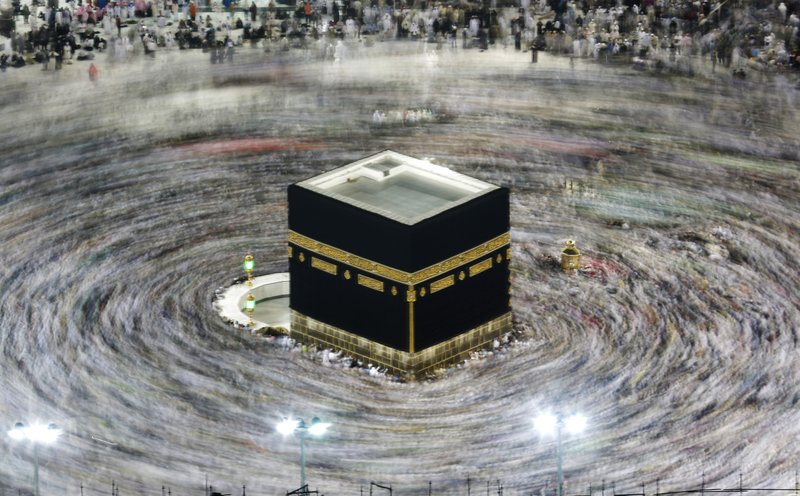
FILE - In this Aug. 13, 2019, file photo taken with a slow shutter speed, Muslim pilgrims circumambulate the Kaaba, the cubic building at the Grand Mosque, during the hajj pilgrimage in the Muslim holy city of Mecca, Saudi Arabia. Saudi Arabia on Thursday, Feb. 27, 2020, halted travel to the holiest sites in Islam over fears of the global outbreak of the new coronavirus just months ahead of the annual hajj pilgrimage, a move coming as the Mideast has over 220 confirmed cases of the illness. (AP Photo/Amr Nabil, File)

DUBAI, United Arab Emirates (AP) — Saudi Arabia on Thursday halted travel to the holiest sites in Islam over fears about a new viral epidemic just months ahead of the annual hajj pilgrimage, a move coming as the Mideast has over 220 confirmed cases of the illness.

The extraordinary decision by Saudi Arabia stops foreigners from reaching the holy city of Mecca and the Kaaba, the cube-shaped structure the world’s 1.8 billion Muslims pray toward five times a day. It also said travel was suspended to Prophet Muhammad’s mosque in Medina.

The decision showed the worry about the outbreak potentially spreading into Saudi Arabia, whose oil-rich monarchy stakes its legitimacy on protecting Islam’s holy sites. The epicenter in the Mideast’s most-affected country, Iran, appears to be in the holy Shiite city of Qom, where a shrine there sees the faithful reach out to kiss and touch it in reverence.

“Saudi Arabia renews its support for all international measures to limit the spread of this virus, and urges its citizens to exercise caution before traveling to countries experiencing coronavirus outbreaks,” the Saudi Foreign Ministry said in a statement announcing the decision. “We ask God Almighty to spare all humanity from all harm.”

Disease outbreaks always have been a concern surrounding the hajj, required of all able-bodied Muslims once in their life, especially as pilgrims come from all over the world. The earliest recorded outbreak came in 632 as pilgrims fought off malaria. A cholera outbreak in 1821 for instance killed an estimated 20,000 pilgrims. Another cholera outbreak in 1865 killed 15,000 pilgrims and then spread worldwide.

More recently, Saudi Arabia faced a danger from a related coronavirus that caused Middle East respiratory syndrome, or MERS. The kingdom increased its public health measures in 2012 and 2013, though no outbreak occurred.

While millions attend the 10-day hajj, this year set for late July into early August, millions more come during the rest of the year to the holy sites in the kingdom.

“It is unprecedented, at least in recent times, but given the worldwide spread of the virus and the global nature of the umrah, it makes sense from a public health and safety point of view,” said Kristian Ulrichsen, a research fellow at the James A. Baker III Institute for Public Policy at Rice University. “Especially since the Iranian example illustrates how a religious crossroads can so quickly amplify the spread and reach of the virus.”

The virus that causes the illness named COVID-19 has infected more than 80,000 people globally, mainly in China. The hardest-hit nation in the Mideast is Iran, where Health Ministry spokesman Kianoush Jahanpour said 19 people have died among 139 confirmed cases.

Experts are concerned Iran may be underreporting cases and deaths, given the illness’s rapid spread from Iran across the Persian Gulf. For example, Iran still has not confirmed any cases in Mashhad, even though a number of cases reported in Kuwait are linked to the Iranian city.

In Bahrain, which confirmed 33 cases as of Thursday morning, authorities halted all flights to Iraq and Lebanon. It separately extended a 48-hour ban over flights from Dubai and Sharjah in the United Arab Emirates, through which infected travelers reached the island kingdom off the coast of Saudi Arabia.

Iranian President Hassan Rouhani said there were no immediate plans to quarantine cities but acknowledged it may take “one, two or three weeks” to get control of the virus in Iran.

As Iran’s 80 million people find themselves increasingly isolated in the region by the outbreak, the country’s sanctions-battered economy saw its currency slump to its lowest level against the U.S. dollar in a year on Wednesday.

Above is from:  https://apnews.com/99cd4d90efcfe62e0518dde701a0608d