“What the people want is very simple. They want an America as good as its promise”—Barbara Jordan

“What the people want is very simple. They want an America as good as its promise”—Barbara Jordan
It may not be smart to add more, but nature probably beat us to it anyway

Credit: C. Scharf 2019
The last few days a number of headlines have pointed to a previously obscure fact about a recent attempt at placing a lander on the Moon by the non-profit Israeli SpaceIL organization. That mission, which unfortunately failed to softly deposit a lander called Beresheet on the lunar surface on April 11th 2019, seems to have been carrying a set of thousands of dehydrated tardigrades as passengers.
In fact, when Beresheet crashed onto the Moon it was carrying a novel repository of human history and information, along with a bunch of human DNA samples (in the form of hair follicles and blood) and the tardigrades. You can read more about the interesting motivations for this complement of terrestrial material, a product of the Arch Mission Foundation based out of Los Angeles, elsewhere.
Now though, the spectre of ‘deliberate’ biocontamination of the Moon is getting some scrutiny. Tardigrades, the tiny 'water-bears', are extraordinarily resilient lifeforms. For a field like astrobiology, looking for life beyond the Earth, one of the biggest challenges in our solar system is to avoid creating false-positives by allowing terrestrial biomarkers or actual organisms into alien environments, whether the Moon, Mars or elsewhere. There is also a sensible consensus that we don’t want to mess up any alien ecosystems – especially if they might be delicate and vulnerable to invasive life.
Since the dawn of the space age there have been internationally vetted protocols and broad agreements about this kind of planetary protection. But it is a tricky business. We know that our efforts to sterilize spacecraft are imperfect, and we know that human spacefarers are an enormous potential cross-contamination problem. On the Moon there are already about 100 baggies of, well, astronaut poop, from the Apollo landings. And if the far-flung ambitions of SpaceX are ever realized we will see hundreds, perhaps thousands, of microbe-oozing humans deposited on the surface of Mars.
None of this appears helpful when seen through the lens of astrobiology’s search for other life. But at the same time, we know that nature has been busy cross-contaminating worlds for the past 4 billion years. And hardy little critters like tardigrades have likely already been deposited far beyond the Earth.
The mechanism involves asteroid impacts and so-called impact ejecta. A large literature exists on both theoretical and experimental work tracking the possibilities. The bottom line is that largish asteroid impacts (i.e. roughly 1-kilometer diameter objects and up) tend to spall (shedding of surface material) stuff from a planet and eject some of it with escape velocity or higher. Furthermore, it appears that microbial life and tough organisms like tardigrades have a decent chance of withstanding the pressure and temperature extremes during these shockingly violent launches.
Big impacts can send billions of cm-scale chunks from the surface of the Earth out across the solar system. Some of those pieces may take thousands of years to drop onto other planetary bodies, wending their way through an unseen web of orbital pathways, but they will get there. Indeed, computer modeling of impact ejecta suggest that even far flung places like Titan around Saturn should – albeit rarely – be recipients of pieces of Earth over time. Places like Mars, or the Moon, get far more detritus.
From the point of view of seeking clues to the deep history of life on Earth, this kind of lithopanspermia is fascinating. It may well be that scattered across the surface of the Moon are fossil-like samples taken sporadically throughout life’s terrestrial history. It is also possible that there are samples, even if millions of years old, that contain naturally dehydrated animals like the tardigrade. It is also, of course, possible (albeit with an unknown probability) that there is a happy ecosystem on Mars populated by descendants of terrestrial life.
There have also been many debates about whether life on Earth got its origins elsewhere before being transported here by impact ejecta. We’re probably a long way from knowing the answer to that. But it is conceivable that any life in our solar system has spent the past few billion years in a merry game of natural cross-contamination; mixing it up on a regular basis.
Does any of this mean it’s a good idea to be incautious about flinging terrestrial biology onto places like the Moon? No, we should step very carefully. But like all things, there has to be a balance between big ideas, exploration, science, and a sense of cosmic ethics.
The views expressed are those of the author(s) and are not necessarily those of Scientific American.

Caleb A. Scharf is director of astrobiology at Columbia University. He is author and co-author of more than 100 scientific research articles in astronomy and astrophysics. His work has been featured in publications such as New Scientist, Scientific American, Science News, Cosmos Magazine, Physics Today and National Geographic.
Above is from: https://blogs.scientificamerican.com/life-unbounded/tardigrades-were-already-on-the-moon/
TRAVERSE CITY, Mich. (AP) — Oil transport company Enbridge says a gap has opened between a section of its Line 5 pipeline and the lake bottom in Michigan’s Straits of Mackinac. Erosion has washed away sediments beneath the pipeline, creating a space that exceeds the 75-foot limit set under a state easement. The company wants to install anchors for additional support but says the line is safe. Attorney General Dana Nessel’s office says the situation reinforces the need to shut down the pipeline.
That information for FY 2019 is now available at: https://www.boonecountyil.org/sites/default/files/images/Boone%20County%20Employee%20Compensation%20FY%202019.pdf
by Jodi S. Cohen and Melissa Sanchez
July 29, 4:07 p.m. CD

The University of Illinois Urbana-Champaign campus pictured on Monday. (Kristen Norman for ProPublica Illinois)
ProPublica Illinois is an independent, nonprofit newsroom that produces investigative journalism with moral force. Sign up for our newsletter to get weekly updates written by our journalists.
Dozens of suburban Chicago families, perhaps many more, have been exploiting a legal loophole to win their children need-based college financial aid and scholarships they would not otherwise receive, court records and interviews show.
Coming months after the national “Varsity Blues” college admissions scandal, this tactic also appears to involve families attempting to gain an advantage in an increasingly competitive and expensive college admissions system.
Parents are giving up legal guardianship of their children during their junior or senior year in high school to someone else — a friend, aunt, cousin or grandparent. The guardianship status then allows the students to declare themselves financially independent of their families so they can qualify for federal, state and university aid, a ProPublica Illinois investigation found.
“It’s a scam,” said Andy Borst, director of undergraduate admissions at the University of Illinois at Urbana-Champaign. “Wealthy families are manipulating the financial aid process to be eligible for financial aid they would not be otherwise eligible for. They are taking away opportunities from families that really need it.”
While ProPublica Illinois uncovered this practice in north suburban Lake County, where almost four dozen such guardianships were filed in the past 18 months, similar petitions have been filed in at least five other counties and the practice may be happening throughout the country. ProPublica Illinois is still investigating.
Borst said he first became suspicious when a high school counselor from an affluent Chicago suburb called him about a year ago to ask why a particular student had been invited to an orientation program for low-income students. Borst checked the student’s financial aid application and saw she had obtained a legal guardian, making her eligible to qualify for financial aid independently.
The University of Illinois has since identified 14 applicants who did the same: three who just completed their freshman year and 11 who plan to enroll this fall, Borst said.


ProPublica Illinois found more than 40 guardianship cases fitting this profile filed between January 2018 and June 2019 in the Chicago suburbs of Lake County alone. The parents involved in these cases include lawyers, a doctor and an assistant schools superintendent, as well as insurance and real estate agents. A number of the children are high-achieving scholars, athletes and musicians who attend or have been accepted to a range of universities, from large public institutions, including the University of Wisconsin, the University of Missouri and Indiana University, to smaller private colleges.
ProPublica Illinois reached parents or guardians in 15 of these cases and none agreed to speak on the record. Some hung up, others declined to comment and some demanded anonymity.
Borst said the university told the three students midway through last school year that their university-based financial aid would be reduced. “We didn’t hear any complaint, and that is also a big red flag,” Borst said. “If they were needy, they would have come in to talk with us.”
The university now asks more questions of students who have recently entered into a guardianship, including whether they have contact with their parents, who they live with and who pays for their health insurance and cellphone bill. The questions have deterred some families from continuing to seek university aid, Borst said.
While the university has discretion over offering institutional aid, it is obligated to distribute the federal and state grants for needy students, known as the Pell Grant and the state Monetary Award Program, or MAP grant in Illinois, Borst said. Combined, they can total about $11,000 a year.
He said the university has alerted the U.S. Department of Education and officials at the Illinois agency that administers state financial aid, the Illinois Student Assistance Commission. An ISAC spokeswoman said the agency has not yet been told about a specific case, but that it would alert the state attorney general and the U.S. Department of Education if necessary. A U.S. Department of Education spokesman said he could neither confirm nor deny current or potential investigations.
In Illinois last year, about 82,000 students who were eligible for the MAP grant, up to about $5,000, did not receive it because there wasn’t enough money. The grant is awarded on a first-come, first-served basis.
When filling out the application for financial aid, called the Free Application for Federal Student Aid, or FAFSA, students have to prove formal separation from their parents to qualify as an independent. One of the few ways to do that is through a legal guardianship change. Students cannot just declare financial independence — even in cases where parents are able to pay but refuse to do so, Borst said.
 Andy Borst, director of undergraduate admissions for the University of Illinois Urbana-Champaign. (Kristen Norman for ProPublica Illinois)
According to the U.S. Department of Education website, “a student in legal guardianship does not need to report parent information on the FAFSA form because he or she is considered an independent student.” Independent students are evaluated for financial aid based on their own income and resources and not that of their parents.
“It’s not like these families are close or on the tipping point” of being eligible for the aid, Borst said. “I don’t know how big this is, but I hope we can nip this in the bud now. … If it is legal, at what point is it wrong?”
The process starts in the courthouse.
Nearly all the cases identified by ProPublica Illinois were handled by one of two law firms: The Rogers Law Group in Deerfield, which handled most of them, and the Kabbe Law Group in Naperville. The only case filed by a different firm involved the family of Rick Rogers, of the Rogers Law Group.
The petitions filed by Rogers, whose firm specializes in real estate, are very similar, with language saying the guardianship would be in the minors’ “best interest” and typically citing educational reasons.
Many, for example, say: “The Guardian can provide educational and financial support and opportunities to the minor that her parents could not otherwise provide.”
Reached by phone, Rogers declined several times to comment about the families he represented, the process or why he sought a legal guardian for his son.
The Illinois Probate Act, the law that governs guardianship, does not specify circumstances in which guardianship should be denied. According to Illinois law, a court can appoint a guardian if the parents consent, the minor agrees and the court determines it is in the minor’s best interest. Even if a parent is able to care for the child, the court can approve the guardianship if the parents voluntarily relinquish custody of the child.
 Lake County court records show parents giving up their rights to someone they say can provide their children with “financial and educational support” better than they can. The children can then get financial aid they wouldn’t otherwise get.
That is what was happening routinely in the Lake County courthouse until late last month, when Judge Joseph Salvi, who recently began hearing guardianship cases, questioned a petition involving a high school student who lives with his parents in suburban Long Grove. The judge denied guardianship and, in response, the attorney for the guardian, a “close family friend” of the student, wrote a brief arguing why the judge should use his “broad authority” to grant the guardianship.
In the brief, attorney Mari Berlin argued that the student’s parents are finalizing a divorce and can’t afford to support his college education. It said that the family is “working with a Certified College Planner to help him find a way to independently support himself through college, with specific focus on how to afford tuition.”
Berlin wrote in the brief that the student, who dreams of becoming a doctor, would be best served by a guardianship “that would allow him to attain the independent status necessary to achieve his goal.”
Berlin, of the Kabbe Law Group, said the firm has represented families in about a dozen cases in Lake County. She said the firm has filed between 20 and 30 cases in all, with varying success, throughout the Chicago area during the past two years, including in Kane, Will, DuPage, Cook and McHenry counties.
Berlin said families who are going this route are in a financial position where their income is too high to qualify for financial aid but they still will struggle to pay for college. While this is an atypical use of guardianship, Berlin said, families have a strong legal basis for bringing the cases. The law doesn’t preclude it, she said.
“It’s a solution they have been able to find as college costs go up and they are unable to pay,” she said. “It is in the best interest of the minor, which is the statute’s purpose.”
In typical guardianship cases, an adult is stepping in to care for a child after an unexpected or troubling event: Mothers are homeless, seeking mental health care or working two jobs and can’t care for a child, fathers are in prison, addicted to drugs or deported. One Lake County guardianship case describes a child suffering from “severe physical and emotional abuse” by a parent, while another pleads: “He is a good kid. He is alone. He needs someone to take care of him.”
Those are the types of cases Rebekah Rashidfarokhi usually deals with at Chicago Volunteer Legal Services, a legal aid group that she said handles more than 300 guardianship cases in Cook County annually. While she said she hasn’t seen the so-called college guardianship cases, she said the law is intended to address the life of a child as a minor and who will care for the child on a day-to-day basis, not an “11th-hour petition” right before the teen turns 18.
“That’s not the way guardianship is supposed to be used,” she said. “If someone is trying to do that at the very last minute, it seems that they might be trying to take advantage of the system.”
The children obtaining guardianships for educational opportunities have attended some of the area’s most prestigious schools, including Stevenson High School in Lincolnshire and Glenbrook North High School in Northbrook. Others go to high schools in Vernon Hills, Grayslake, Libertyville and Lake Forest.
A guardian interviewed by ProPublica Illinois said he felt conflicted when some family friends asked him to be their daughter’s guardian. He wanted to help the girl, whose work ethic and grades he admires.
“I did wrestle with this,” said the man, who agreed to speak as long as he was not identified. He said his wife works at a university and “knows it from the other side,” he said. “And her comment was, ‘Is it going to deprive someone else of … financial aid?’ And so that’s the issue. I was told it does not.”
“It’s one of these gray areas, and my heart wanted me to do it for the family,” the man said. “But I also have a conscience. I wanted to make sure we were doing the right thing.”
The man eventually agreed to become the teenager’s guardian, though the guardianship lasted only about a month, until she turned 18. He said that he did not provide financial support for her, and that she did not live in his home.
The man said he asked “a lot” of questions of Rogers, the attorney on the case, and a college consultant named Lora Georgieva with whom the family worked.
Georgieva runs a Lincolnshire-based college consulting company, Destination College, which offers “strategies to lower tuition expenses.” The company’s logo is a graduation cap with dollar bills spilling out of it. In video testimonials, clients praise the company for saving them money.
She is tied to at least several of the families, as well as to Rogers, the attorney, who is also featured in the video.
The description for the company’s “premier” services includes a “College Financial Plan, Using Income and Asset Shifting Strategies to Increase Your Financial and Merit Aid and Lower Out of Pocket Tuition Expenses.”
Reached Monday morning, Georgieva said she was “in the middle of something” and would call later. She then contacted an attorney, Phillip Zisook, who called ProPublica Illinois on her behalf to say she was worried about being depicted in a false light.
Zisook said he would relay ProPublica Illinois’ questions to Georgieva. As of publication time, she had not responded.
Mark Kantrowitz, a leading financial aid expert and publisher and vice president of research for savingforcollege.com, called the guardianship changes “an extreme measure.”
“This is the first time I have heard of something so brazen,” Kantrowitz said. “It’s completely unethical.”
Universities began responding Monday afternoon to the ProPublica Illinois investigation.
Christian Basi, a University of Missouri spokesman, said the school is investigating to ensure that guardianships are not filed “simply to try and gain financial advantage.” He said university officials are flagging accounts that may have benefited from this practice and have been in contact with other schools in the Midwest.
“We are and would be extremely disappointed with anyone who would try to change their information with the sole purpose of taking money from a need-based program when they would typically not be eligible,” he said.
A spokeswoman for the University of Wisconsin-Madison said the university may review and adjust its financial aid award at any point if evidence emerges that a student is actually receiving parental or other financial support not reported on the FAFSA.
ProPublica Illinois reporter Duaa Eldeib contributed to this story
Above is from: .https://www.propublica.org/article/university-of-illinois-financial-aid-fafsa-parents-guardianship-children-students
By Donald Carr, Senior Advisor and Chris Campbell, VP, Information Technology
TUESDAY, JULY 30, 2019

Farm bailout payments designed to offset the impacts of President’s Trump’s trade war have overwhelmingly flowed to the largest and most successful farmers, according to EWG’s analysis of the latest Department of Agriculture data.
EWG today released updated data on payments made through the first two rounds of the Market Facilitation Program, or MFP. Through April, total MFP payments for 2018-19 were $8.4 billion. The data was obtained from the USDA through a Freedom of Information Act request and has now been added to EWG’s online Farm Subsidy Database.
EWG’s analysis of the data found:
Until now, MFP payments have been linked to crop production, favoring the largest producers of certain crops. Although USDA initially said it would place a $125,000 cap on MFP payments, the department chose to apply rules that allow relatives who do not contribute meaningful work on the farm to receive farm payments, allowing many farm businesses to evade the cap.
Changes to the second round of MFP payments, announced last week by Agriculture Secretary Sonny Purdue, will further favor the largest farmers by linking payments to the number of acres, not the number of bushels or bales produced. The bigger the farm, the bigger the government check.
MFP payments are made in addition to other farm subsidies, including multiple layers of commodity subsidies, crop insurance subsidies, and disaster payments. Nearly 28,000 farms have received subsidies from these programs for 32 years continuously.
Total subsidy payments across all programs in 2018, including MFP, totaled more than $18 billion. This means that, in combination, these payments could exceed World Trade Organization caps on farm subsidies, potentially opening a new front in Trump’s trade war. China responded to Trump’s tariffs on Chinese aluminum and steel products by placing retaliatory tariffs on more than 800 U.S. food and farm products, which led in turn to the MFP bailout program.
ABOVE IS FROM: https://www.ewg.org/agmag/2019/07/usda-bailout-impact-trump-s-tariffs-goes-biggest-richest-farmers
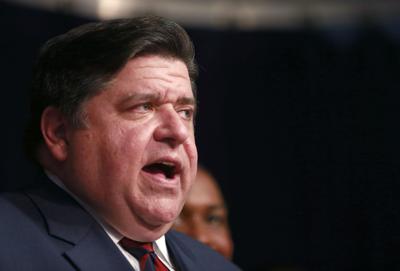
Gov. J.B. Pritzker speaks during a bill signing Wednesday, June 5, 2019 at the Thompson Center in downtown Chicago.
Amr Alfiky / AP Photo
Illinois is sending its largest contingent of National Guard troops in about a decade to Afghanistan.
Nearly 400 troops with the 178th Infantry Regiment left over the weekend. They will stop in Texas for training, then they will spend the next year or in Afghanistan as part of Operation Freedom's Sentinel.
It's the first time Illinois Gov. J.B. Pritzker has sent troops overseas. And it's the largest deployment to Afghanistan for the Illinois Guard in almost 10 years.
"Serving as Commander and Chief of Illinois' citizen soldiers is a humbling endeavor for me because you represent the very best of this state," Pritzker said over the weekend. "The service you and your families give every day to the people of Illinois, that service to defend this nation, will always be a source of inspiration and respect."
The 178th is mainly based in the Chicago area, but members from as far south as Joliet and as far north as Woodstock are also part of the regiment.
Lt. Co. Matt Garrison said the troops will be providing security for coalition forces in Afghanistan.
"Know that this unit and this battalion is ready to meet the mission in Afghanistan," Garrison said. "We have the training, we have the right personnel, and we have the equipment to accomplish the mission."
Garrison said the troops will spend about a year in Afghanistan.

Wood Dale police officer Thomas Nickelson on Friday, his last day on duty before he will be deployed to Afghanistan with the Illinois Army National Guard. He will be on an overseas mission for at least the next year. Courtesy of Wood Dale Police Department
The largest mobilization of Illinois Army National Guardmen in nearly a decade, including from companies in Elgin and Woodstock, starts Saturday.
The guardsmen are with the 1st Battalion, 178th Infantry Regiment headquartered in Chicago and including companies in Elgin, Woodstock, Chicago, Bartonville and Kankakee, and a detachment in Joliet, said Barbara Wilson, public affairs specialist for the Illinois Army National Guard.
The guardsmen are being mobilized in support of Operation Freedom's Sentinel, which followed the Operation Enduring Freedom combat mission in Afghanistan and was designed to focus on training and counterterrorism efforts. They will train at Fort Bliss, Texas, before deploying to Afghanistan.
A mobilization ceremony takes place at 10 a.m. Saturday at Elgin Community College, 1700 Spartan Drive, Elgin, and another one at 4 p.m. Saturday at Woodstock High School, 501 W. South St., Woodstock.
Other ceremonies take place Sunday in Chicago and Kankakee, and Monday in Peoria.
Among those deployed is Wood Dale police officer Thomas Nickelson, whom the Wood Dale Police Department feted Friday.
"Today we were honored to thank Ofc. Nickelson for his service during his upcoming deployment with the U.S. Army," the department posted on Facebook. "He will be on an overseas mission for at least the next year. Today was his last day on the street prior to his report date this weekend."
"We look forward to welcoming him back to our family when he completes his tour of duty."
Above is from: https://www.dailyherald.com/news/20190726/suburbanites-among-the-400-illinois-army-national-guardsmen-off-to-afghanistan