Thursday, January 17, 2019

County t0 use “special action” on the Plote Case

Based upon legal advise from a consulting attorney, Ancel Glick,LLP, Boone County will rework the Plote case and attempt to special “text amendment” the current gravel pit into legal operations.  The consultant’s complete memorandum is available at:  https://www.boarddocs.com/il/boone/Board.nsf/files/B8GPEV5814ED/$file/Plote%20Text%20Amendment%20Boone%20County%20Code.pdf

The following is from page 5 of that memorandum: 

Conclusion

In sum (summary) although the County appeared to follow the procedural requirement in granting a special use permit to Plote to operate the quarry use on the Property, that use was not an authorized use in the A1 district at the time the special use was approved. The parties could not agree to “authorize” that use through the Settlement Agreement or Consent Order because Illinois case law requires the procedural requirements for zoning approvals be followed even in settling land use litigation or disputes. One option to address this issue is to amend the CZO to expressly authorize this use in the A1 district as a special use. Should the County want to avoid opening the special use up to all properties in the A-1 district, it could add certain limiting language to the clarifying conditions in the Table of Permitted Uses.


The quarry use of the property never was authorized because the use was not an authorized use for a A-1(agricultural) district. So one option is for the county to amend the text and now allow such operation by special use in an A1 district.  But limit the provision so that only Plote will qualify.  This appears to be what the county is doing as the case is being sent back for hearings etc. as a text amendment to the A-1.

The real costs of Trump Tariffs


Trump’s Tariffs Are Producing Billions, But China Isn’t Paying

Mark Niquette

,

Bloomberg

January 17, 2019

  • Trump’s Tariffs Are Producing Billions, But China Isn’t Paying

  • Trump’s Tariffs Are Producing Billions, But China Isn’t Paying

1 / 2

Trump’s Tariffs Are Producing Billions, But China Isn’t Paying

(Bloomberg) -- President Donald Trump is right to say that his tariffs are generating billions of dollars for the U.S. But China and other countries aren’t paying them as he’s suggested.

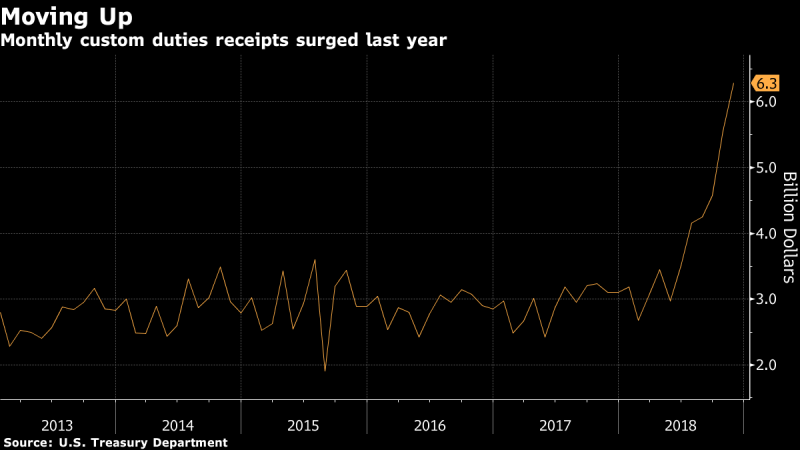
According to data from U.S. Customs and Border Protection, more than $13 billion in duties imposed by the Trump administration were assessed on imported goods as of Dec. 18. Actual collections could lag and be lower because of refunds and other factors, but Treasury Department reports show receipts from all customs duties have risen sharply since the tariffs took effect.

While Trump has suggested on Twitter and in public comments that tariffs are somehow being charged to or paid by China and other countries, trade economists say that’s generally misleading. U.S. importers of record are responsible for the duties, and ultimately U.S. businesses and consumers could pay through higher costs, they say.

Trump is “suggesting this is bringing in lots of new revenue and all of the burden is falling on the Chinese,’’ said Phil Levy, senior fellow on the global economy at the Chicago Council on Global Affairs and a former senior economist for trade for President George W. Bush’s Council of Economic Advisers. “I think that’s mostly false.’’

Trump Tax

Johns Hopkins University applied economics professor Steve Hanke, a member of the Council of Economic Advisers under President Ronald Reagan, put it more bluntly.

“Tariffs on Chinese imports are paid by Americans, not by the Chinese or their government. The President’s tariffs are simply a #tax on American consumers,’’ Hanke said on Twitter Jan. 6.

Hanke also pointed out that there are offsets to increased revenue from Trump’s tariffs, including as much as $12 billion in aid being paid to farmers after China slapped retaliatory tariffs on U.S. agricultural products.

The White House didn’t respond to messages seeking comment. Trump has said any economic pain from tariffs or retaliatory duties imposed by other countries will be outweighed by the long-term benefits from new trade deals.

The Trump administration imposed tariffs starting last January on foreign-made solar equipment and washing machines, then levied duties on steel and aluminum imports from March on the grounds of national security. He has slapped duties on about $250 billion in Chinese goods in response to a trade deficit and allegations of intellectual property theft and other unfair trade practices.

Customs and Border Protection collects the tariffs based on the price paid for shipments and the tariff rate in effect, and duties are charged when shipments are released into the U.S. The assessed amount now tops $13 billion, with $8 billion coming from the duties on Chinese goods, data provided by CBP show.

The duties are deposited in the U.S. Treasury. Customs duties increased by $8 billion in the final three months of 2018, an 83 percent gain from the year-ago period thanks in large part to tariffs imposed by Trump, according to estimates from the non-partisan Congressional Budget Office.

Trump’s comments have suggested the U.S. is benefiting without paying, such as a Jan. 3 tweet that “the United States Treasury has taken in MANY billions of dollars from the Tariffs we are charging China and other countries that have not treated us fairly.” A day later he told reporters that “we’ve taken in billions and billions of dollars in tariffs from China and from others.’’

It’s not foreign governments paying, said Dan Anthony, vice president of The Trade Partnership, an economic consulting firm. U.S. businesses paid $2.8 billion in new Trump tariffs in October alone, The Trade Partnership determined in an analysis for Tariffs Hurt the Heartland, a coalition of business and agricultural groups lobbying against Trump’s duties.

Companies aren’t equivocating about the cost. Ford Motor Co. executives, speaking during the Deutsche Bank Global Automotive Conference in Detroit on Wednesday, said they see a $700 million headwind from duties this year. General Motors Co. said late last year that tariffs on steel and aluminum had already cost it $1 billion.

“Let me be very clear: Tariffs are taxes paid by American families and American businesses -- not by foreigners,’’ Thomas Donohue, president of the U.S. Chamber of Commerce, said in his annual state of American business address last week.

To contact the reporter on this story: Mark Niquette in Columbus at mniquette@bloomberg.net

To contact the editors responsible for this story: Sara Forden at sforden@bloomberg.net, Sarah McGregor, Randall Woods

For more articles like this, please visit us at bloomberg.com

Above is from:  https://finance.yahoo.com/news/morning-brief-remembering-jack-bogle-father-of-the-index-fund-112016276.html

Wednesday, January 16, 2019

SHOPCO in Belvidere to stay open


Shopko files for Chapter 11 bankruptcy, announces more closures

Wisconsin-based retail chain Shopko, which filed for Chapter 11 bankruptcy Wednesday, does not have plans to close several stores in the Stateline.

Shopko operates stores in Beloit, Belvidere, Dixon and Freeport. None of these locations were part of Shopko's list of closing stores.

According to the list, Shopko plans to close around 100 stores by April 2019. The company plans to close 16 stores is Wisconsin, including locations in Green Bay, Madison and Manitowoc.

------

Previous stories

(WIFR) -- Wisconsin-based retail chain Shopko, which operates stores in Beloit, Belvidere, Freeport and Dixon, officially files for bankruptcy Wednesday.

The company announced Wednesday its need for financial restructuring due to excessive debt and competition.

Shopko is closing an extra 38 locations and relocating 20 optical centers to freestanding locations.

"We have had to make some very tough choices, but we are confident
that by operating a smaller and more focused store footprint, we will be able to build a stronger Shopko," said Shopko CEO Russ Steinhorst.

Information is not yet available whether store locations in Freeport, Belvidere or Beloit are affected by the closures.

------

Previous story

(AP) -- McKesson Corp., pharmaceutical drug supplier to Shopko, says it supplied Shopko with $67 million in drugs since Nov. 11 but had not been paid since early December.

McKesson asked a judge for a restraining order this week to keep Shopko from selling the medications it has supplied. McKesson attorney Jeff Garfinkle said during a court hearing that Shopko is expected to file for bankruptcy protection Jan. 15.

Press-Gazette Media says Shopko attorney Stephen Hackney says a restraining order would require the retailer to close its pharmacies and would harm patients who need the medications.

Above is from:  https://www.wifr.com/content/news/Shopko-expected-to-file-for-bankruptcy-next-week-504107021.html


Email to customers:
January 16, 2019
To:       Shopko Customers
Re:      Important Information Regarding Shopko’s Restructuring
Since 1962, Shopko has provided quality name-brand merchandise, great values and services to small and mid-size cities and have consistently met the needs of smaller communities across the Central, Western and Pacific Northwest regions of the U.S.
Over the past several months, we have been taking action to drive improved performance and strengthen Shopko’s financial position. Today, Shopko took an important step towards protecting our future and ensuring our ability to continue delivering the high-quality products and services that our customers are accustomed to receiving.
WHAT THIS MEANS FOR YOU: WE ARE OPEN FOR BUSINESS

  • Our continuing stores are open. We continue to offer the high-quality products that you are accustomed to.
  • Our customer programs will be offered as normal at our continuing stores. Except for those stores that we are closing, we are continuing to honor return policies, warranties, gift cards and merchandise credits, as well as our loyalty programs.
  • You can continue to count on our high-quality products and services.

Today's announcement provides clarity about the path forward for us, and we are confident the outcome will be a stronger Shopko for you, our valued customers, through the process.
If you have questions about this process, you can find FAQ’s and additional information on a special page on our website at
http://info.shopko.com.
We will be sure to communicate with you throughout our reorganization and give regular updates as important decisions and major developments take place.
Sincerely,

Russ Steinhorst signature


Russ Steinhorst, SHOPKO CEO

Tuesday, January 15, 2019

Judge bars citizenship question from 2020 census


LARRY NEUMEISTER

,

Associated PressJanuary 15, 2019

NEW YORK (AP) — The Trump administration cannot put a question about citizenship status on the 2020 census, a federal judge in New York ruled Friday in a boost to proponents of counting immigrants.

In a 277-page decision that won't be the final word on the issue, U.S. District Judge Jesse Furman ruled that while such a question would be constitutional, Commerce Secretary Wilbur Ross had moved to add it to the census arbitrarily and had not followed proper administrative procedures.

"He failed to consider several important aspects of the problem; alternately ignored, cherry-picked, or badly misconstrued the evidence in the record before him; acted irrationally both in light of that evidence and his own stated decisional criteria; and failed to justify significant departures from past policies and practices," Furman wrote.

Among other things, the judge said, Ross didn't follow a law requiring that he give Congress three years notice of any plan to add a question about citizenship to the census.

The ruling came in a case in which a dozen states or big cities and immigrants' rights groups argued that the Commerce Department, which designs the census, had failed to properly analyze the effect the question would have on households where immigrants live.

A separate suit on the same issue, filed by the state of California, is underway in San Francisco.

The U.S. Supreme Court is also poised to address the issue Feb. 19, meaning the legal issue is far from decided for good.

In the New York case, the plaintiffs accused the administration of Republican President Donald Trump of adding the question to intentionally discourage immigrants from participating, which could lead to a population undercount — and possibly fewer seats in Congress — in places that tend to vote Democratic.

Even people in the U.S. legally, they said, might dodge the census questionnaire out of fears they could be targeted by a hostile administration.

The Justice Department argued that Ross had no such motive and acted properly after consulting with Census Bureau staff members and others.

When Ross announced the plan in March, he said the question was needed in part to help the government enforce the Voting Rights Act, a 1965 law meant to protect political representation of minority groups.

Ross said politics played no role in the decision, initially testifying under oath that he hadn't spoken to anyone in the White House on the subject.

Later, however, Justice Department lawyers submitted papers saying Ross remembered speaking in spring 2017 about adding the question with former senior White House adviser Steve Bannon and with then-Attorney General Jeff Sessions.

The U.S. Supreme Court blocked Ross from being deposed, but let the trial proceed, over the objections of Justices Samuel Alito, Clarence Thomas and Neil Gorsuch.

In a dissent on one of two Supreme Court orders related to the case, Gorsuch wrote there was "nothing unusual about a new cabinet secretary coming to office inclined to favor a different policy direction, soliciting support from other agencies to bolster his views, disagreeing with staff, or cutting through red tape."

"Of course, some people may disagree with the policy and process," he wrote. "But until now, at least, this much has never been thought enough to justify a claim of bad faith and launch an inquisition into a cabinet secretary's motives."

The constitutionally mandated census is supposed to count all people living in the U.S., including noncitizens and immigrants living in the country illegally.

The Census Bureau's staff estimated that adding a citizenship question could depress responses in households with at least one noncitizen by as much as 5.8 percent. That could be particularly damaging in states like New York or California, which have large immigrant populations.

Justice Department lawyers argued that the estimate was overblown and that, even if they were true, that didn't mean Ross exceeded his legal authority in putting the question on anyway.

Above is from: https://news.yahoo.com/judge-bars-citizenship-2020-census-150010751.html?.tsrc=bell-brknews

Monday, January 14, 2019

Belvidere North High School students propose backyard chickens ordinance


Local high school students look to change a law that's been in place for decades in Belvidere.

image


Click on the following to see TV Clip: https://www.wifr.com/content/news/Belvidere-backyard-chickens-ordinance-504350141.html


BELVIDERE, Ill (WIFR) -- The city of Belvidere prohibits chickens to be raised on residential properties. While this law has been in effect for decades, some local high school students are looking to change that. The students want to prove the myths wrong about chickens being a nuisance, such as being loud and quite dirty.

Two students from Belvidere North High School have a proposed ordinance on the city council agenda that would allow Belvidere residents to own and raise chickens on their property. Gina DelRose, Community Development Planner for the City of Belvidere, says this isn't the first time students contacted the city and the ordinance still has a long way to go.

She says, "At the beginning of this school year, the students contacted me again. They are very passionate about chickens and think they're a great thing to have in your backyards, the fresh eggs and just interacting with the chickens themselves are all beneficial. They thought they could try and get the city of Belvidere to allow them."

Residents in bigger cities such as Chicago, New York, and Los Angeles can keep chickens. Around the Rock River Valley, attempts have been made in the past to make chicken coops legal in residential lots. However, these attempts have failed.

In 2013, the Village Board in Machesney Park rejected a proposal to allow chicken hen coops where up to six hens can live on a single residential lot. The City of Rockford also does not allow chickens in residential neighborhoods. In Roscoe, roosters are prohibited but chickens are allowed as long as the chickens on residential lots don't produce noise loud enough to disturb the noise ordinances of local neighborhoods.

The Belvidere North students proposal would minimize nuisances by banning crowing roosters over six months old and limiting the number of chickens allowed on a single lot to five.

The ordinance will be on the Belvidere city council agenda at their next meeting.

Trump promises on coal, steel and China trade are all falling flat


David Knowles

Editor

,

Yahoo NewsJanuary 14, 2019

President Trump speaks at the American Farm Bureau Federation’s 100th annual convention in New Orleans on Monday. (Photo: Jacquelyn Martin/AP)

More

While President Trump regularly boasts that he has singlehandedly saved the U.S. coal and steel industries after years of decline while simultaneously tackling America’s trade imbalance with China, new data shows none of those claims to be true.

Trade deficit with China

The president has long argued that the quickest way to rectify a massive trade imbalance between the United States and China is to impose tariffs on Chinese imports.

Donald J. Trump

@realDonaldTrump

China is robbing us blind in trade deficits and stealing our jobs, yet our leaders are claiming 'progress' http://reut.rs/Ub64mP SAD!

79

2:51 PM - Dec 20, 2012

Twitter Ads info and privacy

427 people are talking about this

“Trade wars are good and easy to win,” he tweeted last March.

In an address Monday to the American Farm Bureau Federation, Trump said his negotiations with China were “going very well,” but figures released Monday by the Chinese government showed that his plan isn’t working. Instead the U.S. trade deficit with China grew 17 percent in 2018, to a record $323.32 billion. Over the past year, as Trump launched a trade war with Beijing, Chinese exports to the U.S. grew by 11.3 percent, while China’s imports of American goods rose just 0.7 percent. American farmers have borne the biggest short term brunt of Trump’s policies, with U.S. soybean exports to China falling 98 percent in 2018 as Beijing retaliated against tariffs imposed by the president.

Steel

“Our Steel Industry is the talk of the World. It has been given new life, and is thriving. Billions of Dollars is being spent on new plants all around the country!”

A 25 percent tariff on imports led to a temporary spike in steel prices last year but also hurt sales and profits at companies that buy steel, such as General Motors. And as manufacturers substituted other materials or cut production, steel prices have fallen back to where they were before the tariffs and stock prices for the largest U.S. producers fell by as much as 47 percent, the New York Timesreported Monday. While Trump rightly notes that some companies have announced plans to either build new steel mills or refurbish existing ones, his most frequent and extravagant boast — that “U.S. Steel just announced that they’re building six new steel mills” — has no basis in fact.

Industry experts point out that employment in the steel industry will almost certainly continue to decline as a consequence of automation, even if production and profits increase. As the conservative think tank AEI points out, “Mr. Trump’s tariffs are trying to revive a world of steel production that no longer exists. He is taxing steel-consuming industries that employ 6.5 million and have the potential to grow more jobs to help a declining industry that employs only 140,000.”

Perhaps this explains why Trump has warmed to the idea of constructing a border wall on the U.S. border with Mexico out of steel rather than concrete. In an interview with NPR, Tom Gibson, president and CEO of the American Iron and Steel Institute estimated that the barrier would require a hefty order of 3 million tons of steel.

Coal

“You know what you can’t hurt? Coal. You can do whatever you want to coal. Very important. … We are back. The coal industry is back.” — President Trump at a 2018 rally in Charleston, W.V.

After running in 2016 on a promise to save the coal industry, Trump was, after being elected, quick to proclaim victory on that score. He signed legislation overturning environmental regulations put in place during the Obama administration that industry opposed. And he tweeted in celebration when a Pennsylvania mine opened for business.

Donald J. Trump

@realDonaldTrump

Congratulations!
'First New Coal Mine of Trump Era Opens in Pennsylvania' http://insider.foxnews.com/2017/06/10/new-coal-mine-donald-trump-pennsylvania-fossil-fuels-regulations …


First New Coal Mine of Trump Era Opens in Pennsylvania

President Trump lauded the opening of the nation's first new coal mine in recent memory.

insider.foxnews.com


But an analysis of coal-fired power plants in the U.S. found that the industry as a whole continues its downward trajectory. In fact, more coal-fired power plants have closed during the first two years of Trump’s presidency than in all of former President Barack Obama’s first term, Reuters reported Monday.

Above is from: https://www.yahoo.com/news/trump-promises-coal-steel-china-trade-falling-flat-235120673.html

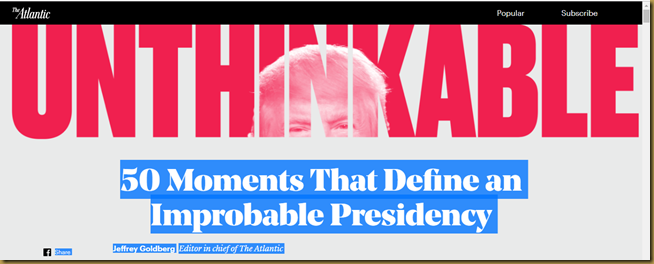
50 Moments That Define an Improbable Presidency


image


Jeffrey Goldberg

Editor in chief of The Atlantic


In an October 2016 editorial, The Atlantic wrote of Donald Trump: “He is a demagogue, a xenophobe, a sexist, a know-nothing, and a liar.” We argued that Trump “expresses admiration for authoritarian rulers, and evinces authoritarian tendencies himself.” Trump, we also noted, “is easily goaded, a poor quality for someone seeking control of America’s nuclear arsenal. He is an enemy of fact-based discourse; he is ignorant of, and indifferent to, the Constitution; he appears not to read.”

In retrospect, we may be guilty of understatement.

There was a hope, in the bewildering days following the 2016 election, that the office would temper the man—that Trump, in short, would change.

He has not changed.

This week marks the midway point of Trump’s term. Like many Americans, we sometimes find the velocity of chaos unmanageable. We find it hard to believe, for example, that we are engaged in a serious debate about whether the president of the United States is a Russian-intelligence asset. So we decided to pause for a moment and analyze 50 of the most improbable, norm-bending, and destructive incidents of this presidency to date.

Our 2016 editorial was a repudiation of Donald Trump’s character as much as it was an endorsement of Hillary Clinton for president. It was not meant to be partisan. The Atlantic’s founders promised their readers that we would be “of no party or clique.” This remains a core governing principle of the magazine today. What follows is a catalog of incidents, ranked—highly subjectively!—according to both their outlandishness and their importance. In most any previous presidency, Democratic or Republican, each moment on this list would have been unthinkable.


50.

Donald Trump touches the magic orb

By James Parker

49.

A Cabinet officer likes private planes too much

By Elaina Plott

48.

The president praises the congressman who body-slammed a reporter

By David French

47.

An overcompensating press secretary lies about crowd size

By Megan Garber

46.

Trump tells the Boy Scouts about a hot New York party

By Yoni Appelbaum

45.

A name-calling feud ends with the secretary of state’s ouster by tweet

By Yara Bayoumy

44.

The WikiLeaks president goes silent

By George Packer

43.

The nation loses its consoler in chief

By James Fallows

42.

The first president to complain about an election he won

By David Graham

41.

Trump waits 19 months to pick his science adviser

By Ed Yong

40.

The president’s most trusted adviser is his own gut

By Sarah Zhang

39.

A White House economist creates facts for the president

By Tom Nichols

38.

Trump holds a top secret confab on the Mar-a-Lago dining terrace

By Ian Bogost

37.

The president just wants to go home

By Vauhini Vara

36.

Trump threatens to strip security clearances from his critics

By David Frum

35.

Mueller’s “witch hunt” is good at finding witches

By Ciara Torres-Spelliscy

34.

Trump leads the country to the longest government shutdown in American history

By Saahil Desai

33.

The chief justice of the United States corrects the president

By Scott Stossel

32.

Trump disseminates Soviet propaganda

By Kori Schake

31.

The White House punishes a CNN reporter for asking questions

By Emily Bell

30.

The buck stops over there

By Kathy Gilsinan

29.

The president tries to kick transgender service members out of the military

By Matt Thompson

28.

Trump tweets the wisdom of Mussolini

By Krishnadev Calamur

27.

Turkish agents assault protesters near the White House

By Don Peck

26.

Trump helps the Saudis cover up a murder

By Lyse Doucet

25.

“We’re gonna have the cleanest air”

By Robinson Meyer

24.

The president can’t stop talking about carnage

By Rebecca J. Rosen

23.

America gets a first daughter

By Caitlin Flanagan

22.

The UN General Assembly laughs at the president

By Rachel Donadio

21.

Rain stops Trump from honoring the dead

By Eliot A. Cohen

20.

The president learns about separation of powers

By Russell Berman

19.

The president learns about the Justice Department

By Natasha Bertrand

18.

The president lies constantly

By Angie Drobnic Holan

17.

Trump threatens to press his “nuclear button”

By Uri Friedman

16.

Public humiliation comes for everyone in the White House

By Alex Wagner

15.

The CIA dead become a TV prop

By Vernon Loeb

14.

You know you’re in a constitutional crisis when...

By Quinta Jurecic

13.

Trump mocks Christine Blasey Ford to a cheering crowd

By McKay Coppins

12.

A new term enters the presidential lexicon: “shithole countries”

By Ibram X. Kendi

11.

Trump throws paper towels at Puerto Ricans

By Vann R. Newkirk II

10.

“I have the absolute right to pardon myself”

By Garrett Epps

9.

Covfefe

By Adrienne LaFrance

8.

The president calls his porn-star ex-paramour “horseface”

By Sophie Gilbert

7.

Trump picks the wrong countries for his travel ban

By Hannah Giorgis

6.

Trump declares war on black athletes

By Jemele Hill

5.

James Comey is fired

By Benjamin Wittes

4.

Putin and Trump talk without chaperones

By Franklin Foer

3.

The president still hasn’t released his tax returns

By Annie Lowrey

2.

“Very fine people on both sides”

By Adam Serwer

1.

Children are taken from their parents and incarcerated

By Ashley Fetters

Read these 50 opinion pieces at:  https://www.theatlantic.com/unthinkable/?utm_source=promotional-email&utm_medium=email&utm_campaign=unthinkable-prospects&utm_content=20190114&utm-term=unthinkable&silverid-ref=MzEwMTkxMTU2MjQxS0