Saturday, September 8, 2018

Vulnerability in America’s lower income brackets poses a risk to the economy


Sheila Bair 4 hours ago

Vulnerability in America’s lower income brackets poses a risk to the economy

Image: US Marines

Sheila Bair, former chair of the FDIC, will appear at Yahoo Finance’s All Markets Summit on Sept. 20.

There are lies, damn lies, and then there are statistics. This famous saying popularized by American humorist Mark Twain aptly describes the current use of economic statistics to paint an overly rosy picture of our economic health.

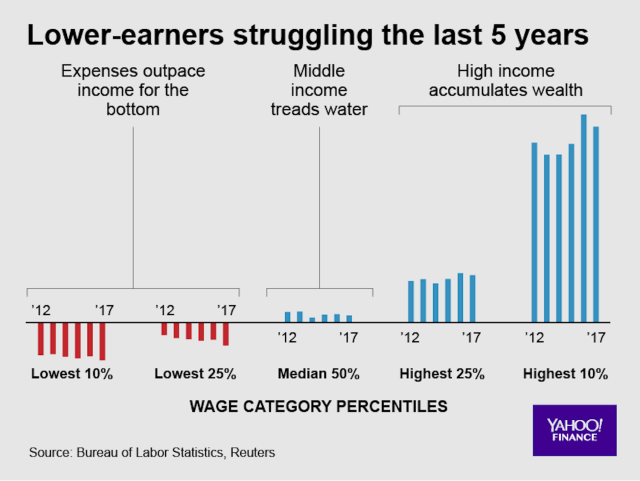
Too often, we rely on aggregate numbers or averages which camouflage the uneven distribution of economic progress (or lack thereof) among lower income families. For instance, the use of aggregates in calculating GDP masks the fact that those economic gains remain heavily skewed toward the rich. Similarly, the use of averages in reporting wage gains conceals distortions caused by booming wages among higher paid workers and the fact that by traditional measures, hourly real wages for most middle-class workers have slightly declined.
Credit: David Foster/Yahoo Finance

This same type of distortion was at work in some recent Wall Street analysis of statistics released by the New York Fed on household borrowing. The NY Fed reported that household borrowing had hit a new peak of $13.29 trillion in the second quarter of 2018, far surpassing its peak of $12.68 trillion in the frothy years preceding the financial crisis. Some analysts argued that this was actually good news because while household borrowing was up, so was consumers’ disposable (after-tax) income, which hit $15.46 trillion in the second quarter.

This put the debt-to-income ratio (DTI) at 86%, significantly lower than its all-time high of 116% in 2008 at the peak of the housing bubble. Thus, American households were financially healthy and had plenty of room to borrow even more, or so the argument went.

Lower-income groups have more trouble paying off debt

It is true that household debt in nominal dollars doesn’t tell you whether American households are over-extended without comparing that debt to the income available to repay it. However, to use the go-go years leading up to the crisis as the benchmark for sustainable rates of household borrowing is questionable, to say the least. In fact, household DTI’s were substantially lower than today’s levels throughout the post-war years. It wasn’t until the early 2000s that they started to escalate with the subprime lending craze. So by historical norms, even at 86%, household DTIs are quite high.

More importantly, aggregate debt-to-income ratios tell us little about the affordability of that debt among various income levels. Rich people may be borrowing a lot but then, they can afford it. Lower income households living near subsistence have scant capacity to absorb any debt. Unfortunately, detailed data about household borrowing among income groups is notoriously difficult to obtain.
Credit: David Foster/Yahoo Finance

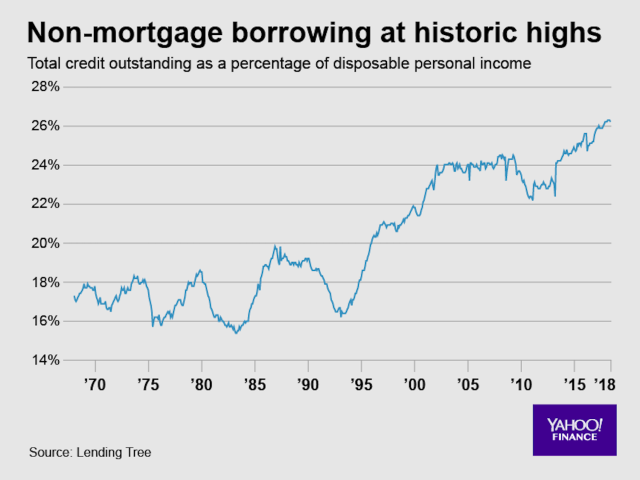
The New York Fed does provide some data on household debt growth rates by income level. This data show that non-mortgage household borrowing (primarily credit cards, auto, and student loans) has grown significantly over the past 5 years among lower income families, while mortgage loans have declined. Mortgage lending standards have tightened since the crisis, but now those families may be getting in over their heads with non-mortgage borrowing. Indeed, non-mortgage debt has grown by a whopping 38% over the past 5 years and its ratio to disposable income is even higher than during the pre-crisis years.

Another statistic Wall Street analysts have cited to argue that American households are not over-borrowing is the sharp increase in household net-worth relative to income, a common measure of balance sheet health. However, here again, to get an accurate picture, you must get behind aggregate numbers and look at the distribution of wealth by income level.

Credit: David Foster/Yahoo Finance

A more sophisticated analysis by Deutsche Bank found that net-worth to income ratios are distorted by rich households who have benefited mightily from appreciating home prices and an exuberant stock market. Net-worth to income ratios have actually fallen for households at all income levels except for the top 10%. The Deutsche analysis also found that “leverage”— the ratio of a family’s debt to its assets — had increased significantly for households in the bottom 40% of income, while decreasing for families in the upper income tiers. Given the massive loss of home ownership following the crisis among low- and middle-income families and their lack of equity ownership, they now have little in the way of assets to buffer them against financial stress. These lower income families are more fragile than ever, suffering from increased debt, stagnant or declining wages, and lack of assets.
Credit: David Foster/Yahoo Finance

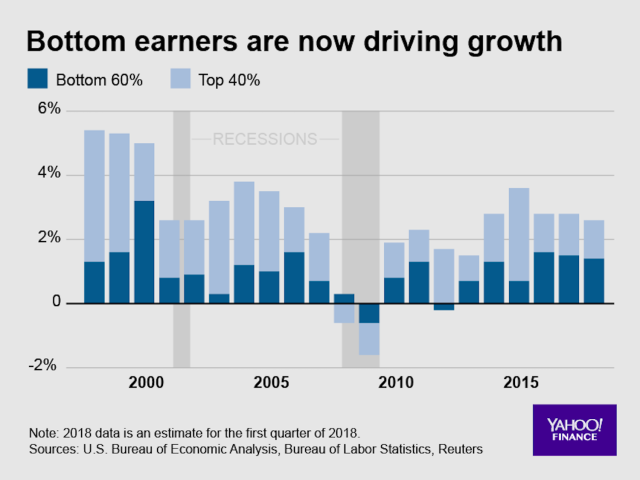
While noting these troubling trends among lower income families, Deutsche analysts concluded that they would not pose a threat to consumer spending as wealthier households represent a greater share of total consumption. However, a recent Reuters analysis reached a different conclusion, finding that spending by the bottom 60% of earners has accounted for most of the rise in consumer spending over the past two years. This breaks a decades-old trend of upper income households accounting for the lion’s share of consumer spending and portends trouble for the economy, as consumer spending accounts for over two-thirds of GDP growth. Reuters also found that spending increases among lower income households far outpaced their meager wage gains and that given their scant savings, they were presumably funding much of this increased consumption with debt.

The financial resilience of our lower income households matters to the health of our overall economy. It also matters to our financial stability. Rapid growth in consumer debt, particularly among economically distressed populations, can be a harbinger of recession and financial crisis. A growing body of research, led by the International Monetary Fund and others, shows that while high levels of consumer borrowing can provide short-term stimulus to an economy, in the long term, it will slow growth and risk financial crisis. As overburdened households are eventually forced to curb consumer spending to service their debt, the economy will slow and defaults will increase, leading banks to pull back on credit — severely if the banks themselves are over leveraged and lack the capacity to absorb credit losses. This is precisely the cycle we experienced in 2008.

Things are not as bad as they were during the subprime crisis — yet. But if we are to avoid repeating the mistakes of the past, we need to stop deluding ourselves with Twain’s damnable statistics. We need a clear-eyed understanding of the fragile financial condition of our most vulnerable households with better data and policies that would increase their disposable income. Regressive payroll taxes, high health care premiums, escalating education costs, poorly designed means testing of programs — all weigh on the purchasing power of working families and cry out for forceful policy responses. 

We cannot keep trying to fulfill working families’ financial needs with more and more consumer borrowing. Economic growth sustained by broadly shared prosperity will be lasting. Growth supported by unaffordable debt will eventually collapse. 


Sheila Bair is the former Chair of the FDIC and has held senior appointments in both Republican and Democrat Administrations. She currently serves as a board member or advisor to a several companies and is a founding board member of the Volcker Alliance, a nonprofit established to rebuild trust in government.

Above is fromhttps://www.yahoo.com/finance/news/vulnerability-americas-lower-income-brackets-poses-risk-economy-122920739.html

Friday, September 7, 2018

Opinion on Rep Adam Kinzinger

image

Opinions need more than a 'small space'

By Susan Kerr Dixon

Sept. 4, 2018

I recently received a mailing from my 16th District representative to the U.S. House of Representatives, Adam Kinzinger, asking my opinion on two very important issues dealing with immigration and opioid addiction.

I was asked to select “yes” or “no” with a very small space to write my opinion.

I do have opinions and questions and would appreciate the opportunity to hear his response. Unfortunately, Rep. Kinzinger will not appear in an open forum.

How can representative democracy survive if open exchange of information between a representative and his constituency isn’t happening?


Above is from:  http://www.saukvalley.com/2018/08/22/opinions-need-more-than-a-small-space/ax5ydp8/

Wednesday, September 5, 2018

“I Am Part of the Resistance Inside the Trump Administration”


image

Opinion

I Am Part of the Resistance Inside the Trump Administration

I work for the president but like-minded colleagues and I have vowed to thwart parts of his agenda and his worst inclinations.

Sept. 5, 2018

The Times today is taking the rare step of publishing an anonymous Op-Ed essay. We have done so at the request of the author, a senior official in the Trump administration whose identity is known to us and whose job would be jeopardized by its disclosure. We believe publishing this essay anonymously is the only way to deliver an important perspective to our readers. We invite you to submit a question about the essay or our vetting process here.


President Trump is facing a test to his presidency unlike any faced by a modern American leader.

It’s not just that the special counsel looms large. Or that the country is bitterly divided over Mr. Trump’s leadership. Or even that his party might well lose the House to an opposition hellbent on his downfall.

The dilemma — which he does not fully grasp — is that many of the senior officials in his own administration are working diligently from within to frustrate parts of his agenda and his worst inclinations.

I would know. I am one of them.

To be clear, ours is not the popular “resistance” of the left. We want the administration to succeed and think that many of its policies have already made America safer and more prosperous.

But we believe our first duty is to this country, and the president continues to act in a manner that is detrimental to the health of our republic.

That is why many Trump appointees have vowed to do what we can to preserve our democratic institutions while thwarting Mr. Trump’s more misguided impulses until he is out of office.

The root of the problem is the president’s amorality. Anyone who works with him knows he is not moored to any discernible first principles that guide his decision making.

Although he was elected as a Republican, the president shows little affinity for ideals long espoused by conservatives: free minds, free markets and free people. At best, he has invoked these ideals in scripted settings. At worst, he has attacked them outright.

In addition to his mass-marketing of the notion that the press is the “enemy of the people,” President Trump’s impulses are generally anti-trade and anti-democratic.

Don’t get me wrong. There are bright spots that the near-ceaseless negative coverage of the administration fails to capture: effective deregulation, historic tax reform, a more robust military and more.

But these successes have come despite — not because of — the president’s leadership style, which is impetuous, adversarial, petty and ineffective.

From the White House to executive branch departments and agencies, senior officials will privately admit their daily disbelief at the commander in chief’s comments and actions. Most are working to insulate their operations from his whims.

Meetings with him veer off topic and off the rails, he engages in repetitive rants, and his impulsiveness results in half-baked, ill-informed and occasionally reckless decisions that have to be walked back.

“There is literally no telling whether he might change his mind from one minute to the next,” a top official complained to me recently, exasperated by an Oval Office meeting at which the president flip-flopped on a major policy decision he’d made only a week earlier.

The erratic behavior would be more concerning if it weren’t for unsung heroes in and around the White House. Some of his aides have been cast as villains by the media. But in private, they have gone to great lengths to keep bad decisions contained to the West Wing, though they are clearly not always successful.

It may be cold comfort in this chaotic era, but Americans should know that there are adults in the room. We fully recognize what is happening. And we are trying to do what’s right even when Donald Trump won’t.

The result is a two-track presidency.

Take foreign policy: In public and in private, President Trump shows a preference for autocrats and dictators, such as President Vladimir Putin of Russia and North Korea’s leader, Kim Jong-un, and displays little genuine appreciation for the ties that bind us to allied, like-minded nations.

Astute observers have noted, though, that the rest of the administration is operating on another track, one where countries like Russia are called out for meddling and punished accordingly, and where allies around the world are engaged as peers rather than ridiculed as rivals.

On Russia, for instance, the president was reluctant to expel so many of Mr. Putin’s spies as punishment for the poisoning of a former Russian spy in Britain. He complained for weeks about senior staff members letting him get boxed into further confrontation with Russia, and he expressed frustration that the United States continued to impose sanctions on the country for its malign behavior. But his national security team knew better — such actions had to be taken, to hold Moscow accountable.

This isn’t the work of the so-called deep state. It’s the work of the steady state.

Given the instability many witnessed, there were early whispers within the cabinet of invoking the 25th Amendment, which would start a complex process for removing the president. But no one wanted to precipitate a constitutional crisis. So we will do what we can to steer the administration in the right direction until — one way or another — it’s over.

The bigger concern is not what Mr. Trump has done to the presidency but rather what we as a nation have allowed him to do to us. We have sunk low with him and allowed our discourse to be stripped of civility.

Senator John McCain put it best in his farewell letter. All Americans should heed his words and break free of the tribalism trap, with the high aim of uniting through our shared values and love of this great nation.

We may no longer have Senator McCain. But we will always have his example — a lodestar for restoring honor to public life and our national dialogue. Mr. Trump may fear such honorable men, but we should revere them.

There is a quiet resistance within the administration of people choosing to put country first. But the real difference will be made by everyday citizens rising above politics, reaching across the aisle and resolving to shed the labels in favor of a single one: Americans.

The writer is a senior official in the Trump administration.

Follow The New York Times Opinion section on Facebook and Twitter (@NYTopinion).


Above is from:  https://www.nytimes.com/2018/09/05/opinion/trump-white-house-anonymous-resistance.html

Monday, September 3, 2018

What President Trump can get away with?


image


Opinion

What if Trump Did Actually Shoot Someone on Fifth Avenue?


Thomas L. Friedman

By Thomas L. Friedman

Opinion Columnist

  • Aug. 28, 2018


  • Sept. 3 (AP) — President Trump stopped his motorcade in Manhattan today, jumped out of his limousine and shot a man on Fifth Avenue who was shouting anti-Trump epithets. The shooting was recorded by the White House press pool as well as by dozens of bystanders with cellphones and by security cameras in the area. When asked for his reaction, House Speaker Paul Ryan said, We will need more information than is available at this point.”

    Senate Majority Leader Mitch McConnell said through pursed lips that he was not going to comment on every up and down with this president.House Intelligence Committee Chairman Devin Nunes said he already had information indicating that the man whom Trump shot worked for the Clinton Foundation and may have been a relative of former Hillary Clinton aide Huma Abedin.

    Fox News did not cover Trump’s shooting at the top of its broadcast, which focused instead on the killing of an Iowa woman by an undocumented immigrant. Fox’s only reference to the fact that the president shot a man on Fifth Avenue was that a New York City man died today when he ran right into a bullet fired by the president.

    Senator Lindsey Graham quipped that Trump shoots as well as he puttsand that this incident would not cause the South Carolina senator to cancel his coming golf round with the president at his Bedminster, N.J., course.

    White House spokeswoman Sarah Huckabee Sanders told reporters that she was looking the other way when the shooting happened so she had no comment, adding: I haven’t had a chance to discuss it with the president. I’ll get back to you if I have something. But the president has stated many times that he could shoot someone on Fifth Avenue and get away with it. So he’s just keeping a campaign promise. He did nothing wrong. There are no charges against him. And even though I have no comment, and he has no comment, we’ve commented on this extensively.

    Hours later, though, the president tweeted: Actually, some people are saying that a man who looked a lot like Barack Obama did the shooting. I’m not saying that — but some people are. It also could have been somebody sitting on their bed that weighs 400 pounds who fired that shot. Like Rudy said: Truth is not truth — unless I say so.


    Jerry Falwell Jr., a top evangelical leader, announced that his movement would be holding a vigil this evening, praying that the president had not stressed himself too much by having to shoot a man on Fifth Avenue. Falwell added, “This would never have happened if Jeff Sessions were doing his job.”

    The day ended with Education Secretary Betsy DeVos declaring that the fact that the president could shoot someone on Fifth Avenue in broad daylight only proves again why we need to arm all our schoolteachers.

    My biggest challenge in writing all of the above? Worrying that readers wouldn’t realize it was made up.


    That’s because we all now know that Trump was right when he said he could shoot someone on Fifth Avenue and his supporters would stick with him. We’ve seen him get away with too much by now. No restraint on Trump will ever come from his party or his base — especially after the passing of John McCain. So save your breath. Trump will be restrained only if his party loses the House or the Senate. That’s what is at stake in the midterm elections — so vote accordingly.

    And for those Republican moderates, independents and suburban white women who voted for Trump in 2016 and are considering voting against G.O.P. House and Senate candidates in November to put some limits on the president and show their disapproval at G.O.P. lawmakers’ failure to act as an independent branch of government, let me describe the stakes in another way:

    America, we all know, won the Cold War. Our values and economic system proved superior to Russia’s. But what is at stake in the 2018 midterms is who is going to win the post-Cold War.

    Yes, that question is back on the table. Because what we are seeing in the behavior of Trump and his toadies in the G.O.P. is the beginnings of the Russification of American politics. Vladimir Putin could still win the post-Cold War.

    At the Cold War’s height, noted Marina Gorbis, executive director of the Institute for the Future and an immigrant from the Soviet Union, Americans took seriously the notion that we had to serve “as a contrast” to the Russians.

    Because the Soviets claimed to have built a worker’s paradise, it was important that we had strong unions, a strong middle class, less inequality and an adequate social safety net. The Soviets did not have the rule of law. So we had to have it more than ever.

    “I came here from Russia in ’75,” Gorbis added, “and it was remarkable to me that in this society there were laws and norms and principles, and people abided by them. The idea that people actually paid their taxes was kind of remarkable to me.” In the Russia she grew up in, said Gorbis, “we did not have that; if there was a law, there was always a way to bribe and get around it.”

    But with the Cold War now far back in our rearview mirror, Trump has not only insisted on bringing America closer to Putin’s Russia geopolitically, but also politically. This, despite the fact that our intelligence agencies and biggest internet companies have confirmed multiple times that Russia interfered in our 2016 election and continues to meddle.


    Trump still refuses to show us his tax returns long after his “audit,” which can only mean he is hiding something. His campaign chairman Paul Manafort is a convicted tax cheat who was trying to keep Putin’s stooge in power in Ukraine. Trump’s lawyer Michael Cohen is another confessed tax cheat.

    And the first two House Republicans to endorse Trump in 2016 — Duncan Hunter and Chris Collins — were both just indicted on corruption charges. They are hardly the first government officials to be arrested; Democrats have not been immune to fittings for handcuffs. But one has a stronger feeling than ever that with a moral vacuum at the heart of the Trump White House — and with the president assaulting the media and the judiciary on a regular basis, not unlike Putin — everything goes, so grab what you can, because no one’s looking. The cat’s away.

    “The Russification of America under Trump, it’s not just about collusion, corruption and money laundering,” said Gorbis. “It is about his behavior” — crass language, simplistic slogans reminiscent of the Soviet rhetoric, use of terms such as “enemy of the people,” and his insistence on personal loyalty over loyalty to the Constitution or institutions.

    Maybe that’s why Trump and Putin understand and appreciate each other — and why so many Russians like Trump. They say, “He is just like us — no better and no worse.”

    There are other parallels between Trumpism and Putinism: the glorification of oil, gas and mining over science and technology; the elevation of white, Christian, nationalist values; and the neutering of the legislative branch — today’s G.O.P.-dominated Congress behaves just like the rubber-stamp Russian Duma. Worse, this Russification of politics is also spreading — to the Philippines, Turkey, Hungary, Poland and maybe soon to Brazil.

    A few more years of this Russification of America and the rot will be everywhere. Russia will have won the post-Cold War, and the fictional story at the top of this column will become nonfiction — just like that. Remember that when you vote in the midterms.

    Update: Several readers have asked me why I did not credit a Guardian op-ed by Lawrence Douglas and Alexander George, which took a similar faux news approach to the question of what would happen if President Trump actually did shoot someone on Fifth Avenue. The simple answer is because I did not see it. However, it turns out that a columnist in the Atlanta Journal-Constitution, perhaps in addition to others, beat us in this approach with a column using this style on April 20. I think the Guardian and A.J.C. articles aregreat and am linking to both of them for readers to enjoy. Let a thousand flowers bloom.


    Thomas L. Friedman is the foreign affairs Op-Ed columnist. He joined the paper in 1981, and has won three Pulitzer Prizes. He is the author of seven books, including “From Beirut to Jerusalem,” which won the National Book Award. @tomfriedmanFacebook

  • Above is from:  https://www.nytimes.com/2018/08/28/opinion/trump-midterms-shoot-fifth-avenue.html

  • Sunday, September 2, 2018

    Tibbett family reacts to Trump Jr.’s Opinion piece


    image

    Mollie was nobody's victim. Nor is she a pawn in others' debate


    Ten days ago, we learned that Mollie would not be coming home. Shattered, my family set out to celebrate Mollie’s extraordinary life and chose to share our sorrow in private. At the outset, politicians and pundits used Mollie’s death to promote various political agendas. We appealed to them and they graciously stopped. For that, we are grateful.

    Sadly, others have ignored our request. They have instead chosen to callously distort and corrupt Mollie’s tragic death to advance a cause she vehemently opposed. I encourage the debate on immigration; there is great merit in its reasonable outcome. But do not appropriate Mollie’s soul in advancing views she believed were profoundly racist. The act grievously extends the crime that stole Mollie from our family and is, to quote Donald Trump Jr., “heartless" and "despicable.”

    Make no mistake, Mollie was my daughter and my best friend. At her eulogy, I said Mollie was nobody’s victim. Nor is she a pawn in others’ debate. She may not be able to speak for herself, but I can and will. Please leave us out of your debate. Allow us to grieve in privacy and with dignity. At long last, show some decency. On behalf of my family and Mollie’s memory, I’m imploring you to stop.

    Throughout this ordeal I’ve asked myself, “What would Mollie do?” As I write this, I am watching Sen. John McCain lie in state in the Capitol Rotunda and know that evil will succeed only if good people do nothing. Both Mollie and Senator McCain were good people. I know that both would stand up now and do something.

    The person who is accused of taking Mollie’s life is no more a reflection of the Hispanic community as white supremacists are of all white people. To suggest otherwise is a lie. Justice in my America is blind. This person will receive a fair trial, as it should be. If convicted, he will face the consequences society has set. Beyond that, he deserves no more attention.  

    To the Hispanic community, my family stands with you and offers its heartfelt apology. That you’ve been beset by the circumstances of Mollie’s death is wrong. We treasure the contribution you bring to the American tapestry in all its color and melody. And yes, we love your food.

    My stepdaughter, whom Mollie loved so dearly, is Latina. Her sons — Mollie’s cherished nephews and my grandchildren — are Latino. That means I am Hispanic. I am African. I am Asian. I am European. My blood runs from every corner of the Earth because I am American. As an American, I have one tenet: to respect every citizen of the world and actively engage in the ongoing pursuit to form a more perfect union.

    Given that, to knowingly foment discord among races is a disgrace to our flag. It incites fear in innocent communities and lends legitimacy to the darkest, most hate-filled corners of the American soul. It is the opposite of leadership. It is the opposite of humanity. It is heartless. It is despicable. It is shameful.

    We have the opportunity now to take heed of the lessons that Mollie, John McCain and Aretha Franklin taught — humanity, fairness and courage. For most of the summer, the search for Mollie brought this nation together like no other pursuit. There was a common national will that did transcend opinion, race, gender and geography. Let’s not lose sight of that miracle. Let’s not lose sight of Mollie.

    Instead, let’s turn against racism in all its ugly manifestations both subtle and overt. Let’s turn toward each other with all the compassion we gave Mollie. Let’s listen, not shout. Let’s build bridges, not walls. Let’s celebrate our diversity rather than argue over our differences. I can tell you, when you’ve lost your best friend, differences are petty and meaningless.

    My family remains eternally grateful to all those who adopted Mollie so completely and showered us with so much care, compassion and generosity. Please accept our desire to remain private as we share our loss. We love Mollie with all our hearts and miss her terribly. We need time.

    Mollie Tibbetts' father Rob Tibbetts talks about the search for the missing 20-year-old University of Iowa student during an interview Thursday, Aug. 2, 2018, in Grinnell, Iowa.Buy Photo

    Mollie Tibbetts' father Rob Tibbetts talks about the search for the missing 20-year-old University of Iowa student during an interview Thursday, Aug. 2, 2018, in Grinnell, Iowa. (Photo: Rodney White/The Register)

    Rob Tibbetts is the father of Mollie Tibbetts.

    Above is from:  https://www.desmoinesregister.com/story/opinion/columnists/2018/09/01/mollie-tibbetts-father-common-decency-immigration-heartless-despicable-donald-trump-jr-column/1163131002/


    This is opinion piece which Rob TIbbett speaks 

    Donald Trump Jr.: Democrats' reaction to Mollie Tibbetts' death is heartless, despicable

    Donald Trump Jr., Guest columnist Published 9:33 a.m. CT Aug. 31, 2018 | Updated 11:58 a.m. CT Aug. 31, 2018

    Register artist Mark Marturello attended a benefit concert for Justin Rood at The Greenwood Lounge in Des Moines on Aug. 19, 2018. Stark Raving Madge and Heath Pattschull performed. Marturello said, "It was a nice gathering of family, friends and co-workers pitching in to help out Justin," who was injured this summer when he fell off a ladder. Marturello's sketchbook from the benefit, animated here, appears in the Aug. 26, 2018 Register.Mark Marturello/The Register, Wochit

    Don Trump Jr.

    (Photo: Special to the Register)


    The reaction from some Democrats and others on the left to the murder of Mollie Tibbetts is as despicable as it is revealing.

    The mask is off and the true radical face of the Democrats has been exposed. They are seemingly more concerned with protecting their radical open-borders agenda than the lives of innocent Americans.

    When asked about Mollie’s murder, Sen. Elizabeth Warren — who is for some reason considered a leading contender for the Democrats’ 2020 ticket — played down the killing and said the focus should be on the “real problems” of our immigration system, such as the separation of families at our border.

    Think about that for a minute. She apparently believes that illegal alien parents being separated from their children is a bigger problem than American parents having to bury theirs.

    Editors' note:  Here's what Warren said on CNN:  “I’m so sorry for the family here, and I know this is hard not only for her family, but for people in her community, the people throughout Iowa. But one of the things we have to remember is we need an immigration system that is effective, that focuses on where real problems are.”  In the same interview, speaking about the separation of children from their parents, she said, “I think we need immigration laws that focus on people who pose a real threat and I don’t think mamas and babies are the place we should be spending our resources.”

    But at least Warren could muster some semblance of humanity, saying she was "so sorry for the family here.” MSNBC commentator Christina Greer, on the other hand, dismissed Mollie and her tragic story as “a girl in Iowa,” while CNN commentator Symone Sanders tweeted that the murder had nothing at all to do with illegal immigration and everything to do with “toxic masculinity.”

    Liberal media outlets went through great pains to cover the story without actually covering the story. Instead of truthful headlines such as “Illegal immigrant arrested in connection with murder of Mollie Tibbetts,” multiple outlets ran headlines such as “Man arrested in connection to disappearance of Mollie Tibbetts.” They don’t want you to know what happened to her — and they certainly don’t want you to know who is responsible.

    Worse still, a number of media outlets and pundits insisted that conservatives and Republicans were “politicizing” Mollie’s murder — an absurd claim coming from the same people who used family separation at the border to call for the abolishment of ICE and jump at the opportunity to exploit any tragedy involving guns to call for the end of the Second Amendment as we know it.

    The most ridiculous response came from journalist Chris Riotta, who claimed in the Independent that “Russian bots used Mollie Tibbetts' death to distract from Michael Cohen and Paul Manafort.” Riotta and his ilk simply can’t face the fact that the murder of an innocent girl at the hands of an illegal alien is news that Americans actually care about.

    It’s not hard to understand why. The Left is so ideologically committed to open borders that they can’t be honest about the consequences of illegal immigration. If the mainstream media reported objectively about illegal alien crime — not to mention the effects of cheap illegal immigrant labor on the labor market — the wall would have been built years ago and my dad’s policies at the border would be implemented immediately.

    Despite what some Democrats may wish in the depths of their hearts, Mollie was murdered by an illegal alien and her murder would never have happened if we policed our southern border properly.


    Unfortunately, Mollie was not the first casualty of the left’s love for open borders. The radical policies of the Democrats have left a trail of human wreckage in pursuit of their open borders dream. Yet they continue to act like violent illegal alien crime is a myth concocted by the right, despite the fact that a Washington Times report released in January indicated that 44 percent of people convicted of federal crimes in 2011-2016 were non-citizens.

    Fact check: Here are the facts on immigrants committing crimes in US

    The murder of Mollie Tibbetts is not a myth. It happened. So did the murders of Kate Steinle, Dominic Durden, Sarah Root, Ronald Da Silva, Grant Ronnebeck, Jamiel Shaw, and countless other innocent Americans sacrificed on the Democrats’ altar of open borders.

    Enough is enough. The Democrats are pushing policies that are a direct existential threat to the lives of innocent Americans. If they refuse to abandon the pursuit of open borders, they must be called out and voted out. The memories of those we’ve lost to illegal alien violence deserve nothing less.

    Donald Trump Jr. is the executive vice president at The Trump Organization.

    Above is from:  https://www.desmoinesregister.com/story/opinion/columnists/2018/08/31/donald-trump-jr-democrats-reaction-mollie-tibbetts-death-heartless-illegal-immigration-border-wall/1143005002/


    Thursday, August 30, 2018

    Amendment to Animal Act requires cat to be registered and vacinated


    Law allows authorities to rescue animals exposed to elements

    Illinois cat owners will soon be required to have their pets registered and vaccinated for rabies

    State law now allows law enforcement officials to rescue dogs or cats from life-threatening heat or cold.

    Legislation signed into law this month by Gov. Bruce Rauner amended the Humane Care for Animals Act. A law enforcement officer may take temporary custody of a dog or cat that is a companion animal if found to be exposed to cold or heat that could threaten the animal's life.

    The official then must attempt to contact the pet's owner and seek emergency veterinary care for the animal as soon as possible.

    Above is from:  http://www.chicagotribune.com/news/sns-bc-il--cat-vaccinations-illinois-20180826-story.html

    SPRINGFIELD, Ill. – Illinois county officials have about four months to figure out details of the rabies vaccination effort for cats.

    Legislation signed into law this month by Gov. Bruce Rauner amended Illinois’ Animal Control Act. Beginning in January, cat owners must vaccinate their cats for rabies and keep them updated from the age of 4 months. The second rabies shot must be done within one year of the first vaccination.

    As with dogs, counties will be required to issue a vaccination certificate and a rabies tag, which they will give to veterinarians to distribute.

    Whiteside County Health Administrator Beth Fiorini says the procedure for shots and registration will be just like for dogs. However, the county hasn’t set prices yet.

    Above is fromhttps://fox2now.com/2018/08/26/law-to-require-illinois-cats-be-registered-and-vaccinated-for-rabies/

    ___

    Tuesday, August 28, 2018

    Free tuition at University of Illinois?

    Beginning Fall 2019

    Illinois Commitment Frequently Asked Questions

    Our commitment is to make the University of Illinois at Urbana-Champaign more affordable for its students.

    If you’re an Illinois resident whose family makes $61,000 or less and has less than $50,000 in family assets, you may be eligible for the Illinois Commitment financial aid package, which covers the cost of tuition and campus fees. The program is unable to cover room and board, as well as selected other expenses listed below.

    What is Illinois Commitment?

    Illinois Commitment is a financial aid package that provides scholarships and grants to cover tuition and campus fees for students who are Illinois residents and have a family income of $61,000 or less.  $61,000 is the current median family income in the state of Illinois.  Illinois Commitment will cover tuition and campus fees for new freshmen for up to four (4) years, eight (8) semesters of continuous enrollment, and tuition and campus fees for up to three (3) years, six (6) semesters of continuous enrollment for new transfer students.

    Who qualifies?

    Illinois residents who are admitted as new freshmen or transfer undergraduate students under the age of 24, whose total family income is $61,000 or less.  The student and the parent(s) on the FAFSA must both be residents of Illinois.

    How do I apply for this program?

    Students must complete an admissions application to the University of Illinois at Urbana-Champaign and complete a Free Application for Federal Student Aid (FAFSA). Be sure to include the University of Illinois Federal School Code (001775) on your FAFSA. In other words, just complete your application to Illinois!

    What costs does the program cover?

    Through Illinois Commitment, eligible students will receive a financial aid package that provides scholarship and grant funding to cover the full cost of tuition and campus fees. The University will cover the cost of tuition and campus fees not covered by other federal, state, institutional and private awards including Federal Pell Grant, State of Illinois MAP Program (MAP), and other awards.

    What does Illinois Commitment not cover?

    Illinois Commitment does not cover room and board, fees related to specific courses (course fees), summer classes, winter classes, study abroad, books and other student expenses.

    What are campus fees?

    Campus Fees are approved by the University Board of Trustees and include: academic facility maintenance fund assessment (AFMFA), general fee, service fee, health service fee, health insurance fee, library and information technology fee, transportation fee and student-initiated fees.

    College and majors vary in their tuition cost at Illinois. Does Illinois Commitment cover the full cost of tuition in all programs?

    Yes.

    Does Illinois Commitment cover course fees?

    It does not.

    How can I determine whether I qualify?

    Recipients must have a total family income of $61,000 or less and family assets totaling less than $50,000. Family income includes parent and student Adjusted Gross Income (AGI) as well as parent and student untaxed income. Income of the non-custodial parent may be considered when determining AGI.  Parents and students with a negative AGI are generally not eligible for this program.  Family assets include savings/checking, investments, real estate and business net worth.  Home value, qualified retirement accounts and family farms not required to be reported on the FAFSA are not counted in family assets. We may ask for more information as needed to determine family qualification.

    What does household Adjusted Gross Income (AGI) mean?

    Adjusted Gross Income (AGI) is a combination of the parent’s and student’s income as reported on line 37 of an IRS Form 1040, line 21 of an IRS Form 1040A, or line 4 of an IRS Form 1040EZ.

    Do I need to submit the Free Application for Federal Student Aid (FAFSA)? If so, when?

    Yes, to determine Illinois Commitment eligibility, students are required to submit the Free Application for Federal Student Aid (FAFSA) on an annual basis. Students are encouraged to file the FAFSA as soon as possible after it becomes available on October 1 and no later than our priority deadline of March 15 to be fully considered for Illinois Commitment and all other financial aid program opportunities.

    Does the program cover my entire time at Illinois?

    New freshmen will receive up to eight (8) continuous semesters of eligibility and new transfer students will receive up to six (6) continuous semesters of eligibility.

    How does the program affect my other financial aid?

    Students receiving Illinois Commitment will be considered for additional financial aid (grants, scholarships, loans and employment) to cover other educational expenses such as room and board, books and supplies, and personal/miscellaneous expenses. Students may be offered work study as a part of other financial aid they may qualify for, which should not be effected by Illinois Commitment.

    Can I receive merit and outside scholarships in addition to Illinois Commitment?

    Merit scholarships and outside scholarships can be used for additional expenses such as room and board, books and supplies, and personal/miscellaneous expenses.  If the total amount of grants/scholarships awarded exceed a student’s calculated financial need, a reduction may be necessary.  Total aid awarded cannot exceed the cost of attendance as established by the Office of Student Financial Aid.

    What if my family income was initially $61,000 or less but is expected to be higher next year?

    Students will continue to receive Illinois Commitment in future years provided the family income is not more than 10% higher than the Illinois median income at the time the initial award was made (i.e. if a student received Illinois Commitment based on a family income of $61,000, family income must be $67,100 or less for the student to remain eligible). A student who becomes ineligible for Illinois Commitment will be automatically considered for other aid. 

    What if my family income isn’t currently $61,000 or less but is expected to drop next year?

    Only new students will be considered for Illinois Commitment, based on family income at the time the student starts either as a new freshman or as a new transfer student.  Decreases in family income may result in eligibility for other financial aid program funding.

    What if I don’t meet all Satisfactory Academic Progress (SAP) requirements in a given term?

    Students must have an eligible Satisfactory Academic Program (SAP) status to continue receiving their Illinois Commitment financial aid package.  Eligible SAP status occurs by meeting the requirements of the SAP Policy or having an SAP appeal approved.

    Can funding for the program be used for the summer or winter term?

    Illinois Commitment funding is only available for fall and spring semesters.

    Are currently enrolled students eligible?

    Only new Illinois students can be considered for the Illinois Commitment program.

    Are students admitted for the spring term eligible?

    Yes, provided they are a new Illinois undergraduate student and meet the eligibility requirements. The first eligible spring term is 2020.

    Are students working on a second bachelor’s degree eligible?

    This program is only for students enrolled in their first bachelor’s degree.

    Are graduate students eligible?

    Illinois Commitment is only for undergraduate students earning their first bachelor’s degree.

    What can I do if I don’t qualify?

    Students who don’t meet the Illinois Commitment eligibility criteria will continue to be considered for other financial aid program funding.

    When does the program go into effect?

    The program begins for new freshman and transfer students in Fall 2019.

    Does Illinois Commitment cover the additional costs of special programs such as intercampus enrollment, concurrent enrollment and study abroad?

    No, Illinois Commitment only covers the tuition and campus fees assessed by Illinois. Illinois Commitment does not cover course fees.

    Can I continue to receive Illinois Commitment if I participate in an approved internship or co-op?

    Students will not be eligible for Illinois Commitment for the semester of their co-op or internship if they are not enrolled full time. However, the award can be reinstated the following semester if they enroll full-time, are making Satisfactory Academic Progress requirements and have not exhausted their 8 semesters of eligibility. 

    Do I need to enroll full-time to be eligible for Illinois Commitment?

    Generally, students must enroll full-time (at least 12 hours) to be eligible for Illinois Commitment. Awards may be prorated for graduating seniors who are not enrolled full-time.

    Who should I contact with questions?

    The Office of Student Financial Aid (OSFA) administers the Illinois Commitment program and will answer any questions you have.

    Above is fromhttps://osfa.illinois.edu/types-of-aid/commitment-faq