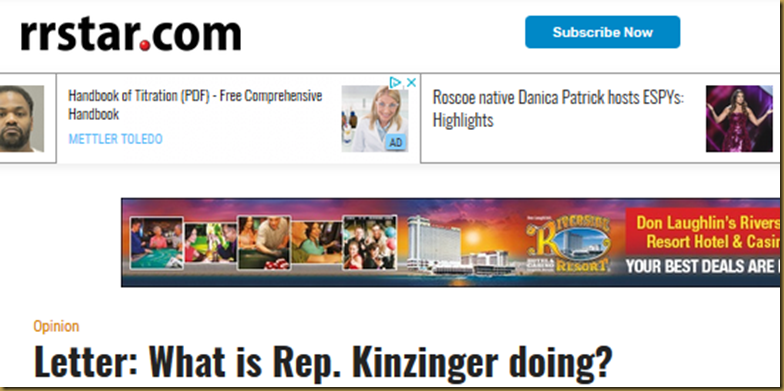

Above is from: http://www.rrstar.com/opinion/20180717/letter-what-is-rep-kinzinger-doing
Wednesday, July 18, 2018


Saturday, July 7, 2018
NIU Board Appointment Means Early Goodbye To Springfield For State Rep. Pritchard
NIU Board Appointment Means Early Goodbye To Springfield For State Rep. Pritchard
By Susan Stephens • Jun 28, 2018
A state representative from northern Illinois is leaving the legislature six months early.
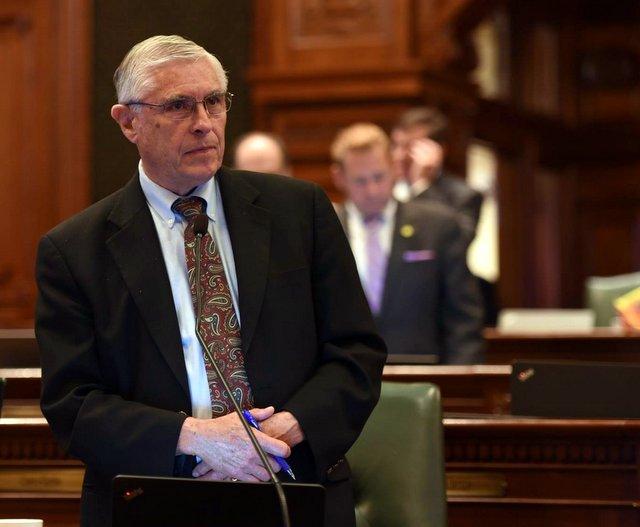
Credit courtesy Bob Pritchard / Facebook
Bob Pritchard, R-Hinckley, announced last year that he wouldn’t run for re-election, but he planned to continue representing the DeKalb area until his replacement is sworn in in January. That plan changed this week.
"I’ve been appointed to a board by the governor," said Pritchard. "As such, I had to resign from my legislative position. And that is all taking place on July 1."
So what’s Pritchard’s new gig? He'll be the newest member of the Northern Illinois University Board of Trustees. Gov. Bruce Rauner made the announcement Thursday afternoon.
Pritchard wanted to keep the news quiet until the governor's announcement, but a state representative in an adjacent district beat him to the punch Wednesday, releasing a statement saying Pritchard will continue his strong commitment to education on the Northern Illinois University Board of Trustees.
“Bob is a very strong addition to the NIU Board,” Rauner said in a news release. “He has a working knowledge of the challenges that face higher education and he is well equipped to advocate for the university, its students and the public-at-large on issues ranging from affordability to access.”
Pritchard has served on many education committees and task forces during his 15 years in the legislature and is recognized as a strong proponent of NIU, which is located within his district. Pritchard was appointed as the 70th district's state representative in 2003 after the death of Rep. David Wirsing.
There are three men vying for the seat Pritchard is vacating: Democrat Paul Stoddard, Republican Jeff Keicher, and Libertarian John Mathey. The Republican party may appoint someone to fill out the remainder of Pritchard's term.
Above is from: http://northernpublicradio.org/post/niu-board-appointment-means-early-goodbye-springfield-state-rep-pritchard
Friday, July 6, 2018
Is President Trump already winning the trade war?

Anthony Mirhaydari
2 hrs ago
Trump starts a trade war, but the path to success remains unclear


After months of threats and gamesmanship, President Trump's tariffs on $34 billion worth of Chinese industrial imports took effect a minute after midnight Friday. It's the latest in a line of protectionism aimed at the U.S. trade deficit with China, which totaled nearly $600 billion in 2017, and includes tariffs on imports of steel and aluminum as well as items like washing machines and solar panels.
And much more has been threatened. Mr. Trump said on Thursday that another $16 billion worth of tariffs against China are coming in two weeks -- and U.S. total alone could reach $550 billion in the next few months.
The actions appear to be having the intended effect, if at the cost of pushing up inflation (prices for washing machine in the U.S. have spiked 16% in recent months, for example). The U.S. trade imbalance with China in May totaled $43.1 billion, down from the $47.2 billion posted in March; it's the smallest monthly deficit since October 2016 and caps the largest three-month reduction in 10 years.
China responded early Friday with its own tariffs on a $34 billion range of American goods including soybeans and pork. The risk now is that the tit-for-tat that marked the verbal standoff will translate into escalation in action, as each side tries to one-up the other.
There are reports that American imports into China are being slow-walked through customs. Moreover, China's currency has weakened markedly in recent weeks in a possible bid to offset U.S. tariffs -- a strategy Trump frequently called out as "currency manipulation" on the campaign trail.
Much depends on how President Trump and the communists in Beijing play the next round in the trade war game. According to calculations by Goldman Sachs, if the full scope of Trump's proposed protectionism is implemented, it would raise the total amount of goods subject to tariffs to nearly $800 billion. Or about four times the cumulative amount proposed just a few months ago.
China appears more vulnerable, with Societe Generale economists estimating that the Chinese economy could lose 1 percentage point of GDP growth and upwards of four million jobs while the U.S. would suffer a modest 0.2 percentage point drag on GDP growth.

While U.S markets are taking this in stride, Chinese share prices are down 12 percent over the past month on reports that U.S. export orders have shrunk as customers wait to see what happens with tariffs and thus the cost of sourcing.
According to a report by the AP, Ningbo Top East Technology, which makes soldering irons south of Shanghai, has suffered upwards of a 50 percent drop in U.S.-bound orders, which used to make up roughly a third of its total order book. The problem is that the company is asking customers to split the cost of the tariff hike. But few are willing.
Another wrinkle to the China trade war story is a Reuters report that the European Union flatly rejected a proposal by Beijing to form a strategic alliance to take on the U.S. on trade. This is possibly because Europe knows deep down that China's mercantilism is real -- and that they have been guilty of similar behavior in the past. German Chancellor Angela Merkel, who just barely survived a recent internal political spat over immigration, warned Germany's lower house of parliament that trade tensions risk reversing the multi-lateralism that quickly quelled the global financial crisis after the U.S. housing bubble popped.
As the trade rhetoric turns to trade actions, business surveys suggest commerce is already being impacted. JPMorgan's Global Purchasing Managers' Index (PMI) data show that new export activity has nearly stalled, returning to a low ebb not seen since the middle of 2016 as China was coming off a destabilizing round of currency volatility.
If this impacts U.S. corporate earnings estimates in coming quarters, investors will have no choice but to pay attention. But for now, hope springs eternal that a de-escalation is coming -- or, if the trade spat worsens but remains contained, that U.S. equities will fare the best.
Put another way: That America has the most to gain from taking a firmer stance on trade terms. Small-cap stocks, which rely less on trade trends than large-cap stocks, in particular are hot lately, with the Russell 2000 up more than 9 percent for the year-to-date with the bulk of the gains coming since the beginning of May.
Anthony Mirhaydari is founder of the Edge , an investment advisory newsletter, and Edge Pro, options newsletter. Previously, he was a markets columnist for MSN Money; a senior research analyst with Markman Capital Insight, a money management firm; and an analyst with Moss Adams focusing on the financial services industry.
Above is from: https://www.cbsnews.com/news/china-trade-war-with-u-s-is-president-trump-already-winning-the-tariff-fight/
Red states will lose the most in trade war with China: Citigroup
- The U.S. officially implemented tariffs on Chinese imports, to which China immediately retaliated to with levies of its own.
- This tit-for-tat trade war would mostly impact states that voted “overwhelmingly” in favor of Trump in 2016 as they possess “jobs and output significantly affected by tariffs,” says Dana Peterson, Citi's North America economist.
- She notes, “80 percent of ‘red’ states produce goods subject to retaliatory tariffs totaling 10 percent or more of GDP, compared to 10 percent of ‘blue’ states.”
Published 7 Hours Ago Updated 5 Hours Ago CNBC.com
Scott Morgan | Reuters
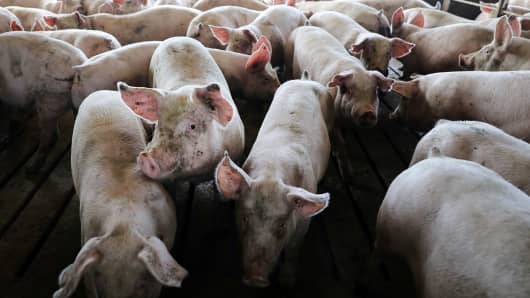
Four-month-old pigs in a finishing barn are seen at Wessling Farms near Grand Junction, Iowa.
States won by President Donald Trump in the 2016 election stand to lose the most as a trade war between the U.S. and China kicks off, according to Citigroup research.
The U.S. officially implemented tariffs on $34 billion worth of Chinese imports, including water boilers, airplane tires and X-ray machine components. China responded with its own set of tariffs on U.S. pork and soybeans, among other goods.
This tit-for-tat trade war would mostly impact states that voted “overwhelmingly” in favor of Trump in 2016 — relative to the states won by Hillary Clinton — as they possess “jobs and output significantly affected by tariffs,” Dana Peterson, Citi's North America economist, said in a note Thursday evening.
Peterson pointed out that so-called red states have 3.9 million jobs linked to foreign trade, far more than the 2.5 million in blue states. She added that “80 percent of ‘red’ states produce goods subject to retaliatory tariffs totaling 10 percent or more of GDP, compared to 10 percent of ‘blue’ states.”
The tariffs on U.S. and Chinese goods come after months of posturing by both countries. Back in March, Trump announced tariffs on all steel and aluminum imports into the U.S., to which China — along with other key trade partners — threatened to retaliate.
The back-and-forth on trade rhetoric has kept U.S. equities in a range as investors assess the impact of tariffs on corporate profits and global economic growth. The S&P 500 has traded in a 7.5 percent range since March. Since May, the S&P 500’s range had gotten even tighter as the broad index oscillates in a 5.4 percent band.

We depend on global markets for our high-quality grains: Montana farmer 6 Hours Ago | 04:58
“US external trade actions are backfiring, risking a reduction in global trade,” Peterson said. “US tariffs on imported goods are designed to encourage a rebalancing of trade that benefits domestic firms and US exporters. The Trump Administration’s goal of opening closed markets and establishing reciprocal trade abroad has alternatively been met with reciprocal retaliatory tariffs and complaints to the WTO.”
“The dollar value of the US and reciprocal tariffs are nominal, but the tit-for-tat could escalate into a trade war that reduces global, and thereby US trade,” she said.
Trade tensions have also been rising ahead of the U.S. midterm elections in November, when Democrats appear primed to gain seats in the House and possibly a majority.
“Economies exacting retaliatory measures are openly targeting goods produced in ‘red’ states, and sectors the President champions, as well as states represented by key players in Congress, including majority and minority leaders of the House and Senate. Hence, the intensity and duration of the trade disputes may be calibrated by voter sentiment ahead of the midterm elections,” said Peterson.
Above is from: https://www.cnbc.com/2018/07/06/red-states-will-lose-in-china-trade-war-citi.html?__source=newsletter%7Ceveningbrief
Tuesday, July 3, 2018
Big Pharma “pushing” for Kinzinger
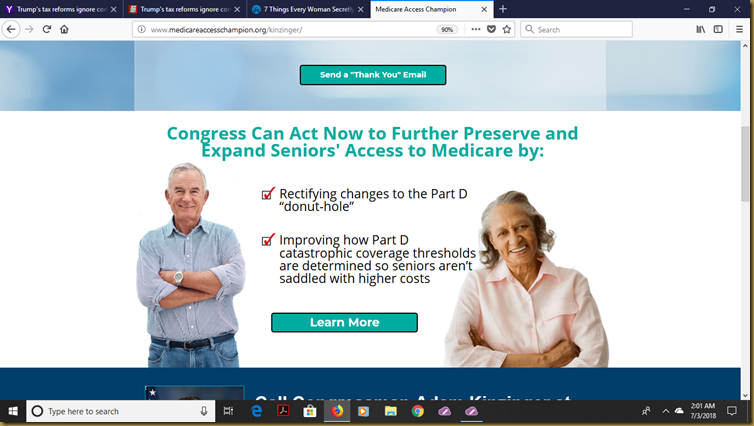
Below is a recent ad from the internet, which proports that Mr. Kinzinger is a Medicare Champion. (It is from: http://www.medicareaccesschampion.org/kinzinger/
This “award” appears completely bogus. The article from Health News Review details the awarding “non-profit”’s history and connections with big pharma. The ad is being paid by the non-profit. Mr. Kinzinger received a similar “award” and a paid mailing from another industry “non-profit”; see: http://boonecountywatchdog.blogspot.com/2018/06/alsic-award-rep-kinzingers-mailer-to.html


*********************************************************************************************************************************************************************
 Story Reviews News Release Review Blog Posts
Non-profit Alliance for Patient Access uses journalists and politicians to push Big Pharma’s agenda
POSTED BY

In an era of widespread calls for action to tame skyrocketing prescription drug costs, one organization consistently opposes measures to rein them in: the Alliance for Patient Access (AfPA).

Associate members of the Alliance for Patient Access, or its offshoot the Institute for Patient Alliance, are primarily drug or medical device companies.
The AfPA claims it’s trying to ensure patients have access to FDA-approved therapies. However, its track record shows it pushes platforms that help drug companies’ bottom lines. HealthNewsReview.org frequently writesabout how patient advocacy groups are co-opted by drug industry funding, but the AfPA is something different, observers say: a front group established solely to do the bidding of industry.
To advance its agenda, the AfPA often uses politicians and the news media, and rarely are its deep pharmaceutical connections called out.
Recently, for example, STAT ran a ghostwritten op-ed piece from an AfPA board member that extolled a $24,000-a-year drug to treat psychosis related to Parkinson’s disease. The op-ed was retracted after HealthNewsReview.org discovered and reported that it was ghostwritten.
A track record of opposition to limits on drug costs
National pushback against high drug costs has coincided with an expanded role for the AfPA. At its inception in 2006 the AfPA claimed to represent a few dozen neurologists who treat Parkinson’s patients. Today it purports to have more than 800 physician members with “working groups” in seven issue areas. In an email, an AfPA spokesperson said its membership “is comprised of policy-minded physicians and healthcare providers” who “contribute their time as volunteers as opposed to financial dues.” Corporate contributors have nearly doubled in number since 2015, based on lists found on the group’s website.
 Critics say the AfPA and other industry-funded nonprofits oppose even modest measures to limit spending on expensive drugs with marginal benefits, pushing up costs for everyone and threatening prospects for a viable system in which everyone gets adequate care.
“They’re trying to shore up what is obviously an otherwise losing public opinion climate on drug pricing,” said John Rother, president of the National Coalition on Health Care, which advocates for affordable care. The Coalition is partially funded by insurance companies who would benefit from lower drug costs. Rother runs the Coalition’s Campaign for Sustainable Rx Pricing.
The AfPA’s general message is that the problem isn’t high drug costs, but rather payers steering patients to drugs not picked by their doctors, through what it calls “non-medical switching.” It calls for “patient-focused” approaches to drug coverage.
David Mitchell, founder and president of Patients for Affordable Drugs, isn’t buying it.
“These groups exist to help sell medication,” Mitchell said. “I don’t love insurance companies. If you’re a patient, they can be a real pain in the ass. But when you’re attacking insurers and government, you’re really attacking the companies and the taxpayers who are trying to grapple with high prices.” (Patients for Affordable Drugs is one of the few patient advocacy organizations that pledges not to accept industry funding; it receives funding from the Laura and John Arnold Foundation, which also supports HealthNewsReview.org.)
As for these criticisms, Susan Hepworth, an AfPA spokesperson who responded to HealthNewsReview.org’s queries, said “AFPA recognizes that policymakers have a tough job trying to balance the demand for health care with finite resources. However, decisions policymakers reach will be better policy if it is informed by the perspectives of those on the front line of clinical care: physicians and their patients.”
A pharma friendly platform
What does patient-focused advocacy look like, to the AfPA? In recent years, the organization has:
- run ads pressuring Congress to oppose value-based purchasing for Medicare Part B drugs,
- issued white papers pushing back against opioid-prescribing restrictions
- made a video endorsing legislation that would block health plan policies that encourage patients to try the most cost-effective drug therapies first,
- conducted a policy forum that raised questions about the safety and efficacy of generic versions of biologic drugs,
- compared coinsurance for high-end cancer drugs to “rationing,”
- used social media to promote co-pay coupons that reduce patient cost-sharing,
- and issued news releases that attack insurance payment denials of very expensive, marginally effective cholesterol-lowering medications as “dangerous.”
Who’s running the show?

Brian Kennedy
The Alliance for Patient Access is operated by a public affairs firm, Woodberry Associates LLC, and the two entities share addresses and management, public documents show. They were both created by former Iowa state GOP chairman Brian Kennedy in 2006, just after he lost a congressional primary bid.
Kennedy is both Woodberry’s president and executive director of the AfPA and at least two offshoots, the Global Alliance for Patient Access and the Institute for Patient Access. He’s listed as a “counselor” of a third affiliate, the Coalition for Clinical Trials Awareness.
In 2015, the most recent year for which data is available, Woodberry and its employees took in more than $900,000 from the AfPA and related groups in payment for consulting, rent, and other services.
Who donates to the AfPA?
Most of the non-profit organization’s funding comes from the drug industry, not physicians. A list of “associate members and financial supporters” linked to its web site contains 26 pharmaceutical companies and a biopharmaceutical trade group, the Biotechnology Industry Organization (BIO). The AfPA also has received more than half a million dollars from the Pharmaceutical Research and Manufacturing Association (PhRMA), a drug industry trade group, since 2008, according to PhRMA disclosures.
Annual dues for these corporations and trade groups are at two levels of $25,000 and $50,000, said Hepworth, the AfPA spokesperson, who is also a Woodberry employee.
Companies funding the AfPA sell some of the nation’s most expensive drugs. They include:
- Abbvie (Hepatitis C drug Viekira Pak, $83,319 for a 12-week course),
- Vertex (cystic fibrosis drug Orkambi, $259,000 per year),
- Bristol Myers-Squibb, (Hepatitis C drug Daklinza, $63,000 for a 12-week course),
- and Mallinckrodt Pharmaceuticals (H.P. Acthar, used for multiple conditions including rheumatic disorders and multiple sclerosis, $205,681 per year).
Board members have received hundreds of thousands in industry money
The group’s six physician board members all have significant financial ties to drugmakers, according to ProPublica’s Dollars for Docs and published research disclosures.
For example, according to the Dollars for Docs database, AfPA board vice president Srinivas Nalamachu, MD, received $811,352 in 2013-2015, nearly all of it related to opioid drugs or drugs that treat side effects from opioids. He is on the AfPA’s working group for pain therapy access. In April 2017, the Kansas City Star identified Nalamachu and his former partner, Steven Simon, MD, as among the top-paid promoters of drugs to treat opioid-related constipation. The Star subsequently reported in July that their clinic was raided by FBI agents in connection with an investigation of Insys Therapeutics, an opioid maker accused of paying kickbacks to physicians who prescribed its drugs. The FBI raid focused on Simon’s patient records and did not involve Nalamachu, according to the Star.

Asked how the group can claim to advocate for patients when it’s funded by drug companies, Hepworth responded in an email: “Physicians, healthcare providers, patients, and manufacturers of medicines all share the same goal: ensuring that patients have access to FDA approved therapies. So it’s not surprising that they support AfPA’s objective. Each brings a unique perspective and AfPA provides a platform for physicians and patients to inform policymaking with their respective perspectives.”
Vested interests don’t always make it into news coverage
Journalists don’t always report the vested interests behind these views.
In Politico’s Prescription Pulse newsletter, covering a positive European study about a biosimilar drug, an article quoted the AfPA’s offshoot, the Global Alliance for Patient Access, saying biosimilars “may disrupt patients’ care and lead to higher costs in the long term.” Politico didn’t disclose that the Alliance is funded by brand-name biologics companies that could lose if biosimilars, which are cheaper generic versions, gain market share.
Similarly, Bloomberg’s Bureau of National Affairs ran a story about legislation to combat the opioid epidemic, in which the AfPA raises concerns about “unintended consequences patients with legitimate medical needs may face because of arbitrary restrictions placed on prescribing.” It didn’t mention that the AfPA takes money from at least five opioid makers: Purdue Pharma, Endo Pharmaceuticals, Johnson & Johnson, Allergan and Teva Pharmaceuticals Industries.
Rother, of the National Coalition on Health Care, said examples like these amount to a false equivalence in news coverage, treating both sides as if they have equal merit. “I think the role of journalism is to expose who’s actually behind these kinds of what I’d call fake groups. They are front groups that are there only to protect in the interests of manufacturers, not consumers,” he said.
Alliance-sponsored forums involving journalists
The Alliance for Patient Access also has elevated its profile by sponsoring policy forums involving journalists.
STAT biotech reporter Damian Garde moderated the AfPA’s National Policy and Advocacy Summit on Biologics and Biosimilars in April. A tweeted photo from that meeting (below) shows Garde sitting next to Robert Yapundich, MD, whose ghostwritten op-ed later published in STAT failed to disclose more than $300,000 in payments from the drug industry.
In 2015 POLITICO hosted a similarly-themed AfPA-sponsored panel, Biosimilars: Can They Break Through?.
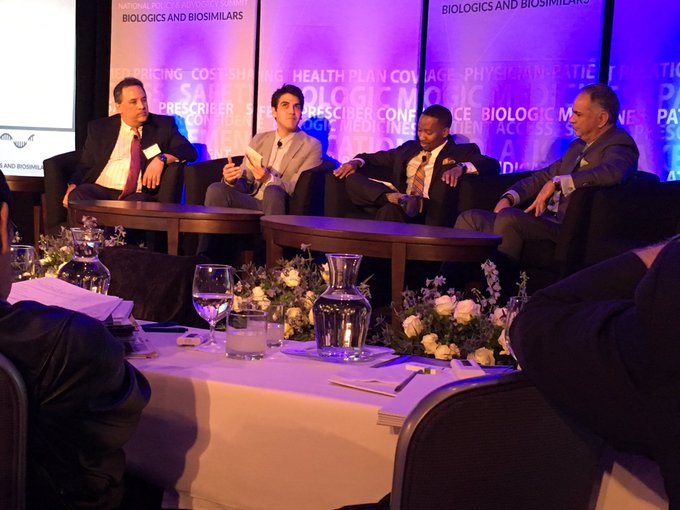
Kathleen Arntsen@KathleenArntsen
Stakeholder panel on #drugpricing interesting but where's the #payer? #AfPASummit @CreakyJoints @IFAArthritis

Both events focused on why biosimilars have been stalled by regulatory hurdles in the U.S. The AfPA receives funding from several makers of brand-name biologics including Pfizer, Johnson & Johnson, Amgen, AbbVie and Sanofi.
Asked about STAT’s participation with the AfPA and other industry partnerships, Executive Editor Rick Berke told HealthNewsReview.org Managing Editor Kevin Lomangino: “Every partnership we enter into, we think about the optics and appearances. We’re comfortable with the decisions we’ve made. They may not be up to your standards but they’re up to our standards.”
[Editor’s Note: STAT managing editor Gideon Gil wrote to us after this piece was published, stating: “Rick Berke’s comment to Kevin Lomangino from a month ago is taken out of context. He did not refer to the AfPA as a partnership. He was referring to our actual partnerships, not to the AfPA.” Although STAT does partner with pharmaceutical industry groups to host events, Gil wrote that Damian Garde’s moderation of the AfPA panel was not such a partnership.]
Politico spokeswoman Katie Pudwill said sponsors are allowed to give opening remarks but “don’t participate in or design the conversations so their interests don’t affect the outcome of the debate/discussion.” She added: “We have editorial independence over the conversations that take place once one of our journalists takes the stage.”
Some were quick to criticize these media organizations. “Politico and STAT were had,” Mitchell, of Patients for Affordable Drugs, said. “It wasn’t a legitimate discussion. It was a paid-for pharma promotion of this scare tactic that you mustn’t take a biosimilar because it won’t do the same thing as a branded biological.” See more on our coverage of tactics used in the biologics vs biosimilars tug-of-war.
‘Patient Access Champion’ awards handed out to Congress
The AfPA attempts to harness physician voices to sway public policy, holding briefings and advocacy training for “policy-minded physicians” who want to “challenge restrictive health policies.” It claims to run a forum of about 40 physician-legislators in 23 states. “With respect to health care issues, physicians serving as elected officials are often in a unique position to shape policy,” it says.
The AfPA offers cover for lawmakers who carry out the pharmaceutical industry’s agenda, some observers say. In one striking example, the group accepted $7.8 million in 2014 and 2015 to give Medicare “Patient Access Champion” awards to members of Congress, according to its IRS disclosures for those years. The AfPA annual report shows that 50 awards were presented. The awards appear to be a way to thank cooperative legislators while also pressuring them and others to enact the AfPA’s policy agenda.
AfPA spokeswoman Hepworth would not tell HealthNewsReview.org who contributed those millions, citing a “general policy” of not disclosing who contributes to particular projects.
In some cases, framed “Patient Access Champion” certificates were presented in district offices, with representatives from other health and senior citizen advocacy groups invited to attend and pose for photos. Many Congress members boasted of their awards in social media, newsletters, and press releases, citing them as evidence that they protect the rights of senior citizens and stand up for the middle class. Here’s a tweet from the AfPA showing U.S. Sen. Debbie Stabenow, D-MI, accepting her award:


Some say those awards and ads shielded lawmakers from criticism for voting against Medicare cost controls, such as an independent rate-setting board and other measures.

A mailer from the Alliance for Patient Access, asking voters to thank Sen John Barrasso, R-WY, for voting on a bill related to Medicare Part B.
“If they are called out for undermining patients’ rights, they can say, ‘No, I received an award for protecting patients’ rights.’ A lot of citizens don’t have time to sort it out,” said Lisa Graves, executive director of the Center for Media and Democracy, a corporate watchdog group.
The AfPA does not have to disclose who funded its bid to influence Congress, or anything else it does, because it’s organized as a not-for-profit under a section of the IRS tax code reserved for “social welfare” organizations, known as 501(c)4. Unlike super PACs, which are independent political committees, nonprofits don’t have to reveal their financial backers. They’ve become the preferred option for groups who want to influence politics without having their identities publicized.
Some advocates want more transparency for nonprofits with 501(c)4 status, which have proliferated since the 2010 Citizens United court decision empowered them to participate in politics. The IRS says politics can’t be their primary function, but that rule is rarely if ever enforced.
For now, said Mitchell, “For consumers, it’s caveat emptor.”
Editor’s note: In a follow-up post, we found a dozen examples of the AfPA using op-eds to push their agenda. See more: ‘Ethical bordellos:’ Op-eds don’t always disclose Big Pharma conflicts of interest
Above is from: https://www.healthnewsreview.org/2017/10/non-profit-alliance-patient-access-uses-journalists-politicians-push-big-pharmas-agenda/
Monday, July 2, 2018
News organizations unknowingly paid Melania Trump at least $100,000 last year to use pictures of her

News organizations unknowingly paid Melania Trump at least $100,000 last year to use pictures of her
6:54 p.m. ET
Olivier Douliery-Pool/Getty Images

President Trump's financial disclosure from May shows that in 2017, first lady Melania Trump earned between $100,000 and $1 million from an unusual deal with Getty Images.
NBC News reports that Getty Images, a photo agency, agreed to pay Trump in royalties for the use of any images in a series of 187 photos of the Trump family taken by Belgian photographer Regine Mahaux. The photos were taken between 2010 and 2016, and it was a requirement that the images be used in "positive stories only." NBC News found that at least 12 media organizations, including Marie Claire, Yahoo News, and NBC News itself, paid to use the Mahaux pictures.
An NBC News spokeswoman said the network did not know about the "positive stories only" clause and did not sign an agreement to abide by it, and was never told that a portion of the royalties paid would go to the Trumps. After NBC News notified organizations about the deal, several took the images down from their websites.
Sometimes celebrities do earn royalties from licensing wedding or baby photos, but it is highly unusual for the spouse of an elected official to do so. Getty Images said that due to confidentiality agreements, the company could not share details related to the deal, which was made before President Trump's election. Mahaux would only tell NBC News that "everything is legal." In a standard photo contract, the photographer receives royalties and the photo agency collects fees after each use of an image, but models do not get paid. Catherine Garcia
Above is from: http://theweek.com/speedreads/782668/news-organizations-unknowingly-paid-melania-trump-least-100000-last-year-use-pictures
How likely is a Fiat Chrysler/Hyundai merger?
Eric D. Lawrence, Detroit Free Press Published 4:43 p.m. ET July 2, 2018
(Photo: PIERO CRUCIATTI/AFP/Getty Images)
CONNECTTWEETLINKEDINCOMMENTEMAILMORE
Acquisition speculation never really goes away for Fiat Chrysler Automobiles.
This time, South Korean automaker Hyundai has been cast in the role of potential suitor, a variation on speculation that spread last year.
Asia Times published a story last week highlighting a scenario where Hyundai Motor Group CEO Chung Mong-koo would launch a "takeover bid" for the Italian-American automaker at some point before FCA CEO Sergio Marchionne retires next year.
The story relied on unnamed sources, and Jim Trainor, a spokesman for Hyundai in the U.S., called the rumor "completely groundless."
But a Hyundai and FCA merger would offer some intriguing possibilities.
Michelle Krebs, Autotrader executive analyst, called it a situation to watch.
"I have long thought – on paper – that an FCA and Hyundai-Kia alliance makes some sense. Hyundai and Kia are strong in cars and Asia. FCA is strong in utilities – far more so than HK – and strong in trucks, which Hyundai doesn’t have at all," Krebs wrote in an email, noting a history that has included working together primarily before Chrysler was part of FCA on engines.
Marchionne also floated a possible connection last year with Hyundai on fuel cell technology development.
But Krebs also noted that alliances do not always succeed even when they appear to make sense.
"While an alliance may look good on paper, it may not work in terms of mindsets of the companies and the culture. I would note that the Daimler Chrysler 'merger' made sense on paper. It was a disaster due to the clashing cultures. The Nissan-Renault alliance didn’t make obvious sense, but it is nearly 20 years old now," Krebs said.
For FCA, the speculation about being purchased is familiar. Last year, numerous Chinese companies were rumored to be interested in the automaker, and at least one, Volvo-parent Geely held informal talks with FCA, according to Bloomberg. Geely ultimately opted to invest $9 billion in Daimler apparently instead.
Part of the speculation has also been fed by Marchionne's penchant for making public overtures to other automakers, such as General Motors and Volkswagen. He's long suggested more consolidation was needed in the auto industry, and FCA has taken a team approach to areas such as autonomous vehicle development such as through its partnership with Waymo.
But Marchionne was forceful during the North American International Auto Show in Detroit in January in pushing back against specific talk of selling off the company — with most focus on the highly valuable Jeep brand — in pieces."The answer is no we’re not going to break up anything," Marchionne said at the time. "We have no intention of breaking it up and giving it to the Chinese."
The assumption has been that FCA needs more help to offset the huge costs associated with development of electric and autonomous vehicles, areas that several of its competitors have focused much more on. With solid financial performance in recent quarters and a share price that has consistently beaten Ford, that talk had cooled a bit.
But with no successor to Marchionne named, the questions about the company's future will continue to percolate, even though the five-year plan laid out last month in Italy was received generally favorably.
Contact Eric D. Lawrence: elawrence@freepress.com. Follow him on Twitter: @_ericdlawrence.
ABOVE IS FROM: https://www.freep.com/story/money/cars/chrysler/2018/07/02/fiat-chrysler-hyundai/751490002/
Subscribe to:
Posts (Atom)