Thursday, May 3, 2018

California Exodus

MarketWatch

With no letup in home prices, the California exodus surges

Andrea Riquier


Now, in the midst of a deepening housing crisis, thousands of people are following that advice.

Over a million more people moved out of California from 2006 to 2016 than moved in, according to a new report, due mainly to the high cost of housing that hits lower-income people the hardest.

“A strong economy can also be dysfunctional,” noted the report, a project of Next 10 and Beacon Economics. Housing costs are much higher in California than in other states, yet wages for workers in the lower income brackets aren’t. And the state attracts more highly-educated high-earners who can afford pricey homes.

There are many reasons for the housing crunch, but the lack of new construction may be the most significant. According to the report, from 2008 to 2017, an average of 24.7 new housing permits were filed for every 100 new residents in California. That’s well below the national average of 43.1 permits per 100 people.

If this trend persists, the researchers argued, analysts forecast the state will be about 3 million homes short by 2025.

a screenshot of a cell phone© Provided by Dow Jones & Company, Inc.

What does it mean?

California homeowners spend an average of 21.9% of their income on housing costs, the 49th worst in the nation, while renters spend 32.8%, the 48th worst. The median rent statewide in 2016 was $1,375, which is 40.2% higher than the national average. And the median home price was — wait for it — more than double that of the national average.

One coping strategy: California residents are more likely to double up. Nearly 14% of renter households had more than one person per bedroom, the highest reading for this category in the nation.

Coping can also mean leaving.

In a separate analysis, Realtor.com found that the number of people searching real estate listings in the 16 top California markets compared to people living there and searching elsewhere was more than double that of other areas — and growing.

And in those areas — counties including Santa Clara, San Mateo and Los Angeles — the growth in views of listings on Realtor.com was virtually unchanged compared to a year ago this spring, while views of listings in other U.S. areas were 15% higher.

(News Corp, owner of MarketWatch, also operates Realtor.com under license from the National Association of Realtors.)

Also read: America’s new great migration in search of lower property taxes

The Next 10 and Beacon Economics researchers used Census data to track migration patterns by demographic characteristics. More than 20% of the 1.1 million people who moved in the decade they tracked did so in 2006, at the height of the housing bubble, when prices were, as they write, “sky-high.”

As the housing market imploded and prices came back to earth, migration out of the state slowed. But as prices recovered, “out-migration” has not only picked up steam, it’s accelerated.

Those migration patterns are shaped by socioeconomics. Most people leaving the state earn less than $30,000 per year, even as those who can afford higher housing costs are still arriving. As the report noted, California was also a net importer of highly skilled professionals from the information, professional and technical services, and arts and entertainment industries. On the other hand, California saw the largest exodus of workers in accommodation, construction, manufacturing and retail trade industries.

(In a note about what this statewide trend might mean for the national economy, the report also calls the housing crunch “most dire” in agricultural areas, particularly the Central Valley and Imperial County.)

And where those refugees head may say a lot about why they’re going. The top five destinations for California migrants between 2014 and 2016 were the nearby, but generally cheaper, states of Texas, Arizona, Nevada, Oregon and Washington.

Median statewide home prices

California
$549,000

Texas
$295,000

Arizona
$339,000

Nevada
$344,900

Oregon
$420,000

Washington
$420,000

(as of April 1; source: Realtor.com)

It’s worth noting that many housing analysts and economists believe that the 2017 tax law changes may push residents of higher-priced properties out of high-tax states like California. But that isn’t happening yet.

Andrea Riquier reports on housing and banking from MarketWatch's New York newsroom. Follow her on Twitter @ARiquier.

Read: Home prices won’t slow down, stumping the experts and shutting out buyers

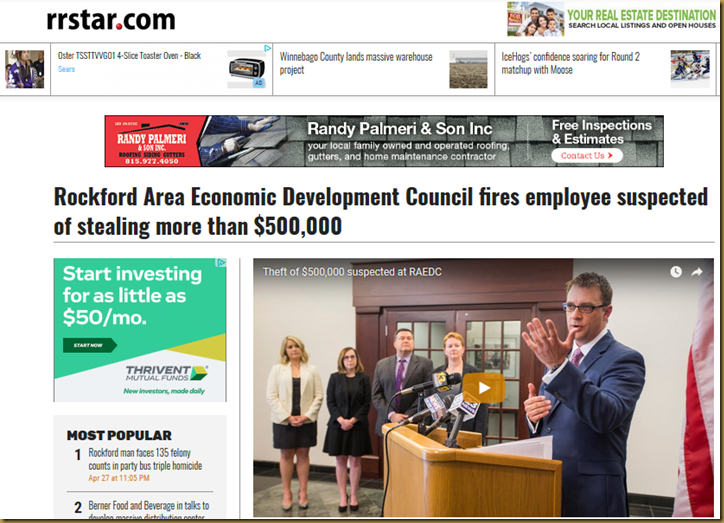
Rockford Area Economic Development Council loses $500,000+


image


By Chris Green
Staff writer

Posted at 11:47 AM Updated at 8:21 PM

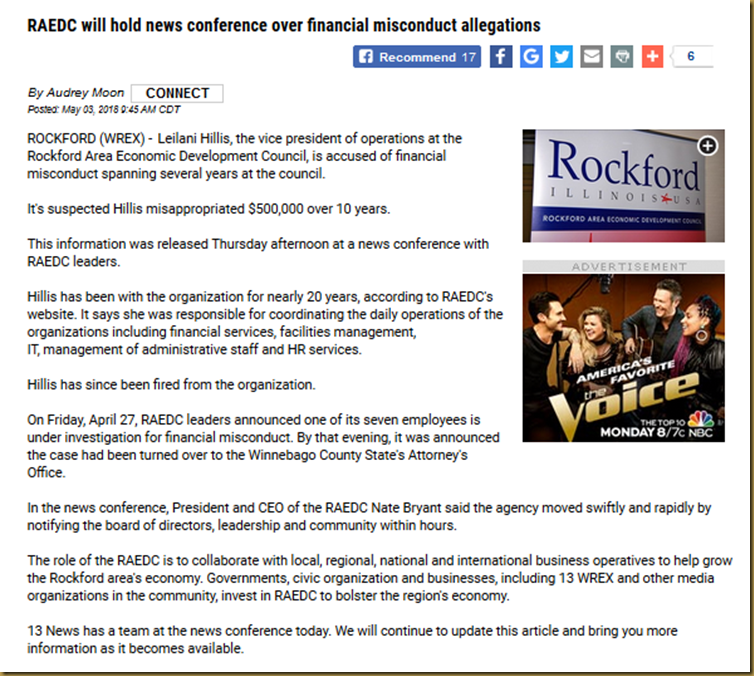
ROCKFORD — The Rockford Area Economic Development Council has fired its vice president of operations, Leilani Hillis, and its leaders accuse her of stealing more than $500,000 from the organization over a period of more than 10 years.

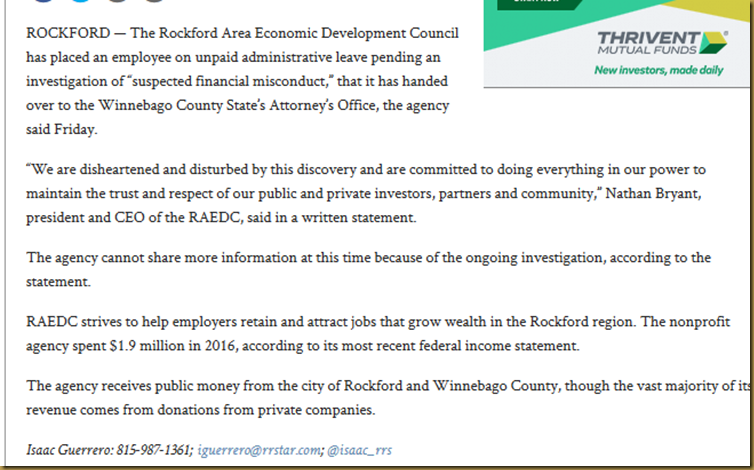
Auditors informed RAEDC officials of the suspected financial misconduct last week, said CEO and President Nathan Bryant. RAEDC officials immediately launched an internal investigation and placed Hillis on unpaid administrative leave.

Hillis has not been charged with a crime. Katie Zimmerman of the Winnebago County state’s attorney’s office said Rockford police are investigating the matter. RAEDC officials held a news conference Thursday to update the public and the agency’s investors about the matter.

“We do believe this is isolated to an individual person in an individual area of our organization,” Bryant said.

Hillis could not be reached for comment.

RAEDC is a nonprofit organization charged with helping employers attract and retain jobs in the Rockford region. The agency spent $1.9 million in 2016, according to its most recent federal income statement. About 20 percent of the organization’s income comes from public sources, including $150,000 a year from the city of Rockford and $100,000 a year from Winnebago County. The remainder comes from donations from private companies.

“Although we are not held to the standards of a public organization, we operate on behalf of the public,” Bryant said. “And because of that, it is terribly important for us to conduct ourselves in a manner that is transparent and no different than what our public partners would do.”

Hillis was employed by RAEDC for more than 18 years. Her duties included coordinating daily operations and financial services of the organization, as well as originating annual budgets and working with the agency’s auditors. Bryant said Hillis is suspected of providing false information to auditors to cover her alleged theft. The agency is working with its auditors to enact tighter financial controls, he said.

Bryant would not say whether RAEDC had lost investors because of the alleged theft, but said: “Our investors have been extremely gracious during this process. They understand that unfortunately activities like this happen.”

Winnebago County Board Chairman Frank Haney said that the agency’s leaders acted quickly after learning of the suspected theft and that RAEDC still has his full support.

“They’ve communicated openly with their stakeholders and the community through the process,” he said. “RAEDC has been clear that this in no way reflects its organizational values and has shared that they are working to restore confidence by actively addressing policies and procedures.

“Economic development efforts are critical to our future success, so we support the staff of the RAEDC who we know to be smart, capable and dedicated advocates for our region.”

Chris Green: 815-987-1241; cgreen@rrstar.com; @chrisfgreen

Above is from:  http://www.rrstar.com/news/20180503/rockford-area-economic-development-council-fires-employee-suspected-of-stealing-more-than-500000


image

Above is from:  http://www.wrex.com/story/38104767/2018/05/03/raedc-will-hold-news-conference-over-financial-misconduct-allegations

Less chaos, more civility needed in White House


image


Less chaos, more civility needed in White House

By Sarah Bingaman Dixon

10:48 pm

Every morning for the past year and a half, we have awakened to a White House in chaos. 

Scandals, firings, tweet storms attacking individuals and institutions, incoherent ramblings and odd gestures flood from 1600 Pennsylvania Ave. People say that the president thrives on chaos. Personally, I tend to favor civility, predictability and peace.

The never-ending barrage of ugliness from the White House is damaging to our global reputation, to the functioning of all facets of our government, and to the very health of all Americans.

It is simply not productive to live in an environment that is in a state of constant chaos, particularly when most of it is generated by the president for no justifiable reason.

The only majority-party congressional members who are willing to express concern about the president’s bizarre behavior are the 30 or so who are leaving Congress in 2019. The rest, including 16th District U.S. Rep. Adam Kinzinger, seem unwilling to criticize the president’s actions in order to protect big donor contributions to their re-election campaigns.

Our remedy is our power to vote. The mid-term election is Nov. 6. As a recent editorial in Sauk Valley Media reminded us, we have more choices on the ballot this year than we have had in a long time.

Unless you are a person who thrives on chaos and unpredictability, you might want to join me in voting for change this fall.

Above is from:  http://www.saukvalley.com/2018/04/30/less-chaos-more-civility-needed-in-white-house/a7bvnzr/


4

Tuesday, April 24, 2018

City of Rockford may allow a solar farm

City Council discusses potential for west side solar farm

Posted: Mon 10:25 PM, Apr 16, 2018


ROCKFORD, Ill. (WIFR) -- The west side of Rockford could soon see new development that will not only generate energy but also much needed money to combat the budget deficit.

The Rockford City Council discussed a plan with Trajectory Energy that would build a solar farm on the west side of town. The new development would take the place of the Horsman Quarry, an area that's been underutilized for years. The city says the solar farm could also generate funds. The Planning and Development Committee will vote on the solar farm next week before it goes on to the full city council.

"It’s really exciting that we will see this type of investment where the city can make some money. We can provide green energy business on the west side of Rockford with the solar farm and also provide a potential savings and energy cost to those citizens in our community with the greatest need,” said Rockford Mayor Thomas McNamara.

The city council also considered the consolidation of environmental labs between the city and the county. The labs test thousands of water samples each year. The consolidation would save the county money and generate between $85,000 to $100,000 for the city.

Above is from:  http://www.wifr.com/content/news/City-Council-discusses-potential-for-west-side-solar-farm--479943463.html

Monday, April 23, 2018

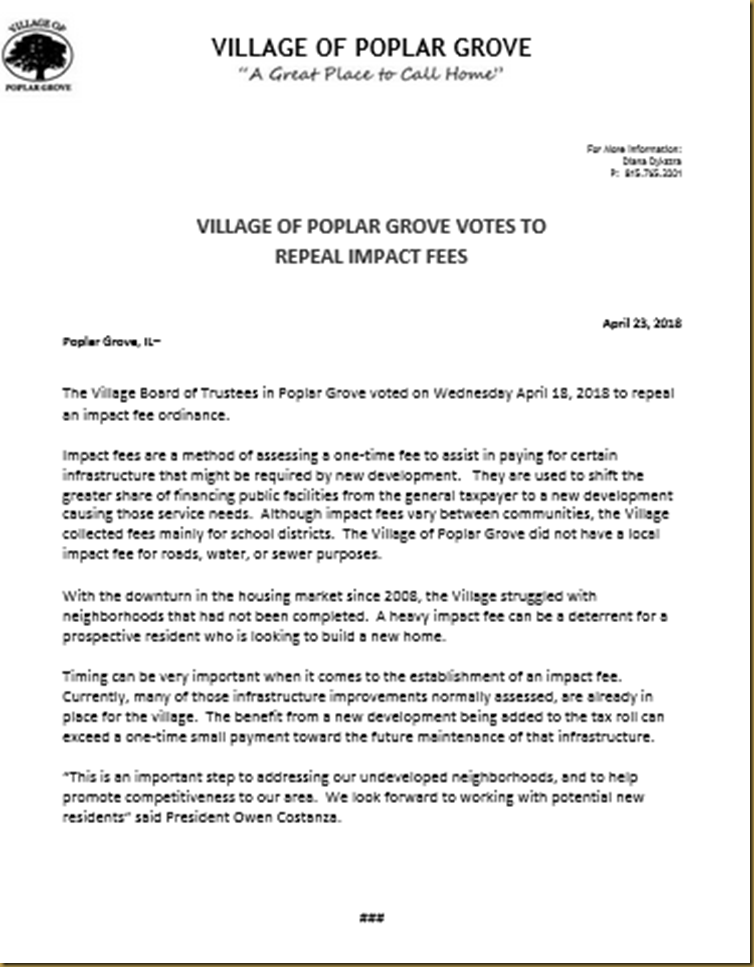
Poplar Grove repeals Impact Fees. Will other communities follow?


School Districts were the biggest beneficiaries of these fees.  Both North Boone and Belvidere Community Schools now have excess capacity and may no longer need funds for building expansion.


image

image


image

image


image

image

Above news article is from:  http://www.rrstar.com/news/20180428/poplar-grove-repeals-impact-fees-hopes-to-spur-residential-development

Community Solar in Illinois


Neighboring McHenry County’s Zoning Board of Appeals has a  hearing regarding a community solar project this Wednesday


McHenry County Zoning Board of Appeals Hearing (Continuation of the hearing on the proposed community solar farm near S Solon and W Ringwood roads.)

Hearing date:
Wednesday, April 25 1:30 p.m.
McHenry Co. Administrative Building Conference Room C
667 Ware Rd.
Woodstock, IL

.


Citizens Utility Board


Community Solar in Illinois

What is community solar?

Illinois’ new community solar program allows Ameren Illinois and ComEd electricity customers to enjoy the benefits of solar energy, even if they can’t install solar panels on their own property. Many people can’t afford to install solar panels on their own homes, don’t have space or enough sun, and/or they are limited by local zoning laws. Community solar allows interested customers, or “subscribers,” to help fund a solar installation—also called a community solar garden—in their area, and in return get credits on their electric bills.

For years, Illinois consumers with rooftop solar panels have been able to receive credits on their electric bills by sending excess renewable energy back to the power grid—a benefit called “net metering.” Community solar projects would utilize “virtual net metering.” A “host customer”—such as a home, business, or school—would recruit neighbors to invest money in a solar energy project. The neighbors who invest would then share electric bill credits generated by that project, based on the level of their financial contribution.

Until now, CUB and other advocates who worked to establish community solar programs in Illinois ran into roadblocks. However, the Future Energy Jobs Act, historic state legislation passed in December 2016, calls for 400 megawatts (MW) of community solar projects to be developed by 2030.

How does community solar work?

Under Illinois’ community solar program, “subscribers” can enter into an agreement to help fund a solar energy installation in their community—on the rooftop of a local school or community center, for example. Any entity could organize a community solar project, including individuals, community groups, businesses, even utilities or alternative suppliers. Each subscriber then receives a credit on the supply section of his or her monthly electric bill for the electricity that was generated by the installation, in proportion to the size of the subscription they purchased.

For example, say you used 1,000 kilowatt-hours (kWh) of electricity in a month, and your share of the community solar project produced 200 kWh of electricity. That means you would receive a credit on your bill amounting to your supply rate multiplied by 200 kWh of electricity. Ultimately, you would only be responsible for paying the per-kWh electricity rate for the other 800 kWh.

You can subscribe to several solar panels in an installation. Depending on the kind of community solar plan you sign up for, you could pay one upfront fee, a monthly subscription fee, or a combination of the two.

What are the benefits?

Lower electric bills for subscribers: Customers who participate get credits on their bills for the electricity generated by the solar installation.

Lower electric bills for non-subscribers: Adding renewable energy to the power grid increases electricity supply, lessens the need for expensive, polluting power plants, and lowers market prices for all residents.

Greater reliability: By encouraging generation near the point of consumption, solar reduces strain on the grid, and that reduces system maintenance and repair and prevents costly “line losses,” in which electricity is lost along the transmission and distribution system.

Reduced peak demand: Community solar adds more electricity to the grid, which would help reduce demand during peak times—when prices skyrocket and power plants produce the most pollution. A 2007 Brattle Group study found that shaving peak demand by just 5 percent could lead to at least $35 billion in savings nationwide over the next two decades. Reducing line loss and maintenance/repair costs is especially beneficial during these peak times.

Added financial benefit through selling Solar Renewable Energy Credits (S-RECs): A Renewal Energy Credit (RECs)—a measure of the environmental benefits of renewable energy—can be bought and sold on the energy market. Under the Future Energy Jobs Act, the state will purchase a community solar project’s RECs to meet Illinois’ renewable energy goals. (See below: What are S-RECs?)

Consumer education: Homeowners involved in solar tend to be more aware of, and therefore more conscientious about, their energy consumption. This awareness provides lasting benefits to all consumers since reducing energy consumption lowers costs for all consumers.

Community improvement: Community solar installations make efficient use of space that would otherwise be wasted, such as the rooftop of a school, or an eyesore, such as a “brownfield”—a former industrial site that remains vacant because it has environmental contamination. In fact, a community center could use the financial benefits of such a program to help fund a new roof to hold the solar panels.

What are the general requirements for the community solar program?

Under state law…

  • A community solar installation has a maximum size of 2 Megawatts (MW) of electricity output—that’s roughly 10,000 standard (2 x1 meter) panels.
  • The minimum subscription per customer is 200 watts of electricity output—or approximately one solar panel.
  • No individual subscriber can own or lease more than 40 percent of a project.
  • Two state agencies, the Illinois Commerce Commission (ICC) and the Illinois Power Agency (IPA), have to sign off on any community solar contract.
  • ComEd or Ameren is required to buy any energy output that hasn’t been subscribed out.

Note: More specific rules applying to community solar projects are being worked out at the Illinois Power Agency.

Are there restrictions on who can participate?

No. Residential and business customers can participate as subscribers in community solar projects. Business and industrial customers could host a community solar site or develop a community solar project.

Does the power in a community solar project go directly to my home?

No, unlike a solar panel on your rooftop, there is no way to guarantee that the energy generated would power your home. The power could be used by the building that hosts the solar installation. Or, like most energy generated in Illinois, it could simply be sent to the grid the moment it is created, along with a thousand other sources of power—from coal plants to nuclear power plants to wind farms.

What are Solar Renewable Energy Credits?

“Solar Renewable Energy Credits,” or S-RECs, are a measure of the environmental benefits—such as reduced Greenhouse Gas emissions, for example—of a community solar installation. For every megawatt-hour of renewable electricity—in this case, solar power—produced, a Renewable Energy Credit is created. This REC can be sold separately to the state of Illinois, which, under the Future Energy Jobs Act, is required to buy them to meet its own renewable energy goals.

Depending on the solar agreement, either the subscriber can own the RECs and sell it to the state, or the operator will own the RECs. For example, an operator could put the RECs created by a community solar installation to good use, using the proceeds from selling them to bring down the cost of the project to subscribers.

Who are the major players in community solar projects?

Note: In the descriptions below, many of these roles can be performed by the same individual or entity.

Subscribers: Individual electricity customers who participate in a community solar project.

Site Assessor
: An expert who studies and recommends solar garden locations.

Host
: The individual, business, community group, or other entity that owns the land that is the site of the community solar project.

Developer: The primary individual or group that organizes the community solar project.

Operator
: The individual, business, community group or other entity that maintains the community solar installation.

Funders
: Sources of financing for the project.
Outreach Partners: Help recruit subscribers for the community solar project.

Installer
: An expert who builds the community solar installation.
Utility: Ameren or ComEd, the utility where the community solar panels are installed.

Why is Community Solar a big deal?

Community solar only became possible through the Future Energy Jobs Act. Illinois homeowners with their own rooftop solar panels have long been able to send excess energy back to the power grid in return for credits on their electric bills—a benefit called “net metering.” But very few participated because many weren’t able to install solar panels on their own property. Community solar helps overcome those barriers.

While the act offers a historic opportunity for community solar in Illinois, many details are still being worked out. Sign up for CUB’s community solar newsletter to receive email updates as community solar develops in Illinois. If you have more specific questions, contact Annabelle Rosser, CUB’s environmental outreach coordinator.

 Above is fromhttps://citizensutilityboard.org/community-solar-illinois/