Tuesday, January 9, 2018

Alabama picked for Toyota-Mazda plant, sources say

4.5k shares

By William Thornton

wthornton@al.com

Toyota and Mazda have apparently picked Alabama as the site for the company's new $1.6 billion auto plant, according to sources in North Carolina and Alabama.

Reuters is reporting that a formal announcement is expected Wednesday.

Sources for months have said the decision was between North Carolina and Alabama. The Raleigh News & Observer is reporting that North Carolina lost out on the plant because it does not have the supply chain logistics that the car companies desire.

Toyota Motor Corp. and Mazda Motor Corp. announced in August a joint venture to build a $1.6 billion assembly plant in the U.S. which would create 4,000 jobs and be up and running by 2021.

It is projected to produce 300,000 vehicles a year, with half being the Toyota Corolla and the rest an unspecified Mazda model. For some perspective, Alabama's Honda and Hyundai plants both produced more than 320,000 vehicles in 2017.

But the venture is more than that, as both companies hope to co-develop electric vehicles, safety features and connected-car technologies, according to published reports last year.

There has been no official confirmation from Alabama state officials, the City of Huntsville or from Toyota and Mazda as yet.


A 1,252-acre tract of farmland in Limestone County's Greenbrier community, which is part of Huntsville, is apparently the site where Toyota-Mazda might locate the plant.

The area, off Powell Road and Greenbrier Road, was passed over by Volkswagen in 2008 in favor of Chattanooga. Since then, it has been certified as a TVA Megasite, and an Advantage Alabama site by the Economic Development Partnership of Alabama.

Tax Law May Send Factories and Jobs Abroad, Critics Say


In Indiana, Missouri and Pennsylvania, President Trump used the same promise to sell the tax bill: It would bring jobs streaming back to struggling cities and towns.

“Factories will be pouring into this country,” Mr. Trump told a crowd in St. Charles, Mo., in November. “The tax cut will mean more companies moving to America, staying in America and hiring American workers right here.”

The bill that Mr. Trump signed, however, could actually make it attractive for companies to put more assembly lines on foreign soil.

Under the new law, income made by American companies’ overseas subsidiaries will face United States taxes that are half the rate applied to their domestic income, 10.5 percent compared with the new top corporate rate of 21 percent.


“It’s sort of an America-last tax policy,” said Kimberly Clausing, an economist at Reed College in Portland, Ore., who studies tax policy. “We are basically saying that if you earn in the U.S., you pay X, and if you earn abroad, you pay X divided by two.”

What could be more dangerous for American workers, economists said, is that the bill ends up creating a tax break for manufacturers with foreign operations. Under the new rules, beyond the lower rate, companies will not have to pay United States taxes on the money they earn from plants or equipment located abroad, if those earnings amount to 10 percent or less of the total investment.

The Republican vision for the tax plan was to make the United States a more competitive place to do business. Supporters contend that the new rules do not encourage companies to locate overseas. Rather, they say, slashing the corporate rate will make it more attractive to set up shop at home, since many other advanced economies now have higher taxes.

And manufacturers do not simply follow their accountants’ advice. They consider taxes, but they also look at an array of other factors, including the local talent pool and transportation network, when deciding where to build a new plant.

Before the tax overhaul, companies had to pay the standard corporate tax on the money they earned abroad, with a top rate of 35 percent, but only when they brought that income back into the United States.

Many corporations responded by keeping their profits abroad indefinitely. A record $2.6 trillion was in offshore accounts as of 2015, according to the Joint Committee on Taxation, a congressional panel. Republicans argued that the system deprived the American economy of investments that could have financed new ventures and hiring at home.

It also meant that many multinationals effectively paid no American tax on their overseas earnings. The new bill, supporters point out, will prevent that from happening on such a large scale in the future.

“It’s a vast improvement from what was on the books,” said Ray Beeman, a tax lawyer at Ernst & Young who worked on a tax reform proposal that was a precursor to the current law when he was counsel to the House Ways and Means Committee, under Republican leadership, from 2011 to 2014.

To prevent an exodus of businesses from the United States, the law establishes a minimum tax rate of 10.5 percent every year.

Companies will get credit for up to 80 percent of the taxes they pay to foreign governments. But if the total still comes to less than 10.5 percent of the income they earn abroad, they have to make up the difference with a check to the American government.

So while companies will now have to pay some tax in most cases, wherever they operate, they will pay much less on what they make abroad than at home.

“Having such a low rate on foreign income is outrageous,” said Stephen E. Shay, a senior lecturer at Harvard Law School and a Treasury Department official during the Reagan and Obama administrations. “It creates terrible incentives.”

Mr. Shay said the new rule could make a big difference for small and medium-size companies, which make up a vast majority of American businesses. When those companies used to ask him whether to open offices abroad, he advised against it if they needed to bring their cash home.

Such companies, Mr. Shay said, now have no reason to resist the temptation to shift some of their operations abroad, since they would end up paying half the rate they would pay in the United States.

Some companies may not want to leave the comforts of home for a cut in their tax bill. Plants are expensive — they can cost more than $1 billion to buy and to outfit with the necessary industrial machinery. Manufacturers also gravitate toward stable, affordable locales where they can reach their customers easily and hire skilled workers.

“You may prefer to stay in the U.S., with the protections of our legal system, our infrastructure and our labor force,” said Steven M. Rosenthal, an expert at the nonpartisan Tax Policy Center.

On the other hand, for the biggest makers of cars and machines — the kinds of companies that Mr. Trump promised to lure back to the United States — a few percentage points in tax savings can be valuable.

“There are lots of great retail markets out there,” Mr. Rosenthal said. “The new rules might yet encourage jobs and factories to be shipped offshore.”

Above is from:  https://www.msn.com/en-us/news/us/tax-law-may-send-factories-and-jobs-abroad-critics-say/ar-BBI77KY?li=BBmkt5R&ocid=spartanntp

Saturday, January 6, 2018

What do we know concerning the resignation of Boone County’s Head of Assessments?


Here is what Mr. Zielinski said to Cal Skinner’s McHenry County Blog.


image


Al Zielinski Staying as Grafton Township Assessor

Posted on 01/05/2018 by Cal Skinner

17

This is a press release from Grafton Township Assessor Al Zieliniski:

Four more years of accurate and fair assessments for Grafton Township


HUNTLEY, IL – Grafton Township property owners can look forward to four more years of accurate and fair assessments based on Al Zielinski’s decision to take his oath of office for the 2018 through 2021 term.

Zielinski’s first term as Grafton Township Assessor ran from January, 2014 through December, 2017.

He won re-election in 2017 as a write-in candidate.

An amazing team of professionals generating exemplary results

“Grafton Township is blessed to have skilled and experienced professionals making its valuations.” said Zielinski.

“Based on my emphasis on continuing education and the township’s investments in its Deputies, Grafton has one of the most qualified assessment staffs in the state.

“We have

  • one Certified General Appraiser (the highest appraiser designation in the state)
  • one CIAO-S (the second highest designation offered by IPAI, the Illinois Property Assessment Institute) and
  • two CIAO-I designations (the third highest designation offered by the IPAI).

Given our focus on using the market approach to value and our openness to review and revise assessments each year, property owners can rest assured their assessments are truly based on current market values.”

Focusing on Grafton Township

When asked about his decision to relinquish his appointment as Boone County’s Chief Assessment Officer, Zielinski was forthright.

“I was told I was too blunt with the township assessors. I

“don’t know how anyone can demand absolute compliance with the Illinois Property Tax Code, the Board of Review’s Rules and his/her oath of office in a more delicate manner.

“Because the County Board was unwilling to accommodate my commitment to excellence so we could achieve results similar to Grafton, it accepted my resignation.

“I achieved a lot in my time there creating processes that will help them improve future accuracy and equity.

“They have my best wishes.”

Looking to the future and building on an established record

Based on the 2017 results obtained from McHenry County, Grafton Township has consistently exceeded the Illinois Department of Revenue’s accuracy (sales ratio) and equity (coefficient of dispersion) specifications for each of the four years during Zielinski’s first term.

“We’re not resting on our laurels.

“To th

Comments
Al Zielinski Staying as Grafton Township Assessor — 17 Comments
  1. ss on 01/05/2018 at 12:14 pm said:

    SH*T

  2. HonestAbe1 on 01/05/2018 at 12:52 pm said:

    Accurate and fair ?

    That’s a joke, right Al ?

    Hey Al, if you haven’t noticed or have been in a
    coma for the past few years, Huntley home owners
    have been fleeing in record numbers year after year.

    Why is that, Al ?

  3. HonestAbe1 on 01/05/2018 at 12:57 pm said:

    The Land Of Leaving ….
    https://www.illinoispolicy.org/land-of-leaving-moving-companies-rank-illinois-no-1-for-outbound-vans/

  4. Al Zielinski on 01/05/2018 at 1:04 pm said:

    No joke (unless one thinks the Department of Revenue’s accuracy and fairness metrics are laughable – which they aren’t).

    Assessments and taxes are not directly correlated.

    Assessments could be cut by half and property taxes would be the exactly same because the tax rate would double.

    The driving force behind the tax rate is the numerator (levy) not the denominator (EAV).
    What our accuracy and fairness provide is a bright, clear light allowing focus on the levy.

  5. Grafton Taxpayer on 01/05/2018 at 1:05 pm said:

    That’s right!

    Al Zielinski resigned from a job paying over $70k to stay on a job that pays….less than half of that! And you were so intent on quitting that Boone job that….you held the Annual Boone Assessors meeting less than three weeks ago, which is a meeting to discuss the upcoming assessment year.

    http://www.boonecountyil.org/news/public-notice-2017-annual-assessors-meeting

    I’m sure Al wasn’t fired at all.

    And now he returns to a job position that…he didn’t want to have replaced after he left! (He was recommending that the office not replace his position, but roll his responsibilities over to a Deputy Assessor) so he’s really useful and consistent around here. And again, it wasn’t his fault in Boone, it was those darn non-compliant township assessors. I wonder how you deal with those. I mean, I know one that was sued and told to resign from the Grafton Township board multiple times.

    We have all the reason to believe you Al. Since you’ve done nothing but lie to us so far.

  6. Bald_Eagle on 01/05/2018 at 1:47 pm said:

    Time to end townships.

    Currently the county board has the power to put a referendum on ballot.

    Franks what are you waiting for?

  7. Al Zielinski on 01/05/2018 at 3:48 pm said:

    “I’m sure Al wasn’t fired at all.”
    At least that part is accurate.

    35 ILCS 200/3-10 is very clear.
    “The county board, by a vote of 2/3 of its members, may dismiss a supervisor of assessments before the expiration of his or her term for misfeasance, malfeasance or nonfeasance in the performance of the duties of the office.”

    Since none of those occurred, it wasn’t a “firing” but a resignation as stated.

    Hopefully some readers can/will relate to the fact that honor still takes precedence over salary.

    Thank you for providing the link to the Assessors’ Meeting.

    That same page provides a link to the presentation that was made.

    After reading it, it’ll be clear that:
    – compliance (as conveyed in the press release) was a critical fundamental and
    – my honor and integrity have always been, and remain, inviolate.

  8. AlabamaShake on 01/05/2018 at 4:04 pm said:

    **Huntley home owners have been fleeing in record numbers year after year.**

    Something tells me it isn’t because of property assessments.

  9. Truth2Power on 01/05/2018 at 4:20 pm said:

    Townships must go. 17 Counties got rid of them and the pension losers that go with them.

  10. Grafton Taxpayer on 01/05/2018 at 5:02 pm said:

    You know it’s funny Al.

    – You “resigned” from a job and went back to one that was half the salary. Over Integrity? Do you really think we were born yesterday? By the way, were you drawing a pension over there? And when did you start drawing a full time salary over there?

    – There was a Closed Meeting on December 19th in Boone County that was a “Special Finance, Taxes and Salaries Committee Meeting.” Before that meeting, your name was on the Boone website. Not long after that meeting, your name was off the website. The minutes will eventually be released from said meeting. I’m sure the minutes will not undermine the supposed ethical unicorn that you are.

    https://www.boarddocs.com/il/boone/Board.nsf/Public

    (You’ll have to click a meeting and scroll to 2017)

    – You point fingers at everyone. You’ve pointed fingers at the Grafton Board, The County Assessor, the Grafton Township Attorney, Grafton citizens, and now Boone County. (I’m pretty sure you’ve pissed off the Mchenry County Board of Review too.) Everyone else is dishonest and corrupt except you. Here’s a hint: Honest people don’t pass blame to literally everyone else.

    But the pathetic facade you attempt to present in this blog is hilarious.

  11. Grafton Taxpayer on 01/05/2018 at 7:38 pm said:

    Hey Al…another thing. You can keep pointing the finger at the tax levies for people moving, but like it or not you are the most powerful person in the taxing process. And people would rather move than deal with your line of idiocy. There was even a homeowner interviewed by the Northwest Herald that had sold his home in Huntley and moved to Florida. And what was one of the moving factors? When you jacked his home value in that illegal 2014 reassessment. It’s funny how you keep touting accuracy, from your woefully underassessed 1.4 acre estate.

    And the funny thing is…there is probably a reason you never flat out quit Grafton and went to Boone. In the private sector, you give your two weeks notice and leave one job before going to another. And most people in the government sector do that too. The Grafton Board told you multiple times to resign. But you kept your foot in the Grafton door didn’t you? Down deep, you probably knew the people at Boone might find out if you were a squib. And I’m guessing they did.

  12. AlabamaShake on 01/05/2018 at 9:40 pm said:

    **like it or not you are the most powerful person in the taxing process.**

    I have absolutely no skin in the Al game.

    I don’t have a side.

    But… this attack is asinine.

    If you really think that the assessor is the most powerful person in the taxing process, you’re either blatantly lying or intentionally ignorant.

    The assessor assesses the value.

    He/she does not set tax levels.

    This isn’t hard to understand.

  13. Billy Bob on 01/05/2018 at 10:47 pm said:

    In the aggregate, it’s a zero sum game, but to the individual homeowner, a bad assessment will have a far greater effect on his or her property tax bill than the tax rate.

  14. Grafton Taxpayer on 01/05/2018 at 11:08 pm said:

    Alabama Shake…first I’m glad you don’t have skin in this game. Jealous.

    The problem with the Grafton assessor is his failure to assess uniformly through the township.

    He showed preference to certain neighborhoods by lowering their assessments and shifted a tax burden to others when he raised theirs.

    That is power in the taxing process.

    One citizen had to sue for neighborhood data because Z wouldn’t give what should be very public neighborhood information. (The citizen got the data. one thing found out: Z lowered values in his neighborhood despite sale prices rising in the same period.)

    And the fun part is a citizen can’t do much more than appeal their own home value…but not appeal with homes outside their neighborhood.

    You will hear him spout how he the numbers fit all his way, and how hes a man of integrity.

    He will spin and spin and spin.

    But notice how he doesn’t post data.

    And do you trust a guy by what he says or what he does?

    Try asking him hard questions and see how far you get.

  15. Cal Skinner on 01/06/2018 at 12:40 pm said:

    I can’t speak to the micro (neighborhood) data, but the margin of error (Coefficient of Dispersion) inGrafton Township last year was second lowest in McHenry County.

  16. Grafton Taxpayer on 01/06/2018 at 1:45 pm said:

    Cal…Grafton had the lowest Coefficient of Dispersion in McHenry long before Z took over.

    There is fairly uniform housing compared to other townships, (Del Webb for example) which leads to a lower COD anyway.

    Also…Z fails at another key metric: the Sales Assessment Ratio. Don’t forget, the target ratio is 33.3%. Well, in 2014, the year Z (illegally) reassessed, the Raw Median was 31.16%. IN 2015, when he reassessed for the Quadrennial, the sales ration was WORSE at 29.06%.

    This is stupid for a few reasons:

    – His rationale for reassessing in 2014 was because some neighborhoods fell to 29% or 31% sales ratios. So why was it so bad in 2013, but acceptable when he took over?

    – The Grafton Sales Assessment ratio in 2013, the year before Z took office, was 33.6%. JUST 0.3% FROM THE TARGET. And the COD was lowest in the county too. That’s about as close to perfect as you can be. Yet Z comes in one year before the Quadrennial, and says “We need to reassess” and then the sales ratio drops under Z, and then drops again?

    Here’s the link to the IDOR Sales Ratio numbers in 2013 (You need to scroll down a few pages)

    http://www.revenue.state.il.us/AboutIdor/TaxStats/PropertyTaxStats/Table-1/2013-AssessmentRatios.pdf

    – And don’t forget…some neighborhoods got RAISED values in 2014. Meanwhile other neighborhoods definitely dropped. Who got some shade? And what happened when a citizen asked for neighborhood data? He had to take Z to court.

    The premise that Z is accurate is a blatant lie where he cherry picked some numbers.

  17. Al Zielinski on 01/06/2018 at 3:14 pm said:

    If, as the proposed wizard of statistics Grafton Taxpayer opines, the Coefficient of Dispersion is truly related solely to “fairly uniform housing compared to other townships,” how could Burton Township, with its much greater diversity of housing, be the only township to have a lower CoD than Grafton for 2017?

    If someone is going to spout statistics, one should know (at least a little) of what they speak (especially when their commentary relates to what happened three and four years ago).

    What I said.

    “Based on the 2017 results obtained from McHenry County, Grafton Township has consistently exceeded the Illinois Department of Revenue’s accuracy (sales ratio) and equity (coefficient of dispersion) specifications for each of the four years during Zielinski’s first term.”

    TRUE based on Department of Revenue statistics which don’t “spin” and have no personal agenda.

    To my knowledge, no other township McHenry County can make that claim.

    The purpose of the press release was to advise Grafton taxpayers they can look forward to four more years of accuracy and fairness (especially no deals).

    It’s my firm belief that’s what the vast majority want (except those who long for the ‘ol days of “Let’s Make a Deal!).

e contrary, we’re using our past record as the minimum acceptable performance level for the next four years.” said Zielinski.


Above is from:  http://mchenrycountyblog.com/2018/01/05/al-zielinski-staying-as-grafton-township-assessor/


Below is the 2018 Fiscal Year budgeted salaries and benefit costs for the Supervisor of Assessment Office of Boone County.

Mr. Zielinski’s Boone County salary is $72,000 and benefits including health valued at an additional $22,338.

Source: http://www.boonecountyil.org/sites/default/files/images/employee%20compensation%20FY%202017rev%201.pdf

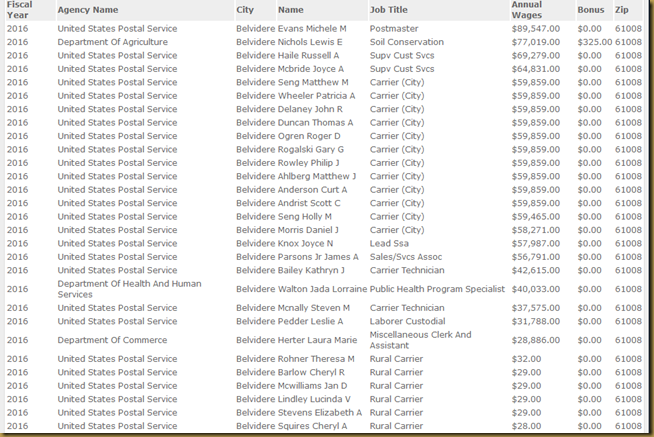
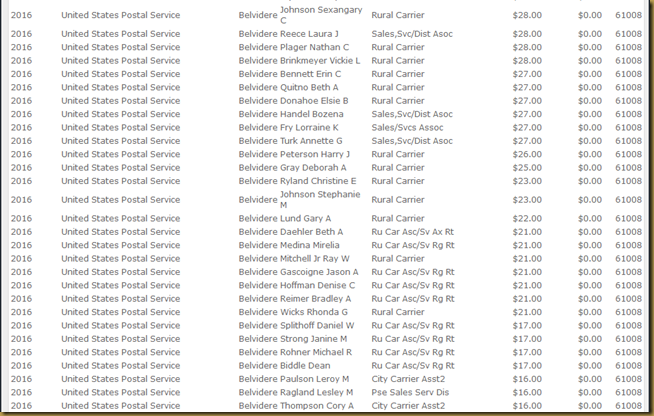
Interesting new website: Federal Employees/Salaries in your area

GO TO:  https://www.openthebooks.com/map/?Map=5874&MapType=Pin

And you can find information similar to this: 


image

image

imageimage

The effect of PAYGO on Medicare


Senate Tax Bill Would Trigger Medicare Cuts

Measure would increase the federal debt, lead to mandatory reductions in 'safety net' programs

by Dena Bunis, AARP, November 28, 2017|Comments: 235

Senate Tax Bill Would Trigger Medicare Cuts

Getty Images

The $25 billion reduction would affect the payments that doctors, hospitals and other health care providers receive for treating Medicare patients.

If you read through the umpteen pages of the Senate tax bill, you won’t find a clause that says it dramatically cuts Medicare spending. But the effect of the legislation being debated this week would be to slash up to $25 billion from the health program in 2018 and possibly more in the future.

That’s because the tax measure would prompt the “pay-as-you-go” law, commonly referred to as PAYGO. The law was designed to keep the deficit in check by requiring the administration to institute spending cuts in many mandatory federal programs if Congress passes any measure that increases the deficit but doesn’t include offsetting revenues.

The Senate tax proposal would add $1.5 trillion to the federal deficit over the next 10 years. Under PAYGO, if this bill were to become law, the government would have to lop off $150 billion in spending every year for 10 years.

Medicaid, Social Security, food stamps and other social safety net programs are exempt from the PAYGO law, which went into effect in 2010. But Medicare and other programs — such as federal student loans, agricultural subsidies and the operations of the Customs and Border Patrol — are not exempt.

The law caps how much the government can trim from Medicare at 4 percent. That’s $25 billion the first year, according to a report by the nonpartisan Congressional Budget Office. The annual amount could increase in subsequent years depending on the size of the deficit and Medicare’s budget.

The $25 billion reduction would affect the payments that doctors, hospitals and other health care providers receive for treating Medicare patients. Individual benefits would not change and neither would premiums, deductibles or copays. But with so much less money going to providers, the cuts could have major impacts on patient access to health care — such as fewer physicians accepting Medicare patients.

“We’re deeply concerned that the tax proposals being made will very directly affect the ability of Medicare to maintain services, and we do not think it is fair that older Americans who have paid into Medicare their entire working lives get stuck with the bill for a tax overhaul,” says Cristina Martin Firvida, AARP director of financial security.

The Senate is scheduled to debate the bill this week. The tax bill the House of Representatives passed earlier this month would also add $1.5 trillion to the deficit and lead to automatic spending cuts.

Congress has the authority to waive the PAYGO law and forestall such cuts. But it is not yet clear whether lawmakers would do so. And waiving the rules would simply cause higher deficits in later years.

Above is from:  https://www.aarp.org/politics-society/advocacy/info-2017/senate-tax-medicare-cuts-fd.html

Friday, January 5, 2018

Unusual volume trading on Chrysler stock

Fiat Chrysler shares surge 22%; company won't comment on talks

Greg Gardner, Detroit Free Press Published 5:31 p.m. ET Jan. 5, 2018 | Updated 6:31 p.m. ET Jan. 5, 2018

Mike Manley, head of the Jeep and Ram brands for Fiat Chrysler Automobiles, says a new Wrangler and Ram 1500 and refreshed Cherokee will make for a good year. Wochit

Sergio Marchionne

(Photo: Carlos Osorio, AP)

CONNECTTWEETLINKEDINCOMMENTEMAILMORE

Shares of Fiat Chrysler Automobiles surged more than 20% this week on heavy trading volume, raising the possibility that a potential acquirer is buying shares.

Under U.S. securities law, any investor who acquires 5% or more of a publicly traded company must disclose that holding and any additional shares thereafter. So far no one has made that disclosure.

The automaker's largest shareholder is Exor, an Italian investment company controlled by the Agnelli and Elkann families. The fund owns 25.3% of FCA.

FCA shares rose 5.4% Friday to close at a record high of $21.77. Since Tuesday, the stock has risen 22%. In each of the last three days, more trading volume has ranged between 10.6 million and 14.3 million shares, well above the average daily volume of 3.1 million.

By contrast, Ford and General Motors shares have gained 5.6% and 7.5%, respectively over that period, on light trading.

An FCA spokesman declined to comment on whether the company was currently in talks with a potential partner or acquirer.

CEO Sergio Marchionne has looking for a buyer for more than two years. He plans to retire by 2019 and the company has not signaled who might succeed him.

In May 2015, Marchionne pleaded with competitors to explore mergers and partnerships to deal with the rapidly rising cost of global manufacturing and new autonomous vehicles technologies.

Last August, a spokesman for Great Wall Motors, a Chinese manufacturer that sells mainly SUVs, said his company was interested in FCA's Jeep brand.

Read more:

What happens to Fiat Chrysler if Chinese automaker Great Wall buys Jeep?

Fiat Chrysler merger looming?

Last March at the Geneva auto show in Switzerland, Marchionne said, "I have no doubt that at the relevant time Volkswagen may show up and have a chat" for a merger. He said it in the context of General Motors sale of its Opel and Vauxhaul brands to PSA.

One month later he backed off, warning, "we need to be very careful that we don’t start unrealistic dreams about consolidation."

Then in early December he said FCA could potentially partner with Hyundai on hydrogen fuel cell technology.

On Wednesday, FCA reported its December sales in the U.S. fell 11% from a year earlier. But it is about to unveil a redesigned Ram pickup at this month's Detroit auto show. A redesigned Jeep Wrangler goes on sale soon. 

While North America has generated most of the automaker's profit since Fiat took control of Chrysler following its 2009 taxpayer-funded bankruptcy, FCA doubled its operating profit in Europe, the Middle East and Africa from 2015 to 2016, and is expected to show an increase for 2017 when it reports fourth-quarter results, said Richard Hilgert, a Morningstar analyst in Chicago.

Marchionne has talked about spinning off its Magneti Marelli components unit.

How could that deal raise the stock price?

"That would be like taking a car apart, selling the parts and realizing you get more than the price of selling the car," said Hilgert.

Maryann Keller, a former industry analyst and founder of MK&A Global Automotive Strategy, downplayed acquisition speculation. She said selling off nonessential holdings such as Magneti Marelli, paying down debt and a much lower tax rate on its U.S. earnings are driving the stock price.

"If someone were truly going to make a bid for FCA, they wouldn't be silently buying shares. They would be talking," Keller said. "The Chinese are not going to buy in dribs and drabs."

Despite is smaller scale, FCA was ahead of the curve by halting sales of small and midsize passenger cars in the U.S.

Unlike General Motors, Ford, Toyota, Nissan and others, FCA has outsourced its autonomous vehicle effort to Waymo, the Google spin-off, to which it has provided more than 500 Chrysler Pacifica minivans that Waymo equips with the sensors and navigation components. Waymo is testing those vehicles in the Phoenix area and elsewhere.

As a result, FCA is spending much less than competitors on this technology that initially will be introduced in ride-sharing and delivery fleets.

Contact Greg Gardner: 313-222-8848 or ggardner99@freepress.com. Follow him on Tiwtter @GregGardner12

Above is from:  https://www.freep.com/story/money/cars/chrysler/2018/01/05/fiat-chrysler-shares-surge-22-company-wont-comment-talks/1007349001/