Sunday, December 17, 2017

Robert Reich: The Three Big Lies About Trump’s Tax Plan

Robert Reich: The Three Big Lies About Trump’s Tax Plan

By Robert Reich On 12/17/17 at 5:43 AM

Share

Opinion

This article first appeared on RobertReich.org.

Here are the three main Republican arguments in favor of the Republican tax plan, followed by the truth.

1. It will make American corporations competitive with foreign corporations, which are taxed at a lower rate

Rubbish.


(1) American corporations now pay an effective rate (after taking deductions and tax credits) that’s just about the same as most foreign based corporations pay.

(2) Most of these other countries also impose a “Value Added Tax” on top of the corporate tax.

(3) When we cut our corporate rate from 35 percent to 20 percent, other nations will cut their corporate rates in order to be competitive with us – so we gain nothing anyway.

(4) Most big American corporations who benefit most from the Republican tax plan aren’t even “American.” Over 35 percent of their shareholders are foreign (which means that by cutting corporate taxes we’re giving a big tax cut to those foreign shareholders). 20 percent of their employees are foreign, while many Americans work for foreign-based corporations.

(5) The “competitiveness” of America depends on American workers , not on “American” corporations. But this tax plan will make it harder to finance public investments in education, health, and infrastructure, on which the future competitiveness of American workers depends.

(6) American corporations already have more money than they know what to do with. Their profits are at record levels. They’re using them to buy back their shares of stock, and raise executive pay. That’s what they’ll do with the additional $1 trillion they’ll receive in this tax cut.

2. With the tax cut, big corporations and the rich will invest and create more jobs

Baloney.

(1) Job creation doesn’t trickle down. After Ronald Reagan and George W. Bush cut taxes on the top, few jobs and little growth resulted.

America cut taxes on corporations in 2004 in an attempt to get them to bring their profits home from abroad, and what happened? They didn’t invest. They just bought up more shares of their own stock, and increased executive pay.

(2) Companies expand and create jobs when there’s more demand for their goods and services. That demand comes from customers who have the money to buy what companies sell.

Those customers are primarily the middle class and poor, who spend far more of their incomes than the rich. But this tax bill mostly benefits the rich.

(3) At a time when the richest 1 percent already have 40 percent of all the wealth in the country, it’s immoral to give them even more – especially when financed partly by 13 million low-income Americans who will lose their health coverage as a result of this tax plan (according to the Congressional Budget Office), and by subsequent cuts in safety-net programs necessitated by increasing the deficit by $1.5 trillion.

3. It will give small businesses an incentive to invest and create more jobs

Untrue.

(1) At least 85 percent of small businesses earn so little they already pay the lowest corporate tax rate, which this plan doesn’t change.

(2) In fact, because the tax plan bestows much larger rewards on big businesses, they’ll have more ability to use predatory tactics to squeeze small firms and force them out of business.

***

Don’t let your Uncle Bob be fooled: Republicans are voting for this because their wealthy patrons demand it.

Their tax plan will weaken our economy for years – reducing demand, widening inequality, and increasing the national debt by at least $1.5 trillion over the next decade.

Shame on the greedy Republican backers who have engineered this.

Shame on Trump and the Republicans who have lied to the public about its consequences.

GettyImages-632212568 Trump donor Sheldon Adelson attends the Inaugural Luncheon in the US Capitol January 20, 2017 in Washington, DC. Aaron P. Bernstein/Getty

Robert Reich is the chancellor’s professor of public policy at the University of California, Berkeley, and a senior fellow at the Blum Center for Developing Economies. He served as secretary of labor in the Clinton administration, and Time magazine named him one of the 10 most effective Cabinet secretaries of the 20th century. He has written 14 books, including the best-sellers Aftershock, The Work of Nations and Beyond Outrage and, most recently, Saving Capitalism. He is also a founding editor of The American Prospect magazine, chairman of Common Cause, a member of the American Academy of Arts and Sciences and co-creator of the award-winning documentary Inequality for All. HIs latest documentary, "Saving Capitalism," is available on Netflix.

Tuesday, December 12, 2017

**Killing the state and local tax deduction may be unconstitutional. Here's why**


Column

Article below is from:  http://www.latimes.com/business/hiltzik/la-fi-hiltzik-salt-deduction-20171208-story,amp.html

Killing the state and local tax deduction may be unconstitutional. Here's why

A rally participant holds a sign protesting a Republican-crafted tax cut plan outside the U.S. Capitol Building. (Reynold /EPA/Shutterstock)

Michael HiltzikContact Reporter

The debate over eliminating the federal tax deduction for state and local taxes — a linchpin of the Republican tax cut plans now working their way through Congress — has focused on the economic and political effects of the change. But that may be the wrong discussion. The question is whether eliminating the deduction is even constitutional. History suggests that it’s not.

The most cogent analysis of this issue comes to us from the grave — specifically, from the late Sen. Daniel Patrick Moynihan (D-N.Y.). Moynihan addressed the issue in a 1985 speech, later published in the political science journal Publius.

Leaders of states that rely on state and local income taxes for a large share of their revenue, including California, have threatened to bring a legal challenge to a tax bill that eliminates the deduction. They would do well to take their lead from Moynihan.

There are arenas of government that must not be invaded by other governments. — The late Sen. Daniel P. Moynihan, 1985

At the time of his speech, the state and local tax deduction was under attack by the Reagan administration, which like today’s GOP, was looking for ways to pay for a tax cut for the rich. Moynihan labeled the idea “a profound constitutional error.”

Moynihan drew his argument from the principle of federalism enshrined in the Constitution, the essence of which is that “there are arenas of government that must not be invaded by other governments.” He observed that the notion that this applied to taxation had been understood dating back to the origins of the federal income tax, enacted under Abraham Lincoln to finance the Civil War.

The Revenue Act of 1862, Moynihan noted, provided that federal tax liability was to be calculated only after state and local taxes were first deducted, “and this under the most pressing emergency conditions ever faced by our country.” The deduction was enshrined in the Revenue Act of 1913, which created the modern federal income tax.

A few contemporary commentators have noticed that eliminating the SALT deduction, as it’s known today, invades local prerogatives. Progressive pundit John Stoehr wrote recently that the change would be “a violation of the states' rights the Republicans say they alone represent.” At the other end of the ideological spectrum is Stan Veuger, a fellow of the conservative American Enterprise Institute, who called the deduction “a linchpin of the federalist system,” which “expresses our preference for local solutions to local problems.”

But that’s definitely a minority approach. Virtually the entire debate over the current tax cut bills has treated the SALT deduction as just another loophole, akin to the mortgage interest deduction, that favors the wealthy. The political component of the discussion relies on the fact that the states with the highest percentage of residents claiming the deduction — such as California, New York, New Jersey and Maryland — tend to vote Democratic. In our denatured political discourse, the idea that Republicans in Congress would turn their gun sights on Democratic states is seen as sort of adorable.

It’s also commonly argued that, insofar as the deduction is most heavily concentrated in big, urban states, it’s tantamount to a “subsidy” of blue states by their poorer red neighbors.

Moynihan, a New York Democrat, albeit one who wasn’t averse to taking a conservative stance on issues from time to time, had little regard for these arguments. He thought it inaccurate to label the deduction a “tax expenditure” — a term used to describe giveaways to favored groups through the tax code. “I do not think we should let the Treasury Department get away with calling it a federal ‘subsidy,’ ” he added. “In diplomacy, this is known as semantic infiltration: if the other fellow can get you to use his words, he wins.”

In any event, the notion that other states “subsidize” big blue states through the SALT deduction happens to be wrong. As New York State Comptroller Thomas P. DiNapoli demonstrated in a 2016 study, the “subsidy” generally goes in the other direction: The states with the largest state and local tax burdens typically paid out more to the federal coffers than they received in return. The states with the biggest outflow were those on the West Coast and Northeast, and those receiving the largest inflows tended to be Southern states with low state and local taxes.

Another principle Moynihan discussed was the issue of “double taxation.” Interestingly, an aversion to “double taxation” is frequently cited by Republicans and conservatives to justify reducing or eliminating taxes on dividends — dividends already are taxed once as corporate income, so why should they be taxed again when they’re received by shareholders.

Big states with high state and local taxes tend to be net contributors to federal coffers, shown here in red. The majority (green) get more from the federal government than their residents pay. (New York State Comptroller)

But eliminating the SALT deduction would be a more far-reaching example of double taxation, Moynihan said, citing a resolution by the National League of Cities calling the deduction “a fundamental statement of the historical right of state and local governments to raise revenues and of individuals not to be double taxed.” As it happens, the Supreme Court has spoken on the issue of double-taxation: It’s wrong. In a 2015 decision written by Justice Samuel Alito, the court ruled that a Maryland provision denying its taxpayers credit for taxes paid to other states was unconstitutional. Expect the states’ challenges to the GOP tax bill to cite that ruling (Comptroller vs. Wynne) prominently.

In 1862, Moynihan noted, Rep. Justin Smith Morrill of Vermont, then chairman of the Ways and Means Committee, warned that eliminating the SALT deduction would “perplex and jostle, if … not actually crush, some of the most loyal States of the Union.” Moynihan called it a “huge and final irony” that eliminating the deduction would transfer more resources to the federal government, allowing it to grow larger — exactly the outcome that the advocates of “small government” in the Republican congressional caucus say they don’t want.

Moynihan and his colleagues managed to defeat the Reagan administration’s effort to eliminate the SALT deduction. Subsequent efforts also failed. At this moment, the GOP plan to take an ax to the SALT deduction looks like a juggernaut. But history and the Constitution may say otherwise.

Posted by bill pysson at 7:38 AM No comments:

Continuation: How much would Boone County have to pay its Administrator if he retired?


Well like so many questions you ask Boone County it leads just to more questions.  Here is a summary of what I have discovered.

First the reason for this inquiry.  Each year the county pays some individual  tens of thousands of dollars at retirement for unused annual leave and sick leave.  Board Member Cathy Ward has a list of some of the sums which together amount in the hundreds of thousands over the years. Mrs. Ward’s information immediately follows this posting.

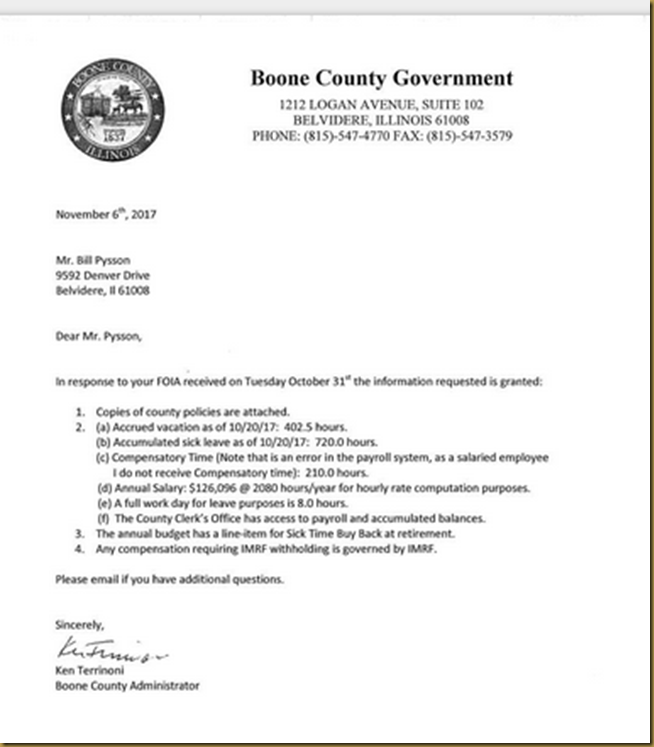
In an attempt to understand the situation I ask Mr. Terrinoni, the County Administrator, for his accumulated leave and have attempted to calculate how much the county would owe him if he would leave.

Below is his response to my FOIA request.

image

Here is my Freedom of Information Request:

During the last several years the county has paid out tens of thousands of dollars to retirees for unused sick leave, unused annual leave and unused compensated time (comp time) for unpaid overtime etc.

Under the Freedom of Information Act please provide the following information:

1. A copy of all policies or county ordinances which limit the accumulation of the various types of leave or deadline the use of such leave.

2. You as a highly paid official maybe eligible for a very large such payment at retirement.

Please provide the following information for County Administrator, Ken Terrinoni, as of November 30, 2017 or a more convenient recent pay period.

a. Accumulated annual leave

b. Accumulated sick leave

c. Any and all leave for comp time

d. Hourly rate to be used to calculate the dollar amount based upon your current salary

e. The number of hours and fractions of hours to be considered one full day for leave purposes

f. Please indicate which county office/department (other than your Admin Office) maintain the current balance for each type of your leave.

3. Accounting wise, does the county reserve/accrue for unpaid leave? If so when and under what account heading? When the retiree is granted the leave which accounting heading/account pays the unpaid leave?

4. What determines which of these leaves payments require personal withholding to Illinois Municipal Retirement Fund?

5. Thank you for your cooperation.


If Mr. Terrinoni would retire/resign today the following would be owed:  $48,269

Hourly rate:  $126,092/2080 hours per year= $60.62 per hour.

Annual Leave owed:  402.5 hours** X $60.62 =  $24,400.

Sick Leave payment due;  720 HOURS   AS A RETIREE WITH 20 YEARS:   first 427. 5  HOURS x .75 x 60.62 = $19,436 plus 292.5 hours X .25 X $60.62 = $4,433  Therefore Total Sick Leave $23,869.

**Based upon the vacation policy shown immediately  below it would appear that accumulated annual leave for Mr. Terrinoni greatly exceeds the policy.  Mr. Terrinoni was questioned regarding this matter but did not respond. See:  Subsequent Questions of FOIA October 31, 2017

image


Boone County Vacation/sick leave Policy

Policy statements supplied by October 31, 2017  FOIA

Subsequent Questions of October 31, 2017 FOIA

To:Ken Terrinoni

Nov 22 at 4:54 PM

I had several questions regarding the FOIA and have not received a reply.   Below is a copy of my questions.  Please respond at your earliest convenience.

Thank you for the prompt response to my recent FOIA request. Unfortunately I still have a number of questions.

The personnel policy statement you supplied does not give the definition of the various classes of employees. Those definitions are necessary to properly apply the rules regarding use and limits on the various types of leave.

It appears that you as the Administrator are a “Type C” employee. Based upon that assumption your available annual leave greatly exceeds 20 days of annual accumulation. With 402.5 hours accumulated you have over 10 weeks of vacation coming. Have you been paid for unusable leave in the past? Have you forfeited leave? If leave was forfeited should the record be corrected to reflect the forfeiture? Is there some other reason why your accumulation shows so many hours?

The policy does not mention what happens when there are “budgetary restraints” that do not allow the payment of unused leave for employees unable to use the leave due to “scheduling or operational needs”. Does such leave carryover until such time as the county has the funds? Is this the case for your excess leave?

I appreciate your prompt response to these questions.


Response:  No answer since “no additional documentation”