Thursday, September 7, 2017

Rauner will borrow $6 billion to start paying off Illinois pile of unpaid bills

BY Kim Geiger and Monique Garcia Contact Reporter Chicago Tribune

Republican Gov. Bruce Rauner announced plans Thursday to borrow $6 billion to work on paying down Illinois' massive backlog of unpaid bills, but he warned that he'll try to trim state spending in order to pay for the new debt costs.

The move comes months after Democrats and some Republicans gave the governor the borrowing authority as part of a budget they enacted over his objections.

ADVERTISING

Rauner initially resisted taking advantage, contending that there wasn't money included in the budget to make payments on new debt. Democrats dispute that, saying $350 million was set aside for that purpose.

Democrats tried to raise pressure on the governor this week, pointing to a late-August report that estimated that the state could save as much as $6 billion by selling bonds to pay down a portion of its about $14 billion backlog of bills. The report by the Commission on Government Forecasting and Accountability also estimated that the state is paying $2 million in additional costs per day on the portion of those bills that are accruing interest.

Democratic Comptroller Susana Mendoza sent out a statement Wednesday charging that Rauner's delay in issuing the bonds had already cost taxpayers $120 million.

On Thursday, Rauner said in a news release that he had decided to proceed with the bond sale after concluding that "it's better to have Wall Street carry our debt than Main Street Illinois."

Unpaid bills can accrue as much as 12 percent interest per year. The state can more than cut that rate in half, even with its low credit rating, by refinancing the debt in the bond market.

Rauner win on schools bill comes at a price

In announcing his plans, Rauner held out the possibility that his office could make cuts to state spending, though he did not spell out what programs would be on the chopping block.

"The legislature-passed budget did not account for the increase in debt service costs to cover the bill backlog bond issuance," the Rauner statement said. "The governor's office is identifying several hundred million dollars in possible spending reductions to address this budgetary shortfall. The governor also would like the General Assembly to return to Springfield this fall to work with him to balance the budget and enact structural reforms that could save much more."

Rep. Greg Harris, a key budget negotiator for House Democrats, said Rauner's read of the budget legislation is incorrect. He said $350 million was set aside to help pay for the borrowing.

The budget gives the state the authority to issue up to $6 billion in general obligation bonds that must be issued by the end of the calendar year. The money raised must be used to pay down expenses that were incurred during the two-year budget stalemate that ended in July. That's when lawmakers overrode Rauner's veto of the budget, enacting it.

Rauner vetoes bills on spending transparency, home health care worker OT

Harris, of Chicago, said he was glad Rauner decided to move forward with the borrowing plan, which he credited to pressure put on the governor by Mendoza.

"His delay has cost us over $120 million in interest that could have been spent on actual services to the people of Illinois. But instead, he has essentially thrown it into the middle of the plaza at the Thompson Center and lit it on fire," Harris said.

Mendoza, whose job is to manage cash flow in the state's main checking account, praised the decision.

"Refinancing our debt at a much lower interest rate — just like any sensible homeowner with a high mortgage rate would do — will provide payment for services rendered to thousands of people across the state and save Illinois taxpayers billions of dollars over the life of the bonds," she said in a statement.

Also on Thursday, Mendoza announced that she had released $541 million in state aid payments to schools, bringing the state current on two payments that had been due in August. They were delayed because of the fight between Rauner and lawmakers over education funding formula legislation. That dispute was resolved last week.

kgeiger@chicagotribune.com

mcgarcia@chicagotribune.com

Above is from:  http://www.chicagotribune.com/news/local/politics/ct-bruce-rauner-bond-sale-met-20170908-story.html

Wednesday, September 6, 2017

Mandatory Union Dues questioned


McCaleb: All eyes on Illinois case that could change U.S. labor law

U.S. Supreme Court

Shutterstock photo

Americans are back to work this week after celebrating another Labor Day holiday.

By the time the next Labor Day rolls around in 2018, the country's labor laws – particularly as they relate to public employee unions – could be dramatically different.

That's thanks to a lawsuit emanating from the state of Illinois.

The U.S. Supreme Court is expected to decide later this month whether it will hear arguments in the case Janus v. AFSCME.

Mark Janus is a child support specialist for the Illinois Department of Healthcare and Family Services. He fights for kids who get caught up in custody disputes or who otherwise need an advocate outside of their families.

As a non-salaried state employee, Janus was forced to pay fees to the American Federation of State, County and Municipal Employees Union. He didn't realize it until he received his first paycheck and noticed a portion of his salary went to AFSCME.

Janus didn't like that. He and many others like him believe that being forced to pay dues to a union whose representation they don't want and whose politics they don't agree with is a violation of their First Amendment rights.

Make no mistake: Unions, both public sector and private, are political organizations.

Get news headlines sent daily to your inbox

The National Institute for Labor Relations Research issued data earlier this year that showed labor unions spent more than $1.7 billion on last year's election. That's more than George Soros and the Koch brothers combined. In Illinois, unions spent more than $35 million on political campaigns in 2016.

Janus and thousands of others like him essentially are forced to contribute to political organizations that donate to the campaigns of candidates they otherwise wouldn't support.

That's un-American.

"I don't see my union working totally for the good of Illinois government," Janus said in a guest column published in the Chicago Tribune. "For years, it supported candidates who put Illinois into its current budget and pension crisis. Government unions have pushed for government spending that made the state's fiscal situation worse."

So Janus sued AFSCME.

As his attorneys anticipated, Janus lost every step of the way as the case made its way through Illinois' federal courtrooms. In March, the U.S. 7th Circuit Court of Appeals struck it down, opening the door for an appeal to the U.S. Supreme Court. His attorneys filed that petition in June, and the court is expected to decide whether to accept the case by Sept. 28.

If the Supreme Court decides to take the case, Janus has a good shot at winning.

A similar case in California, Friedrichs vs. the California Teachers Association, made it to the Supreme Court in 2016. The court split on the California case, 4-4. But that decision was rendered after conservative Justice Antonin Scalia died. Scalia likely would have joined his colleagues who ruled in favor of Rebecca Friedrichs, a California school teacher who also believed her constitutional rights were being violated by being forced to pay union dues.

With Neil Gorsuch – President Donald Trump's pick to replace Scalia – now on the bench, advocates for both sides of the issue are focused on Janus.

If Janus wins, millions of government workers who have been forced to give up part of their salaries to unions they don't support will no longer have to if they don't want.

Unions, essentially, will have to prove to public employees that their representation is worth the cost of the dues they charge.

And that's the way it should be.

Dan McCaleb is news director of Illinois News Network and the digital hub ILNews.org. He welcomes your comments. Contact Dan at dmccaleb@ilnews.org.

Above is from:  https://www.ilnews.org/opinion/mccaleb-all-eyes-on-illinois-case-that-could-change-u/article_7a714760-924b-11e7-932a-d310c6ca8314.html

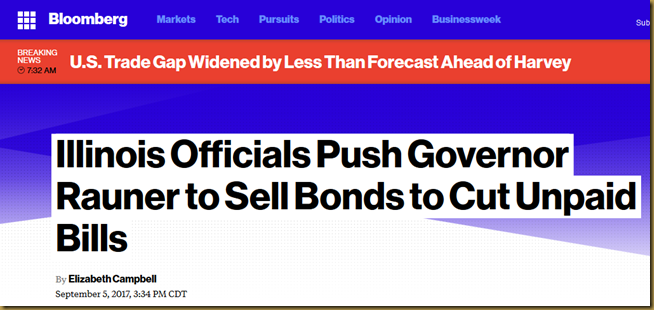
Push Governor Rauner to Sell Bonds to Cut Unpaid Bills


image


Illinois Officials Push Governor Rauner to Sell Bonds to Cut Unpaid Bills

By

Elizabeth Campbell

September 5, 2017, 3:34 PM CDT

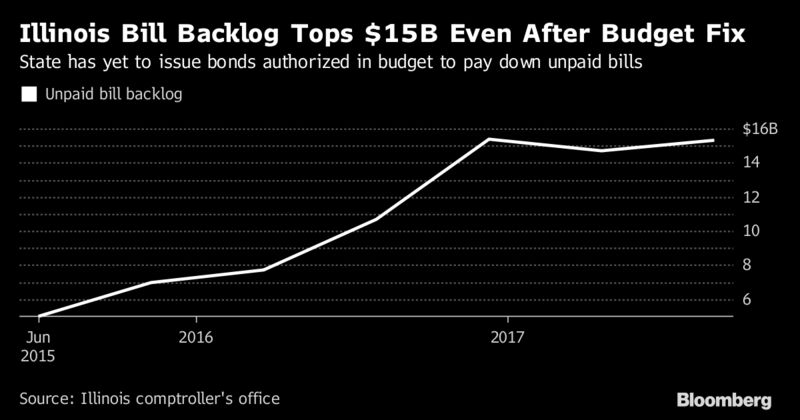
  • Unpaid bills have ratched up to $15.3 billion, near record

  • State could save money if it refinances debt, S&P has said

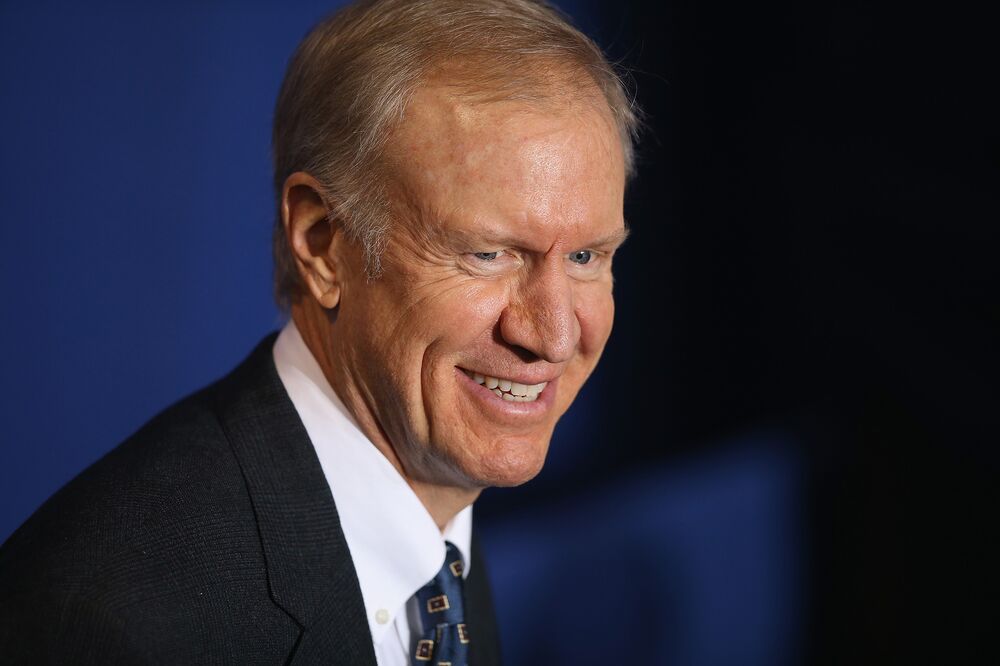
Illinois governor Bruce Rauner

Photographer: Scott Olson/Getty Images

Illinois officials are pushing Governor Bruce Rauner to sell bonds to pay bills left from the state’s record budget impasse, saying it would reduce steep interest penalties of as much as $2 million a day.

The spending package that the legislature enacted two months ago over Rauner’s veto authorized the state to issue as much as $6 billion of securities to cover bills that accumulated during a unprecedented two-year standoff over the budget.

On Tuesday, Senator Donne Trotter, a Democrat, urged Rauner, a Republican, to sell the debt to pay health-care providers and other state contractors that have had to lay off staff and borrow because they’re waiting to be paid. Comptroller Susana Mendoza has also called for the governor to sell the bonds.

“We remain in a political and fiscal crisis,” Trotter said during a press conference in Chicago on Tuesday.

Illinois could save money if it borrows to pay down the unpaid bills, some of which are accumulating as much as 12 percent interest, S&P Global Ratings said in a report last month. In the meantime, the state is paying about $2 million a day in interest on about $5.5 billion of unpaid bills that were more than 90 days old as of June 30, according to a memo from the Commission on Governor Forecasting and Accountability, which cited the state comptroller’s office.

Elizabeth Tomev, a spokeswoman for Rauner, didn’t immediately have a comment on Trotter’s call to issue the bonds. Trotter is a sponsor of the budget implementation bill that extended the state the borrowing authority.

The budget package for the year that started July 1 estimates an operating surplus of about $360 million, enough to cover debt service on about $3 billion of GO bonds with a 12-year maturity, according to S&P, which cited legislative sponsors of the bill. The bonds, which have a 12-year maturity, must be sold by Dec. 31, according to the parameters of the legislation.

The state’s bill backlog stood at $15.3 billion on Sept. 1, just shy of the record $15.4 billion reached in June, according the comptrollers’ office. Those unpaid bills include about $540 million of general state aid payments that will go out this week, and another $270 million that will go out over the weekend now that lawmakers approved a school funding bill, said Abdon Pallasch, a spokesman for the comptroller.

Marvin Lindsey, chief executive officer of Community Behavioral Healthcare Association of Illinois, and Leslie Rogers, vice president of South Shore Hospital, joined Trotter to urge Rauner to use the bonding authority.

“What it means to us is lost opportunity as you’re paying interest on loans that you did not anticipate having, that is sunk, lost cost that will not be reimbursed by anyone,” Rogers said during the press conference. “We ask and we need for the governor to utilize the tools in order to help move us forward.”

Tuesday, September 5, 2017

“Resident only” does not exist for public comment.

image

Question: Can a unit of local government pass a policy limiting public comment to residents only?

Answer: According to a recent PAC opinion, public bodies may not restrict public comment to residents only, as Section 2.06(g) of the Open Meetings Act provides that "any person" shall be permitted an opportunity to address public officials under the rules established by the public body

Sunday, September 3, 2017

Congressman Adam Kinzinger’s townhall in Dixon?


Not My Idea Of A 'Town Hall'

By Phillip LeFevre • Aug 29, 2017

TweetShareGoogle+Email

Listen

Listening...

1:37

Phillip LeFevre's "Perspective" (August 29, 2017).

My idea of what a Congressional Town Hall meeting is about has been shattered.

I recently experienced my first Town Hall meeting in Dixon with Republican Congressman Adam Kinzinger. The Congressman referred to the gathering as both a town hall meeting and a legislative luncheon. It became obvious that this meeting was rigged, with more than 99.9% of Dixon citizens not being welcomed.

First, there were beautiful pre-printed name tags for the "guests." And, there was a very short time given for attendees to ask questions. Questions that obviously were not to the liking of Kinzinger were blown off. After one question Kinzinger said, "Are you kidding me? This is a legislative luncheon!"

Secondly, I attended the meeting to ask the Congressman one question for a future WNIJ Perspective. My question was about whether he supports a new bipartisan approach to passing healthcare legislation.

I was not allowed to ask my question. As I began verbalizing the question to him, his staff began physically pushing and pulling me out of the way. Then local police deputies got involved, pulling me away as they said he was on a tight schedule and didn't have time for questions.

So, the experience of seeing protesters outside being denied access to Kinzinger's speech; to the pre-printed name tags; and then the shield put around the Congressman by his staff and police. The town meeting with this member of Congress was nothing but a staged and rigged event solely to appease supporters.

I'm Phillip LeFevre, and that's my perspective.

Tags:

WNIJ Perspectives

Above is from:  http://northernpublicradio.org/post/not-my-idea-town-hall

Federal Transportation Board rejects Great Lakes Basin rail line


By Kevin Haas
Staff writer
By Susan Vela
Staff writer

Posted Aug 31, 2017 at 12:40 PM Updated Sep 1, 2017 at 12:11 AM

ROCKFORD — The U.S. Surface Transportation Board has rejected a proposal to build a 261-mile railroad that would have cut through the Rockford area as it moved through Wisconsin, Illinois and Indiana.

In a decision Wednesday, the board said that Great Lakes Basin Transportation’s financial information was “fundamentally flawed,” making it impossible for the board to determine whether the proposal meets necessary criteria.

Construction projects are not required to be fully funded in the early stages of an application. However, financial fitness of the company behind a proposal is part of the application process, the board says in its decision.

Great Lakes’ assets “are so clearly deficient for purposes of constructing a 261-mile rail line that the board will not proceed with this application given the impacts on stakeholders and the demands upon board resources.”

Great Lakes may file a new application to meet the board’s criteria.

“Resubmitting is an option, but we have made no decision whether we’re going to do that or not,” said Mike Blaszak, Great Lakes’ chief legal and administrative officer.

He declined further comment.

Jim Webster, a Winnebago County Board member who introduced a unanimously approved resolution opposing the railroad, said the Surface Transportation Board’s decision was “the best news I’ve had in a long time for the people of Winnebago County.”

The proposed freight line would have crossed through Webster’s district, and he said, “There was no real benefit to any of us here for that.”

Vicky Rowley organized an October rally against the railroad at her Winnebago Township farm property.

If GLBT submits another application, she plans to renew her protest.

“We were definitely not in support of it at all,” Rowley said. “I’m just so relieved that they didn’t approve it. It would have just been devastating for all the farms in the area. It was just unbelievable.”

Rockton farm owner Marilyn Mohring, 77, has been staying apprised of GLBT’s railroad plans via the Winnebago County Against GLB Railroad’s Facebook page.

“Just no” is what she thought when she first heard that more trains could run through her community.

She and her husband wrote letters of protest and also provided some financial support to stop the railroad proposal. They had concerns about noise, accidents and damage to creeks and wetlands.

“We just didn’t believe it was a viable thing,” she said. “It was going to disrupt way too many farms.”

Worried property owners formed several groups in Illinois and Wisconsin once they learned the controversial rail line might run through their communities. They included Winnebago County Against GLB Railroad and Citizens Against the GLB Railroad in Boone County. They wrote letters, attended meetings and informed neighbors.

Burritt Township farmer Lana Daly ended up being spokeswoman of Winnebago County Against GLB Railroad because of the potential railroad’s threat to her centennial farm. While relieved by the board’s decision, she plans to remain vigilant.

“It’s exciting to think that we’ve been part of the journey,” she said. “But I do think we need to be diligent. I don’t think it’s time to put down the torch and run the other way. It’s going to be ongoing.”

Susan Vela: 815-987-1392; svela@rrstar.com; @susanvela

Kevin Haas: 815-987-1410; khaas@rrstar.com; @KevinMHaas

Above is from:  http://www.rrstar.com/news/20170831/federal-transportation-board-rejects-great-lakes-basin-rail-line

Saturday, September 2, 2017

A $1,000 per month cash handout would grow the economy by $2.5 trillion, new study says


17 / 18

CNBC logoCNBC

CNBC

Catherine Clifford14 hrs ago


0

Giving every adult in the United States a $1000 cash handout per month would grow the economy by $2.5 trillion by 2025, according to a new study on universal basic income.

The report was released in August by the left-leaning Roosevelt Institute. Roosevelt research director Marshall Steinbaum, Michalis Nikiforos at Bard College's Levy Institute, and Gennaro Zezza at the University of Cassino and Southern Lazio in Italy co-authored the study.


The study made economic forecasts for three proposals: a full universal basic income in which every adult gets $1,000 a month ($12,000 a year), a partial basic income in which every adult gets $500 a month ($6,000 a year) and a child allowance in which parents get $250 a month ($3,000 a year).

The larger the universal basic income, the greater the benefit to the economy, according to the report.

A $1,000 cash handout to all adults would grow the economy by 12.56 percent after eight years, the study finds. Current Congressional Budget Office estimates put the GDP at $19.8 trillion. The cash handout would therefore increase the GDP by $2.48 trillion. (Vox first did this extrapolation in their coverage of the report, and Steinbaum confirmed the accuracy of the extrapolation to CNBC Make It by email.)

The $250 allowance would grow the GDP by 0.79 percent and a $500 a month payment would grow the GDP by 6.5 percent.

These estimates are based on a universal basic income paid for by increasing the federal deficit. As part of the study, the researchers also calculated the effect to the economy of paying for the cash handouts by increasing taxes. In that case, there were would be no net benefit to the economy, the report finds.

"When paying for the policy by increasing taxes on households rather than paying for the policy with debt, the policy is not expansionary," the report says. "In effect, it is giving to households with one hand what it is taking away with the other. There is no net effect."

The study is based on the Levy Macro-Economic model, which presupposes that the potential of the economy is constrained because household income is low. That opinion, even the authors of the study admit, is debatable. "Other macroeconomic models would disagree," the report says.

The idea of a universal basic income has been promoted lately by technology leaders and Silicon Valley billionaires.

Some, like Tesla (TSLA) and SpaceX CEO Elon Musk, see cash handouts as a solution to the imminent threat of automation to the labor force. Musk has said that universal basic income will be a virtual necessity because robots will put so many low-skilled workers out of a job.

Others, like Facebook (FB) CEO Mark Zuckerberg, think handouts could give everyone the safety net necessary to think like an entrepreneur. Zuckerberg touts UBIas a way to ensure people are not afraid to take risks to pursue the projects and business ventures they are passionate about.

Y Combinator President and Silicon Valley heavyweight Sam Altman has launched an initiative to study the long-term effects on human behavior of getting a cash handout. The research is still in process.

Even as the idea of universal basic income is being studied by and discussed among the tech elite, the idea is a non-starter in the United States, according to some.

Robert Greenstein, the founder and President of the Washington D.C.-based think tank Center on Budget and Policy Priorities, called the notion too idealistic. "An effort to secure UBI would prove quixotic," he wrote in 2016. Greenstein says universal basic income is both too expensive and impossible to get through Washington D.C.

Greenstein offered one innovative alternative: "To be sure, there is a possible exception: a carbon tax that returns its proceeds to the public via a universal payment." But even that, he says, is more theoretical than realistic because he suggests that money reaped from a carbon tax would be better used to study alternative energy or to support those at the very bottom of the economy.

"If a carbon tax could pass, we might need to focus the proceeds available for these payments on low- and moderate-income families — so the payments would be adequate to offset the higher energy costs these families would face as a result of the tax — rather than extending the payments all the way up the income scale in universal fashion," Greenstein says.

Above is from:  http://www.msn.com/en-us/money/markets/a-dollar1000-per-month-cash-handout-would-grow-the-economy-by-dollar25-trillion-new-study-says/ar-AAr35pQ?li=BBmkt5R&ocid=spartandhp