
Tuesday, June 28, 2022

June 28, 2020: Johns Hopkins COVID 19 Situation Report

COVID-19 Situation Report

Editor: Alyson Browett, MPH

Contributors: Clint Haines, MS; Noelle Huhn, MSPH; Natasha Kaushal, MSPH; Amanda Kobokovich, MPH; Christina Potter, MSPH; Matthew Shearer, MPH; Marc Trotochaud, MSPH; and, Rachel A. Vahey, MHS.

MONKEYPOX OUTBREAKS UPDATE Read our latest updates on the monkeypox outbreaks on our resource page. We will continue to analyze the situation and provide updates, as needed. If you would like to receive these updates, please sign up here.

US FDA CONSIDERS VACCINE UPDATES Today, the US FDA Vaccines and Related Biological Products Advisory Committee (VRBPAC) is meeting to discuss if and how the strain compositions of COVID-19 vaccines should be modified going forward. The meeting will be livestreamed on the FDA website here with presentation materials also available for download. Presentations and discussion points expected to be covered include: evolution of SARS-CoV-2 variants thus far, as well as models predicting future evolution; current effectiveness of COVID-19 vaccines; related recommendations from the WHO on the subject; clinical trial data evaluating COVID-19 vaccines with varying strain composition; and the FDA perspective on the issue, including considerations for and data required to support authorization of any modified vaccines. The committee will then vote regarding recommendations for a COVID-19 vaccine strain composition, weighing the potential expected increases in immunity against the expense and complexity of a change in composition. Experts are hopeful that an updated strain composition could help provide increased protection from a potential fall surge, although there is concern that the speed of SARS-CoV-2 mutations and slowness of updates to formulations could reduce efficacy of boosters, as vaccine protection wanes and composition becomes outdated compared with circulating variants.

PFIZER-BIONTECH OMICRON-ADAPTED VACCINES Pfizer-BioNTech shared new data over the weekend of 2 Omicron-adapted vaccine candidates, both exhibiting positive safety, tolerability, and immunogenicity, and even outperforming the companies’ current vaccine. Given at 30 microgram and 60 microgram doses as a fourth booster dose, the monovalent candidate elicited a 13.5- and 19.6-fold increase in neutralizing geometric titers against Omicron BA.1, respectively, compared to pre-booster levels. The bivalent candidate, which contains antigens to both Omicron and the original strain, exhibited a 9.1- and 10.9-fold increase at the same dosages against BA.1. Both candidates were well-tolerated among participants of the phase 2/3 trial of adults over age 56. Preliminary lab studies show both candidates neutralize BA.4 and BA.5, but to a lesser extent than BA.1. The companies have shared the data with the US FDA ahead of its Vaccines and Related Biological Products Advisory Committee (VRBPAC) meeting today, alongside data from ongoing COVID-19 booster studies. The companies also shared the data with the European Medicines Agency (EMA) ahead of the June 30 meeting of the International Coalition of Medicines Regulatory Authorities (ICMRA).

MODERNA VACCINE FOR OLDER CHILDREN Children and adolescents aged 6 through 17 years can now receive the Moderna COVID-19 vaccine in the US, following publication of the US CDC Advisory Committee on Immunization Practices’ (ACIP) recommendations and CDC Director Dr. Rochelle Wallensky’s endorsement. The US FDA authorized the vaccine for that age group last week. Adolescents and teens ages 12-17 receive the same dosage as adults, while younger children ages 6-11 receive half of that dose, administered in 2 shots separated by 4-8 weeks. The Pfizer-BioNTech vaccine is already available for adolescents and older children.

A decision on the Moderna vaccine for this age group was delayed due to FDA review of data on the risk of heart problems, including myocarditis and pericarditis, among adolescent boys. However, the FDA said the vaccine’s benefits outweigh the risks, which are very small and also observed with the Pfizer-BioNTech vaccine. COVID-19 carries a much greater risk of heart problems than either vaccine, which are both safe overall. To minimize the risk of transient heart problems related to the vaccines, the CDC recommends that boys and men aged 12 through 39 years space their doses by 8 weeks. That recommendation, particularly for young adult men, is supported by findings from a recent study from Canada published in JAMA Network Open.

LONG COVID/PASC Researchers worldwide are investigating the potential causes of post-acute sequelae of SARS-CoV-2 infection (PASC), commonly known as long COVID. Blood clots, persistent virus, and immune system abnormalities—or a combination of those or other underlying mechanisms—are leading theories about what could be causing long-term symptoms following recovery from acute infection. To date, there is no agreement on how to define and diagnose long COVID, and estimates of its prevalence range from 5% to 50% of recovered patients. Recent data published by the US CDC, collected between June 1 and June 13, 2022, show that nearly 1 in 5 US adults who previously had COVID-19 continue to experience symptoms of long COVID, such as fatigue, rapid heartbeat, shortness of breath, muscle weakness, chronic pain, or cognitive difficulties. Overall, about 1 in 13 US adults, or 7.5% of the population, have symptoms lasting 3 or more months after COVID-19 recovery that were not experienced prior to infection. Women were more likely than men to currently have long COVID (9.4% vs. 5.5%), according to the data, findings that are supported by a review published June 20 in Current Medical Research and Opinion.

The CDC data show that older adults are less likely to have long COVID than younger adults, but the symptoms are often overlooked in older individuals and some research suggests seniors are more likely to develop long-term symptoms. A study from Denmark published June 22 in The Lancet Child & Adolescent Health found that among children ranging in age from 0 through 14 years, those who previously tested positive for SARS-CoV-2 were more likely to experience at least 1 symptom for 2 months or more than children who never tested positive. Additionally, one-third of children who previously tested positive experienced at least 1 long-term symptom they did not have prior to infection, including mood swings, rashes, and stomach aches, memory and concentration problems, and fatigue. While any person of any age can experience long COVID, the question of why remains a mystery. But most scientists and public health officials agree that unraveling that mystery, including standardizing the condition’s definition and diagnosis and finding treatments, represents an urgent global emergency to prevent mass suffering.

ESTIMATES OF DEATHS AVERTED Last week, a study published in The Lancet Infectious Diseases reported results from transmission modeling efforts estimating that COVID-19 vaccination programs may have prevented 19.8 million deaths (95% CI: 19.1-20.4 million) worldwide during their first year of rollout, even though global vaccination targets were not reached. The figure is based on using excess deaths to determine the true mortality burden of COVID-19, although modelers also found that using COVID-19 mortality alone and not excess deaths yielded a finding of 14.4 million deaths prevented (95% CI: 13.7-15.9 million), including 7.4 million (95% CI: 6.8-7.7 million) deaths prevented in countries provided vaccine by the COVID-19 Vaccines Global Access (COVAX) Advance Market Commitment. However, if vaccination coverage targets of 20% or 40% had been met in low-income countries, further reductions in mortality in those nations of 45% (95% CI: 42-49%) and 111% (95% CI: 105-118%), respectively, could have been reached. Experts noted that the study highlighted not only the importance of vaccination but also equitable access, with the majority of predicted prevented deaths occurring among high-income and upper-middle-income nations. Notably, China was not included in the analysis due to its status as the origin of the outbreak and its large influence on estimates due to its population size.

CHINA The National Health Commission of China today announced a reduction of the country’s quarantine policy for overseas travelers to 7 days in a centralized facility and an additional 3 days at home. Previously, travelers were required to stay 14-21 days in centralized quarantine depending on the city of entry and destination. The announcement also includes similar guidelines for close contacts of confirmed COVID-19 cases, requiring 7 days in centralized quarantine and 3 days of health monitoring at home, compared to the prior minimum 14-day requirement. China remains an outlier, as most nations have dropped their vaccination and quarantine requirements for international travelers.

Over the weekend, Beijing said it would allow primary and secondary schools to reopen for in-person instruction, with youth sports soon to follow at non-school locations. Shanghai officials also declared that the city reported no new local cases in 2 months, following a 2-month citywide lockdown that ended June 1. The lockdown effort was in line with China’s zero-COVID policy to stop all outbreaks. The policy is being discussed with renewed interest after authorities in Beijing mentioned that the strict policy could be in place for 5 years. The notice was published Monday on the official Communist Party newspaper of the capital, Beijing Daily, and republished by other media outlets, but officials quickly removed the reference to “5 years” from most online publications, as well as a hashtag on the microblogging site Weibo.

COVID-19 RECOVERY As world leaders drop the COVID-19 pandemic from their agendas, and US federal, state, tribal, and local governments roll back pandemic-related funding and mitigation efforts—such as mask mandates—local officials, grassroots organizations, and frontline community health workers continue to push for and implement piecemeal strategies to help increase vaccination rates, draw attention to the need for research into long COVID, and improve trust in and funding for public health systems. There is a need for the US to create “a sustainable infrastructure that can keep more people from getting COVID, regardless of their social circumstances,” writes Ed Yong in The Atlantic. Indeed, the US Government Accountability Office (GAO) last week released a report recommending that the US Department of Health and Human Services (HHS) prioritize the development of a real-time, public health situational awareness network to help raise public awareness to facilitate the early detection of and rapid response to future and potentially catastrophic disease outbreaks, such as COVID-19.

Saturday, June 25, 2022

Trump can teach Democrats a lot about working people

Politico

There Is a Major Rift Dividing the White Working Class — And Democrats Are Clueless

Lisa R. Pruitt

Fri, June 24, 2022, 3:30 AM·17 min read

Ever since J.D. Vance became the Republican Senate nominee in Ohio, journalists and pundits have been preoccupied with how Vance’s politics have shifted since the 2016 publication of his memoir, Hillbilly Elegy. The book brought Vance fame and a platform that he used, among other things, to criticize Donald Trump. Since then, Vance’s positions on polarizing issues like immigration have lurched to the right and he sought — and won — Trump’s endorsement. Vance now also dabbles in conspiracy theories and has taken on a belligerent, Trump-like tone.

What the pundit class isn’t talking about, however, is an important consistency between 2016 author Vance and 2022 politician Vance. In his memoir, Vance pitted two groups of low-status whites against each other—those who work versus those who don’t. In academic circles, these two groups are sometimes labeled the “settled” working class versus the “hard living.” A broad and fuzzy line divides these two groups, but generally speaking, settled folks work consistently while the hard living do not. The latter are thus more likely to fall into destructive habits like substance abuse that lead to further destabilization and, importantly, to reliance on government benefits.

Vance has not renounced that divisive message. He no doubt hopes to garner the support of the slightly more upmarket of the two factions—which, probably not coincidentally, is also the group more likely to go to the polls. While elite progressives tend to see the white working class as monolithic, Vance’s competitiveness in the Ohio Senate race can be explained in no small part by his ability to politically exploit this cleavage.

As a scholar studying working-class and rural whites, I have written about this subtle but consequential divide. I have also lived it. I grew up working-class white, and I watched my truck driver father and teacher’s aide mother struggle mightily to stay on the “settled” side of the ledger. They worked to pay the bills, yes, but also because work set them apart from those in their community who were willing to accept public benefits. Work represented the moral high ground. Work was their religion.

- ADVERTISEMENT -

We lived in an all-white corner of the Arkansas Ozarks, so my parents weren’t fretting about the Black folks Ronald Reagan would later denigrate with the "welfare queen" stereotype. They were talking about their lazy neighbors. They called these folks “white trash,” the worst slur they knew.

Though Vance described this divide in Hillbilly Elegy, readers unfamiliar with the white working class may not have picked up on it. Vance’s beloved grandparents, Mamaw and Papaw, represented hard work. Papaw had a steady job at the Armco steel mill—one good enough to draw him and hundreds like him out of the Appalachian Kentucky hills to Middletown, Ohio. Indeed, it was such a good job that Mamaw could stay home and take care of the kids. Though they were crass and unconventional by polite, mainstream standards, Papaw and Mamaw’s work ethic positioned them in the settled working class.

From that perch, Vance’s grandparents harshly judged neighbors who didn’t work. They even judged their daughter, Vance’s mother, Bev. Though she’d trained for a good job, as a nurse, Bev’s drug use and frequent churn of male partners led to the instability associated with the “hard living.” Indeed, at one point Vance uses that very term to refer to his mother: “Mom’s behavior grew increasingly erratic,” Vance writes. “She was more roommate than parent, and of the three of us — Mom, [my sister], and me — Mom was the roommate most prone to hard living” as she partied and stayed out ‘til the wee hours of the morning.

Given the childhood trauma associated with his mother’s behavior, it’s perhaps not surprising that Vance came to emulate his grandparents’ judgmental stance toward the hard living. This is illustrated by his condemnation of shirking co-workers at a warehouse job and those who used food stamps (SNAP) to pay for the groceries he bagged as a teenager. (It seems that Vance also inherited his family’s pugilistic tendencies, which have come in handy with his conversion to Trumpism; words like “scumbag” and “idiot,” which readers of Hillbilly Elegy can easily imagine coming out of Mamaw’s mouth, have become staples of Vance’s campaign vocabulary).

Ultimately, of course, Vance traveled far from his modest roots to graduate from Yale Law School and become a venture capitalist. For this success, he credited the hard work and boot-strapping mentality he learned from his grandparents. What Vance didn’t credit — not explicitly, anyway — were the structural forces that benefitted him and his grandparents. For Vance, these included an undergraduate degree from an excellent public university (Ohio State) and opportunities in the military. For his grandparents, these included that good union job at Armco Steel—even as Papaw complained about the union. (A significant faction of workers believe that hard-working people like themselves don’t need unions, that unions simply protect slackers from hard work. My own father’s pet peeve was unionized loading dock employees whose generous breaks delayed getting his truck loaded or unloaded and thus back on the road earning money. The naming of “right-to-work” laws plays to this mindset.)

Like Vance, settled white workers tend to see themselves living a version of the American dream grounded primarily — if not entirely — in their own agency. They believe they can survive, even thrive, if they just work hard enough. And some of them are doing just that. Because they lean into the grit of the individual, they tend to downplay structural obstacles to their quest to make a living, e.g., poor schools and even crummy job markets, just as they downplay structural benefits. They also discount “white privilege” because giving skin color credit for what they have achieved devalues the significance of their work. This mindset is also the reason that when Obama said in 2012, “if you’ve got a business, you didn’t build that,” the remark landed so badly among the settled working class. They’re not accustomed to sharing credit for what they have — perhaps especially when they don’t have much.

Vance and my parents are mere anecdotes, yes, but scholars have documented the phenomenon they represent. Kathryn Edin of Princeton University, Jennifer Sherman of Washington State University and Monica Prasad of Northwestern University have studied folks like them in both urban and rural locales. What “settled” and “hard living” express as cultural phenomena, Edin and colleagues express quantitatively as the second-lowest income quintile dissociating from the bottom quintile — the very place from whence many had climbed. Edin described that disassociation as a “virulent social distancing” — “suddenly, you’re a worker and anyone who is not a worker is a bad person.”

Journalists have also brought us illustrations of the settled working class. Alec MacGillis did so in a 2015 New York Times essay, introducing us to Pamela Dougherty of Marshalltown, Iowa, a staunch opponent of safety net programs. As a teenaged mother who divorced young, Pamela’s own journey had been rocky, and she had benefitted from taxpayer-funded tuition breaks at community college to become a nurse. But at the dialysis center where Pamela worked and where Medicare covered everyone’s treatment regardless of age, she noticed that very few patients had regular jobs. Pamela resented this. She thought the patients should have “hoops to jump through” to get the treatment, just as she’d had to keep up her grades when she was getting assistance with college. She thought they should have some skin in the game.

Atul Gawande brought us a similar tale in a 2017 New Yorker article about whether health care should be a right. He introduced us to Monna, a librarian earning $16.50 an hour in Athens, Ohio. After taxes and health insurance premiums were deducted, Monna was taking home less than $1,000 a month, and her health insurance annual deductible was a whopping $3,000. It was her retired husband’s pension, military benefits, and Medicare — all benefits considered earned, not handouts — that kept them afloat. In spite of this struggle, Monna didn’t support health care as a right because it was “another way of undermining responsibility.” Noting that she could quit her job and get Medicaid for free like some of her neighbors were doing, Monna explained that she was “old school” and “not really good at accepting anything I don’t work for.”

Exit polls from 2016 also reflect this division, with the lowest-income voters supporting Clinton—and therefore safety-net programs associated with Democrats—by the greatest margin, 53 percent to 41 percent over Trump. It was folks earning $50,000 to $99,000, those who depending on region and family size might be considered settled working class, who preferred Trump by the greatest margin of all income brackets — 50 percent to 46 percent.

This dynamic shifted a bit by 2020, when exit polls showed Trump garnering the greatest level of support from those earning between $100,000 and $199,000. This may suggest an improvement in the circumstances of the settled working class, or that the lack of empathy for those who don’t work is creeping up the income ladder. By 2020, those in the $50,000 to $99,000 bracket may also have begun feeling the vulnerability associated with those a rung beneath them, particularly during the pandemic, causing them to lean Democratic. Meanwhile, folks in the higher income group may have become increasingly judgmental — and more beholden to Trump as they saw their 401K accounts gain value during his administration.

As important as this divide is to understanding working-class whites — and in spite of national publicity by big-name scholars and journalists — coastal and urban progressives often seem oblivious to it. This may be because few have any meaningful interaction with either faction of the white working class. Outsiders struggle to grasp the significance of this class war that rages within our nation’s broader class war.

But this war within a war animates a lot of voters. It also drives a lot of policy decisions, including work requirements for Medicaid and food stamps (SNAP) imposed by red state governors and legislatures, just as the Clinton administration did for welfare (TANF) a quarter century ago.

Whenever I talk about this settled working class mindset to folks in my coastal progressive world, I get two responses. The first is an assumption that these folks are simply racists whose sole motivation is to deny benefits to people of color. The second response is that they are irrational, even delusional, not to see that they are vulnerable — that they might someday need public benefits, too, given the way precarity has not only crept up the socioeconomic ladder, but also outward and into a growing number of communities left behind by the knowledge economy.

Indeed, it’s true that many in the settled working class would benefit from big structural government interventions like single-payer health care, universal pre-K and other childcare supports, greater investments in education and broadband. They would also benefit if higher taxes on the wealthy paid for these interventions. That many white workers don’t see it this way leads to the oft-heard assertion that working-class whites vote against their own interests.

But both of these progressive responses further alienate folks with strong identities as workers, those hanging on to a version of the American dream that places the individual squarely in the driver’s seat.

First, going straight to allegations of racism is incendiary and infuriating to the folks being labeled “racist.” They tend to define that term narrowly, referring to people who say the n-word or explicitly endorse white nationalism. (Academics label this cohort “old-fashioned racists” to differentiate from the many broader definitions that now dominate public discourse.) Many of these folks know they don’t use overtly racist terms or believe in white supremacy. But just as those oriented to work tend to discount the significance of beneficial structures in their own lives, they also tend to discount the force of structural racism in others’ lives.

Plus, an assumption that these white workers are thinking only in terms of the “welfare queen” stereotype fails to consider that most of the non-workers who people like Pamela and Monna know are almost certainly white folks. After all, they live in Marshalltown, Iowa and Athens, Ohio — virtually all-white burgs. Ditto my folks in the Arkansas Ozarks.

I’m not saying that no one in the settled working class has racist impulses; some do. I am pointing out their tendency to harbor class-based animus toward anyone who doesn’t work, regardless of skin color. Bias based on race and bias based on class are not mutually exclusive, and it can be easier to assume that racial animus is at work when in fact, it’s classist or cultural animus directed at those on a lower economic or social rung. As the late cultural critic Joe Bageant expressed it, “what middle America loathes … are poor and poorish people, especially the kind who look and sound like they just might live in a house trailer.”

Depending on your politics, this is not a flattering image of the settled working class. But it is the reality political candidates are facing when they seek their votes—and J.D. Vance knows that. So does his Democratic opponent Tim Ryan, also a product of white working-class Ohio.

In July 2016, Senator Chuck Schumer suggested Democrats could ignore this constituency. “For every blue-collar Democrat we lose in western Pennsylvania,” he said, “we will pick up two moderate Republicans in the suburbs in Philadelphia, and you can repeat that in Ohio and Illinois and Wisconsin.”

Schumer’s strategy proved a notorious disaster for Democrats, and it’s not a gamble the party can afford to repeat in 2022 or 2024. If anything, white workers look more critical than ever to a winning Democratic coalition, as more Latinos drift into the Republican column.

It thus behooves Ryan and other Democrats to consider carefully how to communicate with a voting bloc they once took for granted.

President Biden talks more about jobs and the working class than President Obama did, but generic job talk may no longer be getting through to workers given the shifting image (and reality) of Democrats as the party of elites and intellectuals. The sad truth is that coastal progressive condescension toward workers has become second nature to many Democrats, so much so that they don’t realize they’re doing it.

Take the issue of higher education. Wider, more affordable access to college is absolutely critical to our country’s future, and I’m a grateful poster child for how it can propel working-class kids up the socioeconomic class ladder. But elite preoccupation with higher education (never mind elitism within that sector) sends a signal that getting a college degree is the only way people succeed and make contributions to our nation. By implication, everyone else is a loser. What the credentialed class often conveys—whether or not they intend to—is that if workers were smart and ambitious enough, they’d have degrees and careers like ours. But many in the settled working class never aspired to go to college. They nevertheless look to their work as a source of dignity, identity, and pride.

Ryan, Vance’s Democratic opponent, gets this. He recently tweeted “Say it with me:  you shouldn’t need a college degree to get a good job and live a good life.”

When Trump said he “love[d] the poorly educated,” the credentialed class cringed. They assumed no one would want to be labeled as such and, indeed, that no one would want to be poorly educated (read to mean having little formal education). But folks without college degrees — even folks without high school diplomas — heard Trump’s comment as affirmation. He was happy to be associated with them, and Trump’s warm embrace was a salve on a deep, festering wound. Trump’s comment was also a rare one that did double duty in speaking to both settled and hard-living factions of the white working class.

But Trump also found a way to speak specifically to the settled working class, those with strong identities as workers. The “again” part of “Make America Great Again” brings to mind a time when their jobs provided greater economic security—as Papaw Vance’s steel mill job had—and also a time when blue-collar workers felt broadly respected. For workers displaced or fearing displacement, Trump named various external culprits (aka structural challenges)—unfair foreign imports, immigrants, regulation. He also offered solutions, e.g., tariffs, a border wall, less red tape, though he didn’t deliver on all of his promises. Trump didn’t save coal jobs, but the American steel industry did benefit from his tariffs.

Democratic solutions to worker travails will mostly differ from those proposed by Republicans, of course, but Democrats can fruitfully borrow a page from how Trump communicated with workers. First and foremost, tell workers that they and their labor are seen and appreciated. A key theme of 2016 election coverage was that many working-class white and rural voters felt overlooked. Tracie St. Martin, a union member and heavy construction worker who supported Trump, summed up the disgruntlement, “I wanted people like me to be cared about. People don’t realize there’s nothing without a blue-collar worker.” (St. Martin, of Miamisburg, Ohio, was quoted in a ProPublica story reported by MacGillis aptly titled “Revenge of the Forgotten Class.”)

The more specific Democrats’ affirming messages, the better. Democrats should go beyond broad “jobs” platitudes and say workers’ names—that is, the names of their vocations: steelworkers, yes, but also stylists, caregivers, police officers, machinists, and food service workers.

Our nation got better at seeing workers—especially certain categories of workers—in the early days of the pandemic. As we collectively waxed poetic about shelf-stockers and truck drivers, I recalled the pride my whole family felt in the mid-1970s when the trucker song “Convoy” topped both pop and country charts and the movie “Smokey and the Bandit” glamorized the work that truckers do. Of course, that was long before we started thinking in terms of two Americas, one blue, the other red, before we started putting down one group to build up the other. To many of us—white folks anyway—America felt more like a commonwealth back then.

Needless to say, I’m not suggesting that it’s within the Democratic Party’s power to deliver another 1970s-style love fest for truckers or any other blue-collar constituency. But the broad, mainstream dignity associated with workers in that earlier era is something for Democrats to aspire to in their messaging.

The ongoing labor shortage is all the more reason Democrats should keep telling blue-collar workers of all races that they are valued—and all the more reason to mean it. Our nation badly needs carpenters, electricians, plumbers and the full array of blue-collar workers who are going to help us overcome our national housing shortage and actually reconstruct our infrastructure. Politicians like Sen. Amy Klobuchar (D-Minn.) speak more often than most about job training for workers like these, as with her Skills Investment and Skills Renewal Acts (co-sponsored by Ben Sasse); others should follow her lead.

There’s other low-hanging fruit. When Democrats talk about investments in childcare, they should talk about it as not only good for the children, but good for the parents—a way to keep them in the workforce and off public benefits.

Finally, Democrats need to channel the can-do spirit of workers themselves and lead with solutions. When politicians belabor the structural challenges to which solutions are supposed to respond, some in the white working class hear government making excuses. When work is your religion, too much emphasis on what’s keeping you from making a living sounds like apostasy.

For them, the most important thing is simply to get to work. A close second is living in a country that values their work—along with a paycheck that reflects both that value and their dignity as workers.

Above is from:  https://www.yahoo.com/news/major-rift-dividing-white-working-083000790.html

Thursday, June 23, 2022

June 22: ISW Russian Offensive Campaign

RUSSIAN OFFENSIVE CAMPAIGN ASSESSMENT, JUNE 22

Jun 22, 2022 - Press ISW

Download the PDF

Karolina Hird, Mason Clark, George Barros, and Grace Mappes

June 22, 5:45 pm ET

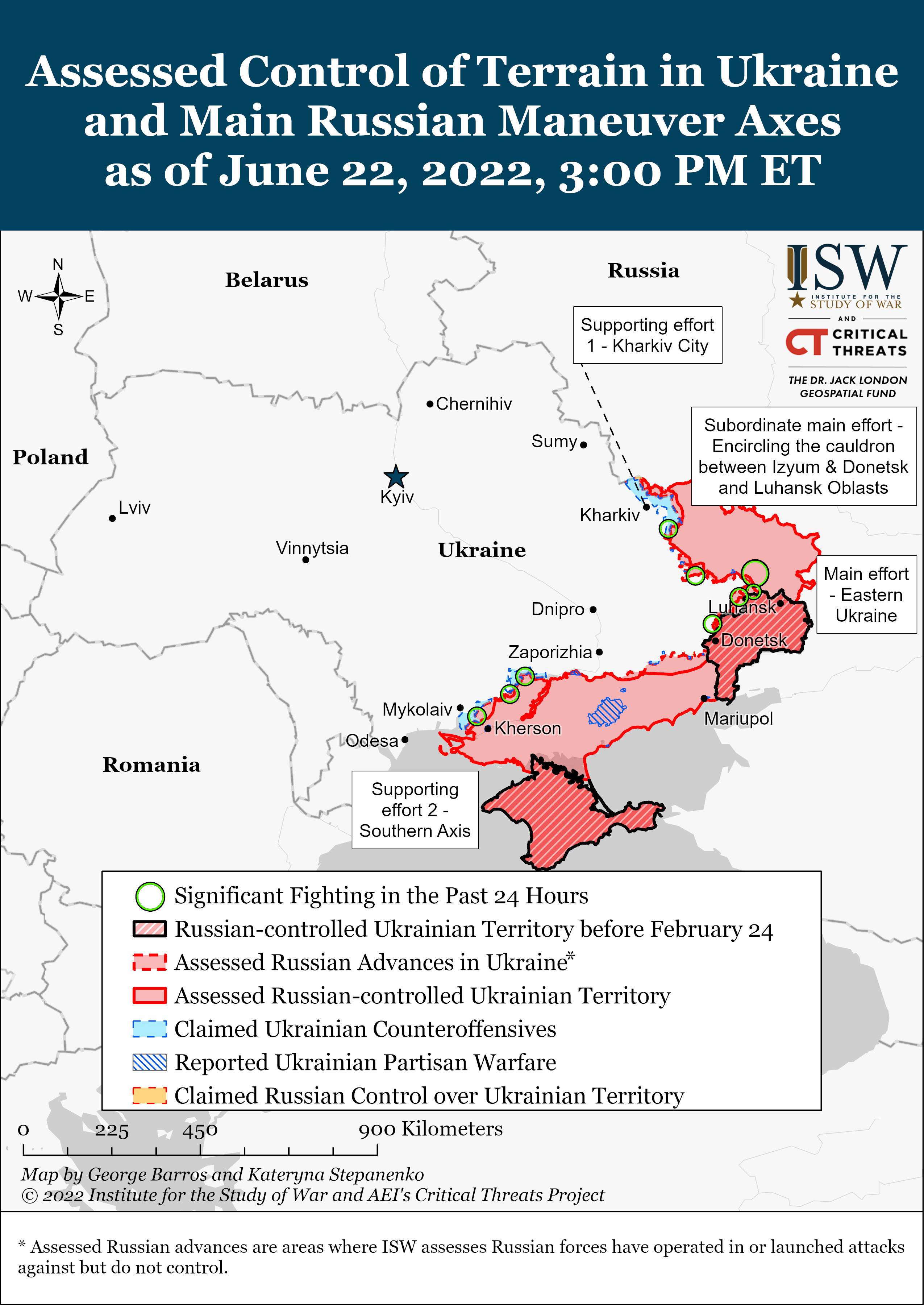
Click here to see ISW's interactive map of the Russian invasion of Ukraine. This map is updated daily alongside the static maps present in this report.

Reinforced Russian air-defense systems in eastern Ukraine are increasingly limiting the effectiveness of Ukrainian drones, undermining a key Ukrainian capability in the war. Foreign Policy’s Jack Detsch quoted several anonymous Ukrainian officials and military personnel that Ukrainian forces have largely halted the use of Turkish Bayraktar drones, which were used to great effect earlier in the war, due to improvements in Russian air-defense capabilities.[1] Ukrainian officials are reportedly increasingly concerned that US-provided Gray Eagle strike drones will also be shot down by reinforced Russian air defense over the Donbas.[2] Ukrainian forces have reportedly scaled back air operations to 20 to 30 sorties per day and are facing a deficit of available aircraft for active pilots. Russian forces are likely prioritizing deploying air defenses to eastern Ukraine to nullify Ukrainian operations and to protect the artillery systems Russian forces are reliant on to make advances. However, the Ukrainian air force and armed drones remain active elsewhere, inflicting several successful strikes on targets in Kherson Oblast in the last week.

Members of the Russian military community continue to comment on the shortcomings of Russian force generation capabilities, which are having tangible impacts on the morale and discipline of Russians fighting in Ukraine. Russian milblogger Yuri Kotyenok claimed that Russian troops lack the numbers and strength for success in combat in Ukraine.[3] Kotyenok accused Russian leadership of deploying new and under-trained recruits and called for replenishment of forces with well-trained recruits with ground infantry experience—though the Russian military is unlikely to be able to quickly generate such a force, as ISW has previously assessed. Despite growing calls for increased recruitment from nationalist figures, Russian leadership continues to carry out coercive partial mobilization efforts that are only producing limited numbers of replacements while negatively impacting the morale and discipline of forcibly mobilized personnel. Ukraine’s Security Service (SBU) claimed that Russian authorities in Luhansk are arranging gas leaks in apartment buildings to force men who are hiding from mobilization into the streets.[4] The Ukrainian Main Intelligence Directorate (GUR) additionally reported that Russian soldiers in occupied Tokmak, Zaporizhia Oblast, are appealing to local Ukrainian doctors to issue them certificates alleging medical inability to continue military service.[5]

Ukrainian forces conducted a drone strike (likely with a loitering munition, though this cannot be confirmed) on a Russian oil refinery in Novoshakhtinsk, Rostov Oblast, on June 22.[6] Russian Telegram channel Voenyi Osvedomitel claimed that the strike, which targeted Russian infrastructure within 15 km of the Ukrainian border, originated from Donetsk Oblast.[7] Ukrainian forces have not targeted Russian infrastructure for several weeks, and this strike is likely an attempt to disrupt Russian logistics and fuel supply to Russian operations in eastern Ukraine.

Key Takeaways

  • Russian forces continued to make gains to the south of Lysychansk and will likely reach the city in the coming days, although they are unlikely to quickly capture the Severodonetsk-Lysychansk area.
  • Russian forces continued offensive operations towards Slovyansk and made minor advances.
  • Russian forces intensified efforts to interdict Ukrainian lines of communication along the T1302 Bakhmut-Lysychansk highway in order to support Russian operations towards Lysychansk.
  • Russian forces focused on defensive operations along the Southern Axis and may have made marginal gains within Mykolaiv Oblast.
  • Russian authorities are continuing measures to facilitate the economic integration of occupied areas.

We do not report in detail on Russian war crimes because those activities are well-covered in Western media and do not directly affect the military operations we are assessing and forecasting. We will continue to evaluate and report on the effects of these criminal activities on the Ukrainian military and population and specifically on combat in Ukrainian urban areas. We utterly condemn these Russian violations of the laws of armed conflict, Geneva Conventions, and humanity even though we do not describe them in these reports.

  • Main Effort—Eastern Ukraine (comprised of one subordinate and three supporting efforts);
  • Subordinate Main Effort—Encirclement of Ukrainian troops in the cauldron between Izyum and Donetsk and Luhansk oblasts
  • Supporting Effort 1—Kharkiv City;
  • Supporting Effort 2—Southern Axis;
  • Activities in Russian-occupied Areas

Main Effort—Eastern Ukraine

Subordinate Main Effort—Southern Kharkiv, Donetsk, Luhansk Oblasts (Russian objective: Encircle Ukrainian forces in Eastern Ukraine and capture the entirety of Donetsk and Luhansk oblasts, the claimed territory of Russia’s proxies in Donbas)

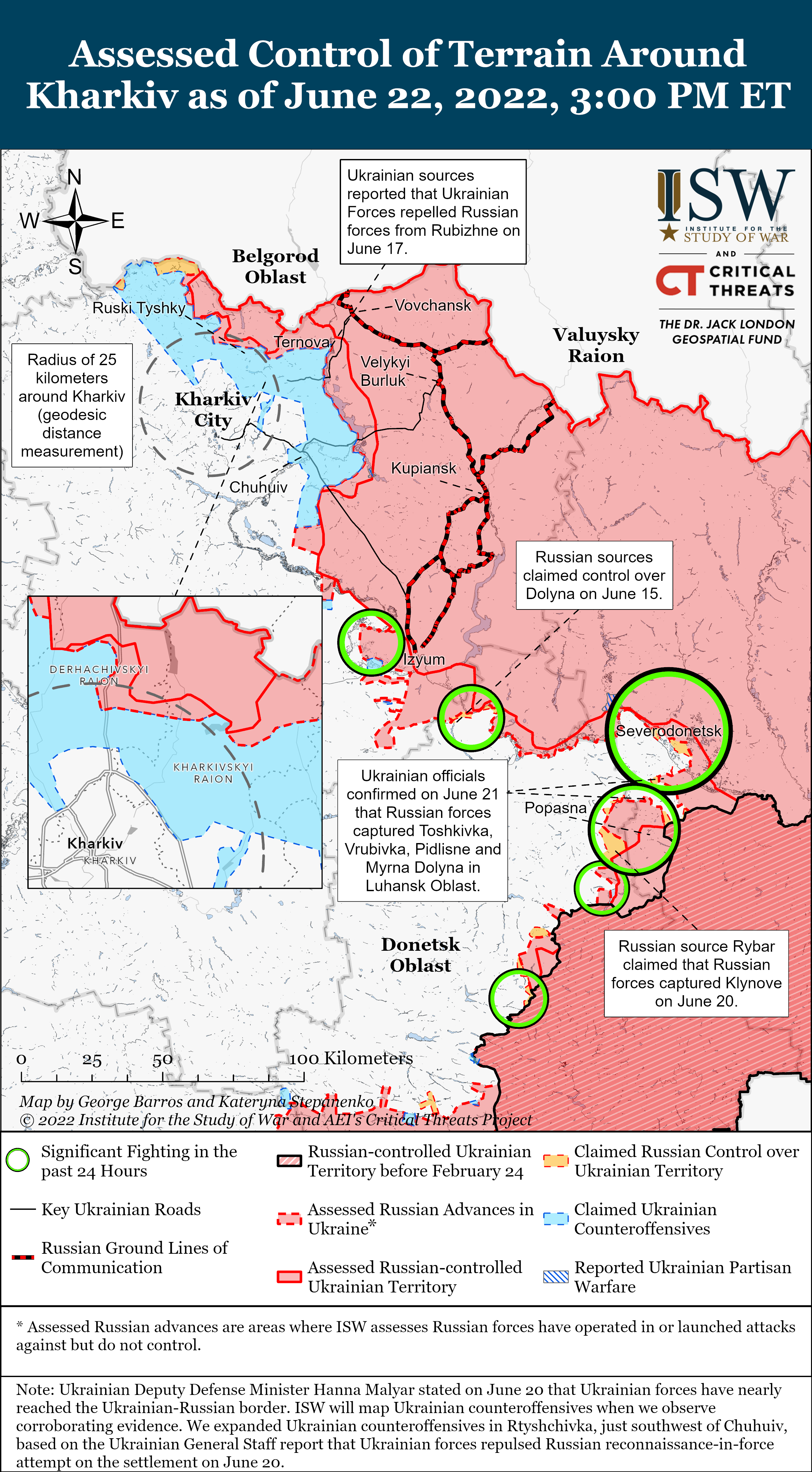
Russian forces continued efforts to push north toward Lysychansk along the west bank of the Siverskyi Donets River and made measured gains south of Lysychansk on June 22. Head of Luhansk Oblast Administration Serhiy Haidai stated that Russian troops are consolidating their positions in Toshkivka, Ustynivka, Pidlisne, and Myrna Dolyna, and are attacking Bila Hora, directly on the southeastern outskirts of Lysychansk.[8] Russian Telegram channel Rybar claimed that Russian forces took control of Rai-Oleksandrivka and Loskutivka, both 10 km south of Lysychansk.[9] Haidai additionally stated that Russian forces are trying to fix in place Ukrainian units in Borivske and Voronove (both within 5 km southeast of Severodonetsk) and are firing on Ukrainian positions in Synetskyi and Pavlohrad (western suburbs of Severodonetsk along the eastern bank of the Siverskyi Donets River).[10] Haidiai’s claim suggests that Ukrainian forces still control the area to the southwest of Severodonetsk along the eastern bank of the Siverskyi Donets River and are therefore not entirely encircled in the Severodonetsk-Lysychansk area. Russian forces continued street fights within Severodonetsk, presumably for control of the industrial zone.[11] Russian forces are moving to complete the encirclement of Ukrainian positions in Zolote and Hirske but likely have not captured these settlements as of June 22.[12]

Russian forces continued offensive operations towards Slovyansk from the southeast of Izyum and west of Lyman on June 22.[13] Spokesperson for the Ukrainian Ministry of Defense Oleksandr Motuzyanyk stated that unspecified elements of the Russian 1st Guards Tank Army, the 20th, 29th, and 35th Combined Arms Armies, 68th Army Corps, and unspecified Airborne Forces (VDV) are operating in the direction of Slovyansk.[14] Russian forces are reportedly fighting in the forests around Krasnopillya, about 20 km northwest of Slovyansk.[15]  Mayor of Slovyansk Vadym Lyakh stated that Russian forces directly shelled a micro-district of Slovyansk, which is the first attack directly on Slovyansk since early June.[16] Russian forces additionally shelled Ukrainian positions west of Lyman around Pryshyb, Sydorove, and Majaky.[17]

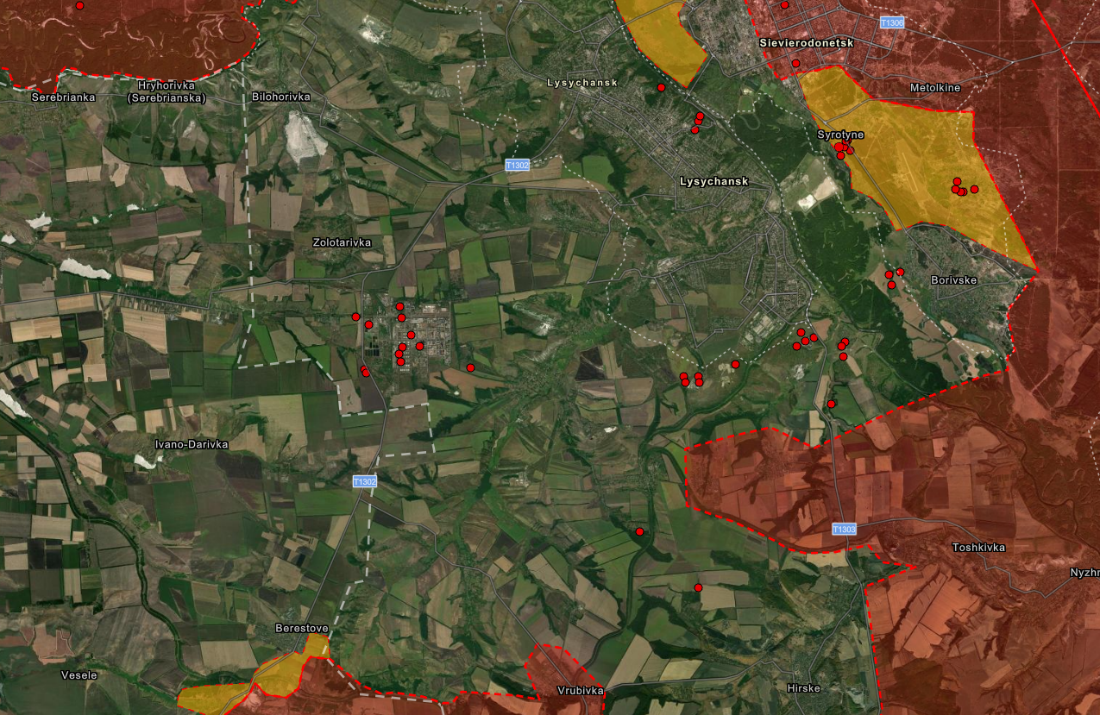
Russian forces continued efforts to interdict Ukrainian lines of communication east of Bakhmut along the T1302 Bakhmut-Lysychansk highway but did not make any confirmed advances on June 22.[18] The Ukrainian General Staff reported that Russian forces are re-grouping around Bakhmut to strengthen their offensive capabilities in the area.[19] Russian forces reportedly conducted an unsuccessful assault near the Vuhledar Power Plant in Svitlodarsk, which suggests that Russian forces may drive up the E40 highway to the northwest in order to gain access to the T3102 and support operations against the Severodonetsk-Lysychansk highway.[20] Russian forces additionally conducted an airstrike on Verkhnyokamyanka (see image in-line with text below), a settlement directly on the T1302 within 10 kilometers southwest of Lysychansk, in a likely effort to interdict Ukrainian movements towards Lysychansk.[21] Russian forces will likely continue to regroup and intensify operations in the area between Bakhmut and Lysychansk to advance toward Lysychansk from an additional axis, sever Ukrainian supply lines, and attempt to consolidate control of the entire Severodonetsk-Lysychansk area in the coming days.

[Source: NASA FIRMS Data from June 22 of fire activity in the Lysychansk area]

Supporting Effort #1—Kharkiv City (Russian objective: Withdraw forces to the north and defend ground lines of communication (GLOCs) to Izyum)

There were no significant changes in northern Kharkiv Oblast on June 22. Russian forces continued to focus on preventing Ukrainian advances toward the international border and shelled Kharkiv City and surrounding settlements.[22]

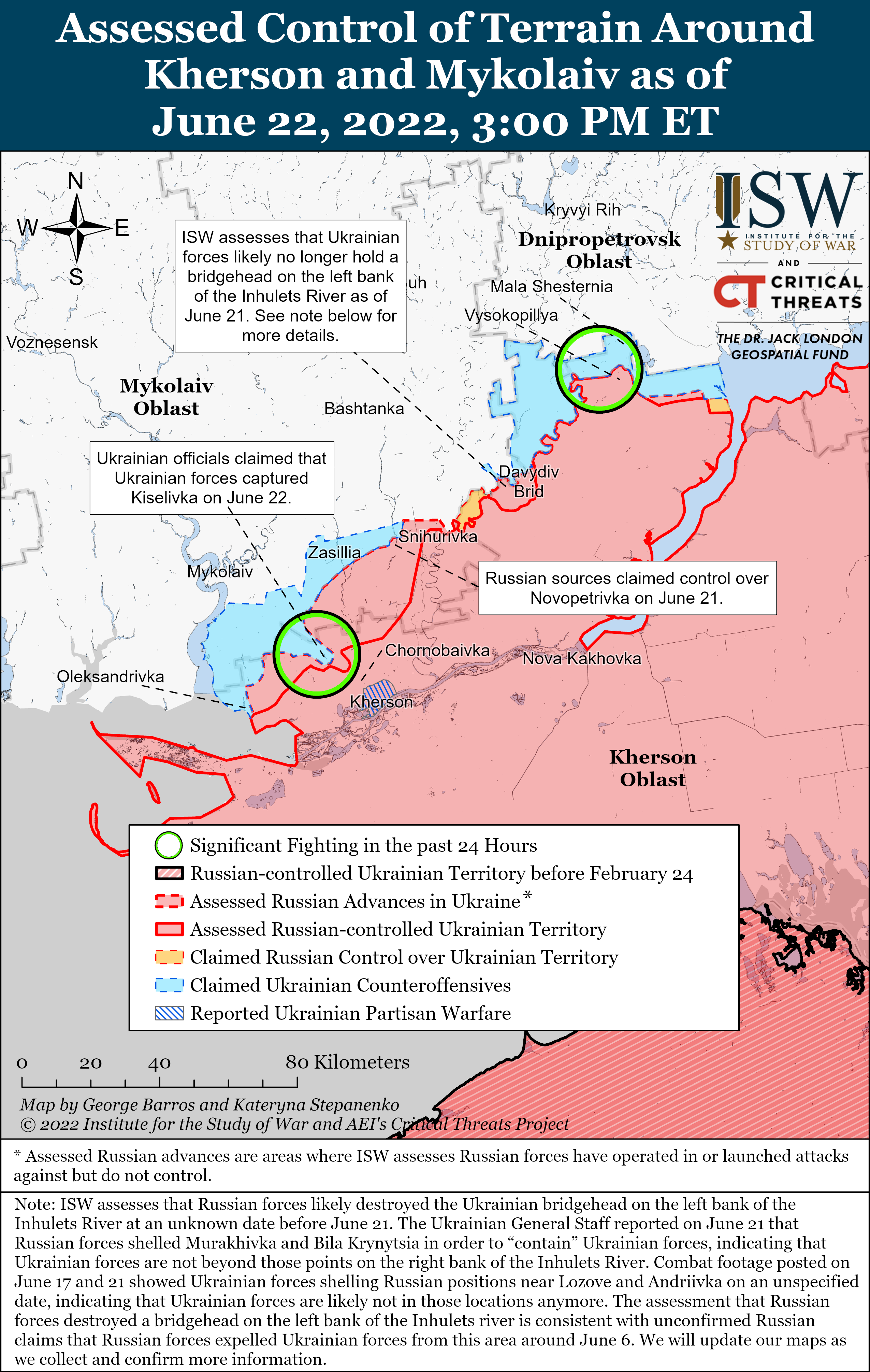
Supporting Effort #2—Southern Axis (Objective: Defend Kherson and Zaporizhia Oblasts against Ukrainian counterattacks)

Russian forces continued to focus on defensive operations along the Southern Axis and may have secured marginal gains in Mykolaiv Oblast, north of Kherson City, on June 22.[23] Russian Telegram channel Rybar claimed that Russian forces took control of Novopetrivka, Burkhanivka, and Kalynivka, three settlements within 25 km of the Kherson-Mykolaiv Oblast border.[24] Spokesperson for the Ukrainian Ministry of Defense Oleksandr Motuzyanyk stated that unspecified elements of the Russian 8th and 49th Combined Arms Armies, 22nd Army Corps, and unspecified Airborne Forces (VDV) are operating between Mykolaiv and Kherson Oblasts to prevent further Ukrainian counterattacks toward Kherson City.[25] Deputy Head of Ukraine’s Presidential Office Kyrylo Tymoshenko stated that Ukrainian forces have recaptured Kiselivka and are now within 15 km of Kherson City, indicating that Russian forces are facing substantial pressure to defend their occupied frontiers against Ukrainian counterattacks.[26]

Ukrainian partisan activity continues to complicate Russian occupation efforts along the Southern Axis. Both the Ukrainian Resistance Center and Kremlin-run RIA Novosti reported that unidentified Ukrainian individuals, likely partisans, conducted an IED attack that injured the Russian-appointed head of Chornobaivka.[27]

Russian forces conducted missile and artillery strikes against various areas in Kherson, Mykolaiv, Dnipropetrovsk, and Zaporizhia Oblasts on June 22.[28] Motuzyanyk stated that Russian forces are conducting missile strikes on Odesa with Kh-35 Bal and K-300P Bastion-P anti-ship missiles, indicating Russian forces have likely exhausted their supply of appropriate missile systems and are resorting to firing on land targets with anti-ship missiles (which can still be effective but are less accurate than purpose-built land-attack systems).[29]

Activity in Russian-occupied Areas (Russian objective: consolidate administrative control of occupied areas; set conditions for potential annexation into the Russian Federation or some other future political arrangement of Moscow’s choosing)

Russian occupation authorities continued economic integration efforts in occupied areas on June 22. Ukraine’s Zaporizhia Oblast Military Administration stated that Russian forces are preparing the Berdyansk Commerical Port for grain exports and are using trains to move grain from Melitopol to Russia.[30] Prime Minister of the Donetsk People’s Republic (DNR) Vitaly Khotsenko additionally met with Governor of Russia’s Amur Oblast Vasily Orlov to secure patronage for infrastructure and agricultural development of the settlement of Amvrosiivka.[31]

June 23, 2022: Johns Hopkins COVID 19 Situation Report

COVID-19 Situation Report

Editor: Alyson Browett, MPH

Contributors: Clint Haines, MS; Noelle Huhn, MSPH; Natasha Kaushal, MSPH; Amanda Kobokovich, MPH; Christina Potter, MSPH; Matthew Shearer, MPH; Marc Trotochaud, MSPH; and, Rachel A. Vahey, MHS.

CALL FOR PAPERS There is an opportunity to integrate Global Catastrophic Biological Risks (GCBRs) into pandemic preparedness policy and practice. In 2023, Health Security will devote a supplement to GCBRs. We encourage submissions of original research articles, case studies, and commentaries that discuss lessons learned from the COVID-19 pandemic response and/or key policy and technology advances that could prevent or better prepare for a future, potentially more severe, globally catastrophic infectious disease pandemic. The deadline is October 3, 2022. For more information: https://www.centerforhealthsecurity.org/our-work/journal/call-for-papers/index.html

MONKEYPOX OUTBREAKS UPDATE Read our latest update from June 15 on the monkeypox outbreaks and visit our monkeypox resource page. We will continue to analyze the situation and provide updates, as needed. If you would like to receive these updates, please sign up here.

EPI UPDATE The WHO COVID-19 Dashboard reports 538 million cumulative cases and 6.32 million deaths worldwide as of June 22.* The global weekly incidence remained relatively stable (-0.68%) from the previous week, when incidence was up nearly 8% after 3 weeks of decline. Global weekly mortality decreased as well, down 11% from the previous week. At the regional level, Europe (+17%), Southeast Asia (+46%), and the Eastern Mediterranean (+52%) experienced increases, while the other 3 regions had decreasing trends.

*The WHO COVID-19 dashboard indicates that there is a delay in reporting for the African Region, so the current totals may not be complete.

UNITED STATES

The US CDC is reporting 86.4 million cumulative cases of COVID-19 and 1,009,444 deaths. The average daily incidence has plateaued over the past several weeks, holding relatively steady at approximately 100-110,000 new cases per day. The current 7-day average is 99,365 new cases per day. Likewise, the average daily mortality has held relatively steady at approximately 250-300 deaths per day since late May.* Notably, the current 7-day average is 248, the lowest level since July 13, 2021.

*Changes in state-level reporting may affect the accuracy of recently reported data, particularly over weekends. In an effort to reflect the longer-term trends, the numbers reported here may not correspond to the most recent dates.

Both new hospital admissions (+1.5% over the past week) and current hospitalizations (+1.1%) continue to increase, although they appear to have stabilized over the past week. Considering the plateau in daily incidence, it is possible that hospitalizations could also remain elevated, rather than peaking and then declining.

Community transmission in the US continues to be driven by the BA.2.12.1 sublineage of Omicron (56%), but BA.5 (23.5%) and BA.4 (11.4%) are now outpacing BA.2 (9.1%). The prevalence of BA.4 and BA.5 now appears to be increasing more rapidly than BA.2.12.1. These 4 sublineages of the Omicron variant represent all new SARS-CoV-2 infections in the US.

PEDIATRIC VACCINES Taking the recommendation of its advisory committee, the US FDA on June 17 authorized pediatric formulations of both the Moderna and Pfizer-BioNTech SARS-CoV-2 vaccines for children as young as 6 months old. The following day, US CDC Director Dr. Rochelle Walensky endorsed the agency’s Advisory Committee on Immunization Protection (ACIP)’s recommendation that all children younger than age 5 get vaccinated against COVID-19. US President Joe Biden visited a vaccine clinic in Washington, DC, on June 21 to mark the rollout of the last major phase of vaccinations in the nation, with virtually all individuals now eligible to receive at least 1 of 3 authorized or approved SARS-CoV-2 vaccines. In his remarks, President Biden said the availability of vaccines for the youngest children marks a “monumental step forward” and provides “some peace of mind” for parents who have been waiting 18 months since the first vaccines were authorized for adults. There are about 19 million children aged 6 months to 5 years in the US.

The Biden administration has said 10 million doses are available for distribution to states and healthcare providers, but only 2.5 million doses of the Pfizer-BioNTech vaccine and 1.3 million doses of the Moderna vaccine have been ordered to date. While some parents have expressed excitement and relief at the vaccines’ availability, it remains unclear how many will vaccinate their young kids. Only 29% of 5-11 year-olds are fully vaccinated, while 59% of those aged 12-17 years are fully vaccinated. Some parents already are facing challenges securing an appointment to get their children vaccinated, despite a federal operational plan released and implemented earlier this month. While neighborhood pharmacies and pharmaceutical chains are included in this phase of the vaccination campaign, many are expecting families to go to primary care physicians and pediatricians because of trust, familiarity, and relationships that may not exist at the pharmacy. Additionally, some parents are weighing the differences between the 2-dose Moderna and 3-dose Pfizer-BioNTech vaccines for children.

The FDA also authorized Moderna’s vaccine for children and adolescents ages 6-17 last week. The CDC’s ACIP is meeting today to discuss clinical considerations and recommendations for the vaccine in that age group. The Pfizer-BioNTech vaccine is already available for adolescents and older children.

ANTIBODY ESCAPE A correspondence letter in the New England Journal of Medicine published June 22 by authors from the Beth Israel Deaconess Medical Center in Boston provides new evidence that Omicron subvariants, including BA.4 and BA.5, are showing substantial escape from neutralizing antibodies provided by vaccination or infection. The authors evaluated neutralizing antibody titers against against the original wildtype SARS-CoV-2 and Omicron subvariants BA.1, BA.2, BA.2.12.1, and BA.4 or BA.5 among 27 participants vaccinated with the Pfizer-BioNTech vaccine who had no indications of prior infection and 27 participants with recent infection with the BA.1 or BA.2 subvariants a median of 29 days earlier (range: 2-113 days), a majority of whom were vaccinated. Among vaccinated but never infected participants, neutralizing antibody titers compared to wild-type SARS-CoV-2 were lower by “a factor of 6.4 against BA.1, by a factor of 7.0 against BA.2, by a factor of 14.1 against BA.2.12.1, and by a factor of 21.0 against BA.4 or BA.5.” Participants with a prior history of infection with BA.1 or BA.2 showed similar trends with neutralizing antibody titers compared to wild-type SARS-CoV-2 lowered by “a factor of 6.4 against BA.1, by a factor of 5.8 against BA.2, by a factor of 9.6 against BA.2.12.1, and by a factor of 18.7 against BA.4 or BA.5.” The authors asserted that these findings indicate that the Omicron variants continue to feature further neutralization escape, which may lead to increased infection among populations with prior immunity against the virus. Findings in a recent Lancet Infectious Diseases correspondence provided similar evidence of substantial escape from neutralizing antibodies against Omicron variants among individuals vaccinated with the Sinopharm vaccine, with only partial recovery after a booster shot of the same vaccine.

SARS-COV-2 REINFECTION The newest Omicron subvariants of BA.4 and BA.5 are driving increases in new SARS-CoV-2 infections in several regions, with many people experiencing reinfections despite immunity from prior infection or vaccination (1+ shots). These subvariants appear to be able to evade antibodies more easily than their predecessors, possibly due to new and different spike proteins. Though global COVID-19-associated mortality appears to be decreasing, a new preprint study posted on Research Square cautions that reinfections pose an increased risk of hospitalization (HR 2.98), all-cause mortality (HR 2.14), and sequelae in pulmonary and other organ systems. The risk of these adverse outcomes—including those impacting the heart, blood, kidneys, lungs, and brain—were most pronounced in the acute phase of infection but persisted throughout the 6-month follow up. Additionally, for every reinfection (1, 2, 3+) there was a stepwise increase in risk for all sequelae evaluated, including hospitalization. Although not yet peer-reviewed, the study serves as a signal that the COVID-19 pandemic remains a threat to the health of the world’s population, and individuals must continue to take precautions to prevent infection.

MODERNA BIVALENT BOOSTER Moderna announced June 22 that it plans to seek regulatory approval for an updated booster vaccine, mRNA-1273.214, after new clinical data on the bivalent candidate showed success against newer Omicron variants. The announcement comes in anticipation of fall booster shots, with the company saying it could ship doses as early as August. Moderna found that mRNA-1273.214 increased neutralizing titers against BA.4 and BA.5 Omicron subvariants among all participants (95% CI: 5.0, 5.9). Neutralizing titers increased by 6.3-fold (95% CI: 5.7, 6.9) among specifically seronegative patients. However, the boost to neutralizing titers for BA.4 and BA.5 was not quite as high as the boost in neutralizing titers against the original Omicron variant, BA.1, or the Delta variant. Moderna noted that a peer-reviewed manuscript describing clinical trial data should be available soon.

Scientists are hopeful that this new booster, as well as others under investigation, will aid in improving protection against a potential surge in the fall. However, both Moderna and BioNTech leadership expressed concern that regulatory processes needed to update boosters could cause delays, hoping that future updates to the most recent strains can be done without clinical trials. In a separate announcement, Moderna said it will establish a new research and manufacturing center in the UK, allowing that country to gain access to mRNA platform-based vaccines.

COVID-19 REBOUND Following a US CDC health advisory issued last month warning about the potential for recurrence of COVID-19 or “COVID-19 rebound” following treatment with the antiviral Paxlovid, several new studies suggest potential causes of the occurrence and support initial studies’ findings that rebound happens in only a small proportion of patients. A study published June 20 in Clinical Infectious Diseases examined the experience of one patient with rebound following Paxlovid treatment. The researchers, from the University of California San Diego School of Medicine, isolated the SARS-CoV-2 BA.2 variant from the patient with symptom relapse and sampled their plasma to test for viral immunity. They found the isolate had not developed drug resistance, nor did the patient have impaired immunity, leading them to hypothesize the rebound likely was the result of insufficient exposure to the drug.

Another study (preprint), posted to medRxiv and conducted by US NIH researchers, examined clinical, virologic, and immune measurements of 7 patients with COVID-19 rebound, 6 who had taken Paxlovid and 1 without previous treatment. Again, the researchers found no evidence of drug resistance, viral mutation, or impaired immune response. Instead, they found the rebounds were associated with elevated SARS-CoV-2-specific antibody and cellular immune responses, possibly due to the body trying to clear residual viral antigens possibly shed from dying infected cells. Both studies were very small and may not be generalizable to all COVID-19 rebound cases; additional larger studies are needed to confirm their findings. On June 21, the US CDC’s Morbidity and Mortality Weekly Report (MMWR) published a study examining 5,287 Paxlovid-treated patients aged 12 years and older, finding less than 1% experienced COVID-19-related hospitalization or emergency room visits 5-15 days after treatment was dispensed.

PANDEMIC INEQUALITY The COVID-19 pandemic has drastically impacted people’s health, income, and various social risk factors, worsening existing inequalities and exposing others. Nature uses 6 graphs to explore the pandemic’s effects. The graphs express various data sets examining specific issues globally, in low- and middle-income countries, and in the US, UK, and Brazil. Notably, by the end of this year, 75 million more people will be pushed into poverty—living on less than US$1.90 per day—than was expected before the pandemic, derailing gains made prior to 2020 and highlighting the need for increased efforts to get the world back on track toward the UN Sustainable Development Goals.

US NATIONAL PUBLIC HEALTH SYSTEM A bipartisan commission of health leaders this week released a set of recommendations to overhaul public health in the US, with the aim of creating a “national public health system” to protect and improve health, advance health equity, and effectively respond to emergencies. The authors call for changes that could address current health challenges—including rising maternal mortality, overdoses, and diabetes—and avoid a repeat of what it called a “splintered” response to COVID-19 that led to widely disparate outcomes nationwide. The Commonwealth Fund Commission on a National Public Health System proposal outlines actions for the US Congress; the administration of US President Joe Biden; and state, local, tribal, and territorial governments to create a coordinated and collaborative national public health system.