Saturday, August 8, 2020

Harleys everywhere, masks nowhere: Sturgis draws thousands


Harleys everywhere, masks nowhere: Sturgis draws thousands

By STEPHEN GROVESyesterday
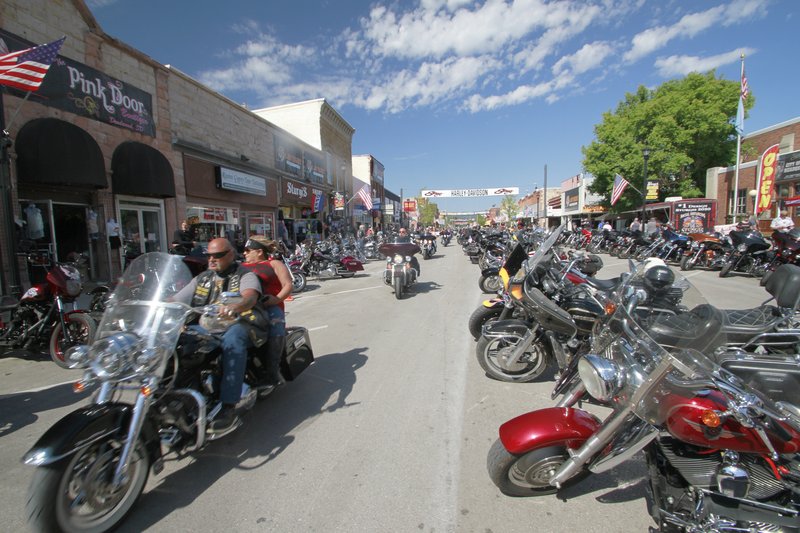
1 of 3

Thousands of bikers rode through the streets for the opening day of the 80th annual Sturgis Motorcycle rally Friday, Aug. 7, 2020, in Sturgis, S.D. (AP Photo/Stephen Groves)

STURGIS, S.D. (AP) — Thousands of bikers poured into the small South Dakota city of Sturgis on Friday as the 80th Sturgis Motorcycle Rally rumbled to life despite fears it could lead to a massive coronavirus outbreak.

The rally could become one of the largest public gatherings since the pandemic began, with organizers expecting 250,000 people from all over the country to make their way through Sturgis during the 10-day event. That would be roughly half the number of previous years, but local residents — and a few bikers — worry that the crowds could create a “super-spreader” event.

ADVERTISEMENT

Many who rode their bikes into Sturgis on Friday expressed defiance at the rules and restrictions that have marked life in many locales during the pandemic. People rode from across the country to a state that offered a reprieve from coronavirus restrictions, as South Dakota has no special limits on indoor crowds, no mask mandates and a governor who is eager to welcome visitors and the money they bring.

“Screw COVID,” read the design on one T-shirt being hawked. “I went to Sturgis.”

Bikers rumbled past hundreds of tents filled with motorcycle gear, T-shirts and food. Harley Davidson motorcycles were everywhere but masks were almost nowhere to be seen, with an Associated Press reporter counting fewer than 10 in a crowd of thousands over a period of several hours.

For Stephen Sample, who rode his Harley from Arizona, the event was a break from the routine of the last several months, when he’s been mostly homebound or wearing a mask when he went to work as a surveyor.

“I don’t want to die, but I don’t want to be cooped up all my life either,” he said.

Still, Sample, who is 66, feared what could happen if he caught COVID-19 at the rally. He said he was trying to avoid indoor bars and venues, where he felt the risk of infection was greater. But on the opening day of the rally, he said he ate breakfast at an indoor diner.

As Sample weighed the risks of navigating the crowds, the same thrill-seeking that attracted him to riding motorcycles seemed to win out.

“I think we’re all willing to take a chance,” he said.

Republican Gov. Kristi Noem has taken a largely hands-off approach to the pandemic, avoiding a mask mandate and preaching personal responsibility. She supported holding the Sturgis rally, pointing out that no virus outbreak was documented from the several thousand people who turned out to see President Donald Trump and fireworks at Mount Rushmore last month.

ADVERTISEMENT

Daily virus cases have been trending upward in South Dakota, but the seven-day average is still only around 84, with fewer than two deaths per day.

The rally attracted crowds of retirees and people in age ranges considered to be at higher risk from the coronavirus. But for many who see the rally as an annual pilgrimage, the camaraderie and atmosphere couldn’t be missed.

“I fell in love with the rally. I love the sound of the bikes,” said Bill Sudkamp, who was making his 20th consecutive rally appearance.

He and his wife, who declined to give their ages but said they were at elevated risk for COVID-19, were among the handful of people seen wearing masks in downtown Sturgis, a community of about 7,000 that’s roughly 25 miles (40 kilometers) northwest of Rapid City. They were also planning to avoid bars. Sudkamp felt it was inevitable that infections would spread in the packed bars and concert venues.

“It looked like South Dakota was plateauing mostly,” Sudkamp said. “It will be interesting to see what it looks like in two weeks.”

Marsha Schmid, who owns the Side Hack Saloon in Sturgis, was trying to keep her bar and restaurant from becoming a virus hot spot by spacing out indoor tables and offering plenty of hand sanitizer. She also scaled back the number of bands hired for the rally, hoping the crowds would stay thin but still spend the cash that keeps her business viable for the rest of the year.

She pointed out that many of her employees depend on the rally and the tips they can make.

“You’ve got people coming from all over the world,” she said. “I just hope they are being responsible and if they don’t feel good, they stay away.”

Several locals said they would spend the rally hunkered down at home. Carol Fellner stocked up on groceries and planned to stay away from any gatherings. Her husband suffers from bouts of pneumonia and kidney problems, and COVID-19 would be a “death sentence” for him, she said.

Fellner felt that the risk of an outbreak would be felt long after the bikers leave. The city plans to mass test residents to try to detect and halt outbreaks, but the area’s largest hospital system is already burdened with the influx of tourists and bikers who inevitably need hospital care during this time.

Sample was aware his trip to the rally could end in the hospital, which seemed to weigh on him.

“This is a major experiment,” he said. “It could be a major mistake.”

Above is from:  https://apnews.com/fa074079157ad9a3683445b291daaf39

*********************************************************************************************************************************************************

Thousands of bikers heading to South Dakota rally to be blocked at tribal land checkpoints

Edward Helmore

,

The GuardianAugust 8, 2020

<span>Photograph: Michael Ciaglo/Getty Images</span>

Photograph: Michael Ciaglo/Getty Images

Thousands of bikers heading to South Dakota’s 10-day Sturgis Motorcycle Rally will not be allowed through Cheyenne River Sioux checkpoints, a spokesman for the Native American group said on Saturday.

The decision to prevent access across tribal lands to the annual rally, which could attract as many as 250,000 bikers amid fears it could lead to a massive, regional coronavirus outbreak, comes as part of larger Covid-19 prevention policy. The policy has pitted seven tribes that make up the Great Sioux Nation against federal and state authorities, which both claim the checkpoints are illegal.

Related: 'It's just madness': bikers throng South Dakota town despite Covid threat

A duty officer for the Cheyenne River Sioux told the Guardian on Saturday that only commercial and emergency vehicles will be let through the checkpoints onto reservation land.

- ADVERTISEMENT -

A number of bikers had tried to enter but had been turned back, they said. Other reservations in the region, including the Oglala Sioux, were also turning away bikers that had attempted routes to Sturgis that pass through sovereign land.

Under Cheyenne River tribal guidelines non-residents driving non-commercial out-of-state vehicles are never allowed through the reservation. During the rally, non-commercial vehicles with South Dakota plates are also not allowed through.

The clampdown comes as fears mount that mask-free bikers visiting Sturgis for the largest gathering of people since the start of the Covid-19 epidemic could spread the virus to tribal groups that are already experiencing a rise in cases.

Oglala Sioux recorded 163 cases last week, while the Cheyenne River Sioux has seen cases rise to 79, according to the tribe’s website.

The restrictions come as local law enforcement reported a convergence of bikers from all directions. According to reports, many bikers heading for Sturgis expressed defiance at rules and restrictions that have marked life during the coronavirus pandemic.

While South Dakota has fared better than most states – it ranks 38th in Covid deaths per capita, according to a Reuters tally – cases have risen in recent weeks as hotspots move into the midwest.

During the rally, people are expected to cram bars and pack concerts with at least 34 acts playing. “Screw COVID,” read the design on one T-shirt on sale. “I went to Sturgis.”

Stephen Sample, who rode his Harley-Davidson from Arizona, told the Associated Press that the event was a break from the routine of the last several months.

“I don’t want to die, but I don’t want to be cooped up all my life either,” Sample, 66, said, adding that he had weighed the risks of navigating the crowds, but the same thrill-seeking that attracted him to riding motorcycles seemed to win out.

“I think we’re all willing to take a chance,” he said, but acknowledged the trip “could be a major mistake.”

South Dakota’s Republican governor, Kristi Noem, has supported holding the Sturgis rally, pointing out that no virus outbreak was documented from the several thousand people who turned out to see Donald Trump at Mount Rushmore last month.

The rally is marking its 80th anniversary and typically injects $800m into South Dakota’s economy. Meade county sheriff, Rob Merwin, said: “It’s going to be a lot of people and a lot of motorcycles all over the place. People are tired of being penned up by this pandemic.”

Related: Navajo elders: alone, without food, in despair

On Friday, a worker at the event told the Guardian crowds seemed larger than in previous years and warned that Sturgis attendees were paying little heed to medical advice.

“I’ve not seen one single person wearing a mask,” said bartender Jessica Christian, 29. “It’s just pretty much the mentality that, ‘If I get it, I get it.’”

“In downtown Sturgis it’s just madness,” Christian added. “People not socially distancing, everybody touching each other. It’ll be interesting to see how that turns out.”

Over 60% of Sturgis 6,900 residents who responded to a city council survey in May said they wanted the rally canceled.

A month later, the council voted to move ahead, although it canceled all city-sponsored events associated with the rally and included measures such as hand-sanitizing stations. Sturgis mayor Mark Carstensen said throughout the pandemic, “the state of South Dakota has been the freedom state and the city of Sturgis has stayed true to that”.

Above is from:  https://www.yahoo.com/news/thousands-bikers-heading-south-dakota-161317138.html

Friday, August 7, 2020

COVID 19 “warning level” for Winnebago County


Winnebago Co. among 13 state counties at warning level for coronavirus

There have been several instances of multiple cases among family members in the same, large household.

COVID-19 Winnebago County Cover

COVID-19 Winnebago County Cover(WIFR)

By Ben Sefarbi

Published: Aug. 7, 2020 at 12:39 PM CDT|Updated: 9 hours ago

<?XML:NAMESPACE PREFIX = "[default] http://www.w3.org/2000/svg" NS = "http://www.w3.org/2000/svg" />

SPRINGFIELD, Ill. (WIFR) - The Illinois Department of Public Health reported 13 counties in Illinois are considered to be at a warning level for COVID-19 on Friday.

A county enters a warning level when two or more COVID-19 risk indicators that measure the amount of COVID-19 increase. Cass, Coles, Grundy, Iroquois, Jackson, Monroe, Perry, Saline, St. Clair, Tazewell, Union, Williamson and Winnebago Counties are now at this level, according to the IDPH.

These counties saw cases or outbreaks associated with businesses, long-term care facilities, large social gatherings and out of state travel. There have been several instances of multiple cases among family members in the same, large household. Students returning to universities and colleges are also driving the recent increase in cases in several communities. Many students are not wearing face coverings or social distancing and are gathering in large groups and at bars, according to the IDPH.

Several counties are taking action and implementing mitigation measures to help slow spread of the virus. Examples include working with university administrations for student education and contact tracing, working with county boards of health, and cancelling events and festivals, according to the IDPH.

ADVERTISEMENT

IDPH uses numerous indicators when determining if a county is experiencing stable COVID-19 activity, or if there are warning signs of increased COVID-19 risk in the county.

New cases per 100,000 people.  If there are 50 or more new cases per 100,000 people in the county, this triggers a warning.

Number of deaths. This metric indicates a warning when the number of deaths increases more than 20% for two consecutive weeks.

Weekly test positivity. This metric indicates a warning when the 7-day test positivity rate rises above 8%.

ICU availability. If there are fewer than 20% of intensive care units available in the region, this triggers a warning.

Weekly emergency department visits.   This metric indicates a warning when the weekly percent of COVID-19-like-illness emergency department visits increase by more than 20% for two consecutive weeks.

Weekly hospital admissions. A warning is triggered when the weekly number of hospital admissions for COVID-19-like-illness increases by more than 20% for two consecutive weeks.

Tests perform.  This metric is used to provide context and indicate if more testing is needed in the county.

Clusters. This metric looks at the percent of COVID-19 cases associated with clusters or outbreaks and is used to understand large increase in cases.

These metrics are intended to be used for local level awareness to help local leaders, businesses, local health departments, and the public make informed decisions about personal and family gatherings, as well as what activities they choose to do.  The metrics are updated weekly, from the Sunday-Saturday of the prior week. 

Above is from:  https://www.wifr.com/2020/08/07/winnebago-co-among-13-state-counties-at-warning-level-for-coronavirus/

August 7: 2084 New COVID 19 Cases in Illinois


Illinois has an additional 2084 cases and 19 additional deaths.  Boone County had 4 new cases.

COVID-19 Confusion by Trump


Trump downplays COVID-19's mortality rate in US

BY NATHANIEL WEIXEL - 08/07/20 06:00 AM EDT 998

412

<?XML:NAMESPACE PREFIX = "[default] http://www.w3.org/2000/svg" NS = "http://www.w3.org/2000/svg" />


Volume 0%

President Trump has repeatedly claimed that the U.S. has one of the lowest COVID-19 mortality rates anywhere in the world, even though the nation has recorded more deaths from the coronavirus than any other country.

The U.S. also has a mortality rate per 100,000 about twice that of Canada. While the U.S. rate is lower than Spain, the United Kingdom and Italy per 100,000 people, it is higher than such nations as Germany, France and the Netherlands.

But Trump is not focused on those numbers.

Rather than the mortality rate, Trump has been fixated on the percentage of people who die after contracting COVID-19, a figure called the case fatality rate.

In doing so, he has downplayed the scope of the coronavirus outbreak in the U.S. and the extremely high rate of deaths as a proportion of the population.

By not specifying the figures he is using, Trump has also likely confused many people about how the U.S. stacks up with other countries.

“Number one low mortality rate,” Trump said during a Fox News interview with Chris Wallace last month. “You said we had the worst mortality rate in the world, and we have the best.”

In an interview on “Axios on HBO” broadcast Monday, Trump was challenged by journalist Jonathan Swan when he said “the United States is lowest in numerous categories, we’re lower than the world, we’re lower than Europe.”

When Swan asked Trump to clarify, Trump handed Swan a chart, revealing that he was referencing the case fatality rate. Pressed on the distinction, Trump maintained that the data should “go by the cases,” not by the population.

Trump repeated that assertion from the podium of the White House briefing room on Tuesday

“I think, actually, the numbers are lower than others,” Trump said. “We, proportionately, are lower than almost all countries. We’re at the bottom of the list.”

According to Johns Hopkins University, the U.S. does have a relatively low case fatality rate of 3.3 percent, compared to countries like Canada (7.5 percent), the United Kingdom (15.1 percent), Italy (14.1 percent) and France (13.3 percent).

Among the 20 countries most affected by COVID-19 in the world according to data compiled by Hopkins, the U.S. is 13th in terms of deaths per confirmed COVID case.

America's case fatality rate is still higher than Chile, India, Argentina, Russia, South Africa, Kazakhstan and Bangladesh.

Case fatality can be influenced by factors including the demographics of people who get infected, the ability of hospitals to treat COVID patients, and whether testing finds more mild cases.

“Case fatality is the chance of dying after you get a positive test. It reflects the amount of testing and access to effective medical care, not the speed at which Americans are dying of COVID,” said Josh Sharfstein, a vice dean at the Johns Hopkins Bloomberg School of Public Health.

Amesh Adjala, a senior scholar at the Johns Hopkins University Center for Health Security, said case fatality is not a bad statistic by itself, but it can't be compared to the actual number of deaths per capita.

“Case fatality rate is important and the fact that it is lower in some countries is really reflective of the sophistication of the medical system, adeptness of critical care physicians, and what segment of the population is getting infected,” Adjala said.

The U.S. is averaging 65,000 new infections a day, and more than 1,000 people a day are dying from COVID-19.

In total, nearly 160,000 Americans have died of a COVID-19 infection, and focusing only on case fatality essentially ignores that number.

That’s where the mortality rate, or deaths per capita, comes in.

“Deaths per capita is a statistic that shows you a national snapshot about how widespread the severe cases are, how well are vulnerable populations being protected, and how contained spread is,” Adjala said.

Minority populations, especially communities of color and Native groups, have been disproportionately hardest hit by the coronavirus in the United States. Lawmakers, advocates and public health experts have been pushing the Trump administration to take action and prioritize minority communities in its coronavirus response. To date, they say the administration has failed to help.

Minorities also make up a large share of the population of essential workers, magnifying the risk they already face from racial disparities in outcomes and access to health care.

According to the Centers for Disease Control and Prevention, the mortality rate measures the frequency of occurrence of death in a defined population— in this case, deaths per 100,000 people, which includes both confirmed cases and healthy people.

Among the 20 countries most affected by COVID-19 in the world right now, the U.S. has the fourth-highest number of COVID-19 deaths per 100,000 people, ranking behind only the United Kingdom, Peru and Chile.

Globally, according to Johns Hopkins data, the U.S. is 10th, ahead of some of Europe's hardest-hit countries like Spain, Italy and Sweden that have since taken control and substantially slowed the virus's spread.

But that list also includes the countries of Belgium and Andorra, which have such proportionally large numbers of deaths because of their small populations.

A White House official said the U.S. mortality rate is similar to that in other industrialized countries.

President Trump "has highlighted the U.S. is among the lowest when it comes to mortality rates of similarly industrialized countries,” the official said. “We also have one of the lowest case fatality rates —below the average of the world and below Europe — and that shows that our therapeutics like Remdesivir, convalescent plasma, and Dexamethasone are working."

But during an interview with CNN’s Sanjay Gupta on Wednesday, Anthony Fauci, the nation’s top infectious disease expert, agreed that the U.S. death rate was one of the highest in the world. He also suggested the U.S. is not doing as well as other countries in handling the disease.

“It is worth reminding people we're not quite five percent of the world's population, yet represent 20 to 25 percent of the world's deaths .. that has to be the worst, is it not the worst?” Gupta asked.

Above is from:  https://thehill.com/policy/healthcare/510912-trump-downplays-covid-19s-mortality-rate-in-us?userid=217221

Thursday, August 6, 2020

Aug 6: 1953 New COVID 19 Cases in Illinois


Extended Unemployment Benefits but some large overpayments


Illinois is extending unemployment benefits by 20 weeks. Meanwhile, some gig workers are learning they’ve been overpaid.


By Abdel Jimenez, Chicago Tribune (TNS)

Posted at 4:31 PM

Illinois extended jobless benefits another 20 weeks as laid off workers continued to struggle with the claims process, including some who say they have to return funds because they were overpaid.

The Illinois Department of Employment Security, the state agency tasked with handling jobless claims, said the extension was available starting Thursday to people who have gone through 26 weeks of state benefits. Illinois is among 19 states providing 20 weeks of extended benefits, the agency said in a news release.

More than 25,000 Illinoisans filed for unemployment insurance for the first time in the week ending Aug. 1, down from more than 33,000 the week before, according to the state’s latest figures.

At the same time, several gig and contract workers who were able to apply for benefits under the federal coronavirus relief package told the Tribune they owe thousands of dollars back to the state after learning they were overpaid.

Some claimants say the state is deducting funds from their weekly benefits to pay down the debt.

Chris Markacek, of Orland Park, has been out of work as a DJ since March due to event cancellations. He said the state notified him he owes about $4,000. By late July, Markacek said his benefits were being deducted to pay off the amount.

“There was no explanation for anything. It all happened very sudden and it was confusing,” Markacek, 34, said.

In an email Wednesday, IDES spokeswoman Rebecca Cisco said the overpayments are an “unfortunate consequence of a federal system haphazardly put together without much foresight” as to how it would affect self-employed workers.

The problem, Cisco said, is that gig workers and other self-employed claimants were asked to enter their 2019 net income to establish their weekly benefit amount before the state could verify the figures, and the state is not allowed to waive recoupment of the funds from people who were overpaid.

“As anticipated, the amount the claimant previously entered does not match the tax documents they submitted. The claimant has either overstated or understated the amount upon filing. When the amount is overstated, an overpayment is established and the claimant is required to pay it back, per federal guidelines,” Cisco said.

She did not immediately respond to questions about how many people in Illinois have been overpaid or by how much.

Gig workers, meanwhile, are worried about how they’ll pay back the funds as several remain unemployed.

Alexandra Eliades, a contract worker who lives in Elk Grove Village, said she owes more than $3,000 and has been trying to reach the agency for the last month to fix the issue.

“I went on blind faith that they knew what they were doing,” Eliades, 32, said.

Eliades said the state never explained why she was overpaid or how she’ll have to pay back the money. She is worried she’ll be left without money if the agency deducts the amount from her weekly benefit.

Last week, millions of Americans lost the extra $600 a week in federal unemployment benefits as Congress remained at a standstill in negotiations for the next coronavirus relief package.

“They slapped us with these huge overpayments. I think they should waive them because this wasn’t our fault,” Eliades said.

Above is fromhttps://www.pjstar.com/news/20200806/illinois-is-extending-unemployment-benefits-by-20-weeks-meanwhile-some-gig-workers-are-learning-theyrsquove-been-overpaid

States with highest unemployment rate

map