Thursday, February 14, 2019

Byron nuclear plant could close in 3 years


By Georgette Braun Tribune News Service

Exelon's Byron Station is located on German Church Road, between Oregon and Byron.


BYRON – Exelon’s Byron nuclear generating station could close as early as mid-2022 because of financial risk, some 2 decades earlier than its planned retirement.

The company said in a Feb. 8 filing with the Securities and Exchange Commission that the Byron plant and two others – Braidwood and Dresden – are showing “increased signs of economic distress which could lead to an early retirement in a market that does not currently compensate them for their unique contribution to grid resiliency and their ability to produce large amounts of energy without carbon and air pollution.”

Crain’s Chicago Business said the earliest the Byron plant could close would be mid-2022, the same for Braidwood, and as early as 2021 for Dresden.

Paul Dempsey, communications specialist for the Byron station, said the Byron plant’s prices were too high for a transmission company to pay in an August bidding process. He said Exelon is working at the “state, regional and federal levels” to emphasize the “benefits of nuclear energy.”

Above is from:  https://www.saukvalley.com/2019/02/14/byron-nuclear-plant-could-close-in-3-years/as9aoxg/

Laquan McDonald’s slayer beaten up in prison


Jason Van Dyke beaten after being transferred out of Illinois prison

POSTED 9:18 PM, FEBRUARY 13, 2019, BY JULIE UNRUH, MELISSA ESPANA AND ERICA DEMAREST, UPDATED AT 09:50PM, FEBRUARY 13,

  • Jason Van Dyke beaten after being transferred out of Illinois prison

    >

      CHICAGO — Former Chicago Police Officer Jason Van Dyke, who was convicted of second-degree murder in the fatal shooting of Laquan McDonald, has been moved out of an Illinois prison and taken to Connecticut.

      Van Dyke, 40, is in the low security Federal Correctional Institution in Danbury, Conn., about an hour outside of New York City, as he serves his six-year and nine-month sentence for the fatal shooting.

      Those close to Van Dyke said he was beaten up at the Connecticut facility. Sources said the beating happened within three hours of him arriving at the facility. No further information was immediately provided on the incident.

      WGN has not been able to confirm why the former officer was transferred to Connecticut.

      Since October, Van Dyke was being held at Rock Island County Jail near the Illinois-Iowa border. At the time, Cara Smith, the chief police officer for Cook County Sheriff Tom Dart said he was transferred after it was “determined this was the best housing assignment for him and the jail compound as a whole.”

      While Van Dyke has long been considered a "high profile detainee" there have also been other notable inmates who have spent time in a Danbury prison cell.

      Leona Helmsley, the hotel tycoon who got 21 months for tax evasion back in the 90s, was an inmate at the prison. In 1985, Sun Myung Moon, the founder of the Unification Church, was there for under a year for tax troubles. Grammy award winning singer and actress Lauryn Hill got three months at the FCI Danbury for not filing taxes at all at one point.

      About 1,000 inmates reside at the Danbury facility.

      Van Dyke's wife, Tiffany Van Dyke, said her greatest fear was that her husband would not survive the prison system, and that he would be targeted, potentially by other inmates, because he was a white cop who shot a black teen 16 times.

      A press conference will be held Thursday with more information about the incident.

      Van Dyke was convicted in October 2018 of second-degree murder and 16 counts of aggravated battery in the October 2014 slaying of McDonald.

      He was the first Chicago police officer in 50 years to be charged with murder for an on-duty incident. He shot McDonald 16 times after a truck driver called 911 to report McDonald in a locked truck lot near 41st Street and Pulaski Road. The 17-year-old was armed with a 3-inch knife and high on PCP.

      Video of the shooting, which was released via court order in November 2015, sparked massive protests and prompted federal and local investigations.

      Above is from:  https://wgntv.com/2019/02/13/jason-van-dyke-beaten-after-being-transferred-out-of-illinois-prison/

      Wednesday, February 13, 2019

      Rock River Valley awaits solar lottery results to learn where panels will go

      By Susan Vela
      Staff writer

      Posted Feb 12, 2019 at 5:54 PMUpdated Feb 12, 2019 at 7:53 PM

      BELVIDERE — The Boone County Board has approved at least 15 solar farm proposals, but a lottery could decide which are built.

      Similar situations are playing out across the region and state because of the Future Energy Jobs Act, a state law that went into effect June 2017. It demands Illinois utilities get 25 percent of their retail power from renewable sources such as solar and wind by 2025.

      An unexpected consequence was how many companies jumped to build. So far, Stephenson County has approved approximately 40 special-use permits for the companies submitting proposals; Ogle County, about 5; Winnebago County, nearly 10; and Rockford, about 5.

      Since there isn’t enough tax money to go around, a lottery will decide who gets the tax incentives and, essentially, where solar farms get built.

      “This lottery is going to limit how many projects get approved,” Boone County Administrator Ken Terrinoni said.

      In Boone County, developers that include Borrego Solar Systems Inc., Hendricks Solar LLC and Terra Navigatoralready have received special-use permits, which means they are set to meet the lottery’s Wednesday deadline.

      The Illinois Power Agency will review their proposals and then choose the lottery winners by April.

      Power Agency Director Anthony Star said a lottery was needed because there have been more solar proposals getting approved than anticipated. To provide tax incentives to all, the state would need five times the dollar amount it expects to have available for such projects.

      Solar developers are expected to pay close attention to the lottery, since winners will move one step closer to breaking ground on their projects.

      Alexander Farkes, Borrego’s project development director, said the upcoming lottery “is one of the key criteria for having a viable community solar project in Illinois.”

      He’s concerned about the randomness of a lottery.

      ″(But) I think the state went through a lot of time putting together the process,” Farkes said. “What we’re most interested in is the most viable projects getting selected. We’re really looking forward to the future of Illinois and what’s going to happen next.”

      Boone County projects that have received approval range from 12 to 200 acres. The largest is a 200-acre, $36.4 million proposal at Genoa and Reeds Crossing roads. Board members approved Hendricks Solar’s request for a special-use permit Oct. 17.

      Chairman Karl Johnson is looking forward to the lottery determining which projects get built. Until then, the board keeps having to review every proposal that gets placed before them.

      “That’s the biggest frustration for me,” he said. “We’ve spent a lot of man hours on solar farm issues. It’s a waste of taxpayer dollars to continue to do this work over and over.”

      Susan Vela: 815-987-1392; svela@rrstar.com; @susanvela

      Above is from:  https://www.rrstar.com/news/20190212/rock-river-valley-awaits-solar-lottery-results-to-learn-where-panels-will-go

      Tuesday, February 12, 2019

      Monday, February 11, 2019

      Was El Paso One of the ‘Most Dangerous Cities’ in U.S. Before a Border Fence Was Built?


      Was El Paso One of the ‘Most Dangerous Cities’ in U.S. Before a Border Fence Was Built?

      <?XML:NAMESPACE PREFIX = "[default] http://www.w3.org/2000/svg" NS = "http://www.w3.org/2000/svg" />

      Claim

      El Paso was one of the U.S. most dangerous cities before a border fence was built there.

      Rating

      FalseAbout this rating

      Origin

      On 5 February 2019, President Donald Trump delivered the annual State of the Union address and made an appeal in his ongoing effort to deliver on a campaign promise to build a border wall.

      In his speech, President Trump stated that the city of El Paso, Texas, “used to have extremely high rates of violent crime — one of the highest in the country, and [was] considered one of our nation’s most dangerous cities. Now, with a powerful barrier in place, El Paso is one of our safest cities.”

      Following that remark, El Paso Mayor Dee Margo took to Twitter to dispute its accuracy:

      El Paso was NEVER one of the MOST dangerous cities in the US. We‘ve had a fence for 10 years and it has impacted illegal immigration and curbed criminal activity. It is NOT the sole deterrent. Law enforcement in our community continues to keep us safe #SOTU

      — Mayor Dee Margo (@mayor_margo) February 6, 2019

      We looked at crime data from the Federal Bureau of Investigation’s Uniform Crime Report (UCR) to weigh which public official’s statements were accurate. The FBI’s UCR project compiles and analyzes data from “more than 18,000 city, university and college, county, state, tribal, and federal law enforcement agencies voluntarily participating in the program.”

      Crime data do not support the president’s claim either that El Paso was one of the country’s “most dangerous cities” or that the barrier built between El Paso and Juarez, Mexico, had the effect of dramatically reducing crime on the U.S. side of the border.

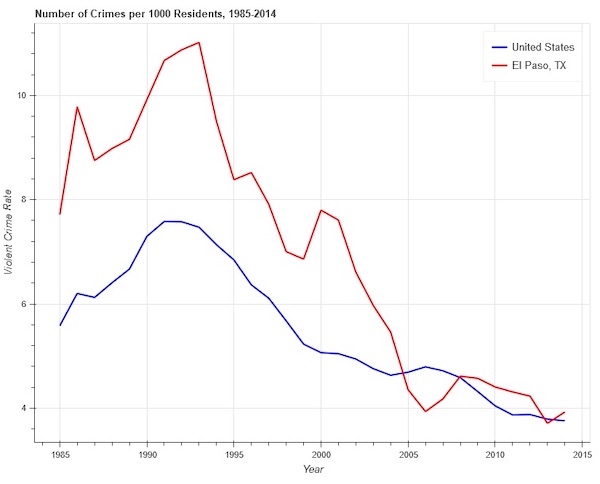
      Instead, UCR data show that violent crime in El Paso generally followed a national trend. It spiked to its highest level in 30 years in the early 1990s and has steadily declined since. The following graph compares crime data from the El Paso Police Department with nationwide figures from 1985 to 2015.

      Source: Uniform Crime Report.

      In that 30-year time frame, El Paso was never one of the “most dangerous cities” in the United States. When compared to cities with similarly-sized populations, El Paso’s violent crime rate consistently fell well below locales such as Boston, Baltimore, Detroit, and Memphis, according to UCR data (which can be found online).

      In 2018, US News & World Report ranked El Paso number 11 in “best places to retire,” citing in part the community’s relative safety and thriving economy. This ranking was not new, as El Paso had regularly been ranked one of the country’s safest cities for its population size going as far back as 2005 — three years before the border fence there was built.

      Construction on the barrier between El Paso and Juarez began in 2008 under President George W. Bush and was completed in 2009 as part of a larger border security plan known as “Operation Hold the Line” which was launched in 1993. UCR data drawn from the El Paso Police Department shows that violent crime, already trending downward, continued to drop fairly consistently in the five years leading up to fence construction, from a high of 6,109 incidents in 1993 to an all-time low in 2006 of 2,422:

      Source: Uniform Crime Report.
      During the fence construction and in the years immediately afterward (2008 to 2012), violent crime incidents rose very slightly.

      Source: Uniform Crime Report.
      In a 5 February 2019 interview with El Paso television station KDBC, Border Patrol Sector Chief Aaron Hull credited the sharp decline in violent crime that started in the early 1990s to the increased presence of border agents:

      El Paso’s violent crime was at its peak in 1992. What did make a difference was a flood of Border Patrol agents, who began Operation Hold the Line in 1993.

      Hundreds of agents were stationed every few feet along the border.

      Violent crime in El Paso drastically reduced in the years following.

      “We’ve played a big part of that,” said Border Patrol Sector Chief Aaron Hull.

      We can’t determine whether crime in El Paso fell as a result of increased Border Patrol presence, the dynamic that caused crime to drop nationwide, or some combination of both. But what can be determined from crime data is that over the previous three decades, border wall construction hadn’t shown a positive impact on reducing violent crime in that community, and El Paso was far and away notone of the most dangerous cities in America.

      The 2019 State of the Union wasn’t the first instance during which the Trump administration made this false claim, and it wasn’t the first time that claim had been debunked. In their own fact check, the El Paso Times reported that Texas Attorney General Ken Paxton had also promoted the claim, along with White House press secretary Sarah Sanders:

      In January 2018, White House Press Secretary Sarah Huckabee Sanders tweeted “Ask El Paso, Texas (now one of America’s safest cities) across the border from Juarez, Mexico (one of the world’s most dangerous) if a wall works.”

      She linked to an opinion piece published in the New York Post that was titled “This town is proof that Trump’s wall can work.” The piece, written by a conservative political commentator based in Washington, D.C., argued that El Paso’s border fence is the reason for the city’s low crime rate and decreased illegal border crossings.

      At the time, local leaders rejected the article’s findings and argued that it did not mention the police-community relations and cooperation between law enforcement agencies that contributed to the city’s safety before border fencing was put in place.

      On the 2016 campaign trail, Donald Trump promised supporters that if elected, he would build a border wall that Mexico would pay for. As time went by and it became clear Mexico would not finance the construction of such a wall, Trump waffled on how it would be funded, resulting in the longest partial shutdown of the federal government in U.S. history when he and Congressional Democrats reached an impasse over the issue.

      Sources
      • Mekelburg, Madlin.   “Fact Check State of the Union: Trump Says El Paso Among Most Dangerous Cities Until Fence.”
        El Paso Times.   5 February 2019.

      • Mekelburg, Madlin.   “Did Construction of a Border Fence Cut Down on Crime Rates in El Paso?”
        El Paso Times.   10 January 2019.

      • ABOVE IS FROM:   https://www.snopes.com/fact-check/el-paso-border-barrier-crime/

      Sunday, February 10, 2019

      12 Things We Should Have Known About Illinois’ New Private School Scholarships

      WBEZ News

      12 Things We Should Have Known About Illinois’ New Private School Scholarships

      Linda Lutton

      August 16, 2018

      4 MINADD TO QUEUE

      An illustration of a swirl of money with the words "taxpayer dollars" flowing into a school building labeled "private schools"

      Paula Friedrich/WBEZ

      Kids are about to head back to school, and for the first time ever, thousands of Illinois students will be using state taxpayer money to attend private schools.

      Last August, with almost no public vetting or debate, Illinois passed a massive school choice program, making it the 18th state to add a “tax credit scholarship” program. Now, at least 5,600 Illinois students are headed to private school with taxpayer help, according to data compiled by WBEZ. Tens of thousands of kids tried for the scholarships, which can pay up to $12,793.

      Tax credit scholarships aren’t technically vouchers, but for families and schools, there’s little difference. Opponents call them “neo-vouchers.”

      The $100 million “Invest in Kids” program was insisted on by Gov. Bruce Rauner in as part of a fix to the state's broken public school funding system.

      Now that it’s up and running, key details of the scholarship program are emerging, including its groundbreaking size compared to other states and the fact that many students who aren’t poor are receiving scholarships.

      Here are a few things the public might have learned had the plan gotten more scrutiny before it passed:

      No other state has started off with a bigger program.

      Illinois’ program allows up to $75 million in taxpayer money to be diverted to private schools each year. For comparison, Indiana’s program is $18 million; when it began in 2010, it was $14 million. Today, Florida has the biggest tax credit scholarship program in the country — last year they gave out $698 million in tax credits and 107,095 scholarships. That program began in 2002 at $50 million.

      EdChoice, a school choice advocacy group, says Illinois’ giant first-year program should be put in perspective: “The $75 million credit cap, while seemingly large, is a small fraction of what Illinois spends on K–12 education.”

      While Illinois’ program allows for $75 million in tax credits ($100 million in total donations), just $31.5 million in credits have been claimed. Advocates say taxpayers are still finding out about the program.

      $31.5 Million

      Tax dollars diverted so far to private school scholarships in Illinois

      Source: Illinois Department of Revenue, Aug. 1, 2018

      Illinois law prohibits sending public money to religious schools. This program gets around that. 

      With vouchers, states pay private schools directly from taxpayer funds. But with tax credit scholarships, the state never actually takes control of tax money. Instead,

      1. Taxpayers donate to a nonprofit “scholarship granting organization.”
      2. Those groups award scholarships and distribute the money to schools.
      3. The state then issues taxpayers a “credit” toward their tax bill. 

      In Illinois, taxpayers get a 75-cent credit for every dollar they donate. Because it’s all voluntary, state supreme courts have repeatedly upheld tax credit scholarship programs. Declining to hear a challenge in 2011, the U.S. Supreme Court said in a 5-4 decision that when “taxpayers choose to contribute to [scholarship organizations], they spend their own money, not money the State has collected.”

      $1 Million

      Maximum amount an individual taxpayer can divert to private school scholarships

      Illinois taxpayers get a huge tax credit. 

      First off, a tax credit is worth much more than a deduction, which is what people usually get when they make a donation to a charity. (A deduction reduces a taxpayer’s income, lowering the amount they’re taxed on. A credit erases actual taxes owed.)

      There are about a dozen credits Illinois taxpayers could possibly take. None comes close to giving back 75 percent of a donation or expense.

      What’s more, Illinois allows individuals to claim a huge credit, far more than other states. In Arizona, where tax credit scholarships began, credits are capped at $2,213 for a married couple or $1,107 for a single filer. In Illinois, individuals can get up to $1 million dollars in tax credits.

      Stay up-to-date with the latest news, stories and insider events.

      SIGN UP

      The scholarships aren’t just for poor kids. 

      Early figures show 28 percent of the scholarships are going to kids who don’t qualify for free or reduced-price lunch. A family of four can make up to $73,800 and get one or more scholarships; once they’re selected they can make up to $98,400 without losing their tuition help. While poor kids are supposed to get priority under the law, that doesn’t necessarily happen. Kids who live in a low-performing school district also get priority. And donors can designate funds to specific schools. If scholarship groups can’t find enough free-lunch kids at that particular school, they can give the designated funds to non-poor applicants (more on this below).

      Some school choice advocates are fine with this; they’re pushing for the middle class to be included in tax credit scholarship programs. Enrollment of middle-income studentsin private schools has been falling.

      28%

      Percentage of scholarships going to kids who are not considered low-income

      Source: WBEZ analysis of data provided by scholarship granting organizations

      It looks like many scholarship winners were already attending private school.

      This has also happened in other states. Many Illinois private schools made sure to get the word about the scholarships out to their families; some held application events so their students would have a better shot at the new first-come, first-served scholarships. At St. Mary Star of the Sea School on the Southwest Side, 30 kids are getting tax credit scholarships. According to Principal Candice Usauskas, two-thirds were already students there. All seven kids who will attend Frances Xavier Warde with taxpayer help were already students at the school, according to the group that awarded their scholarships. 

      We may never know how many scholarship winners were already attending private schools because scholarship groups aren’t required to report that information.

      0

      Number of scholarship granting organizations subject to Illinois’ public records law

      Transparency is a problem. 

      The scholarship groups must report certain information annually beginning Jan. 31, including the names of schools benefiting and the grade, race, gender, income level, and zip code of scholarship students. But other info, like the schools that students originally attended, remains hidden. Donor names are also kept private under the law. So far, eight wealthy Illinois taxpayers have made donations of at least $1 million. Their contributions make up 24 percent of the program funds. Scholarship groups submit an audit of their accounts and records completed by a CPA, but no one can watchdog or regulate the scholarship granting process as it plays out.

      As the first students head to private schools with taxpayer help, WBEZ collected as much data as possible (viewable here), but scholarship groups had no obligation to share it. And some declined giving more detailed information. For instance, Empower Illinois, which controls 73 percent of all scholarship money and is the only active scholarship group operating in the entire state, declined to say where scholarship recipients live.

      Scholarship groups are not subject to Illinois’ open records laws. That’s in contrast to Illinois charter schools, which are privately managed but receive taxpayer dollars, and are subject to FOIA.

      $12,973

      Maximum scholarship amount

      Illinois scholarships pay up to $12,973.

      That covers full cost of tuition and fees at most Illinois private schools. Vouchers are sometimes criticized for not giving students enough money to actually attend all but the lowest-cost private schools. Illinois’ scholarship amount is tied to the average operational expense of public schools. It’s the most generous scholarship amount in the country.

      The nonprofits that administer the scholarships take 5 percent of all donations. 

      Empower Illinois, the group that controls 73 percent of all scholarship funds, wrote and lobbied for the tax credit program and is now benefiting from it financially. The group has accepted $30.8 million in contributions, which entitles it to $1.5 million.

      5%

      Amount “scholarship granting organizations” can take in administrative fees

      There are no limits to the number of nonprofits that can administer scholarships.

      Nine groups have been approved by Illinois as scholarship granting organizations. Of those, five actually raised money and distributed scholarships. In some states, scholarship organizations have become a cottage industry. Georgia has 30 SGOs. Arizona has 62. In Pennsylvania, where the scholarship groups can take up to 20 percentof contributions as an administrative fee, there are 189 groups administering one tax credit scholarship program; 258 groups ad  minister another, making oversight a challenge.

      School choice is limited by donors.

      When proponents talk about Invest in Kids, it sounds like  a way for low-income kids to go to the private school of their choice. But it turns out donors have a big say in shaping which schools kids can attend. That's because they’re allowed to designate that their contribution go to a single school or set of schools (think Wheaton Academy or Chicago Archdiocesan schools).

      Kids can apply to any school they like, but if there aren’t enough funds designated to that school, they’ll be out of luck. So far, according to the scholarship organizations, the majority of funds they’ve received are designated. Business donations are all undesignated, but those contributions have lagged.

      Donors’ ability to designate funds also allows for higher income children to move faster to the front of the scholarship line. At schools with lots of donor-designated funds (typically schools with powerful alumni or well-developed donor networks), the scholarship granting organizations can start handing awards to higher income kids once they’ve exhausted applications from priority students.

      An example: All funds donated to Children at the Crossroads scholarship organization were designated to one school, Frances Xavier Warde, known in part for the politically connected families enrolled there. Only two of Frances Xavier Warde’s seven scholarships will go to kids who qualify for free lunch. (Children at the Crossroads was a pre-existing foundation that became an official state-approved scholarship organization after the Invest in Kids program was passed.)  

      Scholarship groups and school choice advocates say allowing people to channel their money to to a particular school or set of schools makes them more likely to contribute. But some states prohibit scholarship granting organizations from benefiting a single school.

      Archbishop of Chicago Cardinal Blase Cupich pushed for this program, and early numbers show Catholic schools winning big.

      Schools with the most tax credit scholarship recipients include elite college prep schools like St. Ignatius in Chicago, Loyola Academy in Wilmette, and Fenwick High School in Oak Park. Also on the list of top beneficiaries are Waukegan’s Cristo Rey St. Martin College Prep and Chicago Jesuit Academy on the city’s West Side. In fairness, Catholic schools make up the majority of private schools in the Chicago metro area. The top non-Catholic beneficiaries appear to be Solomon Schechter Day School, a Jewish school in Northbrook, and the Islamic Universal School in Bridgeview.

      No state with a tax credit scholarship program has ever repealed it. 

      Illinois’ program sunsets after five years, which means lawmakers will have to pass legislation to extend it. This year, donations to the program only reached half what they’re allowed to. But with each additional donation — and every scholarship granted — the number of supporters and invested families grows, making repeal less likely. Supporters are already organizing parents and schools to win greater support from Democratic lawmakers, many of whom opposed creating this program. A bigger school choice program has never passed in a blue state, and advocates want to keep it alive. Democratic gubernatorial candidate for governor J.B. Pritzker has said he would endthe private school scholarship program.

      Linda Lutton covers education for WBEZ. Follow her @WBEZeducation and @lindalutton.

      Monday, February 4, 2019

      University of Illinois—Champaign—Measles Alert

      illinois public media news

      Second Measles Case Reported In Champaign-Urbana

      February 03, 2019

      BY JIM MEADOWS.

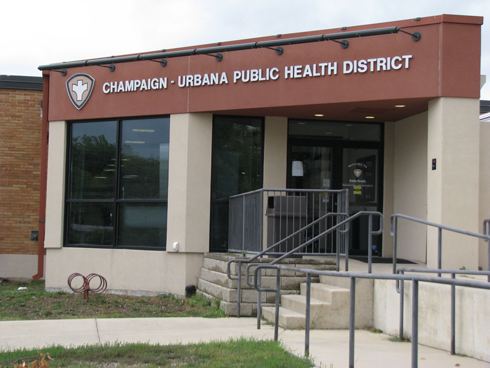
      Champaign-Urbana Public Health District office building.

      Offices of the Champaign-Urbana Public Health District in Champaign.

      CU Citizen Access

      A second case of measles has been reported in Champaign-Urbana. Like the first case announced in January, this second case involves a member of the University of Illinois campus community.

      “What we have right now are two college-age unvaccinated persons, who are infected with measles,” said Champaign-Urbana Public Health District Administrator Julie Pryde. “And we know that right now that it’s not into the school-age population, the K-through-12 or the younger children.”

      Measles is more likely to result in potentially life-threatening complications among children under 5 and adults over 20, according to the federal Centers for Disease Control. Complications can include pneumonia and encephalitis (swelling of the brain).

      Campus Vice-Chancellor for Academic Affairs and Provost Andreas Cangellaris says the university is working with its own McKinley Health Center and the Public Health District to try to identify and warn anyone susceptible to measles about the local presence of the highly infectious disease. That includes anyone who has never had measles and who has never been vaccinated for it.

      The C-U Public Health District says the second measles patient was infectious when visiting the following locations around the following times (two hours have been added to the time after the patient left the following locations):

      1/28/19, 9 AM-Noon & 2:30-5:30 PM:  MTD #22 Bus (weekday daytime Illini or Illini Limited bus)

      1/28/19, 9:30 AM – 4:15 PM & 1/29/19, 3-6 PM: University of Illinois School of Social Work, 1010 W. Nevada St., Urbana, IL

      1/31/19, 7:30-9:30 PM: Carle Hospital Emergency Department, Urbana IL

      1/27-31/19: Maywood Apartment Building, 51 E. John Street, Champaign IL

      Pryde says the two people diagnosed with measles had not been vaccinated or had measles before. She says it’s fortunate for the general population that the measles vaccination rate in the Champaign-Urbana area is high.

      “Champaign is highly immunized, and we definitely have the herd immunity going on right now,” said Pryde. “That is one of the things that we need to be vigilant about and maintain.”

      Immunization against measles is included in the MMR (Measles, Mumps, Rubella) vaccine. The vaccine is delivered in two doses, with the first dose typically given to children at the age of one. But Pryde says the level of protection from the measles virus is up to 93 percent with the first dose alone, and 97 percent with two doses.

      Pryde says anyone who has not been vaccinated for measles should contact their healthcare provider or the Public Health District at 217-531-4255. She says anyone who feels they may have the measles stay home and call their healthcare provider first before going into see them, so that precautions can be taken against exposing others to the virus.

      Symptoms of measles include rash, high fever, cough, runny nose and red, watery eyes. The disease is easily spread through the air via coughing or sneezing. Contact with mucus or saliva from an infected person can also spread measles. Pryde says people with measles can spread the virus for four days before showing symptoms, and be contagious for another four days once symptoms appear.

      Once a common childhood disease, measles was all but eradicated in the United States with the development of the measles vaccine. But small outbreaks of measles have returned in recent years, attributed to a drop in vaccination rates. More than 40 people have been diagnosed with measles in an ongoing outbreak in parts of Oregon and Washington state.

      In Illinois, the last measles outbreak of any size was 17 cases in 2015. In 2018, there were just four cases as of December 5th, no cases reported in 2017, and two cases in 2016. Pryde says that before this year, the last measles case reported in Champaign-Urbana and Champaign County was in 2006.

      Above is from:  https://will.illinois.edu/news/story/second-measles-case-reported-in-champaign-urbanaMcKinley Health Center

      Measles Alert

      McKinley Health Center is working with the Champaign-Urbana Public Health District regarding a recent measles case. Measles is a highly contagious disease to persons who are unvaccinated and exposed. The MMR vaccine (Measles/Mumps/Rubella) provides protection against measles in most situations. The MMR is a routine immunization in many countries and is a requirement at the University of Illinois.

      Measles is spread to others through the air after someone coughs or sneezes. Measles symptoms include: fever, cough, runny nose, red-watery eyes, and a rash.

      Public Health considers a person protected (immune) from measles if they have had one of the following:

      • Two doses of measles containing vaccine (MMR or measles).
      • A laboratory confirmed positive measles antibody result.
      • Born before 1957.

      McKinley is working with Public Health to identify at risk individuals and will be notifying these individuals as identified.

      If you are unsure if you meet the above immunity standards, you may:

      • View your immunization history on the MyMcKinley Student Health Portal
      • Call McKinley Health Center at (217)333-2700 to review your vaccination history. 
      • If you think you have symptoms of measles, stay home, stay away from others and contact McKinley immediately.

      Additional information on measles can be found at: https://www.cdc.gov/measles/index.html